Will a DWP £1 billion digital “transformation plan” for health assessments of disabled benefit claimants be a new disaster?

The National Audit Office last week gave its verdict on plans by the Department for Work and Pensions to digitalise and transform all the health assessments of disabled people claiming benefit and Personal Independence Payments (PIP) by 2029 and raised serious concerns whether it would work..

This is not a minor matter for the disabled. Some 3.9 million working age people claim these benefits and those claiming both PIP and the Employment and Support Allowance have to pass two health assessments. By 2025-6 the number of claimants is estimated to rise to 5.8 million. Every year private contractors assess nearly two million people. There also has been a rise in people claiming ESA as a result of the pension age for women going up from 60 to 66 and for men from 65 to 66.

As usual this report appears to have had little coverage in the national media -despite the millions of people that will be affected.

High risk of delay, cost overruns without achieving benefits

Gareth Davies, the head of the NAO, said:

“While the Programme is ambitious and has the potential to make savings and improve the experience of those being assessed, the scale and complexity of the transformation leaves it at high risk of delay, cost overruns, and of not achieving the intended benefits.”

He called for the department to revise its business plan for the £1 billion scheme and for more transparency so that perhaps even MPs can understand its implications.

At present disabled people have to provide multiple documents and fill in long forms to claim and the system is unpopular. The new system will digitalise the process, cut out duplication but will still depend on private contractors assessing whether people are unfit enough to claim.

Therese Coffey, former DWP secretary of State

Appeals over claiming PIP are unnecessarily high with decisions by the private firms being overturned and there have been cases where people turned down for disabled benefits have died and the DWP under Therese Coffey covered up reports about this. See this report in the Disability News Service.

The transformation is going to take place alongside new five year contracts for three private companies, Capita. US company Maximus, and Australian firm Ingeus worth over £1.6 billion with an IT contract to Atos to provide the computer back up. Nearly all the companies (except Ingeus) have been linked to claimants deaths as an article in Disability News Service reveals.

Limited testing of system using state appointed medical advisers

At the same time there is going to be a limited state provided service in London and Birmingham where the DWP will employ medical assessors directly. The aim according to the NAO report is to ” test and learn ” the new system and pass on the information to the contractors.

The NAO is sceptical whether this twin approach will work in time for the national 2029 launch as the contracts awarded to these firms will not be flexible enough to make changes without no doubt further expensive negotiations.

One of the main aims of the scheme is to save public money through digitalisation and the DWP estimates a £2.6 billion saving up to 2035. One wonders though whether all the disabled people will be able to use computers to apply on line ( all PIP applications will be on line) eventually. Can they download apps etc and do they all possess smart phones?

Once again I am going to be sceptical about this – particularly after the NAO’s report on Making Tax Digital which it revealed has been subject to long delays and huge increases in costs. Given other areas I have covered in the DWP I have little confidence they can get things right.

Please donate to Westminster Confidential to allow me to continue my forensic reporting

One-Time
Monthly
Yearly

Make a one-time donation

Make a monthly donation

Make a yearly donation

Choose an amount

£5.00
£10.00
£20.00
£3.00
£9.00
£60.00
£3.00
£9.00
£60.00

Or enter a custom amount

£

Your contribution is appreciated.

Your contribution is appreciated.

Your contribution is appreciated.

DonateDonate monthlyDonate yearly

Please donate to Westminster Confidential

£10.00

The “systemic maladministration ” facing the disabled applying for Personal Independence Payments -official findings

Margaret Kelly Northern Ireland Ombudsman

Northern Ireland ministry and Capita under fire

An absolutely damning report has been issued by Margaret Kelly, the Northern Ireland Ombudsman on the way hundreds of thousands of disabled people between the ages of 16 and 64 are assessed to see if they qualify for personal independence payments.

This two year investigation into the benefit is the first made by the Ombudsman using new powers under Northern Ireland legislation giving their Ombudsman the power to initiate inquiries if the Ombudsman thinks something is going wrong. This type of inquiry would be illegal in England, Scotland and Wales because Ombudsman do not have the same powers.

In Westminster Michael Gove, the Cabinet Office minister, is currently refusing to even introduce draft legislation to give Rob Behrens, the Parliamentary and Health Service Ombudsman. similar powers to start his own inquiries.

The findings apply to the 250,580 people who applied for the benefit in Northern Ireland but as the NI Ombudsman’s Office says ” there are many similarities to PIP across other parts of the UK.”

The report – which examined 100 cases in minute detail, made extensive inquiries of the ministry and Capita, and looked at statistics governing appeals concludes there has been ” systematic maladministration” by the Northern Ireland Department for Communities and Capita, who were administering the assessments.

Not “one off mistakes”

The report says these were not one off mistakes. Instead she” identified repeated failures which are likely to reoccur if left unremedied. It is therefore my view that there is more work to be done to improve the experience and outcomes for claimants, the robustness of decision making and public confidence in the system.”

She has made some 33 recommendations and has given the ministry and Capita six months to rectify them. She can’t compel the ministry to implement them but has said she will do a follow up report to see what they have done. The report also went to members of the Northern Ireland Assembly.

Ms Kelly said:
“Too many people have had their claims for PIP unfairly rejected, and then found themselves having to challenge that decision, often ‘in the dark’, and on multiple occasions, while not knowing what evidence has been requested and relied upon to assess their entitlement.

” Both Capita and the Department need to shift their focus to ensure that they get more of the PIP benefit decisions right the first time, so that the most vulnerable people in our society get access to the support that they need, when they need it. Furthermore, it will safeguard public resources by reducing both the time and costs associated with examining the same claim on multiple occasions.”

The report reveals a serious lack of leadership and guidance from the ministry, poor communication with claimants and a failure to get key additional medical information which would have helped them get the benefit. As a result many of them had their applications turned down only to appeal and get the benefit – at a cost of some £14m to the taxpayer. If the ministry and Capita had got the information in the first place there would have not have been the need for an appeal.

Capita had an incentive NOT to get further medical information to help claimants

She also discovered that disability assessors working for Capita had a perverse incentive NOT to get additional information to help the claimant because they would get a bonus if they completed the application quicker and getting extra information slowed down the process.

Capita were also criticised for poor communications with health professionals as well as claimants. When evidence was requested from Health Professionals named by the claimant, the request letters sent by Capita were often poorly completed and did not specify what information was sought.

In face to face assessments, the evidence from the consultations was often the primary and in some cases the only source of evidence relied upon by the Disability Assessors when providing their advice to the Department.

I came across this report because of a link to my blog from UKAJI, the United Kingdom Administrative Justice Unit, who have reviewed the long report. Their article is here.

I concur with their review which was impressed with the high standard of the research and the bar it set for future Ombudsman investigations.

To my mind this again shows the current weakness of the Parliamentary Ombudsman in Westminster. The present Ombudsman can only investigate complaints and therefore is left with a much narrower remit. By having powers to do a broad ranging investigation, much more detail can be investigated and issues that governments don’t want to address can be highlighted. Hence the conclusion in this report that the disabled have been subject not just to maladministration but ” systemic maladministration”. I bet disabled claimants are similarly treated in the rest of the UK but nobody has the resources to properly investigate their poor treatment. Let’s see what happens in Northern Ireland following this devastating report.

Predators stalk the corpse of London’s failing private fire firm

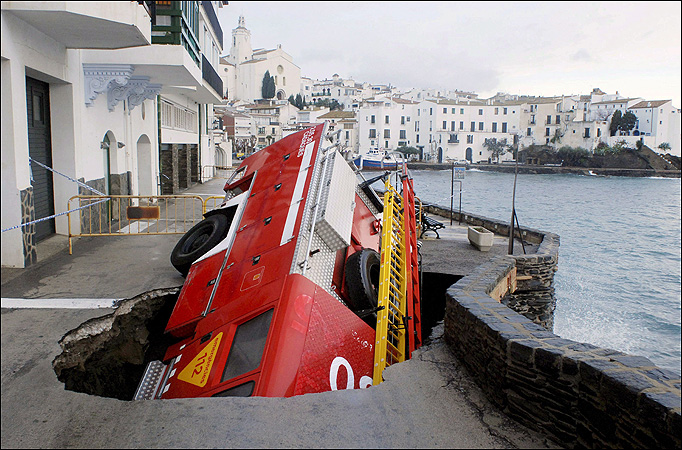
Not their vehicle but the symbolic state of AssetCo. Pic courtesy: TheScottishSun

Like encircling vultures, bidders across the globe are now looking  at the dying corpse of AssetCo, the floundering private fire company, for a cheap buy  as it shares hover around-3-5p mark.

Virtually all the bidders are potential asset strippers looking to buy cheap and then re-sell the company for a potential fast buck. Here is the full list, as far as I can glean. They have some interesting baggage as well.

Still with a bid on the table – but nowhere near the earlier offer of 14-21p a share- is Arcapita Bank  a Bahrain based company run by a wealthy Saudi.

The bank has run up big losses because of the credit crisis and lack of easy credit from financial institutions for private equity speculations. Its latest accounts (2010) post losses of $559 million. It is currently refinancing a $ 1.1 loan by raising cash from shareholders.

It makes its money in US, UK, Singapore and Far East and the Gulf by investing in firms for about seven yrs, restructuring them, and reselling them at a profit. (can be anything from clothing, aircraft manufacturers, retirement homes, dentistry and electricity).

Its most controversial investment is in Cypress Communications, a US high tech company, providing firewalls for US companies. Its bid became embroiled in a row when Arcapita’s chairman, Mohammed Abdukaziz Al Jomaih (27th wealthiest  person in Arab rich list) was accused of secretly financing Osama Bin Laden. His name is on seized list obtained in an anti-terror raid in Bosnia. He claims that he is not the person on the named list but that it is someone with the same name who is conveniently now dead.

Despite this Arcapita found itself forced to sign a National Security Agreement banning all but US nationals holding top posts in its acquired company and only US citizens able to handle sensitive network and security info. Don’t believe me. Read it at  http://bit.ly/j0z0gO .

Abdulaziz Hamad Al Joiah is vice chairman. Another Saudi Arabian. MD of Aljomaih Holding Co and director of Bank Al Bilad, Riyadh. He is chairman of Principle Insurance Holding – a Muslim car insurance company targeting 2 million Muslim drivers in UK –run on Takaful principles – a sort of Muslim mutual co-operative.

Another bidder tipped by Bloomberg is Florida based Seacor Holdings. The Fort Lauderdale company with international interests in supplying  the offshore oil industry  suffered a bad knock  in the wake of Obama’s ban on drilling in the Gulf of Mexico after the BP oil disaster. It is trading at a loss and has had to warn shareholders of potential future losses. Not a good bet.

According to City AM there are two other interested parties. Investindustrial, an Italian based company, that invests in a wide range of companies ( from chemical companies to Ducati motor bikes) from Italy, China, Thailand and USA  and again is interested in making short-term gains.

The only British firm is Consilia Partners from  Manchester. It describes itself as a turn around company  and AssetCo would join an Ipswich catering equipment distributor and an Egyptian marble company in Cairo as its other investments, according to the Manchester Evening News.

 None of this seems to me to bode well- particularly as AssetCo is facing a new creditor, the Northern Bank, with a demand for £1.3m. What seems more likely is  a serious tip-off from City Hall – that the London Fire authority may prefer AssetCo to go bust, go into the hands of an administrator, and be picked up by Capita or Serco , both mega British companies that target public services ripe for privatisation.

Otherwise the idea that the London fire brigade’s extensive fleet of engines will fall into the hands of an Arab company whose boss was once suspected of funding al-Qaeda; an US company in trouble over the Gulf of Mexico oil spill; an Italian firm with a reputation for quick fix investments or a Manchester ” turn around” firm is hardly the best news for Londoners.