On the way: Multi million pound fines for Brexiteer Andrea Leadsom

andrea leadsom

Andrea Leadsom Pic Credit: BBC

CROSS POSTED ON BYLINE.COM

It is probably an extreme irony that Theresa May has dumped  leadership rival Andrea Leadsom right in the slurry with the job at the Department of Environment, Food and Rural Affairs(Defra)

For the Eurosceptic Brexiteer is going to have to eat a lot of humble pie and hand over more money than any other minister to the European Commission long after the United Kingdom has quit the European Union.

Her appointment coincided with the latest accounts from Defra with a caustic comment  from the National Audit Office once again qualifying them because of their incompetence in handing out £2.3 billion of subsidies to British farmers.

But this rap on the knuckles means more than that – as it sets up the UK to have to pay a fortune in fines to the EU. I have written about it in Tribune here.

As the article reports:”Failures under Labour and coalition governments to administer properly a previous farm subsidy programme have already led the Commission to fine the UK £661m.
“But this year’s failure to deliver money to farmers on time – with well over half receiving late payments – has already led to over £65m being set aside for fines in the last financial year.”

As Amyas Morse, head of the National Audit Office, said: “The Department continues to struggle with managing the complex CAP (Common Agricultural Policy) scheme in a way that ensures accurate, timely payments to farmers. As a result, it has incurred EU penalties of £65.8 million related to the CAP scheme in 2015-16, and estimates that it owes 13,000 farmers a total of at least £25.3 million.

“Exit from the European Union will not, in the short term, reduce these penalties. The Department therefore needs to ensure its strategy for tackling these challenges is effective.”

This means that Leadsom and her Eurosceptic farming minister, George Eustice, are going to face a double task until 2020.

First they are going to have to continue sorting out the ministry’s failure to pay farmers on time  while having to devise a national British system of supporting farmers which is bound to be controversial.

The NAO are estimating that if anything the level of fines could go up because of the complexities of the payments.
The ministry is promising a new strategy to sort out the problem – saying it expects payments to be better in 2016 than last year. But to do this it has – already according to the accounts – incurred a £6m increase in its pay bill by having to employ temporary staff to sort out computer failures and mistakes and delays in payments to farmers.

It is going to more than of just passing interest to see how the pair cope with such a mess.

Election Campaign:What the politicians and civil servants didn’t tell us

Are you voting without them telling you all the facts?

The election is virtually over. Tomorrow  you can cast your vote.  The parties will concentrate on their key messages over the last hours before polling day. But have all the issues been covered? No way.
 
Just as there is a black hole in all the parties’ planned spending cuts, there are lots of issues that have not been properly covered and many more that have been completely ignored.
They fall into three groups: there are issues that have been discussed but  not properly explored; there are issues that have been ignored by the political parties; and, perhaps surprisingly, there have been issues that Whitehall – not the politicians – has buried under the carpet.
 
The biggest issue that has not been properly explored is immigration. It was partly catapulted into the election by Gordon Brown’s “Bigotgate” gaffe after meeting pensioner Gillian Duffy, but the parties have tried to obscure the facts.
 
The Tories have promised to introduce a cap on immigration – but it will not apply to the 27 existing members of the European Community. They account for 80 per cent of immigration – according to Channel Four’s fact check file – almost 1.8 million people coming into Britain against 1 million Brits going to live in the EU.
 
While those coming from outside the EU account for only 20 per cent of immigration, according to a BBC analysis for the last recorded year, 8,000 more people left than came in. In effect this makes Cameron’s cap almost meaningless.
 
The Liberal Democrats, while promising to give an amnesty to illegal immigrants who have been here for 10 years, estimate it could help 600,000 – but, as Nick Clegg admits himself, nobody knows where they are. UKIP would block immigration altogether – but that will mean leaving the EU as well. The Liberal Democrats’ policy would mean hundreds of thousands of illegal immigrants paying taxes, while Labour say they would deport them all, if they can find them. So more heat than light.
 
Then there are buried issues. The biggest is pensions and how we are going to fund an ageing population. The Tories have promised to raise the pension age to 66 but not until 2016, after the next election.
 
And while the election is taking place, more companies are ending final salary schemes, which will make it more difficult to get a good pension, and the cost of providing care is going up all the time. The parties have touched on the cost of care but the multi billion pounds for pensions has not even been debated. Anyone thinking seriously about this would know that something has got to give.
 
Similarly, for younger people, one issue that might have been raised is the draconian measure – rushed through Parliament just before the election – to curb illegal file-sharing.  There is now a law that could give the music and video business powers to demand internet providers disconnect people from the internet. This has been barely mentioned.
 
Other issues hardly touched on include the environment, overseas aid, transport and housing.
 
But probably the most surprising thing that happened during the election was a decision by Whitehall – which runs the country while the PM is busy campaigning – to ban the release of new statistics which would have revealed how much you are funding farmers and agribusiness through the European Union.
 
Last Friday the EU expected every one of their 27 members to release details of the billions of euros spent subsidising farmers and big companies to produce food for last year. Every country except the UK published these figures.
 
In Whitehall, civil servants took the decision that to release this information in the middle of an election campaign would be wrong. They justified this on the grounds that some Parliamentary candidates might be receiving the  subsidies. I quote the explanation: “This decision reflects the need to maintain, and be seen to maintain, the impartiality of the UK Civil Service, given the potential risk that … payment  information relating to any individuals involved in the election might be used as part of election campaigning.” Possibly as many as 80 candidates, mainly Conservative, and a few UKIP and Liberal Democrats are benefitting from this.
 
Extraordinarily, in Scotland – where there is a devolved government – the figures were released. They showed that 19,000 farmers and businesses shared nearly £600m of taxpayers’ money. The figure for the UK was over £3 billion the previous year.
 
But the effect was to close down any political debate on the cost of the EU to the taxpayer. Other statistics like hospital admissions, road statistics and all the economic data have all been released.
 
So it is not only politicians who have limited debate during the election.

This blog is also on the msn website as part of their general election coverage.

Whitehall’s censorship of farming subsidies spares Tories (and UKIP’s) blushes

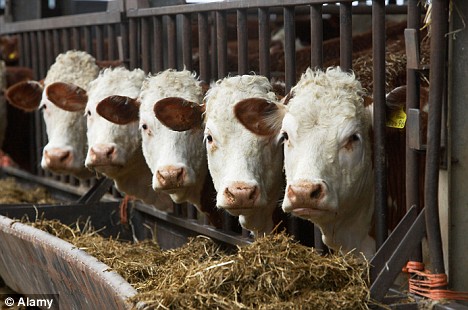
tucking into censored farm subsidy pic courtesy daily mail

Over the bank holiday weekend senior civil servants running the country took an extraordinary decision to ban the public  from seeing  information because  they thought it was so controversial that it would disrupt election campaigning.

They decided to protect candidates from being asked questions on the issue and thought it best the public be left in ignorance about the facts.

 What was this issue? Not some horrendous economic figure, some real facts on immigration. No, it was decision not to reveal which farmers and agribusinesses scooped up some £3 billion from the taxpayer from EU farm subsidies last year.

On Friday statistics were published simultaneously in the other 26 EU countries revealing who had been paid what – it is part of a victory by European journalists to force countries under freedom of information acts to release all this previously secret information.

But in London – against an EU directive – the information was banned. The Department for Environment, Food and Rural Affairs website says: “Due to the general election campaign, this website will not be updated with the 2009 figures until after the election.”

A letter from a DEFRA official to Jack Thurston, head of farmsubsidy.org, which campaigns for transparency for EU payments, says why:

“This decision reflects the need to maintain, and be seen to maintain, the impartiality of the UK Civil Service, given the potential risk that CAP payment  information relating to any individuals involved in the election might be used as part of election campaigning.”

Yet ministries continue to publish information on hospital admissions and roads just to name two. And in Scotland because of devolved government – they have taken the opposite decision. They published their figures over the weekend –revealing that 19,000 farmers and agribusinesses shared nearly £600m of public money and the world has not fallen apart north of the border.

So who does this protect? Initial research by farmsubsidy.org reveals that possibly up to 70 of the 650 Tory candidates standing at the election could be receiving some sort of subsidy. Up to half a dozen UKIP candidates- who campaign against the EU- could be receiving EU cash as well as a smattering of Liberal Democrat and BNP candidates. On the Tory side they have discovered that the declared postcode for receipt of EU subsidies is often the same one as used by a local Conservative Association, suggesting that leading officials of the local parties are also receiving subsidies. These are all taken from the previous year’s subsidy figures.

 Yet we won’t know, thanks to Whitehall, until after the election- even though the EU has made it clear in an article in the EU Observer today that it is disappointed with Britain and intends to write to the new government pointing out it is not in line with the EU directive.

Frankly disappointment is too weak a word. It is scandal that unelected officials should decide what information should be made public and when. The decision is also partisan in that it appears to protect opposition party candidates more than Labour candidates from scrutiny – particularly in the case of the Conservatives.

Sir Gus O’Donnell, the Cabinet Secretary, should reverse this now. Otherwise it bodes very badly if we are in “ hung Parliament “ territory when Whitehall  will be effectively  running the country while politicians sort out a new government. If officials are going to select what information the public should know and what should be kept secret, they are exceeding their brief.

This blog is also on the Guardian’s Comment is Free website.