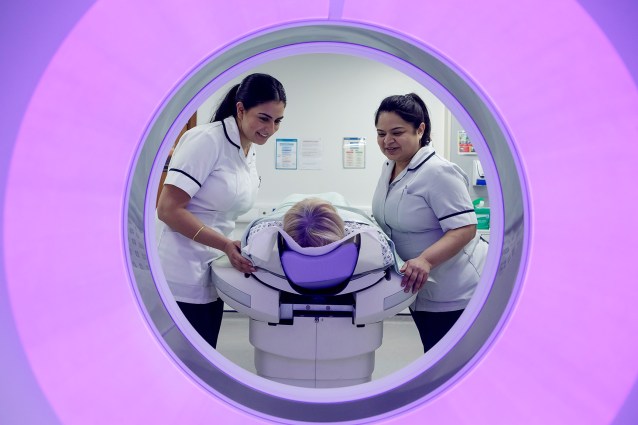
I am currently being monitored by the NHS after having day surgery last year to remove a melanoma on my lower back. As part of the cancer recovery treatment I am being checked every three months at Mount Vernon hospital with both a CT and MRI scans to make sure there is no recurrence and having my skin checked by a dermatologist at Hemel Hempstead hospital.
Two weeks ago I had both scans at the Paul Strickland Scanner Centre, run by an independent charity, at the hospital. Imagine my surprise and nervousness when the CT scanner said to me as I was about to go home to stay behind because doctors were taking a look at my CT scan.
Then Luke, a junior doctor at Mount Vernon, turned up to tell me the scan had discovered blood clots in my lung. What was really amazing to me it had been discovered because the scanners at the charity use AI to check CT scanner. The AI showed up something was wrong which led the radiographer to examine the scan more closely to reveal multiple blood clots.
As a result I got instant medical treatment instead of waiting for the standard 14 days for the results of the scan to come back. The doctors and nurses gave me a through check on the spot – blood pressure, an ecg, a blood sample and checks on my breathing before prescribing blood thinners to start treatment that night.
Undetected blood clot produced no serious symptoms
If it was not for AI for the last two weeks I would have had a untreated blood clot on my lung without me knowing anything about it. It was virtually symptomless apart from a dull pain in my upper back when I was driving which I had put down to old age rather than anything else.
What I didn’t know is that Paul Strickland Scanner Centre, a charity which relies on donations, is at the cutting edge of linking AI with radiology. Its first introduction of new AI linked scanners was in 2022 -way ahead of other centres.
At the time Mr Will McGuire, the Deputy Superintendent for MRI at Paul Strickland Scanner Centre, said:“It’s the first time we have used deep learning, often referred to as artificial intelligence, as part of the image acquisition. The scanner software has been trained on thousands of scans. When the radiographer runs the scan, the scanner takes less data from the patient and the ‘Deep Resolve’ software then basically fills in the gaps based on its knowledge. The software packages we will get will both reduce ‘noise’ on scan images and provide radiologists with a better definition image.”
New uses for ” Deep Resolve ” software which could benefit kidney, prostate and breast cancer patients are also being pioneered this year. For the first time MRI scans could analyse bone structure as well as soft tissue speeding up treatment and reducing the need for both CT and MRI scans. The charity is planning to demonstrate this new technique at the European Congress of Radiology this year.
The initiatives by the charity show how dramatic the use of AI could transform services inside the NHS to benefit patients and provide services. I gather from Hillingdon NHS Trust where the hospital is based – though it is run by the East and North Hertfordshire NHS Trust – that there is also a trial using AI among hospitals in North West London to provide instant information after chest X rays which would speed up treatment.
The latest information on the state of public provision of AI came from a report by the Commons Public Accounts Committee after a National Audit Office report reveal very uneven provision.
The report concluded that the government is facing significant challenges to introduce AI across Whitehall and the NHS – with out of date computer systems and a big shortage of skilled staff.
It says :”For AI to be used well, it needs high quality data on which to learn …too often Government data are of poor quality, and often locked away in out-of-date, or ‘legacy’, IT systems, which are partially defined as “an end-of-life product, out of support from the supplier, [and] impossible to update…” An estimated 28% of central government systems met this definition in 2024. Approximately a third of Government’s 72 highest-risk legacy systems still lack remediation funding. The report warns that there are no quick fixes here, and calls for funding for the remediation of this kind of technology to be prioritised.”
“Another barrier to the safe and effective adoption of AI by Government are longstanding and persistent digital skills shortages. Around half of roles advertised in civil service digital and data campaigns went unfilled in 2024, and 70% of Government departments report difficulty recruiting and retaining staff with AI skills. The PAC has long raised concerns about digital skills gaps in Government, and is sceptical that the Department for Science, Innovation and Technology’s (DSIT) planned digital reforms will address the problem.”
Government’s ” sclerotic digital architecture”
Sir Geoffrey Clifton-Brown MP, Chair of the Committee, said:“The Government has said it wants to mainline AI into the veins of the nation, but our report raises questions over whether the public sector is ready for such a procedure. The ambition to harness the potential of one of the most significant technological developments of modern times is of course to be welcomed. Unfortunately, those familiar with our Committee’s past scrutiny of the Government’s frankly sclerotic digital architecture will know that any promises of sudden transformation are for the birds.
“A transformation of thinking in Government at senior levels is required, and the best way for this to happen is for digital professionals to be brought round the top table in management and governing boards of every Department and their agencies. I have serious concerns that DSIT does not have the authority over the rest of Government to bring about the scale and pace of change that’s needed. We hope the recommendations in our report aid the Government in succeeding in bringing public sector systems into the 21st century for their users, where other efforts have failed.”
Perhaps MPs on the committee and NHS government ministers should go and visit the Paul Strickland Scanner Centre at Mount Vernon Hospital in Northwood and see how they have pioneered linking AI to radiology. It is anything but sclerotic and ministers might learn how to avoid some of the pitfalls of the great transformation they are promising. Many patients, including me, would be very grateful if they did.
Make a one-time donation
Make a monthly donation
Make a yearly donation
Choose an amount
Or enter a custom amount
Your contribution is appreciated.
Your contribution is appreciated.
Your contribution is appreciated.
DonateDonate monthlyDonate yearlyPlease donate to Westminster Confidential
£10.00
 Westminster Confidential