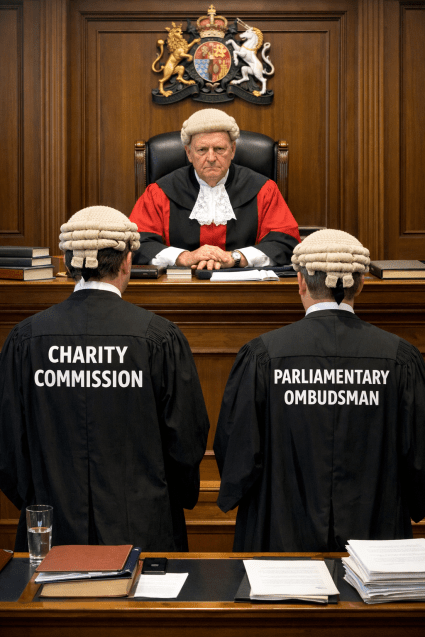
A judge has blocked the Charity Commission from challenging the powers of the Parliamentary Commissioner through a judicial review.The decision is a victory for Parliament which said permission to grant the review would be academic, non justiciable and a breach of Parliamentary privilege.
However the small print of the ruling by Mr Justice Fordham clarifies the law over what is covered by Parliamentary privilege and what is not and how far charities can be expected to investigate cases when the police and the Crown Prosecution Service decide there is not enough evidence to prosecute.
Harrowing cases
The two cases where there was a dispute between the Parliamentary Ombudsman and the Commission were extremely harrowing. Both complainants waived their anonymity. One brought by Damian Murray, concerned the failure to investigate historic child sexual at a now closed school run by Roman Catholic Marist Brothers in Blackburn, Lancashire. A former pupil at the school he learned from another pupil’s memoirs that the principal, Father O’Neill was a paedophile. Not only was this covered up but he was venerated with a Requiem Mass at his death and had a school building named after him, when it was known he was a paedophile by the authorities.
The second case involves Ms Lara Hall, a volunteer and a victim of sex trafficking, who sought help from the Help for Persecuted Christians charity and ended up having an extra marital affair with the chairman of the trust, WiIson Chowdhury. She complained according to the judgement that it was ” an abusive and exploitative relationship”. He resigned but his wife has now been appointed the chair.
The issue was not that the Charity Commission did not accept the complaints but neither the complainants nor the Ombudsman felt it had not done enough to investigate them and assess risk and communicate what it had done. So the Parliamentary Ombudsman decided to issue a further report. This can be done “if injustice has been caused to the person aggrieved in consequence of maladministration and that the injustice has not been, or will not be, remedied, she] may, if [she] thinks fit, lay before each House of Parliament a special report upon the case.”
The judge is scathing about the Charity Commission’s failings in dealing with this. He says it was ” plainly wrong” for the Commission to claim that a risk assessment review should apply only to future cases and equally wrong to say the Parliamentary Ombudsman to have overreached herself by evaluating and examining the risk reviews rather than factually reporting them.
The judgement noted the Commission claimed a ” symptomatic of a more widespread systemic unlawfulness in the Ombudsman’s approach to cases about the Charity Commission actions.” He ruled “But, in my
judgment, it is plainly not open to the Commission to contest the findings of maladministration in these cases.”

The judgement backs the Charity Commission in saying the Parliamentary Ombudsman’s decision letter cannot expect the Commission to act as a criminal investigator , prosecutor or decision maker over these issues – when its main job is to investigate the mismanagement of charities. This made the Ombudsman’s letter flawed.
There was also a very interesting subtle clarification of Parliamentary privilege. While accepting Parliament’s argument that it was a breach of Parliamentary privilege to go for a judicial review – it said the special report by Parliamentary Ombudsman that followed her main report could be challenged in the courts and was not subject to Parliamentary privilege . The Charity Commission does not intend to do this.
The Parliamentary Ombudsman spokesman said:
“One of our roles is to hold public bodies to account, acting on behalf of Parliament. This is an important principle to uphold, and the Court’s decision supports that principle by refusing the Charity Commission’s request for permission to judicially review.
“Our reports were laid before Parliament after failing to reach agreement on compliance with the Charity Commission.
“At the heart of what might seem like a matter of process are two people, Miss Hall and Mr Murray, who have suffered significant injustice. Securing resolution for the complainants remains the priority, alongside making sure the lessons identified in our investigations are implemented.
“While the Charity Commission has made some changes after our original reports, we hope the Commission will now focus on working constructively to fully comply with our reports and provide the assurance that the public are entitled to expect.”
A Charity Commission spokesman said:
“We reiterate our apologies to the two complainants in these sensitive cases. We have long accepted that there were important lessons for the Commission to learn from these, and we have previously apologised and paid compensation to each complainant.
“We brought this case in good faith to get clarity from the courts on the respective remits of the PHSO and Commission, to provide certainty to the sector we regulate. While we are disappointed with the decision not to permit a full hearing, the judgment provides a clearer basis on which both organisations can perform the distinct roles Parliament has given us.
“The court has reaffirmed the Commission’s role in regulating charity governance rather than acting as a safeguarding authority, and indicated that we cannot be expected to reinvestigate serious criminal allegations made against charity trustees.
“We recognise we need to draw further lessons from the court’s decision, particularly in terms of how we record and communicate our assessments of risk, and we will immediately review key aspects of the two cases in question.”
Complainant Damian Murray said: “My actual primary concerns about the deliberate concealment of sexual abuse at the former St Mary’s College Blackburn by the Marist Fathers charity have yet to be acknowledged let alone addressed by the CC since I first raised them in 2018. And whilst PHSO, Mr Justice Fordham and PACAC have also made no adjudication about my original concerns, and have not been asked to do so, I am very grateful for the care and seriousness with which they have within their remits taken account of the grave issues of governance and regulatory failure I have raised, and the sensitivity and professionalism with which they have dealt with me personally to date.”
The full judgement is here.https://drive.google.com/file/d/1vhcXwEWJm6uivRi-CvhoXYP8YJKyp3f7/view?usp=sharing
Make a one-time donation
Make a monthly donation
Make a yearly donation
Choose an amount
Or enter a custom amount
Your contribution is appreciated.
Your contribution is appreciated.
Your contribution is appreciated.
 Westminster Confidential
This case really highlights how accountability works in practice, the court refusing the Charity Commission permission to challenge the ombudsman shows that oversight bodies also have to answer for their actions. It’s not just charities being scrutinised, but the regulator itself being held to a standard.
LikeLike