Government decision on 50swomen promised by the end of February next year

UPDATE: Following publication of this post one issue has been raised by John Halford, Waspi’s lawyer from Bindman’s. He says it is not true that originally you needed permission for both parties or would have to pay £300 to attend the case management hearing. I have checked this back and staff at the administrative court did advise people to do this and told people If no agreement then you need to complete N244 Application form at a cost of £300 to register. This was overruled by the judge on December 2 who made it an open hearing. I passed this back to Mr Halford only to find he had blocked me sending a reply. What extraordinary behaviour from a lawyer.

A long awaited decision on the six year battle for redress for the 3.6 million remaining 50s women has been promised by the Department for Work and Pensions by the end of February next year – as part of a deal agreed between the ministry and Waspi Ltd.
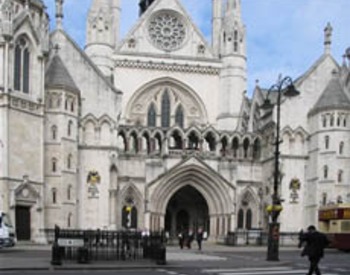
Royal Courts of Justice

Under the deal Waspi has dropped its judicial review claim due to be heard next week and accepted an offer by the DWP to pay the Waspi company £180,000 towards its legal costs in bringing the claim.

Most of the manoeuvring to obtain this arrangement has been behind the scenes in meetings between lawyers on both sides. As a result there will be no public hearing in the courts of the arguments where both sides would have put their case under the watchful eye of the Parliamentary Ombudsman who was an interested party. Waspi had been challenging Pat McFadden, the DWP secretary of state, over his decision not to award any compensation following the Parliamentary Ombudsman’s findings of partial maladministration over the communications informing the women.
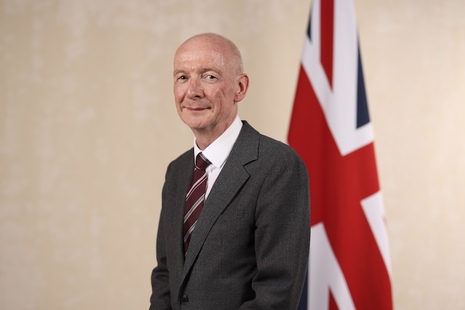
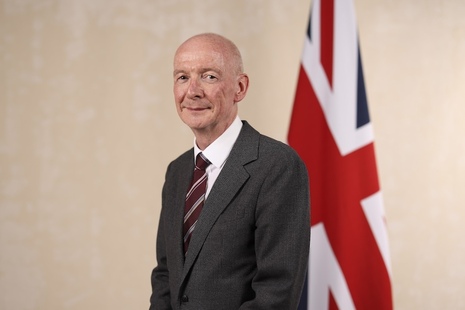
05/07/2024. London, United Kingdom.Chancellor of the Duchy of Lancaster, Pat McFadden, poses for a photograph following his appointment to Cabinet by Prime Minister Sir Keir Starmer in 10 Downing Street. Picture by Lauren Hurley / No 10 Downing Street

Then rather dramatically Mr McFadden on November 11 change his mind after the discovery of an earlier document which had been overlooked for 18 years revealing that attempts to inform the women had failed. Waspi’s lawyers Bindmans are said to have found it -presumably in the exchange of documents before the hearing. See my coverage of the document on this site here.

Before the hearing was dropped Waspi and DWP had the DWP arranged a case management hearing on December 3 with the most extraordinary terms allowing either side to block who would be allowed to attend or have to pay over £300 to obtain the right to attend.

This amounted to secret justice and it is no wonder on the day before the hearing the judge, Mr Justice Swift put out a national statement giving his directions for the case which made it clear it was a public hearing that anybody could attend and there were arrangements for people to hear it remotely.

This scotched the plan for a semi secret hearing so that evening it is clear that lawyers from both sides must have met and agreed to abandon the hearing the next day and Waspi Ltd agreed to pull out alongside the DWP from the two day judicial review.

It is my speculation that it will mean that some arrangement has been agreed under ” a nod and a wink” that the ministry will offer some form of compensation to some of the women. Certainly a seasoned lawyer like John Halford at Bindman’s ,would not have agreed to this without some hint or his client ,Waspi, would have been left in a very precarious position.

Waspi has not been alone in making representations to the government. Enter Edward Romain, a former whistleblower who has set up Blind Justice, a community interest company, to take up injustice cases and has joined joined forces with Cedaw in Law, to fight the case for the women on both discrimination and maladministration. I covered his case against Glyndebourne in an earlier article here. The case is now settled but it also discloses some strange behaviour by lawyers.His website is blindjustice.org.uk .

The day before the planned case review he delivered a recorded letter to Sir Keir Starmer and copied to Pat McFadden staking CedawinLaw’s claim to participate in any mediation process.

He followed this up with a powerful letter to Mr Oliver Towle, a senior lawyer at the Litigation Directorate for the DWP with a copy to the Treasury solicitor.

The letter asks the lawyer to confirm that following the court order that CEDAWinLAW and all other materially affected groups will be included in the consultations from the outset and clarifications of the intended structure and timeline for stakeholder engagement. The letter states

  • CEDAWinLAW represents the interests of 3.5 million women affected by State Pension Age changes. ​
  • The organization has made formal legal submissions and engaged with public authorities over four years. ​
  • It has pursued mediation and presented evidence to Parliament, highlighting ongoing advocacy efforts.

It also cites legal precedents quoting past cases covering natural justice, legitimate expectations, Wednesbury unreasonableness ( ie irrational responses), civil procedure rules and international law.

It concludes:”We respectfully submit that any reconsideration that does not include CEDAWinLAW would be procedurally flawed and open to future challenge. We remain available to assist constructively and can provide additional documentation or legal submissions if required.
We look forward to your confirmation and to contributing meaningfully to the reconsideration process.”

One curious fact, actions by WASPI and CedawinLaw appear to have come to attention of the Chinese government over the last five months.Altogether I have received over 76,000 hits from China from Beijing and 40 other cities across China data scraping my blogs on the pensions issue.

China has one of the lowest retirement ages in the world. Women can retire at 50, men at 60. I wondering whether the Government is thinking of raising it and is looking at the opposition to it in the UK. President Putin tried to raise the pension age for women some time ago but had such opposition from the Babuskas that he backed down -probably the only reversal he made as President.

The full letter to the government lawyer can be read here.

One-Time
Monthly
Yearly

Make a one-time donation

Make a monthly donation

Make a yearly donation

Choose an amount

£5.00
£10.00
£20.00
£5.00
£15.00
£100.00
£5.00
£15.00
£100.00

Or enter a custom amount

£

Your contribution is appreciated.

Your contribution is appreciated.

Your contribution is appreciated.

DonateDonate monthlyDonate yearly

You can donate via PayPal on the link below.
cards
Powered by paypal

Revealed: Hospital doctors are the top target for the NHS Resolution Practitioner Performance Service

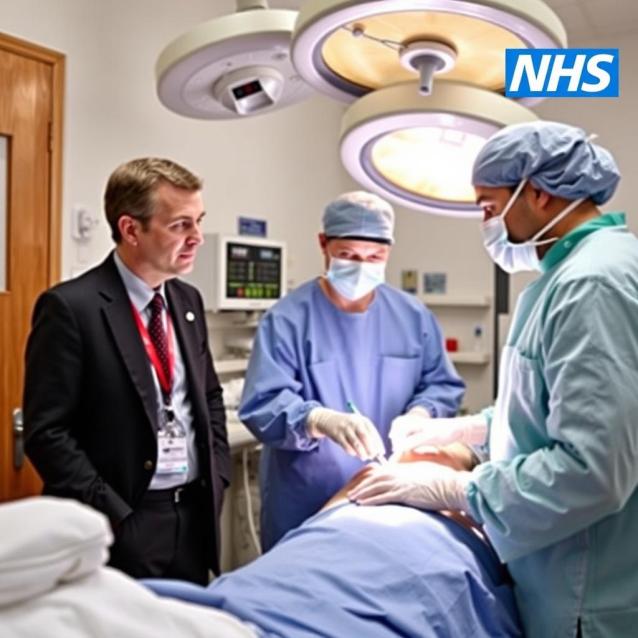
NHS Resolution solicitor overlooking hospital doctors under investigation. An AI image illustrating the situation facing hospital doctors in the NHS

Following my blog on the secret process using NHS Resolution to help hospital managers discredit whistleblowers I decided to ask the advisory body a series of questions on its operations using the Freedom of Information Act.

What emerged was extremely revealing. NHS Resolution hides in its annual report how many hospital doctors are involved by lumping them together with dentists and pharmacists. But the breakdown revealed through FOI reveals it is almost exclusively targeting doctors to advise trusts on how to handle them.

It shows that in the last financial year it advised in cases involving 1168 doctors in England, Wales and Northern Ireland. And the number of cases would be higher – as a number have multiple complaints from managers against them. This compares with 53 dentists and under 5 pharmacists. Indeed the pharmacists involved are so few – it won’t give me an exact number for fear of identifying individuals.

The PPS was last audited in 2019 and the organisation says it was then considered to be adequate and. effective. A more recent review in July this year by Dr Penny Dash looked just at the patient safety and learning role of the organisation and not wider issues.

Nor does NHS Resolution check whether it is given accurate information by managers. It said:” our role is to provide impartial and expert advice which is aimed towards supporting the local management and resolution of performance concerns. We are not a decision-making or an investigative body – in all cases, any decisions about the ongoing management, employment or contractual status of the practitioner rests solely with the healthcare organisation.”

In other words it is there solely to support health managers – who have no duty of candour – and it tries to include doctors by saying managers should tell them about their request for advice. In fact managers can and do ignore this as there is no requirement for them to say anything to the doctor they are investigating. So without hearing the doctor’s case it cannot be genuinely impartial. Also should a practitioner object to the partial advice given by a health manager they are ignored and the body continues to deal with the health manager.

NHS Resolution has not carried out any audit on the effect on doctors who are subject to complaints but it does do occasional research into problems arising on a very small scale. One example in its Insight Publication series last year was looking at whether ethnic minority doctors were badly treated in the NHS.

Involving just 11 doctors it said:”Most participants felt discriminated against based on their ethnicity and/or where they qualified. They felt this was reflected in the way their cases were handled by both their employer and Advice, and the higher rates of concerns raised against practitioners from ethnic minority backgrounds.”

Not surprisingly there was a lot of ignorance of how NHS Resolution’s advice service worked – given that health managers needn’t tell them about it. Again NHS Resolution’s solution was to give advice to managers which they need not take up. The full report is here.

Then there is the question of the phrase, performance. Is it a misnomer? NHS Resolution advice service does not look into the question of performance by doctors – relying on hospital manager for that – and it does not employ people qualified to do so. Many are solicitors, human resources staff and employment law experts and are not qualified to know when say a complex heart operation went wrong or the details of paediatric care. Indeed from doctors who have contacted me the trust often cites uncooperative behaviour and not working well with colleagues as part of its case.

Taken with earlier articles on the role of the General Medical Council a disturbing picture emerges which shows the hospital doctor is always at a disadvantage while the responsible officer – usually the medical director – holds all the cards – using NHS Resolution for advice and reporting the doctor to the GMC. Yet neither body is necessarily equipped to handle this and in NHS Resolution’s case, it is toothless to influence decisions by trusts. It can help to easily ruin a doctor’s career and even ban him or her for life for continuing their careers.

There seems to be a wholly unregulated sector covering NHS Resolution, the GMC and the trusts themselves and certainly no accountability. Patients have no idea how this is handled -yet their safety should be paramount in the NHS. And while NHS Resolution says it works under the direction of the Department for Health and Social Care my research shows it is not clear who regulates them.

If ever there was a case for reform of both systems, now is the time for something to be done.

One-Time
Monthly
Yearly

Make a one-time donation

Make a monthly donation

Make a yearly donation

Choose an amount

£5.00
£10.00
£20.00
£5.00
£15.00
£100.00
£5.00
£15.00
£100.00

Or enter a custom amount

£

Your contribution is appreciated.

Your contribution is appreciated.

Your contribution is appreciated.

DonateDonate monthlyDonate yearly

You can also donate using PayPal on the link below.

https://www.paypal.com/ncp/payment/865JAS3QJ3CGQ

Exclusive: 50s women: Details revealed of the damning buried DWP report that derailed Pat McFadden

Pat McFadden, poses for a photograph following his appointment to Cabinet by Prime Minister Sir Keir Starmer in 10 Downing Street. Picture by Lauren Hurley / No 10 Downing Street

The 18 year old research report that derailed work and pension secretary Pat Mc Fadden and forced him to review his decision to pay nothing in compensation to 3.6 million 50s born women is a comprehensive and damning document. No wonder he didn’t go into details in his Parliamentary statement this week on what the Labour government then did not do to inform the women and the first cohort of men who faced a rise in the pension age.

The key finding by researchers on the exercise of sending 16 million letters with automatic pension forecasts was that it was a “ systematic failure to reach the target populations most in need of provision.”

The research is very thorough. It took over a year to do it. It involved covering 16 million letters. Researchers interviewed 11,690 people. It involved both the women in the target 50-59 age group and men aged 59-64. ( 2007 was the year it was revealed that both men and women faced the pension age going up to 66). But it also involved men and women aged 20-49 to see if they were aware of the pension changes.

The first fact discovered was that out of the 16 million letters sent out, staggeringly 11 million went unread.

The report said The APF ( automatic pension forecast) was least effective among those who most needed it:

  • Those with no pension knowledge: 16% readership
  • Those without pension provision: 25% readership
  • Younger people: 20-24% readership
  • Lower socioeconomic groups: 30% readership

This represents a systematic failure to reach the target populations most in need of intervention.

All the letters did was reinforce people better off people’s decision to take early action to safeguard themselves.

It said This suggests the APF largely reached people who would have acted anyway, providing little marginal benefit.

There was also a Self-Selection Bias.

Those who read the APF were systematically different:

  • 64% already had basic/good pension knowledge
  • 33% already had pension provision
  • Higher income and socioeconomic status

The APF appears to have reinforced existing advantages rather than closing gaps.

It concluded:” “This research provides rigorous evidence that mass information provision, while well-intentioned, has minimal impact on pension knowledge or retirement planning behaviour. The APF initiative reached 16 million people but meaningfully engaged only about 5 million, with measurable behavioural impact likely affecting fewer than 1-2 million.

It lays down three fundamental truths.

  1. Information Is Not Enough Knowledge deficits are not the primary barrier to retirement planning. The research shows that those with the greatest information needs were least likely to engage with information provided.
  2. Existing Advantages Compound The APF was most effective among those who already had pension knowledge, existing provision, higher incomes, and greater financial capability—reinforcing rather than reducing pension inequality.
  3. Behaviour Change Requires Architecture, Not Just Information The minimal difference between APF and control groups demonstrates that passive information provision cannot drive behaviour change for complex, long-term decisions like retirement plan.

The report did tell ministers what they should do and why it was needed – that included specifically targeting the groups who did not respond in the future and running a systematic campaign to raise awareness of the change. As the Parliamentary Ombudsman found the result was maladministration.

DWP in ministerial flux

The ministry at the time was in flux. The year 2007 saw Peter Hain replaced by John Hutton – now both peers – as work and pension secretaries. The minister responsible for pensions changed as well from Mike O’Brien ( long left Parliament and working as a lawyer) and Dame Rosie Winterton.

There was zilch coverage in the media about its findings – the Iraq War was raging at the time – and it is not clear whether the report was kept for internal use anyway.

What will the impact be? First Pat McFadden says the review would not necessarily lead to the government paying out compensation. Secondly it could affect the judicial review brought by WASPI on the failure to act on the Parliamentary Ombudsman’s report and pay out compensation, as he said he had informed the high court about his decision to review the issue.

This could torpedo the hearing due on December 9 because judges may not want to hear the case if the minister says he is reviewing the situation.

As I have stated many times this would not have happened as CedawinLaw , the other main group campaigning for restitution for women, has said if they had applied instead for mediation and a court ruling to enforce it. But sadly WASPI has always refused to work with other groups wanting to create an impression in the media that they are the only people concerned about the issue.

Also the issue of past discrimination against these women as well as maladministration could have been included in the case. But Waspi do not seem to be bothered about this.

Not so transparent McFadden

There is one other issue to raise. Pat McFadden made a big issue of being transparent in his statement. But in fact he made it difficult for journalists to access this report. Normally when a minister makes a statement – and it will the case in the Budget – all the papers are available in the Vote Office to lobby journalists. In this case this paper was only available in the House of Commons library which can only be accessed by MPs. I would like to thank the anonymous MP who got me a copy.

Since then the library have allowed the report to be available to the public. The link is here.

One-Time
Monthly
Yearly

Make a one-time donation

Make a monthly donation

Make a yearly donation

Choose an amount

£5.00
£10.00
£20.00
£5.00
£15.00
£100.00
£5.00
£15.00
£100.00

Or enter a custom amount

£

Your contribution is appreciated.

Your contribution is appreciated.

Your contribution is appreciated.

DonateDonate monthlyDonate yearly

You can also donate via PayPal using the link below.
https://www.paypal.com/ncp/payment/865JAS3QJ3C

Exclusive: Hundreds of low paid NHS workers cheated out of their rightful pensions in hospital trust blunder

St Helier Hospital

The trust running St Helier and Epsom hospitals in South London and Surrey has admitted it has deprived hundreds of its lowest paid workers their rightful NHS pensions for up to seven years due to a major blunder by its management in signing them up to the wrong scheme.

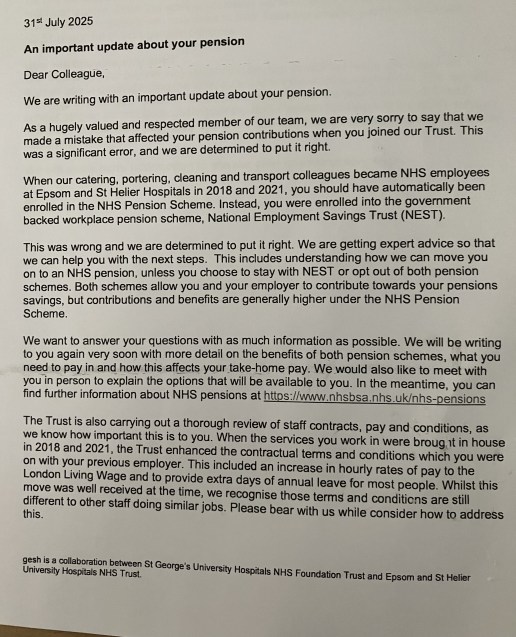
A letter sent out two weeks ago to catering staff, porters, delivery and transport drivers and cleaners admits it made ” a significant error” when it took the workers back in house in 2018 and 2021 from private contractors.

The move at the time was welcomed by staff as it gave the lowest paid staff higher pay than the going rate by private firms.

It has now emerged that instead of automatically signing staff up to the NHS pension scheme the workers were signed up to an inferior government backed workplace pension scheme, the National Employment Savings Trust (NEST).This pension scheme is aimed at small businesses as well as large private employers.

The letter says that benefits and contributions to the NHS pension scheme are higher.

The trust now part of the St George’s, Epsom and St Helier University Trust employs 5000 staff in the two hospitals – a sizeable number will be low paid staff. The trust will have to compensate workers for this error and has called in the Government Actuary Department to help estimate the scale of the problem which could cost several million pounds at a time when the NHS is squeezed in trying to bring down waiting lists.

The letter also reveals that the new trust has ordered a review of all staff contracts, pay and conditions as a result of the error. It now appears that there are differences between staff doing the same jobs with some receiving extra days leave than others and others on different pay rates.

There is also a suggestion of racism over Sunday working for low paid workers One rate seems to apply for many people from black and ethnic minority workers of £13.86 an hour while Agenda for Change workers, who are mainly white, get £26.31 an hour.

There appears to be a high level of dissatisfaction among lower paid workers with a ballot result for strike action for porters and cleaning staff by their union, the United Voices of the World, just announced of 98 per cent wanting to go on strike. This suggests workers are very unhappy working there.

The trust has one of the highest paid chief executives in the country, Jacqueline Totterdell, who gets £340,000 a year. She and her predecessor, Daniel Elkeles, now chief executive of NHS Providers, were in charge when these errors were made. Jacqueline Totterdell is planning to step down as the NHS faces a big reorganisation under the health secretary, Wes Streeting.

The letter is here:

Letter sent to staff
One-Time
Monthly
Yearly

Make a one-time donation

Make a monthly donation

Make a yearly donation

Choose an amount

£5.00
£10.00
£20.00
£5.00
£15.00
£100.00
£5.00
£15.00
£100.00

Or enter a custom amount

£

Your contribution is appreciated.

Your contribution is appreciated.

Your contribution is appreciated.

DonateDonate monthlyDonate yearly

Please donate to Westminster Confidential

£10.00

Exclusive: NHS Trust chief executives who persecute whistleblowers on patient safety win prestigious awards

From L to R: Alex Whitfield, Hampshire Ben Travis, Lewisham Daniel Elkeles London Ambulance

Three of the top 50 NHS chief executives chosen by a panel set up by the Health Services Journal in 2024 as the best people to run the NHS have been involved in attempting to cover up patient deaths and persecuting doctors and nurses who raised the issues.

One of the top three NHS awards went to Daniel Elkeles, as chief executive of London Ambulance Service Trust and is now chief executive of NHS Providers. He was chief executive of the Epsom and St Helier Trust when Usha Prasad, a cardiologist, reported the ” avoidable death ” of a heart patient. He told her to drop her case at an employment tribunal or face an internal disciplinary hearing which led to her being sacked.

I have since been told that Mr Elkeles was involved in an alleged cover up at the London Ambulance Service when a paramedic was suspended during the stressful period of the pandemic. He had alleged bullying, Elkeles said he would investigate but got the person to sign a non disclosure agreement. When it was signed it is said any investigation was dropped.

The second chief executive is Alex Whitfield who heads Hampshire Hospitals Foundation Trust, was involved in the sacking of Dr Martyn Pitman, a well respected obstetrician and gynaecologist, who raised patient safety issues in the already nationally stressed maternity services. The former oil executive is rated the 15th best chief executive.

The lack of care at the hospital in Winchester led to one mother and a baby dying, but Alex Whitfield used the tribunal to claim that Dr Pitman was ” putting patients at risk” rather than supporting the doctor and midwives who were helping patients. Lawyers for the trust monstered Dr Pitman claiming he was a bully for raising these issues.

Julie Dawes, the chief nursing officer at the trust, who also pursued Dr Pitman ,has just been awarded an MBE for services to nursing in the King’s Birthday Honours List.

The third award winner is Ben Travis, chief executive of Lewisham and Greenwich NHS Trust, which the Care Quality Commission, say ” requires improvement.”

Ben Travis was heavily involved in the 2022 tribunal hearings brought by Dr Chris Day, who has fought the trust for 10 years after he raised important patient safety concerns that became associated with two avoidable deaths  in the intensive care unit of Woolwich Hospital, run by the trust. The 2022 tribunal ruled against him despite evidence given by Ben Travis which shown to be untrue, the destruction of 90,000 emails during the hearing and the discovery of fresh documents .which should have been released by the trust to him to help his case.

The results of the last hearing is up for appeal on six grounds next week. He won the right to appeal that some of the findings of the judgment were perverse, that the judgment failed to draw any inferences from the destruction of 90,000 emails and the failure to provide documents that would have helped Dr Day’s case. This in particular followed the disclosure in documents that under oath the chief executive, Ben Travis gave an untrue account about a board meeting and had hidden he had contacted other trust chief executives about Dr Day.

Yet Mr Travis won the award on his personal performance over the last year; the performance of the organisation he led, given the circumstances it is in; and the contribution made to the wider health and social care system.

Award for Diversity

At the same time the trust has won a second award for its equality, diversity and inclusiveness despite its NHS staff report showing that it has a below average rating for the fair promotion of ethnic minority staff and for racial discrimination inside the trust and from members of the public.

The panel who decided the awards for the best chief executives included Dr Rosie Benneyworth, chief executive, Health Service Safety Investigations Body:Steve Brine, former Tory MP for Winchester and former chair, Commons Health and Social Care Committee,; Matthew Taylor, head of the NHS Confederation;Sir Julian Hartley, former chief executive of NHS Providers; Patricia Marquis, executive director for England, Royal College of Nursing and Dr Vish Sharma, chair, BMA’s consultant committee.

It is inconceivable that many of them did not know about the whistleblower cases. Dr Chris Day’s case is high profile; Dr Martyn Pitman’s case was in the national press and Steve Brine was his local MP. Usha Prasad’s case was a long running one.

There is another issue which is worth pursuing in a later blog – how ethnic minorities are treated in the NHS and the level of racial discrimination and whether black and Asian people have fair promotion prospects. Lewisham and Greenwich NHS Trust is not alone

One-Time
Monthly
Yearly

Make a one-time donation

Make a monthly donation

Make a yearly donation

Choose an amount

£5.00
£10.00
£20.00
£5.00
£15.00
£100.00
£5.00
£15.00
£100.00

Or enter a custom amount

£

Your contribution is appreciated.

Your contribution is appreciated.

Your contribution is appreciated.

DonateDonate monthlyDonate yearly

Please donate to Westminster Confidential

£10.00

Lawyers threaten the Judicial Conduct Investigations Office with a judicial review over failure to investigate Judge Lancaster

The logo of the JCIO Pic Credit: Ministry of Justice

The 13 claimants who allege bullying and misogyny by judge Philip Lancaster, most of them women, took their complaints against the JCIO to a new level last week when their all women team of lawyers issued what is known as a ” letter before action” to the investigatory body.

Their lawyers, DFG, standing for Deighton, Pierce and Glynn, have given the JCIO until Monday to reply or face action for a judicial review.

The statement in their letter reads in bold type: “By this Group Complaint, we are therefore requesting the JCIO to open a proper investigation into the cases of all these complainants on the grounds that it is now clear that Judge Lancaster has repeatedly engaged in misconduct in his judicial role over many years.

The misconduct consists of regular bullying of litigants-in-person and legal representatives, including shouting, harsh and inappropriate personal criticisms, intimidation and interruption of evidence.
We make clear that if this longstanding pattern of Judge Lancaster’s misconduct is not properly investigated by the JCIO we intend to challenge that decision by way of judicial review.

As I reported in Byline Times earlier this year ( see the article here) the Good Law Project first announced it was backing the then ten women who had faced bullying and misogynist comments from the elderly judge. Since then they have been joined by men who say they faced the same bullying tone from the judge who sits on the Leeds employment tribunal.

Judge Lancaster

The campaign began after the treatment of Alison McDermott, the now famous whistleblower, who exposed bullying and harassment at Sellafield nuclear waste facility, only to be bullied and rudely treated herself by judge Lancaster and lawyers representing Sellafield and the Nuclear Decommissioning Authority.

Judge Barry Clarke

Barry Clarke, President of the Employment Tribunal system, claimed she was fit to lodge a complaint — despite having no medical qualifications and ignoring a GP’s note saying she was suffering from severe clinical depression. He used this self-made “diagnosis” to deny her an extension, effectively blocking any investigation into Judge Lancaster, even as serious complaints from others were piling up.

The ramifications of what has happened since are causing serious problems for the nuclear waste plant and the judiciary. MPs on the Public Accounts Committee are now sceptical of claims by the top executives at the plant that there is no bullying or harassment and one MP, Anna Dixon, the new Labour MP for Shipley, and a member of the PAC, demanded in public that the chief executive of Sellafield apologise to her for the way Sellafield has behaved to her.

Harriet Harman Pic Credit:BBC

Meanwhile, Baroness Harriet Harman is conducting a separate investigation, with the support of the Bar Standards Board, into sexual harassment at the bar and in the judiciary — and has reportedly taken a direct interest in the Lancaster complaints.

Lawyers have demanded the JCIO does a complete and thorough investigation into Judge Lancaster.

1 A comprehensive review of all complaints submitted against Judge Lancaster, including those previously dismissed without investigation.
2 Statements from each complainant to ensure their full accounts are properly recorded and considered.
3.Interviews with relevant witnesses — including legal professionals, medical experts, accredited journalists, and public observers who attended the hearings and submitted complaints or documentation.
4 Consideration of the Employment Appeal Tribunal’s formal criticisms of Judge Lancaster’s conduct as part of the evidentiary record.
5 An analysis of Judge Lancaster’s written judgments to identify recurring patterns of reasoning, tone, and language indicating systemic bias. We have found consistent indicators of gender bias in descriptions of female claimants versus male respondents, including demeaning language, unsupported
character judgments, and disparate procedural treatment.

Alison McDermott

The JCIO originally said it did not comment on individual cases but now says it considers complaints carefully.

This is not the view of the complainants, their lawyers, and soon I expect if this gets more coverage, the general public.

One-Time
Monthly
Yearly

Make a one-time donation

Make a monthly donation

Make a yearly donation

Choose an amount

£5.00
£10.00
£20.00
£5.00
£15.00
£100.00
£5.00
£15.00
£100.00

Or enter a custom amount

£

Your contribution is appreciated.

Your contribution is appreciated.

Your contribution is appreciated.

DonateDonate monthlyDonate yearly

Please donate to Westminster Confidential

£10.00

Equality and Human Rights Commission hides findings on Hilsenrath’s breach of Covid lockdown

Rebecca Hilsenrath

The EHRC has refused to release the findings of an investigation into the huge breach of the Covid lockdown rules during the pandemic by Rebecca Hilsenrath, now chief executive of the Parliamentary Ombudsman’s Office.

The decision is in contravention of a ruling by John Edwards, the Information Commissioner, who ruled that Mark Benney , who put in the request to his office ,was entitled to answers about the finding of the report but not allowed to see it himself.

The EHRC has confirmed that a report was completed at the time Rebecca Hilsenrath, then its chief exceutive, was suspended by the EHRC as a precautionary measure. She then suddenly resigned only to get a senior job at the Parliamentary Ombudsman’s office almost immediately.

Her breach of Covid rules involved her traveling from her North London home to her country cottage in North Wales where her children also joined her -presumably also in breach of the rules – to spend their Christmas holiday together. She has four children. It was exposed in The Times newspaper.

Her holiday cottage in North Wales

Baroness Falkner, a crossbench peer and the chair of the EHRC, has used the same argument it deployed unsuccessfully to say that it would not answer questions about the report to protect Rebecca Hilsenrath’s privacy to refuse to publish the finding of the report.

Official Portrait of Baroness Falkner

She has decided not to appeal the decision but Mark Benney has put in his own appeal. It includes the words;” the Commissioner has erred in failing to consider whether the report and supporting documentation are capable of appropriate redaction in order to remove any special category data. Finally, it also follows that material within the report and supporting documentation that is neither personal data nor special category data is properly disclosable according to the overarching logic of the inDecision Notice.”

In my opinion this decision to hide the finding of a report about Rebecca Hilsenrath’s breach of the Covid rules is totally wrong. It may be five years ago but the lockdown meant tens of thousands of people could not move around the country, make trips like hers to celebrate Christmas and were not even able to visit relatives dying in hospitals all over the country.

In my opinion there appears to be a certain class of people who are arrogant enough to think that they are above rules that everybody else in the country is expected to obey. These people are often protected by friends in powerful positions to avoid the consequences that other less privileged people have to suffer from breaking the rules. I am not saying in this particular case this is necessarily so but the failure of public organisations to come clean about the facts in this case can only add to further speculation.

Incidently the Parliamentary Ombudsman website is still silent on any new cases and no date has been fixed yet for the new Ombudsman, Paula Sussex, to join it.

Rebecca Hilsenrath has broken her silence from the Parliamentary Ombudsman’s Office in a YouTube video on mental health put out by the Ombudsman’s Association on Leadership, Listening and Making Mistakes dealing with mental health issues. She frankly discloses that she suffered four bouts of post natal depression when she had her children and members of her family have suffered mental health problems so she is sympathetic about mentally ill people who are being badly treated by the NHS and other organisations. See the interview below.

One-Time
Monthly
Yearly

Make a one-time donation

Make a monthly donation

Make a yearly donation

Choose an amount

£5.00
£10.00
£20.00
£5.00
£15.00
£100.00
£5.00
£15.00
£100.00

Or enter a custom amount

£

Your contribution is appreciated.

Your contribution is appreciated.

Your contribution is appreciated.

DonateDonate monthlyDonate yearly

Please donate to Westminster Confidential

£10.00

Information Commissioner orders EHRC to provide answers over Covid breach by former chief executive Rebecca Hilsenrath

Rebecca Hilsenrath

NEW: Since this post was published I have learned that Rebecca Hilsenrath has been awarded an honorary KC and been appointed a member of the Civil Justice Council, chaired by the Master of the Rolls,Sir Geoffrey Vos. She is responsible for advising the judiciary on the use of alternative dispute resolution, where disputes are settled outside the courts. Ironically this would include the demand from CEDAWinLAW to solve the dispute over compensation for 50swomen pensioners which ministers oppose. She was and still is chief executive of the Parliamentary Ombudsman’s Office when the former ombudsman ,Robert Behrens, recommended compensation for partial maladministration by the DWP. It would be curious to know what her position will be on this if this ever came up.

John Edwards, the Information commissioner, has ruled that the Equality and Human Rights Commission must answer what action it took when it was revealed that its former chief executive, breached Covid rules at the height of the pandemic by driving from north London to her holiday cottage in Wales for a family Christmas in 2020.

The decision is a partial victory for Mark Benny, a dogged campaigner, who sought answers to what action it took when it became publicly known through an article in The Times that she had driven hundreds of miles when there was a ban on any long distance travel as part of the national lockdown.

But the information commissioner has decided not to release a report of an EHRC investigation or correspondence from her because it goes into her private life and might cause unwanted distress.

Rebecca Hilsenrath’s Welsh holiday cottage

However his ruling is significant for a number of reasons. He has had to weigh up public interest in this case versus a person’s right to privacy. And he has come down very firmly that there is a public interest case about how senior public figures conducted themselves during the pandemic. He also ruled that public bodies cannot, as the EHRC did, impose a blanket ban under the privacy section of the Freedom of Information Act, to refuse to confirm or deny anything because it involves personal data.

This could have wider implications since public bodies use this technique where there are controversial appointments or resignations to refuse to provide information because itinvolves personal data

John Edwards, Information Commissioner

Rebecca Hilsenrath’s case was particularly controversial because she resigned her chief executive’s job at EHRC only to be parachuted into a top position at the Parliamentary Ombudsman’s Office where since became Interim Ombudsman and chief executive, an equivalent or even better status than she had at the EHRC.

Extraordinarily when Mark Benny pressed the Parliamentary Ombudsman’s Office on what they knew or whether they took into account of her Covid breach during her appointment, the office said it had lost the papers on her appointment process.

So now the EHRC will have to answer his questions within 30 days or as the Commissioner says in his report “failure to comply may result in the Commissioner making written certification of this fact to the High Court pursuant to section 54 of the Act and may be dealt with as a contempt of court.”
The questions he has asked include whether there was a proper investigation into the breach, whether it was completed and what was the outcome. He also wants to know whether she was suspended by the EHRC or put on gardening leave and whether she was dismissed or decided to resign.

All the public had at the time was a terse statement by the EHRC to the press. It said:

“The Equality and Human Rights Commission said they will consider whether further action against its chief executive is needed.
“She has apologised for this error of judgement,” said EHRC chair Baroness Kishwer Falkner.
“I will establish all the facts before deciding if any further action is
required.”

Nothing has been heard of this since and it is now known whether it came up again when she was interviewed to be Interim Ombudsman last year.

What the ruling by the Information Commissioner does is say that Mark Benney’s request was legitimate and it was necessary for the information to be released. But he thought this could be done through his questions and it was not a legitimate interest to release the full report because it contained details of her private life.

Interestingly he thought it might throw some more light on what happened at the Parliamentary Ombudsman’s Office. He said “he considers that disclosure of the requested
information would allow further scrutiny of that process.”

One-Time
Monthly
Yearly

Make a one-time donation

Make a monthly donation

Make a yearly donation

Choose an amount

£5.00
£10.00
£20.00
£5.00
£15.00
£100.00
£5.00
£15.00
£100.00

Or enter a custom amount

£

Your contribution is appreciated.

Your contribution is appreciated.

Your contribution is appreciated.

DonateDonate monthlyDonate yearly

Please donate to Westminster Confidential

£10.00

Antidote to our hysteria about immigration: City of London welcomes a new Migration Museum

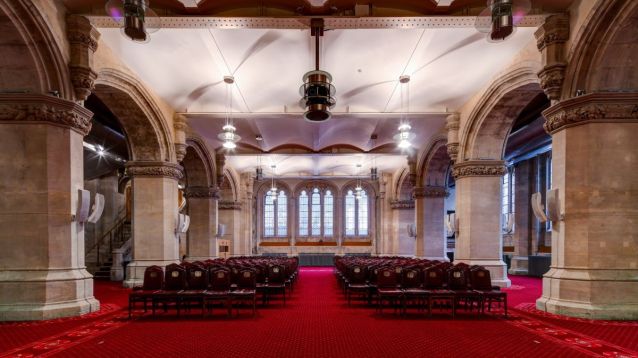
The rather splendid Livery Hall

Last night I attended a reception by the City of London to welcome the opening in three years time of Britain’s first national Migration Museum which will be located in the heart of the capital.

You could not have had a better antidote to the current political antipathy to migrants whether it is from Nigel Farage’s by election and Reform council election victories or Sir Keir Starmer’s ill judged views that we are becoming a nation of strangers because of the number of people wanting to live here.

Nor could there be a bigger statement of support from the City of London in choosing the prestigious Livery Hall at London’s Guildhall to launch this. Talking to officials from the City of London at the reception it was very clear they are extremely enthusiastic about the project.

The Migration Museum project is now 10 years old. It has moved from an old fire station at the back of the Albert Embankment to an empty H & M store in Lewisham shopping centre before getting to the City. It will be a new three floor museum in a brand new building in Aldgate. This latest move has only been made possible by a superb gift from a successful property company , Dominus, set up by a refugee to the UK.

The brilliance of this museum is that it focuses on human interest stories and treats everybody as a human being – not as some bogeyman or threat to the stability of our country. And the stories and history of migration and emigration are so rich and diverse and so much part of this country that it is amazing that no such museum has been created until now to celebrate this.

Also it will not have a metropolitan bias. There are plans for pop up museums all over the country to bring the same human interest stories to the rest of Britain. It will be popular with schools visits and when it is open it is expected to attract 140,000 visitors a year plus another 100,000 on the internet.

Last night’s launch included a panel discussion with Sathnam Sanghera , David Olusoga , Es Devlin, Indhu Rubasingham mediated by BBC news presenter Reeta Chakrabarti.

You can see how enthusiastic people were from this short Youtube video from Dr Krishna Kandiah, director of the Sanctuary Foundation. He says it better than I could express it.

On the way back home from the event on the tube I noticed a couple opposite me. The young man was a typical white Englishman with dark black hair. His girlfriend was a brown Asian lady. It was quite clear they were in love. And I thought those who claim we are a nation of strangers have got it wrong. The missing ingredient is love. In such a diverse country these attempts to drive wedges between people of different races will not resonate with them. Those who want to stir up fear and loathing are on the wrong side of history. Love will conquer all.

One-Time
Monthly
Yearly

Make a one-time donation

Make a monthly donation

Make a yearly donation

Choose an amount

£5.00
£10.00
£20.00
£5.00
£15.00
£100.00
£5.00
£15.00
£100.00

Or enter a custom amount

£

Your contribution is appreciated.

Your contribution is appreciated.

Your contribution is appreciated.

DonateDonate monthlyDonate yearly

Please donate to Westminster Confidential

£10.00

The legal establishment v Charlotte Proudman: An extraordinary exposure of misogyny and arrogant male entitlement in family courts

Charlotte Proudman Pic Credit:charlotteproudman.com

Last week I attended with Janice Chapman from CEDAWinLAW the launch of barrister Charlotte Proudman’s book He Said, She Said in London.

She is an extraordinary brave woman who stands up for sexually abused women and children in one of the most secretive parts of the judicial system – the family court – where estranged couples fight for custody of their children following a marriage breakdown. Most hearings are in private, ostensibly to protect the children, though a few can be reported in public following recent reforms.

For those familiar with my reporting of judgments in employment tribunals where whistleblowers stand only a 4 per cent chance of success this may not be such a surprise. Hearings such as those conducted by Leeds employment judge Philip Lancaster who has received 16 complaints from women he has insulted, belittled and patronised during hearings fit a pattern that seems rife in the family court system.

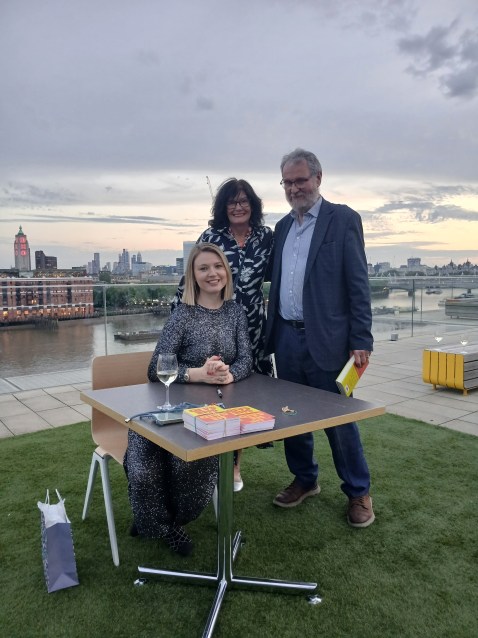
Janice Chapman and me with Charlotte Proudman at her book launch on the roof garden at Carmelite House. Janice asked her as a patron of CEDAWinLAW about the convention for the elimination of all forms of discrimination against women and why it needed to become law here.. Evidently the UK has not had a representative on the Geneva based committee under the last government and Baroness Helena Kennedy did not know whether the present government had to done anything to rectify this.

The book is a shocking eye opener into what goes on these largely secretive area of justice and exposes the appalling treatment of women in family courts – both by husbands and judges and ends with a failed attempt by the Bar Standards Board to end Charlotte’s career because she was exposing the mentality of the “boys club” world by both some male barristers and judges.

Among these is the case of a judge -Judge Scarratt – who threatened a woman who had been raped by her abusive partner and had been forced by him to take drugs to take away her daughter and put her in care and report her to social services for taking drugs. He made it clear that he was going to allow her abusive husband to have unsupervised contact with her daughter and said the whole proceedings were a waste of time. Charlotte Proudman managed to get his decision reversed by the Court of Appeal but by then the woman was traumatised as she says ” forcing even those who win to crawl over broken glass, leaving wounds that may never heal.”

Other highly disturbing material in the book includes the role of parental alienation used against women by men to say that women are turning their children against them. Extraordinarily these claims are backed up by so called experts – some who have no qualifications – who seem to be making a business out of the family court system.

Husband made wife sign a written contract allowing him to sexually assault his wife whenever he wanted

The most disgusting stuff is in a chapter on abortion and and reproductive coercion. It includes two contracts one before a woman became pregnant – which men forced on their partners. One insisted the husband would not have to give his sporting hobbies while she had to agree to shop for clothes in charity shops and ” keep the house as tidy as possible” and included the phrase ” I will entertain all sex requests- whenever and whatever -with a smile on my face and as a willing participant. It went to specify conditions for oral sex. As she comments; “It was, in effect, a charter for a man to rape and sexually assault his wife whenever he chose – a disgusting power fantasy.”

Two other chapters deal with a tragic case that involved the Hague Convention which is so limited in its scope that a woman fleeing her partner in Australia with her child because of domestic abuse was forced to return to him – as the issue of domestic abuse could not be used as a reason under the Hague Convention as it would have to be decided in Australia. The man then broke all his promises to the court.

Another case involved the hostile environment against child asylum seekers who faced female genital mutilation in their own country. Though the practice is illegal in the UK, the Home Office decided to split two sisters – allowing an 11 year old to stay but to deport her 14 year old sister on the wrong grounds she was too old to have FGM. After a desperate battle Charlotte managed to prevent the 14 year old from being deported.

The final part of the book turns the tables on Charlotte herself when she finds herself facing a tribunal at the Bar Standards Board for bringing the judiciary into disrepute – while far worse attacks are made against her on line by other barristers and men who lost their cases.

The tribunal decides that the justice system is robust enough to accept her on line criticisms of it – and board loses the case. The arguments put by the board to discredit her frankly look pathetic.

What this devastating book shows is that we still have along way to go to reform the judiciary and end the outdated boys club mentality. But Charlotte Proudman is on the right side of history and I am sure will prevail.

One-Time
Monthly
Yearly

Make a one-time donation

Make a monthly donation

Make a yearly donation

Choose an amount

£5.00
£10.00
£20.00
£5.00
£15.00
£100.00
£5.00
£15.00
£100.00

Or enter a custom amount

£

Your contribution is appreciated.

Your contribution is appreciated.

Your contribution is appreciated.

DonateDonate monthlyDonate yearly

Please donate to Westminster Confidential

£10.00