Revealed: The huge cover up of bad practices by leading law firms

Most people might expect a fake review of a new product, a Restaurant or a hotel included among the many posts on company websites..

A forensic investigation by the charity Blind Justice UK of reviews on leading law firms websites reveals this practice exists on an industrial scale with any critical review of the firm ruthlessly removed from the public domain. The chance of a faulty product, a poor meal or a bad night at a hotel pales into insignificance with the loss of money for the client when the law firm goes bust.

The Blind Justice investigation is comprehensive. It looked at 486 website reviews across 22 leading firms, all registered with the Solicitor’s Regulation Authority, which should provide some protection for clients. Every single one was a five star review – not a single critical review existed.

It examined 14 firms that had a complaint history with the Legal Ombudsman in over five cases. Not one was recorded on the firm’s website.
It examined 70,507 Trustpilot reviews analysed across 14 firms and over 16,000 Review Solicitors cases ( more about them later).

One firm had 2,529 consecutive reviews with zero negative feedback across 1,687 days.

What is more disturbing is that three firms, PM Law, SSB Law and Axiom Ince went bust during this period owing clients over £300m between them – a not insubstantial sum – but you would have no early warning from their websites or from the Solicitors Regulation Authority that this was about to happen. The research records 35 reviews removed from PM Law’s profile while the firm was still trading and 7,500 PM Law reviews were no longer reachable through their original URLs. 54 SSB Law’s review count: frozen for five years through its entire collapse.

This has not happened by accident. I have been told of an organisation called Review Solicitors which is recognised by the the Solicitors Regulation Authority and can do all the work to disguise critical reviews for the law firms. I am told for a premium rate of £7000 a month – not too big for the largest firms which often have communication budgets of £1 million a year – all the criticism disappears.

The Review Solicitors platform integrates with law firm case management systems to send automated review invitations at matter close. Firms choose which clients receive an invitation. The platform’s own marketing states: “Not appropriate to send feedback to a client? Simply click a button.” This is review gating by design.

Negative reviews are held for up to 48 hours while the firm attempts to resolve the complaint. Positive reviews are published immediately.

Firms can immediately suspend any review they flag as defamatory or from a non-client. The review is removed first; investigation happens second. The reviewer has 14 days to confirm their identity or the review is permanently deleted. The party with the clearest commercial interest in removal decides whether removal is warranted.

Between 2018 and 2021, ReviewSolicitors quietly changed its ranking algorithm. In 2018, negative inputs included Legal Ombudsman rulings, Solicitors Disciplinary Tribunal rulings, and notifications that a firm had threatened legal action against a reviewer. By 2021, all negative inputs had been removed. The revised algorithm rewards size, volume, rating, recency, and “how the law firm has historically collected reviews.” The direction of change is uniform: away from consumer protection, toward commercial engagement.

Between 26 September 2024 and 13 December 2024, the published review count on PM Law’s primary ReviewSolicitors profile dropped from 794 to 759. That is a net loss of 35 reviews in 79 days. The count can only decrease if reviews are being removed. During that three-month window, more reviews were removed from the platform than were added.
While the count was falling, named reviewers were posting unmistakable warnings on the same platform: missed completion dates, unanswered communication, offices that had effectively stopped functioning. These are exactly the problems that materialised at scale when PM Law collapsed on 2 February 2026, with £39.5 million of client money missing.

sarah rapson ceo solicitors regulation authority

Blind Justice have this week also published an open letter to Sarah Rapson, Chief Executive of the Solicitors Regulation Authority, calling for an independent audit of the SRA’s complaint closure system. The charity’s accompanying briefing analyses seven years of the SRA’s own enforcement data and will be published in full on 3 June 2026.

Bust firm PM Law
cards
Powered by paypal

Pat McFadden’s perverse benefit cuts that is undermining the government’s apprenticeship initiative

05/07/2024. London, Pat McFadden, poses for a photograph following his appointment to Cabinet by Prime Minister Sir Keir Starmer in 10 Downing Street. Picture by Lauren Hurley / No 10 Downing Street

With a million young people currently not in work, training or school the government’s plans for a huge increase in apprenticeship programmes is a key plank to get people back to work. The full scale of the programme is published by the business department here.

Yet it turns out that the Department for Work and Pensions is undermining its own initiative by a series of hidden benefit cuts which have been exposed by the experts who monitor changes in the benefit system.

The Social Security Advisory Committee, a panel of experts appointed to scrutinise benefit changes in the ministry, has just produced a highly critical report, revealing that the families whose 16 year olds take up apprenticeship can lose thousands of pounds a year in benefits the moment they take up a place.

“The report shows that when a young person leaves full‑time education to start an apprenticeship, families can face a sudden loss of social security financial support. Often the young person’s apprentice wage theoretically offsets this – although in practice, their parents will only be compensated if a lot of the pay packet is handed over to them. Sometimes, the loss is so great that the household as a whole is worse off – which means that, even if all the apprenticeship earnings were handed to the parent, the family would be poorer. This is particularly the case when the young person has a disability and the loss of social security income can be greater than the apprenticeship wage.”

What is happening is that the family immediately lose child benefit when the 16 year old takes a job and the 16 year old loses his or her universal credit. which is paid to parents. The most seriously affected are disabled people – who the government want to take up jobs – who lose additional benefits.

While the apprentice will receive £8 an hour he or she is expected by the ministry to hand over the money to the family to compensate them. But in many cases the social security experts found the cash fell short. It varied from £68 a month to £1320 a month if the person was disabled.

Stephen Brien

Dr Stephen Brien, Chair of the Social Security Advisory Committee, said:

“The social security system is not neutral in the choices young people make at 16. In its current form, it can penalise families when young people take up apprenticeships, even though this is a route that government actively encourages. This creates a real risk that decisions are driven by short‑term affordability rather than what is right for a young person’s long-term future.”

In some cases it can lead to the young person abandoning the apprenticeship altogether as the benefit cuts come as a shock and even advisers don’t seem to know about this change.

There is also a rather extraordinary irony in all this – if the young person chooses to turn down the apprenticeship and stays at school, the family continue to get child benefit and disabled people get help. This is exactly the opposite of what the government wants to happen.

The committee are recommending changes to this -particularly if it affects disabled people. But there are no signs despite the cost of living crisis that the ministry wishes to make any change.

I expect with all the plotting surrounding Labour Party leadership Pat McFadden will take his eye off the ball and yet another good government initiative will bite the dust because of penny pinching and Labour being out of touch with voters real lives.

cards
Powered by paypal

Journalist who exposed racism,bullying and misogyny among top judicial appointments faces £14,000 bill for FOI requests

Barnie Choudhury Pic credit: Barnie Choudhury

The Judicial Appointments Commission, the body that appoints the top judges in England and Wales, is pursuing a journalist for an unprecedented bill to try and silence him after a six year investigation exposed huge shortcomings in the handling of applications for new judges, especially from ethnic minorities.

Barnie Choudhury, a journalist on Eastern Eye, a national Asian paper, has pursued the JAC using Freedom of Information requests and covering tribunal cases brought by applicants only to face a £14,200 costs bill from the JAC for daring to challenge the body in a tribunal hearing. The action by the body has been widely condemned by the National Union of Journalists and by newspaper organisations as an attempt to silence him which could have widespread implications for other journalists using FOI requests and covering tribunal cases to root out malpractice.

judge abbas mithyani KC Pic credit: Eastern Eye

One of the cases he covered involved Abbas Mithani KC, a former designated civil judge for the West Midlands and Warwickshire. He was asking the General Regulatory Chamber to rule whether the Judicial Appointments Commission [JAC] and Information Commissioner’s Office [ICO] were wrong to deny him full disclosure to three freedom of information requests he made.

He accused the JAC of “avoiding public scrutiny” and one of its heads of being “guilty of gross negligence and deliberate recklessness”.

The JAC used exemptions under the act, and the ICO upheld its decisions, even though there was an error in the decision-making process, the panel heard. “Their reliance on those exemptions are flawed and incorrect,” said Mithani in his opening statement to the online tribunal.

One exemption under the FOI act which allows public bodies to refuse information on the grounds that it would “prejudice the effective conduct of public affairs” depended on a qualified person to approve this. Through Choudhury’s work the judge discovered the JAC had no qualified person to do this.

His public challenge has been echoed by complaints from a number of anonymous judges who did not want to challenge the body as they did not trust them to treat them fairly.

The judges – South Asian and white – talked of bullying, racism and misogyny as being widespread in the judiciary – when applying for new appointments. But complaints are only accepted if they come from people who publicly say who they are. Some are on on anti depressants, others even contemplated suicide.

Worse, bodies that would have powers to investigate what appears to be widespread abuse of the system have no resources to do so. Their budgets have been hollowed out by previous governments and Labour show no signs of giving them extra resources. These include the Information Commissioner’s Office, the Equality and Human Rights Commission, and even Parliamentary select committees who have turned down investigations.

There is push back from inside the judiciary. Notably Judge Kaly Paul from the Justice Support Network who won £50,000 in a settlement after she took from her employer to a tribunal over bullying claims. She wrote to the Commons justice select committee:

“We understand that this cancer of secret soundings: sifting for attitudes, allegiances, composed of gossip and never revealed to the candidate has crept in and proliferated within the system, being used at a far earlier stage in the process than before. It creates bias and undermines the apparent objectivity of scoring from other subjective panel assessment and other information sources,”

What appears to be here is the harassment of a journalist who over a long period has reported and revealed a very bad situation in one of the country’s most important legal bodies.

In my view they have misused laws designed to protect the public and the press using both their rights under the Freedom of Information Act and regulations governing tribunals.

Over 20 years ago I sat on the Lord Chancellor’s advisory committee on implementing the 2005 Act. The whole emphasis was to make it easier for people to obtain information and hold public bodies to account. it is simply called open government. The JAC has abused its position to withhold fundamental material – like how much as been spent on staff and legal costs fighting these judges. We don’t know the full package given to the chief executive of the organisation who resigned, we do now know that at least £212,000 was spent in legal costs to stop challenges from judges.

As for the £14,200 costs the journalist is facing – it goes against the whole grain of the tribunal system where the vast majority of claimants are not charged any costs. Indeed to seems to me to be a device used to intimidate whistleblowers who have annoyed public bodies and the NHS ( examples include Alison McDermott exposing bullying at Sellafield, and a leading cardiologist at St Helier hospital who exposed patient safety issues. It seems vindicative and aimed to ruin an individual.

Sir James Eadie

I note the JAC is employing one of the most expensive KC known as the “Treasury Devil” – the colloquial title for the First Treasury Counsel (Common Law), a leading barrister retained to represent the UK Government in major civil litigation, often in the Supreme Court. Currently, this key legal role is held by Sir James Eadie KC. He is the man who fought the judicial review to stop the government paying any cash to 3.6 million 50s women pensioners who felt cheated by the system and also took on the Scottish government.

As for Barney himself there is an excellent description of where he stands in an Eastern Eye article.

” The problem with me is that I’m a campaigning journalist who isn’t scared or overawed by authority. It’s always been this way. My bosses say I’m a maverick. I argue that every organisation needs one. My family worry that I don’t know when to back down with authority figures. That problem is exacerbated by the fact I’m brown. Sadly, some white people just don’t get that we of colour can be as intelligent as they are.”

As for the JAC it doesn’t comment on individual cases but there was a telling response from one of their lawyers during the Mithani case.

JAC’s barrister Natasha Simonsen told the hearing “Some very serious allegations have been made, and they are rejected in their entirety,” Simonsen said.

“The allegations are not only against the JAC but also against that JAC’s legal advisers, the GLD and perhaps me as well.

“These are matters we take extremely seriously.

“If the tribunal considered any of that relevant then we would wish to respond in writing to those specific allegations.

“Mr Thomson and his colleagues in the JAC, and my colleagues at the GLD are extremely hard working civil servants who have strived consistently to do the right thing at every stage of the proceedings.

“There is absolutely no desire to cover things up or suppress information.

“What there is is a concern to protect personal information, including sensitive or special category information for both applicants of judicial office and panel members.

“There is also a concern to ensure the appointments system is not prejudiced by disclosure of scoring frameworks which may be unable to be reused in subsequent exercises.”

cards
Powered by paypal

Senior judge orders court hearing over alleged missing text in coroner Mary Hassell’s transcript of death of TV journalist

Mr Justice Chamberlain, the head of the Royal Court of Justice’s Administrative Court, has intervened in the case against controversial coroner Mary Hassell by ordering a hearing later this year after months of inaction by the judiciary.

Mr Justice Chamberlain pic credit: Avalon

The allegations that the report of the hearing into the death of ITV news editor Teresa McMahon appeared to be tampered with were brought by her aunt Lorna McMahon at a hearing last July. The judge Mr Justice Stephen Morris took the allegations so seriously that he postponed the judicial review hearing and wanted the matter dealt with speedily later last year. The coroner tried to get her name removed from the hearing but was overruled by the judge saying it was a matter of ” open justice”.

There is a full report of the hearing here. The judge insisted that her allegations must be corroborated by witnesses at the hearing which attracted wide press attention. Two journalists. including myself and a member of the public have come forward saying the text was missing.

Mary Hassell found that the TV journalist committed suicide and ruled out that she was subject to ” coercive control” by her ex boyfriend, Robert Chalmers, an NHS estates employee, who had previous convictions for violence. Mary Hassell believed the words of the pathologist ,Dr Mohammed Bashir, who examined the body but kept no photographic evidence and discounted domestic violence and Greater Manchester Police who decided from the start that no crime had been committed and never took any photographs either at the scene of her death.

The missing text covers when Lorna McMahon was questioning Teresa’s boyfriend after she was frequently interrupted by Mary Hassell.

Court cases involving coroner’s verdicts are very rare and allegations of tampering with the inquest report can be seen as a criminal offence of perverting the course of justice.

Mr Justice Chamberlain looks set to hear the case himself as he ruled that it could not be heard by a deputy high court judge. The full report of the inquest hearing held in December 2024 can be read here.

cards
Powered by paypal

Government commissioned research reveals whistleblowers have no faith in the system to protect them

Glum whistleblower at an Employment tribunal. Picture created through AI

A research report published this July by the new Labour government has painted a devastating picture of the failure of the culture of the whistleblower system in the United Kingdom.

The report, originally commissioned by the Tories under Rishi Sunak, and undertaken by researchers at Grant Thornton, one of the big accountancy firms, pulls no punches. It reveals how whistleblowers, whether in industry, the NHS and other public bodies, see a failure by the courts, employers, and even those appointed to help them, to protect them.

The sad news is the report, commissioned by the Department of Business and Trade, looks like remaining on the shelf – and the one improvement planned by the justice ministry could make matters worse. It plans to appoint 50 new employment tribunal judges to handle an increase in whistleblowing cases, among other issues, following the implementation of the new Employment Rights Act. For those who follow my blogs, they will know, they are more than often part of the problem, not the solution.

For a start whistleblowers found the terms used to describe whistleblowers as vague and confusing.

The report notes that terms like “reasonable belief,” “public interest,” and “worker” are seen as subjective, vague, inconsistent, and narrow, creating uncertainty about whether protections actually apply. One whistleblower expressed surprise when an Employment Tribunal decided their concerns didn’t meet legislative requirements despite their employer telling them they did.

The majority of whistleblower participants reported feeling victimized by their employer after blowing the whistle. The research found that many whistleblowers believed the framework doesn’t provide effective protection in practice. The “protection” offered is essentially just the right to seek redress after harm has already occurred, not proactive prevention of retaliation.

Multiple barriers for whistleblowers

Multiple barriers existed for whistleblowers when their case came before an employment tribunal. These included:

Resource imbalance: They lacked time, money, knowledge, and skills compared to their employers Mental toll: The process was described as complex, draining, and requiring resilience many didn’t have Evidential burden: Proving detriment was directly related to their disclosure was extremely challenging Delays: Tribunals experience significant delays

Time limits: Strict deadlines created additional barriers

Unfair treatment: Limited access to evidence and risks around non-disclosure agreements

Lack of trust: Many didn’t believe tribunals would be balanced or deliver meaningful

Nor did whistleblowers find people designated to help them such as regulators much good.

They found they could not protect them from detriments or victimisation. Some were conflicted particularly where there had been regulatory failure.

Several whistleblowers stated it was “not easy” to blow the whistle internally: They found:

  • Little faith in the process based on previous experience
  • Fear of retaliation after hearing stories from others
  • Restrictions from non-disclosure agreements
  • Conflicts of interest when those receiving reports were implicated
  • Lack of independence in investigations
  • Concerns not being properly investigated or addressed
  • No feedback or perceived remedies

The report describes the huge tolls on whistleblowers. At employment tribunals,phrases from whistleblowers included: public execution,exhausting, beyond difficult, miserable. complex, ardous, horrible and abusive, soul destroying,toxic and unsafe.

Litigants in person fared worse with descriptions that they were not treated respectfully by judges, lawyers and other parties and that they were not impartial.

Many stated they would not blow the whistle again due to negative experiences

Cases that involved international jurisdictions were even more complicated with slow co-operation from countries and regulators abroad.

The report makes suggestions for change. These are:

  • create a central body for whistleblowing
  • ongoing engagement and research to assess and monitor all aspects of the GB
    framework
  • efforts to improve effectiveness should be multifaceted and monitored
  • improved mental health support for individuals
  • legal advice and a degree of financial security while the claim progresses
  • consideration of disincentives and incentives, for example implementation of a United
    States style reward system

I contacted the ministry about the report:

A Government spokesperson said:

The Employment Rights Bill will strengthen protections for whistleblowers reporting sexual harassment at work and extend time limits for bringing tribunal claims from three to six months.

“We are also fixing the employment tribunal system by ensuring more cases are resolved before reaching them and recruiting more Employment Judges.”

They said that didn’t regard the report’s conclusions as firm recommendations and many of the suggestions were outside the remit of the ministry.

The full report can be read here.

You can donate by PayPal using the link below

https://www.paypal.com/ncp/payment/865JAS3QJ3C

Exclusive: 50s women: Details revealed of the damning buried DWP report that derailed Pat McFadden

Pat McFadden, poses for a photograph following his appointment to Cabinet by Prime Minister Sir Keir Starmer in 10 Downing Street. Picture by Lauren Hurley / No 10 Downing Street

The 18 year old research report that derailed work and pension secretary Pat Mc Fadden and forced him to review his decision to pay nothing in compensation to 3.6 million 50s born women is a comprehensive and damning document. No wonder he didn’t go into details in his Parliamentary statement this week on what the Labour government then did not do to inform the women and the first cohort of men who faced a rise in the pension age.

The key finding by researchers on the exercise of sending 16 million letters with automatic pension forecasts was that it was a “ systematic failure to reach the target populations most in need of provision.”

The research is very thorough. It took over a year to do it. It involved covering 16 million letters. Researchers interviewed 11,690 people. It involved both the women in the target 50-59 age group and men aged 59-64. ( 2007 was the year it was revealed that both men and women faced the pension age going up to 66). But it also involved men and women aged 20-49 to see if they were aware of the pension changes.

The first fact discovered was that out of the 16 million letters sent out, staggeringly 11 million went unread.

The report said The APF ( automatic pension forecast) was least effective among those who most needed it:

  • Those with no pension knowledge: 16% readership
  • Those without pension provision: 25% readership
  • Younger people: 20-24% readership
  • Lower socioeconomic groups: 30% readership

This represents a systematic failure to reach the target populations most in need of intervention.

All the letters did was reinforce people better off people’s decision to take early action to safeguard themselves.

It said This suggests the APF largely reached people who would have acted anyway, providing little marginal benefit.

There was also a Self-Selection Bias.

Those who read the APF were systematically different:

  • 64% already had basic/good pension knowledge
  • 33% already had pension provision
  • Higher income and socioeconomic status

The APF appears to have reinforced existing advantages rather than closing gaps.

It concluded:” “This research provides rigorous evidence that mass information provision, while well-intentioned, has minimal impact on pension knowledge or retirement planning behaviour. The APF initiative reached 16 million people but meaningfully engaged only about 5 million, with measurable behavioural impact likely affecting fewer than 1-2 million.

It lays down three fundamental truths.

  1. Information Is Not Enough Knowledge deficits are not the primary barrier to retirement planning. The research shows that those with the greatest information needs were least likely to engage with information provided.
  2. Existing Advantages Compound The APF was most effective among those who already had pension knowledge, existing provision, higher incomes, and greater financial capability—reinforcing rather than reducing pension inequality.
  3. Behaviour Change Requires Architecture, Not Just Information The minimal difference between APF and control groups demonstrates that passive information provision cannot drive behaviour change for complex, long-term decisions like retirement plan.

The report did tell ministers what they should do and why it was needed – that included specifically targeting the groups who did not respond in the future and running a systematic campaign to raise awareness of the change. As the Parliamentary Ombudsman found the result was maladministration.

DWP in ministerial flux

The ministry at the time was in flux. The year 2007 saw Peter Hain replaced by John Hutton – now both peers – as work and pension secretaries. The minister responsible for pensions changed as well from Mike O’Brien ( long left Parliament and working as a lawyer) and Dame Rosie Winterton.

There was zilch coverage in the media about its findings – the Iraq War was raging at the time – and it is not clear whether the report was kept for internal use anyway.

What will the impact be? First Pat McFadden says the review would not necessarily lead to the government paying out compensation. Secondly it could affect the judicial review brought by WASPI on the failure to act on the Parliamentary Ombudsman’s report and pay out compensation, as he said he had informed the high court about his decision to review the issue.

This could torpedo the hearing due on December 9 because judges may not want to hear the case if the minister says he is reviewing the situation.

As I have stated many times this would not have happened as CedawinLaw , the other main group campaigning for restitution for women, has said if they had applied instead for mediation and a court ruling to enforce it. But sadly WASPI has always refused to work with other groups wanting to create an impression in the media that they are the only people concerned about the issue.

Also the issue of past discrimination against these women as well as maladministration could have been included in the case. But Waspi do not seem to be bothered about this.

Not so transparent McFadden

There is one other issue to raise. Pat McFadden made a big issue of being transparent in his statement. But in fact he made it difficult for journalists to access this report. Normally when a minister makes a statement – and it will the case in the Budget – all the papers are available in the Vote Office to lobby journalists. In this case this paper was only available in the House of Commons library which can only be accessed by MPs. I would like to thank the anonymous MP who got me a copy.

Since then the library have allowed the report to be available to the public. The link is here.

You can also donate via PayPal using the link below.

https://www.paypal.com/ncp/payment/865JAS3QJ3C

Two damning reports from Parliamentary Ombudsman say Charity Commission failed complainants about sexual abuse

The Parliamentary Ombudsman’s Office today published two reports into the Charity Commission’s handling of separate sexual abuse cases following Parliament’s rare privilege decision last week – see my report here – to compel Paula Sussex, the Parliamentary Ombudsman, to release them in the face of the Commission starting legal action to stop or delay publication.

Both reports highlight the failure of the Charity Commission to implement some of its findings and the total dissatisfaction of the two complainants – Lara Hall, 37 and Damian Murray, who is 66. Both decided to waive their anonymity. I will be publishing a separate follow up story on Mr Murray’s case after he contacted me – particularly after the local media failed to cover it. It is a truly shocking story.

The two cases are different. Lara Hall’s case involves the sexual exploitation by a trustee of a UK charity where she acted as a whistleblower.

Damian Murray’s case involved historic sexual child abuse by a prominent figure in the local community which was concealed by the charity and the college where he worked.

Lara said:

“The Charity Commission’s repeated failures have caused me profound pain and ongoing injustice. Instead of holding a trustee to account for appalling sexual exploitation, it questioned my experience and forced me to relive my worst trauma. How can survivors feel safe reporting abuse if they think they will be treated like I have? 

“By trying to block Parliament from seeing the reports, the Commission attempted to avoid scrutiny – striking at the heart of accountability in our democracy. Even now, it refuses to accept responsibility or act to put things right.

“It is my hope that by bringing the reports to Parliament’s attention action will finally be taken. The Commission must urgently address safeguarding to protect vulnerable people. Right now, it is failing in its core duty.

“It is time for change, oversight, and accountability within the Charity Sector so what happened to me is never repeated. I call on Parliament to hold the Commission to account and restore public trust. People deserve to feel safe approaching charities, and they deserve a regulator that takes safeguarding seriously

Damian Murray said:“For over seven years the Charity Commission has refused to act upon my complaint about the concealment of child sexual abuse.

“The Charity Commission has doggedly resisted all efforts by me, and latterly the Parliamentary Ombudsman, to encourage it properly or promptly to discharge its statutory responsibilities, choosing rather to shield the charity and its Trustees from scrutiny and accountability.

“After much unnecessary time incurred due to this resistance, the Ombudsman’s report has now been laid in Parliament. I trust now that politicians will hold the Commission to account, where I as an ordinary UK citizen failed.

“By stark contrast with the Commission, I very much appreciate the careful, professional and empathetic way that the Ombudsman’s team have dealt with me and with the complex and consequential concerns I have raised.”

Parliamentary and Health Service Ombudsman CEO, Rebecca Hilsenrath KC (Hon) said: 

“The Charity Commission indicated throughout our investigations that they did not agree with our findings.  They have not complied with the bulk of our recommendations, despite our best efforts and our willingness to work with them to ensure compliance.

“It is important that the Commission provides a full apology for their failings and reassures Lara and Damian that they will put things right by complying completely with our recommendations. They have not done this so far. 

“Our report has now been laid in the House of Commons, following the intervention of Parliament last week. The Commission had prevented us from doing so by bringing legal proceedings. We act on behalf of Parliament to hold Government and other national bodies to account for failures, and we have a responsibility to make Parliament aware of cases of non-compliance. I am pleased that Parliament has taken an interest in these cases and has given us the opportunity to bring them to the attention of the House so that it can intervene.

“The purpose of our investigations is always to encourage learning and service improvements. If an organisation looks at what went wrong, it will be able to stop the same mistake from happening again.”

The Charity Commission released a statement criticising the action of Parliament to order publication of the reports.

A spokesperson said: “We have long accepted that there are genuine and important lessons for the Commission to learn from these two sensitive cases, principally in the way in which we communicate with complainants, and we have made improvements to our processes as a result. We have previously apologised to both complainants.

The Commission undertook detailed reviews in each case, as set out by the Ombudsman, and concluded that the overall outcome in each case was sound. In the case of Ms Hall, we had already issued an official warning to the charity concerned. 

But it is our view that by making the decision that we did not comply with certain recommendations in its reports, the Ombudsman has misunderstood our remit and overstepped its role, meaning that its decision making was unlawful.

We respect the work and authority of the Ombudsman, but it is vital that we, in turn, are enabled to do the job that Parliament set us

We have worked hard to seek to resolve the matter with the Ombudsman directly, but this has not proven possible. For that reason, we have brought legal action at the High Court. 

We have not asked the court to block the laying of any report before Parliament. We did, though, ask the Parliamentary committee to delay considering the reports to allow the courts to give judgment on our own and the Ombudsman’s statutory remits first.”

You can also donate via PayPal The link is:

https://www.paypal.com/ncp/payment/865JAS3QJ3CGQ

Institutional Corruption in Employment Tribunals: Dr Chris Day’s damning letter to top judge

Lord Fairley

Veteran NHS whistleblower campaigner, Dr Chris Day, has written a damning letter to Lord Fairley, President of the Employment Appeal Tribunal, accusing the system of “Institutional Corruption” in the way it has handled his case.

Dr Day, who has just lost an appeal case heard by employment appeal judge Sheldon, compared the way both the employment appeal court and the previous employment tribunal handled the proceedings to the verdict in the infamous Daniel Morgan murder case which has never been solved after a trial of suspects collapsed.

The way this murder was handled by the Metropolitan police led the independent panel to rule: ““Concealing or denying failings, for the sake of an organisation’s public image, is dishonesty on the part of the organisation for reputational benefit. In the Panel’s view, this constitutes a form of institutional corruption.”

Dr Day has emerged bloodied but not unbowed from a judgment that rejected all the detriments he claimed and was surprisingly unconcerned about the defendants Lewisham and Greenwich Health Trust’s chief executive lying on oath about a board meeting and its deputy communications office, Mr Cocke, destroying 90,000 emails that could have been useful to his case during the hearing. The worst the judgment could say was this was ” troubling.” Given this centred on his whistleblowing about the avoidable deaths of two patients in Woolwich hospital’s intensive care unit, which the trust has always tried to deny, this is a remarkably tame comment.

What was particularly hurtful to Dr Day is that at the appeal hearing he was accused in open court of lying about cost threats. He had been clear that he was forced at one stage to try to settle his case because he was told by his barrister that he would face a proposed application from the NHS for £500,000. See my report on his wife’s evidence here.

Effectively he was being called a liar by saying this had happened. Instead there is copious evidence that it did happen.

As he says in his letter: “At my most recent hearing, Mr Justice Sheldon explicitly stated in front of public observers that I was “lying” about being threatened for costs. He did this in circumstances when he knew my belief in cost threats was robustly grounded on written material from by former barrister Chris Milsom. He also knew that this material was enough to convince 2 MPs, the Telegraph and Financial Times that I had been threatened for costs. Accusing me of lying about cost threats in these circumstances was nothing more than a cheap smear to make me look like a liar in public.”

Or as he wrote earlier: “Dishonest or deluded whistleblowers don’t tend to have the support of former health ministers, senior doctors and the BMA to fund a KC.”

Also there is ample evidence in reports by lawyers that attempts to put costs on whistleblowers are commonplace. Indeed some lawyers moan they can’t get enough of them.

Dt Chris Day

His complaint about ” institutional corruption ” is not directed at individual judges but at the legal system where lawyers socialise with each other and don’t want to see a colleague’s reputation or career damaged by having to admit they got it wrong.

As he says in his letter: “My complaint is not directed solely at individual judges but at the institutional handling of this matter. The EAT has placed judges in an impossible position: adjudicating on issues that, if determined on the evidence, would have serious implications for people with whom they admit to having ongoing professional or social relationships including being connected on social media.
“This is precisely the type of reputational self-protection identified as “institutional corruption” in the
Daniel Morgan inquiry. I am not expecting you or the EAT to do anything about this but want to record
my position and the fact that it has been put to you as EAT president. You will note 2 MPs have called
for a public inquiry into this case.”

The full letter is on the internet here. His account of the case on Linked In is on https://lnkd.in/dZuKkTFG.

My view from covering a number of tribunals- both involving whistleblower doctors, nurses and in the world of industry and the arts – is that lawyers are getting too cosy and comfortable with each other. Add to this the loss of media interest in all but the most lurid of court cases, there are precious few journalists left to observe what is happening in the courts.

All this is to the detriment of the ordinary member of the public when they fight their case. Arraigned against them is a club that knows how to fix the outcome. And this is destroying the principle of open justice and why we need radical reform of both the employment tribunal and county court system.

Pay via Paypal. Use link below.

https://www.paypal.com/ncp/payment/865JAS3QJ3CGQ

Exclusive: Hundreds of low paid NHS workers cheated out of their rightful pensions in hospital trust blunder

St Helier Hospital

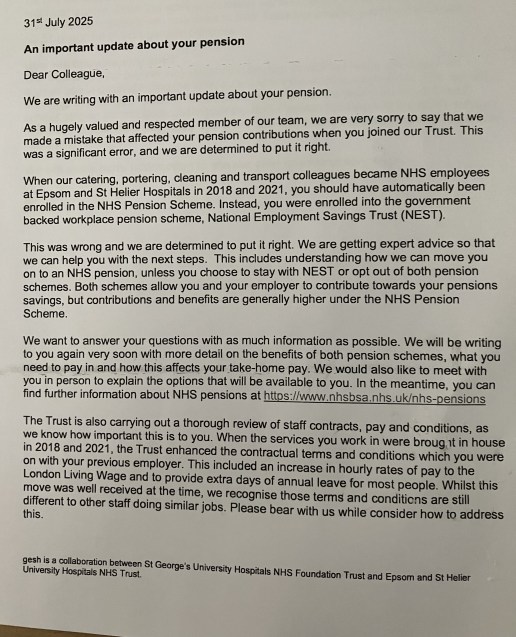
The trust running St Helier and Epsom hospitals in South London and Surrey has admitted it has deprived hundreds of its lowest paid workers their rightful NHS pensions for up to seven years due to a major blunder by its management in signing them up to the wrong scheme.

A letter sent out two weeks ago to catering staff, porters, delivery and transport drivers and cleaners admits it made ” a significant error” when it took the workers back in house in 2018 and 2021 from private contractors.

The move at the time was welcomed by staff as it gave the lowest paid staff higher pay than the going rate by private firms.

It has now emerged that instead of automatically signing staff up to the NHS pension scheme the workers were signed up to an inferior government backed workplace pension scheme, the National Employment Savings Trust (NEST).This pension scheme is aimed at small businesses as well as large private employers.

The letter says that benefits and contributions to the NHS pension scheme are higher.

The trust now part of the St George’s, Epsom and St Helier University Trust employs 5000 staff in the two hospitals – a sizeable number will be low paid staff. The trust will have to compensate workers for this error and has called in the Government Actuary Department to help estimate the scale of the problem which could cost several million pounds at a time when the NHS is squeezed in trying to bring down waiting lists.

The letter also reveals that the new trust has ordered a review of all staff contracts, pay and conditions as a result of the error. It now appears that there are differences between staff doing the same jobs with some receiving extra days leave than others and others on different pay rates.

There is also a suggestion of racism over Sunday working for low paid workers One rate seems to apply for many people from black and ethnic minority workers of £13.86 an hour while Agenda for Change workers, who are mainly white, get £26.31 an hour.

There appears to be a high level of dissatisfaction among lower paid workers with a ballot result for strike action for porters and cleaning staff by their union, the United Voices of the World, just announced of 98 per cent wanting to go on strike. This suggests workers are very unhappy working there.

The trust has one of the highest paid chief executives in the country, Jacqueline Totterdell, who gets £340,000 a year. She and her predecessor, Daniel Elkeles, now chief executive of NHS Providers, were in charge when these errors were made. Jacqueline Totterdell is planning to step down as the NHS faces a big reorganisation under the health secretary, Wes Streeting.

The letter is here:

Letter sent to staff

Please donate to Westminster Confidential

£10.00

Yet another potentially dangerous leak at Sellafield nuclear waste plant

The giant Sellafield site

The Sunday Mirror reports today of yet another potentially serious leak affecting worker safety at Sellafield which was not publicly released two years ago.

A whistleblower told the paper that an elevated level of nitrogen which can cause asphyxiation was released in the most dangerous building on the site – the Magnox nuclear storage facility which is also leaking contaminated water into the ground.

As I reported in Byline Times last month the 100 year clean up is already 13 years behind schedule and £20 billion over budget and its own nuclear safety experts say is becoming increasingly unsafe. The article is here.

What is disturbing is that the whistleblower told the newspaper. “It was most serious because it could have killed somebody. The whole point of having all these safety procedures is to stop people breathing in inert gas, so we can evacuate before there’s a chance of breathing it in.”

The source said the leak in May 2023 was raised as an incident report and “was of a level that needed to be escalated”. But it was not escalated, according to the whistleblower, who added that “no lessons were learned”.

The source said: “There is no confidence or trust in the senior management now. We are dealing with nuclear waste and people are afraid to speak up. The problem is that people are being victimised if they report safety issues.

“Or they are escalated to managers who then try to cover them up or sweep them under the carpet. And that is a really dangerous culture in a place like Sellafield.”

This new disclosure just comes after a report from the Commons Public Accounts Committee that was highly critical of the management at Sellafield and the oversight of the dangerous site by the Nuclear Decommissioning Authority. It was also highlighted safety issues as the buildings reach the end end of their life span and MPs were sceptical of claims by the senior management that relations with staff are improving and a toxic culture of bullying and harassment had been stopped.

Officially Sellafield told the paper:”This was reported and investigated swiftly and thoroughly. Our regulator was informed in line with established protocols,” they said. “Our Safecall system remains independent providing a safe and confidential reporting system for the whole of the NDA group.

“Whistleblowers are respected, protected, and valued and we actively encourage employees to report matters of concern. Without exception, issues raised are taken seriously, investigated appropriately, and treated confidentially. We strongly advise anyone with a concern about a safety event or investigation to report it so we can act on it.”

They added that during routine testing of a nitrogen delivery system in the Magnox Swarf Storage Silo in 2023, a control valve was opened causing a ‘brief increase in flow and pressure of nitrogen’.

‌ The paper reports that Ex-Sellafield HR consultant Alison McDermott raised safety concerns in an employment tribunal in 2021. The management ended and her contract and spent hundreds of thousands of pounds of taxpayers’ money to undermine her concerns at employment tribunals.

Alison McDermott

Alison, who lives near Ilkley, West Yorks, said: “In my experience, leaders cover up problems and lash out at people who speak out. That’s a terrifying state of affairs at a nuclear site. In my 30 years in HR it’s the most secretive, punitive toxic culture I’ve ever experienced.”

To my mind it suggests that Sellafield still has a very long way to go to convince Parliament and the public that they are handling safety issues properly at this plant.

Please donate to Westminster Confidential

£10.00