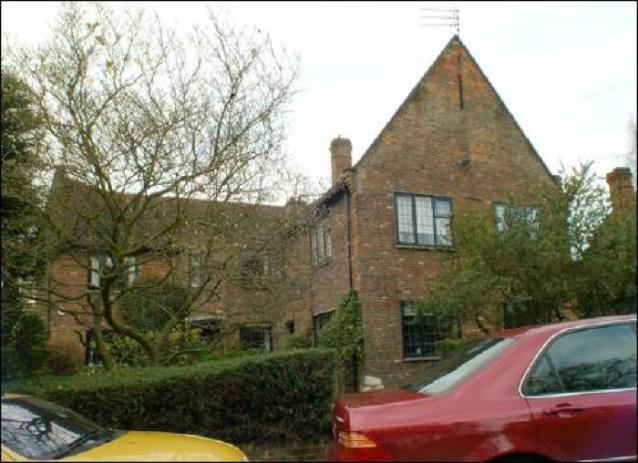
Exclusive: Northiam, the picture postcard Sussex village that hides a fractious community of hate and harassment

Northiam village

By David Hencke and Joseph Eden

An alleged horse murder, police protection at a parish meeting and council office and notice board defaced with hated filled graffiti

You could not imagine a more bucolic English scene. Beautiful rolling Sussex countryside, white painted country cottages, a heritage steam railway running by the village and Bodiam Castle, an imposing moated medieval ruin dominating the valley.

But this quintessential sleepy English village hides some of the most vicious in fighting by former and sitting parish councillors and their friends involving hate filled Facebook posts, false allegations, dodgy contracts, one sided council investigations, favours for friends, while Sussex police and the Rother District Council try to pretend nothing is happening here.

If this was inner city London or Birmingham such battles would be factional or party political. But here it is not politics but rival personalities who either want to control events or who are convinced dirty business is afoot in secret meetings.

A Midsomer Murders village?

If there is a script for this story it could either be an Agatha Christie novel or an episode of Midsomer Murders. So far only a grazing horse has died, but given the tensions here one wonders whatever will happen next.

So how has this happened? The trigger for all this is a remarkable pot of gold given to this little village by the former Tory Cabinet minister Michael Gove. As levelling up secretary he approved a massive £1.4 million loan in 2019 to enable the parish council to purchase a former Blue Cross animal rescue centre so the village could use its ample green acres for community use.

There had been much consternation in the village when the Blue Cross decided to close and sell the site as the original land had been donated by a local farmer and it was a valued part of the village as well as providing much employment.

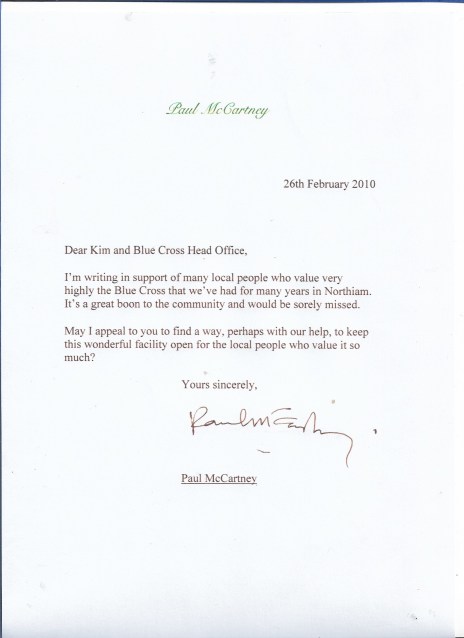
The parish council was united in wanting this centre. Before they bid to buy it former Beatle Sir Paul McCartney came to the village with the chief executive of the Blue X centre to see if it could be saved. He even offered to underwrite the cost but the organisation was determined to close it.

His earlier letter of support for the Blue X Centre before it closed is here:
The purchase of this 34 acre greenfield site has meant that all the residents face an extra parish council precept on top of their council tax to pay back a Public Loans Work Board loan backed by the Treasury for the next 50 years.

Horses looked after by Lauren Sapsted graze on the former Blue X site – known as St Francis Fields

The row emerged about what to do with the land once it was owned by the council. At the time when all was sweetness and light a proposal was drawn up by then councillor Penny Farmer with the aim of providing local facilities for local people with talk of a riding school, workshops and local people being allowed to graze their own horses and allowing a small number of new houses to rent to local people who couldn’t afford Sussex’s rocketing house prices. These would have been built on an ‘exception site’ basis and was limited to an initial build of six. 

Then councillor Penny Farmer, who has an equine background  was also asked to provide costings of how the stabling and grazing could be made to work so that government loan would be affordable while allowing public use and her costings were included in the proposal to the government, to help convince them to grant the loan. The proposal and map of the huge site is here https://docs.google.com/document/d/1PJLomhPMtDrIGl3yNsnQofsjlJDopvPcRQcYpiIW_24/edit?pli=1

The first sign of things going wrong was when it was decided to hand over the running of the site to a  non profit making Community Interest Company with a clause saying the directors could take profits from developments on the site and it was allowed to keep all the revenue from the site to spend as it saw fit.

The big issue with the CIC is that as a corporate body, it has cost the parish council more money than they have created or put back into the project. The Parish Council “grants” them £1500 a year, they use an office and storage space as well as land owned by the Parish Council rent free which the council could otherwise rent out and they have not achieved anything the Parish Council couldn’t have done itself despite not having “power of competence”. Last financial year – they got double the grant -two tranches of £1500. They also rent unknown land/buildings on the site to unknown people for £1460 a year – there is no record as to who or what this is all about at the Parish Council; it has never voted or agreed to this use. The latest accounts are here.
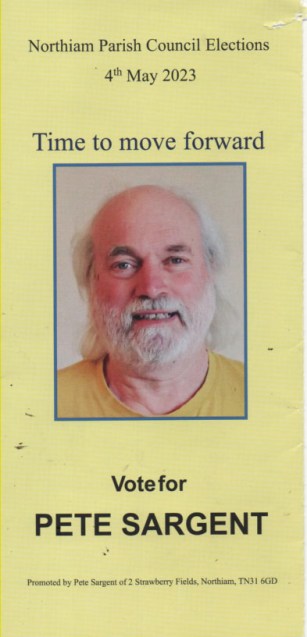
Pete Sargent

When it was set up it soon emerged that other councillors had different ideas and one in particular Pete Sargant, who chaired the council at the time and is still a member, was seen by opponents as the ” village Godfather figure”. He is a smooth talking man with a lot of friends in the village but rather like Macavity in the musical Cats it is his friends who do a lot of the arrangements. Macavity is not there.

Pete Sargent said: “Several of them stated that they would be interested in helping set up the CIC and so I called them all together and asked them if they would like to set up the company, which they duly did. They chose themselves.”

This is not entirely true. Judith O’ Connor, the chair was tipped for the post in advance while Carolyn Pierce, previously a councillor, who had worked on the Blue X rescue centre for 20 years, was denied a post when she requested one. It is said by Jon Streatfeild. a former chairman of the council ,that Sargent kept the book with the directorships to himself for six months until all the posts were filled, mainly to members and friends of his in the local Bonfire Society and the Village Hall Trust.

Later when one councillor, Ben Dallimore, in 2022 demanded to see the minutes kept at the parish council office, the then clerk to the council, Nicola Ideson, threatened to call the police, started messing up files and tried to make out she was being physically threatened and harassed and pushed him out of the office. He had the foresight to have recorded the conversation and when she complained he made it clear he had recorded it. In February 2023, she contacted the Information Commissioner’s Office to say that as a Parish Councillor, he had recorded her at work and she wanted a copy of the data. After some arguing back and forth with the ICO about the nature and purpose of the recording, he gave her an edited copy of the recording which only contained her information..

It soon emerged there was a reason for this secrecy. For instead of planning new community facilities the first thing that happened was an approach to a housing developer suggested by retired architect, Julian Luckett, partner of Judith O’Connor, who chairs the CIC and an administrator of the Northiam Facebook page.

Jennifer Owen Construction Ltd, a local firm, had already built expensive £500,000 four bedroomed detached homes in the village, and was contacted by Pete Sargent’. He said: “I contacted Mr Malcolm Edmonds, the MD of Jennifer Owen Construction Ltd to discuss possible options on part of a field to which they owned the access. This plot was less than one acre in size, so 3% of the total site rather than 33% as suggested. Initial contact was by email due to lockdown and so a site meeting was impossible. A year later when I was no longer a Councillor he made contact again. I forwarded their email to the new Chair of the Council and the Chair of the CIC, both of whom decided that they did not want to follow it up at that time.”

This turns out not be quite true. A memo from Georgina Jackson, a later parish clerk, reveals there was a secret meeting with the firm to develop one field where there was access and it was not to build cheaper rented homes for ordinary local people but expensive new homes.

Sargent had also written an internal report where other areas of the site could be considered as ‘brown field’ and therefore considered for development. This was in spite that he had given assurances, including in TV interviews and in emails to the government, that the proposed purchase of the site was to save it from development, as well as providing a community asset.

The development foundered because the firm discovered the homes would have to be marketed as leasehold because the parish owned the land and it would not get the best price. The firm was also worried it would have to go out to competitive tender and it could lose the contract. The company was not interested in developing the whole site, despite rumours to the contrary.

A fake Northiam Parish flyer was put out to worried residents about this when news leaked out.
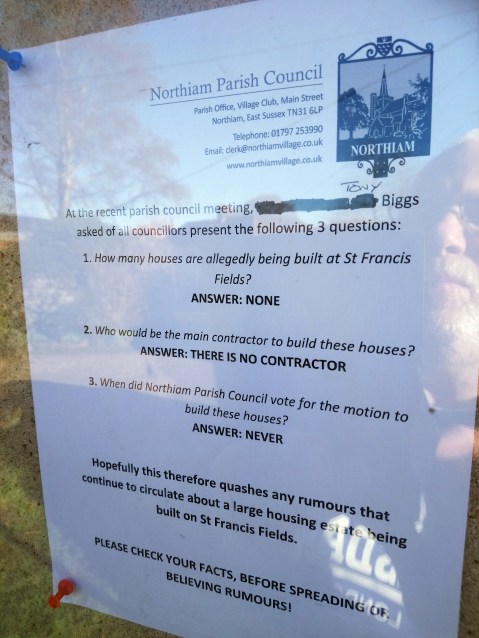
The clerk took legal advice about this and was advised this would have been illegal if they had gone ahead and the parish council could have been prosecuted for breaking the terms of Gove’s loan.

But there was a much bigger row on the horizon that was to lead to nasty consequences for anyone who objected. During the pandemic a decision was made to lease 10 acres of the site to a horse trader, Lauren Sapsted, who would keep horses for wealthy owners, on the site, while at the same time blocking a local resident who wanted to graze her two horses on community owned land.Several other local horse owners were also turned away.  The exclusivity clause in Sapsted’s lease meant that local residents were barred from using much of the site and none of the equine facilities including the sand schools, even though they were funding it through the council tax.

The deal only open to her was she would pay the parish £12,000 a year to lease the land and the parish council even agreed to pay half her £3000 legal costs and she would pay a small sum every month to repay the loan. It was renewable. The loan was not disclosed to the full council. It turned out that the deal could have been illegal because it broke procurement rules and a planning restriction by Rother District Council that forbade commercial activity on the land. Pete Sargent defends it as done during the pandemic and claims that 50:50 arrangement on legal fees is ” common practice”.

Events took an extraordinary turn when the lease came up for renewal . After her horse died Lauren Sapsted demanded the parish paid for security cameras to be put up on the land which costing £14,000 – more than the annual rent. The parish council demurred in drawing up such a contract but unknown to them Sue Schlesinger, chair of the parish council at that time and sister in law of the famous Hollywood director, John Schlesinger who made Midnight Cowboy, secretly made a separate contract granting this without telling the council after Lauren asked her to do it.

The security cameras never came and the shenanigans over the two contracts were too much for Lauren and she left 18 months later leaving the parish with no income and moved her business elsewhere. Sue Schlesinger resigned but has lately been re-elected to the council.
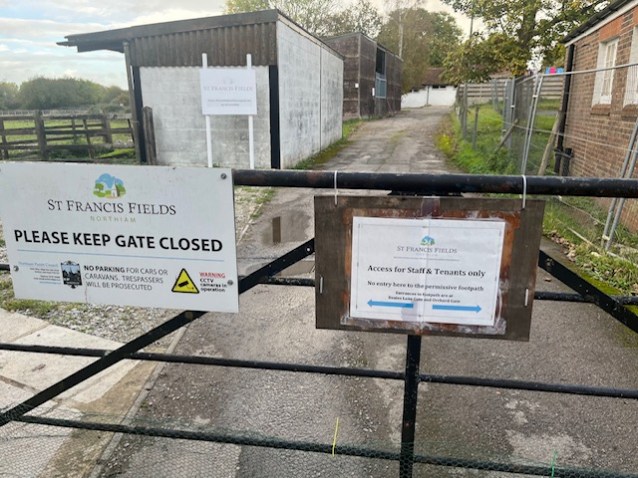
Entrance to Lauren’s Sapsted’s leased business

Lauren still claims her horse was murdered today and the two former councillors are to blame.

There was also a nasty consequence to all of this. When Lauren discovered Alice, a valuable pregnant horse, had been found dead, she was convinced it had been murdered in the night and blamed two councillors, Penny Farmer and Jon Streatfeild , a former chair of the council, for killing it because she had been erroneously told that they wanted to take over her business. Councillor Robert Maltby, a friend of Sargent, gave Lauren the report which he obtained from Sargent of Penny’s 2019 submission, which had originally been requested by Sargent, saying it was her current plan in 2022.

The murder allegation was not just village gossip it was put up on the Northiam and Nearby Facebook page by Lauren on the 16th May 2022.The site administrator, none other that CIC Director Judith O’Connor allowed this post to remain.

You can also see the shock of local people who now believed they were scumbags. Lauren called Sussex police asking them to open a murder investigation. They found no evidence. To do this the councillors -one of them a middle aged lady – would have got up in the dark middle of the night and tramped across fields. Two people questioned this. One, Ben Dallimore, a former councillor, was up in the middle of that night because he and his wife had a new baby. Their house is close to the field and they heard nothing. Another resident was surprised because if strangers were nearby, their dogs immediately start barking. They heard nothing either.

Jon Streatfeild – former chairman of Northiam Parish Council

Then the real harassment began. The parish managed to get sympathetic support from two top officials at Rother District Council to investigate then councillors Penny Farmer and Jon Streatfeild. Lorna Ford, chief executive, and Lisa Cooper, a monitoring officer, got a lawyer from Chichester District Council to prepare a report saying Streatfeild was guilty of leaking the confidential contract with Sapsted which revealed the arrangements for the lease and it was not in the public interest. They paid the lawyer £12,000 for the report but there are no records of their agreement or how much time was spent on the report which sounds highly irregular for a local authority. The finding contradicted later legal advice obtained by Jon Streatfeild that said the deal with Sapstead broke the law – so it was in the public interest for this to be released.

Separately when the police inquired about concerns brought by Jon Streatfeild about what was going on at Northiam, Lorna Ford sent emails to the police that everything was fine there.

Another report was commissioned by the parish council – at a cost of another £12,000 from an independent firm – which was skewed not to include any investigation into the relationship between the parish council and community interest company – which was central to the development and subject of concerns. This was prepared just before a public meeting in Northiam where Streatfeild and Farmer were treated as pariahs, including being spat at by people who believed they were horse murderers.

So bad was this meeting that at a future hustings meeting in the village last year Sussex Police arranged security to protect them – Penny Farmer , a former police officer, was so worried she did not attend.

Last year Streatfeild was defeated in the parish elections as most people believed the allegations. But he also had to put up with further stress. His front garden was sprayed with weedkiller, a parish noticeboard was covered in graffiti denouncing him, and two stalkers appeared to harass him at his place of work.

One, Michael Court was served with an adult ASBO by the police to keep good conduct for the next two years. Another Richard Smith, an ex policeman, came into the pub where he worked part time and denounced him in front of all the pub customers – obviously hoping he would get the sack. But this has not happened.

All these details of the harassment has been put to the police and the Rother District Council. The official statement from Sussex Police is completely defensive.

Rosie Ross, divisional commander at East Sussex police replied: “As a journalist you will know the rules around personal data and sharing of such data. This request is in the context of named individuals and actions we may have taken to either safeguard or sanctions used,  as and such cannot be shared. Even if it were a Freedom of Information request, it would be exempt under s40 FOIA for these same reasons.”

We actually didn’t need to put in a request as we have seen the terms of the order against Michael Court and there were plenty of witnesses to the incidents.

Rother District Council was equally defensive.

A Rother District Council spokesperson said: “The district council has a duty to put in place arrangements to manage complaints against elected members for the town and parishes. We deal with all code of conduct complaints diligently and fairly in relation to all complainants, and we believe we have done so in this case.

“It would not be appropriate to comment in detail on individual code of conduct complaints as they are confidential.

“However, we have repeatedly advised Mr Streatfeild and others of the limited powers that Rother District Council has to become involved in matters relating to other councils, especially with regards to matters such as the Blue Cross Site. We have advised Mr Streatfeild how best to pursue those complaints via organisations which do have the power to intervene, including the police.”

Rother District Council have not investigated any complaints brought against Peter Sargent, even though he helped instigate the proposed development of the land after publicly stating that the loan was for a community asset, lent parish council money without the knowledge of other councillors to help cover Sapsted’s legal bills which is unlawful and brought a complaint for criminal damage on the site, on the very day that we visited it to research this article and witnessed no such criminal damage.

Again we have seen all the details involving the Rother District Council officers involved and have published this in the public interest.

One bizarre reaction from Sussex Police was to suggest the complaints went to the National Audit Office, the Parliamentary watchdog that scrutinises Whitehall. Since the abolition of the Audit Commission by the Tories, which did scrutinise parish councils as well as larger bodies, there is no body that has the power to regulate local government.

As a result the NAO said it could not conduct inquiries into parish councils like the now defunct Audit Commission. But Adeel Shah, the NAO’s FOI and Correspondence Officer gave Jon Streatfeild very useful advice. He said the answer was to go to the external auditor of the council and helpfully looked up who was responsible.

Now the external auditor, PKF Littlejohn LLP, based in London, is looking at Northiam Council following two separate complaints. One is from Penny Farmer, which is challenging the whole way the council is managing its budget and whether certain earmarked funds, such as for a sewer outlet, are being raided, and whether the parish could run out of money.

Ben Dallimore on holiday

Another is from Ben Dallimore, another former councillor, about how money has been promised to Wealden Traditional Construction Ltd for the design plans of the new Football Pavilion to be claimed back from S106 ( money given by builders Persimmon )held by Rother DC. The contract to build the new pavilion will be worth £300,000.

Now the main employee of this company is local villager John Cusden, who plays for Northiam Football Club. His application was supported by retired architect, Julian Luckett and Pete Sargent. Companies House records show that his own company, Wealden Design and Build Limited has just gone bust and is in the hands of a liquidator. The new company is registered at the same address in Rye that the old company recently moved to. It has one new director, Charles Dawson, but its website praises the work of John Cusden over the last 10 years when he was director of the bust company.

A letter from the external auditor has now raised 11 procedural issues that led to the granting of the money which the council must answer. It also discloses that the external auditors may have received more than two complaints.

Mr Dallimore is now facing the same treatment as meted out to Jon Streatfeild. He has been recording council meetings and did some filming after one was held in private. The council are now discussing with Rother District Council whether they can impose restrictions on his activities by imposing the equivalent of an adult ASBO.

Mr Sargent did not want to comment on these complaints. His case is that he is the victim of harassment not the other councillors. The only evidence we could find about this is that someone scratched on the council office that it was ” The Bank of Pete Sargent” – of which there is no evidence that he has ever taken money for himself.

We have done this long special report to illustrate what has happened to local government at parish pump level now there is no official scrutiny by national bodies and local media has disappeared in this part of East Sussex. The irony is the lack of scrutiny has led to people putting too much on the internet so there are a wealth of documents to stand up exactly what has been going on in Northiam.

Michael Gove has left the new Labour government plans to revive a smaller version of the Audit Commission to regulate local government again. The new government need to act not only to police the growing number of technical bankruptcies in big local councils but to ensure that smaller bodies don’t end up being run by cliques helping each other out. The police and bigger authorities are obviously not up to the job and the NAO has much bigger fish to fry in policing waste and dodgy deals in Whitehall.

One-Time
Monthly
Yearly

Make a one-time donation

Make a monthly donation

Make a yearly donation

Choose an amount

£5.00
£10.00
£20.00
£5.00
£15.00
£100.00
£5.00
£15.00
£100.00

Or enter a custom amount

£

Your contribution is appreciated.

Your contribution is appreciated.

Your contribution is appreciated.

DonateDonate monthlyDonate yearly

Please donate to Westminster Confidential

£10.00

National Audit Office investigation: The hidden scandal of rip off landlords cheating the vulnerable and the state

National Audit Office foyer Pic Credit: David Pearson

An investigation by Parliament’s financial watchdog, the National Audit Office, this week has cast light on a hidden scandal of how private and social landlords are making huge profits from providing costly sub standard housing to the elderly, disabled, homeless, recovering drug addicts and domestic abuse survivors.

Officially called Supported Housing this covers providers of homes from short term hostels to specialised homes for the disabled who need a high level of care and sheltered housing for the elderly.

Extraordinarily the provision is not regulated and often not directly supervised by local authorities and the government does not know how many supported homes there are in Britain- the latest figure of 651,000 is eight years out of date. Spending on provision was £3.5 billion in 2016.

The NAO decided to investigate provision in 10 councils and uncovered some startling facts. The councils are

  • Birmingham City Council
  • Lambeth Council
  • Bristol City Council
  • Blackpool Council
  • Hull City Council
  • West Devon Borough Council
  • Bradford Council
  • Nottingham City Council
  • Sunderland City Council
  • Charnwood Borough Council (in Leicestershire)

In Hull for example some conditions were so bad that 323 out of 345 homes inspected needed immediate attention to protect their residents on health and safety grounds. And 62 per cent of homes in the city failed to meet the decent homes standard.

They also discovered the landlords were using the housing benefit system by putting in large claims for rent – which mostly went unchallenged by councils because the landlords would take them to court if they queried the sum.

Levelling Up department does know how many supported homes exist in the UK

The Department for Work and Pensions which often pursues individuals over benefit fraud actually has no record of how many claims there are for supported housing. But when Birmingham Council launched a team to investigate they recovered £3.5 million from fraudulent claims in just one city.

The report says : “Authorities like Birmingham, have seen increasing numbers of landlords who circumvent the regulations enabling them to profit by providing costly sub-standard housing with little or no support, supervision or care.”

“West Devon reported to MPs on the Commons Committee for Levelling up, Housing & Communities ( who also investigated this) that a number of new schemes have entered the market over recent years, claiming to provide exempt accommodation. These schemes involve an investment fund owning the property and a small housing association, registered with the Regulator of Social Housing, acting as the landlord. The local authority considers that these types of schemes are mainly designed to maximise the amount of Housing Benefit that can be claimed.”

Recovering drug addicted were housed with drug dealers

The report added: ” the Committee reported hearing “of people with a history of substance misuse being housed with drug dealers, and of survivors of domestic abuse being housed with perpetrators of such abuse.”

.So what is being done about this? The NAO report that the government has finally commissioned research to find out what exactly is going on..

The report says: “The research intends to focus on the size and composition of the sector, costs, current and
future supply and demand, the interaction between commissioners and housing providers, and how to improve monitoring.”

It is also aware that the supervision of the sector is split between three ministries – levelling up, work and pensions and health and social care so it has set up a supervisory board. And it has pump primed some £5.4 million to five local authorities, Birmingham, Blackburn with Darwen, Bristol, Hull and Blackpool to test monitoring of supported housing.

Blackburn and Darwen told the NAO that without this money they would never have inspected the homes in their area because they hadn’t the resources. And it has asked 26 authorities to bid for extra cash over the next three years.

Bob Blackman MP

The biggest change may come from a private members bill by Bob Blackman, the Tory MP for Harrow East, now being scrutinised in the Lords, which lays out a proper framework for the sector. This still has shortcomings as it does not deal with housing benefit fraud which must be quite high in this sector.

All this is better late than never . But it says something that the government until now has not bothered about protecting vulnerable and elderly people from the landlord sharks who prey on them. It paints a pretty poor picture of modern administration in the UK which must lag behind other Western countries in looking after its vulnerable people.

As Meg Hillier MP, Chair of the Committee of Public Accounts says
“Vulnerable people deserve to live in housing that meets their needs.
But gaps in regulation mean a concerning number live in sub-standard accommodation, at great expense to the taxpayer.
Government must now capitalise on the work of its Supported Housing Programme Board and provide local authorities with the support they need, starting with meaningful data on the scale of the problem.

Please donate to Westminster Confidential to allow me to continue my investigations and reporting on serious social problems and backing whistleblowers

Please donate to Westminster Confidential

£10.00

One-Time
Monthly
Yearly

Make a one-time donation

Make a monthly donation

Make a yearly donation

Choose an amount

£3.00
£10.00
£20.00
£3.00
£9.00
£60.00
£3.00
£9.00
£60.00

Or enter a custom amount

£

Your contribution is appreciated.

Your contribution is appreciated.

Your contribution is appreciated.

DonateDonate monthlyDonate yearly

DWP dumps on benefit watchdog and ignores plea for more help for victims of domestic violence

The Department of Work and Pensions has rejected any changes to its new minimalist regulations to exempt victims of domestic violence -mainly women – from paying the ” bedroom tax ” and helping them to find out how they could qualify to keep more of their benefits.

Ministry turns down plea from social security watchdog

As I reported ten days ago the release of minutes from the little known Social Security Advisory Committee revealed in July the body chaired by Stephen Brien who worked for Ian Duncan Smith’s think tank had written to the ministry criticising the proposed regulations for being too narrow and the ministry for not running a prominent campaign to let victims know they will now be exempt.

The exemption applies to anybody who wants to stay in their own home and has thrown out an abusive partner and enrols in a sanctuary scheme – which provides extra locks, a fireproof letterbox and in extreme cases a reinforced door to a ” panic room” should the abusive partner return and break into the house.

The problem is that not all women know about this and the exemption only applies to council homes and flats. Also abuse from stalkers or strangers is not covered by the new regulations.

Mr Brien wrote: “Given the vulnerable situations of those affected, there is a compelling case for the Department to examine what options exist in terms of proactively identifying those potentially affected. This should be supplemented by a strong communications strategy that sets out clearly the criteria for this exemption, along with guidance on how to access it.”
“There is a risk that a number of claimants entitled to take advantage of this scheme, particularly those who have already benefitted from a sanctuary scheme security adaptation prior to these regulations coming into force, will be unaware of this change.”

Ministry rejects plea to change the regulation

But the DWP has told me not only will there be no changes but they had already implemented the regulations which came into force on October 1.

A DWP spokesperson said:

“The Department offers support to victims of domestic abuse, whether in the private rented sector or not. The benefit system acts as a safety net for people who find themselves in need of financial support with living and housing costs for a variety of reasons. A range of Universal Credit measures are designed to support victims of domestic abuse, including special provisions for temporary accommodation, same day advances, easements from work-related requirements and signposting to expert third-party services.”

Now for these regulations to become law they have to be scrutinised by Parliament. So I looked up what had happened.

It turns out the ministry laid the regulations before the House of Commons and the House of Lords on September 9 – a Thursday evening just before MPs and peers went off for the weekend. They were laid under what is known as a negative statutory instrument – which means that unless a peer or a MP objects they automatically can become law three weeks later.

Not one MP or peer spoke up about this

The regulations were laid alongside numerous other regulations including changes to Covid 19 pandemic regulations. Not one MP or peer objected or even spoke about it.

They would not have known about the criticism from the watchdog body because its minutes had not been published then. Nevertheless this shows up the ineffectiveness of MPs and peers – who have more time – in scrutinising what the executive is doing.

Given the high profile issue of violence against women after the kidnap and murder of Sarah Everard by a serving Met Police officer it is pretty deplorable that a ministry can get away with this.

Benefits watchdog keeps mum

I sent the ministry’s response to the watchdog body – which regards scrutinising regulations as its main priority – and it decided not to comment, preferring to keep silent about its advice being ignored .I haven’t had a reply from the House of Lords on why the new regulations were missed.

However I have discovered the ministry has issued new advice six days ago to its housing benefit officers. It is here and victims of domestic abuse should challenge officials about getting an exemption.

For those in England I would suggest contacting Shelter. The charity has a comprehensive guide for victims of domestic abuse here. It includes a list of other charities who can help.

So if the ministry, the social security watchdog and Parliament are so ineffectual, at least this blog can highlight some information so more people know about it.

Previous Blog

https://davidhencke.com/2021/10/03/exclusive-half-baked-and-half-hearted-dwps-help-for-women-facing-domestic-abuse-and-violence/

Please consider a donation to allow me to expand and develop this blog to hold more people and government to account

One-Time
Monthly
Yearly

Make a one-time donation

Make a monthly donation

Make a yearly donation

Choose an amount

£3.00
£5.00
£10.00
£3.00
£9.00
£60.00
£3.00
£9.00
£60.00

Or enter a custom amount

£

Your contribution is appreciated.

Your contribution is appreciated.

Your contribution is appreciated.

DonateDonate monthlyDonate yearly

Donate to Westminster Confidential

£10.00

Bad news for fighting Climate Change: How Whitehall bungled first Green home insulation scheme

Sarah Munby, permanent secretary, BEIS, clearly not to up to the job over this

In a few weeks time Britain will be playing a pivotal role by hosting the Cop 26 international climate change conference in Glasgow.

Tight targets are going to be set which if not met will mean even more dramatic weather catastrophes than we are seeing now as the planet warms up.

So is Whitehall up to the job? If one takes the first example of action to save energy the answer is a resounding no.

A damning National Audit Office reveals an extraordinary poor performance by BEIS – the business and energy ministry – in getting 600,000 homes – mainly owned by low income families updated with new home insulation to cut their fuel bills and save energy.

The Treasury had earmarked £1.5 billion. The ministry ended up spending only £314 million. Its 600,000 homes target was missed by over 550,000. The administration costs were astronomical – for a scheme that provided grants of up to £5000 or £10,000 for low income income families – it cost over £1000 per house. Instead of of 600,000 saving up to £600 a year in fuel bills – only 47,500 will benefit.

And it should have provided a much needed job boost providing work for 82,500 people during a time when work was in short supply Instead it created just 5,600 jobs before the scheme was closed down last March.

Worse still both customers and contractors were badly treated. Delays paying contractors and customers getting their vouchers led to over 3000 complaints.

Why Sarah Munby is to blame for this fiasco

Who is to blame for such a mess? The answer must lie with the permanent secretary, Sarah Mundy. She is supposed to be this new business friendly appointment bought into government by the Tories to shake up Whitehall. Her biog on the gov.uk website said: “Sarah joined BEIS in July 2019 as Director General, Business Sectors. Before that, Sarah worked at Mckinsey, where she led their Strategy and Corporate Finance practice in the UK and Ireland.

“She has worked with some of the UK’s largest companies to change their strategic direction, and led much of McKinsey’s work on productivity across the UK economy.”

But she in no way lived up to her billing. To be fair HM Treasury gave the Department an over-ambitious 12-week timescale to design the scheme, consult with stakeholders and procure an administrator.

This came at a time when the Department was supporting vaccine procurement, and undertaking activities related to EU Exit. The Department accepted that delivering the scheme within this timescale posed a high risk, but judged it was justified by the need to support businesses in the wake of the COVID-19 pandemic.

A US global company’s cheapskate bid

But it is at the back of the NAO report that her real failings show up. She was obviously entranced by business to use a new state of the art digital voucher system and gave the contract to ICF, a US global consulting and technology company, based in Fairfax, Virginia. The report reveals they put in a cheapskate bid. Their technology was not up to the job as shown by repeated reviews of failures in the digital voucher scheme. This led to the scheme having to managed manually- which is why it cost £1000 per house.

The NAO said: “ICF’s proposed costs for the development of the digital solution were less than half that of the second cheapest bidder, triggering the need for a review under government contracting guidance. The Cabinet Office review concluded there was not enough information within the bids to understand specific costs, and thus whether any adjustment should be made for a low bid.”

But it came back to Sarah Munby. She ignored the Cabinet Office. Having chosen the contractor she was then warned by every single contractor asked to undertake the work that it couldn’t be done in time. But she still went ahead.

Whitehall sceptics ignored

And the same came from inside Whitehall. The Department presented the Scheme’s full business case to its Project and Investment Committee on the 28 September, ahead of the Scheme’s final approval for launch on 30 September last year. The Committee decided not to approve the full business case, raising concerns that the digital systems for the Scheme were not yet fully developed and tested. They were right but still she ignored them and went ahead. Within six months it had to be abandoned and it is largely her fault. As a result hundreds of thousands low income families have lost the chance of cutting their energy bills this winter.

One can only agree with the verdict of Meg Hillier, chair of the Commons Public Accounts Committee.

“The Green Homes Grant scheme was set up to fail, with an undeliverable timetable and overly complex design which took little account of supplier and homeowners’ needs….

Government cannot hope to achieve its net zero ambitions if it doesn’t learn the lessons from this botched scheme.”

Book review: Home Truths and the disaster facing the Tory Party if it can’t help Generation Rent

Liam Halligan Pic credit: Twitter

This is a humdinger of a book. Its author Liam Halligan – a cerebral Brexiteer rather than a flag waving, Rule Britannia supporter – exposes and then tries to solve – the biggest crisis facing the younger generation. They either can’t afford to buy their own home or haven’t a hope in hell if they are poor in getting social housing.

The huge hype in house and land prices – which is still going on despite the pandemic – is exposed in this book as part of deliberate policy by landowners and an oligopoly of huge house builders – to maximise profits, provide sub standard new homes and prevent any changes in planning laws which would release land for housing.

The government is committed to ” build, build, build” hundreds of thousands of new homes for the young generation who increasingly are having wait until they are 40, if they are lucky, to own their own home. Like many political promises this is unlikely to materialise under present government policies and he explains in graphic detail why this will not work.

Instead by subsidising buyers under the Help to Buy scheme they are fueling house price rises and only helping the better off – who also get help from the Bank of Mum and Dad – to acquire a home.

Home Truths book

This well researched book shows that Attlee’s government had the idea of how to both build a lot of council housing and incentivise builders to expand home ownership. But both aims have been destroyed by successive governments -including the error under Tony Blair and Gordon Brown – not to build any council houses.

The current Tory promise is undermined by the fact – exposed in the book – that the party is hamstrung by its donors – many of whom are committed to making more money by keeping house prices high and building land rationed. The big builders have also gobbled up many of the small builders – the very people who have incentives to build homes fast – to strengthen their monopoly.

The result was in 2017 that Jeremy Corbyn garnered votes from the young frustrated at having to eke out of their lives in either overpriced rent sharing properties or stay at home with mum and dad while they were in their 30s. Now without Jeremy Corbyn around to scare the Tories, the government might think they can still get away with it.

Ian Mulheirn Pic credit: Institute for Global Change

Labour need to step up to this problem. They are not financed by landowners. One thing they shouldn’t do is take any notice of the Tony Blair Institute. The former PM’s chief policy maker actually believes there is no housing shortage. Ian Mulheirn is using Blair’s platform to peddle the idea and argue that we should not build hundreds of thousands of new homes. Presumably he is happy for the young to pay ever increasing rents or stay with their parents., The big builders and private landlords must love him.

What is good about this book is that the author also proposes solutions which are pretty radical and involve a major reform of planning legislation ,changes to the value of land and penalties for builders who just hang on to sites. And a major social housing programme as well. Well worth a read. If the Tories don’t act they risk alienating a whole generation.

Electoral rolls falling and Millennials head for Spain

I have added a couple of my own blogs that illustrate the results that the author hasn’t mentioned. One shows the declining electorate in central London because so many properties are going to overseas buyers and are used as AirBnB’s. The others show that if we are not careful this permanently rising market could be used for property developers to take over the care home market. The third is a very recent article in the i paper showing that the millennials are voting with their feet and helping fuel a Spanish property boom. Talented tech savvy young Brits are finding you can rent a whole villa in Marbella for the price of a crummy flat share in London and they are basing themselves there. The country is starting to lose vital young talent.

https://bylinetimes.com/2019/12/05/zombie-neighbourhoods-londons-disappearing-voters/

https://davidhencke.com/2021/03/15/how-the-genteel-retiree-world-of-centenarians-was-shattered-by-the-ruthless-modern-model-of-social-care-capitalism/

https://inews.co.uk/news/uk/costa-del-covid-millennials-swap-uk-drizzle-work-remotely-spain-gain-post-brexit-rights-1003386

Labour: Revival or Nemesis?

Sir Keir Starmer: Labour leader Pic credit: BBC

Labour needs popular policies that attract people from Carlisle to Camden

It would rather cruel to say Sir Keir Starmer named after Labour founder Keir Hardie should be the leader that led to its nemesis. But the weekend’s election results in the North East and the Midlands show it is Boris Johnson’s Conservatives that are the new champions of working class voters there not Labour.

That is not to belittle Labour’s achievements in Wales, Cambridgeshire, the West of England and the South Coast. In Worthing for example, Labour has gone from having no councillors there for 51 years, to a place where the Tories are reduced to a majority of just one.

But it is to say that Labour have lost the plot. They are fighting quite a different Tory Party than under Theresa May or David Cameron and they don’t seem to have got the message. This Tory Party is a high spending, interventionist party wrapped up in the trappings of Rule Britannia and law and order. It is prepared to spend loads of cash in targeted working class areas where it can garner votes and is happy for an image of Gunboats at Dawn with the French in Jersey over fishing rights knowing that a NATO ally is unlikely to open fire.

For Labour there is a choice it can either ape the flag waving ,law and order, overseas aid cutting agenda of the Tories or it could look for new ground to take on the changed Tory Party.

I have four ideas for the latter and they all affect millions of people whether they live in the North, Midlands or South of the country. If successfully implemented they could change hearts and minds.

Having a decent affordable home for Generation Rent

The first is finding a home to live. For younger people under the age of 40 this is rapidly becoming an unobtainable dream as house prices continue to surge way above wages. They are either stuck in expensive flat sharing or forced to continue living in their parent’s home. No chance to aspire to start a family there. And with little council house building social housing is not easily available for the poor.

For a real analysis of this problem read a book called Home Truths by Liam Halligan. It is a comprehensive analysis of what has gone wrong. Labour could do little better than plagiarise the ideas in this book as part of their manifesto.

The Tories – though promising to build more homes- are on the back foot on this one. Their second largest group of donors are property developers – whose rationale has to be to get the most profits for their shareholders and investors. This, as the book explains, means ensuring that house prices continue to rise and they will only rise if they drip feed rather than grossly expand house building. So here’s one policy that will appeal whether you are in Brighton or Barnsley- and it can be sloganised in simple terms as it is both aspirational and a basic need.

Time for Labour to embrace the new world of freelance working

The second is the new world of work. The old huge battalions of workers in the mines, shipyards and even steel no longer exist – the new world of work is often hi tech , freelance contracts or new businesses or low paid work in Amazon or Deliveroo. Yet neither the outdated national insurance system nor employment law helps them. Ed Miliband promised a small step in reforming national insurance under his leadership – to ensure at least the self employed millions got basic help. And this group were the worst off under the furlough scheme. Again the government is weak in this area and whether you have a start up in Maidenhead or Middlesbrough you will benefit.

Women’s rights

Then there is the equality issue -particularly for women. Johnson is not particularly popular among women. And women are half the electorate. There are still issues of inequality, low pay and a law and order issue over women’s safety – so a women’s bill of rights to end injustice and make them safer in the streets would be very popular.

Equal access to the green revolution

Finally there is the issue of green policies. Yes the government is committed to these – but will help be distributed fairly or will electric cars be the prerogative for the better off. There is an area where carefully pointing out the problems and promising to do something about it will be attractive.

These are just some ides.. But whatever happens Labour has to up its game and get out of this continual internal battle talking to themselves and talk to the voters instead. Otherwise it will lead to its traditional male working class voters permanently voting Conservative and its more left wing voters backing the Green Party. It could disappear down a hole in the middle if it doesn’t get its act together and decide what it stands for.

How the genteel retiree world of centenarians was shattered by the ruthless modern model of social care capitalism

Mary Fielding Home, Highgate Pic credit: Mary Feilding Guild

This spring a group of very elderly, sharp minded and bright people will be evicted from a care home where they hoped they would end their lives by a ruthless capitalist who epitomises the new privatised world of social care providers.

The home is unusual in many respects. It caters for bright academics and authors and is a living community of a university of the third age – the oldest is 104 and still going strong. It also occupies a site on the borders of Highgate and Hampstead in London with a book value of £3.8m -a tempting find for any developer.

The group have been placed in this position by the failure of the unique trust, the Mary Feilding Guild, a charity set up in 1962 but dating back to 1882, to make ends meet. The combination of Covid 19, the closure of one of its properties on the site, not being in a position to take new residents, and the need for major modernisation all contributed. The value of the charity’s investments fell from £1.8m to £824,142 in one year.

So the trustees decided to sell it as a ” going concern ” with the aim of finding someone who would keep the residents there and have the funds to improve and modernise the home. Enter Mr Mitesh Kumar Dhanak or Mr Mitesh Girharlal Dhanak as he now prefers to be called. He offered to buy it as a going concern.

Mitesh Dhanak Pic credit: Precious Homes

Within five days of owning it for as yet undisclosed sum he decided to evict everyone by the end of May, declare the staff redundant, demolish the entire home and put a planning application for a new home to Haringey Council.

Mr Dhanak, 63 next month, is not a trained social care or health specialist. He is an accountant with a degree from Sheffield University. He set up his first business Precious Homes in 1994.

His views on the sector were outlined at a Care Conversation webinar on 14 October last year: ” “In terms of the KPIs ( Key Performance Indicators )that funds would look at, it’s property backed, it’s resilient cashflow, it’s government backed – it ticks all the right boxes.” He added later: “Unfortunately, the British press loves the horror stories. It’s about lobbying the government and making sure that our voice is heard and our contribution is recognised. It’s incumbent on all of us to try to do that.”

Now Mr Dhanak has created a complex group of interlocking companies – holding according to Companies House – 27 appointments. All of them are virtually one man bands – himself and a secretary and nobody else – making it difficult to follow his story.

They embrace a small number of care homes for adult care plus the elderly with Alzheimer’s Disease and a property company with investments from Neasden in North London to Barnsley and St Albans. He also got into an enormous tussle with Revenue and Customs when he moved some homes tax free into his pension based in Guernsey- but after a bitter battle he proved the tax people had made an error in law and he won.

The services he provides are rated Good by the Care Quality Commission and he has ploughed money from bank loans into providing a good standard. He also is a trustee of the Cheltenham Playhouse.

The centre of his operations are Precious Homes at Magic House close to Palmers Green. Each each company follows a similar pattern. They are £100 off the shelf companies and within days of him either setting them up or taking over from another operator their assets are mortgaged to the banks – his favourite ones being Coutts and Clydesdale Bank.

His latest £100 company which took over the Mary Feilding Guild home ,Highgate Care is a good example. He has already mortgaged the site to one of his own companies Precious Homes. But this time he has decided to go to a tax haven to get a second mortgage from the Waymade Capital, a Jersey based company run by brothers Vijay and Bhikhu Patel.

The company also has interests in health care, pharmaceuticals, and property and the brothers, both Kenya Asians, originally made their money by setting up a chain of pharmacies which they sold on to Boots. Vijay was awarded an OBE in 2019 under very controversial circumstances. An investigation by the Times revealed he had rebranded generic drugs and overcharged the NHS. This was not picked up by the committee awarding him the honour.

It wrote “Atnahs, a company he co-founded, acquired the rights to old medicines and increased prices by up to 2,500 per cent, costing the NHS at least £80 million. A packet of antidepressants rose from £5.71 to £154 and an insomnia drug soared from £12.10 to £138.” The company now has a financial interest in the Highgate home.

No answers to questions on finance or the price he paid

Mr Dhanak declined to answer through his communications agency any questions about the financing of his ventures or the price he paid for the property.

He did provide an explanation for his change of mind. “The team held meetings within days of completion as there was no desire to mislead residents or staff once a decision was made. Within five days, nearly 40% of the residents have already found potential new homes and we are confident that this trend will continue with the support of the Highgate House team.”

“Since the sale was agreed, the new owner in consultation with professional advisors reviewed the existing model and considered a number of options, including operating the home in its current format and concluded that regrettably it would not be possible to continue to provide care in the same way.  The home has been financially unsustainable for a significant period of time and the Mary Feilding Guild trustees would be aware that a new owner would have to make significant changes.”

owner intends to demolish property, says trust

The trust have also issued a statement: “We now understand that the new owner intends to demolish the existing property and build a completely new home on the site. Four days after completing the sale the purchaser announced a three-month notice period to the staff and residents after which the home will remain empty.

“However, it will take at least seven months to produce a detailed design, obtain planning permission, and commence construction. During this time the home could have been kept open for existing residents, and staff, rather than force them to move, and making staff redundant. The elderly residents will now be forced to seek alternative accommodation during the COVID restrictions, therefore severely limiting their choice.

Please don’t evict them by the end of May

” We are appealing to the new owner to reconsider this wholly unnecessary decision to shut the home immediately. We believe that it is not unreasonable to delay the closure procedure, to one month, before a start on site is possible. This would allow residents and staff reasonable time to consider their options, and by this time the pandemic should have eased.”

The lessons from this saga are two fold. The trust’s lawyers appears to me to have been very naive in not demanding guarantees for their residents in writing. And Mr Dhanak’s business strategy depends of an ever rising property market and ever bigger sums of money being available to local authorities for social care. If there is a major hiccup in either or both of these – the banks are going to demand their money back pretty sharpish and lot of vulnerable people are going to be evicted.

In the meantime Mr Dhanak can retire to his beautiful home in Hampstead Garden Suburb purchased for £2.5 million with a Clydesdale Bank mortgage, according to the land registry,. Here’s a nice picture of it.

Exclusive on Byline Times: Disappearing London voters as foreign buyers and new build AirBnBs flood neighbourhoods

110-112 Vauxhall Bridge Road; One of the AirBnBs block of apartments springing up in Westminster Pic credit: booking.com
The Surprise: This was the old pub that is now a new rebuilt AirBnb The original planning application was for it to be replaced by residential housing.

I have done a special investigation for Byline Times showing the extraordinary contrast between the decline of the electorate in Westminster and Kensington and the huge property and tourist boom bringing in non voting oligarchs, foreign buyers and purpose built blocks of AirBnBs.

This may have contributed to Labour winning Battersea and Kensington from the Conservatives at the last election. This time it is not so clear as Labour and the Lib Dems are vying for votes.

See my full story here.

On Byline Times: The failed Tory manifesto pledge that dashed the hopes of 200,000 first time buyers

Promised starter home? Pic credit; Money Which?

As the manifesto season gears up – a very timely report today from the National Audit Office. It reveals David Cameron’s 2015 manifesto pledge to build 200,000 homes for first time buyers has resulted in not a single starter home being built. The full facts of this failed pledge are on Byline Times here.

Revealed: The £200,000 food bank warehouse in Amber Rudd’s Hastings constituency caused by the Universal Credit debacle

amber rudd

Amber Rudd- former home secretary and MP for Hastings as the Universal Credit debacle rolls out in her constituency

CROSS POSTED IN BYLINE.COM

The  billion pound plus failure of the implementation of Universal Credit is rightly condemned by the National Audit Office in a report published today.

Aimed to save money, get everybody back to work, simplify a complex benefit system and to be easily implemented.  Instead it is going to cost more, is years behind schedule, discriminates against disabled and poorly educated people, and the government has plans to force the elderly not entitled to a pension to have to use it when it  changes entitlement to pension credit ( see my earlier blog here)

But it is also having appalling consequences for food banks, landlords, council and housing association tenants – as the example in Amber Rudd’s constituency ( details down below show).

In the meantime ministers today were patting themselves on the back today how successful it is while senior civil servants behind  it were awarded  bonuses worth up to £20,000 each for its botched introduction ( see an earlier blog  here and  an article in the Sunday Mirror).

The statistics are appalling. According to the NAO :

“In 2017, around one quarter (113,000) of new claims were not paid in full on time. Late payments were delayed on average by four weeks, but from January to October 2017, 40% of those affected by late payments waited in total around 11 weeks or more, and 20% waited almost five months. Despite improvements in payment timeliness, in March 2018 21% of new claimants did not receive their full entitlement on time with 13% receiving no payment on time.

The Department does not anticipate payment timeliness to improve significantly in 2018. On this basis, the NAO estimates that between 270,000 and 338,000 new claimants will not be paid in full at the end of their first assessment period throughout 2018. Those with more complex cases are more likely to be paid late.

The Department expected most claimants would have enough money to cope over the initial waiting period after their claim is submitted (previously six weeks, now five). In reality, nearly 60% of new claimants (around 56,000 a month) receive a Universal Credit advance to help them manage before receiving their first payment.But they have to pay it back which means deducting an average £43 a month from their benefit. 

But while the statistics are bad, the examples are worse.

12363209_1719999128235421_6846245651388343898_o

Hastings Foodbank

Appendix 5 of the report  reveals In  Amber Rudd’s Hastings  constituency for example, according to the NAO Hastings foodbank has increased its opening hours, needs around two tonnes of stock each week to meet demand, and is considering building more storage space, costing £200,000.”

Hastings Citizens Advice pays staff to deliver Universal Support delivered locally. It therefore needs to pay providers regardless of the number of people
that are referred for support. But its income from the Department is not guaranteed so it can’t plan

Hastings Citizens Advice is considering scaling back on what it does in order to cope with increased demand.

Similarly NHS Hastings and Rother Clinical Commissioning Group funds its local advisory services. But this takes time to identify and secure. This hampers the ability of organisations to employ high-quality advocates because of the uncertainty of future funding.

.Hastings and Rother Credit Union no longer accepts Universal Credit claimant because of the complications in dealing with the new benefit and the long time waiting for people to be paid it.

Other areas have also got problems.Landlords are carrying extra debt – Croydon’s rent
collection rate has fallen from 92% to 58%, and its bad debt provision has doubled to £8 million.
Sedgemoor Council  in County Durham reported an increasing unwillingness, even with social landlords, to take on low-income tenants or those claiming Universal Credit.

So the government has piled on misery upon misery for the claimants,. voluntary organisations, food banks, landlords, credit unions, local authorities and health services. Meanwhile ministers on excess of £100,000 a year go home to expensive houses, enjoy fine wines, expensive meals out and luxury holidays while boasting how they are helping the poor. Some sick joke. As Amyas Morse, head of the National Audit Office, said today:

“The Department has pushed ahead with Universal Credit in the face of a number of problems, but has shown a lack of regard in failing to understand the hardship faced by some claimants.

“The benefits that it set out to achieve through Universal Credit, such as increased employment and lower administration costs, are unlikely to be achieved, yet the Department has little realistic alternative but to continue with the programme and hopefully learn from past mistakes.”