Charity Commission loses permission to take Parliamentary Ombudsman to judicial review over safeguarding cases

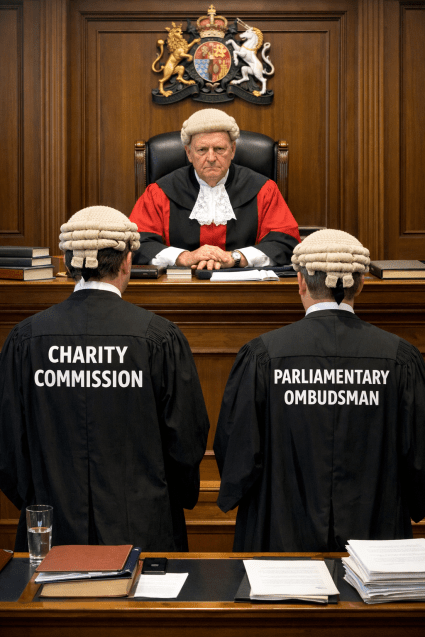
Picture generated by AI ChatGPT

A judge has blocked the Charity Commission from challenging the powers of the Parliamentary Commissioner through a judicial review.The decision is a victory for Parliament which said permission to grant the review would be academic, non justiciable and a breach of Parliamentary privilege.

However the small print of the ruling by Mr Justice Fordham clarifies the law over what is covered by Parliamentary privilege and what is not and how far charities can be expected to investigate cases when the police and the Crown Prosecution Service decide there is not enough evidence to prosecute.

Harrowing cases

The two cases where there was a dispute between the Parliamentary Ombudsman and the Commission were extremely harrowing. Both complainants waived their anonymity. One brought by Damian Murray, concerned the failure to investigate historic child sexual at a now closed school run by Roman Catholic Marist Brothers in Blackburn, Lancashire. A former pupil at the school he learned from another pupil’s memoirs that the principal, Father O’Neill was a paedophile. Not only was this covered up but he was venerated with a Requiem Mass at his death and had a school building named after him, when it was known he was a paedophile by the authorities.

The second case involves Ms Lara Hall, a volunteer and a victim of sex trafficking, who sought help from the Help for Persecuted Christians charity and ended up having an extra marital affair with the chairman of the trust, WiIson Chowdhury. She complained according to the judgement that it was ” an abusive and exploitative relationship”. He resigned but his wife has now been appointed the chair.

The issue was not that the Charity Commission did not accept the complaints but neither the complainants nor the Ombudsman felt it had not done enough to investigate them and assess risk and communicate what it had done. So the Parliamentary Ombudsman decided to issue a further report. This can be done “if injustice has been caused to the person aggrieved in consequence of maladministration and that the injustice has not been, or will not be, remedied, she] may, if [she] thinks fit, lay before each House of Parliament a special report upon the case.”

The judge is scathing about the Charity Commission’s failings in dealing with this. He says it was ” plainly wrong” for the Commission to claim that a risk assessment review should apply only to future cases and equally wrong to say the Parliamentary Ombudsman to have overreached herself by evaluating and examining the risk reviews rather than factually reporting them.

The judgement noted the Commission claimed a ” symptomatic of a more widespread systemic unlawfulness in the Ombudsman’s approach to cases about the Charity Commission actions.” He ruled “But, in my
judgment, it is plainly not open to the Commission to contest the findings of maladministration in these cases.”

Judge Sir Michael Foreman

The judgement backs the Charity Commission in saying the Parliamentary Ombudsman’s decision letter cannot expect the Commission to act as a criminal investigator , prosecutor or decision maker over these issues – when its main job is to investigate the mismanagement of charities. This made the Ombudsman’s letter flawed.

There was also a very interesting subtle clarification of Parliamentary privilege. While accepting Parliament’s argument that it was a breach of Parliamentary privilege to go for a judicial review – it said the special report by Parliamentary Ombudsman that followed her main report could be challenged in the courts and was not subject to Parliamentary privilege . The Charity Commission does not intend to do this.

The Parliamentary Ombudsman spokesman said:

“One of our roles is to hold public bodies to account, acting on behalf of Parliament. This is an important principle to uphold, and the Court’s decision supports that principle by refusing the Charity Commission’s request for permission to judicially review.

“Our reports were laid before Parliament after failing to reach agreement on compliance with the Charity Commission.

“At the heart of what might seem like a matter of process are two people, Miss Hall and Mr Murray, who have suffered significant injustice. Securing resolution for the complainants remains the priority, alongside making sure the lessons identified in our investigations are implemented.

 “While the Charity Commission has made some changes after our original reports, we hope the Commission will now focus on working constructively to fully comply with our reports and provide the assurance that the public are entitled to expect.”

A Charity Commission spokesman said:

“We reiterate our apologies to the two complainants in these sensitive cases. We have long accepted that there were important lessons for the Commission to learn from these, and we have previously apologised and paid compensation to each complainant.

“We brought this case in good faith to get clarity from the courts on the respective remits of the PHSO and Commission, to provide certainty to the sector we regulate. While we are disappointed with the decision not to permit a full hearing, the judgment provides a clearer basis on which both organisations can perform the distinct roles Parliament has given us.

“The court has reaffirmed the Commission’s role in regulating charity governance rather than acting as a safeguarding authority, and indicated that we cannot be expected to reinvestigate serious criminal allegations made against charity trustees.

“We recognise we need to draw further lessons from the court’s decision, particularly in terms of how we record and communicate our assessments of risk, and we will immediately review key aspects of the two cases in question.”

Complainant Damian Murray said: “My actual primary concerns about the deliberate concealment of sexual abuse at the former St Mary’s College Blackburn by the Marist Fathers charity have yet to be acknowledged let alone addressed by the CC since I first raised them in 2018. And whilst PHSO, Mr Justice Fordham and PACAC have also made no adjudication about my original concerns, and have not been asked to do so, I am very grateful for the care and seriousness with which they have within their remits taken account of the grave issues of governance and regulatory failure I have raised, and the sensitivity and professionalism with which they have dealt with me personally to date.”

The full judgement is here.https://drive.google.com/file/d/1vhcXwEWJm6uivRi-CvhoXYP8YJKyp3f7/view?usp=sharing

One-Time
Monthly
Yearly

Make a one-time donation

Make a monthly donation

Make a yearly donation

Choose an amount

£5.00
£10.00
£20.00
£5.00
£15.00
£100.00
£5.00
£15.00
£100.00

Or enter a custom amount

£

Your contribution is appreciated.

Your contribution is appreciated.

Your contribution is appreciated.

DonateDonate monthlyDonate yearly
cards
Powered by paypal

Judge reserves judgement in legal dispute between the Charity Commission and Parliamentary Ombudsman

n extraordinary one day court hearing yesterday is still to decide whether the Charity Commission can bring a judicial review against the Parliamentary Ombudsman for exceeding her powers in two cases involving safeguarding of children and adults involving two separate charities.

Both cases were dramatically accelerated last year when the Speaker, Sir Lindsay Hoyle, gave permission for Parliament to report the Charity Commission to the Committee of Privileges for trying to stop two reports by the Parliamentary Ombudsman being published until the courts decided what the legal position of the two bodies were in the handling of the cases. The Committee of Privileges is still considering the report on the matter more than six months after the referral.

Yesterday’s hearing allowed both sides to present arguments in what could be a landmark judgement on how far the Parliamentary Ombudsman can rule on action taken by charities to safeguard people and whether the Charity Commission is a regulatory body with no powers to compel charities to investigate cases which fall short of a police action.

The two cases were both dramatic and involved both historic child sexual abuse and a much more recent serious sexual assault. The first case became public when the complainant,Damian Murray contacted this blog and revealed a long standing cover up of historic child sexual abuse by a paedophile principal at a now closed religious school in Blackburn. You can read the story here.

The second case involved a complaint against another charity of a serious sexual assault on a vulnerable woman volunteer by the chair of the charity who entered into an inappropriate relationship with her.

Both complaints were upheld by the PHSO and compensation was paid. The dispute arises over whether the Charity Commission should have gone much further to remedy this and investigated both situations. This included whether the second charity should have been wound up and whether the religious foundation which ran the school should have been further investigated despite in both cases there were no police investigations.

The Charity Commission is saying the Parliamentary Ombudsman is exceeding her powers by demanding this. The Commission told the court that the body is a regulatory body and does not have the resources to do this and furthermore would put charities across the country in double jeopardy as they would be obliged to investigate cases where the police and the Crown Prosecution Service had decided that criminal proceedings had little chance of success.

In the argument before Judge Fordman the Commission said; “the PHSO’s decision in effect requires the Commission to carry out a quasi-criminal investigation in circumstances where the Commission does not consider it appropriate to do so, and where other relevant criminal and safeguarding agencies have investigated but not pursued a prosecution. This fundamentally misunderstands the nature of the Commission’s role, as well as its own legitimate policy as to how its resources should be deployed.”

The PHSO in its submission to the judge asked him to throw out the case. It argued that the judicial review was academic because the two reports had already been published and the Commission’s case was inarguable as it was irrational to say the case had been remedied and the ombudsman had wide discretion involving her findings. Finally it argued that the hearing interfered with the proceedings of Parliament.

A spokesperson from the Charity Commission said:
“We acknowledge that the two complaints which led to our legal disagreement with the Ombudsman arose from some very difficult personal experiences, as was heard in court. We have long accepted that there are important lessons for the Commission to learn from the two cases in question and we have previously apologised to both complainants.

“However, at the heart of this case are vital principles about citizens’ right to due process when accused of a criminal offence, and separately avoiding charities being subject to undue overlapping regulation.

“First, the Ombudsman has told the Commission that we should assess the credibility of serious criminal allegations made against charity trustees where those allegations have already been investigated and not taken further by the police and other appropriate authorities. This runs contrary to long standing legal principles designed to ensure fairness to all.

“Second, the Ombudsman has gone beyond its legal remit by effectively second guessing our regulatory decisions. If left unchallenged, charities would in effect be subject to two overlapping regulators, creating confusion and uncertainty for them and the public.

“We have worked hard, over a lengthy period of time, to resolve these matters with the Ombudsman directly, but this has regrettably not proven possible. While we have pursued this legal action reluctantly, we are glad of the opportunity to present our case and seek the clarity of the courts in resolving this issue for the benefit of both organisations, the charitable sector, and the public we serve.”

One-Time
Monthly
Yearly

Make a one-time donation

Make a monthly donation

Make a yearly donation

Choose an amount

£5.00
£10.00
£20.00
£5.00
£15.00
£100.00
£5.00
£15.00
£100.00

Or enter a custom amount

£

Your contribution is appreciated.

Your contribution is appreciated.

Your contribution is appreciated.

DonateDonate monthlyDonate yearly
cards
Powered by paypal

Privileges Committee hears all sides over Charity Commission breaching Parliamentary privilege on Ombudsman’s sex abuse reports

A rare but virtually unreported public hearing by the Privileges Committee on Budget Day revealed a sharp divide between the Parliamentary Ombudsman and the Charity Commission over the role of charities in safeguarding children and adults who have been sexually abused.

The hearing was sparked off by Parliament unanimously reporting the Charity Commission to the Privileges Committee after Stephen Hoare, the chair of the Public Administration and Constitutional Affairs Committee, decided the Commission had breached Parliamentary privilege by wanting to delay publication of the reports until after a judicial hearing being called by the Commission. I did a report here .

The reports which Parliament compelled the Ombudsman to publish with final conclusions covering complaints of a recent adult sex abuse case – Miss A – and a historic child sexual abuse at a school -Mr U.

Mr U later contacted my blog and waived his anonymity to give me a detailed account of what had happened at a Roman Catholic school in Blackburn when it was run by a paedophile priest. The blog about this is here.

Saira Salimi, the Speaker’s Counsel

The hearing began with a statement on the issue from Saira Salimi, the Speaker’s Counsel.

She told the hearing: “This is quite a difficult case, because it does raise difficult questions about
the relationship between parliamentary and legal accountability. There is a power conferring a discretion on a public authority to report in certain circumstances, and the report is made to Parliament. Although it looks at first glance like a function that might be reviewable by the courts, the interaction of parliamentary and legal accountability may mean that the decision is not justiciable.”

She said that if the issue of privilege had not been the raised the Parliamentary Ombudsman would have been inhibited from laying the reports before Parliament.

She added:” this is an unusual case where Parliament and the courts are on the same territory at the
same time. That is not unprecedented but is unusual, because of the self denying ordinance that the House normally maintains in relation to matters before the courts under the sub judice resolution. It is my hope that our intervention in this case will assist both the courts and Parliament in carrying out their respective roles, which are constitutionally distinct ands equally important.”

Karl Banister, Director of Operations, Legal and Clinical and Deputy Ombudsman at Parliamentary and Health Service Ombudsman (PHSO). gave evidence.

He told MPs: “the[ charity] commission should have an independent person review Mr U’s case to consider whether the reasoning was adequately accounted for; consider whether the outcome would have been different; look for learning on how it engages in such cases;[and] look at
its risk guidance;” Similar recommendations were made in Miss A’s case.

It is these recommendations that the Charity Commission is objecting to and says that the Ombudsman exceeded her powers and that such recommendations are unlawful.

He revealed considerable attempts were made at mediating the dispute.

“My assessment was that it was better not to provoke the commission to issue legal proceedings. It is obviously unattractive for two public bodies to be litigating. Were they to do so, they would likely get an injunction, and that would be an additional cost to the public purse.”

However in the end the Charity Commission decided to go ahead with a judicial review. it said:”“a declaration that the decision of 14 March 2025 is unlawful”—that is, our decision that it was
not compliant—“that the 14 March decision is quashed, that the defendant pay the claimant’s cost of the claim or any other order the court considers appropriate. That is what the judicial review sought.”

The Public Administration and Constitutional Affairs Committee were informed and the Parliamentary Ombudsman stuck to its point that the Charity Commission had not fully complied with decision. It was then taken out of their hands and Mr Hoare, the committee chair, decided to raise the privilege issue and compel the reports to be published so the committee could consider them.

David Holdswoth, chief executive of the Charity Commission

The Charity Commission brought a team of people to hearing headed by the chief executive David Holdsworth.

He told MPs:”The decision of the PHSO in its letter of 14 March—that we should reinvestigate criminal matters already investigated by the police, the CPS or the wider criminal justice system but deemed not able to proceed—has grave implications, in our view, for anyone involved in running a charity and, indeed, for wider citizens’ rights under the criminal justice process.
It is also our view that the ombudsman cannot retake regulatory decisions made by the commission to force a different conclusion, replacing our judgment with its own. It is for those reasons that we reluctantly sought to clarify matters through the courts.”

It soon became clear – and this was reinforced during the national Child Sex Abuse inquiry – that the commission regards the Commission as primarily an administrative and registration authority not an investigatory authority.

It was also clear MPs and the Speaker’s Counsel thought that the matter could have been cleared up at a meeting of the PACAC committee without going to the courts.

But Felix Rechtman, head of litigation at the commission said:”: We are not saying that the PHSO decision is just inappropriate. We go further: we say it is unlawful, and matters of law are
reserved to the courts under our constitutional arrangement.”

It is quite clear this issue is going to run and run. The courts have not given the Charity Commission a date for a judicial review hearing yet. The commission will first have to get permission to bring the judicial review and then have a hearing. The next stage will be the Privileges Committee report on whether the Commission has committed a contempt of the House.

One-Time
Monthly
Yearly

Make a one-time donation

Make a monthly donation

Make a yearly donation

Choose an amount

£5.00
£10.00
£20.00
£5.00
£15.00
£100.00
£5.00
£15.00
£100.00

Or enter a custom amount

£

Your contribution is appreciated.

Your contribution is appreciated.

Your contribution is appreciated.

DonateDonate monthlyDonate yearly
cards
Powered by paypal