National Audit Office investigation: The hidden scandal of rip off landlords cheating the vulnerable and the state

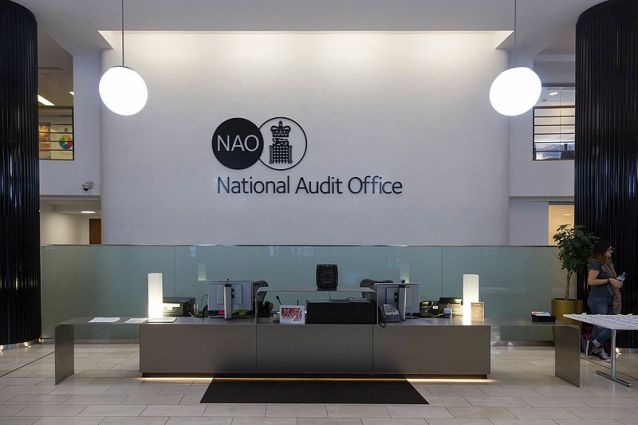
National Audit Office foyer Pic Credit: David Pearson

An investigation by Parliament’s financial watchdog, the National Audit Office, this week has cast light on a hidden scandal of how private and social landlords are making huge profits from providing costly sub standard housing to the elderly, disabled, homeless, recovering drug addicts and domestic abuse survivors.

Officially called Supported Housing this covers providers of homes from short term hostels to specialised homes for the disabled who need a high level of care and sheltered housing for the elderly.

Extraordinarily the provision is not regulated and often not directly supervised by local authorities and the government does not know how many supported homes there are in Britain- the latest figure of 651,000 is eight years out of date. Spending on provision was £3.5 billion in 2016.

The NAO decided to investigate provision in 10 councils and uncovered some startling facts. The councils are

  • Birmingham City Council
  • Lambeth Council
  • Bristol City Council
  • Blackpool Council
  • Hull City Council
  • West Devon Borough Council
  • Bradford Council
  • Nottingham City Council
  • Sunderland City Council
  • Charnwood Borough Council (in Leicestershire)

In Hull for example some conditions were so bad that 323 out of 345 homes inspected needed immediate attention to protect their residents on health and safety grounds. And 62 per cent of homes in the city failed to meet the decent homes standard.

They also discovered the landlords were using the housing benefit system by putting in large claims for rent – which mostly went unchallenged by councils because the landlords would take them to court if they queried the sum.

Levelling Up department does know how many supported homes exist in the UK

The Department for Work and Pensions which often pursues individuals over benefit fraud actually has no record of how many claims there are for supported housing. But when Birmingham Council launched a team to investigate they recovered £3.5 million from fraudulent claims in just one city.

The report says : “Authorities like Birmingham, have seen increasing numbers of landlords who circumvent the regulations enabling them to profit by providing costly sub-standard housing with little or no support, supervision or care.”

“West Devon reported to MPs on the Commons Committee for Levelling up, Housing & Communities ( who also investigated this) that a number of new schemes have entered the market over recent years, claiming to provide exempt accommodation. These schemes involve an investment fund owning the property and a small housing association, registered with the Regulator of Social Housing, acting as the landlord. The local authority considers that these types of schemes are mainly designed to maximise the amount of Housing Benefit that can be claimed.”

Recovering drug addicted were housed with drug dealers

The report added: ” the Committee reported hearing “of people with a history of substance misuse being housed with drug dealers, and of survivors of domestic abuse being housed with perpetrators of such abuse.”

.So what is being done about this? The NAO report that the government has finally commissioned research to find out what exactly is going on..

The report says: “The research intends to focus on the size and composition of the sector, costs, current and
future supply and demand, the interaction between commissioners and housing providers, and how to improve monitoring.”

It is also aware that the supervision of the sector is split between three ministries – levelling up, work and pensions and health and social care so it has set up a supervisory board. And it has pump primed some £5.4 million to five local authorities, Birmingham, Blackburn with Darwen, Bristol, Hull and Blackpool to test monitoring of supported housing.

Blackburn and Darwen told the NAO that without this money they would never have inspected the homes in their area because they hadn’t the resources. And it has asked 26 authorities to bid for extra cash over the next three years.

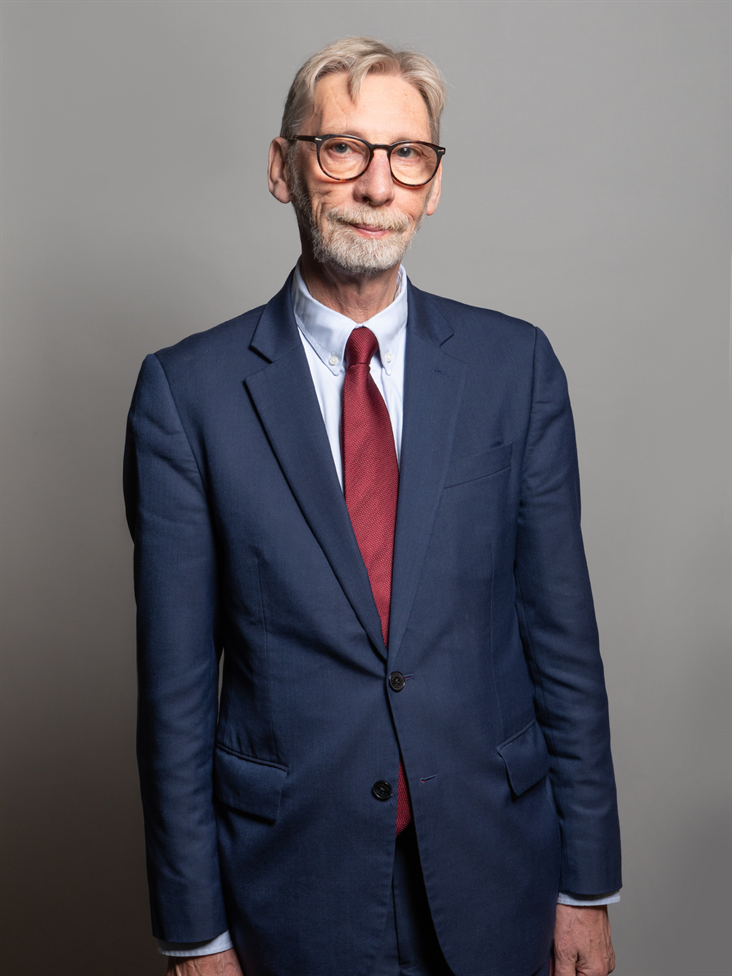
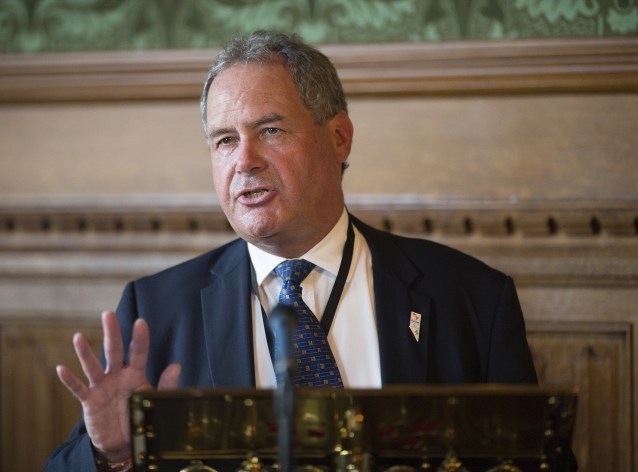
Bob Blackman MP

The biggest change may come from a private members bill by Bob Blackman, the Tory MP for Harrow East, now being scrutinised in the Lords, which lays out a proper framework for the sector. This still has shortcomings as it does not deal with housing benefit fraud which must be quite high in this sector.

All this is better late than never . But it says something that the government until now has not bothered about protecting vulnerable and elderly people from the landlord sharks who prey on them. It paints a pretty poor picture of modern administration in the UK which must lag behind other Western countries in looking after its vulnerable people.

As Meg Hillier MP, Chair of the Committee of Public Accounts says
“Vulnerable people deserve to live in housing that meets their needs.
But gaps in regulation mean a concerning number live in sub-standard accommodation, at great expense to the taxpayer.
Government must now capitalise on the work of its Supported Housing Programme Board and provide local authorities with the support they need, starting with meaningful data on the scale of the problem.

Please donate to Westminster Confidential to allow me to continue my investigations and reporting on serious social problems and backing whistleblowers

Please donate to Westminster Confidential

£10.00
One-Time
Monthly
Yearly

Make a one-time donation

Make a monthly donation

Make a yearly donation

Choose an amount

£3.00
£10.00
£20.00
£3.00
£9.00
£60.00
£3.00
£9.00
£60.00

Or enter a custom amount

£

Your contribution is appreciated.

Your contribution is appreciated.

Your contribution is appreciated.

DonateDonate monthlyDonate yearly

Namibia: Dunes,Moonscape, Prehistoric Plants and Chinese uranium

A visit to Namibia’s extensive desert reveals an extraordinary unique environment probably not repeated anywhere else on earth.

Huge sand dunes near the coast compete with an enormous desert plain dotted with prehistoric plants and an unparalleled moonscape next to mountains full of uranium.

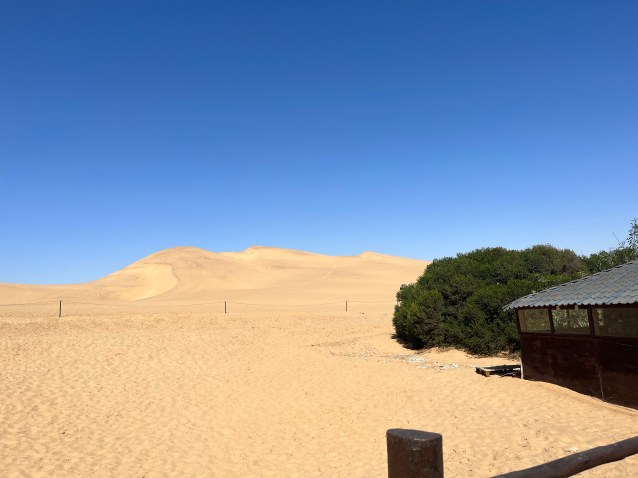
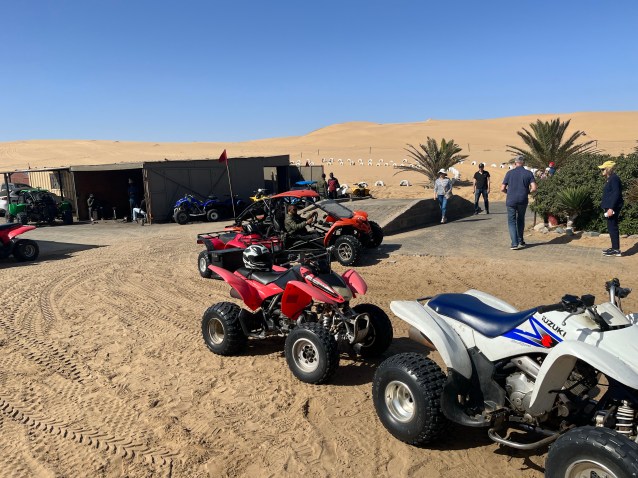
First the sand dunes. Just outside the port of Walvis Bay lie large sand dunes favoured by quad bike fraternity. We visited this first and saw how popular they were.

Sand dune outside a quad bike centre
Quad bikes

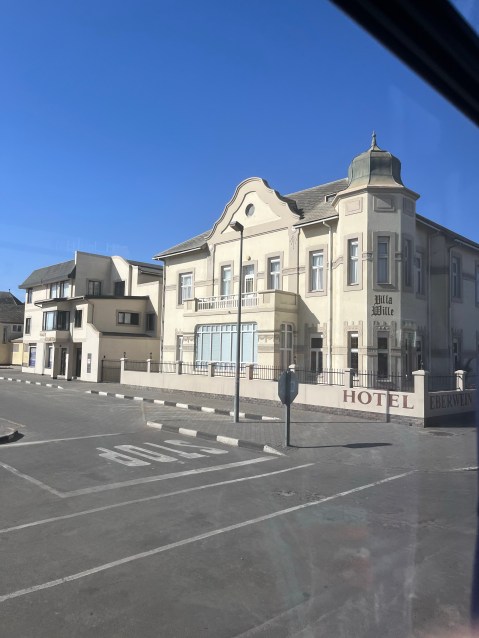
Next we passed the resort of Swakopmund A German colonist resort which still contains many of its original buildings.From here there is a huge desert plain where you find prehistoric plants.

One of the German style hotels in Swakopmund

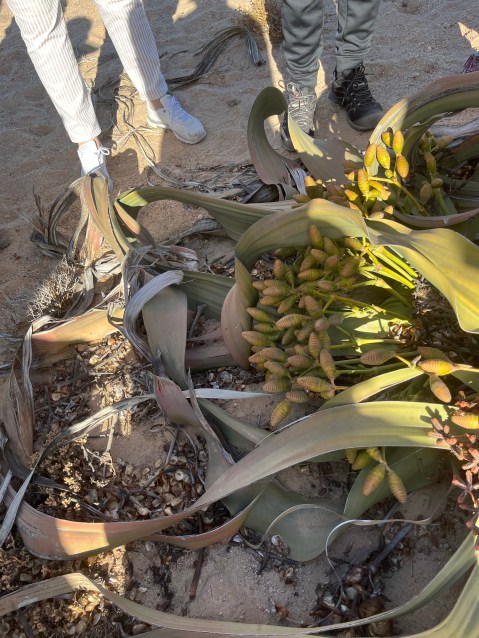
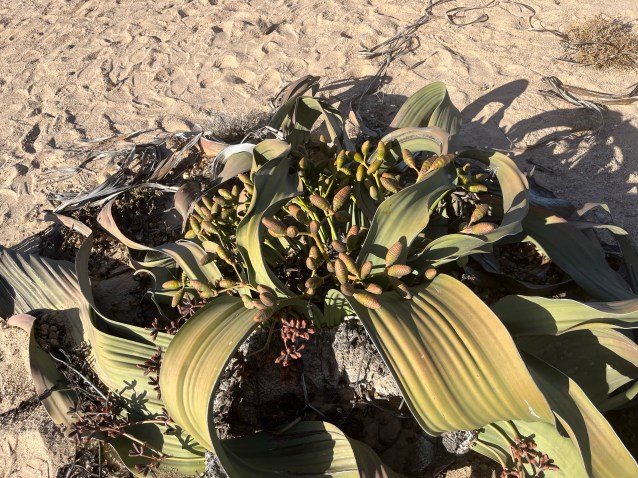
The star of the plants is the Welwitschia mirabilis a prehistoric plant that can live for 3000 years and grows just two large leaves that often split into pieces in the arid desert. Extremely slow growing there are male and female plants which attract desert living insects and beetles .They live only inland in the Namib desert and in the wilder parts of southern Angola.

Female prehistoric plant which has red green cones observed by tourists on our trip
Male prehistoric plant

Life can exist in the desert because a fog moves from the coast during the night creating enough moisture for animals like the springbok and jackals to find moisture from plants including the dollar plant a succulent that stored water in its leaves.There are also sidewinder snakes and scorpions but fortunately are all asleep in their burrows during the day.

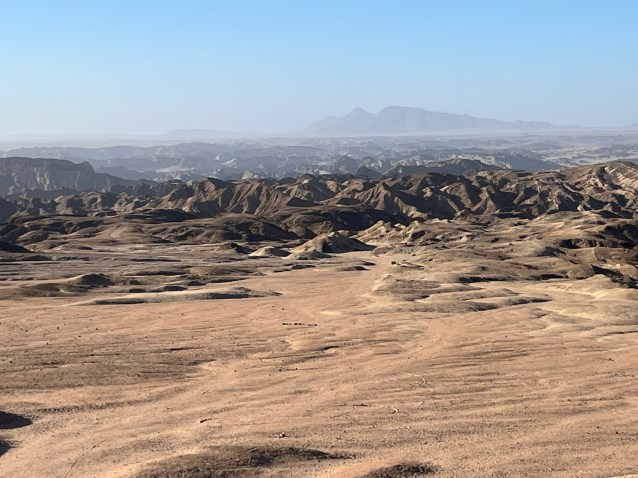
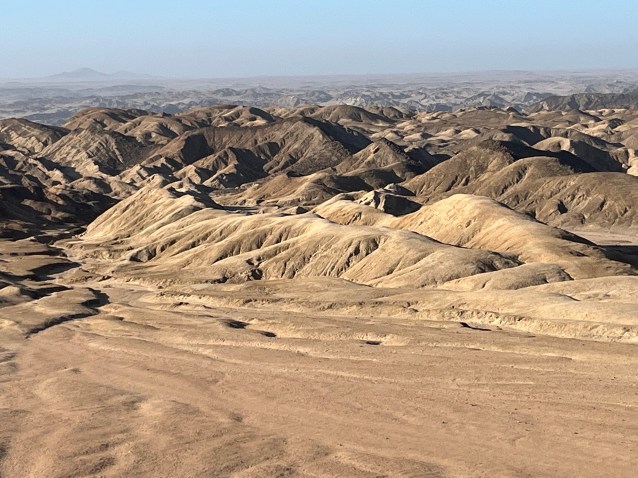
The most dramatic area is the rocky moonscape where nothing appears to live but in fact hides an oasis in a dried river bed that has existed since 1849.

the arid desert
Moonscape of Namibia
the oasis bar restaurant and camping site

In the distance are mountains where Namibia’s huge reserves of uranium can be mined.Now all the main mines are owned by the Chinese according to our guide.The uranium is exported to China for its civil nuclear programme. Curiously another big Namibian export is marble to Italy so perhaps not all Italian marble is home mined.

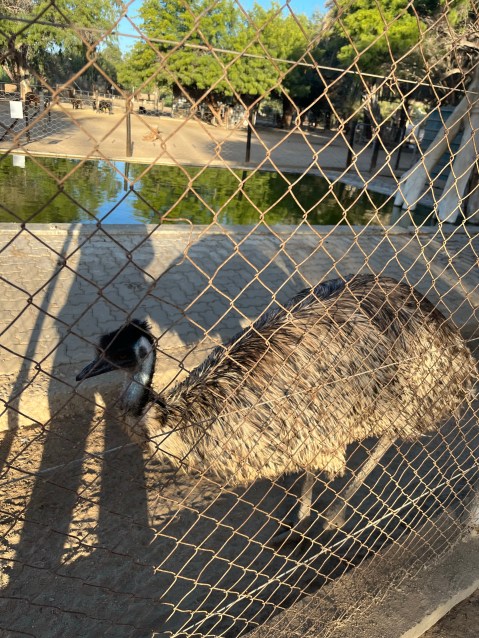
An emu at a small zoo in the oasis

Durban’s amazing hidden Zulu art and history gallery

The day began very badly.We aimed to get a taxi to the City Hall which has both an African art gallery and museum.But when we arrived the city hall staff were on strike because of the cost of living crisis and it was closed.

The taxi driver recommended another art gallery in suburbs and we left just as a number of police squad cars arrived as there were reports of fighting in the building. We got to the second gallery only to find it was closed on Mondays.

About to despair the driver recommended a third gallery which specialised in Zulu art and artefacts.This was open though I later found you were supposed to book in advance.He had taken us to a gem of a place and we got a personal tour and Margaret got help to go round the place – an old Victorian building – in a wheelchair with strong Zulu men lifting it over stairs.

What we had discovered was a place called the African Art Centre or Phansi Gallery a non profit making company which encourages and preserves Zulu artefacts and supports black artists.The gallery houses a huge private collection by Paul Mikula who has amassed over year.

Part of the gallery included a Nelson Mandela concert poster.

Now I know nothing about Zulu culture beyond the populist view of them as warriors. What we were shown have us an insight into their lives and traditions and the everyday utensils they use. One of the most striking exhibits were the fertility dolls given to a young women on reaching puberty. They are given the doll at a special celebration and keep it to give to a man they agree to marry.

A fertility doll It has no face

There were also ordinary utensils from spoons – there are male and female ones – and they keep them for life as they have communal eating,bowls for beer and special pots for making yoghurt.

A collection of spoons- male spoons have a pointed end females ones are flat
a yoghurt pot shaped like a pear

There were also wedding dresses which are put together by relatives and friends each adding a strip of fabric with the symbols of the clans of each partner.

Our guide shows Margaret one of the artefacts a decorative beer bowl

Without the series of unfortunate incidents earlier we would never have found out about this museum which also plays a big role in the community and helps local artists

snake sculpture in the grounds of the museum

Disciplined: The Adelaide train driver who said he locked disabled people on a train if they used the wrong carriage

Our visit to Australia using a wheelchair to get around six big cities has been a heart warming experience. Visiting Darwin,Brisbane,Sydney, Melbourne, Adelaide and Perth we found staff in museums and galleries and the Northern Territories Parliament extremely helpful. Pavements had dropped kerbs and public transport was disabled friendly with spaces for wheelchairs on trains.

Margaret on the Adelaide metro – trouble free on the way in – the problem came on the way back

It was therefore completely unexpected and out of character when we ran into trouble on the Adelaide metro system – not with the train but its driver.

Each four coach metro train has two carriages with spaces for wheelchairs. On the way back at Adelaide City station I put Margaret in the nearest carriage and as the platform was level with the train it was no problem. When we reached the terminus Outer Harbor where the QM2 was docked the train is higher than the platform so I expected the driver to put down a ramp.

“You have got in the wrong disabled carriage”

We saw him put a ramp down for a wheelchair in a carriage nearest his cab. And other passengers alerted him to our need. What happened next was unbelievable. He came up to us saying we had got in the wrong disabled carriage and he was not going to let us out.Instead he said he was going to lock us in and we would have to return to the City station – a 40 minute journey – and start again He said he did this to other disabled passengers if they broke the rules.

There followed a short stand off as I refused to take my finger off the button that kept the door open before he finally relented and said as we were visitors to Adelaide he would put a ramp down but we were not to do it again This took less than 5 minutes but he still complained that he had lost part of his meal break.

The situation was all the more worrying because we had only 20 minutes to board the boat and if he had sent us back we would be stranded in Adelaide.

Good ending

This has had a good ending. I decided to complain to the metro authority using their website It was easy to use and contained information so I could identify the exact train service. They promised to reply within ten days but replied in three thanking me for providing accurate information. Not only did I receive an apology for the distress but they said they had identified the driver and given him a talking to. They also said appropriate action had been taken against him.

This restored my faith in the way the authority handled the complaint and made us feel disabled people were respected there.

It was also good to see the authority taking the issue seriously and replying promptly. There were no quibbles and I hope the individual reflects on his egregious behaviour and no longer thinks he can treat disabled people in this uncaring and disrespectful way.

Kangaroo Island: How this wildlife idyll revived after facing near extinction

One of the most remote places we are visiting around Australia is called Kangaroo Island – the country’s third largest island off a remote peninsula in South Australia.

View of the Kangaroo Island foreshore from our ship anchored in the passage

This island was once attached to the Australian mainland until the thaw following the last ice age created a sea passage between the island and Australia.

It has a chequered history.It’s first inhabitants were from Stone Age but never developed further after being isolated. It was the subject of Aboriginal stories and myths including one that the sea passage was created after a group of rebellious women fled a tyrannical leader who caused the sea to rise up and drown them.

At one time the island was deserted leaving its unique animals and birds to have no fear of humans. But then in the early nineteenth century a group of settlers and ex convicts moved in and there followed a massacre of its animals and birds for food and profits.

One species a dwarf emu became extinct just like the more famous Dodo as settlers ate them all. They then turned on the huge kangaroo population and decimated them. They also killed off most of the seals for their skins but ignored their valuable oil which meant eventually their community collapsed . ASA last gasp they started to kill off the whales of the coast but this was only seasonal.

One of the sandy bays on the island at Penneshaw

But it has a well stocked supermarket, petrol station,post office, cafes,a cricket pitch and a craft market and a number of tourist attractions. Also a number of new species have been introduced including koala bears and bees. Indeed the Ligurian bees on the island produce a unique honey as the population is isolated from any other bees.

Today’s island has recovered and many of its unique mammals are flourishing again.The main threat to them are wildfires which have destroyed a lot of the vegetation not people as the population is very small. Penneshaw the port where ferries link to the mainland has just 300 people.

Sculpture Trail and suspension bridge
Burnt out tree

There is a splendid open air sculpture trail on the island where hidden in the dense bush you can find wallabies and kangaroos if they don’t run off to hide. I have put up pictures of the trail below.

One of the sculptures
trail meets tree
Hidden in here is a wallaby hiding by a bush

When I was there the bush was tinder dry with a few flowers in blossom.Here is one below.

Sealink ferry connecting the island to the mainland

Vibrant Papua New Guinea contemporary art exhibition which slams and praises politicians tackling asylum seekers

Captain Cook looks down on the Papua New Guinea people Painting by Mathias Kauage

Queensland’s Art Gallery is well known for its collection of Aboriginal art. But when we visited it on a day stop in Brisbane what attracted us was a special free exhibition of contemporary Papua New Guinea artists called Kin, reflecting the close relationships among the country’s painters.

It celebrated the work of Mathias Kauage and more recent painters and was a riot of vibrant colours and political messages touching on issues like refugees now right at the heart of debate in Britain. It included a remarkable painting of Captain Cook looking down on residents of Papua New Guinea – see above.

Detailed caption of two modern Papua New Guinea painters who have followed through from Mathias Kauage
A painting celebrating the former New Zealand Premier welcoming refugees

The paintings don’t shy away from tackling political issues particularly on the red hot issue in the UK and Australia on asylum seekers and refugees. A particular striking picture praises Jacinda Arden accepting and helping refugees.

One wonders how the painters would portray Suella Braverman and Rishi Sunak -both brown British politicians deporting largely brown and black asylum seekers from the shores of the UK. Perhaps the UK’s leading art gallery Tate Britain should commission them to paint a series to counteract the baleful influence of Right wing Aussie politician Tony Abbott on stirring up hate and resentment in this country.

Dramatic portrayal of the 2012 Australian general election struggle

Two other striking paintings by the group stand out. One is a painting of the Left v Right Australian general election where the combatants are portrayed as Aboriginal chiefs.

Another is of refugees kept in a holding camp in Papua New Guinea similar to the UK plan for one in France.

Australia’s harsh holding camp for migrants and asylum seekers

Two other striking exhibits in-the exhibition including a remarkable sculpture representing people literally getting under other peoples skins and an amazing collage by an Iranian born artist now living in America using decorative images used by Pakistani lorry drivers to beautify their vehicles .

a striking exhibit using different skins
Amazing collage by an Iranian painter

Cunard’s shambolic gala centenary event

It was meant to be the highlight of the centenary world voyage of the Queen Mary 2. Cunard chose the iconic site of the Flower Field Gardens at the Bay in Singapore. They promised “ you a night to remember”. Instead it became a night you wanted to forget.

Queen Mary 2 earlier At Penang

The combination of the chaos at the event and the long bureaucratic Singapore immigration system which meant long queues both took the pleasure out of the evening.

It began with a long 45 minute wait for immigration to allow anybody to leave the ship.When we had cleared immigration we met our next disappointment. Cunard had promised to lay on disability transport to the event for people like my wife who is in a wheelchair. When got there we were not on the list to get any transport.Indeed from what I saw of the list only six people out of hundreds attending the event qualified. They did rustle up a minibus with two high steps which we shared with another couple who was also not on the list and who was hobbling around on two sticks.

Getting to the event added to the disappointment.Cunard had promised that all diets especially diabetics would be catered for . Their FAQs with the invitation said waitress would be”educated” about diets. Well apparently not. Presented with six starters we asked our waiter for advice about which were lactose free. His response was to go and find his manager. Worse was to come when we joined the long queue for a curry. Asking the server which food was diary free I got the brusque response “everything has dairy in it “

Eventually after someone just ordered rice and flatbread I got someone to give me just that – but helpfulness was not on the agenda. No wonder we learned later that one group of guests had spurned the Cunard haute cuisine and gone to the Gardens on site McDonalds to have their meal.

One group of guests spurned the food at the venue to eat at McDonald’s

So we’re there any redeeming features?Yes the Lion Dance was good and the flowers gardens beautifully lit up.

Lion Dance in the venue
One of the flower displays

But it was not over yet. Going back we encountered the same problem in getting disabled transport back to the ship as we were not on the list.Luckily a Cunard rep did intervene and she got a shared minibus.

The gremlins at Singapore immigration had their last throw. At customs we were diverted to an empty line as my wife was in a wheelchair to speed us up. What we didn’t realise as we went straight ahead is that we had joined the line to board the Spectrum of the Seas the other cruise liner in port.actually It was only a person checking passengers passports who realised the green sticker on our passport meant that we must be on the Queen Mary and diverted us.

Finally I must thank the kindness of fellow Cunard passengers who took great care to help my wife on and off the minibus and the one kind gentleman offered to take my wife Margaret down a staircase that we had been misdirected to at the venue. We did decline and later found like the rest of Singapore the venue had wheelchair lifts to get to the lower floor.

Buddhas,Warlords and ethnic Vietnamese :Ho Chi Minh City’s History Museum

Ho Chi Minh City is famous for a number of tourist sites including its Post Office,Notre Dame Cathedral and its Harrowing Vietnam War Museum.What is not so well known is the city’s history museum telling the story of the country for the last 30,000 years.

Tucked away in a side street off a main road next to the city’s botanical gardens this gem of a museum includes numerous artifacts dating from the Stone Age to the present day.

Big frieze across the entrance of museum
Inner courtyard entrance to the museum

When you get there you are greeted by a large Buddha in a room full of Buddhas from different Asian countries.

This-is the Buddha that greets you

The Buddha here is a reproduction of the oldest known Buddha in Vietnam dating back to the eleventh century

These fine stone sculptures date from the eleventh century when a warlord triumphed over rivals and led to a leap in artistic culture

The museum had some fine costumes and an interesting exhibit showing how ethically diverse the South Vietnamese with no fewer than 34 different indigenous groups in the country .

historic Royal finery and pottery

The sad thing is that we weren’t able to see the whole museum including more modern exhibits.officially designated as disabled friendly some of the rooms were inaccessible to wheelchairs because you had to go up a flight of steps.Also the ramp to the entrance was so steep that I needed the assistance of some fit young Vietnamese lads to get to the top.

Our taxi driver also helped Margaret get up the stairs to the museum’s cafe. On the plus side it had a very good accessible disabled toilet.

Fascinating exhibit showing the 34 different groups making up the Vietnamese nation

Finally since we were last in Vietnam the number of scooter boys and girls has grown on the roads. See a previous blog. So much so the latest new expressway has a a segregated lane for the daredevil scooter drivers Even there they move faster than some motor vehicles weaving around to overtake each other – just like in Ho Chi Minh City.

Off the Western tourist route: Kuala Lumpur’s amazing Islamic arts museum

On the edge of the centre of Kuala Lumpur – a city dominated by huge skyscrapers and apartment blocks – near the greenery of Lakeside Gardens is a modern museum dedicated to Islamic Art.

Ornate metalwork at the museum
Two huge metal candlesticks
Stunning costumes and textiles from India

The Islamic Arts Museum opened as recently as 1998 is not on Cunard’s shore experience programme and consequently has few Western visitors.But this is not a local or even a Malaysian national museum but an important international one.

It has over 12000 artefacts, a large reference library and tells the story of the spread of Islam from the Middle East across Asia and China through Islamic Art.Missing are artefacts from Spain after it was occupied by the Moors.

The collection is impressive. It covers metalwork,ceramics,textiles,jewellery,weaponry, manuscripts, China and furniture.

A 16th century illustrated Koran

With 12 galleries it is almost too much to take in but it also a very cool Restuarant and Cafe to have lunch and a break. What is fascinating is how Islamic art adapted from Turkish carpets to delicate China through a rather extravagant costumes in India.

One of the most intricate China pieces in the museum

There was also an interesting collection of weaponry including heavily decorated rifles as illustrated below.

Malayan rifles

Textiles and ceramics were well represented.

Examples of ceramics

The light and airy building makes the museum pleasant visit especially as Kuala Lumpur has very high humidity and temperatures often top 33C.

Batik carpet

Free education,free healthcare,free land and free parking: How the Gulf States woo their people

The imposing entrance of the Sultan.of Oman’s palace in Salalah
Palace gardens in Salalah
Cave in the foothill of Oman’s mountains It above a spring which is a popular tourist and picnic spot

My first visit to the Gulf states of Oman and Dubai has been an eye opener and shows how two relatively poor Arab Nations have been transformed by the rise of petrodollar. Both are effective absolute monarchies that still have authoritarian rulers. Yet both have used their new found wealth to benefit their indigenous people.

This may explain why both are stable states and largely popular with the Emirates and Omani population. In Oman the 50 year reign of the late Sultan saw his people benefit from the wealth provided by oil. In 1970 Oman had only three schools now it has nearly 1100. Education and healthcare is free for the 1.5 million Omanis and when they start a family they are given a free plot of land to build a house. The younger generation are bilingual as all pupils learn Arabic and English and all signs are in both languages.

Strict regulations lay down how each house in Oman should be built on a 650 square metre plot.It should be no more than two stories high and occupy a third of the plot with a high wall enclosing a garden and garage .

Dubai skyline from the deck of the QM2 with my wife Margaret

In Dubai the government also give a contribution to building costs. The main city is ultra modern and full of skyscrapers and modern apartments. In this heavily trafficked city of five lane roads parking is also free – there were some limited parking charges in Oman in Muscat.

What is really jaw dropping in Dubai despite its authoritarian stance on alcohol, gay rights and on insisting how modestly Muslim women should dress is how cosmopolitan it is. The Dubai Mall said to be largest shopping complex in the world with 1600 shops is a complete mixture of people with women in Western Style dress walking among Arab women covered from head to toe. While young men in shorts walk among young Arab men wearing full robes.

Main square of the Dubai Mall at night

Of course expats don’t benefit from the largesse the Emirs show to their own people But professional Westerners benefit from high tax free salaries, cheap petrol and low utilities bills that are becoming more of a rarity in the UK as the wealth gap grows.

As an example my daughter who is a Dubai state school science teacher earns a tax free salary just short of £50 000 a year plus free and efficient healthcare and fuel bills of just £20 a month. Here in the UK the government is boasting that teachers will soon get £30,000 a year before tax and will have huge fuel bills and petrol costs. There is no comparison.

I noticed that Emirates airlines are now targeting Brits in the hospitality sector to work as cabin crew. They are offering tax free salaries,free training,free accommodation and healthcare as part of the package . In the UK the same person will be lucky to get just above the minimum wage working for Wetherspoon.

Dramatic fountain display in the Dubai Mall at night

The situation is not the same for workers from India,Pakistan, and the Philippines who take more menial jobs in construction or as maids to wealthy Arab families. They miss out big time and are on low wages and/or work long hours for little money.

One last interesting point.What happens if you have a car accident with a camel in Oman? According to our guide if it happens in the day the owner will claim it is his most valuable animal and you will have to compensate him handsomely. If it is after dark the camel owner will have to pay for all the damage to your vehicle. The trouble is that owners don’t always admit that is their camel and can be difficult to trace.