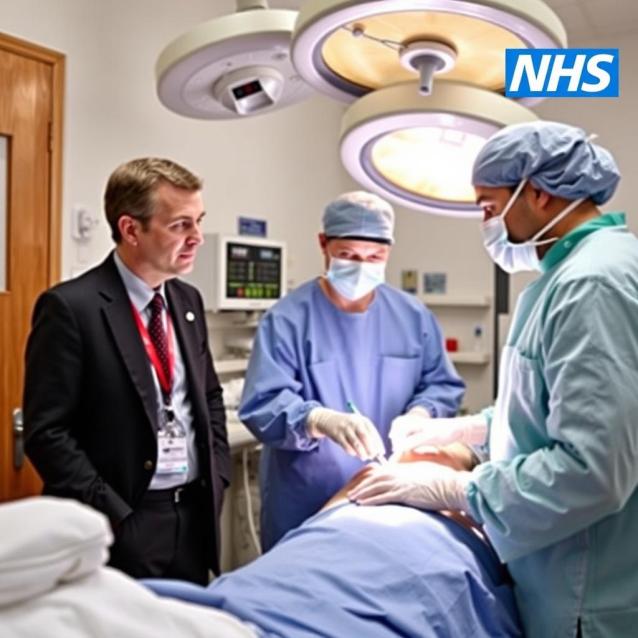
NHS Resolution solicitor overlooking hospital doctors under investigation. An AI image illustrating the situation facing hospital doctors in the NHS
Following my blog on the secret process using NHS Resolution to help hospital managers discredit whistleblowers I decided to ask the advisory body a series of questions on its operations using the Freedom of Information Act.
What emerged was extremely revealing. NHS Resolution hides in its annual report how many hospital doctors are involved by lumping them together with dentists and pharmacists. But the breakdown revealed through FOI reveals it is almost exclusively targeting doctors to advise trusts on how to handle them.
It shows that in the last financial year it advised in cases involving 1168 doctors in England, Wales and Northern Ireland. And the number of cases would be higher – as a number have multiple complaints from managers against them. This compares with 53 dentists and under 5 pharmacists. Indeed the pharmacists involved are so few – it won’t give me an exact number for fear of identifying individuals.
The PPS was last audited in 2019 and the organisation says it was then considered to be adequate and. effective. A more recent review in July this year by Dr Penny Dash looked just at the patient safety and learning role of the organisation and not wider issues.
Nor does NHS Resolution check whether it is given accurate information by managers. It said:” our role is to provide impartial and expert advice which is aimed towards supporting the local management and resolution of performance concerns. We are not a decision-making or an investigative body – in all cases, any decisions about the ongoing management, employment or contractual status of the practitioner rests solely with the healthcare organisation.”
In other words it is there solely to support health managers – who have no duty of candour – and it tries to include doctors by saying managers should tell them about their request for advice. In fact managers can and do ignore this as there is no requirement for them to say anything to the doctor they are investigating. So without hearing the doctor’s case it cannot be genuinely impartial. Also should a practitioner object to the partial advice given by a health manager they are ignored and the body continues to deal with the health manager.
NHS Resolution has not carried out any audit on the effect on doctors who are subject to complaints but it does do occasional research into problems arising on a very small scale. One example in its Insight Publication series last year was looking at whether ethnic minority doctors were badly treated in the NHS.
Involving just 11 doctors it said:”Most participants felt discriminated against based on their ethnicity and/or where they qualified. They felt this was reflected in the way their cases were handled by both their employer and Advice, and the higher rates of concerns raised against practitioners from ethnic minority backgrounds.”
Not surprisingly there was a lot of ignorance of how NHS Resolution’s advice service worked – given that health managers needn’t tell them about it. Again NHS Resolution’s solution was to give advice to managers which they need not take up. The full report is here.
Then there is the question of the phrase, performance. Is it a misnomer? NHS Resolution advice service does not look into the question of performance by doctors – relying on hospital manager for that – and it does not employ people qualified to do so. Many are solicitors, human resources staff and employment law experts and are not qualified to know when say a complex heart operation went wrong or the details of paediatric care. Indeed from doctors who have contacted me the trust often cites uncooperative behaviour and not working well with colleagues as part of its case.
Taken with earlier articles on the role of the General Medical Council a disturbing picture emerges which shows the hospital doctor is always at a disadvantage while the responsible officer – usually the medical director – holds all the cards – using NHS Resolution for advice and reporting the doctor to the GMC. Yet neither body is necessarily equipped to handle this and in NHS Resolution’s case, it is toothless to influence decisions by trusts. It can help to easily ruin a doctor’s career and even ban him or her for life for continuing their careers.
There seems to be a wholly unregulated sector covering NHS Resolution, the GMC and the trusts themselves and certainly no accountability. Patients have no idea how this is handled -yet their safety should be paramount in the NHS. And while NHS Resolution says it works under the direction of the Department for Health and Social Care my research shows it is not clear who regulates them.
If ever there was a case for reform of both systems, now is the time for something to be done.
Guest blog from Dr David Ward on the appalling treatment of whistleblowers in the NHS
Patient safety and the judiciary
What business has the judiciary with patient safety matters you may ask? I am referring primarily to the processes which may unwind when a doctor, having raised patient safety concerns is sacked by the Hospital Trust where they worked and seeks recourse via the corrupt Employment Tribunal system. (NB not sacked “for having raised the alarm” as that is expressly forbidden by the Public Interest Disclosure Act (PIDA 1998[1]). For example, if a piece of equipment is malfunctioning in such a way as to cause harm to a patient; if a process such as preparing a patient for a procedure is flawed in such a way as to put the patient at risk; an inadequate consent process; understaffing in, say, a post-operative ward; inadequately qualified personnel. Each of these deficiencies may put a patient at risk of harm and all have at some time been reported by doctors or nurses. There are many others. A responsible doctor witnessing any of these will be concerned and has a duty to raise an alarm. This is set out in Good Medical Practice, a guide produced by the GMC[2]. It is also part of the Duty of Candour regulations [3][4] and for traditionalists, in “The Hippocratic Oath”[5] the central tenet of which is “primum non nocere” or “do no harm”.
A problem may arise when a doctor (or healthcare worker) reports a “patient safety event” and the Trust reacts adversely (the psychology of such reactions is discussed elsewhere) which is a very common. It may trigger a series of defensive responses by the Trust which almost always ends badly for the doctor. This is seen time and again with “whistleblowers” who have had the “temerity” to raise a concern. The “playbook” is almost set in stone. In several recent cases where a dismissed doctor (Claimant) has sought recourse at an Employment Tribunal, the Respondent (the Trust or Hospital) has reacted vengefully rather than responsibly and promptly to look into the concerns.
The following is a brief account of the saga of a colleague who was referred to the GMC (after she reported safety concerns) in what can only be described as an act of vengeance by the Trust and the CEO who, having taken offence at the temerity of the doctor to report some shortcomings to the Trust, decided to “punish” her culminating with dismissal. Furthermore, the Trust prioritised this vengeful reaction over and above an urgent investigation into the problems she raised. It’s the same “playbook” with many other NHS whistleblowers (see Westminster Confidential 6 7).
Patient safety concerns.
If a doctor “raises a concern”, the most common of which is about something which may jeopardise “patient safety”, the obvious and reasonable response is to investigate it and correct any problems as soon as possible. Astonishingly, this is rarely what happens. The Trust not uncommonly reacts vengefully to the report, for example, by restricting the activities of the doctor who reported it. They may be “hauled over the coals”, have their duties limited, suspended for a period, referred to the GMC or even the CQC. The GMC may commission an external assessment of the doctor in question by an independent party usually another doctor in the same specialty. The Trust is not obliged to take any notice of this report. For example (I could cite many), a colleague who was referred to the GMC by her employing Trust was completely exonerated but she was dismissed all the same.[6] The CEO of the hospital, St Helier Hospital, Daniel Elkeles, made a veiled threat in a letter if she did not cooperate with his dismissal proposals:
4) ESTH agree to cease the MHPS process which means we can find a way to
ensure you are re-validated (not my area of expertise but i am sure there will be a
way)
5) You need to drop all the actions you are taking against ESTH.
If we can agree this then I would hope that everyone can move forward positively.
(This letter is in the Tribunal bundle in the public domain)
Another whistleblowing case where there are ongoing grave concerns about the propriety of the Employment Tribunal decisions (and others) in support of the dismissing Hospital Trust is that of Dr Chris Day whose case features extensively in columns of Westminster Confidential.[7]
Unregulated “Maintaining High Professional Standards”[8]
This code of practice was introduced in 2003 to update and clarify how concerns about a doctor and the associated “disciplinary” procedures are managed.
This entire process is unregulated and no independent body is statutorily involved. In fact, there is not even a statutory register of these processes or the events they purport to investigate. There is no register of NHS whistleblowers or the safety concerns they have raised. Trusts do not keep records, the regulators (BMA, CQC) don’t keep records. The NHS does not keep records (I confirmed this by asking the now defunct NHSE). HM Government does not keep records despite HM Treasury giving £millions (directly or via various organisations) to Trusts to pay inscrutable legal firms to defend the Trust against claims made by doctors who have raised safety concerns. This means a Trust can hire anyone they choose to conduct the investigation. There may even be an “informal agreement” or they may just be a ”pal” of the CEO. The investigator is not required to have any special qualifications and there is no register of such people. The St Helier Hospital case referred to above is a particularly egregious example of how this chumminess may operate. The “investigator”, a retired nurse[9], in her report invoked a fictitious “regulation” not previously seen in this context. The doctor in question was eventually dismissed on the grounds that she was not “fit-for-purpose”[10]. This is entirely confabulated by the investigator (who describes herself as a “non-practising barrister” but is not on any English register of barristers[11]) as no such “reason” for dismissal (or anything relating to humans) exists in English Employment law and the term is not applicable to a “human being” but rather to goods or services. How this has not, so far, been challenged in the Courts eludes me. Could this case even be cited as a “precedent” (pro or anti) in future similar cases?
It doesn’t take a leap of the imagination to conclude that if a Trust wishes to be rid of a doctor it will choose a compliant “investigator” with a reputation for such behaviour. This service costs money (provided, of course, by the taxpayer) and investigators can be very expensive. But hand-picked unregulated quasi-independent “investigators” are very compliant, aren’t they? Money talks… but conveniently no formal or open register is kept of money used to silence whistleblowers (pay the lawyers, investigators, payoffs, seal a Non-Disclosure Agreement etc). I wonder why?
A doctor threatened with dismissal (or who has been dismissed) may just move on, get another job (if possible having been “slandered” by the previous employer), leave the profession altogether, move abroad or any of these choices. Unfortunately, many will seek recourse via the arcane and grossly biased Employment Tribunal system. This may come about because the embattled doctor has received, shall we say, less than impartial advice, possibly from a law firm, recommending this route. Less than 3% of claimants at an Employment Tribunal emerge victorious (whatever that means)[12]. In other words over 95% of Claimants who brave this course will lose their case. Fair and open justice? I think not.
Who bears responsibility for all this?
Is it the doctor who “blew the whistle”? No, it is their duty to raise safety concerns.
Is it the Trust which dismissed the doctor? The Trust will deny dismissing the doctor (for raising concerns) and invoke PIDA 1998 47B in their support (1):
A worker has the right not to be subjected to any detriment by any act, or any deliberate failure to act, by his employer done on the ground that the worker has made a protected disclosure.
The Trust will say “oh no, it wasn’t because he raised a concern…it was because his manner was inappropriate/rude and …” (see story of Martyn Pitman, below). However, it is quite a different matter when it comes to dismissing a doctor “who has raised concerns”. This is not “unlawful” because it is consistent with PIDA. This is why the law needs to be changed; to ban the dismissal of “doctors who have raised safety concerns”. It’s a “no brainer” isn’t it?
Is it the lawyers who advised (and assisted) the dismissed whistleblower to seek recourse via the biased ET system? Yes, they are complicit once dismissed the employees submit themselves to the process. Millions of taxpayers’ money is spent on lawyers defending Trusts against claims made by whistleblowers yet almost nothing (no data are collected so we can’t be sure about this but we can infer it) on investigating and correcting the problems that gave rise to the claims. Sheer madness or what?
Is it the Trust managers who confabulate the case against the whistleblower? They have one aim in mind; to get rid of the “nuisance” doctor and by so doing avoid the “inconvenience” of looking into the safety “issues” raised in detail which could be very embarrassing if gross incompetence or negligence by the Trust or its employees is exposed.
And patient safety? Oh, that’s where the proverbial “carpet and brush” come in, as wielded by Trust managers (with legal advice) who themselves are unregulated[13]. If you want evidence for these claims read the newspapers (or search a major news website).
Inadequate regulations and deficient laws.
The regulations drawn up by regulators (and equally the inadequate laws passed by legislators) have contributed to this unsatisfactory situation where doctors are terrified of speaking up about patient safety because they fear for their careers and the livelihoods. If the regulations were tighter, we wouldn’t be here, would we?
A simple and almost cost-free solution to all these inappropriate behaviours is available without too much hassle and only minor changes to regulations and it based on the supremacy of maintaining patient safety: ban Trusts from dismissing doctors who have raised patient safety concerns and compel the Trust (by statute) to investigate those concerns. Just think of the benefits: no lawyers, no Tribunals, no money filling the coffers of law firms but instead expended on, inter alia, investigating and rectifying the concerns raised, improving care and communication. More openness and less retribution will encourage doctors to ‘’raise a hand” without fear of reprisals. Furthermore, is it not preferable to retain the services of an expensively trained, competent and dedicated doctor who had the courage to speak-up and has committed no offence, rather than destroying their careers and depriving patients of their skills? (This is the “playbook” in the cases of so many NHS whistleblowers I could list here). At present the judiciary (and the regulations they invoke), whether they agree or not, are complicit in covering-up patient safety issues and the adverse consequences of so doing.
Isn’t it time for a change of attitude and changes in the law related to raising concerns about patient safety – also known as “whistleblowing”? Why are the ”powers that be” not listening to the many supporters of whistleblowers who are raising the same issues time and time again?
Just one more thing: there are seven reasons which can be invoked in British Employment law to dismiss an employee[14]. None of them is especially relevant in this context except one.
“Some other Substantial Reason”, a most convenient clause for all the reasons one might imagine: if it isn’t covered by the other 6 this one should satisfy the Trust’s requirement to get rid of the doctor. Furthermore, it may obviate detailed scrutiny of evidence (isn’t that the reason it’s called SOSR?). Other reasons which are commonly exploited include: ”it’s impossible to carry on employing you” and “not being able to do your job properly”. The vagueness, highly subjective and unquantifiable nature of these clauses suggests they have a less-than-straightforward purpose.
If a Trust wants to dismiss a doctor it will find a way to do so. In the case of Martyn Pitman, Consultant Obstetrician and Gynaecologist, the Royal Hampshire Hospital strenuously denied that he had been dismissed for raising concerns. No, of course he wasn’t. The astonishing inanity of it was reported in the Guardian thus[15]:
“The judgment found the “overarching reason” for what has happened to Pitman was down to his communication style and not the message he was trying to convey”. (I couldn’t find this sentence in the 75 pages of the “unsearchable” official judgment).[16] So here is a senior and respected gynaecologist – who has done no wrong – being dismissed for his unacceptable “communication style”. You could not make it up!
It is a truism to state that the health of the nation is the single most important asset it has. (This is why “privatisation” of the NHS which would put “shareholders” ahead of patients would be a disaster). If the workforce is not healthy everything else will decline (I don’t need to explain this assertion but judging by what is happening in Westminster, politicians don’t seem to have grasped this concept. (Neither has the judiciary for that matter but I wouldn’t expect this self-serving body to opine on such “trivial” issues).
“If they [the judiciary and the JCIO] continue to do this, they are acting as a party to suppressing patient safety in the National Health Service and in the case of Sellafield, because it is such a contaminated and dangerous place, putting the general public at risk.
Is anyone listening to critics of the judiciary and its arcane processes in judging NHS doctors, nurses and other healthcare workers who raise patient safety concerns? Is anyone taking notice of the sufferings of the doctors who are doing their best (especially during the recent pandemic) for their patients? Is anyone calling out the absurdly illogical Employment Tribunal judgments which heap suffering on the Claimant (Doctor) and indirectly on patients? I know of one journalist who is – David Hencke. 17
Yesterday a conference of doctors, patients and journalists held at the prestigious Royal Society of Medicine in London highlighted the appalling treatment of doctors by NHS management who raise patient safety issues to protect patients. Examples were given from doctors who had been dismissed after they raised patient safety issues and how trust managers spend unlimited funds on lawyers to make sure they lose employment tribunal cases, sometimes even aided by the judges hearing them.
The conference arranged by Justice for Doctors, a new organisation representing many of the affected doctors, coincided with a series of articles in The Daily Telegraph, which showed that these are not isolated cases but involve doctors right across the country and is a national problem which trusts are trying to hide.
One of the main organisers is David. E. Ward,, a retired cardiologist from St George’s Hospital, South London, who has already written two guest blogs on this site. I have included his planned closing statement to the conference as a fresh blog from him as it succinctly sums up all the issues that were raised.
By David Ward
First, I would like to thank all the contributors to this historic meeting. In a way it is a celebration of all those oppressed whistleblowers who have spoken up for patient safety.
I would personally like to thank my friend Professor Somerville who has been a driving force behind this and many other ideas to stand up for whistleblowers. Jane and I have been trying to set up a second meeting about Patient Safety for 5 years following the first one in March 2019 when we re-enforced our personal campaign to expose – and do something about – the appalling treatment of doctors who speak up for patient safety also known as ”whistleblowers”. During our campaign we met the Justice for Doctors group who helped to organise this meeting
In the past 3 decades a Hospital Trust with its senior management has accrued the powers to destroy a doctor’s career by imposing restrictions, suspensions, referrals to regulators (GMC, CQC) and, astonishingly, an unfettered power to dismiss. These major life-changing decisions are arbitrary and undertaken, incredibly, without any independent or regulatory oversight. For dismissal, “get out” is apparently sufficient.
Allegations against the victimised doctor may be based on made-up and unsubstantiated claims. If major criteria for dismissal cannot be met there is always the “loophole” of “some other substantial reason” which conveniently does not exclude but also does not mandate any additional explanation.
Doctors who see poor practices, faulty equipment, processes (and the like) are obliged to speak-up by Duty of Candour (HSCA 2008 reg 20). But by speaking up but they may put their careers at risk as we have seen so many times recently.
The “The National Guardian” program introduced by Sir Robert Francis and intended to accommodate doctors who speak-up, evidently does not function as intended. It’s called “marking your own homework”.
Investigations into a whistleblower together with their concerns should be independent of the Trust in which they work and be seen to be so. But evidently, they are not. Furthermore, the Trust managements who make these decisions are themselves unregulated. That doesn’t seem right? Does the phrase “judge, jury and executioner” come to mind? Managers should also be regulated, shouldn’t they?
Arcane procedures such as MHPSappeal hearings can be overseen or conducted by “dodgy” external “agencies” some of which claim spurious credentials. These agencies are, in effect, “hired guns” available and willing – for a fee – to “confirm” the Trust’s unfounded allegations and to assist their aims – to dismiss the “troublemaking” doctor; not because of “incompetence” but because the doctor has “annoyed” Trust management by raising concerns about Patient Safety or something else. The reactions of management are often vengeful, as we have seen.
I know of at least one of these agencies which has appropriated and misunderstood (in a written formal report) the phrase not “fit-for-purpose” to describe a doctor in support a Trust’s decision to dismiss. The agency seemed totally unaware that this is not only fictitious nonsense but possibly libellous. No such phrase exists in English Employment Law. Unfortunately, NHS England has also been duped. I know because I’ve asked – in person.
The Judiciary, in the form of Employment Tribunals may be called into action if the dismissed doctor seeks to restore their career via this route. This is a bad choice by the victim as the evidence confirms. Only 3% of Claimants, “win” – not the most apt word – in this system. Put another way, 97% lose! Is that “open and fair justice”? I think not. Some of the judgments are beyond comprehension.
There are many practices which seem grossly unfair, perhaps deliberately. Some obvious ones stand out:
1. Inequality of arms;the law firms acting for the dismissing Trust are funded by each of us – the taxpayer. The Claimant, the doctor, healthcare worker will have no external source of funds except perhaps by “crowdfunding”. Furthermore, if they lose their case, they may required to pay not only their own legal fees but the law firm’s fees too! That’s not fair. I can show you some law firm invoices which would shock you. The phrase “inequality of arms” doesn’t touch it.
2. “Cost threats”are a notorious device employed to, shall we say, “persuade” a claimant to withdraw their claims before, during or after a Tribunal. It’s another weapon deployed by the Respondent, the dismissing Trust, to force the claimant to surrender and withdraw their claims.
3. Non-disclosure agreements or NDAs,are devices designed to conceal the devious practices used to threaten the claimant (and, as it happens, to suppress evidence). They have no place in inquisitorial proceedings in this context. They should be banned.
4. The Public Interest Disclosure Act (PIDA) 1998; I quote: a worker has the right not to be subjected to any detriment by any act, or any deliberate failure to act, by his employer done on the ground that the worker has made a protected disclosure.
In other words, a doctor cannot be dismissed, for example, for raising patient safety concerns. So, any dismissal has to be attributed to another perceived misdemeanour. Read any recent case and it is evident that the “whistleblowing” or “patient safety” concerns were discounted and irrelevant to the dismissal. It was about an “attitude”, a “manner of speaking” and similar unquantifiable and, in most cases, unverifiable attributions. Ask one of the presenters today.
5. At a time of great need for medical expertise, doctors are still being persecuted and dismissed having committed NO offence. The law firms which spend so much public money to pursue the claimants should have no place in any procedures which are primarily about patient safety. Furthermore, the concerns and the person who raised them should be formally registered and documented, including all steps taken towards a solution. This is not happening. Doctors who raise concerns about patient safety are treated like criminals! This must stop!
6. Last but not least the patient safety concerns, the very things that trigger most of these shenanigans. What happened to those? Well, they get buried and forgotten don’t they. What a wonderful system. All that waste of public funds to destroy a doctor’s career instead of correcting potentially dangerous practices. That is why a register is needed.
The problem is a nationwide one of the same gravity as the “Great Post Office Scandal”. Perhaps NHS whistleblowers need a TV drama-documentary because we have seen how that shifts public opinion and awakens the media with unprecedented force. I’ve already draw up a potential cast list!
Last, there should be a searching, durable, logical and legally sound review of the treatment of ALL whistleblowing related laws and processes. Whistleblowers are the canaries in the coalmine. They do society a favour. They should be praised – not persecuted.
This is the 21st century! What country do we live in?
Thank you all for attending. Thank you to all those who presented. And particular thanks to Dr Salam Al-Sam, Dr Azhar Ansari and the Justice for Doctors group.
UPDATE: Who came and Who didn’t send anyone
Newspapers who sent a reporter: Times, Guardian, Daily Mail, Standard,
Major media who sent a reporter: Sky News
Major media one would have expect to send reporter:
BBC, ITV, GBNews, LBC
Major regulatory professional bodies who were notably unrepresented: (very bad show I think especially as some of their members Fellows were major subject dig the WB scandal). If they didn’t know or just couldn’t be bothered – it’s shameful, either way!
BMA, CQC, GMC, Royal Colleges (all of them, Physicians, Surgeons, Obs and Gynae), National Guardians Office (FTSUG), HMCTS (at least they could have send a junior barrister), Law firms; all those with an obvious interest in oppressing Claimants




 Westminster Confidential