Top London coroner faces accusation of tampering with an inquest audio and a judicial review on the handling of her hearing into the death of an ITV journalist

Senior coroner Mary Hassell Pic credit: Archant

Judge blocked her attempt to keep her name secret during the hearing

A highly controversial senior coroner is facing serious allegations that she or her staff removed parts of a transcript and recording of her hearing into the death of a talented and hardworking ITV news editor Teresa McMahon who was found hanged at her home four years ago.

Mary Hassell found that she committed suicide and ruled out that she was subject to ” coercive control” by her ex boyfriend, Robert Chalmers, an NHS estates employee, who had previous convictions for violence. Mary Hassell believed the words of the pathologist ,Dr Mohammed Bashir, who examined the body but kept no photographic evidence and discounted domestic violence and Greater Manchester Police who decided from the start that no crime had been committed and never took any photographs either at the scene of her death.

Throughout the hearing this version was challenged by Teresa’s aunt, Lorna McMahon, who was frequently interrupted by Mary Hassell when she raised questions about the competence of Greater Manchester Police in handling the investigation into her niece’s death.

I was present at the hearing at the hearing with many other journalists. My report on it is here.

Yesterday’s hearing at the Royal Courts of Justice was meant to decide whether the court could give her permission to bring a judicial review into Mary Hassell’s hearing claiming her conduct was irrational and procedurally unfair in coming to her verdict.

Teresa McMahon

But the hearing took a completely different turn under Mr Justice Stephen Morris when Lorna McMahon, having obtained both the transcript and audio recording of the hearing said parts of both, covering descriptions of previous violence against her niece by her ex boyfriend had been omitted.

It also emerged from correspondence I have seen from Mary Hassell’s lawyers and a public ruling by a previous judge Mr Justice Kerr, that the coroner had tried to get her name kept out of the public domain during the hearing.

Her lawyers claimed ” it was customary” to be not named. She wanted it done under ” the slip rule” which meant there would be no hearing about the application. The judge ruled this procedure could not used in this way and rejected her application because it raised issues of ” open justice”.

When Mr Justice Morris heard Lorna McMahon’s evidence he weighed up whether to continue the hearing or adjourn it to allow her complaint to be properly looked at and for her to provide evidence from other people at the original hearing – including members of the public and journalists – to back up her claim.

All sides in the case agreed it was an extremely serious allegation which could be viewed as a criminal case of perverting the cause of justice.

Her own lawyer, Jonathan Glasson KC, agreed as such and but added by adjourning the case until the late autumn it meant that the accusations against the coroner were left hanging over her for some weeks.

The judge also made it clear by adjourning the hearing it did not mean that he was convinced about Lorna’s case and said she would need more evidence.

The directions he gave are worth reporting in full:

IT IS ORDERED THAT

  1. The application for permission to apply for judicial review is adjourned

2. By 4pm on 12 August 2025, the Claimant is to file and serve a witness statement, verified by statement of truth, identifying any and all parts of what was said at the hearing of the inquest by the Defendant on 5 December 2024 (“the Hearing”) which she contends have been omitted from the audio recording of the Hearing provided to the Court and the Claimant by email dated 14 July 2025 at 513pm and sent by Payne Hicks Beach LLP (“the Audio Recording”).

3. At the same time as filing and serving her witness statement pursuant to paragraph 2 above, the Claimant is to file and serve any and all witness statement evidence from others (including witnesses called at the Hearing and/or members of the press and/or members of the public) in support of her contention that parts of what was said at the Hearing have been omitted from the Audio Recording.

4 By 4pm on 9 September 2025, the Defendant is to file and serve a witness statement, verified by statement of truth, in response to the evidence filed and served pursuant to paragraphs 2 and 3 above, to include an explanation as to how the Audio Recording was produced.

5.By 4pm on 23 September 2025, the Claimant, if she so wishes, is to file and serve a written statement stating whether, and if so, why, she seeks a further oral hearing for directions in respect of the matters covered by paragraphs 2 to 4 above.

6.As soon as possible thereafter, the matter is to be placed before a judge (if possible, Mr Justice Morris) on the papers to consider directions for the progress of the case, and in particular whether there should be a further oral hearing dealing with the matters covered by paragraphs 2 to 4 above, taking account of all necessary reasonable adjustments.

7 The case to be reserved to Mr Justice Morris, if possible.

8. Costs of the adjournment and of the matters raised above reserved

This is the second recent case where there has been controversy about Mary Hassell’s handling of inquests.

Earlier that year she held an inquest into the tragic death of Gaia Young,25, who  was rushed to accident and emergency at University College Hospital with severe headaches only to die of an unexplained brain condition and doctors have yet to correctly diagnose what was wrong with her.

Again Mary Hassell  patronised and showed no empathy for her bereaved mother, Lady Dorit Young, who had lost her only child ,Gaia, and failed to properly investigate her death. The full story is on the Truth for Gaia website. She even blocked her from making a statement at the inquest. I reported that hearing and you can read about it here.

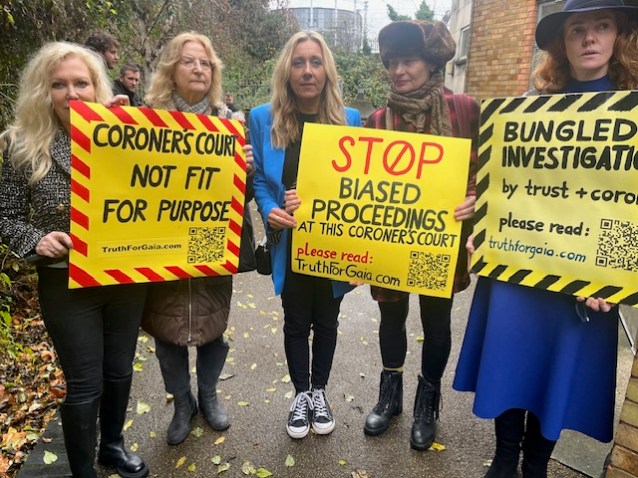
The treatment of both relatives led to a protest outside the coroner’s court during Teresa’s inquest. Pictures are below.

One-Time
Monthly
Yearly

Make a one-time donation

Make a monthly donation

Make a yearly donation

Choose an amount

£5.00
£10.00
£20.00
£5.00
£15.00
£100.00
£5.00
£15.00
£100.00

Or enter a custom amount

£

Your contribution is appreciated.

Your contribution is appreciated.

Your contribution is appreciated.

DonateDonate monthlyDonate yearly

Please donate to Westminster Confidential

£10.00

Exclusive: New mediation demanded for 50s women as judicial review is postponed

CEDAWinLAW takes the fight to the UN in Geneva

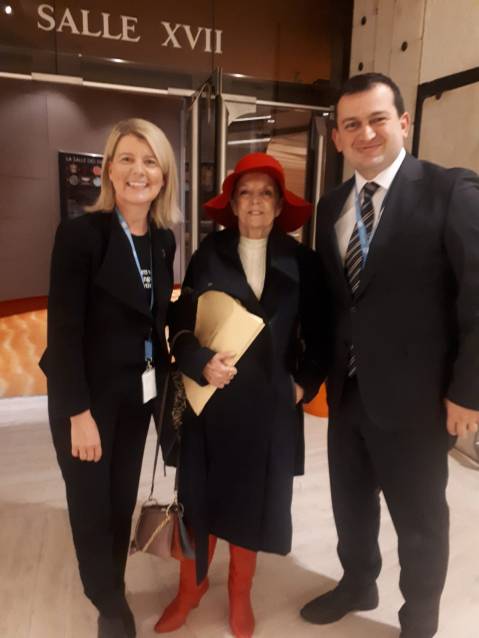
Former judgeJocelynne Scutt (middle) with Professor Natasha Despoja, a CEDAW committee member ((left) and Dr Elgun Safarov ( deputy chairman ( Right)

CEDAWinLAW, the successor organisation to Backto60, has decided to postpone its legal action on behalf of all 1950s women to force Mel Stride, the work and pensions secretary, to go to mediation over the long standing fight over the six year delay in paying out women’s pensions.

A statement from the organisation emphasises that this is a postponement not a total withdrawal of the case since preliminary work by their lawyers has found that Mell Stride did act unlawfully by not agreeing to mediation. Effectively it leaves a Sword of Damocles hanging over Mr Stride and Liz Kendall, his potential Labour successor as work and pensions secretary, should the party win the next general election.

The statement reads:

CEDAWinLAW has decided to postpone its action against the Secretary of State for Work & Pensions. Whilst its case is clear that the Secretary of State refused unlawfully, reasonable invitations to mediate made by Garden Court, it has decided to wait upon further developments before proceeding with its judicial review which it will now withdraw. Funds generously donated have been used in launching the judicial review and taking advice. Those funds fell short in timing of providing funds for a full-blown fight in front to the court. Our counsel said of the fight; “This is an important challenge for so many 1950’s Women in this country. The weight of the evidence indicates a grave injustice to them, and we will robustly represent their interests as we move forward with the assistance of our legal team.”. Whilst in the short term we have not achieved our goal for 1950s women’s pension rights, we have brought further notice to their plight and increased the political pressure which continues to build. We shall succeed for all those women

The decision will be disappointing for the women as an early court hearing on mediation was seen as better bet than the compensation likely to be awarded by the Parliamentary Ombudsman which is in the region of £1000 to £2900. The Department of Work and Pensions opposes compensation to any of the women either via the Ombudsman’s guidelines or through mediation.

CEDAWinLAW was able to raise money easily for the first stage to allow lawyers to prepare a case but lack of further wider publicity meant there was not enough money to continue to a full hearing.

WASPI did not help either. It expressed interest in becoming a party to the case and their lawyers demanded access to the all the papers. They also threatened CEDAWinLAW with costs unless they handed them. When they got access to the papers they decided not to proceed and instead their board sided with the Department of Work and Pensions case against CEDAWinLAW . The WASPI board quote the DWP’s contention that Australian judge Jocelynne Scutt’s report which found discrimination against all 3.8 million had no standing. Unfortunately for them this is not the view of the UN Convention on the Elimination of All Forms of Discrimination Against Women, whose deputy chairman, Dr Elgun Safarov, gave evidence to the people’s tribunal run by Jocelynne Scutt, who regard the findings as very important.

This continual divide between the organisations which includes banning WASPI women seeing any of my articles on their sites has been a gift to the DWP who don’t want to see the women get a penny.

However other developments mean that is not the end of the story. The UN Convention on the Elimination of All Forms of Discrimination against Women , has already received from Jocelynne Scutt a paper to on discrimination in women’s pensions in the UK. This can form the basis for an inquiry which would put the UK in the dock.

CEDAW are already not pleased that after 40 years membership of CEDAW, the UK has not passed all the legislation to comply with the convention, and has written to the UK about this. The UK at the moment is trying to ignore this but cannot stop the body setting up an inquiry.

Mel Stride

Other developments will happen when Parliament returns on April 15. Mel Stride has already met a senior politician and, fresh from his universal roasting by MPs from all parties on the Ombudsman’s report, is beginning to think he will have to offer something.

The SNP is also active. Patricia Gibson, the SNP’s Attorney General spokesman and MP for North Ayrshire and Arran, is planning to put up a backbench motion calling on Mel Stride to agree to WASPI’s demand for compensation and wants to press it to a vote. But given the different political rivalries in the Commons, there could be a danger it could be lost.

CEDAWinLAW is also drawing up a strategy to continue to press for mediation. More news on this is likely to be announced soon.

One-Time
Monthly
Yearly

Make a one-time donation

Make a monthly donation

Make a yearly donation

Choose an amount

£5.00
£10.00
£20.00
£5.00
£15.00
£100.00
£5.00
£15.00
£100.00

Or enter a custom amount

£

Your contribution is appreciated.

Your contribution is appreciated.

Your contribution is appreciated.

DonateDonate monthlyDonate yearly
Please donate to Westminster Confidential

£10.00

Judgement on Court of Appeal for 50s born women pensions fixed for September 15

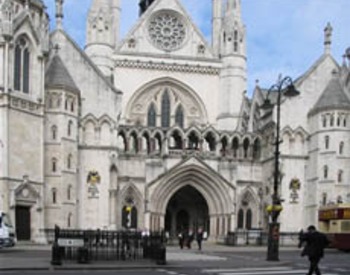
Royal Courts of Justice

The Court of Appeal has announced that the long awaited judgement on the Backto60 case covering 3.8 million women who had to wait up to six years for their delayed pension will be made on September 15.

The judgement will be delivered by email to the two claimants on behalf of BackTo60 campaign and the Department for Work and Pensions. The judgement will be put on the judiciary website.

The official notice published today reads:

NOTICE
Take notice that on TUESDAY, 15 SEPTEMBER, 2020 at 10.30, Judgment will be given in the following.
APPEAL

From The Queen’s Bench Division
(Administrative Court and Divisional Court)
FINAL DECISIONS
C1/2019/2914 The Queen on the application of Delve & Anr -v- The Secretary of State for Work and Pensions.

Covid-19 Protocol:  This judgment will be handed down remotely by circulation to the parties or their representatives by email, release to BAILII and publication on the Courts and Tribunals Judiciary website. The date and time for hand-down will be deemed to be TUESDAY, 15 SEPTEMBER, 2020 at 10.30.

A copy of the judgment in final form as handed down should be available on the Judiciary website (www.judiciary.uk) or BAILII shortly thereafter but can otherwise be obtained on request by email to the Judicial Office.

The decision will be on the merits of whether the DWP handled the policy change properly and whether the women suffered discrimination not on the merits of the plight of the women.

If the judges decide that there were faults in the system the women will have won and be entitled to compensation. If they decide that the DWP acted properly within the law they will lose.

The case has received the attention of three of the most powerful judges in the Court of Appeal.

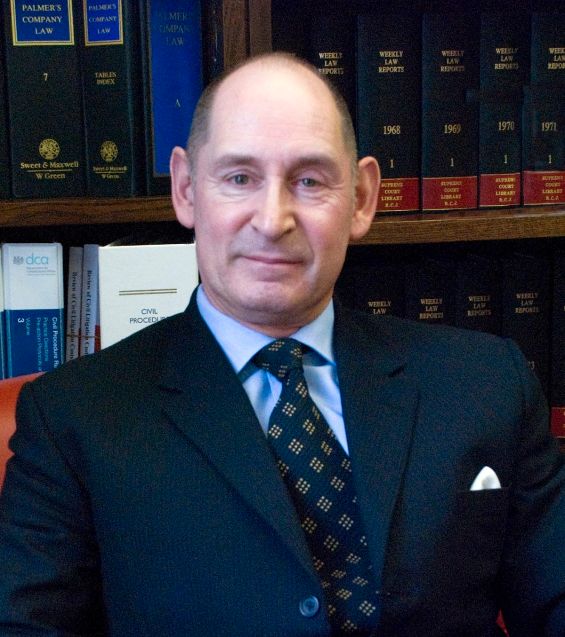
Sir Terence Etherton, Master of the Rolls

They are the Master of the Rolls, 69 year old Sir Terence Etherton; Lord Justice Sir Nicholas Underhill, 68, and Lady Justice Dame Vivien Rose,60.

The DWP engaged Sir James Eadie known as the ” Treasury devil” – one of the most powerful lawyers employed by the government, to argue their case.

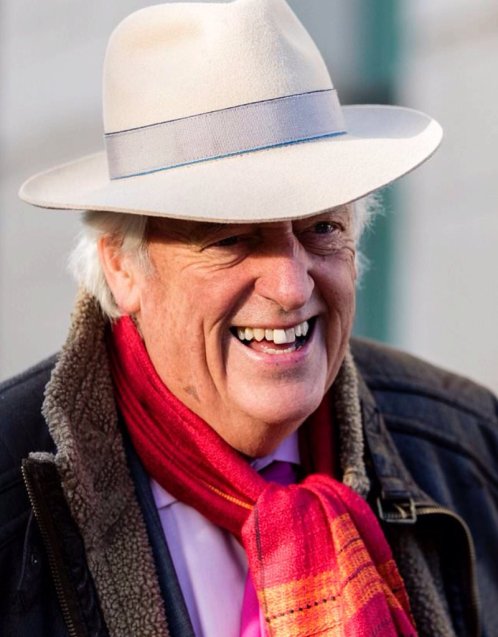
Michael Mansfield

BackTo60 brought in Michael Mansfield, one of the leading human rights lawyers as part of their team.

Government concede victory to unions over pension discrimination for over 4.1 million public sector workers

Stephen Barclay, chief secretary to the Treasury. Pic Credit: gov.uk

Judicial review forces ministers to open negotiations and defer major changes to pension schemes until 2022

Steve Barclay, Chief Secretary to the Treasury,chose a heavy news day today to slip out an announcement that the Treasury had finally given way to the courts and dropped pension discrimination against 4.1 million workers in Whitehall, the NHS,teachers, prison officers and firefighters and ambulance staff .

This came after losing legal battles to the FBU firefighters union, the GMB, the PCS Whitehall union and the Prison Officers Association over what was seen as age discrimination over cuts to their workplace pensions.

The announcement means that terms offered to staff will revert back to the original position – and that includes a lower retirement age – until 2022 and everything is up to grabs during fresh consultations.

£2.4 billion in pension surpluses

It could also mean that some £2.4 billion at present held in pension surpluses, particularly in Whitehall, may have to be redistributed back to the workers in reduced pension contributions or better benefits.

The sting in the tail is that the government want the costs of the victory won by the FBU at the Court of Appeal – which scrapped a discriminatory system that put younger people employed at a disadvantage – should be taken out of the pension surpluses.

The story of the FBU victory appeared in an article in December on this blog.

Any such moves are to be fiercely resisted by the unions. As one GMB official put it: ” We are not going to accept we should pay when we won the argument and the government lost.”

“They knew they were wrong”

Rehana Azam, GMB National Secretary said: 

“It’s welcome that Ministers have in the face of sustained pressure finally U-turned on the pause they imposed on the drawing down of pension benefits. Their indefensible decision has left public sector workers facing financial hardship. 

“GMB has long campaigned for the lifting of the benefits pause the Government unilaterally imposed on our members without consultation. Hard-working public sector workers should now get what they’re owed. 

“The Government has had to make a U-turn because they knew they were in the wrong and were poised to lose the Judicial Review GMB and others had brought against them.  

“Any suggestion that it should now be public sector workers who now bear the costs of Ministers’ discriminatory errors will be fiercely resisted. GMB will not stand by if the Government intends to break its word and force public servants to pick up the bill for its own mistakes. “

The timing of the climb down is interesting as it comes a week before the court of appeal hears the case against raising the pension age from 60 to 66 without proper notice brought by BackTo60 on behalf of 3.8 million women demanding full restitutionb for the loswt money.

The GMB which led the charge over part of the fight is 100 per cent behind the 50swomen and their cause to get their money back.

On Scarlet Standard: How the 50s born women could swing marginal seats in 2019 election

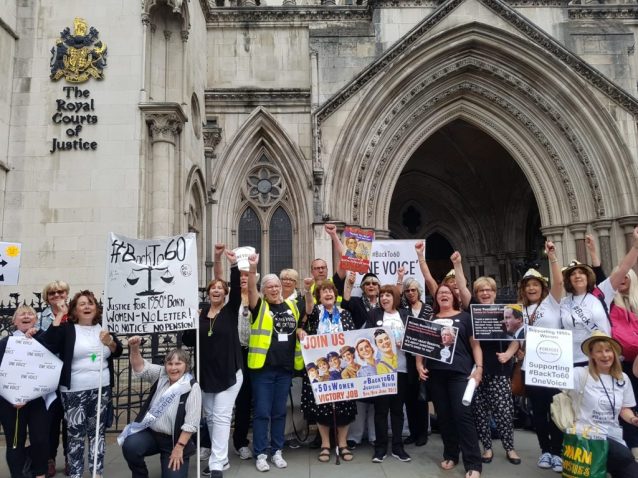
BackTo60 outside the Royal Courts of Justice after the judicial review.

My first article for Scarlet Standard – a new on line magazine for the Labour movement – highlights the plight of 3.8 million women born in the 1950s who are now waiting up to six years to get their pension.

Read it in full here. The gist is the present Tory government don’t plan to do anything about it – but the Labour Party, the Liberal Democrats and the Scottish National Party have got to up their game to get their vote. And there is everything to play for. And the women have the power to decide who could be elected.

Permission to Appeal lodged in High Court for 3.8 million 50s born women who lost their pensions

Going back to the High Court for permission to appeal

The BackTo60 organisation which represents 3.8 million women who face up to six years delay to get their pension has lodged its application for permission to appeal at the High Court.

The decision to go ahead comes on the back of a successful crowd funding appeal which has raised over £70,000 of the £72,000 in a week. The fund raising is to remain open as it will have to cover both the legal action and further campaigning.

The mass media coverage in the Daily Mail and the Express following the judgement by Lord Justice Irvine and Mrs Justice Whipple to turn down the judicial review on all grounds to compensate the women has boosted interest in the case. Perversely the damning judgement created a wave of sympathy for the women and spread the word to a much wider audience.

Lawyers advising the group including Michael Mansfield have decided there are good grounds for appeal but will have to develop their case in seeking permission to appeal.

No date has been fixed yet for a hearing.

Meanwhile BackTo60 is receiving support from people who used to support the original Waspi campaign but now feel they are no longer interested in helping the bulk of the women who are affected by the big rise in the pension age.

One is Lizzie Spring, a former co-ordinator for Waspi in London.

She told me: ” I’m gobsmacked by the JR. I expected some restitution of our lost income, if not back to 60 at least back to the State Pension Age changes added in 2011. The tone and content of the ruling seems so adamantly ignorant of most women’s lives for the past fifty years. Some of it is risible. Men are discriminated against because women were expected to retire early from paid work, to do the housework, cook and provide them with company?  Women’s financial and domestic inequality and lack of opportunities are cultural norms?

” It is shocking that two very materially wealthy people that nobody has elected into power, have the right to inflict such beliefs on so many women. I am not coping with the situation well. It is bewildering to me and almost impossible to believe highly educated people really view women’s historical poverty and imposed inequality in this way. I’m also of course personally still facing being poor my whole old age so I’m frightened and furious about the outcome too.”

She is also scathing about the offer being negotiated with Therese
Coffey , the works and pensions secretary, by the two joint chairs of the All Party Parliamentary Group on behalf of Waspi Ltd.

” It means accepting a lower pension and only some compensation after the age of 63 I think it’s a disappointment. It  risks compounding the poverty of women with the least money who might take such an offer out of desperation.  It contains nothing to support the many women who’ve cashed in small private pensions and/or sold homes to survive for five plus years. The compensation after 63 would take ages to implement even if accepted and if not even backdated, would not be compensation but just a sop for a few. Those of us who’ve finally got state pensions but have spent all our lifetime savings while waiting, will presumably just continue to live in poverty, which is pretty bleak.”

Nor is she impressed by Boris Johnson seeking her vote
“Johnson’s entire shtick is being untrustworthy and it’s an embarrassment having him as PM. I’d not vote Tory anyway so his predictable betrayal of 1950s women doesn’t affect my vote.”

And she is interested in the idea of using a Special Temporary Measure in Parliament to compensate the women : “It’s quite exciting on first viewing. But If it’s used as a route it will need to be done with huge amounts of hard evidence.

“Whoever presented the case would need a great deal of sensitive intelligence in relation to how much women are apparently still resented if we ask for equality. If decisions are made by people with no understanding of inter-sectional discrimination it’ll likely have the same outcome. “

The signs are despite a campaign to try and suggest that the settlement being negotiated with the government by the two MPs Carolyn Harris and Tim Loughton is the only game in town, people are starting to vote with their feet and backing groups that want full restitution.

Boris Johnson’s two faced “support ” for 3.8 million 50s born women who lost their pensions

Boris Johnson’s big U turn on helping 50s born women over their pensions

In July well before the publication of the decision of the judicial review Boris Johnson during the Tory leadership campaign was quoted by Dan Bloom in the Mirror of promising some sort of support for 50swomen who had to wait up to six years for their pension. The quote reproduced by the BackTo60 campaign in the picture below raised hopes that the present government might soften its attitude and offer something.

Image

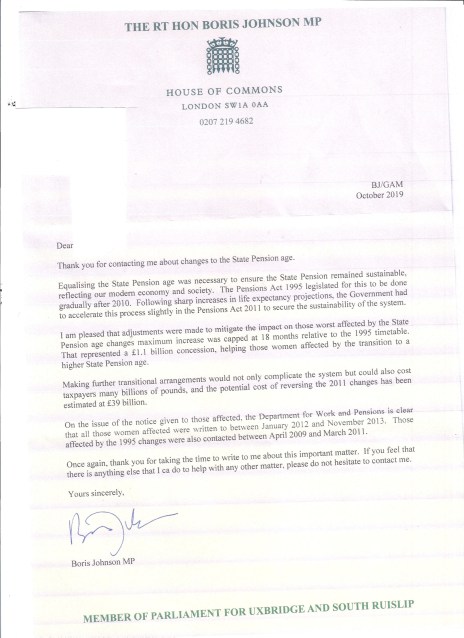
Now just after the publication of the judicial review decision he has changed his mind. Writing to a constituent in Uxbridge and South Ruislip who wishes to remain anonymous he has completely backtracked and also got some of the facts wrong into the bargain.

In a letter to her he now is promising nothing.

” Making further transitional arrangements would not only complicate the system but could also cost the taxpayers many billions of pounds and the potential cost of reversing the 2011 changes has been estimated at £39 billion.”

He then goes on to state that people affected by the 2011 change had all been told between January 2011 and November 2013. And further claims that those affected by the 1995 Pensions Act which raised the pension age were all told between April 2009 and March 2011.

The latter is a major gaffe since even I, as a severe critic of successive governments handling of the issue, would concede that some people were told before 2009. It also is an admission that the whole purpose of introducing the change in 1995 so people had notice was a failure – as April 2009 is just one year before the changes started to take effect. What a monumental own goal.

He also seems to confuse the role of the £1.1 billion concession in 2011 to delay the effect of further changes to the additional rise of the pension age to 66.

He seems to think this was a godsend for women claiming that he was pleased that it mitigated their position. In fact it only delayed the rise and also helped men who started to be affected after 2018.

Finally he talks of the ” sharp increases ” in longevity making the system, unsustainable. Well these cease in 2011 and have flat lined – even falling in the poorer areas such as Blackpool, north of Glasgow and in North Wales.

I can only hope that the PM has a proper understanding of the current negotiations going on over Brexit – because if this is an example of his grasp of facts – they are going to get in a real mess this week.

It also means – if this is now the PM’s view – that Carolyn Harris, Labour MP for Swansea East and Tim Loughton, Conservative MP for Worthing East and Shoreham, are wasting their time seeing Therese Coffey, the new works and pensions secretary to discuss any concessions for the 50s women on behalf of the all party group against pension inequality.

For the women themselves the one power they have left is their vote at a soon to be called general election. Unless they are happy to remain living in poverty voting for a new Conservative government is a waste of space.

On Byline Times: BackTo60 group to seek permission to appeal Judicial Review blocking compensation for 50swomen pensions.

Campaigners after the judicial review.

Tonight I have written a story for Byline Times disclosing that lawyers have decided to seek permission to appeal the Judicial review which rejected all the discrimination claims for the 1950s born women who face a six year delay in getting their pension. The story is here.

BackTo60 have also launched a £72,000 crowdfunding site to raise money for this action. The crowdfunder site is here. Already at time of writing it has raised over £10,000.

On Byline Times: BackTo60 fight on after pension age judicial review dismissed

the fight goes on!

I have written an article for Byline Times on the judgement and the next steps to fight it. Byline Times are also committed to following the story.

The article is here.

The two legal views on the rights of 3.8 million 1950s women to get full restitution for their lost pensions

BackTo60 outside Royal Courts of Justice

The decision by Lord Justice Irwin and Mrs Justice Whipple to dismiss ALL claims of discrimination and failure to inform 3.8 million women born in the 1950s about the rise in their state pension age from 60 to 66 is in total contrast to the decision of Mrs Justice Lang who granted ALL the claims to be heard four months ago.

Obviously there is a big difference between permission for a judicial review to be granted so the case can be argued than a judicial hearing where the arguments are tested.

Nevertheless this startling contrast to me suggests that there are grounds for an appeal because the two judgments are so far apart. That is presumably why the two judges did not ban an appeal.

To remind people Mrs Justice Lang decided that even though the 1995 Pensions Act was passed 24 years ago the effect of the implementation of the Act was happening now and therefore this issue was subject to judicial review. She also agreed that both age and sex discrimination could be part of the hearing, and the issue on whether government action was contrary to EU directives on social security and whether people had been adequately informed about the changes.

The two judges have rejected all of this and upheld the case put by the Department of Work and Pensions in its entirety. No wonder the DWP is cock a hoop today.

They describe any challenge to primary legislation passed over 20 years ago as ” fatal” and they have published in detail all the attempts by the DWP to inform people. They have included discussions from 1993 onwards about changing the law as part of informing people.

But they abrogate any responsibility on whether the DWP did a good job or not. ” We are not in a position to conclude that the steps taken to inform those people affected by the changes to the state pension age for women were inadequate or unreasonable”.

They have also accepted the DWP’s argument that it was under no obligation to tell people at all and certainly not to individually informing anybody about the change because it was not written into the law.

This ruling should be a red line for MPs to insist in the future that any Parliamentary legislation that affects millions of people must include a clause requiring a ministry to individually inform the people affected in language they can understand and in good time.

Goodwill or good sense is obviously not enough to be left in the hands of individual ministers. It must be made mandatory that people are told.

The arguments over whether government action in handling the rise in the pension age contradicted EU directives amounted to age and sex discrimination or indirect legislation are complex.

But broadly the judges have accepted the DWP’s interpretation of the wording so as to exclude the changes to the pension age from any such directives.

They have also ruled out the role of the UN Convention on the Elimination of Discrimination against Women from having any bearing on the case.

” We have not been assisted by reference to CEDAW, it adds nothing to the claimaint’s case”, they say.

Their main argument is that the 1995 Pensions Act removed an advantage (my emphasis) that women had over men at the time they retired and anyway the decision was part of primary legislation which could not be challenged.

Jackie Jones, Labour MEP for Wales and an expert on CEDAW, says the judges have misunderstood the purpose of CEDAW which could make a possible grounds for appeal.

In her view the Judges did not consider the cumulative effect of unequal laws in the past on this particular group of women who were denied contributing to their own pensions when they worked part time which is one of the issues covered by CEDAW.

The judges also ruled out the recent victories in civil service and firefighters pensions having any bearing on the case because they involved transitional arrangements for work pensions rather than their right to a state pension.

Despite the harshness of the judgement the immediate effect has been to create widespread sympathy for the plight of the 50swomen in the media, among the general public and brought finally to national attention the whole issue.

It has also galvanised campaigners to fight on and with a general election on the horizon to put politicians in all political parties under pressure. It could cost the government, if it does nothing, 3.8 million votes from people who reliably go down to the polling station.