How government cuts led to blunders in complex criminal compensation awards

carole oatway chief executive of the Criminal Injuries Compensation Authority

Carole Oatway, chief executive of the Criminal Injuries Compensation Authority

CROSS POSTED ON BYLINE.COM

The government’s obsession with cutting Whitehall  staff is always portrayed by ministers as getting more ” value for money” and greater efficiency. No doubt it will be said again when the remorseless reduction continues over the next two years.

Yet this year’s  crop of annual reports has produced  a vignette from one Whitehall body that nobody knows much about which rather disproves this case.

The Criminal Injuries Compensation Authority is not well known but for those who suffer serious injury it is vital to ensure they receive some compensation for an injury that is no fault of their own. They include British victims of terrorist attacks including recently those injured in Paris and Tunisia and the families of those killed.

Most of its payouts are routine based on a tariff which was already reduced to save public money by Chris Grayling when he was justice secretary.

But for 10 per cent of claimants their cases are complex and they need a detailed assessment by Whitehall staff. It is these that have gone wrong.

As I wrote in Tribune this month the situation through staff cuts and people quitting the agency because of stress caused by their workload. The agency admits it itself.

It’s annual report for the last financial year says: “This issue … is the consequence of an exceptional level of staff turnover in 2015-16, that has resulted in a reduced level of resources  across increasing workloads. This situation is now being rectified with a major recruitment exercise underway.”
The errors were originally found when the National Audit Office, Parlia­ment’s financial watchdog, ran a spot check on payments made to victims in complex cases.
The worst case involved a significant overpayment of £69,023 on an award of £356,964 due to a maths mistake by a caseworker.
Another case revealed a potential underpayment of £15,118 on an award of £69,976 on a case involving two linked claims for dependency.
Other mistakes included under­pay­ments of £80 on a £395,727 award, £1,463 on a £113,071 award, and over­payment of £42 on a £445,355 award.
The NAO investigation triggered an internal inquiry by the agency which found even more errors. The CICA has now ordered a review into its practices.

The report says : “CICA tested a further 98 complex cases, based on a random sample selected by the NAO, and found 17 errors; 8 overpayments and 9 underpayments. These included three errors over £10,000 and four errors of under £80 on sample of cases with a combined value of over £5 million.”

The CICA took its time to reply to me and had to be pressed to admit that while it was refunding those who had been shortchanged it had no power to claim back money it had overpaid. Good news for those who got more cash but hardly an efficient way to run a service.It also stressed that it was only a relatively small number of people and not a huge part of its budget.

But this is not the point. For the individual suffering some damaging injury an underpayment of £15,000 is not a sum of money they won’t miss.

There is also a much wider point. Civil service cuts have also led to people being underpaid benefits, short changed on taxes and the bad handling of cases by public bodies. Cuts being imposed next include the Equality and Human Rights Commission losing lower paid case workers – meaning it will either cut the number of cases it handles or open the risk of stressed staff making mistakes. None of this seems to affect the higher paid.

The government should realise that it can’t magic savings in public services without any consequences for the general public. Something I suspect they won’t want to know as it damages their belief  that austerity doesn’t matter.


How the NHS wasted £16m of your money on a botched privatisation that collapsed within months

portrait-meghillier

Meg Hillier MP:,chair of the Commons Public Accounts Committee, condemned the failings in the scheme

CROSS POSTED ON BYLINE.COM

New ways of  helping the elderly and mentally ill survive in the community and not continually end up in hospital is a cornerstone of government policy.

So when a limited liability partnership offered a cash strapped  NHS commissioning group an initiative which promised better services for these people and could save them £178m over five years it sounded too good to be true.

The trouble is it was. As a devastating report from the National Audit Office reveals today the £800m scheme  ran into trouble just four weeks after it was launched and collapsed seven months later. You can read the full story on the Exaro website.

The scandal of the £800m scheme run by UnitingCare Partnership for Cambridgeshire and Peterborough clinical commissioning group may not be an isolated instance.That is why sources at the National Audit Office have highlighted it in their report – because it exposes an alarming lack of financial expertise inside the NHS and a flawed system to monitor whether projects like this are financially feasible  andcan  be properly checked.

The promised aim of the project was to establish  tapering payments to the partnership – with £152m up front and less money later, ¬ so that the financially challenged commissioning group could put money to better use.

But within four weeks of starting the contract the partnership was asking for an extra £34m, blaming a delay by the commissioning authority in starting the work. When the money was not forthcoming the scheme collapsed after eight months and the NHS was forced to provide services directly.

The NAO report reveals that despite employing reputable financial companies and lawyers, basic errors were made – including a failure to realise that sub-contractors could not recover the VAT from the partnership – a cost that had not been factored into the contract.

Auditors also report that nobody had overall oversight of the contract.

No wonder both Amyas Morse, the head of the NAO, and Meg Hillier, the Labour chair of the Commons Public Accounts Committee have been withering in their criticism.

Amyas Morse said: “This contract was innovative and ambitious but ultimately an unsuccessful venture, which failed for financial reasons which could, and should, have been foreseen.”

Meg Hillier said: “The result is damning: a contract terminated before the ink had even dried out, at an unnecessary cost of £16m.”

What is disturbing is that the NAO point out that Monitor, the body which checks health bodies, had no locus to check whether the scheme was viable and NHS England were too remote to act.”

The report says: ““No organisation was responsible for taking a holistic view of the risks and benefits of this approach, or considering whether the anticipated longer‐term benefits were sufficient to justify additional short‐term support.“

What is really disturbing  is that £16m was wasted -plus £8.9m  on setting up a complex tendering operation and start up costs.

Far better to have spent this extra money on patient and community care – instead of throwing our money down the drain on a scheme that anyone would have thought to be too good to be true.


Where’s St Helena? It’s off Jersey isn’t it?

St Helena Pic Credit St Helena government

St Helena: in the South Atlantic not off Jersey. Pic Credit: St Helena Government

CROSS POSTED ON BYLINE.COM 

A rather amusing aside was missed by the national press and the BBC when they reported on the scandal last week of  St Helena’s  spanking new £285m airport which can’t be used by jets because it is too windy to land.

True they had fun with the video of a British Airways  jet having to abort a landing because of the wind. So no chance yet of a new tourist boom because the only way there is by a six week journey on an ageing mail boat.

But they missed an extraordinary table hidden in a report commissioned by the St Helena government about where the island was located.

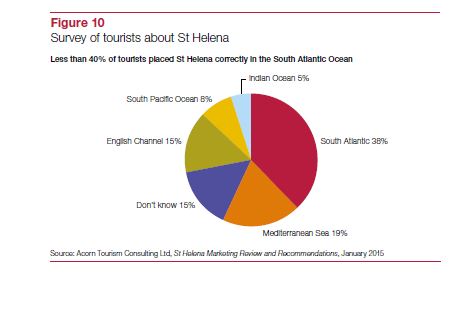
The National  Audit Office reports  that a marketing company- Acorn Tourist Consulting – asked lots of savvy long haul tourists where  is St Helena.

Extraordinarily 19 per cent put the island in the Mediterranean – perhaps near Malta or Cyprus.

Another 15 per cent put the island in the English Channel – perhaps confusing Jersey’s St Helier with St  Helena.

Another 8 per cent thought it was a tropical paradise in the South Pacific – perhaps near Fiji!

And another 5 per cent thought it was in the Indian Ocean – somewhere near Sri Lanka perhaps.

And 15 per cent admitted  honestly they hadn’t a clue.

This left just 38 per cent who correctly identified it as a rocky island in the South Atlantic.

Mind you it might be as well that the Department of International Development has mucked up the project. Not only will it give it time for the island to find a jet that could land safely there but it will give isolated  St Helena a bit longer to prepare for the tourist hordes.

For the same company which discovered the ignorance of British tourists has issued another health warning about going there.

It warns: “There will be new expectations of St. Helena as a destination. In just over 4 hours the tourist will have flown from South Africa to the Island. No time to adjust, reflect, read, and prepare for arrival as they do at the moment. This is likely to make visitors more demanding and less forgiving. They will start to lose sight of the remoteness and challenges an island 1,200 miles off the coast of Africa and 1,800 miles from Brazil faces.

Today, very few tourists leave St. Helena disappointed, but this may change once tourists start arriving by air. St. Helena then runs the risk of over-promising and under-delivering, and this will lead to some tourists returning home and not passing on in a positive way that most effective form of marketing – word of mouth.”

 Perhaps it might be better to look for St Helena off Jersey after all.
St Helena

The report’s findings in the National Audit Office report

How EU law hobbled Parliament investigating worst mis-selling scandal in history

CROSS POSTED ON BYLINE.COM

The scandal of the mis-selling of Personal Protection Insurance is well known as one of the worst financial scandals in history.

Some 12 million people have received £22.5 billion in compensation from  unnecessary Payment Protection Insurance (PPI) schemes sold to gullible people.

And to compound it a National Audit Office report  (NAO) last week highlighted how cold calling claims management companies had ripped off £3.8 billion and £5 billion of the compensation paid for work which could be done by claimants for free.

What might also shock people – particularly in the current debate over whether we should quit the European Union – is the revelation by the NAO  that it could not complete the investigation  to its satisfaction because a European Union directive banned Parliament from getting confidential information. I have written about this in this week’s Tribune magazine.

The situation is this. As well as finding out the scale of the problem the NAO wanted to know -on behalf of you the taxpayer – whether the public watchdog the Financial Conduct Authority had done its job its ensuring the many banks and financial organisation had smartened up their acts to prevent a repetition.. Particularly as they are fears that there could be a new scandal involving the mis-selling of annuities and pension schemes.

The FCA had collected this information but refused to hand it over to Parliament’s watchdog.. The reason it turned out is that the Financial Services and Markets Act 2000 combined with EU law restrictions prevents them obtaining the information from the FCA.

As the NAO said: “ This limits our ability to reach a judgement on the FCA’s value for money, as we could not carry out a full assessment of the effectiveness of the FCA’s actions…. we have only limited evidence on how the FCA’s actions have changed firm behaviour, and how effective its redress schemes have been in providing compensation to consumers.”

The NAO tried to get around this by contacting some 20 banks and financial companies and asking them to volunteer to disclose the information. Fifteen did reply but five including two of the companies with the largest number of complaints, Barclays and British Gas Services, declined to provide any information.

The 15 who did reply included HSBC Bank plc; Lloyds Banking Group; MBNA Limited; Nationwide Building Society; NFU Mutual Insurance Society and Santander UK plc.

But a NAO spokesman said: “The information we got from the others while helpful, didn’t enable us to carry out a full assessment of the effectiveness of the FCA’s actions.”

What  is the EU doing putting  the interests of banks above people and Parliament. The NAO is now asking the Treasury to pass a law allowing it some access to this information but it will have to bow to EU law on how much can be revealed.

I am not a supporter of Brexit but it seems to me there is something very wrong here that needs changing. I am surprised that the vociferous campaigners for a No vote have not latched on to this – even if it is in the small print of the report. The NAO is obviously an independent source with no axe to grind over Europe. But it has provided campaigners who say we are not in control of our country with a very potent example on a very serious issue.


How the Legal Ombudsman’s Office ripped off the taxpayer with a £1m irregular incentive scheme

CROSS POSTED ON BYLINE.COM

What  would you think if the organisation that handles your complaint against a poorly performing solicitor or barrister was itself ripping you off as a taxpayer?

That  is the extraordinary situation in the Office of Legal Complaints or Legal Ombudsman for the last six years where well over £1m extra cash has been paid to its staff  without approval from anyone just to keep them from taking jobs in the private sector.

This was exposed last month in a  virtually unreported disclosure from the National Audit Office. I have written it up for Tribune magazine this month.

The office handles tens of thousands of complaints every year from the general public about poor service from legal professionals – whether it is over conveyancing,personal injuries, wills or family disputes. What emerged about what was going in this office of over 200 people has led to resignation or dismissal  ( whether you take his version or the Ministry of Justice’s ) of its £167,000 a year head, Adam Sampson  who has been described by his permanent secretary as “ not a fit and proper person” to continue  as an accounting officer to Parliament.

He presided over what the NAO called a ” novel and contentious” irregular payment scheme which saw its top officers and the rest of his staff benefit from pay enhancements well beyond anything else available in Whitehall currently suffering pay freezes and one per cent pay rises.

The two unauthorised pay schemes were aimed to retain legal staff who might be tempted to leave and join the private sector. One for senior executives was according to the annual accounts “a benefit in addition to salary and was ­believed by the OLC at the time to be necessary to attract and retain the best candidates nationally to senior posts within the organisation”. Some £33,000 was paid out the last financial year – ­altogether some £348,000 has been paid over six years.

The second scheme for general staff allowed up to an extra 3 per cent to be paid on top of their salaries to encourage them not to leave to join the private sector. This cost nearly £900,000.

Neither scheme was authorised by the Ministry of Justice and neither was spotted for four years either. Successive Lord Chancellors -Kenneth Clarke and Chris Grayling didn’t notice.

On top of this there is suggestion of  alleged expenses fiddling by the chief executive.

The report said an arrangement from 2009 assumed “Mr Sampson to be living in Birmingham [where the OLC offices were based from January 2010] despite his only spending up to two nights a week in Birmingham away from his London home.”

The claims involved train fares which could not be solely justified for business use between London and Birmingham.

The Ministry has reported him to the tax authorities for not declaring them as a benefit in kind. Altogether he had received over £27,000 in benefits in kind over the last two years in office.

What is extraordinary is that the two schemes are still in existence today and the Treasury is still trying to end them this year. The reason is that the contracts drawn up by lawyers are so watertight that the Treasury is having difficulty unravelling them.

One can only say that if the lawyers at the Office of Legal Complaints spent as much time providing a good service to the  public as they did in drawing up lucrative contracts for themselves Whitehall would be a much better place.

How Kenneth Clarke and Chris Grayling’s failed commercial venture cost us the taxpayer over £1m

CROSS POSTED ON BYLINE.COM

An extraordinary report published by the National Audit Office today on ” Just Solutions” – the commercial arm of the Ministry of Justice set up by former Lord Chancellor Kenneth Clarke – reveals that taxpayers have lost over £1m on the failed venture.

Remember this was promoted by Chris Grayling so the Ministry of Justice could make money by selling prison expertise to regimes with appalling judicial systems like Saudi Arabia and Oman. It was closed down by Michael Gove when he became justice secretary after the election.

Now the NAO reveals that not only was this unethical but it actually cost the taxpayer money. Indeed one can see how desperate the government might have been to sign a  £5.9 m contract with Saudi Arabia and further contracts with Oman – as this would have been the only way it could have made a profit out it.

Instead over four years  from 2012 to this year  it lost £302,000, £390,000 £317,000  and £141,000 respectively. leading to a £ 1,150,000 cumulative loss for the taxpayer.

And its scope was much wider than people realised with projects in Nigeria, the Seychelles, Libya, Estonia, Mauritius, Bermuda, the Cayman Islands as well as private study visits to drum up business in China, Bangla Desh, Turkmenistan and India.

As the NAO found: ” The cost of setting up JSi exceeded the income generated by completed contracts. We estimate that JSi’s costs were approximately £2.1 million from 2012 until its closure, including £239,000 on consultancy services. Therefore JSi made a net loss of approximately £1.1 million in this period. This is due, in part, to the decision to withdraw from prospective arrangements with Saudi Arabia and Oman.”

The report discloses that it had big plans for Oman.

“The initial proposal, Phase 1, was for a small piece of work to critique the plans of an
existing prison and was valued at £98,000. This was expected to be followed by work
to develop a new prison in Oman, Phase 2, valued initially at approximately £4 million
but later negotiations increased this to £7.8 million. In addition, preliminary discussions
were held in 2014 with the Omani government around a national training programme.”

Grayling also spent £6500 fighting off a judicial review  of its activities before the organisation was closed by Michael Gove.

This is all a far cry from the boasts in the Ministry of Justice six monthly report saying it was all contributing to the ministry’s budget and supposed to be saving the taxpayer money. Instead it was racking up debts.

This a sorry tale for anybody who has a shred of ethics and thought Britain should not be helping regimes that flog and behead offenders. Bur the fact that it lost money doing it is  a  further damning indictment of the government and Chris Grayling.

As Meg Hillier, chair of the public accounts committee, said yesterday:  “When Just Solutions International was closed down it had made an overall loss of £1.1 million despite a commitment that it would be self-funding by April 2013.

“Despite being a commercial venture, it generated less than £1 million income over three years.

“I am concerned by the loss of taxpayers’ money on this failed venture, and the Ministry of Justice’s ongoing work with countries with questionable human rights records.”


Revealed: The Treasury mandarin who said losing £1bn for the taxpayer was value for money

john kingman, second Permanent secretary at The Treasury Pic Credit: worldellows.yale.edu

john kingman, second Permanent secretary at The Treasury Pic Credit: worldellows.yale.edu

CROSS POSTED FROM  BYLINE.COM WHERE SOME OF MY WHITEHALL AND WESTMINSTER SCOOPS WILL NOW APPEAR FIRST AS PART OF A NEW CROWDFUNDING DEAL TO WIDEN THE SCOPE OF THIS BLOG

There has been enormous outrage about the £1bn loss to the taxpayer caused by the sale of the first tranche of Royal Bank of Scotland shares. An article in The Guardian on August 4 reported not only expected criticism from Labour but concern from a banking analyst that the share price of RBS was too low to justify the sale.

What was only briefly mentioned was that the second most powerful mandarin in the Treasury had also given the go ahead. You might expect him to bow and scrape to the Chancellor but actually he has more powers than you might think and he needn’t have followed his instructions.

If an accounting officer believes that a government minister is about to make a decision that will lead to a big loss to the taxpayer he can refuse to approve the action.

These actions are not taken lightly – one of the most recent examples being the refusal by Richard Heaton (soon to become Permanent Secretary at MoJ) who requested one, on value for money grounds, on 26 June over extra funding for the Kids company charity. He was overruled by ministers who have now seen to have made a big mistake as recent coverage reveals.

John Kingman could have done the same thing. He would face being overruled by George Osborne but it would have caused a furore and triggered an eventual Whitehall investigation.

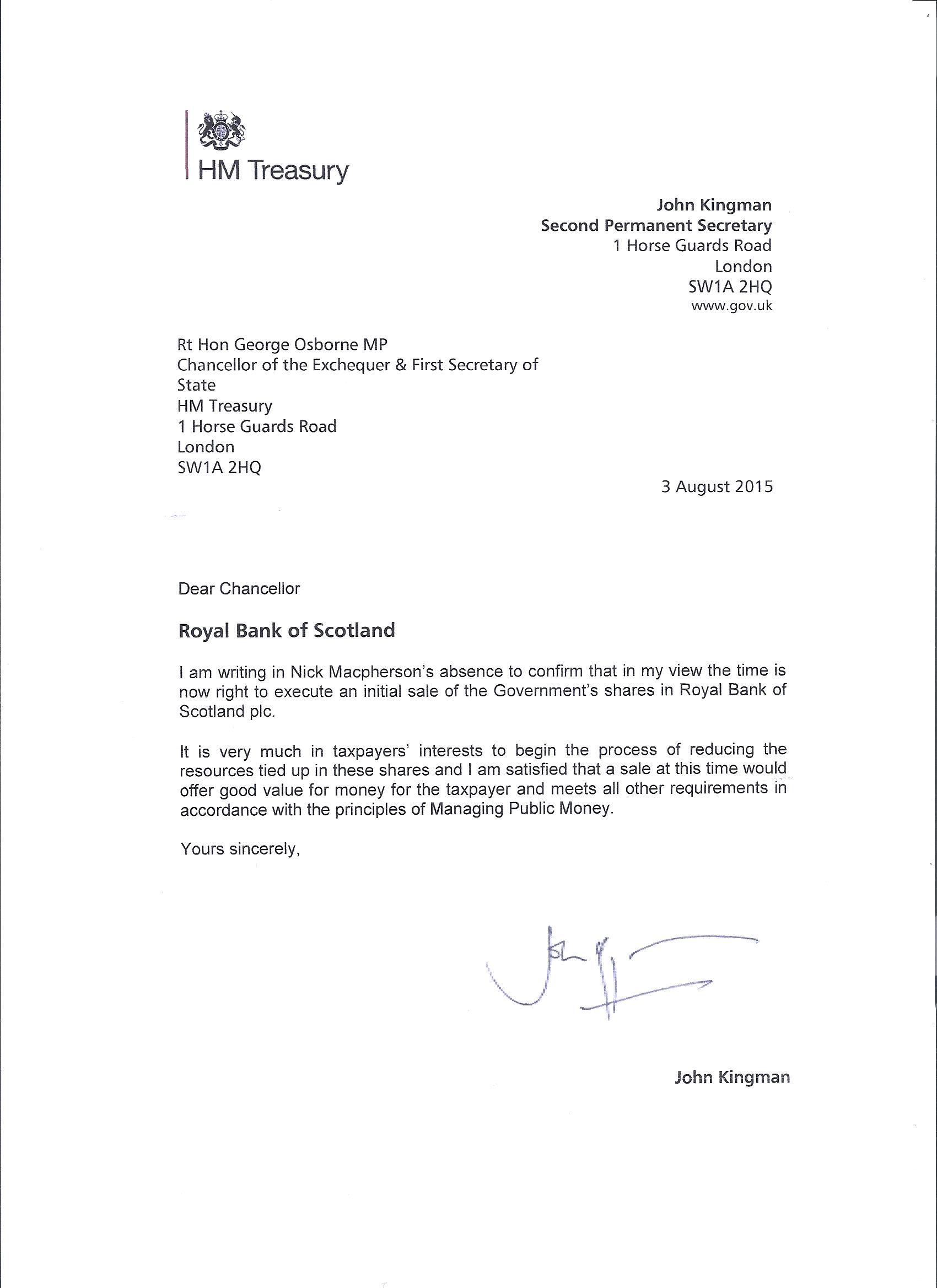
John Kingman Letter Instead as this letter above shows he has positively embraced the sale.

“ I am satisfied that a sale at this time would offer good value for money for the taxpayer and meets all other requirements in accordance with the principles of Managing Public Money,” he wrote to George Osborne.

Really?  Now John Kingman is one of the cleverest mandarins in Whitehall. He hates holidays, lives in Leicester Square and one former colleague describes him in these words: “His arrogance is only marginally ahead of his considerable intelligence, whereas with most ambitious men of his ilk the gap is rather larger.” A profile in 2009 by political editor George Parker in the Financial Times says it all.

He writes “If he can achieve the goal of unwinding the taxpayer’s stake ( in RBS) at a profit, his route to the top of the civil service is clear, even if some question whether he has the patience to manage such a huge, traditional organisation. “

Well at the moment he hasn’t – he has acquiesced in a £1 billion tax loss. And I am not the only one who has noticed this.

The National Audit Office, Parliament’s financial watchdog, which reports on state asset sales, confirmed to me “We are watching the situation”.

They will have to make a report on this. This will lead him to have to appear before the House of Commons public accounts committee to justify why he approved what was done.

No doubt the government would like Parliament to take its time – perhaps not report until the entire sale is over – but that won’t be until 2020.

I say the huge loss to the taxpayer should not go unchallenged for years. Bring it on now!

Why the Tories have only themselves to blame for not reining in BBC excesses

Last week top BBC figures cut a pathetic stance in front of the Public Accounts Committtee. But two years ago Jeremy Hunt, the culture secretary, actually PREVENTED the National Audit Office from getting direct access to their accounts. Don’t take my word for it, see the actual correspondence between Sir Micheal Lyons, Chris Patten, Jeremy Hunt, and Amyas Morse, head of the NAO released under Freedom of Information to Exaro News. How dare Maria Miller now say she wants direct access to accounts, it could have been done two years ago

davidhencke's avatarWestminster Confidential

Remember the great fuss from the Conservatives on how they were going to hold the BBC to account, expose those mega salaries paid to Graham Norton and Jeremy Paxman and make sure the taxpayer got the best value for their money from the BBC.

Well if you beleive  culture secretary Jeremy Hunt and Lib Dem culture spokesman Don Foster, it will be all happening from next year in the new cash frozen agreement to fund the BBC. He has spent the last year telling us about his success in allowing Parliament’s National Audit Office the right to launch any inquiry it likes into whether the BBC is value for money.

To quote him directly: “It is right that licence-fee payers have confidence that the BBC is spending money wisely, so I am pleased that the NAO now has the right to full access to BBC information. Its new power to decide which…

View original post 617 more words

Why Eric Pickles will allow councils to fiddle your cash – MPs’ damning verdict

Eric Pickles:will he make it easier for councils to fiddle your cash?

Eric Pickles:will he make it easier for councils to fiddle your cash?

Do you believe your council spends your money wisely? Are you sure none of your council tax is wasted through incompetence or fraud? Do you trust all your local politicians to be honest? Probably the answer to all three is no!

Communities Secretary, Eric Pickles, has a flagship policy of scrapping the body that  tries to protect you from all of this – the Audit Commission. His passionate belief is that this body of highly skilled auditors and officials  is a load of bureaucratic nonsense – and has produced figures to claim that the public will save  over £1bn in a decade by scrapping it.

Now an all party committee of MPs led by the indefatigable Margaret Hodge, scourge of  tax avoiding Amazon and Starbucks and chair of the Commons Public Accounts Committee, has come to some damning conclusions on what the government is about to do. There is a full report by me on the Exaro News website (http://www.exaronews.com).

Basically Pickles wants to leave it to local councils, health trusts and the new NHS commissioning bodies to police themselves by appointing their own auditors,taking away a whistleblower hot line to the Audit Commission, and allowing big accountancy firms  free rein to up their charges by picking off individual councils. It also allows  even more cosy relationships to be built between the auditor and the local council and leaves whistleblowers nowhere to go.

Given the present background of mass privatisation of services this plain daft. The most extreme example is Tory controlled Barnet’s plan to hand almost everything over to the private sector – see the Broken Barnet website for detailed coverage (http://wwwbrokenbarnet.blogspot.co.uk). Are locally appointed auditors going to be up to doing a tough job – already Grant Thornton missed the MetPro private securityscandal in the borough. How will they keep up with all the services being privatised?

Some amazing facts are comments in  the report. The government claim it will save £137m a year. The MPs say the figure is more likely to be £2.4m. They warn of a fragmented and more complex audit regime.

And on the appointment of local auditors they say: “The proposals for self-appointment of auditors risk compromising the independence of audit. The Government must intervene to ensure that existing governance structures within local bodies are not duplicated; existing contracts are managed proficiently; economies of scale in audit fees are not lost; quality of audit does not diminish; value for money can be measured comprehensively and consistently; fees, especially for smaller bodies, do not increase as a result of increased tendering costs and potential limitations to the market in audit and; processes for auditor removal, whistleblowing and public interest reporting are rigorous enough so that the regime is sufficiently robust in difficult circumstances.”

The link to the full report is: http://www.publications.parliament.uk/pa/cm201213/cmselect/cmdraftlocaudit/696/696vw01.htm.

Pretty damning stuff. And they call on the auditor general, Amyas Morse, to  offer to take calls from whistleblowers as well as local auditors who could have a vested interest in not upsetting the council.

Otherwise they warn that whistleblowers will contact the media, and in Barnet’s case,it will be  the local bloggers. Too right if Pickles gets his way on this dodgy piece of legislation, your money is at stake.

BBC bosses: Squandering £160m of our licence fee

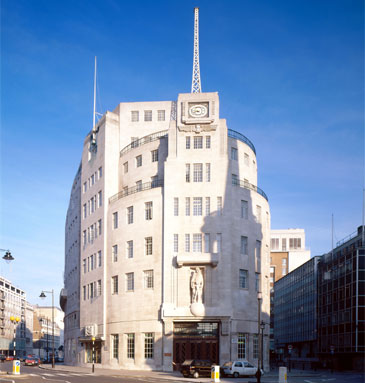
Broadcasting House: Part of the BBC's wasted £160m Pic Courtesy:vam.ac.uk

Update: Since this blog was written Chris Patten, chair of the BBC Trust, has decided to curb the very high levels of executive pay at the BBC – a first step to deal with the problem. But he will need to tackle how the managers control non journalist spending – such as IT contracts and property moves which cost licencepayers £160m.

Don’t get this blog wrong, this is not  an attack  on the BBC for wasting licence payers money on programmes. It is an attack on how the BBC has wasted  tens of millions of pounds by not controlling the money it spends on the boring bits – the money spent on property, studios and digital equipment that go to make those programmes possible.

Two recent reports from the National Audit Office – the body that on our behalf examines whether our taxes are spent wisely –  make very disturbing reading. They are into the BBC’s handling of some £2 billion of cash that is being spent on moves from  London  to Salford and Glasgow  and back to Broadcasting House in London and into cutting edge digitisation of  TV. I have written about this at length in The Journalist – the National Union of Journalists magazine  see http://bit.ly/mCekbZ .

In a nutshell they show that up to £160m was wasted on these plans because of delays, a botched private tender and exposed a  bad management attitude at the top.

As the auditors, not known for colourful phrases, said on people handling the  studio move to Pacific Quay, Glasgow :“It was sometimes difficult to engage senior staff in decision-making about their area as some seemed to either not fully understand their responsibilities or take them seriously enough.”

To put in context the money lost was enough  to run both BBC News Channel and BBC4 – or in radio terms the entire cost of running Radio Three and Four – for a year. That bad.

The reason why it matters is that the BBC is now having to make cuts to meet the government’s spending targets. Journalists are going to be sacked, programmes and parts of the BBC World Service , radio  and TV channels closed down. It can ill afford to make mistakes in its boring  bits.

I don’t mind paying a licence fee to hear Jim Naughtie and John Humphrys confronting a less than straight politician on the Today programme or  see  Ian Hislop and Paul Merton take the piss out of  Boris Johnson on Have I got News for You? I certainly am keen on Panorama exposing scandals in private care homes. I like to be entertained by comedians like David Mitchell or the lewder Russell Howard on Live at the Apollo or dramas like Case Histories, Waking the Dead etc.

I do mind paying a licence fee for some useless manager to spend millions giving IT contractor  Siemens a monopoly tender  to digitalise TV which then falls apart. Or giving some  property company £46m extra cash because  BBC managers can’t get their act together to move back to Broadcasting House in time and have to extend their leases at Bush House.

So I think it is time the corporation got a grip on this. And what are they and Jeremy Hunt, the culture secretary, doing. Trying to bind the hands of the very body exposing this waste from doing its job properly.

Over a  year in government nothing has been done. The head of the National Audit Office who has the wonderful name of Amyas Morse wrote to Mr Hunt last September trying to get three basic things done on behalf of viewers and listeners.  He wanted  unfettered access to information to the BBC, the right to decide what he wanted to investigate and the right to publish his findings when he and not the BBC wanted.  Hardly revolutionary stuff.

Not granted yet. So how about some interactive reaction. If you think the man from the audit office should get  his access on our behalf –  send him an email at  enquiries@nao.gsi.gov.uk  marked Amyas Morse ( as it says on their website). You think  the BBC Trust is blocking this email trust.enquiries@bbc.co.uk or contact its chairman Lord Patten at pattenc@parliament.uk .

Finally you could remind Jeremy Hunt that he is supposed to have sorted this. Try jeremy.hunt@culture.gsi.gov.uk .  It is time the BBC had a metaphorical bomb put under it so it  gets its act together and doesn’t waste another £160m.