Official – Work till you drop: Women in their 50s expect to have to stay in work long after retirement age

The Office for National Statistics – the independent official body which produces official figures for work and inflation in the UK – has come up with some alarming predictions for women born in the 1950s 1960s and 1970s.

They show that post the Covid pandemic there has been a big drop among women expecting to have enough money to retire and enjoy a life of leisure on their pensions. As a result a significant proportion of women now aged 50 to 65 are planning to stay in work – either with reduced hours or full time when they reach the retirement age of 66.

An organisation called Rest Less, which acts a community and an advocate for the over 50s, has analysed these figures and estimates that nearly one in two women pensioners now expect to have to continue working after retirement age.  Either they will work their existing hours (13%) or work with reduced hours (31%).

Huge inequalities between men and women’s pensions

The main reasons for this is pensioner poverty among women and huge inequalities between men and women when it comes to their pension pots. Not only are women less likely to get full state pensions – often they have missed years – than men but there is a big discrepancy in private pensions. The ONS figures show while 78 per cent of men will fund their retirement with a private pension, only 68 per cent of women have one. And the inequality goes on and on. Some 47 per cent of men will fund their retirement through savings, compared to 40 per cent of women. And only seven per cent of men will rely on funds from their partner, while 18 per cent of women will rely on their partner to help fund their retirement.

These figures were compiled 10 months ago in September last year. I hear that the ONS does not plan to update them since the survey was a ” one off” following Covid. Curiously a lot of publicity was given to people dropping out of the workforce when they got to 50 – I can only think that the majority must have been men or women married to men with a very good private pension.

Stuart Lewis, Chief Executive of Rest Less, commented: “Years of gender based earnings disparity has resulted in a large pension savings gap between men and women, leaving many women in their 50s and 60s in real financial precarity.  Nearly half of women aged 50-65 said they plan to continue working in some capacity after reaching state pension age – a number that is likely to have risen even further given the subsequent cost of living crisis.

…..“‘In the last recession of 2009, women could retire at 60 and receive the state pension; today it is 66.  Many women aged 50-65 are stuck between a rock and a hard place – they struggle to find work due to age discrimination or a lack of flexible work opportunities but they are too young to claim their state pension putting them in a vulnerable financial position as they approach retirement. Whilst the state pension age for men and women may now be equal, this data shows that the retirement fortunes of men and women remain anything but equal.”

One person who is caught in this trap is Back to 60 campaigner Michaela Hawkins known as Mac to her friends
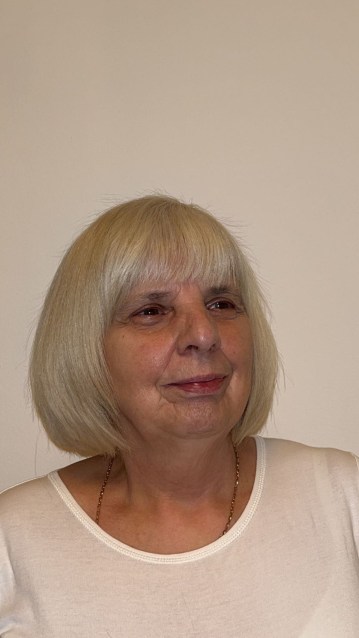
Michaela Hawkins

“.I was forced to stay in work longer than I wanted to or hoped for. 
“My husband is 10yrs older than myself so was relying on retiring at 60 so we could enjoy some quality time together. When SPA was raised this devastated our plans.  It would have meant if I retired before receiving my SP we would have had to survive below the breadline. 
“Austerity along with the pandemic put untold pressure on both myself and husband. I was transferred to work in care home from Day services during Covid. As my husband was in high vulnerable category during this time you can imagine the stress this put on both ourselves. 
“Another reason why I felt stressed also is because as a woman gets older her body is not the same. The physical aspects of working in care sector takes its toll.  When you come home from work you feel exhausted. But if you’re caring for loved one or helping out your children with childcare which I done both you have got no time for any sort of quality life.” 

now tax allowance frozen

“Now the Tax allowance that’s been frozen.  Now I’m retired I’ve been hit with a tax bill for over £1300  on top of cost of living crisis this is going to push many 50s women over the top. “

UPDATE : Since then there has been another demand for £1300.

Mac writes:

“I then received a letter saying I owe them a further £1,300. If this wasn’t payed then they would get in touch with debt collectors.

It took me 2 1/2 hrs to get through to tax office to query this.
It couldn’t be done online.
Although I disputed the amount I owe they were insistent that I did owe that amount.
I was then put through to debt management. Who I got to say was accommodating. But the problem is when older people receive letter from HMRC saying they will bring in debt collectors or as people our age call them bailiffs they become confused and frightened. 
Then to be put on hold for that length of time is again frustrating to say the least. 
When you think how HMRC is quick to chase up pensioners who in good faith think they payed their fair taxes and are chased up and then you got those who knows how to play the system get away with it. It makes me so angry.”

Certainly Backto60, which campaigns for full restitution for all the 1950s women who lost up to six years of their pension, is inundated with stories of women living on the poverty line, unable to heat their homes properly or use their ovens to cook because they can’t afford the fuel bills.

Instead the government concentrates on getting everybody back to work rather than seeking to compensate people who have already worked for decades and now should be able to put their feet up if that’s what they want to do without fear of paying the bills.

Please donate to Westminster Confidential to allow me to continue my reporting.

One-Time
Monthly
Yearly

Make a one-time donation

Make a monthly donation

Make a yearly donation

Choose an amount

£5.00
£10.00
£20.00
£3.00
£9.00
£60.00
£3.00
£9.00
£60.00

Or enter a custom amount

£

Your contribution is appreciated.

Your contribution is appreciated.

Your contribution is appreciated.

DonateDonate monthlyDonate yearly

Please donate to Westminster Confidential

£10.00
The scary chaotic privatised Covid-19 national survey and me

The ONS survey promises they could not fulfill

Inside story of how the government can’t even organise a Covid- 19 survey let alone sort out the pandemic

Much has been said of the government’s expensive muddle and mishandling of the Covid -19 pandemic where millions if not billions of taxpayer’s cash has gone down the drain. Contracts have gone to the Vote Leave chumocracy, apps have failed, people have unnecessarily died in care homes and it has been bonanza time for private firms.

What has been missed is that while all this is happening the Department for Health through the Office for National Statistics and Oxford University have undertaken a randomised survey of 220,000 people to find out about the spread of Covid -19.

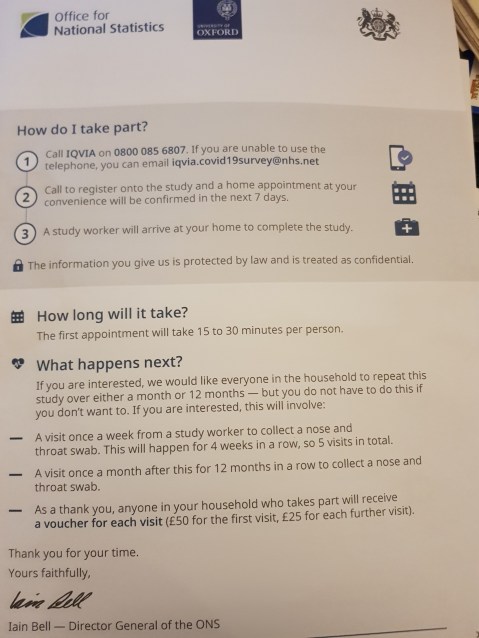
This is not just a once off questionnaire but those taking part in each household can opt to participate for a year. For the first month they are swabbed once a week and then monthly. The aim is to provide the government with a detailed picture of the pandemic’s progress and once approved the effectiveness of any new vaccines.

The scheme has been branded with trustworthy names – who would object to helping researchers at Oxford University or the Office for National Statistics.

Private company bonanza

But in fact the work is yet another bonanza for private companies and labs just like test and trace. What could possibly go wrong?

Well it did and this blog is my personal experience and my wife Margaret’s experience.

It started with a package being posted through our front door.

We were invited to ring a free number to sign up. Then within a week you would have an appointment. A pleasant socially distanced study worker would turn up, take your details, show you how to administer your own swab and send it off to a lab. You would get the result – if positive – within 24 to 72 hours from Public Health England. If it was negative you wouldn’t hear. You would also be eventually paid £50 in vouchers for the first visit and £25 for subsequent visits.

Sounds a doddle. It wasn’t.

First try and ring up and get an answer. I got through on the sixth attempt. And it is not to Oxford University but to IQVIA, an American multinational based in Durham, North Carolina, not Durham, England, with an income of $11.11 billion – effectively a health care data mining company. They have set up offices in the UK and guess what they are under staffed – hence the difficulty in getting through.

I was told to expect a call from NatCen, a private social research company, based in London that were in charge of appointments.

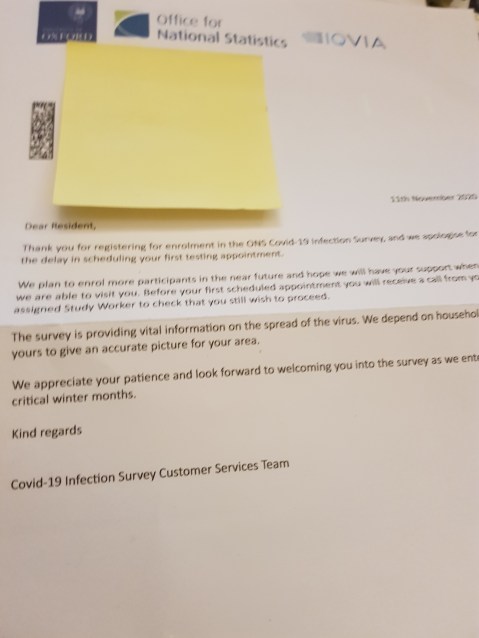
Rhe survey organisation must have been going wrong – they sent out this standardised apology to me and plenty of others.

A week went by, two, three, then a month and nothing. Finally there was a knock on the door and a genial man called Kirk asked me who I was.

” We have been trying to ring you for weeks and couldn’t get you. We got someone else who was already on the programme”, he told me

The reason was simple. The mobile number they had for me was not remotely like mine – they had put in someone else’s in their records

The came the swab – straightforward. We were told if we heard nothing after 48 hours we would be in the clear.

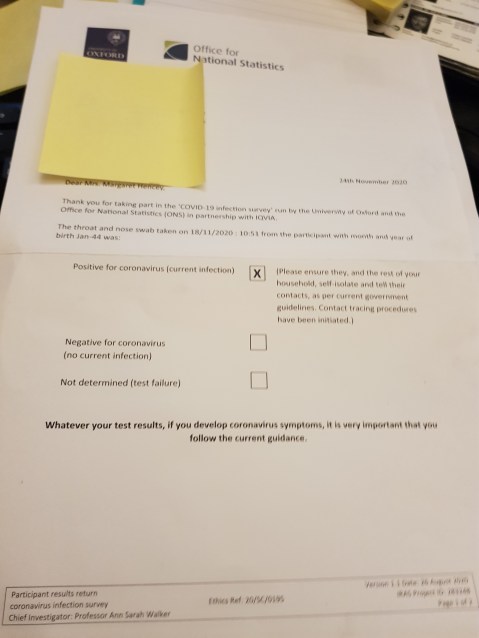
Then SIX days later we took a call from Hertfordshire County Council. It was for my wife – we are both in our 70s – she was Covid 19 positive . She had to self isolate for another four days. I was negative but had to self isolate for another seven.

The woman didn’t seem to know why we had been tested together, didn’t know about the national survey, and then told my wife not to have another swab in case it was a false positive.

This was scary because my wife did not have ONE SYMPTOM, no temperature, no cough, nothing. But we had to quickly cancel a hospital outpatient appointment for that day and cancel a visit due the next day from a physiotherapist.

The advice from Herts County Council was contradicted the next day by another study worker pointed out that the survey required people who were positive to take another test. He was puzzled that she – given we are part of the vulnerable group susceptible to Covid 19 – had no symptoms. He could not explain why we had been contacted by Herts County Council and not Public Health England.

Even after we got the invalidated result they still sent us the wrong result ( Note they spelt our surname wrong

After scary days of waiting to see if anything developed we had another call from IQVIA. It was to tell us that Lighthouse Laboratories – the privatised mega lab consortium – set up by  Medicines Discovery Catapult Ltd and UK Biocentre Ltd- who tested the swab had got it wrong. She was not positive and the test had been invalidated because the lab had used the wrong compounds to test it.

Nor were we the only ones – an entire batch – was wrong. Imagine the distress this would cause.It wasn’t the first time either. The Independent reported in September that tens of thousands of people had been cleared of Covid- 19 by the same labs when they were positive.

We now await our promised vouchers. I see they are provided by Sodexo – a private company which I remember was responsible for the hopeless failed privatisation of the probation service. They also provide child care vouchers. I wonder what they can to do to muck things up. I can’t wait.

The chances of living longer are getting shorter – new Office of National Statistics figures show only small rise in longevity

Is the DWP not telling the truth over the rise in people living longer?

One of the biggest issues about funding future state pensions and the incessant demands for raising the pension age is the fact that we are all going to live longer. This ministers argue is going to be too expensive for new generations paying into the national insurance fund and therefore retirement should continue to rise, possibly eventually to 75.

This argument was used ruthlessly by the Department for Work and Pensions in the judicial review against the appellants supported by the BackTo60 campaign for not compensating any of the 3.8 million women who have seen their pension age rise from 60 to 66.

To justify this ministers always quote figures up to 2011. The reason why they use this year as a comparator is that it was last year of any big rise in longevity which had risen for decades.

Since then the rise has flattened – in one year it actually fell – and last year was the first in five years that showed a small rise. Next year the ONS is warning will be the first year they will have figures of the effects of Covid-19 – and the hint is that longevity will fall because of the disproportionate deaths among pensioners.

The figures released by the ONS in this report yesterday cover three years from 2017 to 2019 – which statisticians say is more reliable than taking one year in isolation.

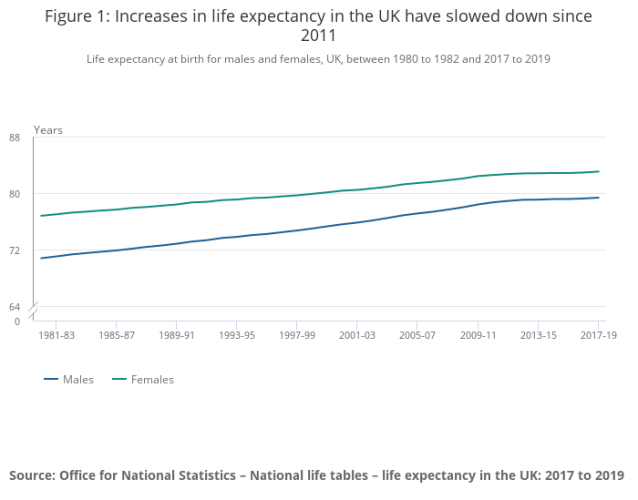
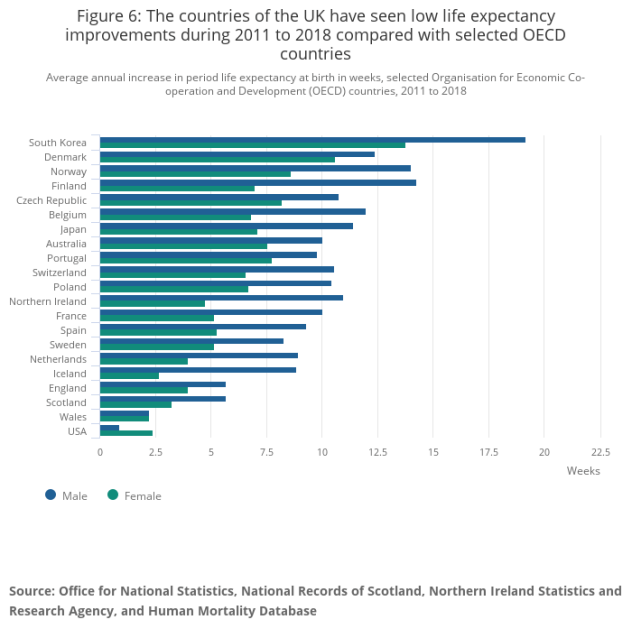
As you can see from this graph from the report illustrates longevity has largely flatlined. Women still live longer than men – but the greatest beneficiaries of rising longevity have been men. They are steadily catching up with women and the report wonders whether the huge drop in men smoking and moves from manual and agricultural work to less physical work in the office or behind a computer is the reason for this.

The report says: “Following decades of steady increases in life expectancy in the UK, a marked slowdown in the rate of improvements has been observed since 2011. Between 2002 to 2004 and 2009 to 2011, life expectancy at birth in the UK increased each year by an average of 16.7 weeks for males and 12.7 weeks for females. In contrast, between 2010 to 2012 and 2017 to 2019, these improvements slowed to an average of 6.3 weeks and 4.2 weeks per year for males and females respectively.”

The report also reveals another startling fact. When you compare the UK to many other developed countries both men and women have lost out big time in the longevity stakes. The countries that make up the UK (with the exception of Northern Ireland) are all near the bottom of the table only beaten by the United States.

Near Bottom of the league UK

Top of the league is fast growing South Korea followed by Denmark, Norway and Finland. The figures are for the number of extra weeks people can expect to live – comparing 2018 with 2011. Note again with the exception of Wales and the USA men have been the biggest gainers not women.

So while we all are being expected to wait longer for our pension in the UK, our extra weeks of life expectancy fall well below many comparable developed countries. We are being cheated – or at least not given the full facts – by our political leaders. So don’t believe any facile claims we have a world beating system for pensioners. Far from it.

Now the figures for this small rise in longevity are not uniform throughout the UK.

Another report says:

  • The lowest regional life expectancy for both males and females in 2017 to 2019 was observed in the North East; the North East’s life expectancy at birth was also lower than in the countries of Wales and Northern Ireland but higher than in Scotland.
  • Males living in the four most southerly regions of England had life expectancies at birth exceeding 80 years, whereas regions of the midlands and the north fell short of 80 years; London exceeded the North East region by almost three years.

Women live longest in the Outer Hebrides

The largest local area increase in life expectancy between 2009 to 2011 and 2017 to 2019 for males at birth was in Westminster, while for females it was in Scotland’s council area of Na h-Eileanan Siar. ( better known as the Outer Hebrides).

Live longer in London, die sooner in Blackpool

The statisticians comment:

“The rate of growth in life expectancy in London continues to surpass that occurring in other regions and the constituent countries of the UK. This has resulted in London now having the highest life expectancy for both males and females among regions in England.

“Four of the top five local areas with the highest male life expectancy in 2017 to 2019 were London boroughs, while three were for females. Since 2001 to 2003 traditional deprived parts of London such as Tower Hamlets, Newham and Hackney have seen strong gains in life expectancy over the time series. In fact, 17 of the top 20 local areas with the strongest growth in male life expectancy since 2001 to 2003 were London boroughs. This contrasts with Ceredigion where male life expectancy has only grown by 0.8 years since 2001 to 2003. These patterns add to the growing inequality observed across different areas of the UK over the past decade.”

inequality

This is heightened by other observations :

“Overall, for the UK, the difference was 11.3 years between Westminster, with the highest life expectancy at birth, and Glasgow City, with the lowest.

” For females, the local area gap in life expectancy at birth in England was 7.7 years between Westminster (87.2 years) and Blackpool (79.5 years), meaning Blackpool was the lowest in England for males and females. In Scotland, the gap stood at 5.5 years between East Renfrewshire (84.0 years) and Glasgow City (78.5 years). “

These findings must call into question whether there should be such a rush to raise the pension age – since the UK is both lagging behind other countries in life expectancy, has a huge inequality between the prosperous South and London and the North East ( Red Wall MPs please note). Finally the DWP is misrepresenting what is happening – both in its evidence to the judicial review over the raising of the pension age for women and to the nation as a whole. Longer life expectancy is tailing off not growing anywhere near the rate it did when decisions were made to raise the pension age.