For those with long memories some 32 months ago I wrote a disparaging blog about justice in employment tribunals after sitting through yet another hearing involving Dr Chris Day’s ten year whistleblowing battle against the Lewisham and Greenwich NHS Trust. So shocked I was over the way justice was meted out to Dr Day that I labelled it as the Tribunal of the Absurd – liking it to a Harold Pinter play that could be set in a court room.
This was the tribunal that revealed that lawyers and the Trust had held back evidence which should have been given to him and his lawyers years ago; that the chief executive of the trust, Ben Travis had lied under oath about a virtual board meeting and other matters to discuss his case, and that a senior communications officer of the trust, David Cocke, had gone into the trust’s offices at 5.0 am and destroyed 90,000 emails which could have been relevant to his case. The latter happened while the hearing was taking place and he then failed to appear as a witness.
Yet the judge Anne Martin ignored all this and exonerated the trust’s case against Dr Day. To remind readers the original claim was a serious patient safety issue – two people had died in the intensive care unit of Woolwich Hospital where he was working because of serious mistakes by other staff. Yet the trust for reputational reasons has always denied this really happened.
Now a long time later – the courts take ages to progress issues – a judge at an employment appeal tribunal has largely rubber stamped her decision and found against Dr Day and rejected an application to return legal costs to the British Medical Association to compensate for the extra days of hearing caused by the destruction and concealment of evidence. Worse than that during the hearing Dr Day’s reputation for telling the truth about a previous hearing was called into question. It was like the second house in the theatre of the absurd.
Mr Justice Sheldon who presided over the hearing found only two faults. He thought the tribunal should have ruled on whether the trust was wrong not to remove disparaging comments about Dr Day sent to MPs and the press after concerns were raised by the watchdog body, the Care Quality Commission was a detriment to Dr Day. And it criticised the tribunal for misinterpreting one area of employment law.
But the judgment adds: “The Employment Appeal Tribunal concluded that the errors were immaterial to the outcome, as the Employment Tribunal had correctly found that the protected disclosures did not materially influence the Respondent’s actions. The appeal against the Costs Judgment was also dismissed, with the Employment Tribunal’s reasoning found to be within its discretion and supported by the evidence.”
It refused to return the case to another employment tribunal for reconsideration.
What this means is that the trust’s actions in this case have been exonerated by a higher court. Mr Ben Travis is regarded as a credible witness despite not telling the truth under oath about the board meeting.
And Mr Cocke’s destruction of 90,000 emails while thought to be ” troubling” are largely exonerated setting what could be a dangerous precedent in other whistleblowing cases for people in NHS trusts and private companies to destroy evidence that should be passed under discovery to the claimant. They can now cite this judgment.
What was also amazing and bizarre was that the judge accepted from Daniel Talbot Brown KC , instructed by lawyers Capsticks, an argument used in another legal case which said that tribunals could take a benevolent view of the proceedings and if they did not comment on a finding it did not mean they had not considered it.
This seems to go against forensic testing of arguments put forward at a hearing – where both sides must probe for the truth. If they do this and a judge decides not to comment on the issue, surely this more like a dereliction of duty than anything else.
This judgment marks a bad day for whistleblowers and good day for bureaucrats who want to hide the truth. It shows that even if you have the support of medical experts to back your judgment and the support of two prominent former politicians, Jeremy Hunt, the former health secretary and Norman Lamb, a former health minister, this counts for nothing in the eyes of judges.
Perhaps the judges prefer the judicial theatre of the absurd to life in the real world.
Wes Streeting, the health secretary has promised new protections for whistleblowers but do they go far enough? Dr David Ward gives a detailed list of proposals that the NHS should implement and calls for lawyers and courts to play no part in the process.
NHS whistleblowers are obliged by law to raise patient safety concerns and are punished having done so. (Arising out of conversations with other doctors particularly members of Justice For Doctors. https://www.justice4doctors.co.uk).
1. All “whistleblowing” issues should be formally logged by the Trust (hospital) in which they have arisen and in a statutory, independent central register which is open to scrutiny and auditable. Isn’t an audit trail essential for regulatory and financial reasons?
2.Hospitals should be banned from dismissing a doctor who has raised safety concerns as they are obliged to do by MHPS, Duty of Candour laws and the Hippocratic Oath. This is a simple idea which could be implemented without complex regulatory amendments. Devices such as dismissal by “Some other substantial reason or “SOSR” are convenient for the dismissing Trust to bury all sorts of evidence. NDAs are another trick which could impede investigation of evidence. It reeks of “dodginess”
3.Hospitals and their managements should be compelled by statuteto urgently investigate concerns raised by a whistleblower. Failure to do so could be regarded as some sort of Tort because harm to patients could (and probably will) recur. (The concerns cannot be investigated if they are not known, doh!). Investigations should be conducted independently not by internal personnel because these are known to be biased (no, really?). External investigators (whether MHPS or otherwise) can be paid large sums by the Trust. The results are not infrequently “favourable” to the Trust. A new, more open and accountable system should be introduced.
4.The problems reported by a whistleblower should be remedied as soon as possible to reduce the risk of further harm. This hardly needs stating, does it? But a remedial approach (even if it is instigated) nearly always takes second place to hyper-investigation (persecution) of the doctor who has reported the problem. Imagine if such vigour could be directed toward correcting any shortcomings, improving processes, enhancing safety and so on. It could even save money as well as improving patient safety. “A stitch in time….” 5.NHS Trust Managers should be formally regulated by a statutory independent body. They should be subject to regulatory bodies just as the medical professions are – and disciplined if they “manipulate” the truth. There are examples of “wild west behaviour” by managers which would be stopped immediately if regulation were in place. 6.“Maintaining High Professional Standards” (MHPS) investigationsare internal and unregulated. (See St Helier Hospital saga on this blog). “Marking one’s own homework” comes to mind. Investigators can be “hired guns” who will produce a report favourable to the Trust for a “fee” (taxpayer funded of course). Corrupted or what? (Let me be clear, I am not suggesting any cause-and-effect relationship between the fees paid and an outcome “favourable to the Trust”). Data about any of these matters which are prevalent all over the NHS is, unsurprisingly, not available (see 1).
7.Stop the wastage of £millions of taxpayers’ money on lawyers defending Trusts at Employment Tribunals against the unfunded “claimant” (the solution is at 2). This egregious inequality of arms should be disallowed but if (2) was implemented it would not arise. Another way of putting this is “stop persecuting whistleblowers who are doing their duty”. It is the Tribunal system which endorses a Trust’s decision to dismiss a doctor (if the dismissed doctor seeks the support of a Tribunal he is unlikely to succeed: see 15) . (How much taxpayer funded money is expended on law firms supporting Trusts against the claims of a dismissed doctor? This is my FOI request February 2023:
The answer was “DHSC does not hold information relevant to your request”. Perhaps not but I am willing to bet it is kept somewhere.
8.Lawyers and Courts have no place in the investigation of patient safety issues (see 2 and 6). Lawyers have little or no appreciation of health issues and the operation of a hospital. They are not best placed to investigate patient safety issues which are, unsurprisingly, central in whistleblowing cases.
9.Patient safety is prime. There should be no stigmata or detriments attached to raising patient safety concerns. Failure to raise or conceal a concern could be an offence. 10.Non-disclosure agreements (NDAs) about safety issues should be banned. They may be abused to conceal safety evidence. Information which is not disclosed cannot be tested can it. Could this be an intended (or unintended?) consequence of NDAs? 11.PIDA 1996 (section2, 47b (1): “A worker has the right not to be subjected to any detriment by any act, or any deliberate failure to act, by his employer done on the ground that the worker has made a protected disclosure”. So, no whistleblower can be dismissed because they have “made a protected disclosure” as that is forbidden by PIDA. But they can be dismissed (conveniently) “having made such a disclosure” just not for that reason. Usually one of the 5 “fair” reasons for dismissal is invoked including, “committing some form of misconduct” and “SOSR” (see 13). (See the case of Martyn Pitman on this blog). The section of PIDA referred to above is a loophole which is open to (possibly deliberate) misinterpretation. Perhaps it was written like this for a reason, who knows. Shouldn’t the loophole be closed and PIDA updated?
12.Is the Dunning-Kruger effect (qv) relevant? Yes. It could apply to elements and procedures of the British Establishment – such as the Judiciary and the Employment Tribunal system. “The Dunning–Kruger effect is defined as the tendency of people with low ability in a specific area to give overly positive assessments of this ability”. (Wikipedia). Take a moment to think about D-K in the context of the treatment of whistleblowers. It rings true, doesn’t it.
13.Dismissal of an employee can be for any one of the 5 reasons specified in the Employment Rights Act 1996, Section 98. The last of these is “SOSR” or “some other substantial reason” which need not be specified (obviously) which is very convenient (see 11). Some reasons are specified but these are not exclusive and there is no need to specify a reason – which is why this clause exists, right? I need not enlarge on why this is another fudge but it is open to abuse. The notable observer and blogger, Dr Minh Alexander has ascertained (via an FOI request) that over 10,604 staff were dismissed by the “SOSR” method between 2010 and 2018 (Yes, she does provide a detailed breakdown of the figures, see link). This is a staggering statistic which surely points to a profound failure of process.
14.Resurrect the “problems of whistleblower persecution” for debate in Parliament with an emphasis on “protection”. I believe several proposals are under consideration including some by the Rt Hon Wes Streeting MP, Secretary of State for Health and Social Care, who will become a hero to many if he achieves what is required.
15.Doctors who have been whistleblowers and subsequently dismissed are well advised to avoid the legal profession. One thing that does emerge from my exploration of this fraught topic is that doctors (as a retired medic I can speak for this profession) who have been “dismissed” should not go anywhere near a law firm or engage the Employment Tribunal process for all the reasons I need not enumerate here. Fewer than 3% who do so will emerge victorious. Some have been bankrupted by the process. Open and fair justice? I don’t think so
Who are the ultimate losers in all this ?You may ask why make such a fuss? I will answer directly. It’s not primarily about the Judiciary, or the Employment tribunal system, or hospital managements, or even doctors and healthcare staff. On the contrary it is fundamentally about sick people, or “patients” when they seek medical advice. It is these “end-users” of the NHS who suffer when doctors (or any HealthCare professionals) who speak up about patient safety (aka whistleblowers) are subjected to kangaroo courts and persecution culminating in their dismissal and whose lives are consequently ruined: loss of a career, loss of self-esteem, disruption of family life, possible financial ruin (lawyers bills really are “astronomical”), and even more extreme consequences. If you think I am exaggerating read the story of Mr Martyn Pitman FRCOG, Consultant Obstetrician a man of high integrity and whistleblower who lost his career at the whim of a Tribunal sitting before a judge who probably has no idea what a Fallopian tube is. The Tribunal stated:
“Our issue was never about the concerns raised by Mr Pitman, but about concerns
raised by others of disruptive behaviour and then a breakdown in working
relationships. These factors are damaging in any workplace, but in a healthcare setting, which is by its nature an intense and pressurised environment, their destabilising effect
The judgment refers to “bullying and undermining behaviour” or similar 6 times but the word “concerns” appears 123 times. Have I made the point?
Anyone who knows anything about the modus operandi of Employment Tribunals will see through this obfuscatory gobbledegook immediately. I doubt even the Tribunal persons who wrote it knew what they were talking about. What is happening to justice in this country?
Karin Smyth – health minister responsible for professional regulation reform
The new Labour government is embarking in the first reform of the professional regulation of the General Medical Council for 40 years. This welcome development comes after the GMC extended its scope to cover physician and anaesthesia associates at the end of last year. In theory it will allow the GMC more flexibility to change its rules and allow less adversity among fitness to practice cases involving doctors thus avoiding referrals to the overloaded and often unfair employment tribunals. It also abolishes an arbitrary rule that prevents it looking at cases that are more than five years old.
From my observations of recent complaints against doctors who raise patient safety cases and conversations with doctors who are concerned about referrals to the GMC the whole process needs a radical overhaul. It is also an overhaul that requires some political intervention.
How the GMC handles individual complaints against doctors is by no means transparent. Nor is the GMC directly accountable for their failings and omissions and its workings can be manipulated by individual health trusts. I am about to give you two different examples,
Many doctors think the complaints system is flawed because of a practice of referring the case to the so called ” responsible officer ” to handle it. The responsible officer is often the person who has brought the complaint in the first place – the chief medical officer of the trust. Now the chief medical officer is not what the public might think – the ultimate person protecting medical standards on behalf of patients. He is part of the trust’s management team whose main purpose is to protect the reputation of the trust which may not be in the interest of patients. So surely this is a conflict of interest?
NHS Managers labelled one doctor ” too passionate about patient safety”
There was also an extraordinary experience of a whistle-blower who was a warned by local managers against being too “passionate about patient safety.”
And does the GMC do a thorough job when it investigates.? Doctors are sceptical. In one example it appears the complaints about serious safety issues, were closed at the first step and not even seen by GMC clinician. The bald reply from the GMC confirmed that to be the case; neither the team had nor did they seek any advice or expert opinion.
The GMC’s current practices enable its staff without clinical knowledge to close clinical concerns in such manner or only with hospital managers’ response, even when the concerns about the said managers are known to the GMC. In one example it appears the complaint was not even seen by fellow clinicians.
Given the whole point, according to many of the doctors who have raised patient issues, is the worry that either patients have already been harmed or more are left at risk of being harmed by such poor medical practice, these do not appear to be safe concern closure processes for a regulatory body.
Dr Usha Prasad
There is another side and here I can quote an actual case – as it came up in an employment tribunal – the removal of cardiologist Dr Usha Prasad from the then Epsom and St Helier NHS Trust ( now merged with St George’s Hospital in Tooting, south London.)
Here the GMC faced with 41 complaints from the trust who wanted her removed did do a thorough investigation and checked with very senior cardiologists and exonerated her -including revalidating her working for the next five years.
But the trust’s chief medical officer, Dr James Marsh , refused to accept this, making the fatuous statement that the trust’s medical standards were ” higher than the GMC’s “. This is also ironic as the doctors from that organisation are being revalidated by, no one else but the GMC.
Where a doctor is revaluated the rules should be changed so in those circumstances the GMC’s decision is binding and final and this requires a politician to intervene to make sure this happens. An individual chief medical officer should not have the power to wreck a doctor’s career if their complaint to the GMC is utterly rejected. and not formally appealed against.
I would be very interested to see if other doctors have had similar experiences in both these areas and doctors can contact me on my website ie either concerns were dismissed without due consideration or the GMC decision was ignored by the managers. All contact will be treated in confidence unless the doctor wishes to go public.
This is a once in a lifetime reform and we need to get it right for both the benefit of the doctors and the safety of patients who entrust their lives to the NHS.
Karen Smyth, the minister of state for health, has a huge list of responsibilities from this area to cancer care and hospital car parking. The list is here. She needs to focus on this and ask pertinent questions.
Guest blog from Dr David Ward on the appalling treatment of whistleblowers in the NHS
Patient safety and the judiciary
What business has the judiciary with patient safety matters you may ask? I am referring primarily to the processes which may unwind when a doctor, having raised patient safety concerns is sacked by the Hospital Trust where they worked and seeks recourse via the corrupt Employment Tribunal system. (NB not sacked “for having raised the alarm” as that is expressly forbidden by the Public Interest Disclosure Act (PIDA 1998[1]). For example, if a piece of equipment is malfunctioning in such a way as to cause harm to a patient; if a process such as preparing a patient for a procedure is flawed in such a way as to put the patient at risk; an inadequate consent process; understaffing in, say, a post-operative ward; inadequately qualified personnel. Each of these deficiencies may put a patient at risk of harm and all have at some time been reported by doctors or nurses. There are many others. A responsible doctor witnessing any of these will be concerned and has a duty to raise an alarm. This is set out in Good Medical Practice, a guide produced by the GMC[2]. It is also part of the Duty of Candour regulations [3][4] and for traditionalists, in “The Hippocratic Oath”[5] the central tenet of which is “primum non nocere” or “do no harm”.
A problem may arise when a doctor (or healthcare worker) reports a “patient safety event” and the Trust reacts adversely (the psychology of such reactions is discussed elsewhere) which is a very common. It may trigger a series of defensive responses by the Trust which almost always ends badly for the doctor. This is seen time and again with “whistleblowers” who have had the “temerity” to raise a concern. The “playbook” is almost set in stone. In several recent cases where a dismissed doctor (Claimant) has sought recourse at an Employment Tribunal, the Respondent (the Trust or Hospital) has reacted vengefully rather than responsibly and promptly to look into the concerns.
The following is a brief account of the saga of a colleague who was referred to the GMC (after she reported safety concerns) in what can only be described as an act of vengeance by the Trust and the CEO who, having taken offence at the temerity of the doctor to report some shortcomings to the Trust, decided to “punish” her culminating with dismissal. Furthermore, the Trust prioritised this vengeful reaction over and above an urgent investigation into the problems she raised. It’s the same “playbook” with many other NHS whistleblowers (see Westminster Confidential 6 7).
Patient safety concerns.
If a doctor “raises a concern”, the most common of which is about something which may jeopardise “patient safety”, the obvious and reasonable response is to investigate it and correct any problems as soon as possible. Astonishingly, this is rarely what happens. The Trust not uncommonly reacts vengefully to the report, for example, by restricting the activities of the doctor who reported it. They may be “hauled over the coals”, have their duties limited, suspended for a period, referred to the GMC or even the CQC. The GMC may commission an external assessment of the doctor in question by an independent party usually another doctor in the same specialty. The Trust is not obliged to take any notice of this report. For example (I could cite many), a colleague who was referred to the GMC by her employing Trust was completely exonerated but she was dismissed all the same.[6] The CEO of the hospital, St Helier Hospital, Daniel Elkeles, made a veiled threat in a letter if she did not cooperate with his dismissal proposals:
4) ESTH agree to cease the MHPS process which means we can find a way to
ensure you are re-validated (not my area of expertise but i am sure there will be a
way)
5) You need to drop all the actions you are taking against ESTH.
If we can agree this then I would hope that everyone can move forward positively.
(This letter is in the Tribunal bundle in the public domain)
Another whistleblowing case where there are ongoing grave concerns about the propriety of the Employment Tribunal decisions (and others) in support of the dismissing Hospital Trust is that of Dr Chris Day whose case features extensively in columns of Westminster Confidential.[7]
Unregulated “Maintaining High Professional Standards”[8]
This code of practice was introduced in 2003 to update and clarify how concerns about a doctor and the associated “disciplinary” procedures are managed.
This entire process is unregulated and no independent body is statutorily involved. In fact, there is not even a statutory register of these processes or the events they purport to investigate. There is no register of NHS whistleblowers or the safety concerns they have raised. Trusts do not keep records, the regulators (BMA, CQC) don’t keep records. The NHS does not keep records (I confirmed this by asking the now defunct NHSE). HM Government does not keep records despite HM Treasury giving £millions (directly or via various organisations) to Trusts to pay inscrutable legal firms to defend the Trust against claims made by doctors who have raised safety concerns. This means a Trust can hire anyone they choose to conduct the investigation. There may even be an “informal agreement” or they may just be a ”pal” of the CEO. The investigator is not required to have any special qualifications and there is no register of such people. The St Helier Hospital case referred to above is a particularly egregious example of how this chumminess may operate. The “investigator”, a retired nurse[9], in her report invoked a fictitious “regulation” not previously seen in this context. The doctor in question was eventually dismissed on the grounds that she was not “fit-for-purpose”[10]. This is entirely confabulated by the investigator (who describes herself as a “non-practising barrister” but is not on any English register of barristers[11]) as no such “reason” for dismissal (or anything relating to humans) exists in English Employment law and the term is not applicable to a “human being” but rather to goods or services. How this has not, so far, been challenged in the Courts eludes me. Could this case even be cited as a “precedent” (pro or anti) in future similar cases?
It doesn’t take a leap of the imagination to conclude that if a Trust wishes to be rid of a doctor it will choose a compliant “investigator” with a reputation for such behaviour. This service costs money (provided, of course, by the taxpayer) and investigators can be very expensive. But hand-picked unregulated quasi-independent “investigators” are very compliant, aren’t they? Money talks… but conveniently no formal or open register is kept of money used to silence whistleblowers (pay the lawyers, investigators, payoffs, seal a Non-Disclosure Agreement etc). I wonder why?
A doctor threatened with dismissal (or who has been dismissed) may just move on, get another job (if possible having been “slandered” by the previous employer), leave the profession altogether, move abroad or any of these choices. Unfortunately, many will seek recourse via the arcane and grossly biased Employment Tribunal system. This may come about because the embattled doctor has received, shall we say, less than impartial advice, possibly from a law firm, recommending this route. Less than 3% of claimants at an Employment Tribunal emerge victorious (whatever that means)[12]. In other words over 95% of Claimants who brave this course will lose their case. Fair and open justice? I think not.
Who bears responsibility for all this?
Is it the doctor who “blew the whistle”? No, it is their duty to raise safety concerns.
Is it the Trust which dismissed the doctor? The Trust will deny dismissing the doctor (for raising concerns) and invoke PIDA 1998 47B in their support (1):
A worker has the right not to be subjected to any detriment by any act, or any deliberate failure to act, by his employer done on the ground that the worker has made a protected disclosure.
The Trust will say “oh no, it wasn’t because he raised a concern…it was because his manner was inappropriate/rude and …” (see story of Martyn Pitman, below). However, it is quite a different matter when it comes to dismissing a doctor “who has raised concerns”. This is not “unlawful” because it is consistent with PIDA. This is why the law needs to be changed; to ban the dismissal of “doctors who have raised safety concerns”. It’s a “no brainer” isn’t it?
Is it the lawyers who advised (and assisted) the dismissed whistleblower to seek recourse via the biased ET system? Yes, they are complicit once dismissed the employees submit themselves to the process. Millions of taxpayers’ money is spent on lawyers defending Trusts against claims made by whistleblowers yet almost nothing (no data are collected so we can’t be sure about this but we can infer it) on investigating and correcting the problems that gave rise to the claims. Sheer madness or what?
Is it the Trust managers who confabulate the case against the whistleblower? They have one aim in mind; to get rid of the “nuisance” doctor and by so doing avoid the “inconvenience” of looking into the safety “issues” raised in detail which could be very embarrassing if gross incompetence or negligence by the Trust or its employees is exposed.
And patient safety? Oh, that’s where the proverbial “carpet and brush” come in, as wielded by Trust managers (with legal advice) who themselves are unregulated[13]. If you want evidence for these claims read the newspapers (or search a major news website).
Inadequate regulations and deficient laws.
The regulations drawn up by regulators (and equally the inadequate laws passed by legislators) have contributed to this unsatisfactory situation where doctors are terrified of speaking up about patient safety because they fear for their careers and the livelihoods. If the regulations were tighter, we wouldn’t be here, would we?
A simple and almost cost-free solution to all these inappropriate behaviours is available without too much hassle and only minor changes to regulations and it based on the supremacy of maintaining patient safety: ban Trusts from dismissing doctors who have raised patient safety concerns and compel the Trust (by statute) to investigate those concerns. Just think of the benefits: no lawyers, no Tribunals, no money filling the coffers of law firms but instead expended on, inter alia, investigating and rectifying the concerns raised, improving care and communication. More openness and less retribution will encourage doctors to ‘’raise a hand” without fear of reprisals. Furthermore, is it not preferable to retain the services of an expensively trained, competent and dedicated doctor who had the courage to speak-up and has committed no offence, rather than destroying their careers and depriving patients of their skills? (This is the “playbook” in the cases of so many NHS whistleblowers I could list here). At present the judiciary (and the regulations they invoke), whether they agree or not, are complicit in covering-up patient safety issues and the adverse consequences of so doing.
Isn’t it time for a change of attitude and changes in the law related to raising concerns about patient safety – also known as “whistleblowing”? Why are the ”powers that be” not listening to the many supporters of whistleblowers who are raising the same issues time and time again?
Just one more thing: there are seven reasons which can be invoked in British Employment law to dismiss an employee[14]. None of them is especially relevant in this context except one.
“Some other Substantial Reason”, a most convenient clause for all the reasons one might imagine: if it isn’t covered by the other 6 this one should satisfy the Trust’s requirement to get rid of the doctor. Furthermore, it may obviate detailed scrutiny of evidence (isn’t that the reason it’s called SOSR?). Other reasons which are commonly exploited include: ”it’s impossible to carry on employing you” and “not being able to do your job properly”. The vagueness, highly subjective and unquantifiable nature of these clauses suggests they have a less-than-straightforward purpose.
If a Trust wants to dismiss a doctor it will find a way to do so. In the case of Martyn Pitman, Consultant Obstetrician and Gynaecologist, the Royal Hampshire Hospital strenuously denied that he had been dismissed for raising concerns. No, of course he wasn’t. The astonishing inanity of it was reported in the Guardian thus[15]:
“The judgment found the “overarching reason” for what has happened to Pitman was down to his communication style and not the message he was trying to convey”. (I couldn’t find this sentence in the 75 pages of the “unsearchable” official judgment).[16] So here is a senior and respected gynaecologist – who has done no wrong – being dismissed for his unacceptable “communication style”. You could not make it up!
It is a truism to state that the health of the nation is the single most important asset it has. (This is why “privatisation” of the NHS which would put “shareholders” ahead of patients would be a disaster). If the workforce is not healthy everything else will decline (I don’t need to explain this assertion but judging by what is happening in Westminster, politicians don’t seem to have grasped this concept. (Neither has the judiciary for that matter but I wouldn’t expect this self-serving body to opine on such “trivial” issues).
“If they [the judiciary and the JCIO] continue to do this, they are acting as a party to suppressing patient safety in the National Health Service and in the case of Sellafield, because it is such a contaminated and dangerous place, putting the general public at risk.
Is anyone listening to critics of the judiciary and its arcane processes in judging NHS doctors, nurses and other healthcare workers who raise patient safety concerns? Is anyone taking notice of the sufferings of the doctors who are doing their best (especially during the recent pandemic) for their patients? Is anyone calling out the absurdly illogical Employment Tribunal judgments which heap suffering on the Claimant (Doctor) and indirectly on patients? I know of one journalist who is – David Hencke. 17
Hits on my blog jumped from 219,000 in 2023 to over 358,000 last year. This will be an underestimate because it does not include thousands of additional hits on Linked In, particularly where I highlighted bad practices in employment tribunals and hideous unjust treatment of whistleblowers by NHS trusts and other state and private organisations including Sellafield and a Network Rail contractor.
By far the biggest interest was in a blog I wrote on the decision by Rachel Reeves, the Chancellor, and Sir Keir Starmer, the PM, to abolish the winter fuel allowance for all people claiming the state pensions – leaving it only available to a rump of pensioners claiming pension credit. This attracted an astonishing 187,400 hits on the site plus nearly 20,000 on Facebook and Linked In and reflected the fury among pensioners and the shock that a Labour Government should target people earning little more than £11,300 a year as its first priority for cuts. The ineptitude of this decision is not likely to go away and both well off ministers are still oblivious of the damage they have caused. The blog is here.
Throughout the year there was continual interest in the plight of the 3.6 million 50swomen who faced up to a six year delay to get their pension with tens of thousands of hits on stories detailing every twist and turn of this sorry saga. The year ended with total defeat for the WASPI campaign, when Liz Kendall, the new Labour works and pensions secretary, blocked compensation payments to any of the women despite a partial maladministration ruling by a weak former Parliamentary Ombudsman, Sir Robert Behrens. An older blog showing how much successive government’s saved by cutting Treasury contributions to the NI fund got another 2,444 hits this year.
IF ministers think this is the end of the story they are sorely mistaken as the fight by CEDAWinLAW will continue this year since they have international backing and ministers could have to face a call for arbitration despite the suspension of a potential court case.
Dr Chris Day
The other big issue on this blog which attracted thousands of hits was the appalling treatment of whistleblowers particularly in the NHS. Trusts are spending hundreds of thousands of pounds employing expensive lawyers to hound and ruin the careers of doctors who expose patient safety issues which trust managers want to bury. By highlighting individual cases when they come before employment tribunals I am building up a bigger picture of injustice and even corruption in NHS trusts and exposing barristers and solicitors who are enhancing their careers and bank balances by pursuing consultants and doctors who are brave enough to stand up for patient safety in the NHS. These included last year cardiologist Dr Usha Prasad, obstetrician, Martyn Pitman; emergency doctor, Dr Chris Day plus nurses at the Lewisham and Greenwich NHS Trust. The latest Chris day blog is here
Alison McDermott
I also highlighted the on going scandal at Sellafield where whistleblower and management consultant, Alison McDermott exposed bullying and harassment which put nuclear safety at risk only to be pursued by expensive lawyers working on behalf of the management to silence and humiliate her. The behaviour of employment judge Philip Lancaster, who heard the case, is now under scrutiny as six women have brought complaints about his behaviour towards women claimants. The blog is here.
Northiam part of the site
One particular story which attracted interest was an in depth investigation into the running of a small parish council in East Sussex, Northiam, where a ruling clique of councillors harassed and pursued anybody raising questions about dubious practices that followed a loan of £1.4 million from Michael Gove, the former Tory levelling up secretary, to allow the council to purchase ta former Blue Cross animal sanctuary for the village. This now the subject of an investigation by the external auditor the council. It attracted over 10,200 hits – 8000 of them locally. The blog is here.
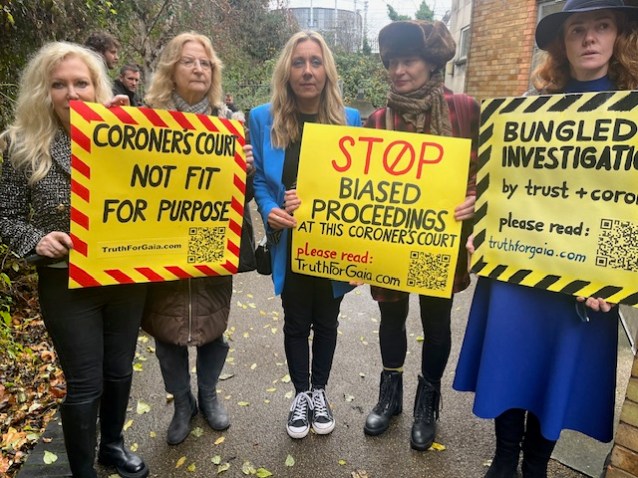
Protest outside Mary Hassell’s coroner’s court
Finally I turned my attention to the coroner service after one particular coroner, Mary Hassell, appeared to me to the cross a red line in her treatment of bereaved relatives who were either banned or censored from making statements at both her inquests. Both were heartbreaking cases- one involving a mother losing her only daughter 17 hours after being admitted to University College Hospital in London, the other involving the death of a TV journalist who had complained of domestic abuse by an ex partner who had a record of violence.the blogs are here and here.
Expect more investigations this year as I take up more cases.
Yesterday a conference of doctors, patients and journalists held at the prestigious Royal Society of Medicine in London highlighted the appalling treatment of doctors by NHS management who raise patient safety issues to protect patients. Examples were given from doctors who had been dismissed after they raised patient safety issues and how trust managers spend unlimited funds on lawyers to make sure they lose employment tribunal cases, sometimes even aided by the judges hearing them.
The conference arranged by Justice for Doctors, a new organisation representing many of the affected doctors, coincided with a series of articles in The Daily Telegraph, which showed that these are not isolated cases but involve doctors right across the country and is a national problem which trusts are trying to hide.
One of the main organisers is David. E. Ward,, a retired cardiologist from St George’s Hospital, South London, who has already written two guest blogs on this site. I have included his planned closing statement to the conference as a fresh blog from him as it succinctly sums up all the issues that were raised.
By David Ward
First, I would like to thank all the contributors to this historic meeting. In a way it is a celebration of all those oppressed whistleblowers who have spoken up for patient safety.
I would personally like to thank my friend Professor Somerville who has been a driving force behind this and many other ideas to stand up for whistleblowers. Jane and I have been trying to set up a second meeting about Patient Safety for 5 years following the first one in March 2019 when we re-enforced our personal campaign to expose – and do something about – the appalling treatment of doctors who speak up for patient safety also known as ”whistleblowers”. During our campaign we met the Justice for Doctors group who helped to organise this meeting
In the past 3 decades a Hospital Trust with its senior management has accrued the powers to destroy a doctor’s career by imposing restrictions, suspensions, referrals to regulators (GMC, CQC) and, astonishingly, an unfettered power to dismiss. These major life-changing decisions are arbitrary and undertaken, incredibly, without any independent or regulatory oversight. For dismissal, “get out” is apparently sufficient.
Allegations against the victimised doctor may be based on made-up and unsubstantiated claims. If major criteria for dismissal cannot be met there is always the “loophole” of “some other substantial reason” which conveniently does not exclude but also does not mandate any additional explanation.
Doctors who see poor practices, faulty equipment, processes (and the like) are obliged to speak-up by Duty of Candour (HSCA 2008 reg 20). But by speaking up but they may put their careers at risk as we have seen so many times recently.
The “The National Guardian” program introduced by Sir Robert Francis and intended to accommodate doctors who speak-up, evidently does not function as intended. It’s called “marking your own homework”.
Investigations into a whistleblower together with their concerns should be independent of the Trust in which they work and be seen to be so. But evidently, they are not. Furthermore, the Trust managements who make these decisions are themselves unregulated. That doesn’t seem right? Does the phrase “judge, jury and executioner” come to mind? Managers should also be regulated, shouldn’t they?
Arcane procedures such as MHPSappeal hearings can be overseen or conducted by “dodgy” external “agencies” some of which claim spurious credentials. These agencies are, in effect, “hired guns” available and willing – for a fee – to “confirm” the Trust’s unfounded allegations and to assist their aims – to dismiss the “troublemaking” doctor; not because of “incompetence” but because the doctor has “annoyed” Trust management by raising concerns about Patient Safety or something else. The reactions of management are often vengeful, as we have seen.
I know of at least one of these agencies which has appropriated and misunderstood (in a written formal report) the phrase not “fit-for-purpose” to describe a doctor in support a Trust’s decision to dismiss. The agency seemed totally unaware that this is not only fictitious nonsense but possibly libellous. No such phrase exists in English Employment Law. Unfortunately, NHS England has also been duped. I know because I’ve asked – in person.
The Judiciary, in the form of Employment Tribunals may be called into action if the dismissed doctor seeks to restore their career via this route. This is a bad choice by the victim as the evidence confirms. Only 3% of Claimants, “win” – not the most apt word – in this system. Put another way, 97% lose! Is that “open and fair justice”? I think not. Some of the judgments are beyond comprehension.
There are many practices which seem grossly unfair, perhaps deliberately. Some obvious ones stand out:
1. Inequality of arms;the law firms acting for the dismissing Trust are funded by each of us – the taxpayer. The Claimant, the doctor, healthcare worker will have no external source of funds except perhaps by “crowdfunding”. Furthermore, if they lose their case, they may required to pay not only their own legal fees but the law firm’s fees too! That’s not fair. I can show you some law firm invoices which would shock you. The phrase “inequality of arms” doesn’t touch it.
2. “Cost threats”are a notorious device employed to, shall we say, “persuade” a claimant to withdraw their claims before, during or after a Tribunal. It’s another weapon deployed by the Respondent, the dismissing Trust, to force the claimant to surrender and withdraw their claims.
3. Non-disclosure agreements or NDAs,are devices designed to conceal the devious practices used to threaten the claimant (and, as it happens, to suppress evidence). They have no place in inquisitorial proceedings in this context. They should be banned.
4. The Public Interest Disclosure Act (PIDA) 1998; I quote: a worker has the right not to be subjected to any detriment by any act, or any deliberate failure to act, by his employer done on the ground that the worker has made a protected disclosure.
In other words, a doctor cannot be dismissed, for example, for raising patient safety concerns. So, any dismissal has to be attributed to another perceived misdemeanour. Read any recent case and it is evident that the “whistleblowing” or “patient safety” concerns were discounted and irrelevant to the dismissal. It was about an “attitude”, a “manner of speaking” and similar unquantifiable and, in most cases, unverifiable attributions. Ask one of the presenters today.
5. At a time of great need for medical expertise, doctors are still being persecuted and dismissed having committed NO offence. The law firms which spend so much public money to pursue the claimants should have no place in any procedures which are primarily about patient safety. Furthermore, the concerns and the person who raised them should be formally registered and documented, including all steps taken towards a solution. This is not happening. Doctors who raise concerns about patient safety are treated like criminals! This must stop!
6. Last but not least the patient safety concerns, the very things that trigger most of these shenanigans. What happened to those? Well, they get buried and forgotten don’t they. What a wonderful system. All that waste of public funds to destroy a doctor’s career instead of correcting potentially dangerous practices. That is why a register is needed.
The problem is a nationwide one of the same gravity as the “Great Post Office Scandal”. Perhaps NHS whistleblowers need a TV drama-documentary because we have seen how that shifts public opinion and awakens the media with unprecedented force. I’ve already draw up a potential cast list!
Last, there should be a searching, durable, logical and legally sound review of the treatment of ALL whistleblowing related laws and processes. Whistleblowers are the canaries in the coalmine. They do society a favour. They should be praised – not persecuted.
This is the 21st century! What country do we live in?
Thank you all for attending. Thank you to all those who presented. And particular thanks to Dr Salam Al-Sam, Dr Azhar Ansari and the Justice for Doctors group.
UPDATE: Who came and Who didn’t send anyone
Newspapers who sent a reporter: Times, Guardian, Daily Mail, Standard,
Major media who sent a reporter: Sky News
Major media one would have expect to send reporter:
BBC, ITV, GBNews, LBC
Major regulatory professional bodies who were notably unrepresented: (very bad show I think especially as some of their members Fellows were major subject dig the WB scandal). If they didn’t know or just couldn’t be bothered – it’s shameful, either way!
BMA, CQC, GMC, Royal Colleges (all of them, Physicians, Surgeons, Obs and Gynae), National Guardians Office (FTSUG), HMCTS (at least they could have send a junior barrister), Law firms; all those with an obvious interest in oppressing Claimants
They act as ” judge, jury and executioner” when whistleblowers raise patient safety issues
By David Ward, a former consultant cardiologist at St George’s Hospital, Tooting, London
All staff working in the healthcare professions should be regulated for very obvious reasons. Most of them are but NHS Trust managers (non-medical) are not. Why? Given that managers have enormous and disproportionate powers to initiate investigation, (enlisting private investigators is not unknown) restrict activities, refer to disciplinary hearings and regulatory bodies such as the GMC [ General Medical Council ] and the CQC, [Care Quality Commission] suspend and dismiss healthcare staff – most notably well-meaning, hardworking doctors for raising concerns about patient safety – shouldn’t managers should be regulated just like other NHS workers?
Doctors are obliged to raise concerns if they see problems which may affect patient safety (Duty of Candour, Reg 20 HSC Act 2008 and 2014) pejoratively called “whistleblowing”. It is a matter of patient safety. We know that the reactions by Trust managements to doctors raising concerns can destroy careers and family lives. Suicides of staff under persecution are not unknown. A few courageous people may resort to the corrupt Employment Tribunal process after dismissal. Trusts spend £millions (yes, really!) to defend their untenable self-appointed positions as “judge, jury and executioner”. Where does this money come from? You and me, the taxpayer. Does the victim (whistleblower) have equal access to such resources? Of course not! In fact, they are often sent the bill (aka a cost threat, a merciless device not worthy of a civilised society and in this context used to force the claimant to concede the case) for the huge legal expenses of the Trust’s lawyers. (I’ve seen a well-known law firms’ cost sheet, it’s mind-blowing).
Who initiates the actions that can result in these disastrous consequences? Yes, the Trust managers; sorry, but it’s true. (OK, sometimes medical managers are complicit as we have seen in recent dismissals – shame on them). This process must be taken away from management and regulation could incorporate this. As many recent cases illustrate, PIDA (1998) forces a Trust to deny that “whistleblowing” had any part of a dismissal despite the prior narrative being clearly laden with raising patient safety concerns. It urgently requires updating.
No winners in this egregious process
There are no winners during these egregious processes. Trusts are deprived of money that would be better spent on care. Doctors and nurses who have families to support but may be left without employment even in times of severe need such as the recent pandemic, their careers and family lives in ruins. Mental problems are not uncommon, why wouldn’t they be? Doctors who are required to cover for suspended and dismissed colleagues have to put in more hours. Dismissed doctors often find it difficult to get work in other Trusts. I know of cases where the management at the index Trust interferes with (including preventing) the appointment of a whistleblowing doctor elsewhere.
Managers (and their acolytes) should be banned from acting as “judge, jury and executioner”*. That’s not in keeping with open and fair justice, is it? (Human Rights Act,1998, Article 6). Stop disciplinaries just initiate prompt investigation (thereby reducing risk of further harms) of the concerns, analogous to the inquisitorial French system of discovering the facts – not the damaging adversarial approach prevalent at present in these situations.
Stop trusts wasting £millions on law firms
No wasting £millions on law firms and costly (very costly) barristers, no claimants (victims) forced to sell the family house, move abroad, give up the profession, no months of waiting for court hearings (often many, recurring over years – I know of at least 2 cases of dismissed doctors whose cases in the Employment Tribunal system have dragged on for a decade or more), less mental illness.
Pastoral care for staff who raise concerns? That would be a constructive, cost effective and beneficial alternative approach, wouldn’t it?
Just one last thing: in any given Trust does anyone remember the patient safety concerns that triggered all the iniquitous nonsensical sequence of particular events, what they were about and whether steps have been taken to rectify the deficiencies which led to the concerns in the first place (which may have included avoidable deaths)? Have they been documented other than by the person who initially raised the concerns? Were they formally registered? I doubt it. They are usually buried in a fog of emails and shrouded by a cloud of managerial vengeance directed toward the whistleblower. Perhaps some of the simple and inexpensive ideas mentioned here could be explored.
Does anyone really think that NHS managers should be exempt from regulation?
There is of course one simple solution: ban the suspension and dismissal by Trusts of medical staff who raise patient safety concerns in good faith. They are doing society a favour. *The Political State of Great Britain, for October 1717, Vol.XIV:398]
Whistleblower Dr Chris Day won the right to appeal today when a a Deputy High Court Judge Andrew Burns of the Employment Appeal Tribunal granted permission to appeal the November 2022 decision of the London South Employment Tribunal on six out of ten grounds at a hearing in London.
The saga which has now being going on for almost ten years began when Dr Day raised patient safety issues in intensive care unit at Woolwich Hospital in London. The Judge said today this was of the “utmost seriousness” and were linked to two avoidable deaths but their status as reasonable beliefs were contested by the NHS for 4 years using public money.
Deputy High Court judge Andrew Burns
In a series of twists and turns at various tribunals investigating his claims Dr Day has been vilified by the trust not only in court but in a press release sent out by the trust and correspondence with four neighbouring trust chief executives and the head of NHS England, Dr Amanda Pritchard and local MPs.
This specific hearing followed a judgement in favour of the trust by employment judge Anne Martin at a hearing which revealed that David Cocke, a director of communications at the trust, who was due to be a witness but never turned up, destroyed 90,000 emails overnight during the hearing. A huge amount of evidence and correspondence that should have been released to Dr Day was suddenly discovered. The new evidence showed that the trust’s chief executive, Ben Travis, had misled the tribunal when he said that a board meeting which discussed Dr Day’s case did not exist and that he had not informed any other chief executive about the case other than the documents that were eventually disclosed to the court..
The hearing went on for an extra week because of all these disclosures and the British Medical Association, who are representing Dr Day, asked for their costs to be repaid yesterday because of the additional expense at the hearing. The judge agreed that a separate appeal to recover the BMA costs should also be granted permission to be heard.
Instead of a decision to allow an appeal this hearing was held today to decide whether there was an ” arguable case ” for an appeal.
Dr Chris Day won the right to appeal that some of the findings of the judgement were perverse, that the judgement failed to draw any inferences from the destruction of 90,000 emails and the failure to provide documents that would have helped Dr Day’s case. This in particular followed the disclosure in documents that under oath the chief executive, Ben Travis gave an untrue account about a board meeting and had hidden he had contacted other trust chief executives about Dr Day.
The judge seemed exercised that the trust despite the Care Quality Commission expressing concern about a press release which attacked Dr Day decided to do nothing about it and the judgement appeared to ignore this.
Andrew Allen KC
The judge also allowed the right of appeal for Dr Day about the way he had been treated as an employee and how events had unfolded at the trust.
What was not allowed was the right of Andrew Allen, the BMA’s funded lawyer, to cross examine the trust’s lawyer, Ben Cooper, about remarks he had made about Dr Day during the hearing. some of which he was forced to concede were not accurate. Mr Cooper was rescued By Judge Anne Martin from having to respond to Dr Day’s supplementary statement on this point and was further rescued by the EAT today. Coincidently today Mr Cooper was representing the retail giant Asda in a case next door to today’s hearing.
The Judge also blocked a ground of appeal relating to factual findings being made on whether MPs and the Press has been misled on Dr Day’s protected disclosures. Also blocked was Dr Day’s and his legal team’s clear request for a formal finding on whether deliberate concealment had occurred as part of Dr Day’s protected disclosures. It was made clear to the Judge these points were what the case was about.
Ben Cooper QC
Despite this the decision of a senior judge does call into question the judgement made by Anne Martin who it is now arguable made some poor calls -particularly avoiding the issue of the destruction of emails and withholding documents that should have been disclosed to Dr Day’s lawyers.
The judge also paid Dr Day a compliment saying by raising the dangers for patient safety caused by staff shortages in 2014 he was ” way ahead of his time.” This might suggest that judiciary is becoming increasingly aware about the state of the NHS and its effect on patient safety. Perhaps judges are seeing too many scandals reported in NHS trusts.
Gary Hay former Capsticks lawyer and current member of the Portsmouth Hospitals NHS Trust board
An independent investigator appointed by the Hampshire Hospitals NHS Foundation Trust to review the treatment of whistleblower Dr Martyn Pitman, turned out be a former lawyer from Capsticks who specialised in exposing ” difficult doctors ” for NHS trusts, it was revealed at the employment tribunal hearing today.
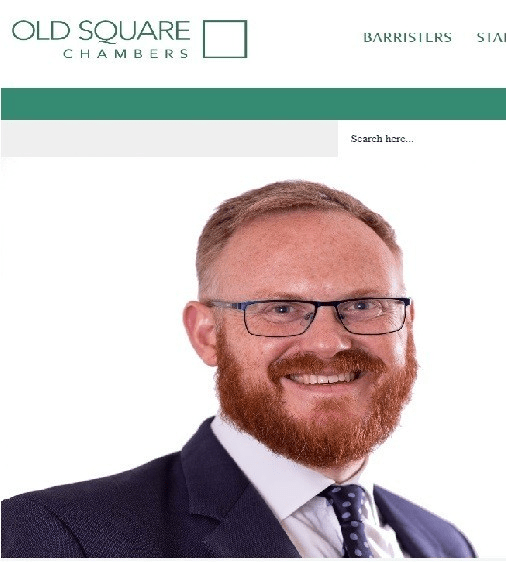
The disclosure came during the questioning by Jack Mitchell, the junior barrister from Old Square Chambers, of the chairman of the trust, Steve Erskine, about how he and chief executive Alex Whitfield handled a request by Dr Pitman for an independent inquiry into the way the trust handled his grievances.
Dr Pitman, a well regarded consultant obstetrician and gynaecologist, was dismissed by the trust on the grounds that he couldn’t work with colleagues which could put patient safety at risk. This was the last day of evidence.
Capsticks are well known as the “go to ” lawyers for NHS trusts and have a big contract with the NHS which has just been renewed. They have a track record of denigrating and undermining whistleblowers in the NHS. The firm played a prominent role in the recent case against Dr Usha Prasad, the dismissed whistleblower cardiologist who revealed an ” avoidable death” of an elderly heart patient which the Epsom and St Helier University NHS trust never reported to the coroner.
Steve Erskine
Mr Erskine confirmed evidence by Alex Whitfield yesterday that his original decision to have an independent inquiry requested by Dr Pitman into his grievances was later change to include a much broader inquiry in which his grievances were subsumed. He insisted he did this on his own reflection.
Questioning by Mr Mitchell revealed that the trust knew it was not compliant with new guidance issued by Baroness Harding, on how NHS staff should be treated by trusts in the aftermath of the suicide of nurse Amin Abdullah who burnt himself to death outside Kensington Palace after being unfairly treated and dismissed by his trust. Baroness Harding was then chair of NHS Improvement before her more infamous role in charge of test and trace during the Covid pandemic.
The guidance that later became mandatory was not implemented by the trust until much later when it convened a sub committee, which meets in private, to draw up the changes. Mr Erskine argued that confidentiality was needed because of some of the information in the report. Initially he said the new rules had not been published by the board, but later when this was queried by the trust’s lawyer Mark Sutton and the judge because it breached a NHS directive, it was suggested there was some public reference which had not been given to the tribunal.
After the terms of the inquiry were changed, Dr Pitman wanted it dropped but was overruled by the chairman and chief executive. He then suggested that Verita, an independent investigation consultancy which found failings by Imperial College Healthcare NHS Trust in the way Amin Abdullah was treated, should be appointed to do the inquiry. Steve Erskine rejected this saying it would be ” a conflict of interest” if Dr Pitman suggested who should conduct the inquiry.
Instead the trust approached the law firm Bevan Brittan, who are representing the trust at the tribunal, to advise them.
The trust then settled on Gary Haye a lawyer and partner who had sat on the board of Capsticks and who Mr Mitchell said he had publicly said his specialism was ” dealing with difficult doctors” to be the independent investigator. He was also a member of Portsmouth Hospitals NHS Trust, the same board where Steve Erskine was a member. When challenged why he had not declared this, Mr Erskine said he did not need to, as they were members at different times.
Mr Mitchell disclosed that findings of Mr Hay’s report were part of Dr Pittman’s claim for detriment, as he found the report was “full of inaccuracies” and was “partial “. Mr Hay has no medical qualifications only degrees in law, English and business.
Please donate to Westminster Confidential to allow me to follow whistleblower cases.
Alex Whitfield, chief executive of Hampshire Hospitals NHS Foundation Trust
Alex Whitfield denies ever saying ” Martyn Pitman was a ” direct threat to patient safety”
Whistle blower consultant obstetrician Martyn Pitman made numerous attempts to get Hampshire Hospitals NHS Foundation Trust to independently investigate the allegations against him but was met with silence until he complained to the board , the tribunal was told yesterday.
The disclosures came out during the cross -examination of Alex Whitfield, the chief executive of the trust, by Jack Mitchell, the junior barrister from Old Square Chambers. Dr Pitman was dismissed by the trust for allegedly not being able to work with colleagues after he raised concerns about patient safety in the maternity wards at Royal Hampshire Hospital. The trust is arguing he is not a whistleblower in this case.
Alex Whitfield, a former oil refinery operating manager has been employed in managerial roles in the NHS since 2007. She was cross questioned in detail about how the terms of an independent inquiry were changed from one solely concentrating on his treatment by the trust after he had raised patient safety issues to much broader issues covering staff treatment.
Dr Pitman won the inquiry after complaining directly to a board member because no one else in management would take it up. It was passed to the chair of the board, Steve Erskine, a highly experienced Whitehall player and business development director who was keen for it to go ahead.
Steve Erskine, chair of Hampshire Hospitals NHS Trust on X as @ErskineSteve
At the same time the trust was grappling with new guidance later turned into a directive from Baroness Harding, on how NHS staff should be treated by trusts in the aftermath of the suicide of nurse Amin Abdullah who burnt himself to death outside Kensington Palace after being unfairly treated and dismissed by his trust. Baroness Harding was then chair of NHS Improvement before her more infamous role in charge of test and trace during the Covid pandemic.
At the time the trust was not fully compliant with the directive but the chief executive insisted at the tribunal that the trust was compliant with part of directive that covered Dr Pitman’s case. She also vehemently denied Mr Mitchell’s claim that she hid the non compliance ” to save her own skin” from questions by the chair.
The tribunal was told however that she was behind the change in terms of the inquiry to make it much broader than Mr Pitman’s case. If it had remained solely with him, it would have put her close colleague, Dr Lara Alloway, at the centre of the investigation, who, as reported yesterday as Dr Pitman’s case worker, faced questions of conflict of interest and not minuting meetings.
Dr Martyn Pitman Pic credit: Adele Bouchard, Hampshire Chronicle
The chief executive told the chairman that Dr Pitman would be able to appeal against any findings against him so would not lose out with a wider inquiry. But questioning from Jack Mitchell revealed this was not true. He would have been able to appeal if he had been found guilty of misconduct or lack of capability but because he went down the mediation route instead he had no right of appeal.
Mr Mitchell repeatedly argued that the trust had ” mapped out” a strategy to get rid of him at meetings – and also cited how the people director of the trust thought the best solution was to pay him off with a settlement. But Alex Whitfield insisted that they all wanted him to stay because he was such a good clinician and only wanted him to moderate his behaviour.
At the end of her cross examination she very strongly denied she had ever said that he had been sacked because he was a present danger to patients and the public. She insisted that she had never said that in discussions with Dr Lara Alloway.
Her denial sits oddly with Dr Lara Alloway’s evidence yesterday about the need for an extraordinary advisory meeting to discuss his future and complaints against him because they were worried about the risk to patient safety because of the toxic atmosphere with his relationship with some other staff.
And also the reason why Dr Pitman took ” special leave ” after he had a letter raising clinical issues does not fit with that. The hearing continues tomorrow.













 Westminster Confidential