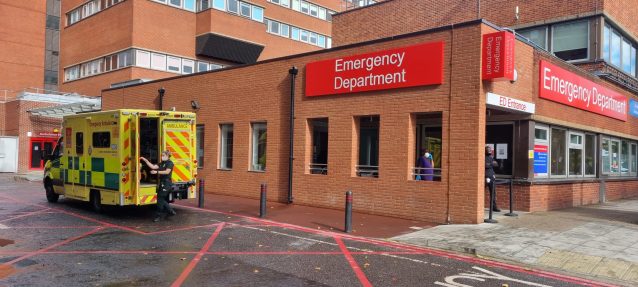
If you thought the NHS was at breaking point and want to know why – the National Audit Office have today provided a handy fact and figures guide to the decline of the country’s most cherished service.
A new report from Parliament’s financial watchdog charts the scale of both the failure of the NHS to respond to emergencies fast enough and the unprecedented demand from the public to use its facilities in the 13 years the NHS has been run by the Tories and the coalition government.
These are the startling figures:
711,881 A&E patients waiting over four hours from arrival to be admitted, transferred or discharged in December 2022, an all-time high. Since fallen to just over 550,000 in March this year.
90,998 ambulance handovers to A&E taking longer than 30 minutes in March 2023, equivalent to 25.9% of all ambulance handovers
32.0m reported number of appointments in general practice provided in October 2022, an all-time high, compared with 27.1 million reported in October 2018
92.3% general and acute hospital beds occupied during Q4 2022-23,representing record levels
88 seconds mean time to answer 999 calls related to health issues in December 2022, an all-time high
July 2015 the last time the NHS met its target for 95% of A&E patients to be admitted, transferred, or discharged within four hours of their arrival
8.4 million 111 calls answered within 60 seconds in 2021-22, compared with 11.2 million to 13.3 million between 2014-15 and 2020-21
1.27 million full-time equivalent NHS staff in February 2023, compared with the most recent low of 0.96 million in June 2013
£21.5 billion estimated annual cost in 2020-21 of providing the services reviewed in this report
Big variations in different regions in England
Delving deeper into the figures there are big variations in different regions of the UK. For example those being admitted, treated and discharged from A&E within four hours varied between 67.9 per cent in the East of England to 75.9 percent in the South East – both noticeably lower than the standard 95 per cent treated in that time just after the Tories got into power in 2011.
Similarly among ambulance response times there were wide variations. In 2021-22, the mean Category 1 (life threatening incidents like strokes and heart attacks) incident response time for the London ambulance service was 6 minutes 51 seconds compared with 10 minutes 20 seconds for the South-West ambulance service.,
In the same year the mean Category 2 incident response time for the ambulance service in the Isle of Wight was 26 minutes 20 seconds, compared with 1 hour 1 minute 57 seconds for the South-West ambulance service.
Some other points emerge why this is happening. The growing elderly population and general population increase in the UK is increasing demands on the NHS and effects of the Covid pandemic has left its mark.
More staff recruited but more off sick from stress
The government can claim it has recruited more NHS staff, including GPs and ambulance drivers. But this has been offset by more staff going off sick and more staff leaving the NHS because they can’t cope with the workload. I should not think the government’s attitude to keeping down pay rises in the middle of a cost of living crisis has helped either.
The government is promising a great £2.5 billion recovery programme and has allocated the extra money. But the NAO report says:
“More people than ever before are receiving unplanned and urgent NHS care every day. To support these services, the NHS is spending increasing amounts of public money and employing record numbers of people. Nevertheless, patients’ satisfaction and access to services have been worsening, suggesting there is no single, straightforward solution to improving what is a complex and interdependent
system.”
The real test will come next winter -since the government is promising much better services by March 2024. If it fails it will just add to the multiple problems facing this government and increase the distrust between the public and politicians.
Please donate to Westminster Confidential to allow me to continue my forensic reporting.
Make a one-time donation
Make a monthly donation
Make a yearly donation
Choose an amount
Or enter a custom amount
Your contribution is appreciated.
Your contribution is appreciated.
Your contribution is appreciated.
DonateDonate monthlyDonate yearlyPlease donate to Westminster Confidential
£10.00

 Westminster Confidential