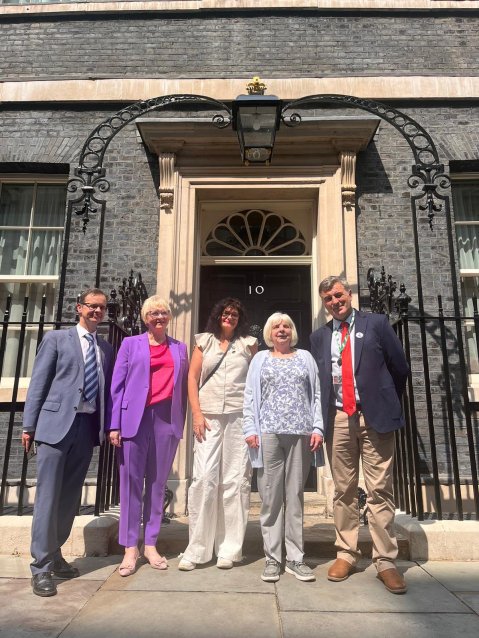
Delegation at No 10. (L to R) Ioan Bellin (Senior Communications and Research Officer for Delyth Jewell MS Senedd Wales);Vivienne Porritt OBE – WomenEd;Janice Chapman (CEDAWinLAW Volunteer):Michaela Hawkins (CEDAWinLAW Volunteer) and Ian Byrne, MP.
A delegation including Liverpool Mp Ian Byrne and former Australian judge Jocelynne Scutt yesterday increased pressure on Sir Keir Starmer, to start mediation talks on behalf of all 50swomen to end the stalemate in paying out compensation and restitution to those who waited six years to get their pensions.
As well as a letter, a petition signed by 36,000 50s women called on the government to get Liz Kendall, the new works and pension secretary, to open talks to sort out this long standing issue which was neglected by both the Tories and Labour during the general election campaign.
The petition is handed in
Both Tory ministers and Labour shadow ministers kept insisting they needed more time to study the former Parliamentary Ombudsman’s report by the now knighted Sir Rob Behrens ,which found partial maladministration over communications to the 3.8 million women who faced a six year delay until they reached 66 to get a pension. He recommended up to £2,900 each to cover maladministration.
CEDAWinLAW decided this was not enough since it did not cover the past discrimination against women – who had many hurdles to prevent them qualifying for a full pension and have insisted that since the UK signed the UN Convention on Eliminating all forms of Discrimination against Women in 1986 such paltry compensation breaks international law.
Later Jocelynne Scutt, the former Australian judge whose report found discrimination against the women. made a strong speech saying it was time for a new government to open talks and settle this dispute. She did praise Rachel Reeves, the new Chancellor, for planning to implement one key CEDAW recommendation, promising to implement part of the Equality Act that would gain equal pay for women with men. She pointed out that future generations would at least earn higher pensions as a result – ending the gap in the private sector between men and women.
I also gave a short speech backing the women’s case and calling for action from the government.
Will the government listen? Probably not before the summer recess. But what this shows is that these women are not giving up and there are more MPs who want this settled. It is not going away nor should it until the women have proper compensation.
State pension banner when the new pension came into force in 2016
One of the key complaints made by the 3.6 million 50s born women is that they didn’t know about the six year delay in the rise of the pension age for women from 60 to 66 until it was too late. This along with direct discrimination against women caused by the absence of a level playing field with men for that generation of women to pay national insurance contributions is behind this long battle with the government.
Now a report published today and sent to me reveals that these 3.6 million women are by no means alone. It implies that the majority of people in the UK today have little knowledge or understanding of how the state pension system works. A research report from the Policy Institute of Kings College, London commissioned for Phoenix Insights, a think tank for a large savings company, reveals that many people have misconceptions about the system. When these are pointed out they are unhappy about the current level of the pension and are concerned about how vulnerable people can live.
The research is not based on mass questionnaires but by taking 100 people in London and Birmingham and giving them detailed information at workshops after receiving a talk from former Liberal Democrat pensions minister Steve Webb. This enabled them to put forward policy changes they would like the government to enact.
Steve Webb gave a presentation to the group
The biggest misconception comes from how people think they have built up their pension. Some, believe it or not, think they just get an automatic full pension, when they reach retirement age provided by the state. One said: ““I thought when you retire everyone is entitled to the pensions. I don’t know why…I thought this is what happens.” But the majority believe by paying national insurance contributions all their working lives they have built up their own personal pension pot which they are entitled to get when they retire. This is a complete lie. Their money is instead used to pay people already retired to get a pension.
People are not stupid about state pensions – just misled
People are not stupid in believing this because the way the scheme works makes it look like that. Your level of pension depends on your national insurance contributions and you don’t get anything until you have made ten years contributions and only a full pension after 35 years. Anybody who contributed to a private pension scheme. would think that because that is the way they work..
Rather worryingly nearly half the people thought they had a a basic knowledge of how the pension system works and were embarrassed when they realised they didn’t.
When all this had been explained to them, the report reveals people thought the present system did not deliver an adequate pension for everybody.
As the report says: “The study identified five main knowledge gaps covering most of the core elements of how the state pension system works: the number of years of National Insurance contributions needed to qualify for the full state pension, eligibility criteria, the value of payments, what the “triple lock” is, and how the state pension differs from workplace savings.” The people’s conclusion was that the state pension was inadequate for anybody to live on without being able to top it up with a workplace pension, a private pension or property assets. Some retirees among the 100 people said unsurprisingly that the cost of living crisis had made a big impact.
People also thought that vulnerable people needed more help -particularly those with health issues who could not work – and either the level of benefit should be higher or they should be able to draw a pension earlier than the official retirement age.
People had bought into the government’s argument that the retirement age should rise because people are living longer – even though at the moment longevity has stalled and started to fall in poorer areas.
Phoenix Insights said: ” When we talk about longevity, we are looking at a long term view of life expectancy in the context of comparing to previous generations. Long-term life expectancy improvements mean that the pensioner population is projected to increase by over 5 million, rising from over 12 million today to over 17 million by 2070 (DWP, 2023).”
I thought this report is rather damning of the failure of successive government to explain how the state pension works or so many people would not be so ignorant. And it might suit governments that this remains so – or it would create a groundswell for much higher pensions.
But it is also a damning indictment of the minority of people who try and blame the 50swomen for not realising about the pension changes that have left so many people in poverty. They may well be the very people -unless they are pension experts – who are ignorant themselves and get a shock when pension day dawns.


 Westminster Confidential