Revised All Party Pension Inequality Group for Women to act as bridge to get justice

The new Parliament has seen a complete revamp of the all party group tackling the long standing festering issue of pension inequality for millions of women caused by the mishandling of the rise in the women’s pension age.

Out go Carolyn Harris, the former chair and Labour MP for Swansea, East and co chair Tim Loughton, Conservative MP for East Worthing and Shoreham.

In come Andrew Gwynne, Labour MP for Denton and Reddish as the new chair and Peter Aldous, Conservative MP for Waveney as co chair.

The good news is that the change means a fresh start and a move to a more inclusive approach taking in the views of all the different women’s organisations that represent those born in the 1950s who were faced with a wait for up to six years to get their pension. Unfortunately under his predecessor Carolyn Harris this was not always the case and it was a never completely clear what this group of MPs wanted in compensation for the millions of women affected by the change.

Andrew Gwynne summed up the change succinctly.

“The APPG on State Pension Inequality exists to keep the issue of the 1950s women’s pension injustice alive.

“As new Chairs, Peter Aldous and I are informally taking evidence from all the 1950s women’s groups to get as much information as possible. We also await the Ombudsman’s report.[This is the report on maladministration]

“We recently had a good meeting with BackTo60 who are providing information to us about CEDAW and whether there is a parliamentary route on the issue.”

I gather that as well as Waspi and Waspi 2018 they have asked Joanne Welch, who ran BackTo60, to address a full meeting of the committee.

welcome news

This is particularly welcome news as for years we had a ridiculous position of a major court case seeking a judicial review of the government’s handling of the issue running alongside complaints to the Parliamentary Ombudsman – with the former being ignored by this committee. The first dealt with the past inequalities that were enshrined by the legislation, the second with whether the Department for Work and Pensions was guilty of maladministration in handling it.

The first ultimately failed but the fact that it took place at all is due to a ruling by Mrs Justice Lang – a remarkably independent woman judge – who decided that it couldn’t have possibly been known in 1995 that the new act would cause such present hardship to a group of women born in the 1950s. She incidentally took an equally controversial decision to save at the eleventh hour from destruction Brandon Station on the Suffolk/ Norfolk border designed by the architect who supervised the stone carvings in the Houses of Parliament. See my blog here.

The great news is that MPs will now look at all proposals from full restitution to compensation, take account of what the Parliamentary Ombudsman finally says, and be able to present their views to ministers who have been extremely reluctant to award any money at all to the 50s women.

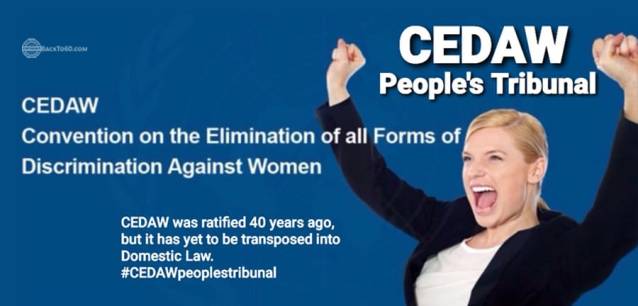
CEDAW People’s Tribunal

They have also acknowledged the link to CEDAW – the UN Convention on the Elimination of all Discrimination Against Women, ratified by Margaret Thatcher in 1986.

With a CEDAW People’s Tribunal due to be held from June 21 in London with the backing of lawyers from Garden Court Chambers – it also very likely that the plight of the 50swomen will form part of wide ranging submissions covering violence to women, unequal pay and job discrimination.

The other members of the committee are: Philippa Whitford, SNP MP for Central Ayrshire; Liz Saville Roberts, Plaid Cymru MP for Dwyfor Meirionnydd; Ruth Cadbury, Labour MP for Brentford and Isleworth; Jason McCartney, Conservative MP for Colne Valley; and Gavin Newlands ,SNP MP for Paisley and Renfrewshire North.

Exclusive: Parliamentary Ombudsman proposes to say maladministration by DWP over the rise in the women’s pension age

Sir Robert Behrens – provisional ruling

Provisional findings point to some compensation likely to be paid to women born in the 1950s and 1960s

A confidential letter seen by this website shows the Parliamentary Ombudsman, Sir Robert Behrens, has managed to both exonerate and damn the Department for Work and Pensions for its handling of the administration of the rise in the pension age for millions of women born in the 1950s and 1960s,

The letter contains the provisional findings of an investigation which has taken years to undertake by his office – also wrongly temporarily halted because of a court case brought by Back To 60 seeking full restitution of the hundreds of millions lost by pensioners on grounds of inequality not maladministration.

The ministry is exonerated for all the work it did between 1995 and 2004 – from the passing of the 1995,Pensions Act.

DWP exonerated for first nine years of the announced change

The relevant paragraph reads: ” Between 1995 and 2004, accurate information about changes to State Pensions Age was publicly available in leaflets, through DWP’s agencies and on its website. What the DWP did reflects expectations set out in the Civil Service Code, the DWP Policy Statement, the Pension Services Customer Services Charter and the Benefit Agency Customer Charter”.

But the provisional report go on to make findings of maladministration for the department’s handling of events from 2005 to 2007 when it belatedly found out through internal research that people still did not know about the change and needed targeted information.

The report reveals that at the time the ministry had a sufficient database to have issued targeted information to people who were affected by 2005. But the huge delay in sending out letters meant in the worse case scenario many women did not get an official letter until 14 years after the event. The letter quotes Paul Lewis, a financial campaigning journalist, saying on average women born in the 1950s did not get a letter until one year and four months before they turned 60.

DWP ” did not get it right “

It says: ” We think DWP’s decision making following the 2003/04 research failed to give due weight to relevant considerations, including what research showed about the need for ” appropriately targeted” information, what was known about the need for individually tailored information, or how likely it was doing the same thing would achieve different results. It failed to make a reasonable decision about next steps. In Augusts 2005 DWP did not ” get it right”. And its failure to use feedback to improve service delivery meant it did not seek continuous improvement. Our provisional view is that it was maladministration.”

” We think DWP then failed to act promptly on its 2006 proposal to write directly to affected women, or to give due weight to how much time had already been lost.. It did not get it right because it did not meet the requirements of the Civil Service Code and it did not take all relevant considerations into account. And it failed again to use feedback to improve service delivery and seek continuous improvement.. Our provisional view is that was also maladministration.”

” We think maladministration led to a delay in DWP writing directly to women about changes in the state pension age. In our view that letters would have been issued around 28 months earlier than they were if the maladministration had not happened.”

This led to women who were not aware of the changes being given less time to make changes to their retirement plans. ” The next stage of our investigation will consider the impact that injustice had.”

The report seems to exonerate Whitehall for the way it handled the pension changes in 2011 with letters going out 18 months after the further change. But because of a huge delay in sending out letters to the women affected by the changes in 1995 many did not know until just before they thought they were going to retire.

CEDAW People’s Tribunal: Links for hearing announced

The long awaited UN Convention for the Elimination of All Discrimination Against Women People’s Tribunal will take place in London for three days at the end of the month.

Here is the announcement:

 CEDAW PEOPLE’S TRIBUNAL   You are warmly invited to view the Tribunal Hearings which take place between 9-5pm on these 3 dates:- Monday 21st June  21          View Here 
Tuesday 22nd June  21        View Here  
Wednesday 23rd June 21     View Here  

The inquisitorial Tribunal will examine a body of evidence out of which a body of learning will evolve. Opening and Closing Statements by Garden Court Chambers will be followed on the final day by the President of the Independent Judges Panel’s ‘Brief Summary’. A Report will be published ahead of August Bank Holiday accompanied by a film where more information will also be shared.

Huge interest

Since there is a lot of interest by holding the hearings on line to reach the maximum number of people. The hearings will be chaired as reported before by leading QC’s and Barristers from Garden Court Chambers.

For full details of all the people involved please see my previous blogs for their profiles. More details about the issues to be debated will be published later but it is expected to comprehensively cover all the points in the Convention about discrimination against women and girls.

My previous blogs on the issue are here:

https://davidhencke.com/2021/04/08/womens-discrimination-what-is-cedaw/ https://davidhencke.com/2021/03/31/independent-panel-of-judges-announced-to-head-tribunal-examining-discrimination-against-women/

https://davidhencke.com/2021/05/05/exclusive-whats-missing-for-womens-rights-in-the-uk-former-judge-dr-jocelynne-scutt-and-former-chief-prosecutor-nazil-afzal-talk-about-cedaw/

https://davidhencke.com/2021/05/14/exclusive-londons-largest-human-rights-law-chambers-backs-initiative-to-end-all-discrimination-against-women-in-the-uk/

Later in the same week the Labour Party’s Women Conference will also be debating a motion to commit the party to supporting the UN Convention into British domestic law. The Scottish National Party is already committed to implementing the convention into Scottish law and has started to prepare to do this after winning the Scottish Parliamentary elections in May.