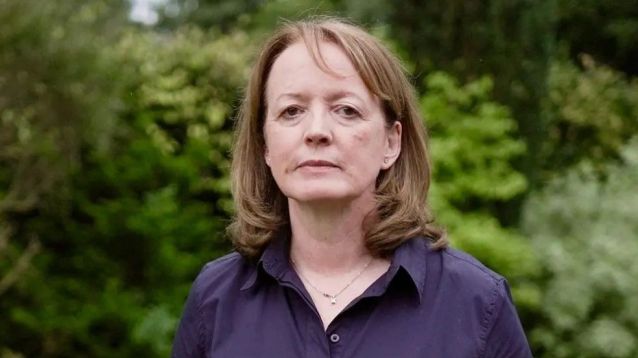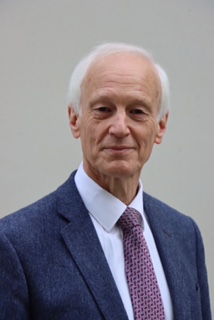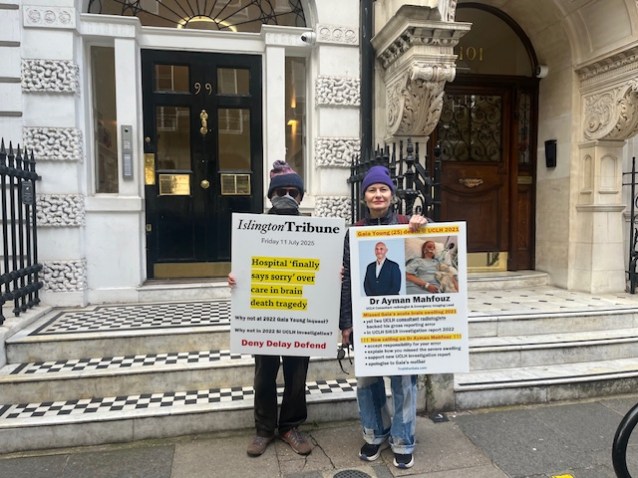
Mother and former coroner hold Harley Street protest over radiologist’s mistake that may have contributed to the death of Gaia Young

ex coroner and mother at a vigil in Harley Street

Posted on  by davidhencke
Last year I reported on the tragic death of talented 25 year old Gaia Young 17 hours after she was admitted to University College Hospital with severe headaches. Her mother Lady Dorit Young was subject to an entirely unsatisfactory and unsympathetic coroner’s inquest by Mary Hassell which let the hospital off the hook saying the cause of death was unknown. You can read my original blog here.

The coroner blocked Lady’s Young’s attempt to get independent evidence from a neurologist but since then she has managed to get an independent neuro-radiologist and neurologist’s report and UCLH have opened a further review into her tragic death.

The protest vigil on September 15 was sparked by the findings of the neuro radiologist who examined the CT scans of Gaia’s brain. It showed quite clearly even to a lay person, according to Dorit ,that the first scan taken and I quote ” there is a gross cerebral and cerebellar swelling. There is effacement meaning ( ” literally meaning ‘ rubbed out’: these fluid spaces should be visible but cannot be seen).”

This is the opposite to the consultant radiologist who examined Gaia’s scan who said: “The ventricles and basal cisterns are patent…Impression No acute intracranial finding.”

Gaia Young

The independent consultant’s diagnosis was confirmed by Dr Charles House, the medical director, when he met Dorit and compared Gaia’s scan with a normal brain scan.

The consultant radiologist who examined this first scan was Dr Ayman Mahfouz, who was on duty at UCLH at the time Gaia was admitted. Dr Mahfouz, has a private practice in Harley Street.

His entry on the private practice site says he  has specialist expertise in breast, gynaecology and general imaging.

He undertakes all aspects of breast imaging including mammographic (plain, contrast enhanced and 3D), Ultrasound, MRI and CT diagnostics. He performs all ultrasound and stereotactic breast related procedures including vacuum excision.

Dr. Ayman Mahfouz is a designated appraiser for doctors at UCLH and has previously been elected as a regional representative for doctors in training at the Royal College of Radiologists. At the time of Gaia’s admission he  held the role as Emergency Imaging Lead for UCLH.

Gaia’s mother would like to contact him about the scans but so far he has not responded. She does not know what pressure he might have been under at the time or how much time he took to examine the scan. I did ask UCLH about whether he wanted to say anything about this but there was no response to my question.

UCLH did issue a response about the review into Gaia’s death.

A UCLH spokesperson said: 

“We met with Lady Young and apologised that Gaia’s care fell below the high standards we strive to provide. We sympathise greatly that the cause of her beloved daughter’s death four years ago is still unknown.  

“We are committed to learning from external opinion and scrutiny and have commissioned a range of independent experts to explore further the circumstances surrounding Gaia’s death. We agreed with Lady Young the scope of the reviews and the experts who will undertake them.   

    “We await the outcomes of all the external reviews to understand if further lessons can be learned and acted upon.”

Dorit’s vigil last month caused more than a flutter on Harley Street. The clinic at 99 Harley Street called the police and also alerted its own security guards. When the one man patrol car turned up with flashing blue lights the policeman turned out to be incredibly polite and said no-one was breaking the law so long as the entrance to the premises and pavement was not blocked.
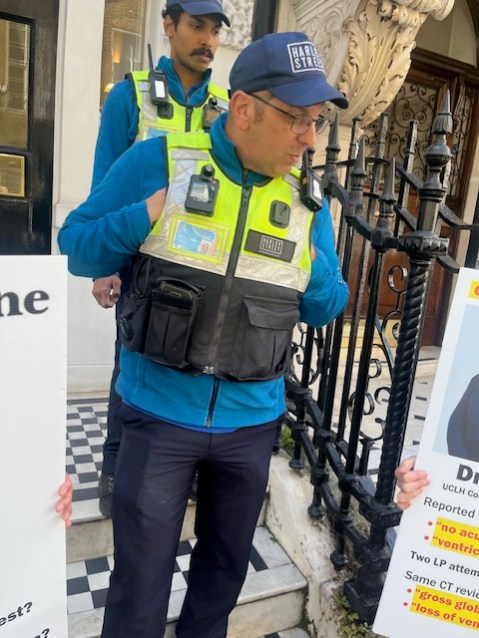
The friendly security guards curious about the case

Then two security guards turned up, saying they had been informed by a member of the public that large numbers of people were demonstrating there. It turned out to be just three people and they were remarkably friendly and polite when they heard about the circumstances. They didn’t mind having their pictures taken.

The one person who didn’t turn up was the doctor and one of his private practice colleagues politely remonstrated with us that this was not the right way to do things and Dorit should arrange a meeting with the hospital. It was pointed out to him she had been reprimanded by the Trust on various occasions for trying to contact clinicians having cared for Gaia. She never received an answer. The Trust never offered a meeting with any of these doctors.

Gaia’s case has been taken up by an Islington councillor, Dr Hannah McHugh. She wrote a strongly worded opinion piece for her local paper, The Islington Tribune. You can read it here.

She says:” As an Islington councillor, I’ve supported Lady Young in this painful journey. It has revealed something of concern to us all: when things go wrong in our healthcare system, the path to truth is too often long, difficult, and unjust. Tragedies become injustices.”

Slowly but surely the facts about Gaia’s death are coming to light. But so far it has taken four years to achieve with no help from coroner Mary Hassell.

This to me is a general problem across the NHS. Rather than acknowledge to patient’s relatives that mistakes have been made, trust managers initially go on the defensive and are prone to cover up what went wrong and who was responsible. It is only people with guts and determination like Dorit who are prepared to fight for years until they get answers that the true facts start to come to light.

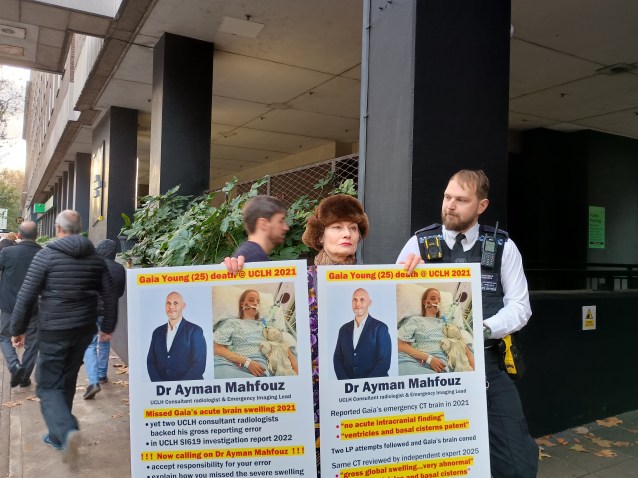
UPDATE; The ex coroner and Lady Dorit Young held a second vigil at a conference organised by the Royal College of Radiologists in London this month to bring it home to the profession the need for the very careful reading of scans by radiologists. Here is a picture of their vigil accompanied by a police officer.
One-Time
Monthly
Yearly

Make a one-time donation

Make a monthly donation

Make a yearly donation

Choose an amount

£5.00
£10.00
£20.00
£5.00
£15.00
£100.00
£5.00
£15.00
£100.00

Or enter a custom amount

£

Your contribution is appreciated.

Your contribution is appreciated.

Your contribution is appreciated.

DonateDonate monthlyDonate yearly

Gaia Young

The secret influence of NHS Resolution that ensures so many doctor whistleblowers don’t get their jobs back

logo for NHS Resolution

Why do 97 per cent of whistleblowers fail to win their cases in employment tribunals? Why are they sacked – not for their disclosures of patient safety which is illegal – but under the nebulous title – some other substantial reason (SOSR)? This could be allegations of bullying or saying they cannot get on with colleagues.

But how does a trust gather such information to discredit a doctor? What I have discovered is that NHS trust managers can get a free advice service or an endorsement for actions considered by managers against a Whistleblower from NHS Resolution, an arms length quango from the Department for Health and Social Care.

This ” phone a friend” service would allow the manager to set up a case file under Practitioner Performance Advice without the doctor even knowing this has happened. Effectively the evidence will be later presented at an employment tribunal by highly skilled and expensive lawyers hired by the trust to discredit the unfortunate doctor.

This process has no transparency, no verification with the doctor and there are no public records of what happens in these cases.

The only information that there is such a process is in the annual reports and accounts of NHS Resolution and even that is very sparse.

While there are reams of statistics about the organisation’s public facing work dealing with patients complaints about clinical and non clinical issues which it tries to resolve without going to expensive legal action, the role of practitioner performance advice service gets very little mention.

In the 2024-25 annual report it acknowledges “NHS Resolution’s Practitioner Performance Advice service delivers expert advice, support and interventions on the fair management of concerns about the performance of doctors, dentists and pharmacists.”

How do they judge performance having branded the therapist with a “behaviour” issue at the outset even with untrue claims or without awareness of risks to patients? Only when the formal referral actioned the therapist or doctors may get an opportunity to represent their side of the story BUT if the behaviour analyse are not even clinicians, how would they understand what culture therapist or doctor has been working in.

The PPA service also claims to be very efficient. It says 90% of advice and other case interventions delivered within target timeframe – this was achieved in 2024/25 NHS Resolution annual report and accounts 2024 to 2025 90% of all exclusions/suspensions critically reviewed (where due) – this was within tolerance at 82%, with 155 of 189 exclusions/suspensions reviewed within required timescales.

What it does reveal is that trusts searching to use its services are booming.

The report says: “The service received 1,420 new and reopened requests for advice from healthcare organisations with concerns about the practice of individual practitioners as well as services in 2024/25, representing a 24% increase compared to 2023/24.The open caseload at the end of the financial year stood at 1,149, a 15% increase when compared with the end of 2023/24 .”

It adds: “Requests for assessment and remediation services remained at a high level in 2024/25, with 50 requests for professional support and remediation action plans, 44 requests for behavioural assessments, six requests for clinical performance assessments and four requests for team reviews.”

And it says:” NHS Resolution delivered OARs ( Organised Activity Reports) to 18 secondary care trusts in England, offering follow-up consultations with a Performance Practitioner Advice adviser to each, and finalized reports for primary care trusts, mental health trusts and trusts in Wales and Northern Ireland for delivery in 2025/26″.

Helen Vernon, CEO of NHS Resolution

On what grounds has this service without transparency or regulation of its advisors been set up and run?Sally Cheshire Chair of the NHSR , and Helen Vernon,CEO, need to explain this.

The only other references are likely to lead to hollow laughs from some of the whistleblowers who lost their jobs at trusts – notably Martyn Pitman at Hampshire Hospitals NHS Trust and Usha Prasad at the now St Georges and Epsom and St Helier Hospitals Trust.

It claims that the whole process is to “develop Compassionate Conversations in relation to performance conversations to support kindness and compassion within the NHS .”

It goes on to say: the aim of the advice includes” Fostering just and learning cultures rather than punitive approaches” and” Ensuring fairness and proportionality in managing performance concerns.”

If there is a lack of transparency how can it be justified as a just culture suitable for learning?

Having covered employment tribunals now in NHS sacking cases the last thing I have seen is any compassionate conversation. Instead the trusts are keen to employ numerous highly paid lawyers to terrify and frighten professional doctors reducing in some cases people to tears – at enormous cost to the taxpayer who foots the bill for their salaries.

So if NHS Resolution is boasting about saving lawyer’s fees in patient complaint cases, it is also responsible for increasing lawyer’s fees – often running to hundreds of thousands of pounds – by advising trusts on how to ruin doctors’ careers when all they have raised is patient safety problems.

If you take this process alongside my previous blog about the role of the General Medical Council and its relationship with the responsible medical officer in the trust- it is no wonder that whistleblowers have little chance of success in the NHS. I now know of senior doctors who are NOT going to report patient safety issues because they fear it will be the end of their careers if they do.

NHSR’s PPA is yet another tool like the unregulated triage by the GMC that can be exploited to bury serious concerns using public funding.

One-Time
Monthly
Yearly

Make a one-time donation

Make a monthly donation

Make a yearly donation

Choose an amount

£5.00
£10.00
£20.00
£5.00
£15.00
£100.00
£5.00
£15.00
£100.00

Or enter a custom amount

£

Your contribution is appreciated.

Your contribution is appreciated.

Your contribution is appreciated.

DonateDonate monthlyDonate yearly

Please donate to Westminster Confidential through Paypal link below

https://www.paypal.com/ncp/payment/865JAS3QJ3CGQ

Are there flaws in the new guidance for General Medical Council investigations?

Dr Andrew Hoyle

Reforms without addressing core issues may lead to persistence of key flaws  or omissions in any future changes with risks to patients

Last month I wrote about the government proposing the first major reforms for 40 years in the running of the General Medical Council. My blog was meant as a warning to ministers to scrutinise the changes very carefully because I was sceptical, after talking to a number of doctors, that there were flaws in the changes. You can read the blog here.

Now the GMC has published its new guidance by Dr Andrew Hoyle, an assistant director in the GMC’s Fitness to Practise Team He is both a doctor and a barrister.

In a high minded piece on Linked In and in a blog ( see the article here) he promises greater clarity and consistency .. and fair, flexible and compassionate fitness to practise processes. He also emphasises the GMC’s duty under the 1983 Medical Act to protect, promote and maintain the health, safety and well being of the public, promote public confidence in the profession and promote and maintain professional standards and conduct by doctors.

Now from the patient’s point of view how is this being enacted by a change to one simple process?

The first point is drawing up guidance for the decision makers on whether to proceed. There is a comprehensive list of issues to consider for the decision makers whether to start an investigation into a doctor. But the response to the concern raiser, the guidance does not specify who the decision makers are. Are they fully competent in the field or even sub-field of medicine practised by the doctor to make a sound judgment  about clinical matters? I have heard from some doctors that this is not always the case. On the question of accountability should it not be made public who made the decision and their qualifications to do so. This would reassure the public and the patients that it had been properly investigated.

The current process’s most crucial step, the  “initial triage and closure of concerns” relies on the “opinions” of the GMC postholders who in turn rely on managers. There is no mandatory requirement to immediately investigate serious harms or near miss issues that may have led to consequences to that or other patients.

This is particularly relevant as there is also the issue of the seriousness of the concern. The guidelines suggest that if there is evidence of repeated bad practice this should be relevant to striking off doctors. But there is a second flaw in this process. How does the GMC know about a bad doctor? The answer is because he or she is reported to the GMC by the responsible officer – normally the medical director or chief medical officer of the trust or far less by patients and or colleagues who are more in the know of bad practices but are fearful of consequences. See article in the Lancet.

Therefore the issue the GMC knows about may not be the first one and the GMC cannot verify it with the current approach neither can the complainant know of all issues. 

From earlier blogs I have found this process to be flawed – either because the responsible officer has targeted a doctor who has raised whistleblowing issues – whether patient safety or fraud – to discredit a perfectly good doctor – the case of Usha Prasad, a former cardiologist at St Helier and Epsom hospital is a current example – or covered up bad practice to save the reputation of the trust or private hospital.

The most egregious example of the latter is the case of Mr Ian Paterson, a breast and general surgeon, now serving a 20 year prison sentence after performing unnecessary operations on hundreds if not thousands of unsuspecting patients until a lawyer brought a civil case against him.

The public inquiry into his practice concluded “They were then let down both by an NHS trust and an independent healthcare provider who failed to supervise him appropriately and did not respond correctly to well-evidenced complaints about his practice.”

It went on: “The recall of patients did not put their safety and care first, which led many of them to consider the Heart of England NHS Foundation Trust and Spire were primarily concerned for their own reputation. Patients were further let down when they complained to regulators and believed themselves frequently treated with disdain.”

Imagine how different the outcome for hundreds of patients if this had been first reported by a responsible officer to the GMC – life changing needless operations would have been stopped rather than covered up. What the GMC should demand is that the management of NHS trusts and private hospital groups have to sign a ” duty of candour” putting them on par with doctors who raise complaints. This would require them to notify the GMC about the practices of the doctor involved and meet the legal requirement that the GMC has to protect patients and promote higher standards in the profession. Otherwise the assessment of a serious repeated bad practice is a hollow gesture in many cases.

 However if the GMC has been and appears it is continuing to rely on the Responsible Officers to provide a response can the GMC’s decisions be evidence-based  and safe for public. Even if a small minority of doctors are unsafe or dishonest,  the impact on the patient and profession must be the core of decision.

The third point is when a doctor acts inappropriately or unsafely that can be investigated by the GMC personnel but who are potentially not being regulated by any one and via a process built on reliance on an RO and in at times without transparency or evidence verification and opinion based decisions are taken that can affect lives This does not appear to be a safe approach as multiple scandals continue to occur; suggesting concerns are not really reaching the GMC due to its current system or are being ignored.

The current concern management requires a complete overhaul and not just superficial tweaks

Since I started looking at this issue I have been contacted by doctors across the country about the GMC and I intend to follow this up in a future blog.

One-Time
Monthly
Yearly

Make a one-time donation

Make a monthly donation

Make a yearly donation

Choose an amount

£5.00
£10.00
£20.00
£5.00
£15.00
£100.00
£5.00
£15.00
£100.00

Or enter a custom amount

£

Your contribution is appreciated.

Your contribution is appreciated.

Your contribution is appreciated.

DonateDonate monthlyDonate yearly

Please donate to Westminster Confidential

£10.00

A horrendous tale: How a strapping lad was injured for life at work and then fell victim to corporate power and unfair justice

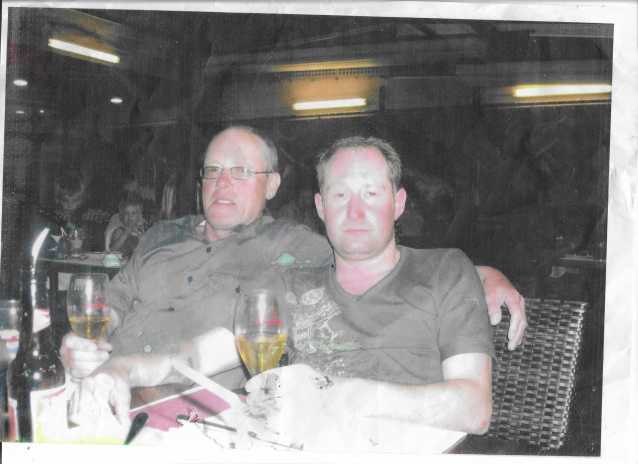
Happier times. Matthew Reynolds (right) enjoying a drink with his late dad, Howard, before his horrendous accident

Matthew Reynolds was a strong strapping lad who earned good money – £80,000 a year – as a welder at the Tata Steel works in Port Talbot, South Wales. He had already bought his own flat and his future was bright.

Then one day as he was welding steel a large heavy refractory brick in the roof of the works came loose and fell 150 feet hitting him on the side of his back. His injuries confined him at the time to a wheelchair, cost him his well paid job, and damaged his spine so he can’t easily move his neck and caused other painful injuries. He had to sell his flat in Port Talbot at a loss ( it was up a flight of stairs) and move back home with his mother in rural Lincolnshire. Today he can barely hobble around, needs help to dress himself and has very little likelihood of getting another job.

This story is not about his injuries -horrendous as they are – but what happened when he tried to claim compensation from Tata Steel so he could live a reasonable life as a disabled person who would always need expensive help and care.

Any reasonable person would expect a multinational company run by a billionaire to pay substantial compensation, especially as the incident had to be reported to the Health and Safety Executive and the company admitted liability.

But in today’s world corporate responsibility is not that straightforward or even ethical. Tata Steel appear to employ health insurers to assess their responsibility and the offer made to Matthew was less than his annual salary – over £50,000 – for a lifelong injury. The figure based on 6 per cent of his claim was recommended by Tata’s health insurers – either coincidently or in line with initial payments offered to sub postmasters.

Just £9500 initial compensation for being left in a wheelchair

As a result he has had to use the county court system for the last SEVEN years to put in a claim and it remains unpaid at the moment. The only money he has received is an initial interim payment of £9500.

Tata, Dousan Babcock, who were managing the site, and Primetals Technologies Ltd- combined to oppose his claim seem to be relying solely on the initial assessment made at accident and emergency department in October 2018 which found no bones were broken but there was serious damage to soft tissue. However three independent specialist doctors have linked other serious damage to himself to the accident. Three and half years later, Mr Caspar Aytott, of Cheltenham Spine Centre found the severe pain had spread from his lower back into his flank, up to his chest into the shoulder and neck with difficulty raising his left arm. This is despite having physiotherapy and two spine injections which had no effect.

Then a rheumatologist found 20 months later that he still had chronic pain and was suffering from fibromyalgia and post traumatic stress disorder due to the accident. A third independent doctor, Karen Simpson, who examined him found he had damaged nerves and wanted him to have rehabilitation which he never got.

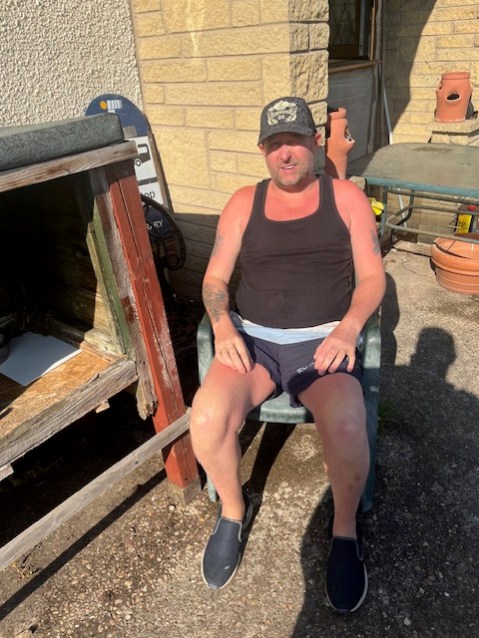
Matthew Reynolds today -now aged 45

What was clear was that he was not returning to full health and getting worse not better. In the meantime his case was dragging on through the slow county court system, which has been heavily exposed by the Commons Justice Committee in a recent report. See my story on this blog here.

During the proceedings that followed his solicitor, supposed to be a family friend who offered to take his case on a ” no win, no fee” basis gave him spectacularly bad advice. This included him cancelling his GMB union subscription, not getting a crucial Health and Safety Executive report on the accident and losing all his original wage slips so a judge could not give him a substantial interim payment at another hearing.

So bad was his role that a judge took a rare decision to remove him from representing Matthew on the grounds of bad communication and mismanagement. There is even an allegation that while representing Matthew he was trying to arrange a dinner with Tata’s leading solicitor in London, Leanne Conisbee.

Matthew and his mother Denniel were meanwhile getting poorer by the minute, racking up the maximum on Matthew’s credit cards, their house faced repossession and a huge bill from their solicitor for handling their case. His mother ended up taking a equity loan on the house. They now rely on food banks to eat and have to pay court fees for every hearing in his case. They have an old Fiat 500 to get around with an adapted front seat as Matthew is in pain if he bends his back.

In desperation Matthew from a wheelchair supervised some men at work to get money for the fees. He did not declare this to court and the lawyers for Tata were tipped off and pounced accusing him of being ” fundamentally dishonest” for not doing so.

After the solicitor had been taken off the case the bundles were returned to Matthew. Included was an email sent to Rodney Fern, a barrister who had tried to prevent the solicitor being removed from the case, which revealed the dirty tricks being prepared by Tata against Matthew.

It read: ” the insurers, as you rightly say, are going to try and starve Matthew Reynolds out. They are not going to withdraw the application on fundamentally dishonesty as this is to be used as a bargaining tool. although it is without any substance.”

Tata’s lawyers said he was ” fundamentally dishonest” in court

I saw it used at Doncaster County Court this year when Matthew tried to get an interim payment. It had to be refused by a sympathetic judge because the law says anybody judged to be ” fundamentally dishonest” cannot be paid. The barrister for Tata was determined he would not get any money.

The situation has now escalated. Last month Matthew asked for a longer period as a litigant in person to prepare for this week’s hearing. He wanted a longer hearing of 10 days, wanted to call 16 extra witnesses including people who witnessed the accident and professional medical people.

All this was refused by both the circuit judge William Hanbury, a former property and local government barrister and senior circuit judge, Mark Gargan. Seven years ago Mark Gargan was found to have given a wrong judgment by the court against a terminally ill claimant in a personal injury claim against a firm when he threw out his case claiming he and his lawyers had ” flagrant disregard” for the rules. The case was reported in the Law Society Gazette here.

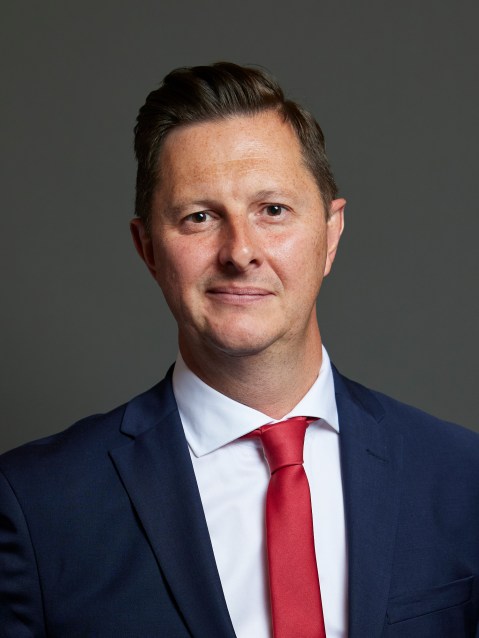
Official Portrait: Lee Pitcher MP Pic Credit: Laurie Noble Photography

The judge took the decision despite receiving a letter from Matthew’s new Labour MP, Lee Pitcher, who represents Doncaster East and the Isle of Axholme.

In it he points out that Matthew, through no fault of his own, has lost his lawyers and is now fighting three large corporations having to navigate ” complex legal proceedings at significant financial and emotional cost”.

He adds: ” it is difficult to see how this can be viewed as a fair and balanced process. That an individual in such a vulnerable position should be left to fight such a case unaided, while the companies involved have already accepted liability, raises serious questions about access to justice.”

“Mr Reynolds has shown remarkable courage in pursuing this case and deserves to be treated with dignity and fairness without.”

His GP also sent a letter to the court saying Matthew was in no fit state to conduct the case and the hearing should be delayed but this was rejected by the judge. Using rather twisted logic the judge rejected this saying even with a delay Matthew would still be in the same state of health in the future – something the big corporations are trying to deny in their case.

He was sent 1500 pages of evidence from the three corporations and given 10 days to digest it and respond before the hearing. He told the judge: ” OK I’ll give these barristers/ solicitors a welding manual. I’ll set them up, give them the equipment ..you’ve got 5-10 days to go for a perfect weld.”

The hearing never went ahead this week. Both Matthew, who had a week of sleepless nights, and his pensioner mother were too ill to attend and drive to the court in Sheffield. I contacted the clerk to the case to find out what would happen next but was told there was no hearing for the rest of the week.

The only new development is that lead solicitor, Leanne Conisbe from Clyde and Co in the City of London has submitted a 74 page victim impact statement – claiming that she and not Matthew had suffered as a result of organising the case. The judge has ruled out his mother putting in a four page victim impact statement.

One-Time
Monthly
Yearly

Make a one-time donation

Make a monthly donation

Make a yearly donation

Choose an amount

£5.00
£10.00
£20.00
£5.00
£15.00
£100.00
£5.00
£15.00
£100.00

Or enter a custom amount

£

Your contribution is appreciated.

Your contribution is appreciated.

Your contribution is appreciated.

DonateDonate monthlyDonate yearly

Please donate to Westminster Confidential

£10.00

Will health minister Karin Smyth spot the need for more radical reform of the General Medical Council to protect clinicians and ultimately patients?

Karin Smyth – health minister responsible for professional regulation reform

The new Labour government is embarking in the first reform of the professional regulation of the General Medical Council for 40 years. This welcome development comes after the GMC extended its scope to cover physician and anaesthesia associates at the end of last year. In theory it will allow the GMC more flexibility to change its rules and allow less adversity among fitness to practice cases involving doctors thus avoiding referrals to the overloaded and often unfair employment tribunals. It also abolishes an arbitrary rule that prevents it looking at cases that are more than five years old.

From my observations of recent complaints against doctors who raise patient safety cases and conversations with doctors who are concerned about referrals to the GMC the whole process needs a radical overhaul. It is also an overhaul that requires some political intervention.

How the GMC handles individual complaints against doctors is by no means transparent. Nor is the GMC directly accountable for their failings and omissions and its workings can be manipulated by individual health trusts. I am about to give you two different examples,

Many doctors think the complaints system is flawed because of a practice of referring the case to the so called ” responsible officer ” to handle it. The responsible officer is often the person who has brought the complaint in the first place – the chief medical officer of the trust. Now the chief medical officer is not what the public might think – the ultimate person protecting medical standards on behalf of patients. He is part of the trust’s management team whose main purpose is to protect the reputation of the trust which may not be in the interest of patients. So surely this is a conflict of interest?

NHS Managers labelled one doctor ” too passionate about patient safety”

There was also an extraordinary experience of a whistle-blower who was a warned by local managers against being too “passionate about patient safety.”

And does the GMC do a thorough job when it investigates.? Doctors are sceptical. In one example it appears the complaints about serious safety issues, were closed at the first step and  not even seen by GMC clinician. The bald reply from the GMC confirmed that to be the case; neither the team had nor did they seek any advice or expert opinion.

The GMC’s current practices enable its staff without clinical knowledge to close clinical concerns in such manner or only with hospital managers’ response, even when the concerns about the said managers are known to the GMC. In one example it appears the complaint was not even seen by fellow clinicians.

Given the whole point, according to many of the doctors who have raised patient issues, is the worry that either patients have already been harmed or more are left  at risk of being harmed by such poor medical practice,  these do not appear to be safe concern closure processes for a regulatory body.

Dr Usha Prasad

There is another side and here I can quote an actual case – as it came up in an employment tribunal – the removal of cardiologist Dr Usha Prasad from the then Epsom and St Helier NHS Trust ( now merged with St George’s Hospital in Tooting, south London.)

Here the GMC faced with 41 complaints from the trust who wanted her removed did do a thorough investigation and checked with very senior cardiologists and exonerated her -including revalidating her working for the next five years.

But the trust’s chief medical officer, Dr James Marsh , refused to accept this, making the fatuous statement that the trust’s medical standards were ” higher than the GMC’s “. This is also ironic as the doctors from that organisation are being revalidated by, no one else but the GMC.

Where a doctor is revaluated the rules should be changed so in those circumstances the GMC’s decision is binding and final and this requires a politician to intervene to make sure this happens. An individual chief medical officer should not have the power to wreck a doctor’s career if their complaint to the GMC is utterly rejected. and not formally appealed against.

I would be very interested to see if other doctors have had similar experiences in both these areas and doctors can contact me on my website  ie either concerns were dismissed without due consideration or the GMC decision was ignored by the managers.  All contact will be treated in confidence unless the doctor wishes to go public.

This is a once in a lifetime reform and we need to get it right for both the benefit of the doctors and the safety of patients who entrust their lives to the NHS.

Karen Smyth, the minister of state for health, has a huge list of responsibilities from this area to cancer care and hospital car parking. The list is here. She needs to focus on this and ask pertinent questions.

One-Time
Monthly
Yearly

Make a one-time donation

Make a monthly donation

Make a yearly donation

Choose an amount

£5.00
£10.00
£20.00
£5.00
£15.00
£100.00
£5.00
£15.00
£100.00

Or enter a custom amount

£

Your contribution is appreciated.

Your contribution is appreciated.

Your contribution is appreciated.

DonateDonate monthlyDonate yearly

Please donate to Westminster Confidential

£10.00

Yet another potentially dangerous leak at Sellafield nuclear waste plant

The giant Sellafield site

The Sunday Mirror reports today of yet another potentially serious leak affecting worker safety at Sellafield which was not publicly released two years ago.

A whistleblower told the paper that an elevated level of nitrogen which can cause asphyxiation was released in the most dangerous building on the site – the Magnox nuclear storage facility which is also leaking contaminated water into the ground.

As I reported in Byline Times last month the 100 year clean up is already 13 years behind schedule and £20 billion over budget and its own nuclear safety experts say is becoming increasingly unsafe. The article is here.

What is disturbing is that the whistleblower told the newspaper. “It was most serious because it could have killed somebody. The whole point of having all these safety procedures is to stop people breathing in inert gas, so we can evacuate before there’s a chance of breathing it in.”

The source said the leak in May 2023 was raised as an incident report and “was of a level that needed to be escalated”. But it was not escalated, according to the whistleblower, who added that “no lessons were learned”.

The source said: “There is no confidence or trust in the senior management now. We are dealing with nuclear waste and people are afraid to speak up. The problem is that people are being victimised if they report safety issues.

“Or they are escalated to managers who then try to cover them up or sweep them under the carpet. And that is a really dangerous culture in a place like Sellafield.”

This new disclosure just comes after a report from the Commons Public Accounts Committee that was highly critical of the management at Sellafield and the oversight of the dangerous site by the Nuclear Decommissioning Authority. It was also highlighted safety issues as the buildings reach the end end of their life span and MPs were sceptical of claims by the senior management that relations with staff are improving and a toxic culture of bullying and harassment had been stopped.

Officially Sellafield told the paper:”This was reported and investigated swiftly and thoroughly. Our regulator was informed in line with established protocols,” they said. “Our Safecall system remains independent providing a safe and confidential reporting system for the whole of the NDA group.

“Whistleblowers are respected, protected, and valued and we actively encourage employees to report matters of concern. Without exception, issues raised are taken seriously, investigated appropriately, and treated confidentially. We strongly advise anyone with a concern about a safety event or investigation to report it so we can act on it.”

They added that during routine testing of a nitrogen delivery system in the Magnox Swarf Storage Silo in 2023, a control valve was opened causing a ‘brief increase in flow and pressure of nitrogen’.

‌ The paper reports that Ex-Sellafield HR consultant Alison McDermott raised safety concerns in an employment tribunal in 2021. The management ended and her contract and spent hundreds of thousands of pounds of taxpayers’ money to undermine her concerns at employment tribunals.

Alison McDermott

Alison, who lives near Ilkley, West Yorks, said: “In my experience, leaders cover up problems and lash out at people who speak out. That’s a terrifying state of affairs at a nuclear site. In my 30 years in HR it’s the most secretive, punitive toxic culture I’ve ever experienced.”

To my mind it suggests that Sellafield still has a very long way to go to convince Parliament and the public that they are handling safety issues properly at this plant.

One-Time
Monthly
Yearly

Make a one-time donation

Make a monthly donation

Make a yearly donation

Choose an amount

£5.00
£10.00
£20.00
£5.00
£15.00
£100.00
£5.00
£15.00
£100.00

Or enter a custom amount

£

Your contribution is appreciated.

Your contribution is appreciated.

Your contribution is appreciated.

DonateDonate monthlyDonate yearly

Please donate to Westminster Confidential

£10.00

Film reveals Israel deliberately killing doctors and paramedics in Lebanon and Gaza under guise of attacking Hamas and Hezbollah

This week the International Court of Justice at The Hague begins a week long public hearing into whether Israel has broken international law in occupied Gaza through its brutal treatment of civilians, medics and aid workers and the Israeli ban on the United Nations aid organisation UNWRA.

Last week I attended a documentary film screening and discussion event organised by the media group Middle East Eye and the International Centre of Justice for Palestinians. The documentary was a searing account of the life and death of paramedics and doctors trying to save lives as Israel bombed the Muslim quarter of Beirut and the villages of Southern Lebanon. The panelists included doctors and volunteers who had worked in Gaza, and an international law expert who made it clear that these attacks were against international law.

The film by Middle East Eye was made with the co-operation of Lebanese workers and an extremely brave woman reporter, Hind Hassan, who embedded herself with emergency ambulance teams going to the latest bombings in Southern Beirut and the surrounding villages at great risk to her own life.

The “double tap” killings

What she discovered was that the Israelis were using a particular brutal bombing technique known as the ” double tap”. First they bombed a building and followed what happened using drones. Then they came back and bombed again just at the moment when ambulances and paramedics arrived to try and rescue victims. The only intention of the second bombing was not to kill Hezbollah but to kill doctors and paramedics at the scene.

The film also showed that many paramedics and doctors slept in Beirut’s hospitals so they could be on call immediately a bomb dropped during the night. The Israeli’s bombed their sleeping quarters killing a number of them. You can watch the video of the film at the top of this article.

The Israeli’s claim the reason they bomb ambulances is that they are used by Hezbollah to transfer arms and missiles not to rescue people – even cartoons are used to illustrate this. The reporter saw no evidence of this when she was working with the ambulance teams and frankly it would odd to load up an ambulance going to a bombed out zone with weapons – they need the space to take back casualties.

The discussion that followed included first hand accounts from medics who had worked in Gaza including Dr Ghassan Abu Sittah, a renowned humanitarian plastic surgeon, who has worked in conflict zones and in Gaza. He has been banned by Israel from returning to the Gaza strip. Dr Victoria Rose, an NHS plastic surgeon and the chair of the UK’s Specialty Advisory Committee on Plastic Surgery Training, who volunteered to work in Gaza and Yasmine Ahmed, UK director of Human Rights Watch.

Some of the statistics that came out during the discussion were terrifying. All Gaza’s hospitals have either been damaged and destroyed, some 512 schools and 12 universities destroyed, 52,000 people killed and some 5,700 people who are now the lone survivor of once large families. The medics and paramedics have been decimated – there are only two pathologists left alive in Gaza and many teachers and journalists have been killed. if all that is not genocide, what is it? It also suggest that the recent killing of Gaza ambulancemen to be dumped in a mass grave is not some professional mistake but part of a strategy to degrade the country and make it uninhabitable.

As I often do on my blogs there is a full report of the panel discussion on Youtube which I have embedded here. It is over an hour long but it will give a proper flavour of the event.

Video of the panel discussion

One-Time
Monthly
Yearly

Make a one-time donation

Make a monthly donation

Make a yearly donation

Choose an amount

£5.00
£10.00
£20.00
£5.00
£15.00
£100.00
£5.00
£15.00
£100.00

Or enter a custom amount

£

Your contribution is appreciated.

Your contribution is appreciated.

Your contribution is appreciated.

DonateDonate monthlyDonate yearly

Please donate to Westminster Confidential

£10.00

AI instantly speeded up my NHS medical treatment – but MPs say government has a long way to go to achieve universal provision

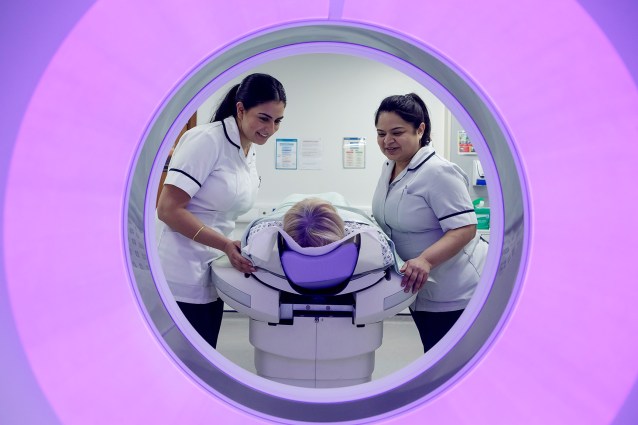
Scanner at the Paul Strickland Scanner Centre charity at Mount Vernon Hospital

I am currently being monitored by the NHS after having day surgery last year to remove a melanoma on my lower back. As part of the cancer recovery treatment I am being checked every three months at Mount Vernon hospital with both a CT and MRI scans to make sure there is no recurrence and having my skin checked by a dermatologist at Hemel Hempstead hospital.

Two weeks ago I had both scans at the Paul Strickland Scanner Centre, run by an independent charity, at the hospital. Imagine my surprise and nervousness when the CT scanner said to me as I was about to go home to stay behind because doctors were taking a look at my CT scan.

Then Luke, a junior doctor at Mount Vernon, turned up to tell me the scan had discovered blood clots in my lung. What was really amazing to me it had been discovered because the scanners at the charity use AI to check CT scanner. The AI showed up something was wrong which led the radiographer to examine the scan more closely to reveal multiple blood clots.

As a result I got instant medical treatment instead of waiting for the standard 14 days for the results of the scan to come back. The doctors and nurses gave me a through check on the spot – blood pressure, an ecg, a blood sample and checks on my breathing before prescribing blood thinners to start treatment that night.

Undetected blood clot produced no serious symptoms

If it was not for AI for the last two weeks I would have had a untreated blood clot on my lung without me knowing anything about it. It was virtually symptomless apart from a dull pain in my upper back when I was driving which I had put down to old age rather than anything else.

What I didn’t know is that Paul Strickland Scanner Centre, a charity which relies on donations, is at the cutting edge of linking AI with radiology. Its first introduction of new AI linked scanners was in 2022 -way ahead of other centres.

At the time Mr Will McGuire, the Deputy Superintendent for MRI at Paul Strickland Scanner Centre, said:“It’s the first time we have used deep learning, often referred to as artificial intelligence, as part of the image acquisition. The scanner software has been trained on thousands of scans. When the radiographer runs the scan, the scanner takes less data from the patient and the ‘Deep Resolve’ software then basically fills in the gaps based on its knowledge. The software packages we will get will both reduce ‘noise’ on scan images and provide radiologists with a better definition image.”

New uses for ” Deep Resolve ” software which could benefit kidney, prostate and breast cancer patients are also being pioneered this year. For the first time MRI scans could analyse bone structure as well as soft tissue speeding up treatment and reducing the need for both CT and MRI scans. The charity is planning to demonstrate this new technique at the European Congress of Radiology this year.

The initiatives by the charity show how dramatic the use of AI could transform services inside the NHS to benefit patients and provide services. I gather from Hillingdon NHS Trust where the hospital is based – though it is run by the East and North Hertfordshire NHS Trust – that there is also a trial using AI among hospitals in North West London to provide instant information after chest X rays which would speed up treatment.

The latest information on the state of public provision of AI came from a report by the Commons Public Accounts Committee after a National Audit Office report reveal very uneven provision.

The report concluded that the government is facing significant challenges to introduce AI across Whitehall and the NHS – with out of date computer systems and a big shortage of skilled staff.

It says :”For AI to be used well, it needs high quality data on which to learn …too often Government data are of poor quality, and often locked away in out-of-date, or ‘legacy’, IT systems, which are partially defined as “an end-of-life product, out of support from the supplier, [and] impossible to update…” An estimated 28% of central government systems met this definition in 2024. Approximately a third of Government’s 72 highest-risk legacy systems still lack remediation funding. The report warns that there are no quick fixes here, and calls for funding for the remediation of this kind of technology to be prioritised.”

“Another barrier to the safe and effective adoption of AI by Government are longstanding and persistent digital skills shortages. Around half of roles advertised in civil service digital and data campaigns went unfilled in 2024, and 70% of Government departments report difficulty recruiting and retaining staff with AI skills. The PAC has long raised concerns about digital skills gaps in Government, and is sceptical that the Department for Science, Innovation and Technology’s (DSIT) planned digital reforms will address the problem.”

Government’s ” sclerotic digital architecture”

Sir Geoffrey Clifton-Brown MP, Chair of the Committee, said:“The Government has said it wants to mainline AI into the veins of the nation, but our report raises questions over whether the public sector is ready for such a procedure. The ambition to harness the potential of one of the most significant technological developments of modern times is of course to be welcomed. Unfortunately, those familiar with our Committee’s past scrutiny of the Government’s frankly sclerotic digital architecture will know that any promises of sudden transformation are for the birds.

“A transformation of thinking in Government at senior levels is required, and the best way for this to happen is for digital professionals to be brought round the top table in management and governing boards of every Department and their agencies. I have serious concerns that DSIT does not have the authority over the rest of Government to bring about the scale and pace of change that’s needed. We hope the recommendations in our report aid the Government in succeeding in bringing public sector systems into the 21st century for their users, where other efforts have failed.”

Perhaps MPs on the committee and NHS government ministers should go and visit the Paul Strickland Scanner Centre at Mount Vernon Hospital in Northwood and see how they have pioneered linking AI to radiology. It is anything but sclerotic and ministers might learn how to avoid some of the pitfalls of the great transformation they are promising. Many patients, including me, would be very grateful if they did.

One-Time
Monthly
Yearly

Make a one-time donation

Make a monthly donation

Make a yearly donation

Choose an amount

£5.00
£10.00
£20.00
£5.00
£15.00
£100.00
£5.00
£15.00
£100.00

Or enter a custom amount

£

Your contribution is appreciated.

Your contribution is appreciated.

Your contribution is appreciated.

DonateDonate monthlyDonate yearly

Please donate to Westminster Confidential

£10.00

Guest Post from Dr David Ward: Time to ban NHS trusts from sacking whistleblower doctors and health care workers

DR DAVID E WARD

This blog arose from the recent case highlighted by the Health Services Journal of Dr Susan Gilby, the former chief executive of the Countess of Chester hospital in giving evidence to the Thirlwell Inquiry about the resistance from senior NHS people she faced trying to admit mistakes there. This is the hospital where a nurse Lucy Letby was found guilty of murdering seven babies and is now trying to get the case reconsidered. The CEO ultimately left the trust in late 2021, shortly after Letby’s trial began. An employment tribunal this month found she had been unfairly forced out by the trust and Mr Ian Haythornthwaite, the former chairman because she had raised concerns about his bullying behaviour. He resigned after the verdict.

Dr Susan Gilby Pic credit: BBC

Dr Susan Gilby is brave. Her experience is in keeping with many others who have raised concerns including patient safety issues. Dr David Drew’s comments ( See HSJ 08.44, 25 Feb) are spot on: the whole play book is sanctioned from above (NHSE and probably higher). Some colleagues and I have spoken to NHSE on several occasions (including in person, at Wellington House, SE London). We have nothing to show for it other than placations and weaselly words. Action, there is none.

Regarding NDAs (anon HSJ 13.39) in relation to healthcare and the NHS, they should be banned. They are “lawful” means of concealing (potentially very important) evidence which therefore cannot be tested in court. That’s the raison d’être of NDAs, isn’t it? And this is England, in the 21st century! And yes, Sir Robert Francis tried but was evidently misguided (see his 290 odd recommendations!). Jeremy Hunt did nothing to improve the “status” of NHS whistleblowers; if anything he made it worse by ignoring the problem and trying to belittle them.

On the Lucy Letby case there are now several authoritative sources seriously questioning the safety of the judgment (see Google). Let us hope that these processes will be allowed to evolve openly and unhindered.

It is high time the NHS leadership, politicians (West Streeting MP, SoS Health, are you listening?) reviewed the whole process of the treatment of NHS whistleblowers (they are “canaries in the coal mine”, right?).

If Trusts were banned from dismissing a doctor (or any Healthcare worker) who has “blown the whistle” or raised patient-safety issues (not “because” they have raised those concerns as that is banned by PIDA) it would save £millions. It would avoid hugely expensive law firms (of course taxpayer funded in the rôle of defending a Trust), Employment Tribunals and all the disastrous personal and professional consequences these Tribunals’ ill-considered decisions may lead to. Another consequence would be to eliminate the unfair and unnecessary loss of competent and sorely needed highly skilled doctors, (see Dr Chris Day’s case, Health Service Journal and elsewhere – its beyond belief but true). Training a doctor takes years, dismissing them takes minutes.

Employment tribunal system unaccountable

The Employment Tribunal system is unaccountable (well, if it is, it is to another branch of the judiciary, the Employment Appeal Tribunal process; marking one’s own homework?). It is heavily biased and has no place evaluating or investigating “patient safety issues” which it doesn’t understand. Neither does it understand the modus operandi of the NHS and medical matters (I won’t rehearse those arguments here – but for a start no offences have been committed and no laws broken by raising safety issues). In fact, raising safety concerns is not only strongly encouraged by professional medical bodies, but also part of a doctor’s code of conduct.

Internal management of “whistleblowing” matters are unregulated and unsupervised by an independent body. They are akin to “marking your own homework” because they are directed by the Trust CEO and perhaps some “chums” who can be relied on to give a favourable opinion. This is hardly appropriate, is it? WB may lose their jobs, their careers, £0000’s. Their professional and personal lives may be destroyed all in a process funded by the taxpayer. How is that “fair and open justice”? It is not!

The last thing a WB wants to do is go to an Employment Tribunal presided over by a “dodgy” ET Judge who delivers questionable judgments and pay “dodgy” law firms £000s for a <3% of winning (whatever “winning” means; if it comes it usually does so at the end of a spiral of losing first ET, appeal at EAT, lose EAT appeal. A “win’ may mean the case is referred back to the ET and round and round we go! This is the gist of things anyway. No wonder dismissed doctors are strongly advised (not by lawyers of course) to give the ET circus a miss, save their hard-earned money instead of paying extortionate fees to law firms and take the less stressful path of getting on with their lives. (NB The Tribunal step could be all but eliminated at a stroke by banning dismissal of a doctor who has raised patient safety issues).

If a Hospital Trust doctor raises patient safety concerns, history tell us they are very likely to suffer serious detriments in the form of restrictions, disciplinary hearings, pay cuts, referred for MHPS investigations concerning contrived allegations of incompetence or whatever, and suspensions as part of a vindictive reaction of Trust management who have (for some reason) taken offence. Instead, should they not be promptly investigating and correcting the shortcomings, how they were raised and by whom? If these adverse rill-informed reactions can be stopped there is hope for progress. One consultant, a colleague, was submitted to a flawed MHPS process (using an external agency) which supported the Trust’s claims of “incompetence” by alleging the doctor was not “fit-for-purpose”. (Further information provided upon request). As far as I know the confabulated charge of “not-fit-for-purpose” does not exist in (English) Employment law, but it was accepted without question by the Trust and the doctor was dismissed. As the saying goes, “You pays your money and you takes your choice”, (Aldous Huxley, Brave New World). The Trust had achieved its aim – to secure dismissal of a “difficult” doctor through what can only be described as a “corrupt” process. I asked people at NHS England if the charge of not “fit-for-purpose” was legitimate. NHSE claimed it was. I’ve searched online and checked with lawyers and found nothing to support its legitimacy. Ten years later that doctor is still fighting for their career. (And no doubt many others).

New laws and regulations to deal fairly with whistleblowing issues are URGENTLY required! The whole process is corrupt and in serious need of a profound and far-reaching review. The current system is ineffective but, more importantly, it is destructive.

All those interested in WB, particularly in the NHS, should read Roger Kline’s LinkedIn article (see 07.29). https://www.linkedin.com/pulse/nhs-hr-leaders-what-would-you-have-done-when-susan-gilby-roger-kline-jlvfe/?trackingId=IT70HHjXTru3VkRS5nkaEw%3D%3D

Also see my blog about the role of Clare McLaughlan when she was questioned at the Thirwell inquiry.

One-Time
Monthly
Yearly

Make a one-time donation

Make a monthly donation

Make a yearly donation

Choose an amount

£5.00
£10.00
£20.00
£5.00
£15.00
£100.00
£5.00
£15.00
£100.00

Or enter a custom amount

£

Your contribution is appreciated.

Your contribution is appreciated.

Your contribution is appreciated.

DonateDonate monthlyDonate yearly

Please donate to Westminster Confidential

£10.00

Exclusive: Infected Blood Compensation Authority plans to gag lawyers from publicly criticising their actions

Sir Brian Langstaff, chair of the infected blood inquiry

Lawyers representing thousands of haemophiliacs who unknowingly got hepatitis, HIV and Aids from blood transfusions provided by drug addicts and criminals in the United States in one of Britain’s biggest health scandals could be gagged from publicly criticising compensation payments.

A new draft contract proposed by the Infected Blood Compensation Authority (ICBA), the body set up by the government to pay out an estimated £11.8 billion by 2029 ,could take legal action for ” reputational damage” if lawyers publicly criticise the authority’s actions without their permission.

The ICBA, despite its name, is not a public body, but a private contractor to the Cabinet Office, so it intends to impose a standard contract on people who deal with it.

The draft clauses read;

15.7.1 not make any press announcement or other public statement or publicise the Contract or any part of it in any way, or make any public statement about the Scheme, without the prior written consent of the Buyer [the Cabinet Office] and must take all reasonable endeavours to ensure that Supplier Staff do not either; and

15.7.2 not (and must ensure its Subcontractors do not) embarrass the Buyer or IBCA or otherwise bring the Buyer or IBCA into disrepute or diminish trust placed in the Buyer or IBCA (“Reputational Damage”) by engaging in any act or omission which is reasonably likely to diminish the trust that the public or Scheme Applicants place in the Buyer and/or IBCA or impacts the reputation of the Buyer and/or IBCA,

This effectively amounts to a comprehensive “gagging clause”, specifically prohibiting lawyers from making “any press announcement or other public statement” about the scheme without prior Cabinet Office approval. Firms would also be required to ensure their staff comply with these restrictions. 

The ICBA is seeking requirements that could compel law firms to take specific actions or make public statements at the IBCA’s direction to mitigate perceived reputational damage, regardless of whether any breach has occurred.

One law firm said; “On any basis this variation is unacceptable to us for professional, ethical and regulatory reasons.  This firm is instructed by individual clients to provide individual, independent legal advice regarding the scheme and will continue to do so.”

The Haemophilia Society, which also supports victims, is consulting lawyers about what action it should take to counter these proposed restrictions.

The  Cabinet Office has told people that these are standard clauses in procurement processes for private companies being paid taxpayers money, but that they are in conversations with IBCA but could not confirm the outcome.

The issue follows negative publicity over problems with interim compensation payments to people which generated criticism of the IBCA.

An IBCA spokesperson said:

“We are committed to supporting the infected blood community, and are working with legal providers currently to agree contracts that will provide support for those claiming. 

“The legal providers are not restricted in the legal advice they deliver to people claiming compensation, and we provided amended terms to clarify this. 

“We welcome an open discussion with all those who are impacted by infected blood, and those who represent them.”

Years of cover ups

Given the history of the infected blood scandal which dates back to the 1970s, culminating in the recent interim report by Sir Brian Langstaff, there have been years of cover -ups. People were never informed that their relatives were infected, there were attempts to use ” commercial confidentiality” to hide the source of the contamination, and this will not add to public trust or increase transparency.

So far £1 billion has been paid out in £100,000 interim payments and the IBCA is just starting to pay full compensation to other people.

Nick Thomas-Symonds, Minister for Cabinet Office, updated Parliament with IBCA’s latest compensation figures this week.

  • 113 people have been invited to start their compensation claim
  • 84 people have accepted their invitations and submitted their claim
  • 23 offers of compensation have been made, totalling £34.4m
  • So far 14 people have accepted their offers with more than £13.3m paid in compensation

New laws will also be passed by the government extending payments to relatives of infected blood victims, which could lead to an extra 140,000 people claiming.

One-Time
Monthly
Yearly

Make a one-time donation

Make a monthly donation

Make a yearly donation

Choose an amount

£5.00
£10.00
£20.00
£5.00
£15.00
£100.00
£5.00
£15.00
£100.00

Or enter a custom amount

£

Your contribution is appreciated.

Your contribution is appreciated.

Your contribution is appreciated.

DonateDonate monthlyDonate yearly

Please donate to Westminster Confidential

£10.00