Mr Justice Chamberlain, the head of the Royal Court of Justice’s Administrative Court, has intervened in the case against controversial coroner Mary Hassell by ordering a hearing later this year after months of inaction by the judiciary.
Mr Justice Chamberlain pic credit: Avalon
The allegations that the report of the hearing into the death of ITV news editor Teresa McMahon appeared to be tampered with were brought by her aunt Lorna McMahon at a hearing last July. The judge Mr Justice Stephen Morris took the allegations so seriously that he postponed the judicial review hearing and wanted the matter dealt with speedily later last year. The coroner tried to get her name removed from the hearing but was overruled by the judge saying it was a matter of ” open justice”.
There is a full report of the hearing here. The judge insisted that her allegations must be corroborated by witnesses at the hearing which attracted wide press attention. Two journalists. including myself and a member of the public have come forward saying the text was missing.
Mary Hassell found that the TV journalist committed suicide and ruled out that she was subject to ” coercive control” by her ex boyfriend, Robert Chalmers, an NHS estates employee, who had previous convictions for violence. Mary Hassell believed the words of the pathologist ,Dr Mohammed Bashir, who examined the body but kept no photographic evidence and discounted domestic violence and Greater Manchester Police who decided from the start that no crime had been committed and never took any photographs either at the scene of her death.
The missing text covers when Lorna McMahon was questioning Teresa’s boyfriend after she was frequently interrupted by Mary Hassell.
Court cases involving coroner’s verdicts are very rare and allegations of tampering with the inquest report can be seen as a criminal offence of perverting the course of justice.
Mr Justice Chamberlain looks set to hear the case himself as he ruled that it could not be heard by a deputy high court judge. The full report of the inquest hearing held in December 2024 can be read here.
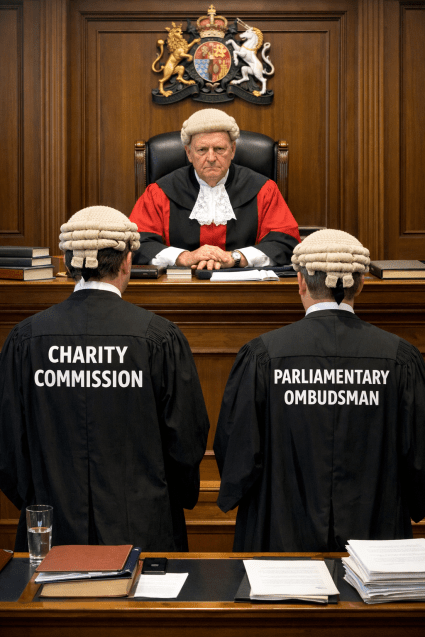
A judge has blocked the Charity Commission from challenging the powers of the Parliamentary Commissioner through a judicial review.The decision is a victory for Parliament which said permission to grant the review would be academic, non justiciable and a breach of Parliamentary privilege.
However the small print of the ruling by Mr Justice Fordham clarifies the law over what is covered by Parliamentary privilege and what is not and how far charities can be expected to investigate cases when the police and the Crown Prosecution Service decide there is not enough evidence to prosecute.
Harrowing cases
The two cases where there was a dispute between the Parliamentary Ombudsman and the Commission were extremely harrowing. Both complainants waived their anonymity. One brought by Damian Murray, concerned the failure to investigate historic child sexual at a now closed school run by Roman Catholic Marist Brothers in Blackburn, Lancashire. A former pupil at the school he learned from another pupil’s memoirs that the principal, Father O’Neill was a paedophile. Not only was this covered up but he was venerated with a Requiem Mass at his death and had a school building named after him, when it was known he was a paedophile by the authorities.
The second case involves Ms Lara Hall, a volunteer and a victim of sex trafficking, who sought help from the Help for Persecuted Christians charity and ended up having an extra marital affair with the chairman of the trust, WiIson Chowdhury. She complained according to the judgement that it was ” an abusive and exploitative relationship”. He resigned but his wife has now been appointed the chair.
The issue was not that the Charity Commission did not accept the complaints but neither the complainants nor the Ombudsman felt it had not done enough to investigate them and assess risk and communicate what it had done. So the Parliamentary Ombudsman decided to issue a further report. This can be done “if injustice has been caused to the person aggrieved in consequence of maladministration and that the injustice has not been, or will not be, remedied, she] may, if [she] thinks fit, lay before each House of Parliament a special report upon the case.”
The judge is scathing about the Charity Commission’s failings in dealing with this. He says it was ” plainly wrong” for the Commission to claim that a risk assessment review should apply only to future cases and equally wrong to say the Parliamentary Ombudsman to have overreached herself by evaluating and examining the risk reviews rather than factually reporting them.
The judgement noted the Commission claimed a ” symptomatic of a more widespread systemic unlawfulness in the Ombudsman’s approach to cases about the Charity Commission actions.” He ruled “But, in my judgment, it is plainly not open to the Commission to contest the findings of maladministration in these cases.”
Judge Sir Michael Foreman
The judgement backs the Charity Commission in saying the Parliamentary Ombudsman’s decision letter cannot expect the Commission to act as a criminal investigator , prosecutor or decision maker over these issues – when its main job is to investigate the mismanagement of charities. This made the Ombudsman’s letter flawed.
There was also a very interesting subtle clarification of Parliamentary privilege. While accepting Parliament’s argument that it was a breach of Parliamentary privilege to go for a judicial review – it said the special report by Parliamentary Ombudsman that followed her main report could be challenged in the courts and was not subject to Parliamentary privilege . The Charity Commission does not intend to do this.
The Parliamentary Ombudsman spokesman said:
“One of our roles is to hold public bodies to account, acting on behalf of Parliament. This is an important principle to uphold, and the Court’s decision supports that principle by refusing the Charity Commission’s request for permission to judicially review.
“Our reports were laid before Parliament after failing to reach agreement on compliance with the Charity Commission.
“At the heart of what might seem like a matter of process are two people, Miss Hall and Mr Murray, who have suffered significant injustice. Securing resolution for the complainants remains the priority, alongside making sure the lessons identified in our investigations are implemented.
“While the Charity Commission has made some changes after our original reports, we hope the Commission will now focus on working constructively to fully comply with our reports and provide the assurance that the public are entitled to expect.”
A Charity Commission spokesman said:
“We reiterate our apologies to the two complainants in these sensitive cases. We have long accepted that there were important lessons for the Commission to learn from these, and we have previously apologised and paid compensation to each complainant.
“We brought this case in good faith to get clarity from the courts on the respective remits of the PHSO and Commission, to provide certainty to the sector we regulate. While we are disappointed with the decision not to permit a full hearing, the judgment provides a clearer basis on which both organisations can perform the distinct roles Parliament has given us.
“The court has reaffirmed the Commission’s role in regulating charity governance rather than acting as a safeguarding authority, and indicated that we cannot be expected to reinvestigate serious criminal allegations made against charity trustees.
“We recognise we need to draw further lessons from the court’s decision, particularly in terms of how we record and communicate our assessments of risk, and we will immediately review key aspects of the two cases in question.”
Complainant Damian Murray said: “My actual primary concerns about the deliberate concealment of sexual abuse at the former St Mary’s College Blackburn by the Marist Fathers charity have yet to be acknowledged let alone addressed by the CC since I first raised them in 2018. And whilst PHSO, Mr Justice Fordham and PACAC have also made no adjudication about my original concerns, and have not been asked to do so, I am very grateful for the care and seriousness with which they have within their remits taken account of the grave issues of governance and regulatory failure I have raised, and the sensitivity and professionalism with which they have dealt with me personally to date.”
This week Salford City Radio hosted a special broadcast on the continuing plight of 50swomen and gave interviews to myself and Dr Jocelynne Scutt. Jocelynne also took a petition and letter to Downing Street yesterday calling for the government to implement in line with the UN Convention on the Elimination of all Discrimination against Women and Girls which has still not been fully introduced by successive British governments.
The key point is that mediation to solve the injustice facing some 3.5 million 50s women who waited more than six years to get their pension is possible under civil procedure rules. This was put to the Prime Minister and senior government lawyers in letters yesterday. CedawinLaw see they have a winning hand over this which is why the government don’t want to know over this.There is a team of mediators prepared to act.The All party group on state pension inequality has also raised the issue of mediation with Torsten Bell, the pensions minister but didn’t publish his response.
To emphasise again no legal challenge is required to initiate mediation.
A Top 500-ranked team of mediators is on standby to be considered for the neutral mediation role.
We learned from Waspi that post the Board’s withdrawal of its judicial review – and acceptance of £180,000 – the Government subsequently reneged on an understanding to initiate mediation solely with Waspi Limited.
CEDAWinLAW’s censored winning hand remains in play – no funds nor any legal challenge is required to do so – whilst The One Bright Light prepares to tell the story. Watch this space.
My AI generated picture of Westminster to go with the blog.
Hits on my blog reached just over 230,000 last year not including the full number on Facebook and Linked In which takes the reach of the blog to even higher figures.
The most startling change in 2025 was a sudden interest from China that began in August and finally petered out at the end of the year. Figures from China totalled 128,000 over a five month period with at one stage Beijing having more hits than London. Altogether some 40 Chinese cities downloaded stuff from my site.
What was particularly interesting was that there were old blogs and nearly all were concerned with the same issue – the plight of the 50s women who faced a six year delay in their pensions involving Back to 60, CedawinLaw and WASPI.
The largest number of hits were on a 2019 blog which was cross posted with Byline.Com on the date set for a judicial review won by Backto60. In one year this blog added 12,507 hits taking it to over 136,000.
The second highest hits came on my story that men who “retired” at 60 had all their national insurance contributions paid by the state until they reached 65. This gained another 8,744 taking it to over 83,000.
Other large hits were on the Downing Street pensions robbery, the court of appeal decision and the decision to appeal to the Supreme court.
Two blogs not concerned with the issue but led to large hits from China included the leak of Dame Janet Smith’s report into the BBC’s mishandling of the paedophile Jimmy Savile and a 2015 blog on my statistics that showed my blog on the secret hideout of singer Amy Winehouse and a dispute with David Aaronovitch had driven traffic to the site.
I have talked with people who have had dealings with China who suggest that this was a data scraping exercise connected to planned changes in China’s pensions policy. China has one of the lowest ages for women’s retirement in the world at 50. It is currently running a 15 year plan to raise women’s retirement ages from 50 to 55 and 58 and men’s from 60 to 63. It looks as though the Chinese were sussing out the opposition in the UK.
The blog attracted over 8000 hits from the US, and over 1000 from Germany and Ireland down to single hits from places like Angola, Brunei, Myanmar and Mongolia.
The other big growth was on Linked In whose stats are not fully recorded by WordPress. At the end of the year the organisation sent me a note saying I was in the top five per cent of contributors on the site. This is very pleasing as I have had large number of hits where I have taken up whistleblowing cases, unfair employment tribunal hearings, failures of accountability in the NHS and in the judiciary, and injustice for patients in both the NHS and the coroner’s service.
Since it is read by professionals I have gained a following both at home and abroad which is growing. Let’s hope 2026 sees the reach of the blog to new heights.
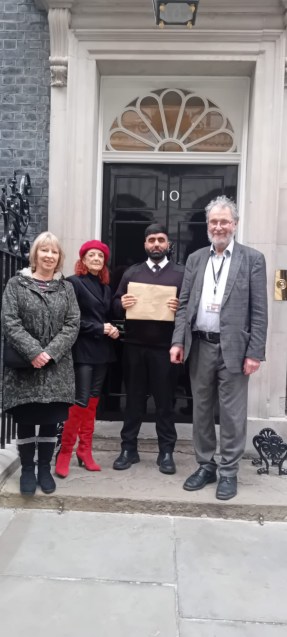
Cedar in Law delegation at Number 10 Downing Street. From Left to Right: Sharon Wheeler, Joycelene Scutt, No 10 doorman and David Hencke
Cedaw in Law returned to Downing Street yesterday to deliver letters to Sir Keir Starmer asking him to intervene in the latest battle to secure justice for 50swomen.
The delegation is repeating their case for mediation and recompense for the discrimination and maladministration over the big rise in the women’s pensions age for 50swomen. One of the letters which would have gone to DWP lawyers also reiterated that all women’s groups should be consulted under the review promised by Pat McFadden, the work and pensions secretary, not just a private arrangement between WASPI and the ministry. WASPI pulled out of their judicial review case to challenge the DWP over maladministration last week accepting a £180,000 payment in full and final settlement from the DWP.
Tonight Joanne Welch, the organiser for CedawinLaw, Jocelynne Scutt, the Australian judge who chaired a tribunal into the issue, and myself, a patron of Cedaw in Law and a lobby journalist, will appear on Salford City Radio, in the constituency of Rebecca Long Bailey, the Labour chair of the All party group on State Pension Inequality for Women.
The link to hear it is here and it is on Ian Rothwell’s show between 6 and 7 pm.
Joe Milner ex Loch Employment Law now Brightstar Law Ltd
Three months after this blog first reported (see here) unusual conduct by a leading employment law firm, public records reveal just how far that conduct went — and how the courts may have got it very wrong.
High Court records confirm that on 8 October 2025, Loch Employment Law Ltd launched a breach of contract claim (Case No. BL-2025-001254) against a group of former employees and entities, including a newly formed legal outfit called Brightstar Law Ltd.
Among the seven named defendants is Joe Milner, formerly a director of Loch Employment Law and Claudia Yorath former Group People Director for Loch Group.
Strikingly, Milner and Brightstar have fired back. Part 20 counterclaims have been filed not just against Loch Employment Law, but against its parent company Loch Associates Group Ltd, and even against Pamela Loch, the firm’s founder, in her personal capacity.
The public filings suggest not a polite departure — but a full-blown legal and commercial rupture.
Pamela Loch -founder of law firm
The Timeline That Should Have Stopped Everything
Official records from Companies House show that Milner’s directorship at Loch Employment Law ended on 24 July 2025. The company filed the required TM01 termination form the very next day.
And yet — a full 35 days later, on 28 August 2025, a legal document known as an N260 Statement of Costs was filed with Milner’s signature, identifying him as “Partner” of Loch Law.
That same day, a strike-out application brought in Loch Law’s name was allowed by the High Court. Costs were awarded against the claimant. The judge, Master Eastman, made no reference in his ruling to the fact that the signatory had no authority to act on behalf of the firm.
Four days later, on 1 September 2025, Milner became a director of Brightstar Law Ltd — a direct competitor.
A Warning Ignored
What makes this situation particularly troubling is that the issue was flagged to the court in advance.
According to public filings, the claimant — who had no legal representation — had:
Submitted evidence from Companies House showing Milner’s removal
Filed detailed submissions alleging that Milner’s filings were unauthorised
Cited Yonge v Toynbee [1910], a century-old case establishing that documents filed by solicitors without authority are void
Provided metadata analysis suggesting that at least one signature may have been reused from unrelated proceedings.
Despite these warnings, the strike-out application was allowed to proceed. The claimant’s submissions appear to have been entirely disregarded. There is no indication that the court considered the authority of the solicitor filing the costs claim — or whether the underlying application was even valid.
The Legal Consequence: A Void Strike-Out?
Lawyers consulted about the case (who are not connected to the parties) note that if Milner lacked authority, the strike-out application was not merely procedurally defective — it was void.
It is a foundational principle of English law that someone without standing or instructions cannot bind a firm. If the court had taken proper account of this, the claim might never have been struck out — and costs might never have been awarded.
That it was allowed to proceed suggests a serious failure to scrutinise who was behind the filings.
Vindicated — But at What Cost?
The claimant, Edward Romain, who now runs Blind Justice, a community interest company supporting litigants in person, appears to have been correct in every material respect, Milner had no authority and the strike application should not have been entertained.
Yet the cost order remains. The ruling stands.
In the view of legal observers, this raises a deeper question: How many other strike-outs, cost rulings or orders are being granted without the court verifying the authority of the legal representative?
When professional parties operate in bad faith — or when firms collapse mid-case — the risks to access to justice are real. The consequences fall heaviest on litigants without lawyers.
A Case That’s Still Unfolding
The High Court dispute — Loch Employment Law Ltd v Brightstar Ltd & Ors (BL-2025-001254) — remains live as of 2 December 2025.
Whether regulators or courts will revisit the earlier strike-out ruling is unclear. But one thing is certain: a litigant was right, and the system failed to listen.
UPDATE: Following publication of this post one issue has been raised by John Halford, Waspi’s lawyer from Bindman’s. He says it is not true that originally you needed permission for both parties or would have to pay £300 to attend the case management hearing. I have checked this back and staff at the administrative court did advise people to do this and told people If no agreement then you need to complete N244 Application form at a cost of £300 to register.This was overruled by the judge on December 2who made it an open hearing. I passed this back to Mr Halford only to find he had blocked me sending a reply. What extraordinary behaviour from a lawyer.
A long awaited decision on the six year battle for redress for the 3.6 million remaining 50s women has been promised by the Department for Work and Pensions by the end of February next year – as part of a deal agreed between the ministry and Waspi Ltd.
Royal Courts of Justice
Under the deal Waspi has dropped its judicial review claim due to be heard next week and accepted an offer by the DWP to pay the Waspi company £180,000 towards its legal costs in bringing the claim.
Most of the manoeuvring to obtain this arrangement has been behind the scenes in meetings between lawyers on both sides. As a result there will be no public hearing in the courts of the arguments where both sides would have put their case under the watchful eye of the Parliamentary Ombudsman who was an interested party. Waspi had been challenging Pat McFadden, the DWP secretary of state, over his decision not to award any compensation following the Parliamentary Ombudsman’s findings of partial maladministration over the communications informing the women.
05/07/2024. London, United Kingdom.Chancellor of the Duchy of Lancaster, Pat McFadden, poses for a photograph following his appointment to Cabinet by Prime Minister Sir Keir Starmer in 10 Downing Street. Picture by Lauren Hurley / No 10 Downing Street
Then rather dramatically Mr McFadden on November 11 change his mind after the discovery of an earlier document which had been overlooked for 18 years revealing that attempts to inform the women had failed. Waspi’s lawyers Bindmans are said to have found it -presumably in the exchange of documents before the hearing. See my coverage of the document on this sitehere.
Before the hearing was dropped Waspi and DWP had the DWP arranged a case management hearing on December 3 with the most extraordinary terms allowing either side to block who would be allowed to attend or have to pay over £300 to obtain the right to attend.
This amounted to secret justice and it is no wonder on the day before the hearing the judge, Mr Justice Swift put out a national statement giving his directions for the case which made it clear it was a public hearing that anybody could attend and there were arrangements for people to hear it remotely.
This scotched the plan for a semi secret hearing so that evening it is clear that lawyers from both sides must have met and agreed to abandon the hearing the next day and Waspi Ltd agreed to pull out alongside the DWP from the two day judicial review.
It is my speculation that it will mean that some arrangement has been agreed under ” a nod and a wink” that the ministry will offer some form of compensation to some of the women. Certainly a seasoned lawyer like John Halford at Bindman’s ,would not have agreed to this without some hint or his client ,Waspi, would have been left in a very precarious position.
Waspi has not been alone in making representations to the government. Enter Edward Romain, a former whistleblower who has set up Blind Justice, a community interest company, to take up injustice cases and has joined joined forces with Cedaw in Law, to fight the case for the women on both discrimination and maladministration. I covered his case against Glyndebourne in an earlier article here. The case is now settled but it also discloses some strange behaviour by lawyers.His website is blindjustice.org.uk .
The day before the planned case review he delivered a recorded letter to Sir Keir Starmer and copied to Pat McFadden staking CedawinLaw’s claim to participate in any mediation process.
He followed this up with a powerful letter to Mr Oliver Towle, a senior lawyer at the Litigation Directorate for the DWP with a copy to the Treasury solicitor.
The letter asks the lawyer to confirm that following the court order that CEDAWinLAW and all other materially affected groups will be included in the consultations from the outset and clarifications of the intended structure and timeline for stakeholder engagement. The letter states
CEDAWinLAW represents the interests of 3.5 million women affected by State Pension Age changes.
The organization has made formal legal submissions and engaged with public authorities over four years.
It has pursued mediation and presented evidence to Parliament, highlighting ongoing advocacy efforts.
It also cites legal precedents quoting past cases covering natural justice, legitimate expectations, Wednesbury unreasonableness ( ie irrational responses), civil procedure rules and international law.
It concludes:”We respectfully submit that any reconsideration that does not include CEDAWinLAW would be procedurally flawed and open to future challenge. We remain available to assist constructively and can provide additional documentation or legal submissions if required. We look forward to your confirmation and to contributing meaningfully to the reconsideration process.”
One curious fact, actions by WASPI and CedawinLaw appear to have come to attention of the Chinese government over the last five months.Altogether I have received over 76,000 hits from China from Beijing and 40 other cities across China data scraping my blogs on the pensions issue.
China has one of the lowest retirement ages in the world. Women can retire at 50, men at 60. I wondering whether the Government is thinking of raising it and is looking at the opposition to it in the UK. President Putin tried to raise the pension age for women some time ago but had such opposition from the Babuskas that he backed down -probably the only reversal he made as President.
The full letter to the government lawyer can be read here.
NHS Resolution solicitor overlooking hospital doctors under investigation. An AI image illustrating the situation facing hospital doctors in the NHS
Following my blog on the secret process using NHS Resolution to help hospital managers discredit whistleblowers I decided to ask the advisory body a series of questions on its operations using the Freedom of Information Act.
What emerged was extremely revealing. NHS Resolution hides in its annual report how many hospital doctors are involved by lumping them together with dentists and pharmacists. But the breakdown revealed through FOI reveals it is almost exclusively targeting doctors to advise trusts on how to handle them.
It shows that in the last financial year it advised in cases involving 1168 doctors in England, Wales and Northern Ireland. And the number of cases would be higher – as a number have multiple complaints from managers against them. This compares with 53 dentists and under 5 pharmacists. Indeed the pharmacists involved are so few – it won’t give me an exact number for fear of identifying individuals.
The PPS was last audited in 2019 and the organisation says it was then considered to be adequate and. effective. A more recent review in July this year by Dr Penny Dash looked just at the patient safety and learning role of the organisation and not wider issues.
Nor does NHS Resolution check whether it is given accurate information by managers. It said:” our role is to provide impartial and expert advice which is aimed towards supporting the local management and resolution of performance concerns. We are not a decision-making or an investigative body – in all cases, any decisions about the ongoing management, employment or contractual status of the practitioner rests solely with the healthcare organisation.”
In other words it is there solely to support health managers – who have no duty of candour – and it tries to include doctors by saying managers should tell them about their request for advice. In fact managers can and do ignore this as there is no requirement for them to say anything to the doctor they are investigating. So without hearing the doctor’s case it cannot be genuinely impartial. Also should a practitioner object to the partial advice given by a health manager they are ignored and the body continues to deal with the health manager.
NHS Resolution has not carried out any audit on the effect on doctors who are subject to complaints but it does do occasional research into problems arising on a very small scale. One example in its Insight Publication series last year was looking at whether ethnic minority doctors were badly treated in the NHS.
Involving just 11 doctors it said:”Most participants felt discriminated against based on their ethnicity and/or where they qualified. They felt this was reflected in the way their cases were handled by both their employer and Advice, and the higher rates of concerns raised against practitioners from ethnic minority backgrounds.”
Not surprisingly there was a lot of ignorance of how NHS Resolution’s advice service worked – given that health managers needn’t tell them about it. Again NHS Resolution’s solution was to give advice to managers which they need not take up. The full report is here.
Then there is the question of the phrase, performance. Is it a misnomer? NHS Resolution advice service does not look into the question of performance by doctors – relying on hospital manager for that – and it does not employ people qualified to do so. Many are solicitors, human resources staff and employment law experts and are not qualified to know when say a complex heart operation went wrong or the details of paediatric care. Indeed from doctors who have contacted me the trust often cites uncooperative behaviour and not working well with colleagues as part of its case.
Taken with earlier articles on the role of the General Medical Council a disturbing picture emerges which shows the hospital doctor is always at a disadvantage while the responsible officer – usually the medical director – holds all the cards – using NHS Resolution for advice and reporting the doctor to the GMC. Yet neither body is necessarily equipped to handle this and in NHS Resolution’s case, it is toothless to influence decisions by trusts. It can help to easily ruin a doctor’s career and even ban him or her for life for continuing their careers.
There seems to be a wholly unregulated sector covering NHS Resolution, the GMC and the trusts themselves and certainly no accountability. Patients have no idea how this is handled -yet their safety should be paramount in the NHS. And while NHS Resolution says it works under the direction of the Department for Health and Social Care my research shows it is not clear who regulates them.
If ever there was a case for reform of both systems, now is the time for something to be done.
Glum whistleblower at an Employment tribunal. Picture created through AI
A research report published this July by the new Labour government has painted a devastating picture of the failure of the culture of the whistleblower system in the United Kingdom.
The report, originally commissioned by the Tories under Rishi Sunak, and undertaken by researchers at Grant Thornton, one of the big accountancy firms, pulls no punches. It reveals how whistleblowers, whether in industry, the NHS and other public bodies, see a failure by the courts, employers, and even those appointed to help them, to protect them.
The sad news is the report, commissioned by the Department of Business and Trade, looks like remaining on the shelf – and the one improvement planned by the justice ministry could make matters worse. It plans to appoint 50 new employment tribunal judges to handle an increase in whistleblowing cases, among other issues, following the implementation of the new Employment Rights Act. For those who follow my blogs, they will know, they are more than often part of the problem, not the solution.
For a start whistleblowers found the terms used to describe whistleblowers as vague and confusing.
The report notes that terms like “reasonable belief,” “public interest,” and “worker” are seen as subjective, vague, inconsistent, and narrow, creating uncertainty about whether protections actually apply. One whistleblower expressed surprise when an Employment Tribunal decided their concerns didn’t meet legislative requirements despite their employer telling them they did.
The majority of whistleblower participants reported feeling victimized by their employer after blowing the whistle. The research found that many whistleblowers believed the framework doesn’t provide effective protection in practice. The “protection” offered is essentially just the right to seek redress after harm has already occurred, not proactive prevention of retaliation.
Multiple barriers for whistleblowers
Multiple barriers existed for whistleblowers when their case came before an employment tribunal. These included:
Resource imbalance: They lacked time, money, knowledge, and skills compared to their employers Mental toll: The process was described as complex, draining, and requiring resilience many didn’t have Evidential burden: Proving detriment was directly related to their disclosure was extremely challenging Delays: Tribunals experience significant delays
Time limits: Strict deadlines created additional barriers
Unfair treatment: Limited access to evidence and risks around non-disclosure agreements
Lack of trust: Many didn’t believe tribunals would be balanced or deliver meaningful
Nor did whistleblowers find people designated to help them such as regulators much good.
They found they could not protect them from detriments or victimisation. Some were conflicted particularly where there had been regulatory failure.
Several whistleblowers stated it was “not easy” to blow the whistle internally: They found:
Little faith in the process based on previous experience
Fear of retaliation after hearing stories from others
Restrictions from non-disclosure agreements
Conflicts of interest when those receiving reports were implicated
Lack of independence in investigations
Concerns not being properly investigated or addressed
No feedback or perceived remedies
The report describes the huge tolls on whistleblowers. At employment tribunals,phrases from whistleblowers included: public execution,exhausting, beyond difficult, miserable. complex, ardous, horrible and abusive, soul destroying,toxic and unsafe.
Litigants in person fared worse with descriptions that they were not treated respectfully by judges, lawyers and other parties and that they were not impartial.
Many stated they would not blow the whistle again due to negative experiences
Cases that involved international jurisdictions were even more complicated with slow co-operation from countries and regulators abroad.
The report makes suggestions for change. These are:
create a central body for whistleblowing
ongoing engagement and research to assess and monitor all aspects of the GB framework
efforts to improve effectiveness should be multifaceted and monitored
improved mental health support for individuals
legal advice and a degree of financial security while the claim progresses
consideration of disincentives and incentives, for example implementation of a United States style reward system
I contacted the ministry about the report:
A Government spokesperson said:
“The Employment Rights Bill will strengthen protections for whistleblowers reporting sexual harassment at work and extend time limits for bringing tribunal claims from three to six months.
“We are also fixing the employment tribunal system by ensuring more cases are resolved before reaching them and recruiting more Employment Judges.”
They said that didn’t regard the report’s conclusions as firm recommendations and many of the suggestions were outside the remit of the ministry.
At the end of July I published a scathing report from the House of Commons Justice Committee on the appalling state of the dysfunctional county court system. MPs were so appalled that they demanded a root and branch inquiry into the system to address its myriad problems – huge waiting times to hear cases, court buildings infested by rats, lack of disabled access and a chaotic and incompatible digital system to handle cases. You can read it again here .
Now we have the ministerial response. And what a tepid, pathetic and apology for an answer it is from Sarah Sackman KC. It even incorporates a potential ” pork barrel” issue with somehow one of the few courts now undergoing modernisation is in her own Finchley and Golders Green constituency in North London.
She rejects the main finding of the committee – the call for the inquiry to deal with the problem.
She said: “Rather than focusing on a root and branch review of the County Court, the Government is keen to focus on taking tangible and practical steps to improve the operation of the County CShe rejects the main finding of the committee – the call for the inquiry to deal with the problem.
She said: “Rather than focusing on a root and branch review of the County Court, the Government is keen to focus on taking tangible and practical steps to improve the operation of the County Court – which will benefit everyday users – without further delay. We are already seeing these measures bear fruit with improvements to the timeliness of claims that got to trial, improving call waiting times, growth in small claims mediation and further improvement to case management and file transfer systems.”
Her so called improvements include a reduction in waiting times for Small Claims cases from 50.5 weeks a year go to an amazing 49.2 weeks up to July. A fantastic reduction of of 1.3 weeks – I am sure she being cheered to the rafters for that. While those waiting longer face a 72.4 week delay compared to 79 weeks a year ago. I am sure they appreciate that.
Meanwhile many litigants are facing wasted costs for travel, legal fees and subsistence to attend hearings that are ” overlisted ” or as the result of poor management of the courts and MPs thought they should be compensated. But for Sarah Sackman ” over listing ” is fine and she rejected any money to reimburse claimants.
Probably the most interesting revelation is the paucity of the programme to modernise the courts to bring them up to 21st century standards. Only three courts are currently being modernised- Norwich, Taunton and Barnet and there are plans for Reading and Blackpool.
The Barnet court project got funding in October 2024 – three months after Sarah Sackman had been appointed solicitor general and two months after she became justice minister. I may be being unfair to her but I do find it curious that of all the courts to get modernise first is in her constituency.
Barnet County Court, Regents Park Road, Finchley
When you compare this with the long list in the justice committee ‘of courts that don’t even provide wheelchair access – only Taunton is being modernised. So for disabled people there is no hope of admission to Mansfield County Court; Brentford County Court; Darlington County Court ;Edmonton County Court; Hertford County Court and Lewes Combined Court Centre to name a few.
She does accept a number of reforms to improve digital communication in county courts but again I wonder if these will just add to the different schemes already in operation. On litigants in person, she accepted that there should be more granular data on their cases and also that guidance for litigants should be improved . But I wonder how far this will go given the heavy criticism from MPs on how difficult it is for litigants in person to understand procedure.
Frankly this is a disappointing response from the new Labour government to tackle the enormous problems in the court service and Sarah Sackman as a KC should be well aware of this. But it seems to reflect the general public mood that Labour is failing to make an impact.











 Westminster Confidential