This week Salford City Radio hosted a special broadcast on the continuing plight of 50swomen and gave interviews to myself and Dr Jocelynne Scutt. Jocelynne also took a petition and letter to Downing Street yesterday calling for the government to implement in line with the UN Convention on the Elimination of all Discrimination against Women and Girls which has still not been fully introduced by successive British governments.
The key point is that mediation to solve the injustice facing some 3.5 million 50s women who waited more than six years to get their pension is possible under civil procedure rules. This was put to the Prime Minister and senior government lawyers in letters yesterday. CedawinLaw see they have a winning hand over this which is why the government don’t want to know over this.There is a team of mediators prepared to act.The All party group on state pension inequality has also raised the issue of mediation with Torsten Bell, the pensions minister but didn’t publish his response.
To emphasise again no legal challenge is required to initiate mediation.
A Top 500-ranked team of mediators is on standby to be considered for the neutral mediation role.
We learned from Waspi that post the Board’s withdrawal of its judicial review – and acceptance of £180,000 – the Government subsequently reneged on an understanding to initiate mediation solely with Waspi Limited.
CEDAWinLAW’s censored winning hand remains in play – no funds nor any legal challenge is required to do so – whilst The One Bright Light prepares to tell the story. Watch this space.
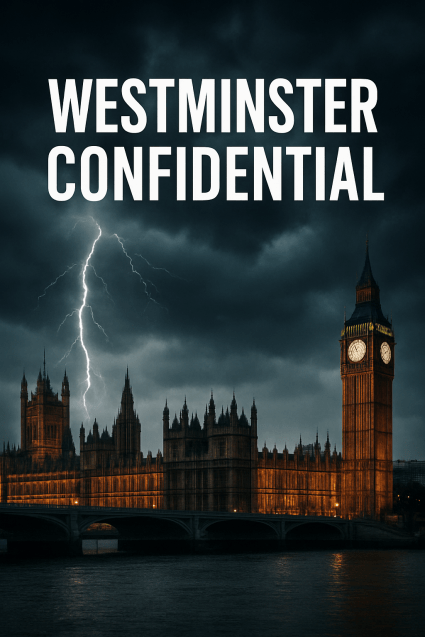
My AI generated picture of Westminster to go with the blog.
Hits on my blog reached just over 230,000 last year not including the full number on Facebook and Linked In which takes the reach of the blog to even higher figures.
The most startling change in 2025 was a sudden interest from China that began in August and finally petered out at the end of the year. Figures from China totalled 128,000 over a five month period with at one stage Beijing having more hits than London. Altogether some 40 Chinese cities downloaded stuff from my site.
What was particularly interesting was that there were old blogs and nearly all were concerned with the same issue – the plight of the 50s women who faced a six year delay in their pensions involving Back to 60, CedawinLaw and WASPI.
The largest number of hits were on a 2019 blog which was cross posted with Byline.Com on the date set for a judicial review won by Backto60. In one year this blog added 12,507 hits taking it to over 136,000.
The second highest hits came on my story that men who “retired” at 60 had all their national insurance contributions paid by the state until they reached 65. This gained another 8,744 taking it to over 83,000.
Other large hits were on the Downing Street pensions robbery, the court of appeal decision and the decision to appeal to the Supreme court.
Two blogs not concerned with the issue but led to large hits from China included the leak of Dame Janet Smith’s report into the BBC’s mishandling of the paedophile Jimmy Savile and a 2015 blog on my statistics that showed my blog on the secret hideout of singer Amy Winehouse and a dispute with David Aaronovitch had driven traffic to the site.
I have talked with people who have had dealings with China who suggest that this was a data scraping exercise connected to planned changes in China’s pensions policy. China has one of the lowest ages for women’s retirement in the world at 50. It is currently running a 15 year plan to raise women’s retirement ages from 50 to 55 and 58 and men’s from 60 to 63. It looks as though the Chinese were sussing out the opposition in the UK.
The blog attracted over 8000 hits from the US, and over 1000 from Germany and Ireland down to single hits from places like Angola, Brunei, Myanmar and Mongolia.
The other big growth was on Linked In whose stats are not fully recorded by WordPress. At the end of the year the organisation sent me a note saying I was in the top five per cent of contributors on the site. This is very pleasing as I have had large number of hits where I have taken up whistleblowing cases, unfair employment tribunal hearings, failures of accountability in the NHS and in the judiciary, and injustice for patients in both the NHS and the coroner’s service.
Since it is read by professionals I have gained a following both at home and abroad which is growing. Let’s hope 2026 sees the reach of the blog to new heights.
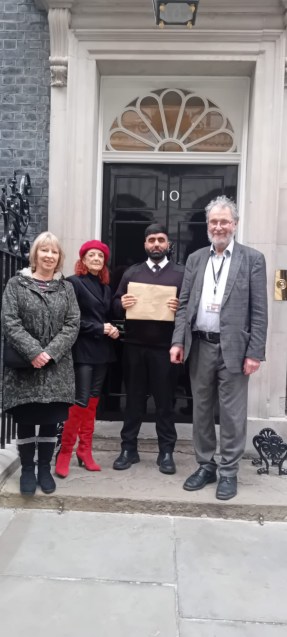
Cedar in Law delegation at Number 10 Downing Street. From Left to Right: Sharon Wheeler, Joycelene Scutt, No 10 doorman and David Hencke
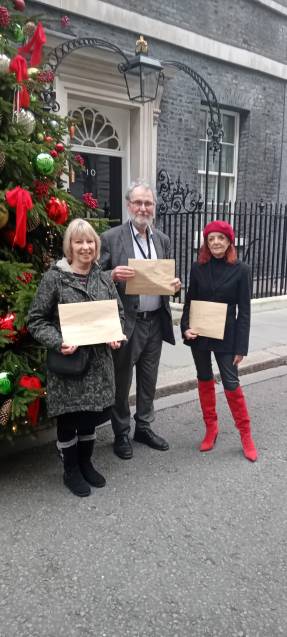
Cedaw in Law returned to Downing Street yesterday to deliver letters to Sir Keir Starmer asking him to intervene in the latest battle to secure justice for 50swomen.
The delegation is repeating their case for mediation and recompense for the discrimination and maladministration over the big rise in the women’s pensions age for 50swomen. One of the letters which would have gone to DWP lawyers also reiterated that all women’s groups should be consulted under the review promised by Pat McFadden, the work and pensions secretary, not just a private arrangement between WASPI and the ministry. WASPI pulled out of their judicial review case to challenge the DWP over maladministration last week accepting a £180,000 payment in full and final settlement from the DWP.
Tonight Joanne Welch, the organiser for CedawinLaw, Jocelynne Scutt, the Australian judge who chaired a tribunal into the issue, and myself, a patron of Cedaw in Law and a lobby journalist, will appear on Salford City Radio, in the constituency of Rebecca Long Bailey, the Labour chair of the All party group on State Pension Inequality for Women.
The link to hear it is here and it is on Ian Rothwell’s show between 6 and 7 pm.
Posted on by davidhencke Last year I reported on the tragic death of talented 25 year old Gaia Young 17 hours after she was admitted to University College Hospital with severe headaches. Her mother Lady Dorit Young was subject to an entirely unsatisfactory and unsympathetic coroner’s inquest by Mary Hassell which let the hospital off the hook saying the cause of death was unknown. You can read my original blog here.
The coroner blocked Lady’s Young’s attempt to get independent evidence from a neurologist but since then she has managed to get an independent neuro-radiologist and neurologist’s report and UCLH have opened a further review into her tragic death.
The protest vigil on September 15 was sparked by the findings of the neuro radiologist who examined the CT scans of Gaia’s brain. It showed quite clearly even to a lay person, according to Dorit ,that the first scan taken and I quote ” there is a gross cerebral and cerebellar swelling. There is effacement meaning ( ” literally meaning ‘ rubbed out’: these fluid spaces should be visible but cannot be seen).”
This is the opposite to the consultant radiologist who examined Gaia’s scan who said: “The ventricles and basal cisterns are patent…Impression No acute intracranial finding.”
Gaia Young
The independent consultant’s diagnosis was confirmed by Dr Charles House, the medical director, when he met Dorit and compared Gaia’s scan with a normal brain scan.
The consultant radiologist who examined this first scan was Dr Ayman Mahfouz, who was on duty at UCLH at the time Gaia was admitted. Dr Mahfouz, has a private practice in Harley Street.
His entry on the private practice site says he has specialist expertise in breast, gynaecology and general imaging.
He undertakes all aspects of breast imaging including mammographic (plain, contrast enhanced and 3D), Ultrasound, MRI and CT diagnostics. He performs all ultrasound and stereotactic breast related procedures including vacuum excision.
Dr. Ayman Mahfouz is a designated appraiser for doctors at UCLH and has previously been elected as a regional representative for doctors in training at the Royal College of Radiologists. At the time of Gaia’s admission he held the role as Emergency Imaging Lead for UCLH.
Gaia’s mother would like to contact him about the scans but so far he has not responded. She does not know what pressure he might have been under at the time or how much time he took to examine the scan. I did ask UCLH about whether he wanted to say anything about this but there was no response to my question.
UCLH did issue a response about the review into Gaia’s death.
A UCLH spokesperson said:
“We met with Lady Young and apologised that Gaia’s care fell below the high standards we strive to provide. We sympathise greatly that the cause of her beloved daughter’s death four years ago is still unknown.
“We are committed to learning from external opinion and scrutiny and have commissioned a range of independent experts to explore further the circumstances surrounding Gaia’s death. We agreed with Lady Young the scope of the reviews and the experts who will undertake them.
“We await the outcomes of all the external reviews to understand if further lessons can be learned and acted upon.”
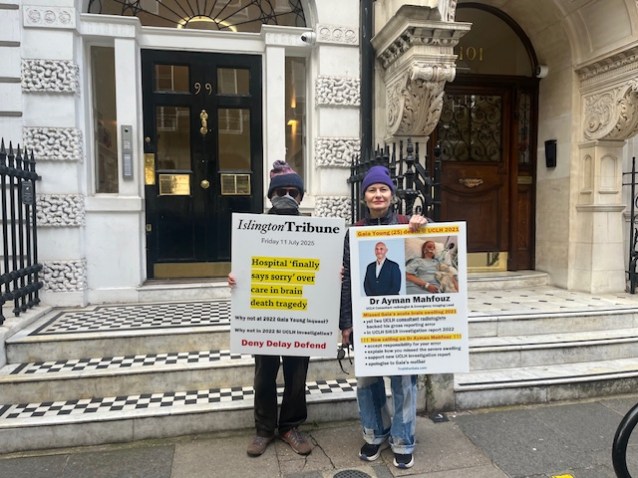
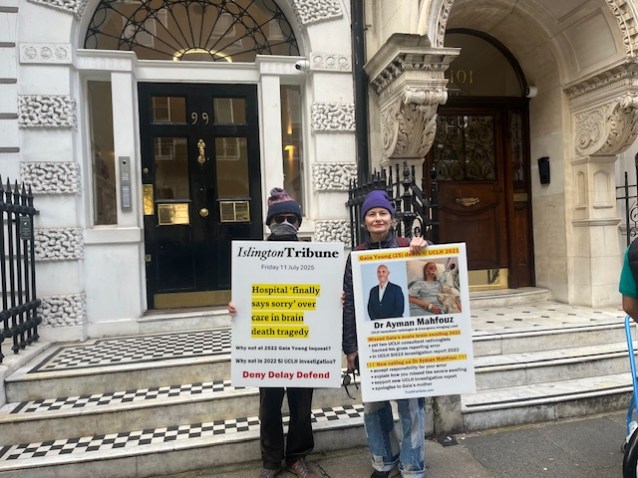
Dorit’s vigil last month caused more than a flutter on Harley Street. The clinic at 99 Harley Street called the police and also alerted its own security guards. When the one man patrol car turned up with flashing blue lights the policeman turned out to be incredibly polite and said no-one was breaking the law so long as the entrance to the premises and pavement was not blocked.
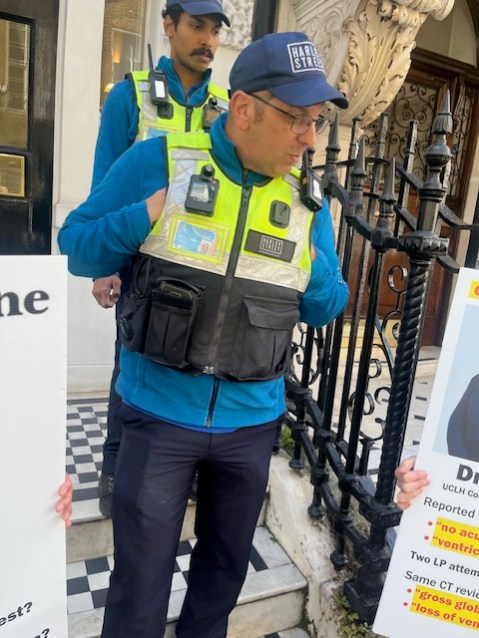
The friendly security guards curious about the case
Then two security guards turned up, saying they had been informed by a member of the public that large numbers of people were demonstrating there. It turned out to be just three people and they were remarkably friendly and polite when they heard about the circumstances. They didn’t mind having their pictures taken.
The one person who didn’t turn up was the doctor and one of his private practice colleagues politely remonstrated with us that this was not the right way to do things and Dorit should arrange a meeting with the hospital. It was pointed out to him she had been reprimanded by the Trust on various occasions for trying to contact clinicians having cared for Gaia. She never received an answer. The Trust never offered a meeting with any of these doctors.
Gaia’s case has been taken up by an Islington councillor, Dr Hannah McHugh. She wrote a strongly worded opinion piece for her local paper, The Islington Tribune. You can read ithere.
She says:” As an Islington councillor, I’ve supported Lady Young in this painful journey. It has revealed something of concern to us all: when things go wrong in our healthcare system, the path to truth is too often long, difficult, and unjust. Tragedies become injustices.”
Slowly but surely the facts about Gaia’s death are coming to light. But so far it has taken four years to achieve with no help from coroner Mary Hassell.
This to me is a general problem across the NHS. Rather than acknowledge to patient’s relatives that mistakes have been made, trust managers initially go on the defensive and are prone to cover up what went wrong and who was responsible. It is only people with guts and determination like Dorit who are prepared to fight for years until they get answers that the true facts start to come to light.
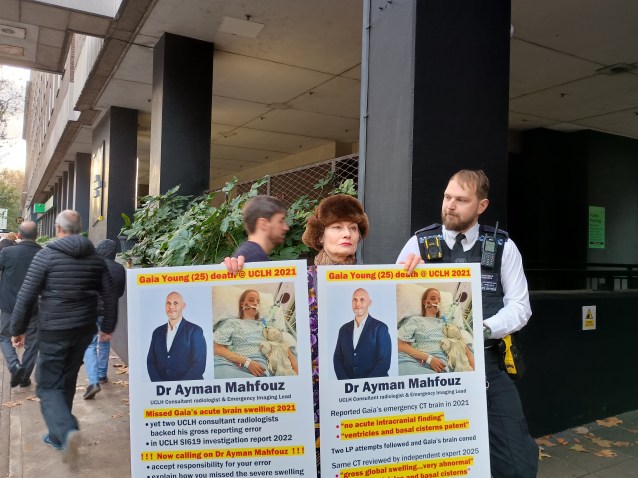
UPDATE; The ex coroner and Lady Dorit Young held a second vigil at a conference organised by the Royal College of Radiologists in London this month to bring it home to the profession the need for the very careful reading of scans by radiologists. Here is a picture of their vigil accompanied by a police officer.
Dorit Young and an ex coroner on a vigil in Harley Street.
Last year I reported on the tragic death of talented 25 year old Gaia Young 17 hours after she was admitted to University College Hospital with severe headaches. Her mother Lady Dorit Young was subject to an entirely unsatisfactory and unsympathetic coroner’s inquest by Mary Hassell which let the hospital off the hook saying the cause of death was unknown. You can read my original blog here.
The coroner blocked Lady’s Young’s attempt to get independent evidence from a neurologist but since then she has managed to get an independent neuro-radiologist and neurologist’s report and UCLH have opened a further review into her tragic death.
The protest vigil on September 15 was sparked by the findings of the neuro radiologist who examined the CT scans of Gaia’s brain. It showed quite clearly even to a lay person, according to Dorit ,that the first scan taken and I quote ” there is a gross cerebral and cerebellar swelling. There is effacement meaning ( ” literally meaning ‘ rubbed out’: these fluid spaces should be visible but cannot be seen).”
Gaia Young
This is the opposite to the consultant radiologist who examined Gaia’s scan who said: “The ventricles and basal cisterns are patent…Impression No acute intracranial finding.”
The independent consultant’s diagnosis was confirmed by Dr Charles House, the medical director, when he met Dorit and compared Gaia’s scan with a normal brain scan.
The consultant radiologist who examined this first scan was Dr Ayman Mahfouz, who was on duty at UCLH at the time Gaia was admitted. Dr Mahfouz, has a private practice in Harley Street.
His entry on the private practice site says he has specialist expertise in breast, gynaecology and general imaging.
He undertakes all aspects of breast imaging including mammographic (plain, contrast enhanced and 3D), Ultrasound, MRI and CT diagnostics. He performs all ultrasound and stereotactic breast related procedures including vacuum excision.
Dr. Ayman Mahfouz is a designated appraiser for doctors at UCLH and has previously been elected as a regional representative for doctors in training at the Royal College of Radiologists. At the time of Gaia’s admission he held the role as Emergency Imaging Lead for UCLH.
Gaia’s mother would like to contact him about the scans but so far he has not responded. She does not know what pressure he might have been under at the time or how much time he took to examine the scan. I did ask UCLH about whether he wanted to say anything about this but there was no response to my question.
UCLH did issue a response about the review into Gaia’s death.
A UCLH spokesperson said:
“We met with Lady Young and apologised that Gaia’s care fell below the high standards we strive to provide. We sympathise greatly that the cause of her beloved daughter’s death four years ago is still unknown.
“We are committed to learning from external opinion and scrutiny and have commissioned a range of independent experts to explore further the circumstances surrounding Gaia’s death. We agreed with Lady Young the scope of the reviews and the experts who will undertake them.
“We await the outcomes of all the external reviews to understand if further lessons can be learned and acted upon.”
Dorit’s vigil last month caused more than a flutter on Harley Street. The clinic at 99 Harley Street called the police and also alerted its own security guards. When the one man patrol car turned up with flashing blue lights the policeman turned out to be incredibly polite and said no-one was breaking the law so long as the entrance to the premises and pavement was not blocked.
The friendly security guards curious about the case
Then two security guards turned up, saying they had been informed by a member of the public that large numbers of people were demonstrating there. It turned out to be just three people and they were remarkably friendly and polite when they heard about the circumstances. They didn’t mind having their pictures taken.
The one person who didn’t turn up was the doctor and one of his private practice colleagues politely remonstrated with us that this was not the right way to do things and Dorit should arrange a meeting with the hospital. It was pointed out to him she had been reprimanded by the Trust on various occasions for trying to contact clinicians having cared for Gaia. She never received an answer. The Trust never offered a meeting with any of these doctors.
Gaia’s case has been taken up by an Islington councillor, Dr Hannah McHugh. She wrote a strongly worded opinion piece for her local paper, The Islington Tribune. You can read ithere.
She says:” As an Islington councillor, I’ve supported Lady Young in this painful journey. It has revealed something of concern to us all: when things go wrong in our healthcare system, the path to truth is too often long, difficult, and unjust. Tragedies become injustices.”
Slowly but surely the facts about Gaia’s death are coming to light. But so far it has taken four years to achieve with no help from coroner Mary Hassell.
This to me is a general problem across the NHS. Rather than acknowledge to patient’s relatives that mistakes have been made, trust managers initially go on the defensive and are prone to cover up what went wrong and who was responsible. It is only people with guts and determination like Dorit who are prepared to fight for years until they get answers that the true facts start to come to light.
Kevin O’Neill Marist college principal and paedophile Pic credit: Lancashire Evening Telegraph
Damian Murray tells Westminster Confidential about his long battle with the Roman Catholic charity which covered up child sex abuse for 11 years
This is a story of the concealment and denial of child sex abuse by a charismatic principal of a college and religious charity who escaped justice in his lifetime and the failure of many organisations, including the Charity Commission and the charity to do anything about it.
Father Kevin O’Neill, a Marist priest, was principal of the Roman Catholic St Mary’s College in Blackburn. It was closed down in 2022 with £8.2 million debts reportedly caused by falling student numbers. It had been propped up by the last Tory government with emergency funding since 2020.
He was principal of the college from 1978 to 1993 and worked in Blackburn since 1964. He was born in Barking, east London and attended the Roman Catholic St Mary’s College in Middlesbrough going on to a get a degree at Christ’s College, Cambridge.
Damian was a pupil at the school between 1970 and 1977 and only discovered years later when a former pupil Graham Caveney revealed in a memoir that he had been sexually assaulted by O’Neill when he was a pupil there. It was then he realised O’Neill, as he long suspected, had been trying to groom him. The book, The Boy with Perpetual Nervousness was reviewed in The Guardian in 2017. See here.
Unlike Graham Caveney he was never sexually assaulted. It was in 2017 -seven years ago – that he started putting in a complaint to the Charity Commission and the Department for Education only to discover that neither were keen to take action. That is what led him to complain via his MP to the Parliamentary Ombudsman who have been the only people to do something about it
His view of the process is scathing. “This tortuously extended process also uncovered to me the worryingly close personal and organisational relationships actively fostered and maintained between the UK Roman Catholic Church and both the DfE and the Commission. It has shown in my view the Commission in particular to be proudly unaccountable, intransigent, incompetent and completely unfit for purpose.”
The former St Mary’s College, Blackburn Pic credit: Lancashire Evening Telegraph
The cover up by the Marist priests is as bad as the actual child sexual abuse. When it was admitted in 1993 none of the governors of the school were apparently told and the principal was packed off to the United States on the grounds he was sick. When he died back in the UK in 2011 after getting dementia a celebratory mass was held at the school and the Lancashire Evening Telegraph is full of glowing tributes to him from former pupils with his nickname ” the Rev Kev” prominently mentioned. None of the pupils would have known about his dirty secret.
As bad as that the school in 2008 named a new £2.5 million arts centre in his honour – the O’Neill Academy for Performing Arts – which is now in use as a community venue.
And as late as 2024 the accounts of Marist society a curious note reveals :“At the start of 2023, the Charity was informed by the RLSS [ Religious Life Safeguarding Service] of an historic allegation madeagainst a deceased member of the Society. The allegation was immediately investigatedwith all relevant parties (including the Charity Commission) notified of the event. After afull investigation and professional advice, the victim received a private financial settlementof £30,000 in full and final settlement of the claim. The RLSS has now closed this case.”
Damian says the charity ” deliberately lied about and concealed O’Neill’s abuse from the police; from school and charity regulators; from charitable donors and beneficiaries; from current, former and prospective staff, pupils and parents at St Mary’s College from other potential victims of O’Neill’s grooming or abuse; and from the wider public.”
He said :”The Diocese of Middlesbrough, the Department for Education and the Charity Commission have all failed to demonstrate effective, timely, or appropriate oversight of the Marist Fathers at any time since the abuse was disclosed in 1993. Between 2017 and 2020 when I brought these important concerns to their attention in great detail and in line with their statutory or other formal responsibilities, these allegedly independent regulators have blankly refused to address any of them directly. They have simply chosen to turn a blind eye, both to O’Neill’s sexual abuse of a child in his care and to its long-term, deliberate concealment by the Marist Fathers.”
He managed to send his evidence to the national child sex abuse inquiry in the UK headed by Professor Alexis Jay about the case, though by that stage its formal hearings were closed. The inquiry has published a wider critical report on child sexual abuse in the Roman Catholic Church.
The Charity Commission says it is beyond its power to do anything about a charity’s role in “historic ” cases of child sexual abuse but this will be tested in a judicial review it is bringing against the Parliamentary Ombudsman claiming it is exceeding its powers in this case.
Blackburn is not alone in suffering child sexual abuse at the hands of Marist Fathers or the associated Marist Brothers. The Royal Commission into child sex abuse in Australia reported in 2014 on cases in schools in Queensland and New South Wales – one involving 19 boys – and in New Zealand nine Marist brothers were convicted of child sexual abuse.
Veteran NHS whistleblower campaigner, Dr Chris Day, has written a damning letter to Lord Fairley, President of the Employment Appeal Tribunal, accusing the system of “Institutional Corruption” in the way it has handled his case.
Dr Day, who has just lost an appeal case heard by employment appeal judge Sheldon, compared the way both the employment appeal court and the previous employment tribunal handled the proceedings to the verdict in the infamous Daniel Morgan murder case which has never been solved after a trial of suspects collapsed.
The way this murder was handled by the Metropolitan police led the independent panel to rule: ““Concealing or denying failings, for the sake of an organisation’s public image, is dishonesty on the part of the organisation for reputational benefit. In the Panel’s view, this constitutes a form of institutional corruption.”
Dr Day has emerged bloodied but not unbowed from a judgment that rejected all the detriments he claimed and was surprisingly unconcerned about the defendants Lewisham and Greenwich Health Trust’s chief executive lying on oath about a board meeting and its deputy communications office, Mr Cocke, destroying 90,000 emails that could have been useful to his case during the hearing. The worst the judgment could say was this was ” troubling.” Given this centred on his whistleblowing about the avoidable deaths of two patients in Woolwich hospital’s intensive care unit, which the trust has always tried to deny, this is a remarkably tame comment.
What was particularly hurtful to Dr Day is that at the appeal hearing he was accused in open court of lying about cost threats. He had been clear that he was forced at one stage to try to settle his case because he was told by his barrister that he would face a proposed application from the NHS for £500,000. See my report on his wife’s evidence here.
Effectively he was being called a liar by saying this had happened. Instead there is copious evidence that it did happen.
As he says in his letter: “At my most recent hearing, Mr Justice Sheldon explicitly stated in front of public observers that I was “lying” about being threatened for costs. He did this in circumstances when he knew my belief in cost threats was robustly grounded on written material from by former barrister Chris Milsom. He also knew that this material was enough to convince 2 MPs, the Telegraph and Financial Times that I had been threatened for costs. Accusing me of lying about cost threats in these circumstances was nothing more than a cheap smear to make me look like a liar in public.”
Or as he wrote earlier: “Dishonest or deluded whistleblowers don’t tend to have the support of former health ministers, senior doctors and the BMA to fund a KC.”
Also there is ample evidence in reports by lawyers that attempts to put costs on whistleblowers are commonplace. Indeed some lawyers moan they can’t get enough of them.
Dt Chris Day
His complaint about ” institutional corruption ” is not directed at individual judges but at the legal system where lawyers socialise with each other and don’t want to see a colleague’s reputation or career damaged by having to admit they got it wrong.
As he says in his letter: “My complaint is not directed solely at individual judges but at the institutional handling of this matter. The EAT has placed judges in an impossible position: adjudicating on issues that, if determined on the evidence, would have serious implications for people with whom they admit to having ongoing professional or social relationships including being connected on social media. “This is precisely the type of reputational self-protection identified as “institutional corruption” in the Daniel Morgan inquiry. I am not expecting you or the EAT to do anything about this but want to record my position and the fact that it has been put to you as EAT president. You will note 2 MPs have called for a public inquiry into this case.”
My view from covering a number of tribunals- both involving whistleblower doctors, nurses and in the world of industry and the arts – is that lawyers are getting too cosy and comfortable with each other. Add to this the loss of media interest in all but the most lurid of court cases, there are precious few journalists left to observe what is happening in the courts.
All this is to the detriment of the ordinary member of the public when they fight their case. Arraigned against them is a club that knows how to fix the outcome. And this is destroying the principle of open justice and why we need radical reform of both the employment tribunal and county court system.
The Sunday Mirror reports today of yet another potentially serious leak affecting worker safety at Sellafield which was not publicly released two years ago.
A whistleblower told the paper that an elevated level of nitrogen which can cause asphyxiation was released in the most dangerous building on the site – the Magnox nuclear storage facility which is also leaking contaminated water into the ground.
As I reported in Byline Times last month the 100 year clean up is already 13 years behind schedule and £20 billion over budget and its own nuclear safety experts say is becoming increasingly unsafe. The article is here.
What is disturbing is that the whistleblower told the newspaper. “It was most serious because it could have killed somebody. The whole point of having all these safety procedures is to stop people breathing in inert gas, so we can evacuate before there’s a chance of breathing it in.”
The source said the leak in May 2023 was raised as an incident report and “was of a level that needed to be escalated”. But it was not escalated, according to the whistleblower, who added that “no lessons were learned”.
The source said: “There is no confidence or trust in the senior management now. We are dealing with nuclear waste and people are afraid to speak up. The problem is that people are being victimised if they report safety issues.
“Or they are escalated to managers who then try to cover them up or sweep them under the carpet. And that is a really dangerous culture in a place like Sellafield.”
This new disclosure just comes after a report from the Commons Public Accounts Committee that was highly critical of the management at Sellafield and the oversight of the dangerous site by the Nuclear Decommissioning Authority. It was also highlighted safety issues as the buildings reach the end end of their life span and MPs were sceptical of claims by the senior management that relations with staff are improving and a toxic culture of bullying and harassment had been stopped.
Officially Sellafield told the paper:”This was reported and investigated swiftly and thoroughly. Our regulator was informed in line with established protocols,” they said. “Our Safecall system remains independent providing a safe and confidential reporting system for the whole of the NDA group.
“Whistleblowers are respected, protected, and valued and we actively encourage employees to report matters of concern. Without exception, issues raised are taken seriously, investigated appropriately, and treated confidentially. We strongly advise anyone with a concern about a safety event or investigation to report it so we can act on it.”
They added that during routine testing of a nitrogen delivery system in the Magnox Swarf Storage Silo in 2023, a control valve was opened causing a ‘brief increase in flow and pressure of nitrogen’.
The paper reports that Ex-Sellafield HR consultant Alison McDermott raised safety concerns in an employment tribunal in 2021. The management ended and her contract and spent hundreds of thousands of pounds of taxpayers’ money to undermine her concerns at employment tribunals.
Alison McDermott
Alison, who lives near Ilkley, West Yorks, said: “In my experience, leaders cover up problems and lash out at people who speak out. That’s a terrifying state of affairs at a nuclear site. In my 30 years in HR it’s the most secretive, punitive toxic culture I’ve ever experienced.”
To my mind it suggests that Sellafield still has a very long way to go to convince Parliament and the public that they are handling safety issues properly at this plant.
You may not have noticed but the UK Parliament and the National Health Service has not had a permanent Ombudsman to handle complaints for more than a year.
Ever since for some unexplained reason the former PM Rishi Sunak blackballed the first choice, Nick Hardwick, a former chair of the Parole Board, for the job despite going through a thorough selection process, interfering with a body which is independent of government, it has been rudderless without a permanent boss. See my blog on this here.
To solve the problem the Parliamentary Ombudsman’s office appointed an interim candidate, Rebecca Hilsenraft, then chief executive, after a meteoric rise since joining the organisation from the Equality and Human Rights Commission, who at least could adjudicate on complaints.
But they would have known then that her appointment would end on March 31st this year – a year after the last permanent Ombudsman, Sir Rob Behrens, retired. You would think that would have given them plenty of time to find a successor and go through a thorough selection process. But Oh no, by the time she reverted back to her old job, nobody had been appointed.
As a result the press office had to issue this statement:
“We are currently awaiting news on the appointment of a permanent Ombudsman.
“Our dedicated staff remain committed to delivering an important service for the public.
There may be a small number of cases we are unable to progress without an Ombudsman in post. Caseworkers will directly contact any complainants whose cases are affected.”
Checking their website yesterday there has not been one new press release nor any new decision of cases announced since April 1.
Then suddenly last week it was announced that the Public Administration and Constitutional Affairs Committee were to hold a pre appointment meeting this week for a new Ombudsman. Extraordinarily the name was kept secret from the public record until this Tuesday.
I gather it was at the request of the favoured candidate, Paula Sussex, because it appears she had not told told her present employer, she is chief executive of OneID, that she had clinched the job.
Now yesterday there was a hearing. The current chairman of the committee, Tory MP, Simon Hoare, recused himself from the hearing as he had sat on the selection board leaving Labour MP, Lauren Edwards, to take the chair.
It was a very underwhelming event both from the appearance of the favoured candidate and the MPs questioning. For a start four MPs did not attend and those who did were mostly newbies whom I thought had yet to get in their stride.
The candidate herself appeared to know little about the working of the PHSO system and even less about the NHS. She appeared to be a management and process person steeped in working for the private sector rather than a person concerned about policy. This was noticed when she was chief executive of the Charity Commission when a profile of her highlighted this. The article is here.
She was also wary of journalists. The same article noted: “she has declined to give interviews: she is said to be unused to dealing with the media, disconcerted by the amount of press attention the commission attracts and confirmed in her reluctance to speak by any coverage she perceives as negative.”
Considering she admitted during the hearing that the Parliamentary Ombudsman had too low a profile – it strikes me she is going to have to be more proactive with the media if she wants to change it.
Her previous jobs have involved her as a consultant on new technology, working at a top level at the transactional Students Loan Company and for private industry.
Her most recent role is as a non executive director with the Infected Blood Compensation Authority which will ” sadly”, as she said, to have to give up. Given her sparse knowledge of the workings of the Parliamentary Ombudsman’s Office I was rather surprised she did not mention that her fellow non executive director is none other than Sir Robert Behrens, the last Ombudsman, who could have given her great detail about its inner workings.
Also it is rather ironic that this body – which despite its name is a private contractor not a public body- is to face a recalled two day hearing next month of the Infected Blood Inquiry under Sir Brian Langstaff because of public dissatisfaction with its handling of compensation and a slew of other complaints. Jenni Richards KC , the inquiry’s counsel, has just published a huge list of issues. See here.
Given some of these issues will be the very bread and butter work that a Parliamentary Ombudsman and Health Service Ombudsman would have to handle, someone might ask why she presided in an organisation that now faces such searching questions for not doing its job. Of course its minutes aren’t published so we won’t know whether she raised such issues or went along with the management.
Altogether I am sceptical of whether there will be great change at the Parliamentary Ombudsman’s Office and I am afraid her attitude and the lax scrutiny by the one committee that can hold it to account will mean any great change.
The committee of course do not agree and think she is wonderful. This is their conclusion In a report published after the hearing.
“We are satisfied that Paula Sussex has the personal independence and professional skills necessary to fulfil the high profile, demanding and varied role of Parliamentary and Health Service Ombudsman. Paula Sussex is an excellent candidate with a track record of organisational transformation with a focus on improving the effectiveness and external reputations of the organisations she has led. Her professional background and experience as Chief Executive will aid her in giving the PHSO direction and certainty. We wish her every success in this role.”
Some 114 people applied for the job at a salary of between £171,000 and £189,000 a year -42 per cent were women.
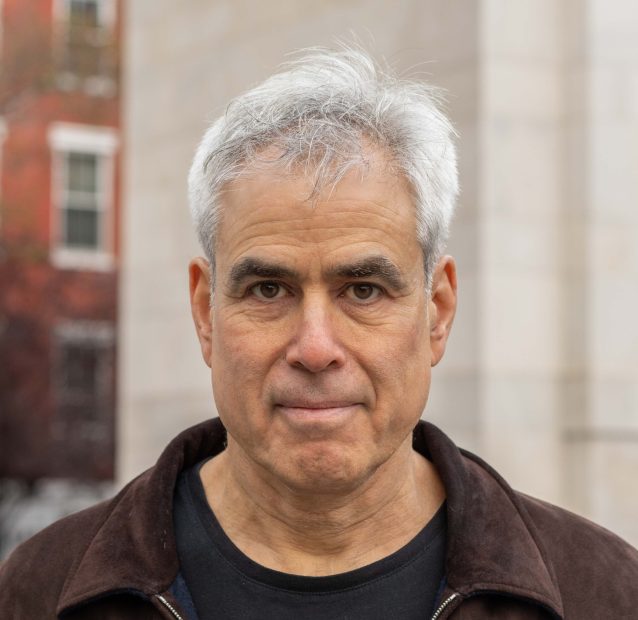
Yesterday I attended an extraordinary lecture by Jonathan Haidt ( pronounced height) a US social psychologist revealing extremely worrying trends following the invention of smart phones on kids education’s prospects.
It showed both in the UK and the US that educational attainment – far from rising – is dropping and that issues like mental illness and self harm are rising.
His research can precisely connect the emergence of the ubiquitous smart phone and a dramatic change in attainment in schools, increased loneliness among teenagers, who then become vulnerable prey to malevolent influencers or in the most extreme cases tricked by criminals and paedophiles.
We are all aware of teenagers being glued to their phones – even when walking down the streets – and might have thought this is a passing phrase with nothing to worry about. This research suggests otherwise.
Situation in UK worse since Covid lockdown
Part of the increase in isolation comes from this present generation’s experience of the Covid pandemic and lockdown. One might then expect to see some bounce back when life returned to normal. But his research shows the opposite, the situation in the UK and US is worse post Covid.
The main players in this are undoubtedly short videos on Tik Tok, Snapchat and Instagram – which provide addictive instant distraction and gratification for teenagers, and make more detailed lessons studying books or complicated maths formula seem boring. Add this to the distractions of X Box computer games and kids can – and sometime do – have 24 hours glued to screens only to be tired and irritable the next day.
Jonathan Haidt pointed out in his lecture that puberty is also the time when the brain develops new connections allowing teenagers to understand more complex concepts and ideas as well as emotional development. But fed on a permanent diet of addictive videos and porn is not helping the brain to develop and probably damaging it.
Given the power of Big Tech to influence politicians – brilliantly illustrated recently when a victorious Donald Trump was surrounded by billionaire tech barons- can we do anything about it?
The answer according to him is yes. Schools can play a big role in curbing the rot by banning the use of phones while teenagers are learning. My daughter, who teaches at a private school in Luton dealing exclusively with kids who have been expelled from other mainstream schools, all phones have to be handed in at the beginning of the day and returned when they leave. Even the staff are restricted from using phones so as not to set a bad example to the kids there.
Schools – and there are by no means enough of them – that have done this according to his research have seen a dramatic increase in educational attainment in English, maths and science and a dramatic decrease in disrupted lessons making it easier for teachers to do their job.
Sir Keir Starmer should be concerned
The government ought to be concerned about this. Sir Keir Starmer, has set great store on increasing the skills of a new generation so he can get the growth needed to boost jobs and the economy. But it is being undermined by this trend where the latest generation are being continually distracted by what they see on their smart phone. Employers are not keen to take on people whose spend time exclusively on their phones and as a result have worse literacy and mathematical skills.
For those who want to follow this up you should go to Jonathan Haidt’s website https://www.anxiousgeneration.com/ where his research team has all the details you need to know about this trend and its implications seem to have passed us all by.





 Westminster Confidential