I don’t usually run appeals for money on my blog but I am making an exception in this case because of the huge injustice in the employment tribunal system that allows some judges to insult, berate and patronise women who come before them.
if you want to donate this is the link. DO NOT CLICK ON THE YELLOW BUTTON ON TOP OF THE PAGE WHERE IT SAYS DONATE – as this will go to the general fund for the Good Law Project and not to the women. INSTEAD SCROLL DOWN AND CLICK ON DONATE BY CARD.
To do so they have to get a judicial review against the Judicial Conduct Investigation Office which is both refusing to investigate their complaints and ironically believes it is above our freedom of information laws so it doesn’t have to answer any questions from the press or the public on simple facts like how many complaints there have been against judges. This view is not shared by the Information Commissioner who ruled it should comply with FOI but the Ministry of Justice is planning to appeal this decision.
The case the women want to bring is not just against the bullying Judge Philip Lancaster – but against the whole employment tribunal system which doesn’t allow access to judges’ notes and does not produce court records for all cases and even when it does makes sure it is very expensive to get hold of them.
The women’s case has been taken up by the Good Law Project but the women still have to raise some £13,OOO to cover legal opinions. So far they have raised just over £5000. The case was covered by me in Byline Times here. Now it has been taken up by the BBC programme Look North.
You can see their report below.
BBC Look North coverage of the complaints against Judge Lancaster with interviews with Alison McDermott and Dr Hinaa Toheed.
The treatment of management and diversity consultant Alison Mcdermott, by Sellafield who spent £750,000 on top flight lawyers to oppose her claim at an employment tribunal presided over by judge Lancaster led to her local MP Anna Dixon to request an apology from Sellafield’s chief Euan Hutton at a recent Parliamentary hearing. None was forthcoming. Dr Hinnha Toheed, a GP, tells how she was shouted at 16 times by Judge Lancaster during a maternity discrimination hearing She says: “Judge Lancaster shouted at me 16 times, called my case an “omnishambles” before we had even begun, and showed open bias and contempt throughout the hearing. The experience was devastating. My barrister formally documented his behaviour and submitted a written statement to support my complaint. Yet despite this evidence, the system protected him — and he remains in post to this day.”
She is one of two doctors and a nurse who have put in complaints about Judge Lancaster.
These women need support to get to the position of bringing a judicial review because of the enormous cost of doing so – another barrier against people being able to challenge the judiciary. Their legal team include Emily Soothill of Deighton Pierce Glynn, Dr. Charlotte Proudman, and a prominent King’s Counsel have agreed to capped fees. But they need this money to be able to pay for this advice – and that is why there is a need for this crowdfunder.
II have chosen not to call for any donations for my site on this blog so the money can go direct to the women.
Last week Salford City Radio’s Ian Rothwell devoted a whole programme to the CedawinLaw case for mediation to solve the impasse of compensation for the 50swomen who faced a six year delay in getting their pension. Three speakers discussed the issues. Jocelynne Scutt, a former Australian judge and anti discrimination commissioner for Tasmania, gave an update description of the present legal position and how you do not have to court to start a mediation process. Janice Chapman ,a 1950s woman, gives a heart rending account of how women have already been discriminated against before they got their pension and then had to wait six more years before they could get it and how alternatives to work longer are often not possible. I give an interview questioning the wisdom of Waspi’s legal case for partial maladministration and how the All Party Group on State Pension Equality is moving towards insisting that all groups campaign together rather than the division between Waspi and all the other groups which has bedeviled the issue for years.
A ground breaking decision by the Information Commissioner which would lead to the end of secrecy around the behaviour of judges will soon be tested in one of the highest tribunals in the country.
For years the Judicial Conduct Investigations Office, which, among other matters investigates complaints against judges, has claimed it is a private independent body which is not subject to the Freedom of Information Act, which covers the rest of Whitehall and the courts. It tells anyone who puts in a request that a reply will be discretionary and refuses to give the information.
And the Ministry of Justice, which is subject to the Freedom of Information Act, if asked the same information sidesteps the issue by saying it doesn’t hold the information.
Now John Edwards, the Information Commissioner, has blown the JCIO’s defence apart by saying it is a public body and like the rest of government should have to answer freedom of information requests.
Information Commissioner backing complainants
By doing so, he is backing at least two complainants who have taken their cases through tribunals plus numerous other people who have sought to get into the public domain how many judges are subject to complaints. The whole matter is going to be settled in an appeal to the Upper Tier Tribunal after a judge ruled that the decision by the Information Commissioner has to be included in the proceedings.
The Ministry of Justice, on behalf of the JCIO, is seeking to squash the decision. No date has been fixed yet for the hearing.
The Information Commissioner’s says: “the Lord Chancellor and the Lord Chief Justice (now Lady Chief Justice)are jointly responsible for judicial discipline’. The JCIO, therefore supports not just the Lord Chief Justice but also the Lord Chancellor in relation to such matters.
“This highlights how the structure of the JO and JCIO is not simply to support the judiciary, with wider public functions included within its ambit. The Commissioner further notes that the Judicial Appointment and Conduct Ombudsman, the statutory office sitting at the head of the complaints process of which the JCIO is part, was added by parliament to the scope of FOIA. In the Commissioner’s view, it seems unlikely that it would have concluded that the operation of part of this process should fall in scope of FOIA, with others outside of it.”
“Based on the summary above, the Commissioner’s conclusion is that the JCIO is part of the JO, which, while operating at arms length in practice, is still part of the MOJ for the purposes of FOIA. In light of this, it is not necessary for the JO or JCIO to be listed separately in Schedule 1 FOIA for it to be within scope of the legislation.”
He adds:” Any information request made to the JCIO is effectively a request made to the MOJ and should be treated as such. This is important in order for the MOJ to carry out its functions under FOIA, and to enable individuals to exercise their statutory right to public information.”
Judge Philip Lancaster
The Information Commissioner’s decision is very important because of its context that judges are being protected by senior members of the judiciary from any scrutiny about their behaviour. The BBC and this blog have already reported that judge Philip Lancaster, an employment judge, has received as many as 12 complaints from women who have appeared before him that he is patronising, biased and rude towards female litigants. See my blog here.
Barry Clarke, President of the Employment Tribunals in England, steadfastly refuses to entertain any criticism of his judges thereby blocking any information about complaints. And Baroness Sue Carr, the Lady Chief Justice, appears to be equally protective.
So this ruling while not likely to see the naming of judges will be able to provide the context of just how many complaints there have been and upheld and show the scope of the problem.
Sir Brian Langstaff, chair of the infected blood inquiry
Lawyers representing thousands of haemophiliacs who unknowingly got hepatitis, HIV and Aids from blood transfusions provided by drug addicts and criminals in the United States in one of Britain’s biggest health scandals could be gagged from publicly criticising compensation payments.
A new draft contract proposed by the Infected Blood Compensation Authority (ICBA), the body set up by the government to pay out an estimated £11.8 billion by 2029 ,could take legal action for ” reputational damage” if lawyers publicly criticise the authority’s actions without their permission.
The ICBA, despite its name, is not a public body, but a private contractor to the Cabinet Office, so it intends to impose a standard contract on people who deal with it.
The draft clauses read;
15.7.1 not make any press announcement or other public statement or publicise the Contract or any part of it in any way, or make any public statement about the Scheme, without the prior written consent of the Buyer [the Cabinet Office] and must take all reasonable endeavours to ensure that Supplier Staff do not either; and
15.7.2 not (and must ensure its Subcontractors do not) embarrass the Buyer or IBCA or otherwise bring the Buyer or IBCA into disrepute or diminish trust placed in the Buyer or IBCA (“Reputational Damage”) by engaging in any act or omission which is reasonably likely to diminish the trust that the public or Scheme Applicantsplace in the Buyer and/or IBCAor impacts the reputation of the Buyerand/or IBCA,
This effectively amounts to a comprehensive “gagging clause”, specifically prohibiting lawyers from making “any press announcement or other public statement” about the scheme without prior Cabinet Office approval. Firms would also be required to ensure their staff comply with these restrictions.
The ICBA is seeking requirements that could compel law firms to take specific actions or make public statements at the IBCA’s direction to mitigate perceived reputational damage, regardless of whether any breach has occurred.
One law firm said; “On any basis this variation is unacceptable to us for professional, ethical and regulatory reasons. This firm is instructed by individual clients to provide individual, independent legal advice regarding the scheme and will continue to do so.”
The Haemophilia Society, which also supports victims, is consulting lawyers about what action it should take to counter these proposed restrictions.
The Cabinet Office has told people that these are standard clauses in procurement processes for private companies being paid taxpayers money, but that they are in conversations with IBCA but could not confirm the outcome.
The issue follows negative publicity over problems with interim compensation payments to people which generated criticism of the IBCA.
An IBCA spokesperson said:
“We are committed to supporting the infected blood community, and are working with legal providers currently to agree contracts that will provide support for those claiming.
“The legal providers are not restricted in the legal advice they deliver to people claiming compensation, and we provided amended terms to clarify this.
“We welcome an open discussion with all those who are impacted by infected blood, and those who represent them.”
Years of cover ups
Given the history of the infected blood scandal which dates back to the 1970s, culminating in the recent interim report by Sir Brian Langstaff, there have been years of cover -ups. People were never informed that their relatives were infected, there were attempts to use ” commercial confidentiality” to hide the source of the contamination, and this will not add to public trust or increase transparency.
So far £1 billion has been paid out in £100,000 interim payments and the IBCA is just starting to pay full compensation to other people.
Nick Thomas-Symonds, Minister for Cabinet Office, updated Parliament with IBCA’s latest compensation figures this week.
113 people have been invited to start their compensation claim
84 people have accepted their invitations and submitted their claim
23 offers of compensation have been made, totalling £34.4m
So far 14 people have accepted their offers with more than £13.3m paid in compensation
New laws will also be passed by the government extending payments to relatives of infected blood victims, which could lead to an extra 140,000 people claiming.
Head of the National Audit Office raises pertinent questions about the future direction of Whitehall in annual speech
Anybody reading the latest tranche of reports from the National Audit Office and the Commons Public Accounts Committee could be forgiven for thinking the UK is living in a dystopian world. Indeed fiction writers could use their reports as a basis for a dystopian novel or a new TV series.
The problem is that it is not fiction, it is factual based evidence.
Never in my 40 years of reporting the NAO have I seen so many things run by Whitehall going wrong. Yes we have had scandals, waste of public money and even corrupt deals exposed by them. But the last tranche of reports almost beggars belief.
Simultaneously we have had the biggest backlog of building maintenance, totally £49 billion, the largest ever NHS waiting lists for operations, the Home Office admitting it has made 1000 mistakes and wasted tens of millions on acquiring sites for housing asylum seekers, half the local authorities in England on the verge of bankruptcy, outdated computer systems without proper security protection, record homelessness, and a huge backlog of people waiting for special education places or treatment in psychiatric hospitals.
Innovate or die
It is against this background that Gareth Davies, the head of the National Audit Office, addressed a well attended meeting yesterday in Parliament of MPs, peers, former permanent secretaries, academics and journalists.
While he did not use my journalistic hyperbole, his message was a simple one to Whitehall, innovate or die. And although the NAO is strictly non party political, there was an underlying message to the present government, sharpen your act or lose the next election.
As he put it: “we have a new Parliament and a new Government, but many of the same problems of rising demand and not enough money to quickly fix the gaps in key public services. We also face other challenges that risk causing widespread disruption, from global instability and climate change to public health emergencies and cyber threats.”
NHS needed fundamental reform
He was particularly critical of the department for Health and Social Care and the NHS, the biggest employer in the UK.
” Figures from NHS England in May last year showed it was still 8 per cent lower in productivity in 2023/24 than before the pandemic and much work is underway to address this.”
He went on later: ” In the last few months, our reports on supporting children with special education needs and NHS financial sustainability both identified the need for fundamental reform in the face of rising demand and costs, alongside unsatisfactory outcomes. This means tackling the causes of avoidable demand and allocating resources in a redesigned system where they can have maximum impact on outcomes.”
He is pleased that Whitehall is piloting AI but also warned that new technology is not the whole answer to greater productivity. He also emphasised that ministries need to employ the best skilled people – notably recently in the need for people with good computer skills and capable of negotiating good procurement deals.
He is also wanted Whitehall to concentrate on tackling resilience to protect the country. This included fighting cyber attacks and the risk of future pandemics. He revealed the NAO would soon publish a report looking at the international and domestic implications of protecting the UK from another pandemic like Covid 19 which came from abroad.
Civil servants must be less risk averse
Finally he wanted civil servants to be less risk averse and try out well managed schemes, dropping those that don’t work quickly.
His solution was summed up in four succinct points.
First, a clearly articulated risk appetite and a spread of investments, to maximise the chances of success in innovation
Second, harnessing new technology as I’ve already mentioned
Third, a culture of fast learning and evaluation, stopping failed experiments quickly and scaling up successes
Finally – and close to home for us – an accountability and scrutiny framework that encourages well-managed risk taking
” It’s no coincidence that innovation thrives in times of crisis, such as when lives are at stake. Organisations rapidly adjusted their risk appetites during the pandemic to meet urgent needs,” he said.
He pointed that Whitehall fears that they would hung up to dry by MPs and the press if they failed was now no longer true -instead MPs on the public accounts committee were now more critical of civil servants who failed to look at new ways of tackling problems rather than following safe bureaucratic procedures.
So what are the NAO doing themselves? “our refreshed strategy from 2025 to 2030 takes fully into account the risk appetite set for the range of innovative projects. We will continue to look for and highlight positive examples of innovation, including where unsuccessful initiatives have been stopped in favour of more promising ones. As well as featuring these in our reports on departments and organisations, we will publish what we learn across government as part of our programme of lessons learned reports.”
AI is also coming to the NAO so auditors can spend more time making professional judgements on department’s performance and less time on manual exercises.
Talking to people who attended afterwards it was clear that MPs and academics are well aware that innovation is necessary or we will not be able to deliver public services to meet growing demand. MPs seemed especially aware that the NHS was not functioning properly – whether it was their local health trust – or the bureaucracy at the top. MPs have already publicly criticised the top management of the NHS for being complacent.
Over the next five years how Whitehall balances the money needed for innovation and risk taking against the perennial problem of working in a public sector which has been neglected for too long and needs ” first aid” to keep going will be crucial. Whitehall should treat the present state of public services as a national crisis which can only be tackled by radical innovation.
Hits on my blog jumped from 219,000 in 2023 to over 358,000 last year. This will be an underestimate because it does not include thousands of additional hits on Linked In, particularly where I highlighted bad practices in employment tribunals and hideous unjust treatment of whistleblowers by NHS trusts and other state and private organisations including Sellafield and a Network Rail contractor.
By far the biggest interest was in a blog I wrote on the decision by Rachel Reeves, the Chancellor, and Sir Keir Starmer, the PM, to abolish the winter fuel allowance for all people claiming the state pensions – leaving it only available to a rump of pensioners claiming pension credit. This attracted an astonishing 187,400 hits on the site plus nearly 20,000 on Facebook and Linked In and reflected the fury among pensioners and the shock that a Labour Government should target people earning little more than £11,300 a year as its first priority for cuts. The ineptitude of this decision is not likely to go away and both well off ministers are still oblivious of the damage they have caused. The blog is here.
Throughout the year there was continual interest in the plight of the 3.6 million 50swomen who faced up to a six year delay to get their pension with tens of thousands of hits on stories detailing every twist and turn of this sorry saga. The year ended with total defeat for the WASPI campaign, when Liz Kendall, the new Labour works and pensions secretary, blocked compensation payments to any of the women despite a partial maladministration ruling by a weak former Parliamentary Ombudsman, Sir Robert Behrens. An older blog showing how much successive government’s saved by cutting Treasury contributions to the NI fund got another 2,444 hits this year.
IF ministers think this is the end of the story they are sorely mistaken as the fight by CEDAWinLAW will continue this year since they have international backing and ministers could have to face a call for arbitration despite the suspension of a potential court case.
Dr Chris Day
The other big issue on this blog which attracted thousands of hits was the appalling treatment of whistleblowers particularly in the NHS. Trusts are spending hundreds of thousands of pounds employing expensive lawyers to hound and ruin the careers of doctors who expose patient safety issues which trust managers want to bury. By highlighting individual cases when they come before employment tribunals I am building up a bigger picture of injustice and even corruption in NHS trusts and exposing barristers and solicitors who are enhancing their careers and bank balances by pursuing consultants and doctors who are brave enough to stand up for patient safety in the NHS. These included last year cardiologist Dr Usha Prasad, obstetrician, Martyn Pitman; emergency doctor, Dr Chris Day plus nurses at the Lewisham and Greenwich NHS Trust. The latest Chris day blog is here
Alison McDermott
I also highlighted the on going scandal at Sellafield where whistleblower and management consultant, Alison McDermott exposed bullying and harassment which put nuclear safety at risk only to be pursued by expensive lawyers working on behalf of the management to silence and humiliate her. The behaviour of employment judge Philip Lancaster, who heard the case, is now under scrutiny as six women have brought complaints about his behaviour towards women claimants. The blog is here.
Northiam part of the site
One particular story which attracted interest was an in depth investigation into the running of a small parish council in East Sussex, Northiam, where a ruling clique of councillors harassed and pursued anybody raising questions about dubious practices that followed a loan of £1.4 million from Michael Gove, the former Tory levelling up secretary, to allow the council to purchase ta former Blue Cross animal sanctuary for the village. This now the subject of an investigation by the external auditor the council. It attracted over 10,200 hits – 8000 of them locally. The blog is here.
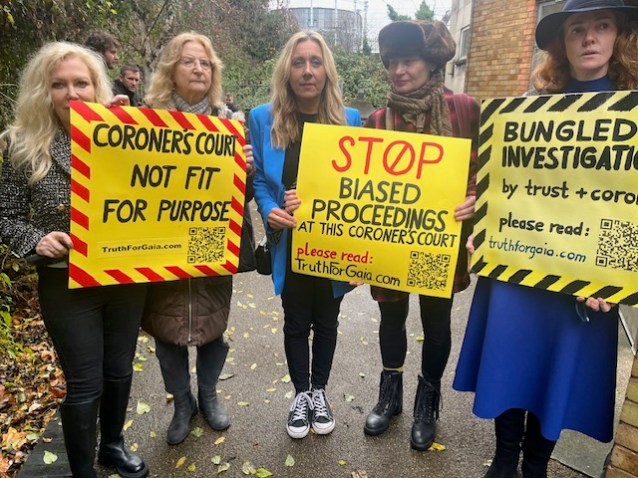
Protest outside Mary Hassell’s coroner’s court
Finally I turned my attention to the coroner service after one particular coroner, Mary Hassell, appeared to me to the cross a red line in her treatment of bereaved relatives who were either banned or censored from making statements at both her inquests. Both were heartbreaking cases- one involving a mother losing her only daughter 17 hours after being admitted to University College Hospital in London, the other involving the death of a TV journalist who had complained of domestic abuse by an ex partner who had a record of violence.the blogs are here and here.
Expect more investigations this year as I take up more cases.
Coroner Mary Hassell now facing bereaved members of two families unhappy about the way she conducts inquests
Teresa McMahon was a well liked news editor for ITV’s Granada Reports who had a first class honours degree in journalism and was based in Salford. From humble beginnings she was rated by colleagues as ” a highly competent news editor, who had worked on and overseen – some of the biggest news stories including the Manchester Arena terror attack, the coronavirus outbreak and Tyson Fury’s world heavyweight championship win.”
Over three years ago she was found hanged at her home in Little Holten, Salford and it took until last week for an inquest to be held. What emerged is that the police “investigation” into her death, the pathologist’s report and the conduct of the coroner who heard the case, Mary Hassell, fell well short of the professionalism and unbiased news values Teresa McMahon had practised during her life.
The hearing itself did not start for an hour after lawyers for Lorna McMahon requested an adjournment because she had not received all the documentation she needed, had no confidence in the robustness of the process and thought her rights to participate compromised procedures under Section 2 of the European Court of Human Rights legislation particularly in relation to domestic abuse.
Michael Etienne Pic credit: Garden Court Chambers
Her lawyer, Michael Etienne, from Garden Court Chambers, who acted pro bono, highlighted concerns that coroners did not pay enough attention as to whether domestic abuse by a partner or ex partner led to suicide and cited previous cases. He told the coroner ” the inquest will (or at else is very likely to) fall short in its primary duty to provide a full and fearless inquiry into these important matters.”
All this was rejected by Mary Hassell, the coroner who insisted she would conduct a frank and fearless inquiry.
The hearing had already been moved from Manchester West coroner’s court to Inner London because of a conflict of interest and concern about the involvement of Greater Manchester Police. A senior coroner had recused himself from hearing – hence the delay in hearing the case.
Mary Hassell ” suicide verdict” Pic credit: Archant
Mary Hassell decided that it was a suicide and ruled that there was no coercion or control by her ex partner Robert Chalmers that led to her death.
Mohammed Bashir – no ” Silent Witness” material
For her the star witness was Pathologist Dr Mohammed Bashir. He insisted that the ligature around her neck was consistent with hanging and not strangulation but he knew nothing about her complaint about domestic abuse and said there were no other marks on her body. Extraordinarily he had taken no photos when he examined the body and his evidence was partly contradicted by the policeman who went to the scene who noted bruises on her breast and biceps. Certainly Dr Bashir would not have qualified for a star role in ” Silent Witness.” He was no Dr Nikki Alexander and Lorna McMahon complained that the body had not been examined by a forensic pathologist.
This lax approach was compounded by the so called investigation by Greater Manchester Police. Detective Chief Inspector Gareth Humphries who arrived on the scene and immediately ruled out murder. She was already dead and it was Robert Chalmers, who snapped the cord. Her brother Bernard, who was also there, confirmed that Chalmers had done it by himself,
No pictures taken by pathologist or police
Extraordinarily again he did not take any pictures either and apologised to the coroner for not doing so. “Policy at the time was to take photos if you think there’s a crime. I did not think there was a crime at the time. I could have accessed the digital camera and I did not. I wish I had. If I had, you would have got photos for the answers you seek and I apologise that I did not.”
Instead he read her journal which he found in the bedroom where she expressed her loneliness, lack of contact with her daughter, and a list of complaints about the way her ex Robert Chalmers had treated her.
But only three weeks before this she made a complaint about domestic abuse to a police constable under Clare’s Law and was wrongly told that she had no right to find out whether he ex had convictions for violence. She then withdrew the complaint and police found that they had given her the wrong advice but could not contact her to tell her.
A lot of this came out during the hearing because of persistent questioning by Lorna McMahon not the coroner. She ended up being told off because the coroner did not think her hearing should be an inquiry into the police.
Her ex, Robert Chalmers, was supposed to give evidence but did not turn up. Mary Hassell issued an arrest warrant and he was taken by the police from his home to Bolton Coroner’s Court where he had to give evidence. He is a NHS estates manager working for the trust in Salford.
Her ex was nervous and unprepossessing
He emerged as a nervous, unprepossessing character, replying with monosyllabic answers and denying he was in any way responsible for her death. His only concession was that their relationship was ” volatile” – an under statement given neighbours had witnessed shouting, him being thrown out of her flat, and she tearfully sitting outside her house with her head in her hands. He also denied that he alone had snapped the cord contradicting her father’s statement.
Her father did not give evidence in person either but the coroner accepted a statement from him as he said he was to ill to attend. He painted a sad picture of his daughter being caught up in an alcohol fueled relationship with a man was not good enough for her. But it was also revealed that this man had been his best man at his wedding and he had known him for 25 years.
When his sister, Lorna, complained she could not question him, Mary Hassell accused her of preventing him coming because she had damaged his health by her attitude towards him. It was clear brother and sister did not get on but a coroner should be above that.
The final indignity was a decision by the coroner to first vet Lorna’s statement to the hearing and then ban most of its contents. Her reason was that coroner’s hearings were not a place where either side could try to influence a coroner’s verdict. To my mind this was preposterous. It was obvious that Mary Hassell was a very strong minded woman and the idea that anybody could influence her in any way was absurd. She may even have made up her mind before the full hearing.
I suspect the real reason is that she did not want any more criticism of Greater Manchester Police in public or more details about the behaviour of Teresa’s ex including his past, particularly as this hearing was well covered by the press and TV.
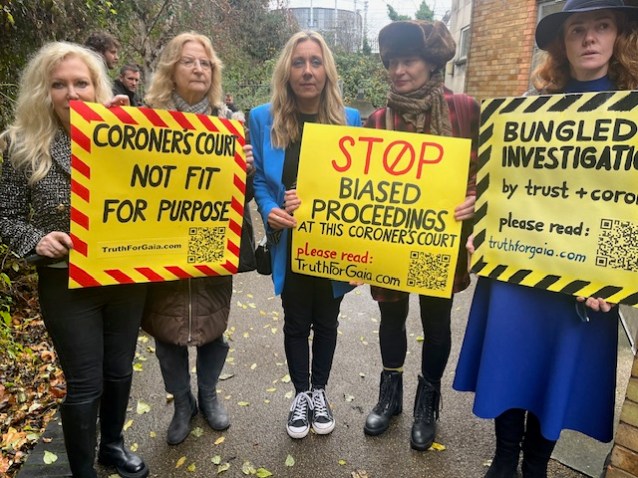
Lorna McMahon (far left) and Dorit Young ( second from right) demonstrate outside the coroner’s court
And it is not the first time she has silenced a bereaved relative. Lady Dorit Young was similarly treated over the death of her only daughter, Gaia. That is why there was a small demonstration outside the coroner’s court whereby Lady Young and her supporters and Lorna combined to protest. You can read about their case on https://truthforgaia.com/ and an earlier blog by me here.
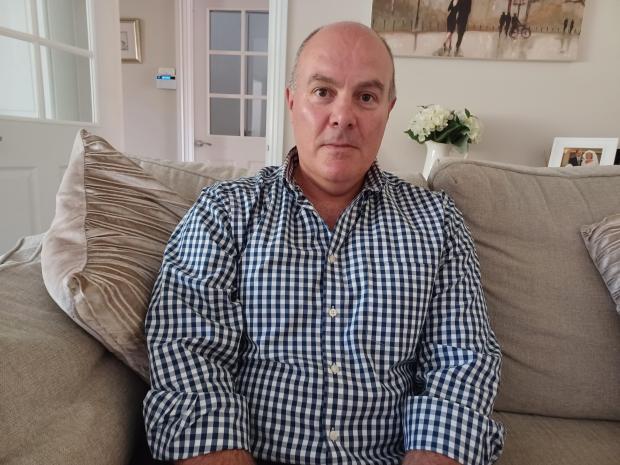
Thousands of followers of this website may remember last year’s nine blog coverage I gave to the employment tribunal over the sacking of whistleblower Mr Martyn Pitman at Hampshire Hospitals NHS Foundation Trust (HHFT). He lost the hearing. He was belittled and and repeatedly insulted by the former head of chambers, Mark Sutton of Old Square Chambers, including calling him a ‘freelance agitator,’ only to later be forced to retract that slur. Sutton, who picked up a big share of the £650,000 taxpayer funded legal fees pay out to represent the trust, approached the ET by portraying Mr Pitman as something of a tyrant, an assessment clearly not shared by his previous colleagues, who actually worked with him, attending in numbers at the hearing, or indeed by his thousands of social media supporters
Mr Pitman was sacked because it was said his employment there was ” a present danger to patient safety ” by the former chief medical officer of the trust, Lara Alloway. It was also claimed that his relationship with the Trust’s senior management had ‘irretrievably broken down”. Yet it was he who had raised patient safety issues which was stomped on by non-clinical senior midwifery managers, despite identical concerns also being raised a few months later by several senior clinical midwives.
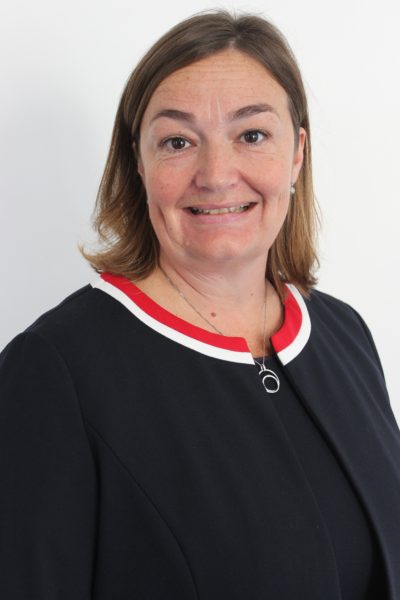
Dr Lara Alloway now chief medical officer for Hampshire and the Isle of Wight Integrated Care Board
Well now a year on, following Mr Pitman’s dismissal, it is revealed that there is a ” present danger to patient safety ” in the maternity wards at the trust – a more than five fold increase in the number of babies delivered there with labour-related hypoxic brain injury (Hypoxic Ischaemic Encephalopathy: HIE) many of which may have been preventable. According to the Trust’s latest on-line patient information approximately 5,700 babies are delivered across its 3 sites.
The trust had an extremely low rate of HIE until now
In the final year of Mr Pitman’s Consultant tenure at HHFT, prior to his formal dismissal, the HIE rate across the Trust was reported as 0.5 per 1000 deliveries – equivalent to less than 3 babies per annum. In 2023, the year following his dismissal, the rate increased, in a previously unprecedented fashion, to 2.5 per 1000 deliveries, equivalent to 14 babies per annum.
Of course the trust dispute this – even though it was published in a very thorough article by Sirin Kale for Guardian Society. The full article is well worth a read and you can link to it here.
The trust communications department described the article as misleading. A statement said:
“There are instances in Ms Kale’s reporting where we believe her reflection of the facts is misleading. This interpretation of the data fails to provide the reader with the wider context required to understand it. It therefore runs the risk of unreasonably undermining public confidence in a service which is safe and performing well. To avoid misleading the public we would strongly suggest that your article must explain that the rate of HIE in live births with Hampshire Hospitals is well within the normal limits.”
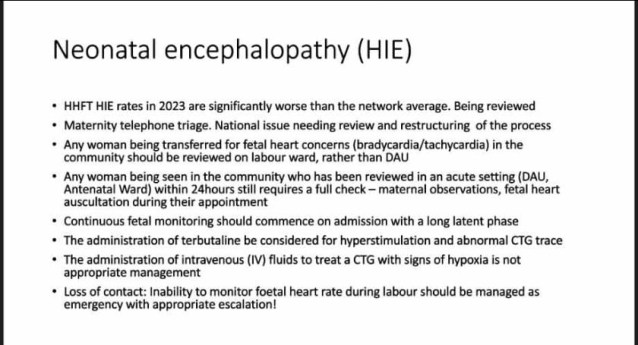
I might have believed them but for an internal power point presentation at a clinician led Neonatal Morbidity and Mortality meeting held at the trust in February. Reproduced below it says precisely the opposite to what the communications department is claiming – that cases of HIE are ” significantly worse than the network average”. It also proposes tough action to combat it. If people are to believe there is no problem and everything is safe – such action speaks volumes.
This particular issue at the trust was one of the problems raised by Mr Pitman in 2019 when he made his whistleblowing complaint in early 2019.
He told me:” I had a specialist interest in fetal monitoring, CTG interpretation and labour management optimisation. Throughout my period of tenure I was responsible for cross-site staff teaching of fetal /CTG monitoring and had developed a regional reputation for my expertise in this area. For several consecutive years I had been praised for playing a significant role at RHCH in minimising the HIE rates down to commendably low levels well below the network and indeed national average for 2 consecutive years. For instance, we achieved the enviable statistic of not having a single poor maternity outcome attributed to CTG misinterpretation. This dramatic deterioration, in a critical maternity outcome metric, that I was passionate about and had successfully devoted my focus and clinical attention to, to have occurred within the 12 months since my dismissal will certainly not have escaped the attention of either the senior midwifery managers or the Trust’s senior management.”
Indeed significant events back in 2019, that led to Mr Pitman’s formal investigation and eventual dismissal included a a dispute between him and the midwifery managers about the dangers of sub-optimal fetal monitoring, including the potential pitfalls of assessing the baby’s heart rate using hand-held dopplers (intermittent auscultation) and confusing the baby’s heart rate with that of the mother.
He told me:” I was concerned that deteriorations in the standard of fetal monitoring and, particularly midwifery complacency in this regard in what were thought to be low-risk mothers was a developing concern and that if it was not addressed would lead to worse outcomes and, potentially increased baby injury (HIE) and death rates. This warning was completely and utterly ignored by the senior midwifery management. ” Such concerns have been highlighted repeatedly in other units across the UK, including the recent reviews undertaken by Donna Ockenden”.
What he predicted and was striving to prevent, by making practice recommendations, in the April 2019 Fetal Monitoring Guideline meeting has now happened. Instead of supporting him moves were made to silence him and to get him out of the way.
He said: “The very evening after this, unusually confrontational and adversarial, guideline meeting was when I was first ‘invited’ to a meeting which eventually developed into my formal disciplinary investigation. The senior midwifery managers had decided that my attempts to prevent their dangerous normalisation agenda had to be stopped
Two terrible baby births at Winchester hospital
Worse then happened, within just a week of this fateful meeting. As well as the tragic case raised in Sirin Kale’s article distressing case, where a baby was deprived of oxygen throughout labour and delivery . This second baby was delivered within just hours of the case featured in Sirin Kale’s Guardian article. Mr Pitman was the Consultant on-call in the Winchester Maternity Unit when both these tragic cases were delivered but, as they were midwifery-led, as they were believed to be ‘low-risk,’ neither he nor the Obstetric team had been directly involved in their care, until the ‘crash-calls’ were put out.
He said: a ” supposedly entirely low-risk healthy baby, maintained under solely midwifery-led care, was born moribundly unwell from HIE and needed to be urgently transferred to Southampton Hospital for brain cooling. The Head of midwifery, my principal complainant, who had been in the guideline meeting would have come into work the following Monday, been informed of these 2 cases, that there were huge issue with the intrapartum monitoring of them both, realised that this put her in a challenged position and given my concerns and the practice changes that I had been recommending just the previous week. This appears to have prompted her to escalate her concerns about me into a formal complaint, rather than an issue that could and should have been addressed by mediation. The timeline of events, at this time, was very telling”
So where does leave the maternity services at Winchester and Basingstoke hospitals? The trust has been on a public relations drive inviting the local BBC TV station, BBC South, into the maternity wards BEFORE it published these worrying figures on babies delivered with HIE. This was arranged and was broadcast less than a month before the concerning increased HIE rates were presented.
Here’s a video of the report:
BBC South Today broadcast on maternity services at Hampshire Hospitals NHS trust on 4th January this year chief executive Alex Whitfield tells viewers it is safe
Since then the trust has promised an internal , rather than , perhaps far more appropriate, independent external inquiry – rather the same philosophy as the Post Office used to say their Horizon computer project was sound when sub postmasters were being jailed for false accounting.
The most tragic outcome is that there are potentially parents in Hampshire who face a lifetime of worry worry and expense caring for children, who may have suffered avoidable labour-related hypoxic brain injuries. One also has to wonder what the level of medical negligence claims associated with these cases could, potentially, extend to? This could have been prevented if the trust was doing its job. Given the state of social care in this country this is a very serious state of affairs. You cannot say the trust were not warned by Dr Pitman. The then interim chief medical officer was Dr Nick Ward, a consultant paediatrician whose expertise is in paediatric nephrology.
So does the top management carry some blame? I put it to the communications department that Alex Whitfield, Lara Alloway ( now CMO at Hampshire and Isle of Wight Integrated Care Board), the midwifery management team, and Steve Erskine, chair of the trust board did. I got no comment on this but given what appears to be their complacent attitude to what is happening there I really wonder whether they do care about anything except the trust’s reputation.
On May 2nd one of the foremost experts on inquiries into maternity care Mr Bill Kirkup, has been invited to give a lecture at the trust. He has investigated baby deaths in the Morecambe Bay Trust and in the East Kent Trust. I wonder what my former colleague on the Gosport War Memorial Hospital independent panel will have to say about the Hampshire Hospitals NHS Foundation Trust.
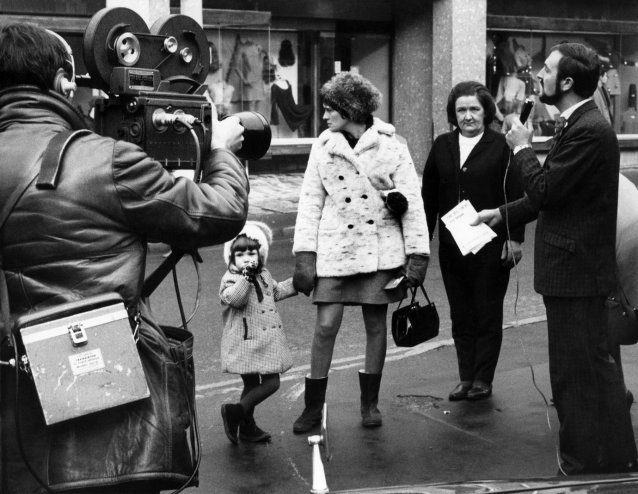
Wellingborough By Election. John Mann of the Labour Party, canvassing outside the John White factory. ;November 1969 Pic credit: Alamy and Trinity Mirror
Tomorrow’s Wellingborough by-election brings back memories of an earlier by-election there 55 years ago which nearly ended my career.
The election was triggered by the death of the sitting Labour MP. Harry Howarth and was won by the Tory candidate Peter Fry a right wing populist who blamed Labour for the permissive society of the 1960s and later voted against joining the European Economic Community, the predecessor of the European Union. He died in 2015. His losing Labour opponent was John Mann, a local man, who with his wife Jean, a county councillor, was a stalwart of the local Labour Party. He is alive and we still exchange Christmas cards.
I was a young cub reporter, fresh from Warwick University, one of the first graduates to join the Northamptonshire Evening Telegraph, apprenticed at £16 and sixpence a week. I had that summer married my wife, Margaret. Aged just 22, I was young and enthusiastic and learnt my trade covering parish councils, magistrates courts and local societies.
Imagine my excitement when a by-election was declared in the autumn of 1969 in Wellingborough, a sleepy Northamptonshire market town, extended only by a Greater London Council estate which meant the town had a mixture of Northamptonshire and Cockney accents. I would be able to rub shoulders with the ” big boys ” – then they were mostly male – from the nationals coming to cover it. And indeed I did, meeting, I remember, Laurence Marks from the Observer and numerous journalists from the Mail , Express and the Daily Mirror.
Now Peter Fry being on the right of the party invited Enoch Powell to speak at a hustings meeting. I managed to get there – not to report- and bring my wife, than a teacher at a local infants school.
Powell did not repeat his infamous ” rivers of blood speech” on immigration made the year before but instead gave a rather dry speech on economics. But the audience had been infiltrated by local Young Socialists. They started heckling him and then my wife joined in. I decided as I was a reporter I should remain neutral and didn’t.
After the meeting we had some drinks with some of the national journalists who thought my wife had been brave and I didn’t think much more about it.
” You failed to control your wife”
The next day I discovered that the local Tory big wigs and Mr Fry had been in touch with the editor, Ron Howe, to get me the sack. My crime was ” I had failed to control my wife” at the meeting. I had not thought about that as I always regard my wife as an independent person and not supposed to be controlled by me. But it says a lot about attitudes in Wellingborough in the late 1960s.
But the editor decided not to sack me. Instead I was banned from the Conservative Club in the town for at least a year ( I didn’t mind that) and was not allowed to write about Conservatives. If I had been sacked my journalist career would have just been 15 months long instead of the 56 years today. I had escaped nemesis by a hair’s breath.
Wellingborough inner ring road scandal
I did redeem myself two years later. Wellingborough Urban District Council called a secret meeting of the whole council to discuss plans for six options for a new inner city ring road – these were the fashion in the early 1970s. One option involved demolishing 300 houses to make way for the road. A local Labour councillor decided this was too much and leaked all the proposals to me. It made the splash, the project was eventually buried and I won my first journalist award as reporter of the year on the East Midlands Allied Press group. I did get a summons to see to town clerk who was furious with me saying ” Who the hell do you think you are, you’re not working for the Guardian”. When I did six years later I was tempted to ring him up. My local editor backed me and in turn threatened the town clerk with national publicity for the cover up.
I then left the Northants ET as a qualified journalist and I got a job on the Western Mail in Cardiff. I suspected the Tory Establishment in Wellingborough were glad to see the back of me.
Journalists hold a unique position in a democracy. They are the only people with the time, energy and hopefully a decent salary to investigate matters of public interest that the rest of people are too busy or exhausted to have the time and space to devote to it.
Their no hold bars investigations of dodgy politicians, the Royals, the entertainment industry, and business scandals fill our screens, print pages and social media every day. Undercover investigations expose malpractice and bad treatment of vulnerable people. The only caveat to that is some of the media spend loads of money pursuing celebrity gossip and tittle tattle that they believe the public are interested in rather than devoting cash to expose scandals from whistleblowers in the public interest .
But there is one area where there is a wall of silence and that is the media itself. Unlike everything else which is fair game, journalist practices are off limits.
Leveson’s second inquiry should not have been stopped
Now I am not one who wants huge regulation of the press by the state but I supported the Leveson inquiry and it was a mistake not to have the second part of the inquiry which would have examined in detail what happened over the phone hacking scandal that affected more than one national media organisation. Why couldn’t the media be put under the microscope in a judge led inquiry just like we are doing over the Covid 19 inquiry and the Post Office Horizon scandal.
Lord Justice Leveson
In this column I have no intention of going into the detail of the Dan Wotton case – you can follow that by reading Byline Times – and his reaction to the stories on GB News and Twitter. I am upholding the right of journalists to investigate other media if people come to them with allegations of malpractice just like they would with any other area. And sadly most mainstream media avoids doing so.
Not only is malpractice not reported but the BBC tried for years to avoid scrutiny on how well it spends its money and protect its household name journalists and commentators from revealing their salaries.
You may have noticed in the last few weeks that the salaries of top BBC presenters have been highlighted in the news.
BBC’s attempt to avoid scrutiny
The only reason this has happened is because two successive auditor generals took on the BBC which claimed that it was a special case and could not be scrutinised by the National Audit Office or have to reveal the salaries of top people unlike other publicly funded bodies. The NAO was interested in both whether major capital projects like the setting up of Salford Quays and revamping Broadcasting House were value for money. The BBC sought to try and control what the NAO could investigate and even argued that its editorial independence was in jeopardy if the NAO had powers to investigate what it chooses. The defence was rubbish. Is the present auditor general going to spend time investigating whether the latest Panorama was value for money or whether the current BBC political editor, Chris Mason, has made biased reports? I don’t think so..
Misrepresentation of Byline Times by Dan Wootton
One issue over the present furore between Dan Wootton and Byline Times is the misrepresentation of what Byline Times is about by Wootton
At a recent Press Gallery reception in the Commons I had an interesting discussion about this with a Tory MP I have known for a long time. He asked what Byline Times was and was told by other journalists that it was a left wing publication. When I explained to him as a freelance journalist who regularly writes for them on Westminster and Whitehall that the editor, Hardeep Matharu, rightly expected me to get a response from whatever department was facing a highly critical report he was amazed. He had assumed that articles would be left wing polemics, not based on hard fact.
Dan Wootton has claimed Byline Times is a hard left blog. It is nothing of the sort. It is a growing multimedia publication , on line, in print and on TV.
Its determination to get the facts right and collect real evidence was tested when six years ago it took on the powerful Paul Dacre of the Daily Mail exposing journalistic malpractice. Here again there were dire threats to sue. But they came to nothing. Not a good precedent for the present media furore.
Please donate to Westminster Confidential to allow me to continue my reporting and investigating.





 Westminster Confidential