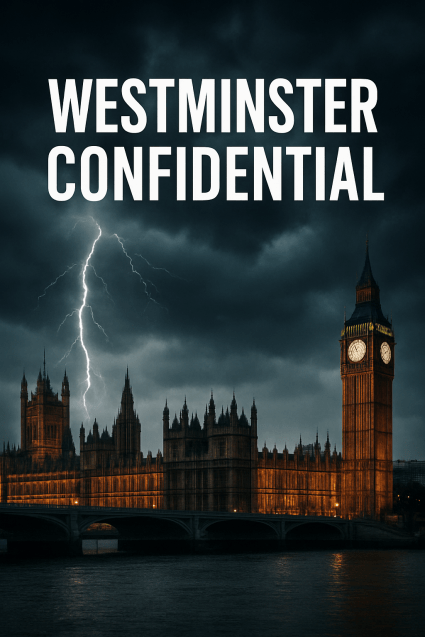
My AI generated picture of Westminster to go with the blog.
Hits on my blog reached just over 230,000 last year not including the full number on Facebook and Linked In which takes the reach of the blog to even higher figures.
The most startling change in 2025 was a sudden interest from China that began in August and finally petered out at the end of the year. Figures from China totalled 128,000 over a five month period with at one stage Beijing having more hits than London. Altogether some 40 Chinese cities downloaded stuff from my site.
What was particularly interesting was that there were old blogs and nearly all were concerned with the same issue – the plight of the 50s women who faced a six year delay in their pensions involving Back to 60, CedawinLaw and WASPI.
The largest number of hits were on a 2019 blog which was cross posted with Byline.Com on the date set for a judicial review won by Backto60. In one year this blog added 12,507 hits taking it to over 136,000.
The second highest hits came on my story that men who “retired” at 60 had all their national insurance contributions paid by the state until they reached 65. This gained another 8,744 taking it to over 83,000.
Other large hits were on the Downing Street pensions robbery, the court of appeal decision and the decision to appeal to the Supreme court.
Two blogs not concerned with the issue but led to large hits from China included the leak of Dame Janet Smith’s report into the BBC’s mishandling of the paedophile Jimmy Savile and a 2015 blog on my statistics that showed my blog on the secret hideout of singer Amy Winehouse and a dispute with David Aaronovitch had driven traffic to the site.
I have talked with people who have had dealings with China who suggest that this was a data scraping exercise connected to planned changes in China’s pensions policy. China has one of the lowest ages for women’s retirement in the world at 50. It is currently running a 15 year plan to raise women’s retirement ages from 50 to 55 and 58 and men’s from 60 to 63. It looks as though the Chinese were sussing out the opposition in the UK.
The blog attracted over 8000 hits from the US, and over 1000 from Germany and Ireland down to single hits from places like Angola, Brunei, Myanmar and Mongolia.
The other big growth was on Linked In whose stats are not fully recorded by WordPress. At the end of the year the organisation sent me a note saying I was in the top five per cent of contributors on the site. This is very pleasing as I have had large number of hits where I have taken up whistleblowing cases, unfair employment tribunal hearings, failures of accountability in the NHS and in the judiciary, and injustice for patients in both the NHS and the coroner’s service.
Since it is read by professionals I have gained a following both at home and abroad which is growing. Let’s hope 2026 sees the reach of the blog to new heights.
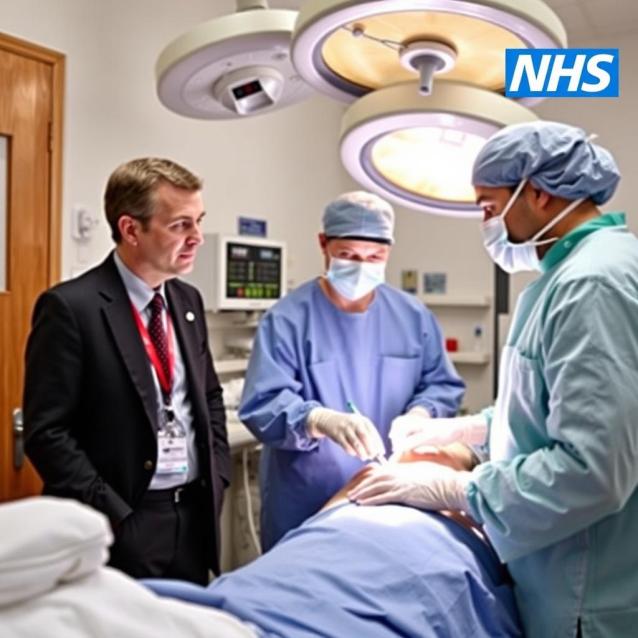
NHS Resolution solicitor overlooking hospital doctors under investigation. An AI image illustrating the situation facing hospital doctors in the NHS
Following my blog on the secret process using NHS Resolution to help hospital managers discredit whistleblowers I decided to ask the advisory body a series of questions on its operations using the Freedom of Information Act.
What emerged was extremely revealing. NHS Resolution hides in its annual report how many hospital doctors are involved by lumping them together with dentists and pharmacists. But the breakdown revealed through FOI reveals it is almost exclusively targeting doctors to advise trusts on how to handle them.
It shows that in the last financial year it advised in cases involving 1168 doctors in England, Wales and Northern Ireland. And the number of cases would be higher – as a number have multiple complaints from managers against them. This compares with 53 dentists and under 5 pharmacists. Indeed the pharmacists involved are so few – it won’t give me an exact number for fear of identifying individuals.
The PPS was last audited in 2019 and the organisation says it was then considered to be adequate and. effective. A more recent review in July this year by Dr Penny Dash looked just at the patient safety and learning role of the organisation and not wider issues.
Nor does NHS Resolution check whether it is given accurate information by managers. It said:” our role is to provide impartial and expert advice which is aimed towards supporting the local management and resolution of performance concerns. We are not a decision-making or an investigative body – in all cases, any decisions about the ongoing management, employment or contractual status of the practitioner rests solely with the healthcare organisation.”
In other words it is there solely to support health managers – who have no duty of candour – and it tries to include doctors by saying managers should tell them about their request for advice. In fact managers can and do ignore this as there is no requirement for them to say anything to the doctor they are investigating. So without hearing the doctor’s case it cannot be genuinely impartial. Also should a practitioner object to the partial advice given by a health manager they are ignored and the body continues to deal with the health manager.
NHS Resolution has not carried out any audit on the effect on doctors who are subject to complaints but it does do occasional research into problems arising on a very small scale. One example in its Insight Publication series last year was looking at whether ethnic minority doctors were badly treated in the NHS.
Involving just 11 doctors it said:”Most participants felt discriminated against based on their ethnicity and/or where they qualified. They felt this was reflected in the way their cases were handled by both their employer and Advice, and the higher rates of concerns raised against practitioners from ethnic minority backgrounds.”
Not surprisingly there was a lot of ignorance of how NHS Resolution’s advice service worked – given that health managers needn’t tell them about it. Again NHS Resolution’s solution was to give advice to managers which they need not take up. The full report is here.
Then there is the question of the phrase, performance. Is it a misnomer? NHS Resolution advice service does not look into the question of performance by doctors – relying on hospital manager for that – and it does not employ people qualified to do so. Many are solicitors, human resources staff and employment law experts and are not qualified to know when say a complex heart operation went wrong or the details of paediatric care. Indeed from doctors who have contacted me the trust often cites uncooperative behaviour and not working well with colleagues as part of its case.
Taken with earlier articles on the role of the General Medical Council a disturbing picture emerges which shows the hospital doctor is always at a disadvantage while the responsible officer – usually the medical director – holds all the cards – using NHS Resolution for advice and reporting the doctor to the GMC. Yet neither body is necessarily equipped to handle this and in NHS Resolution’s case, it is toothless to influence decisions by trusts. It can help to easily ruin a doctor’s career and even ban him or her for life for continuing their careers.
There seems to be a wholly unregulated sector covering NHS Resolution, the GMC and the trusts themselves and certainly no accountability. Patients have no idea how this is handled -yet their safety should be paramount in the NHS. And while NHS Resolution says it works under the direction of the Department for Health and Social Care my research shows it is not clear who regulates them.
If ever there was a case for reform of both systems, now is the time for something to be done.
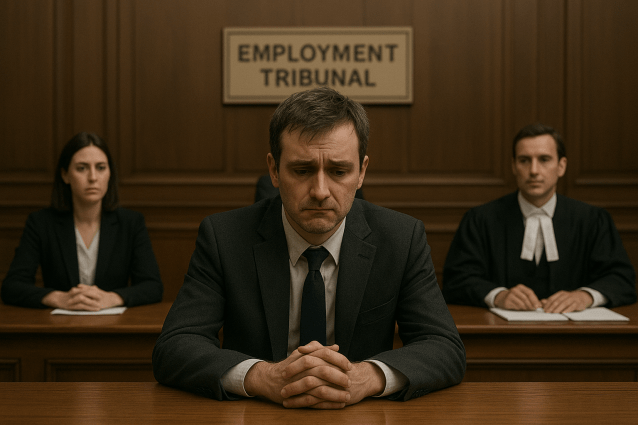
Glum whistleblower at an Employment tribunal. Picture created through AI
A research report published this July by the new Labour government has painted a devastating picture of the failure of the culture of the whistleblower system in the United Kingdom.
The report, originally commissioned by the Tories under Rishi Sunak, and undertaken by researchers at Grant Thornton, one of the big accountancy firms, pulls no punches. It reveals how whistleblowers, whether in industry, the NHS and other public bodies, see a failure by the courts, employers, and even those appointed to help them, to protect them.
The sad news is the report, commissioned by the Department of Business and Trade, looks like remaining on the shelf – and the one improvement planned by the justice ministry could make matters worse. It plans to appoint 50 new employment tribunal judges to handle an increase in whistleblowing cases, among other issues, following the implementation of the new Employment Rights Act. For those who follow my blogs, they will know, they are more than often part of the problem, not the solution.
For a start whistleblowers found the terms used to describe whistleblowers as vague and confusing.
The report notes that terms like “reasonable belief,” “public interest,” and “worker” are seen as subjective, vague, inconsistent, and narrow, creating uncertainty about whether protections actually apply. One whistleblower expressed surprise when an Employment Tribunal decided their concerns didn’t meet legislative requirements despite their employer telling them they did.
The majority of whistleblower participants reported feeling victimized by their employer after blowing the whistle. The research found that many whistleblowers believed the framework doesn’t provide effective protection in practice. The “protection” offered is essentially just the right to seek redress after harm has already occurred, not proactive prevention of retaliation.
Multiple barriers for whistleblowers
Multiple barriers existed for whistleblowers when their case came before an employment tribunal. These included:
Resource imbalance: They lacked time, money, knowledge, and skills compared to their employers Mental toll: The process was described as complex, draining, and requiring resilience many didn’t have Evidential burden: Proving detriment was directly related to their disclosure was extremely challenging Delays: Tribunals experience significant delays
Time limits: Strict deadlines created additional barriers
Unfair treatment: Limited access to evidence and risks around non-disclosure agreements
Lack of trust: Many didn’t believe tribunals would be balanced or deliver meaningful
Nor did whistleblowers find people designated to help them such as regulators much good.
They found they could not protect them from detriments or victimisation. Some were conflicted particularly where there had been regulatory failure.
Several whistleblowers stated it was “not easy” to blow the whistle internally: They found:
Little faith in the process based on previous experience
Fear of retaliation after hearing stories from others
Restrictions from non-disclosure agreements
Conflicts of interest when those receiving reports were implicated
Lack of independence in investigations
Concerns not being properly investigated or addressed
No feedback or perceived remedies
The report describes the huge tolls on whistleblowers. At employment tribunals,phrases from whistleblowers included: public execution,exhausting, beyond difficult, miserable. complex, ardous, horrible and abusive, soul destroying,toxic and unsafe.
Litigants in person fared worse with descriptions that they were not treated respectfully by judges, lawyers and other parties and that they were not impartial.
Many stated they would not blow the whistle again due to negative experiences
Cases that involved international jurisdictions were even more complicated with slow co-operation from countries and regulators abroad.
The report makes suggestions for change. These are:
create a central body for whistleblowing
ongoing engagement and research to assess and monitor all aspects of the GB framework
efforts to improve effectiveness should be multifaceted and monitored
improved mental health support for individuals
legal advice and a degree of financial security while the claim progresses
consideration of disincentives and incentives, for example implementation of a United States style reward system
I contacted the ministry about the report:
A Government spokesperson said:
“The Employment Rights Bill will strengthen protections for whistleblowers reporting sexual harassment at work and extend time limits for bringing tribunal claims from three to six months.
“We are also fixing the employment tribunal system by ensuring more cases are resolved before reaching them and recruiting more Employment Judges.”
They said that didn’t regard the report’s conclusions as firm recommendations and many of the suggestions were outside the remit of the ministry.
Posted on by davidhencke Last year I reported on the tragic death of talented 25 year old Gaia Young 17 hours after she was admitted to University College Hospital with severe headaches. Her mother Lady Dorit Young was subject to an entirely unsatisfactory and unsympathetic coroner’s inquest by Mary Hassell which let the hospital off the hook saying the cause of death was unknown. You can read my original blog here.
The coroner blocked Lady’s Young’s attempt to get independent evidence from a neurologist but since then she has managed to get an independent neuro-radiologist and neurologist’s report and UCLH have opened a further review into her tragic death.
The protest vigil on September 15 was sparked by the findings of the neuro radiologist who examined the CT scans of Gaia’s brain. It showed quite clearly even to a lay person, according to Dorit ,that the first scan taken and I quote ” there is a gross cerebral and cerebellar swelling. There is effacement meaning ( ” literally meaning ‘ rubbed out’: these fluid spaces should be visible but cannot be seen).”
This is the opposite to the consultant radiologist who examined Gaia’s scan who said: “The ventricles and basal cisterns are patent…Impression No acute intracranial finding.”
Gaia Young
The independent consultant’s diagnosis was confirmed by Dr Charles House, the medical director, when he met Dorit and compared Gaia’s scan with a normal brain scan.
The consultant radiologist who examined this first scan was Dr Ayman Mahfouz, who was on duty at UCLH at the time Gaia was admitted. Dr Mahfouz, has a private practice in Harley Street.
His entry on the private practice site says he has specialist expertise in breast, gynaecology and general imaging.
He undertakes all aspects of breast imaging including mammographic (plain, contrast enhanced and 3D), Ultrasound, MRI and CT diagnostics. He performs all ultrasound and stereotactic breast related procedures including vacuum excision.
Dr. Ayman Mahfouz is a designated appraiser for doctors at UCLH and has previously been elected as a regional representative for doctors in training at the Royal College of Radiologists. At the time of Gaia’s admission he held the role as Emergency Imaging Lead for UCLH.
Gaia’s mother would like to contact him about the scans but so far he has not responded. She does not know what pressure he might have been under at the time or how much time he took to examine the scan. I did ask UCLH about whether he wanted to say anything about this but there was no response to my question.
UCLH did issue a response about the review into Gaia’s death.
A UCLH spokesperson said:
“We met with Lady Young and apologised that Gaia’s care fell below the high standards we strive to provide. We sympathise greatly that the cause of her beloved daughter’s death four years ago is still unknown.
“We are committed to learning from external opinion and scrutiny and have commissioned a range of independent experts to explore further the circumstances surrounding Gaia’s death. We agreed with Lady Young the scope of the reviews and the experts who will undertake them.
“We await the outcomes of all the external reviews to understand if further lessons can be learned and acted upon.”
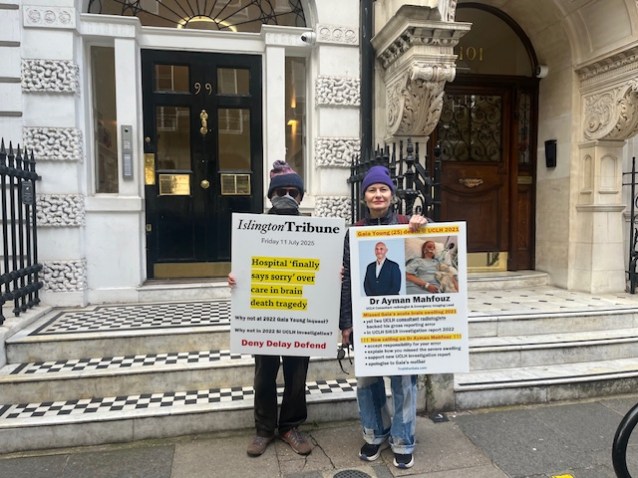
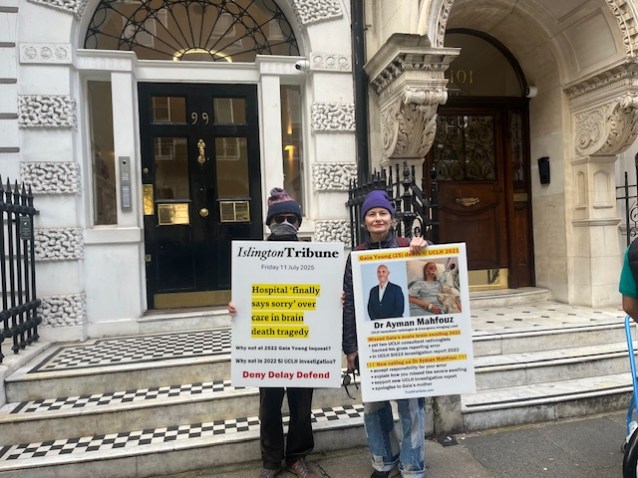
Dorit’s vigil last month caused more than a flutter on Harley Street. The clinic at 99 Harley Street called the police and also alerted its own security guards. When the one man patrol car turned up with flashing blue lights the policeman turned out to be incredibly polite and said no-one was breaking the law so long as the entrance to the premises and pavement was not blocked.
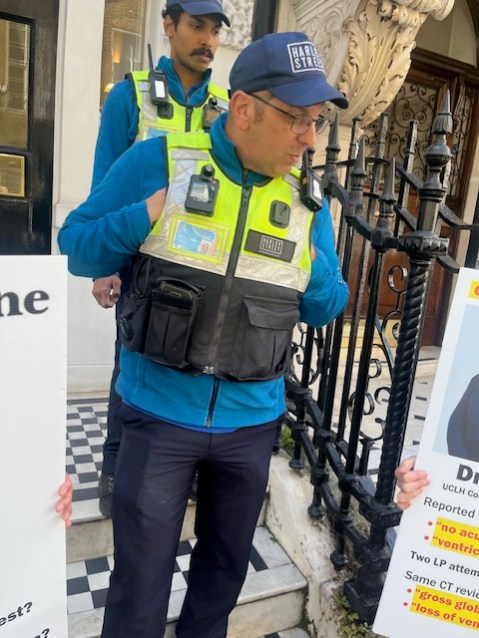
The friendly security guards curious about the case
Then two security guards turned up, saying they had been informed by a member of the public that large numbers of people were demonstrating there. It turned out to be just three people and they were remarkably friendly and polite when they heard about the circumstances. They didn’t mind having their pictures taken.
The one person who didn’t turn up was the doctor and one of his private practice colleagues politely remonstrated with us that this was not the right way to do things and Dorit should arrange a meeting with the hospital. It was pointed out to him she had been reprimanded by the Trust on various occasions for trying to contact clinicians having cared for Gaia. She never received an answer. The Trust never offered a meeting with any of these doctors.
Gaia’s case has been taken up by an Islington councillor, Dr Hannah McHugh. She wrote a strongly worded opinion piece for her local paper, The Islington Tribune. You can read ithere.
She says:” As an Islington councillor, I’ve supported Lady Young in this painful journey. It has revealed something of concern to us all: when things go wrong in our healthcare system, the path to truth is too often long, difficult, and unjust. Tragedies become injustices.”
Slowly but surely the facts about Gaia’s death are coming to light. But so far it has taken four years to achieve with no help from coroner Mary Hassell.
This to me is a general problem across the NHS. Rather than acknowledge to patient’s relatives that mistakes have been made, trust managers initially go on the defensive and are prone to cover up what went wrong and who was responsible. It is only people with guts and determination like Dorit who are prepared to fight for years until they get answers that the true facts start to come to light.
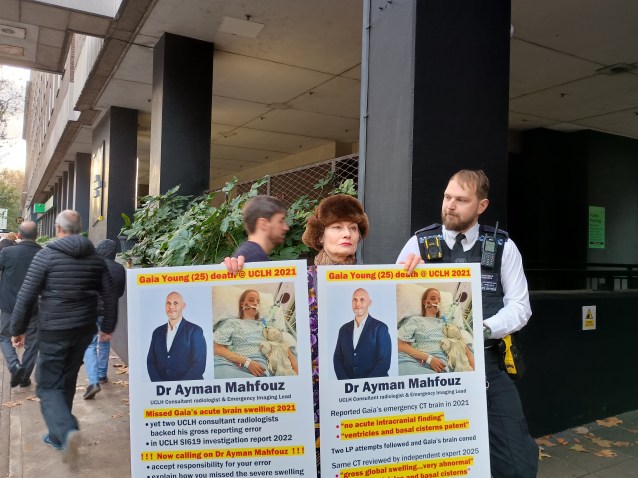
UPDATE; The ex coroner and Lady Dorit Young held a second vigil at a conference organised by the Royal College of Radiologists in London this month to bring it home to the profession the need for the very careful reading of scans by radiologists. Here is a picture of their vigil accompanied by a police officer.
Dorit Young and an ex coroner on a vigil in Harley Street.
Last year I reported on the tragic death of talented 25 year old Gaia Young 17 hours after she was admitted to University College Hospital with severe headaches. Her mother Lady Dorit Young was subject to an entirely unsatisfactory and unsympathetic coroner’s inquest by Mary Hassell which let the hospital off the hook saying the cause of death was unknown. You can read my original blog here.
The coroner blocked Lady’s Young’s attempt to get independent evidence from a neurologist but since then she has managed to get an independent neuro-radiologist and neurologist’s report and UCLH have opened a further review into her tragic death.
The protest vigil on September 15 was sparked by the findings of the neuro radiologist who examined the CT scans of Gaia’s brain. It showed quite clearly even to a lay person, according to Dorit ,that the first scan taken and I quote ” there is a gross cerebral and cerebellar swelling. There is effacement meaning ( ” literally meaning ‘ rubbed out’: these fluid spaces should be visible but cannot be seen).”
Gaia Young
This is the opposite to the consultant radiologist who examined Gaia’s scan who said: “The ventricles and basal cisterns are patent…Impression No acute intracranial finding.”
The independent consultant’s diagnosis was confirmed by Dr Charles House, the medical director, when he met Dorit and compared Gaia’s scan with a normal brain scan.
The consultant radiologist who examined this first scan was Dr Ayman Mahfouz, who was on duty at UCLH at the time Gaia was admitted. Dr Mahfouz, has a private practice in Harley Street.
His entry on the private practice site says he has specialist expertise in breast, gynaecology and general imaging.
He undertakes all aspects of breast imaging including mammographic (plain, contrast enhanced and 3D), Ultrasound, MRI and CT diagnostics. He performs all ultrasound and stereotactic breast related procedures including vacuum excision.
Dr. Ayman Mahfouz is a designated appraiser for doctors at UCLH and has previously been elected as a regional representative for doctors in training at the Royal College of Radiologists. At the time of Gaia’s admission he held the role as Emergency Imaging Lead for UCLH.
Gaia’s mother would like to contact him about the scans but so far he has not responded. She does not know what pressure he might have been under at the time or how much time he took to examine the scan. I did ask UCLH about whether he wanted to say anything about this but there was no response to my question.
UCLH did issue a response about the review into Gaia’s death.
A UCLH spokesperson said:
“We met with Lady Young and apologised that Gaia’s care fell below the high standards we strive to provide. We sympathise greatly that the cause of her beloved daughter’s death four years ago is still unknown.
“We are committed to learning from external opinion and scrutiny and have commissioned a range of independent experts to explore further the circumstances surrounding Gaia’s death. We agreed with Lady Young the scope of the reviews and the experts who will undertake them.
“We await the outcomes of all the external reviews to understand if further lessons can be learned and acted upon.”
Dorit’s vigil last month caused more than a flutter on Harley Street. The clinic at 99 Harley Street called the police and also alerted its own security guards. When the one man patrol car turned up with flashing blue lights the policeman turned out to be incredibly polite and said no-one was breaking the law so long as the entrance to the premises and pavement was not blocked.
The friendly security guards curious about the case
Then two security guards turned up, saying they had been informed by a member of the public that large numbers of people were demonstrating there. It turned out to be just three people and they were remarkably friendly and polite when they heard about the circumstances. They didn’t mind having their pictures taken.
The one person who didn’t turn up was the doctor and one of his private practice colleagues politely remonstrated with us that this was not the right way to do things and Dorit should arrange a meeting with the hospital. It was pointed out to him she had been reprimanded by the Trust on various occasions for trying to contact clinicians having cared for Gaia. She never received an answer. The Trust never offered a meeting with any of these doctors.
Gaia’s case has been taken up by an Islington councillor, Dr Hannah McHugh. She wrote a strongly worded opinion piece for her local paper, The Islington Tribune. You can read ithere.
She says:” As an Islington councillor, I’ve supported Lady Young in this painful journey. It has revealed something of concern to us all: when things go wrong in our healthcare system, the path to truth is too often long, difficult, and unjust. Tragedies become injustices.”
Slowly but surely the facts about Gaia’s death are coming to light. But so far it has taken four years to achieve with no help from coroner Mary Hassell.
This to me is a general problem across the NHS. Rather than acknowledge to patient’s relatives that mistakes have been made, trust managers initially go on the defensive and are prone to cover up what went wrong and who was responsible. It is only people with guts and determination like Dorit who are prepared to fight for years until they get answers that the true facts start to come to light.
Two weeks ago I published a critical examination of how NHS Resolution’s Practitioner Performance Advice service contributed to the demise of whistleblower doctors revealing patient safety issues who stand to lose in 97 per cent of cases when they come before an employment tribunal.
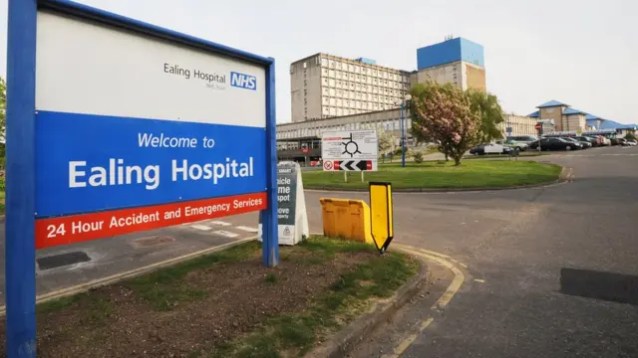
Ealing Hospital Pic credit:BBC
Since publication a number of doctors and patients have contacted me about their experiences with NHS Resolution and it makes disturbing reading. This is one of the cases.
One of the key points in the previous blog is that NHS Resolution does not require the health trust to inform a doctor when it has received advice from NHSR on what action to take against a doctor accused by the trust. So the doctor is completely ignorant that this has happened.
The paragraph in their letter, which is similar in other cases involving doctors, reads: “We encourage transparency in the management of cases and recommend that practitioners should be informed when their case has been discussed with us. I am happy for you to share this letter with the practitioner unless you consider it inappropriate to do so. Moreover, the practitioner is also welcome to contact us for a confidential discussion regarding their case.”
The London and North West University NHS Trust
I am not naming the doctor – an obstetrics and gynaecology consultant – as there will be an employment tribunal in 2027 – six years after the incident – but I am naming the trust, the London North West University NHS Trust- and the manager involved Dr Martin Kuper, then its chief medical officer – as events following this case were in the public domain.
A very tragic story
The incident that caused the referral to NHS Resolution is a very tragic story. An Afghan woman came to the hospital for a myomectomy – a surgical procedure to take out fibroids ( small lumps) from the uterus.
The operation can be performed by either an incision into the abdomen or key hole surgery. The woman chose to have keyhole surgery as it is less invasive. The doctor performed the operation with an anaesthetist putting her to sleep. Unfortunately during the operation she arrested, bled heavily and died.
The doctor was blamed by the trust for acting ” seriously below the accepted standard” despite PM Examination clearly reported absence of any injuries to major arteries and veins. According to the doctor what NHSR was not told that the delay in helping the patient was caused by the delay in transfusing blood products especially platelets as Ealing theatres did not stock any Emergency Platelets like Northwick Park theatres when the incident took place. The surgeon used to operate at Northwick Park and he was asked to move his complex surgeries to Ealing Hospital because he had a number of cases waiting more than two years. The day prior to index surgery the surgeon wrote to Trust management explaining that his cases were complex and should be operated upon at Northwick Park and not at Ealing theatres.
Worse the record of the conversation involving Dr Kuper in a letter from NHSR says the doctor was accused of tampering with the electronic record of the incident and omitted to tell NHSR that the doctor was a whistleblower who had raised serious questions about maternity and gynaecology services by that hospital which had not pleased the management.
The doctor says this account is distorted. He had made an electronic draft entry into the record at 07:30, then made few linguistic corrections to finalise the draft and few hours later at 11:45 he submitted his statement. All these entries and the changes made to the draft are available should you press the Audit Tap of the software used at any time.
As for his concerns about maternity services, it was confirmed on the following month when the Care Quality Commission inspected the hospital and ruled the service as ” inadequate.”
The letter showed NHSR had been told by MD (Chief Medical Officer) that there were ” no other concerns in relation to this surgeon of a clinical nature brought to his attention in the last two years”, i.e, since he joined the Trust.
The letter from NHSR – based on Dr Kuper’s submission- advised as the doctor went off sick following the incident that the doctor should be referred to the Occupational Health service for possible mental and physical health problems. The surgeon also suffered series of sanctions upon his practice including his maternity work despite no concerns were raised at any stages in relation to his maternity work. On the contrary, he was one of the two consultants appointed to the Trust in 2006 to turn the maternity services around following CQC imposing measures on the maternity unit being ranked in 2005.
Trust was selective and biased during collecting and while considering various witnesses statements aiming at victimising the surgeon. The surgeon and all gynaecologist involved were excluded from the initial stages to set him up for the next step. He was also subjected to an internal special investigation taken through Maintaining High Professional Standards procedure which amounts to an internal disciplinary procedure. Trust was selective
None of this advice was conveyed to the doctor and the trust ignored the suggestion from NHSR that they should be open and transparent about the letter.
The letter was not sent to the doctor in a timely manner prior to start of MHPS investigation and he had to submit a subject access at some point, which cannot be refused, to obtain all the correspondences between Trust and NHSR.
There had been a coroner’s hearing under senior coroner Lydia Brown in which he was blamed for the death and the coroner blocked his barrister from pursuing questions about the action taken or not taken by the anaesthetist especially the delay in transfusing coagulation factors and the trust emphasised he had been reported to the General Medical Council for Fitness to practice investigation to protect patients and public.
However, this was not enough for the trust which made it impossible for him to get a job elsewhere by requesting NHSR to issue HPAN against his practice advising other potential employers not to appoint him advising responsible officers in other organisations to contact Dr Kuper’s successor Dr Johnathon Baker, the current CMO). By issuing the Notice the NHSR was given Trust another opportunity to wreck the surgeon career. This HPAN notice will be kept at NHSR records for thirty years before it can be destroyed.
Dr Baker raised numerous concerns regarding the Surgeon practice following carrying out an unjustifiable look back investigation into his unblemished practice, ending up referring a total of 23 cases to GMC but did not mention at any stage that the doctor raised patients’ safety concerns.
Helen Vernon, chief executive NHS Resolution
But when the report came back from the GMC he was completely exonerated of any clinical allegations in relation to the index case or any of the other 22 cases.
The surgeon complained to the NHSR in November 2023. The reply from Helen Vernon, the chief executive a month later is very revealing.
First the adviser was on prolonged sick leave and was unable to be involved. But her reply raises points on the role of the NHSR which show how weak it is.
She says: “As the Advice Service is not a decision-making body, any decisions regarding the management of a practitioner must rest solely with their employer/contracting body. Whilst the employer/contracting body may have regard to any advice provided by the Advice Service, having considered and weighed up all the relevant information available, they may take a view which differs from the opinion expressed by the Advice team.”
It was also clear that NHSR did not know he was a whistleblower, and were not certain whether it was aware of the bad CQC report on maternity care at the hospital. An unsatisfactory reply. altogether.
There is a postscript about the senior manager involved in this case – Dr Martin Kuper. He went on to become chief executive of the prestigious Moorfield Eye Hospital NHS Trust.
Martin Kuper
This year GB News reported that no fewer than 80 consultants had sent a letter to the board of the hospital complaining it had a culture of bullying, financial mismanagement and lack of transparency.
The report is here. As a result both the chair and the chief executive resigned. The trust in a statement said “Martin Kuper has taken the decision to resign from his position as chief executive of Moorfields and will formally leave the organisation.” There was very little about his achievements while he was there and at the moment does not appear to have got another job in the NHS.
Why do 97 per cent of whistleblowers fail to win their cases in employment tribunals? Why are they sacked – not for their disclosures of patient safety which is illegal – but under the nebulous title – some other substantial reason (SOSR)? This could be allegations of bullying or saying they cannot get on with colleagues.
But how does a trust gather such information to discredit a doctor? What I have discovered is that NHS trust managers can get a free advice service or an endorsement for actions considered by managers against a Whistleblower from NHS Resolution, an arms length quango from the Department for Health and Social Care.
This ” phone a friend” service would allow the manager to set up a case file under Practitioner Performance Advice without the doctor even knowing this has happened. Effectively the evidence will be later presented at an employment tribunal by highly skilled and expensive lawyers hired by the trust to discredit the unfortunate doctor.
This process has no transparency, no verification with the doctor and there are no public records of what happens in these cases.
The only information that there is such a process is in the annual reports and accounts of NHS Resolution and even that is very sparse.
While there are reams of statistics about the organisation’s public facing work dealing with patients complaints about clinical and non clinical issues which it tries to resolve without going to expensive legal action, the role of practitioner performance advice service gets very little mention.
In the 2024-25 annual report it acknowledges “NHS Resolution’s Practitioner Performance Advice service delivers expert advice, support and interventions on the fair management of concerns about the performance of doctors, dentists and pharmacists.”
How do they judge performance having branded the therapist with a “behaviour” issue at the outset even with untrue claims or without awareness of risks to patients? Only when the formal referral actioned the therapist or doctors may get an opportunity to represent their side of the story BUT if the behaviour analyse are not even clinicians, how would they understand what culture therapist or doctor has been working in.
The PPA service also claims to be very efficient. It says 90% of advice and other case interventions delivered within target timeframe – this was achieved in 2024/25 NHS Resolution annual report and accounts 2024 to 2025 90% of all exclusions/suspensions critically reviewed (where due) – this was within tolerance at 82%, with 155 of 189 exclusions/suspensions reviewed within required timescales.
What it does reveal is that trusts searching to use its services are booming.
The report says: “The service received 1,420 new and reopened requests for advice from healthcare organisations with concerns about the practice of individual practitioners as well as services in 2024/25, representing a 24% increase compared to 2023/24.The open caseload at the end of the financial year stood at 1,149, a 15% increase when compared with the end of 2023/24 .”
It adds: “Requests for assessment and remediation services remained at a high level in 2024/25, with 50 requests for professional support and remediation action plans, 44 requests for behavioural assessments, six requests for clinical performance assessments and four requests for team reviews.”
And it says:” NHS Resolution delivered OARs ( Organised Activity Reports) to 18 secondary care trusts in England, offering follow-up consultations with a Performance Practitioner Advice adviser to each, and finalized reports for primary care trusts, mental health trusts and trusts in Wales and Northern Ireland for delivery in 2025/26″.
Helen Vernon, CEO of NHS Resolution
On what grounds has this service without transparency or regulation of its advisors been set up and run?Sally Cheshire Chair of the NHSR , and Helen Vernon,CEO, need to explain this.
The only other references are likely to lead to hollow laughs from some of the whistleblowers who lost their jobs at trusts – notably Martyn Pitman at Hampshire Hospitals NHS Trust and Usha Prasad at the now St Georges and Epsom and St Helier Hospitals Trust.
It claims that the whole process is to “develop Compassionate Conversations in relation to performance conversations to support kindness and compassion within the NHS .”
It goes on to say: the aim of the advice includes” Fostering just and learning cultures rather than punitive approaches” and” Ensuring fairness and proportionality in managing performance concerns.”
If there is a lack of transparency how can it be justified as a just culture suitable for learning?
Having covered employment tribunals now in NHS sacking cases the last thing I have seen is any compassionate conversation. Instead the trusts are keen to employ numerous highly paid lawyers to terrify and frighten professional doctors reducing in some cases people to tears – at enormous cost to the taxpayer who foots the bill for their salaries.
So if NHS Resolution is boasting about saving lawyer’s fees in patient complaint cases, it is also responsible for increasing lawyer’s fees – often running to hundreds of thousands of pounds – by advising trusts on how to ruin doctors’ careers when all they have raised is patient safety problems.
If you take this process alongside my previous blog about the role of the General Medical Council and its relationship with the responsible medical officer in the trust- it is no wonder that whistleblowers have little chance of success in the NHS. I now know of senior doctors who are NOT going to report patient safety issues because they fear it will be the end of their careers if they do.
NHSR’s PPA is yet another tool like the unregulated triage by the GMC that can be exploited to bury serious concerns using public funding.
Veteran NHS whistleblower campaigner, Dr Chris Day, has written a damning letter to Lord Fairley, President of the Employment Appeal Tribunal, accusing the system of “Institutional Corruption” in the way it has handled his case.
Dr Day, who has just lost an appeal case heard by employment appeal judge Sheldon, compared the way both the employment appeal court and the previous employment tribunal handled the proceedings to the verdict in the infamous Daniel Morgan murder case which has never been solved after a trial of suspects collapsed.
The way this murder was handled by the Metropolitan police led the independent panel to rule: ““Concealing or denying failings, for the sake of an organisation’s public image, is dishonesty on the part of the organisation for reputational benefit. In the Panel’s view, this constitutes a form of institutional corruption.”
Dr Day has emerged bloodied but not unbowed from a judgment that rejected all the detriments he claimed and was surprisingly unconcerned about the defendants Lewisham and Greenwich Health Trust’s chief executive lying on oath about a board meeting and its deputy communications office, Mr Cocke, destroying 90,000 emails that could have been useful to his case during the hearing. The worst the judgment could say was this was ” troubling.” Given this centred on his whistleblowing about the avoidable deaths of two patients in Woolwich hospital’s intensive care unit, which the trust has always tried to deny, this is a remarkably tame comment.
What was particularly hurtful to Dr Day is that at the appeal hearing he was accused in open court of lying about cost threats. He had been clear that he was forced at one stage to try to settle his case because he was told by his barrister that he would face a proposed application from the NHS for £500,000. See my report on his wife’s evidence here.
Effectively he was being called a liar by saying this had happened. Instead there is copious evidence that it did happen.
As he says in his letter: “At my most recent hearing, Mr Justice Sheldon explicitly stated in front of public observers that I was “lying” about being threatened for costs. He did this in circumstances when he knew my belief in cost threats was robustly grounded on written material from by former barrister Chris Milsom. He also knew that this material was enough to convince 2 MPs, the Telegraph and Financial Times that I had been threatened for costs. Accusing me of lying about cost threats in these circumstances was nothing more than a cheap smear to make me look like a liar in public.”
Or as he wrote earlier: “Dishonest or deluded whistleblowers don’t tend to have the support of former health ministers, senior doctors and the BMA to fund a KC.”
Also there is ample evidence in reports by lawyers that attempts to put costs on whistleblowers are commonplace. Indeed some lawyers moan they can’t get enough of them.
Dt Chris Day
His complaint about ” institutional corruption ” is not directed at individual judges but at the legal system where lawyers socialise with each other and don’t want to see a colleague’s reputation or career damaged by having to admit they got it wrong.
As he says in his letter: “My complaint is not directed solely at individual judges but at the institutional handling of this matter. The EAT has placed judges in an impossible position: adjudicating on issues that, if determined on the evidence, would have serious implications for people with whom they admit to having ongoing professional or social relationships including being connected on social media. “This is precisely the type of reputational self-protection identified as “institutional corruption” in the Daniel Morgan inquiry. I am not expecting you or the EAT to do anything about this but want to record my position and the fact that it has been put to you as EAT president. You will note 2 MPs have called for a public inquiry into this case.”
My view from covering a number of tribunals- both involving whistleblower doctors, nurses and in the world of industry and the arts – is that lawyers are getting too cosy and comfortable with each other. Add to this the loss of media interest in all but the most lurid of court cases, there are precious few journalists left to observe what is happening in the courts.
All this is to the detriment of the ordinary member of the public when they fight their case. Arraigned against them is a club that knows how to fix the outcome. And this is destroying the principle of open justice and why we need radical reform of both the employment tribunal and county court system.
For those with long memories some 32 months ago I wrote a disparaging blog about justice in employment tribunals after sitting through yet another hearing involving Dr Chris Day’s ten year whistleblowing battle against the Lewisham and Greenwich NHS Trust. So shocked I was over the way justice was meted out to Dr Day that I labelled it as the Tribunal of the Absurd – liking it to a Harold Pinter play that could be set in a court room.
This was the tribunal that revealed that lawyers and the Trust had held back evidence which should have been given to him and his lawyers years ago; that the chief executive of the trust, Ben Travis had lied under oath about a virtual board meeting and other matters to discuss his case, and that a senior communications officer of the trust, David Cocke, had gone into the trust’s offices at 5.0 am and destroyed 90,000 emails which could have been relevant to his case. The latter happened while the hearing was taking place and he then failed to appear as a witness.
Yet the judge Anne Martin ignored all this and exonerated the trust’s case against Dr Day. To remind readers the original claim was a serious patient safety issue – two people had died in the intensive care unit of Woolwich Hospital where he was working because of serious mistakes by other staff. Yet the trust for reputational reasons has always denied this really happened.
Now a long time later – the courts take ages to progress issues – a judge at an employment appeal tribunal has largely rubber stamped her decision and found against Dr Day and rejected an application to return legal costs to the British Medical Association to compensate for the extra days of hearing caused by the destruction and concealment of evidence. Worse than that during the hearing Dr Day’s reputation for telling the truth about a previous hearing was called into question. It was like the second house in the theatre of the absurd.
Mr Justice Sheldon who presided over the hearing found only two faults. He thought the tribunal should have ruled on whether the trust was wrong not to remove disparaging comments about Dr Day sent to MPs and the press after concerns were raised by the watchdog body, the Care Quality Commission was a detriment to Dr Day. And it criticised the tribunal for misinterpreting one area of employment law.
But the judgment adds: “The Employment Appeal Tribunal concluded that the errors were immaterial to the outcome, as the Employment Tribunal had correctly found that the protected disclosures did not materially influence the Respondent’s actions. The appeal against the Costs Judgment was also dismissed, with the Employment Tribunal’s reasoning found to be within its discretion and supported by the evidence.”
It refused to return the case to another employment tribunal for reconsideration.
What this means is that the trust’s actions in this case have been exonerated by a higher court. Mr Ben Travis is regarded as a credible witness despite not telling the truth under oath about the board meeting.
And Mr Cocke’s destruction of 90,000 emails while thought to be ” troubling” are largely exonerated setting what could be a dangerous precedent in other whistleblowing cases for people in NHS trusts and private companies to destroy evidence that should be passed under discovery to the claimant. They can now cite this judgment.
What was also amazing and bizarre was that the judge accepted from Daniel Talbot Brown KC , instructed by lawyers Capsticks, an argument used in another legal case which said that tribunals could take a benevolent view of the proceedings and if they did not comment on a finding it did not mean they had not considered it.
This seems to go against forensic testing of arguments put forward at a hearing – where both sides must probe for the truth. If they do this and a judge decides not to comment on the issue, surely this more like a dereliction of duty than anything else.
This judgment marks a bad day for whistleblowers and good day for bureaucrats who want to hide the truth. It shows that even if you have the support of medical experts to back your judgment and the support of two prominent former politicians, Jeremy Hunt, the former health secretary and Norman Lamb, a former health minister, this counts for nothing in the eyes of judges.
Perhaps the judges prefer the judicial theatre of the absurd to life in the real world.
Reforms without addressing core issues may lead to persistence of key flaws or omissions in any future changes with risks to patients
Last month I wrote about the government proposing the first major reforms for 40 years in the running of the General Medical Council. My blog was meant as a warning to ministers to scrutinise the changes very carefully because I was sceptical, after talking to a number of doctors, that there were flaws in the changes. You can read the blog here.
Now the GMC has published its new guidance by Dr Andrew Hoyle, an assistant director in the GMC’s Fitness to Practise Team He is both a doctor and a barrister.
In a high minded piece on Linked In and in a blog ( see the article here) he promises greater clarity and consistency .. and fair, flexible and compassionate fitness to practise processes. He also emphasises the GMC’s duty under the 1983 Medical Act to protect, promote and maintain the health, safety and well being of the public, promote public confidence in the profession and promote and maintain professional standards and conduct by doctors.
Now from the patient’s point of view how is this being enacted by a change to one simple process?
The first point is drawing up guidance for the decision makers on whether to proceed. There is a comprehensive list of issues to consider for the decision makers whether to start an investigation into a doctor. But the response to the concern raiser, the guidance does not specify who the decision makers are. Are they fully competent in the field or even sub-field of medicine practised by the doctor to make a sound judgment about clinical matters? I have heard from some doctors that this is not always the case. On the question of accountability should it not be made public who made the decision and their qualifications to do so. This would reassure the public and the patients that it had been properly investigated.
The current process’s most crucial step, the “initial triage and closure of concerns” relies on the “opinions” of the GMC postholders who in turn rely on managers. There is no mandatory requirement to immediately investigate serious harms or near miss issues that may have led to consequences to that or other patients.
This is particularly relevant asthere is also the issue of the seriousness of the concern. The guidelines suggest that if there is evidence of repeated bad practice this should be relevant to striking off doctors. But there is a second flaw in this process. How does the GMC know about a bad doctor? The answer is because he or she is reported to the GMC by the responsible officer – normally the medical director or chief medical officer of the trust or far less by patients and or colleagues who are more in the know of bad practices but are fearful of consequences. See article inthe Lancet.
Therefore the issue the GMC knows about may not be the first one and the GMC cannot verify it with the current approach neither can the complainant know of all issues.
From earlier blogs I have found this process to be flawed – either because the responsible officer has targeted a doctor who has raised whistleblowing issues – whether patient safety or fraud – to discredit a perfectly good doctor – the case of Usha Prasad, a former cardiologist at St Helier and Epsom hospital is a current example – or covered up bad practice to save the reputation of the trust or private hospital.
The most egregious example of the latter is the case of Mr Ian Paterson, a breast and general surgeon, now serving a 20 year prison sentence after performing unnecessary operations on hundreds if not thousands of unsuspecting patients until a lawyer brought a civil case against him.
The public inquiry into his practice concluded “They were then let down both by an NHS trust and an independent healthcare provider who failed to supervise him appropriately and did not respond correctly to well-evidenced complaints about his practice.”
It went on: “The recall of patients did not put their safety and care first, which led many of them to consider the Heart of England NHS Foundation Trust and Spire were primarily concerned for their own reputation. Patients were further let down when they complained to regulators and believed themselves frequently treated with disdain.”
Imagine how different the outcome for hundreds of patients if this had been first reported by a responsible officer to the GMC – life changing needless operations would have been stopped rather than covered up. What the GMC should demand is that the management of NHS trusts and private hospital groups have to sign a ” duty of candour” putting them on par with doctors who raise complaints. This would require them to notify the GMC about the practices of the doctor involved and meet the legal requirement that the GMC has to protect patients and promote higher standards in the profession. Otherwise the assessment of a serious repeated bad practice is a hollow gesture in many cases.
However if the GMC has been and appears it is continuing to rely on the Responsible Officers to provide a response can the GMC’s decisions be evidence-based and safe for public. Even if a small minority of doctors are unsafe or dishonest, the impact on the patient and profession must be the core of decision.
The third point is when a doctor acts inappropriately or unsafely that can be investigated by the GMC personnel but who are potentially not being regulated by any one and via a process built on reliance on an RO and in at times without transparency or evidence verification and opinion based decisions are taken that can affect lives This does not appear to be a safe approach as multiple scandals continue to occur; suggesting concerns are not really reaching the GMC due to its current system or are being ignored.
The current concern management requires a complete overhaul and not just superficial tweaks
Since I started looking at this issue I have been contacted by doctors across the country about the GMC and I intend to follow this up in a future blog.








 Westminster Confidential