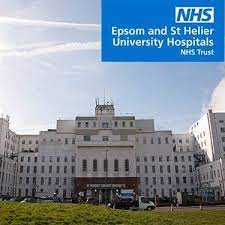
The trust running St Helier and Epsom hospitals in South London and Surrey has admitted it has deprived hundreds of its lowest paid workers their rightful NHS pensions for up to seven years due to a major blunder by its management in signing them up to the wrong scheme.
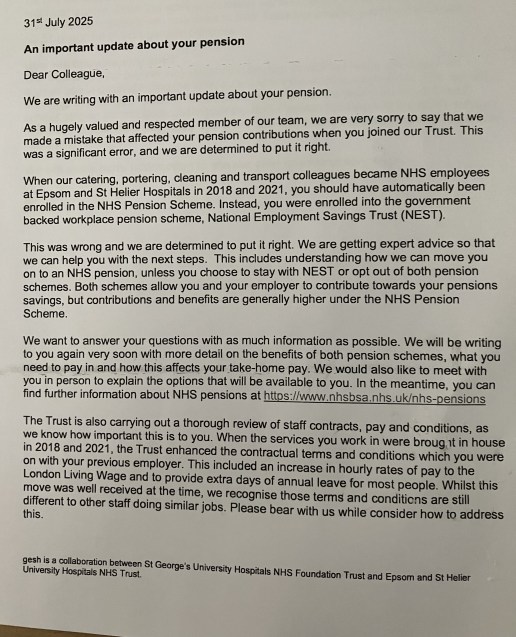
A letter sent out two weeks ago to catering staff, porters, delivery and transport drivers and cleaners admits it made ” a significant error” when it took the workers back in house in 2018 and 2021 from private contractors.
The move at the time was welcomed by staff as it gave the lowest paid staff higher pay than the going rate by private firms.
It has now emerged that instead of automatically signing staff up to the NHS pension scheme the workers were signed up to an inferior government backed workplace pension scheme, the National Employment Savings Trust (NEST).This pension scheme is aimed at small businesses as well as large private employers.
The letter says that benefits and contributions to the NHS pension scheme are higher.
The trust now part of the St George’s, Epsom and St Helier University Trust employs 5000 staff in the two hospitals – a sizeable number will be low paid staff. The trust will have to compensate workers for this error and has called in the Government Actuary Department to help estimate the scale of the problem which could cost several million pounds at a time when the NHS is squeezed in trying to bring down waiting lists.
The letter also reveals that the new trust has ordered a review of all staff contracts, pay and conditions as a result of the error. It now appears that there are differences between staff doing the same jobs with some receiving extra days leave than others and others on different pay rates.
There is also a suggestion of racism over Sunday working for low paid workers One rate seems to apply for many people from black and ethnic minority workers of £13.86 an hour while Agenda for Change workers, who are mainly white, get £26.31 an hour.
There appears to be a high level of dissatisfaction among lower paid workers with a ballot result for strike action for porters and cleaning staff by their union, the United Voices of the World, just announced of 98 per cent wanting to go on strike. This suggests workers are very unhappy working there.
The trust has one of the highest paid chief executives in the country, Jacqueline Totterdell, who gets £340,000 a year. She and her predecessor, Daniel Elkeles, now chief executive of NHS Providers, were in charge when these errors were made. Jacqueline Totterdell is planning to step down as the NHS faces a big reorganisation under the health secretary, Wes Streeting.
Wes Streeting, the health secretary has promised new protections for whistleblowers but do they go far enough? Dr David Ward gives a detailed list of proposals that the NHS should implement and calls for lawyers and courts to play no part in the process.
NHS whistleblowers are obliged by law to raise patient safety concerns and are punished having done so. (Arising out of conversations with other doctors particularly members of Justice For Doctors. https://www.justice4doctors.co.uk).
1. All “whistleblowing” issues should be formally logged by the Trust (hospital) in which they have arisen and in a statutory, independent central register which is open to scrutiny and auditable. Isn’t an audit trail essential for regulatory and financial reasons?
2.Hospitals should be banned from dismissing a doctor who has raised safety concerns as they are obliged to do by MHPS, Duty of Candour laws and the Hippocratic Oath. This is a simple idea which could be implemented without complex regulatory amendments. Devices such as dismissal by “Some other substantial reason or “SOSR” are convenient for the dismissing Trust to bury all sorts of evidence. NDAs are another trick which could impede investigation of evidence. It reeks of “dodginess”
3.Hospitals and their managements should be compelled by statuteto urgently investigate concerns raised by a whistleblower. Failure to do so could be regarded as some sort of Tort because harm to patients could (and probably will) recur. (The concerns cannot be investigated if they are not known, doh!). Investigations should be conducted independently not by internal personnel because these are known to be biased (no, really?). External investigators (whether MHPS or otherwise) can be paid large sums by the Trust. The results are not infrequently “favourable” to the Trust. A new, more open and accountable system should be introduced.
4.The problems reported by a whistleblower should be remedied as soon as possible to reduce the risk of further harm. This hardly needs stating, does it? But a remedial approach (even if it is instigated) nearly always takes second place to hyper-investigation (persecution) of the doctor who has reported the problem. Imagine if such vigour could be directed toward correcting any shortcomings, improving processes, enhancing safety and so on. It could even save money as well as improving patient safety. “A stitch in time….” 5.NHS Trust Managers should be formally regulated by a statutory independent body. They should be subject to regulatory bodies just as the medical professions are – and disciplined if they “manipulate” the truth. There are examples of “wild west behaviour” by managers which would be stopped immediately if regulation were in place. 6.“Maintaining High Professional Standards” (MHPS) investigationsare internal and unregulated. (See St Helier Hospital saga on this blog). “Marking one’s own homework” comes to mind. Investigators can be “hired guns” who will produce a report favourable to the Trust for a “fee” (taxpayer funded of course). Corrupted or what? (Let me be clear, I am not suggesting any cause-and-effect relationship between the fees paid and an outcome “favourable to the Trust”). Data about any of these matters which are prevalent all over the NHS is, unsurprisingly, not available (see 1).
7.Stop the wastage of £millions of taxpayers’ money on lawyers defending Trusts at Employment Tribunals against the unfunded “claimant” (the solution is at 2). This egregious inequality of arms should be disallowed but if (2) was implemented it would not arise. Another way of putting this is “stop persecuting whistleblowers who are doing their duty”. It is the Tribunal system which endorses a Trust’s decision to dismiss a doctor (if the dismissed doctor seeks the support of a Tribunal he is unlikely to succeed: see 15) . (How much taxpayer funded money is expended on law firms supporting Trusts against the claims of a dismissed doctor? This is my FOI request February 2023:
The answer was “DHSC does not hold information relevant to your request”. Perhaps not but I am willing to bet it is kept somewhere.
8.Lawyers and Courts have no place in the investigation of patient safety issues (see 2 and 6). Lawyers have little or no appreciation of health issues and the operation of a hospital. They are not best placed to investigate patient safety issues which are, unsurprisingly, central in whistleblowing cases.
9.Patient safety is prime. There should be no stigmata or detriments attached to raising patient safety concerns. Failure to raise or conceal a concern could be an offence. 10.Non-disclosure agreements (NDAs) about safety issues should be banned. They may be abused to conceal safety evidence. Information which is not disclosed cannot be tested can it. Could this be an intended (or unintended?) consequence of NDAs? 11.PIDA 1996 (section2, 47b (1): “A worker has the right not to be subjected to any detriment by any act, or any deliberate failure to act, by his employer done on the ground that the worker has made a protected disclosure”. So, no whistleblower can be dismissed because they have “made a protected disclosure” as that is forbidden by PIDA. But they can be dismissed (conveniently) “having made such a disclosure” just not for that reason. Usually one of the 5 “fair” reasons for dismissal is invoked including, “committing some form of misconduct” and “SOSR” (see 13). (See the case of Martyn Pitman on this blog). The section of PIDA referred to above is a loophole which is open to (possibly deliberate) misinterpretation. Perhaps it was written like this for a reason, who knows. Shouldn’t the loophole be closed and PIDA updated?
12.Is the Dunning-Kruger effect (qv) relevant? Yes. It could apply to elements and procedures of the British Establishment – such as the Judiciary and the Employment Tribunal system. “The Dunning–Kruger effect is defined as the tendency of people with low ability in a specific area to give overly positive assessments of this ability”. (Wikipedia). Take a moment to think about D-K in the context of the treatment of whistleblowers. It rings true, doesn’t it.
13.Dismissal of an employee can be for any one of the 5 reasons specified in the Employment Rights Act 1996, Section 98. The last of these is “SOSR” or “some other substantial reason” which need not be specified (obviously) which is very convenient (see 11). Some reasons are specified but these are not exclusive and there is no need to specify a reason – which is why this clause exists, right? I need not enlarge on why this is another fudge but it is open to abuse. The notable observer and blogger, Dr Minh Alexander has ascertained (via an FOI request) that over 10,604 staff were dismissed by the “SOSR” method between 2010 and 2018 (Yes, she does provide a detailed breakdown of the figures, see link). This is a staggering statistic which surely points to a profound failure of process.
14.Resurrect the “problems of whistleblower persecution” for debate in Parliament with an emphasis on “protection”. I believe several proposals are under consideration including some by the Rt Hon Wes Streeting MP, Secretary of State for Health and Social Care, who will become a hero to many if he achieves what is required.
15.Doctors who have been whistleblowers and subsequently dismissed are well advised to avoid the legal profession. One thing that does emerge from my exploration of this fraught topic is that doctors (as a retired medic I can speak for this profession) who have been “dismissed” should not go anywhere near a law firm or engage the Employment Tribunal process for all the reasons I need not enumerate here. Fewer than 3% who do so will emerge victorious. Some have been bankrupted by the process. Open and fair justice? I don’t think so
Who are the ultimate losers in all this ?You may ask why make such a fuss? I will answer directly. It’s not primarily about the Judiciary, or the Employment tribunal system, or hospital managements, or even doctors and healthcare staff. On the contrary it is fundamentally about sick people, or “patients” when they seek medical advice. It is these “end-users” of the NHS who suffer when doctors (or any HealthCare professionals) who speak up about patient safety (aka whistleblowers) are subjected to kangaroo courts and persecution culminating in their dismissal and whose lives are consequently ruined: loss of a career, loss of self-esteem, disruption of family life, possible financial ruin (lawyers bills really are “astronomical”), and even more extreme consequences. If you think I am exaggerating read the story of Mr Martyn Pitman FRCOG, Consultant Obstetrician a man of high integrity and whistleblower who lost his career at the whim of a Tribunal sitting before a judge who probably has no idea what a Fallopian tube is. The Tribunal stated:
“Our issue was never about the concerns raised by Mr Pitman, but about concerns
raised by others of disruptive behaviour and then a breakdown in working
relationships. These factors are damaging in any workplace, but in a healthcare setting, which is by its nature an intense and pressurised environment, their destabilising effect
The judgment refers to “bullying and undermining behaviour” or similar 6 times but the word “concerns” appears 123 times. Have I made the point?
Anyone who knows anything about the modus operandi of Employment Tribunals will see through this obfuscatory gobbledegook immediately. I doubt even the Tribunal persons who wrote it knew what they were talking about. What is happening to justice in this country?
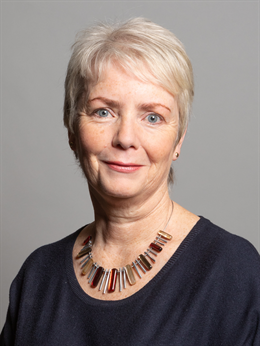
Karin Smyth – health minister responsible for professional regulation reform
The new Labour government is embarking in the first reform of the professional regulation of the General Medical Council for 40 years. This welcome development comes after the GMC extended its scope to cover physician and anaesthesia associates at the end of last year. In theory it will allow the GMC more flexibility to change its rules and allow less adversity among fitness to practice cases involving doctors thus avoiding referrals to the overloaded and often unfair employment tribunals. It also abolishes an arbitrary rule that prevents it looking at cases that are more than five years old.
From my observations of recent complaints against doctors who raise patient safety cases and conversations with doctors who are concerned about referrals to the GMC the whole process needs a radical overhaul. It is also an overhaul that requires some political intervention.
How the GMC handles individual complaints against doctors is by no means transparent. Nor is the GMC directly accountable for their failings and omissions and its workings can be manipulated by individual health trusts. I am about to give you two different examples,
Many doctors think the complaints system is flawed because of a practice of referring the case to the so called ” responsible officer ” to handle it. The responsible officer is often the person who has brought the complaint in the first place – the chief medical officer of the trust. Now the chief medical officer is not what the public might think – the ultimate person protecting medical standards on behalf of patients. He is part of the trust’s management team whose main purpose is to protect the reputation of the trust which may not be in the interest of patients. So surely this is a conflict of interest?
NHS Managers labelled one doctor ” too passionate about patient safety”
There was also an extraordinary experience of a whistle-blower who was a warned by local managers against being too “passionate about patient safety.”
And does the GMC do a thorough job when it investigates.? Doctors are sceptical. In one example it appears the complaints about serious safety issues, were closed at the first step and not even seen by GMC clinician. The bald reply from the GMC confirmed that to be the case; neither the team had nor did they seek any advice or expert opinion.
The GMC’s current practices enable its staff without clinical knowledge to close clinical concerns in such manner or only with hospital managers’ response, even when the concerns about the said managers are known to the GMC. In one example it appears the complaint was not even seen by fellow clinicians.
Given the whole point, according to many of the doctors who have raised patient issues, is the worry that either patients have already been harmed or more are left at risk of being harmed by such poor medical practice, these do not appear to be safe concern closure processes for a regulatory body.
Dr Usha Prasad
There is another side and here I can quote an actual case – as it came up in an employment tribunal – the removal of cardiologist Dr Usha Prasad from the then Epsom and St Helier NHS Trust ( now merged with St George’s Hospital in Tooting, south London.)
Here the GMC faced with 41 complaints from the trust who wanted her removed did do a thorough investigation and checked with very senior cardiologists and exonerated her -including revalidating her working for the next five years.
But the trust’s chief medical officer, Dr James Marsh , refused to accept this, making the fatuous statement that the trust’s medical standards were ” higher than the GMC’s “. This is also ironic as the doctors from that organisation are being revalidated by, no one else but the GMC.
Where a doctor is revaluated the rules should be changed so in those circumstances the GMC’s decision is binding and final and this requires a politician to intervene to make sure this happens. An individual chief medical officer should not have the power to wreck a doctor’s career if their complaint to the GMC is utterly rejected. and not formally appealed against.
I would be very interested to see if other doctors have had similar experiences in both these areas and doctors can contact me on my website ie either concerns were dismissed without due consideration or the GMC decision was ignored by the managers. All contact will be treated in confidence unless the doctor wishes to go public.
This is a once in a lifetime reform and we need to get it right for both the benefit of the doctors and the safety of patients who entrust their lives to the NHS.
Karen Smyth, the minister of state for health, has a huge list of responsibilities from this area to cancer care and hospital car parking. The list is here. She needs to focus on this and ask pertinent questions.
From L to R: Alex Whitfield, Hampshire Ben Travis, Lewisham Daniel Elkeles London Ambulance
Three of the top 50 NHS chief executives chosen by a panel set up by the Health Services Journal in 2024 as the best people to run the NHS have been involved in attempting to cover up patient deaths and persecuting doctors and nurses who raised the issues.
One of the top three NHS awards went to Daniel Elkeles, as chief executive of London Ambulance Service Trust and is now chief executive of NHS Providers. He was chief executive of the Epsom and St Helier Trust when Usha Prasad, a cardiologist, reported the ” avoidable death ” of a heart patient. He told her to drop her case at an employment tribunal or face an internal disciplinary hearing which led to her being sacked.
I have since been told that Mr Elkeles was involved in an alleged cover up at the London Ambulance Service when a paramedic was suspended during the stressful period of the pandemic. He had alleged bullying, Elkeles said he would investigate but got the person to sign a non disclosure agreement. When it was signed it is said any investigation was dropped.
The second chief executive is Alex Whitfield who heads Hampshire Hospitals Foundation Trust, was involved in the sacking of Dr Martyn Pitman, a well respected obstetrician and gynaecologist, who raised patient safety issues in the already nationally stressed maternity services. The former oil executive is rated the 15th best chief executive.
The lack of care at the hospital in Winchester led to one mother and a baby dying, but Alex Whitfield used the tribunal to claim that Dr Pitman was ” putting patients at risk” rather than supporting the doctor and midwives who were helping patients. Lawyers for the trust monstered Dr Pitman claiming he was a bully for raising these issues.
Julie Dawes, the chief nursing officer at the trust, who also pursued Dr Pitman ,has just been awarded an MBE for services to nursing in the King’s Birthday Honours List.
The third award winner is Ben Travis, chief executive of Lewisham and Greenwich NHS Trust, which the Care Quality Commission, say ” requires improvement.”
Ben Travis was heavily involved in the 2022 tribunal hearings brought by Dr Chris Day, who has fought the trust for 10 years after he raised important patient safety concerns that became associated with two avoidable deaths in the intensive care unit of Woolwich Hospital, run by the trust. The 2022 tribunal ruled against him despite evidence given by Ben Travis which shown to be untrue, the destruction of 90,000 emails during the hearing and the discovery of fresh documents .which should have been released by the trust to him to help his case.
The results of the last hearing is up for appeal on six grounds next week. He won the right to appeal that some of the findings of the judgment were perverse, that the judgment failed to draw any inferences from the destruction of 90,000 emails and the failure to provide documents that would have helped Dr Day’s case. This in particular followed the disclosure in documents that under oath the chief executive, Ben Travis gave an untrue account about a board meeting and had hidden he had contacted other trust chief executives about Dr Day.
Chris DayUsha PrasadMartyn Pitman
Yet Mr Travis won the award on his personal performance over the last year; the performance of the organisation he led, given the circumstances it is in; and the contribution made to the wider health and social care system.
Award for Diversity
At the same time the trust has won a second award for its equality, diversity and inclusiveness despite its NHS staff report showing that it has a below average rating for the fair promotion of ethnic minority staff and for racial discrimination inside the trust and from members of the public.
The panel who decided the awards for the best chief executives included Dr Rosie Benneyworth, chief executive, Health Service Safety Investigations Body:Steve Brine, former Tory MP for Winchester and former chair, Commons Health and Social Care Committee,; Matthew Taylor, head of the NHS Confederation;Sir Julian Hartley, former chief executive of NHS Providers; Patricia Marquis, executive director for England, Royal College of Nursing and Dr Vish Sharma, chair, BMA’s consultant committee.
It is inconceivable that many of them did not know about the whistleblower cases. Dr Chris Day’s case is high profile; Dr Martyn Pitman’s case was in the national press and Steve Brine was his local MP. Usha Prasad’s case was a long running one.
There is another issue which is worth pursuing in a later blog – how ethnic minorities are treated in the NHS and the level of racial discrimination and whether black and Asian people have fair promotion prospects. Lewisham and Greenwich NHS Trust is not alone
Guest blog from Dr David Ward on the appalling treatment of whistleblowers in the NHS
Patient safety and the judiciary
What business has the judiciary with patient safety matters you may ask? I am referring primarily to the processes which may unwind when a doctor, having raised patient safety concerns is sacked by the Hospital Trust where they worked and seeks recourse via the corrupt Employment Tribunal system. (NB not sacked “for having raised the alarm” as that is expressly forbidden by the Public Interest Disclosure Act (PIDA 1998[1]). For example, if a piece of equipment is malfunctioning in such a way as to cause harm to a patient; if a process such as preparing a patient for a procedure is flawed in such a way as to put the patient at risk; an inadequate consent process; understaffing in, say, a post-operative ward; inadequately qualified personnel. Each of these deficiencies may put a patient at risk of harm and all have at some time been reported by doctors or nurses. There are many others. A responsible doctor witnessing any of these will be concerned and has a duty to raise an alarm. This is set out in Good Medical Practice, a guide produced by the GMC[2]. It is also part of the Duty of Candour regulations [3][4] and for traditionalists, in “The Hippocratic Oath”[5] the central tenet of which is “primum non nocere” or “do no harm”.
A problem may arise when a doctor (or healthcare worker) reports a “patient safety event” and the Trust reacts adversely (the psychology of such reactions is discussed elsewhere) which is a very common. It may trigger a series of defensive responses by the Trust which almost always ends badly for the doctor. This is seen time and again with “whistleblowers” who have had the “temerity” to raise a concern. The “playbook” is almost set in stone. In several recent cases where a dismissed doctor (Claimant) has sought recourse at an Employment Tribunal, the Respondent (the Trust or Hospital) has reacted vengefully rather than responsibly and promptly to look into the concerns.
The following is a brief account of the saga of a colleague who was referred to the GMC (after she reported safety concerns) in what can only be described as an act of vengeance by the Trust and the CEO who, having taken offence at the temerity of the doctor to report some shortcomings to the Trust, decided to “punish” her culminating with dismissal. Furthermore, the Trust prioritised this vengeful reaction over and above an urgent investigation into the problems she raised. It’s the same “playbook” with many other NHS whistleblowers (see Westminster Confidential 6 7).
Patient safety concerns.
If a doctor “raises a concern”, the most common of which is about something which may jeopardise “patient safety”, the obvious and reasonable response is to investigate it and correct any problems as soon as possible. Astonishingly, this is rarely what happens. The Trust not uncommonly reacts vengefully to the report, for example, by restricting the activities of the doctor who reported it. They may be “hauled over the coals”, have their duties limited, suspended for a period, referred to the GMC or even the CQC. The GMC may commission an external assessment of the doctor in question by an independent party usually another doctor in the same specialty. The Trust is not obliged to take any notice of this report. For example (I could cite many), a colleague who was referred to the GMC by her employing Trust was completely exonerated but she was dismissed all the same.[6] The CEO of the hospital, St Helier Hospital, Daniel Elkeles, made a veiled threat in a letter if she did not cooperate with his dismissal proposals:
4) ESTH agree to cease the MHPS process which means we can find a way to
ensure you are re-validated (not my area of expertise but i am sure there will be a
way)
5) You need to drop all the actions you are taking against ESTH.
If we can agree this then I would hope that everyone can move forward positively.
(This letter is in the Tribunal bundle in the public domain)
Another whistleblowing case where there are ongoing grave concerns about the propriety of the Employment Tribunal decisions (and others) in support of the dismissing Hospital Trust is that of Dr Chris Day whose case features extensively in columns of Westminster Confidential.[7]
Unregulated “Maintaining High Professional Standards”[8]
This code of practice was introduced in 2003 to update and clarify how concerns about a doctor and the associated “disciplinary” procedures are managed.
This entire process is unregulated and no independent body is statutorily involved. In fact, there is not even a statutory register of these processes or the events they purport to investigate. There is no register of NHS whistleblowers or the safety concerns they have raised. Trusts do not keep records, the regulators (BMA, CQC) don’t keep records. The NHS does not keep records (I confirmed this by asking the now defunct NHSE). HM Government does not keep records despite HM Treasury giving £millions (directly or via various organisations) to Trusts to pay inscrutable legal firms to defend the Trust against claims made by doctors who have raised safety concerns. This means a Trust can hire anyone they choose to conduct the investigation. There may even be an “informal agreement” or they may just be a ”pal” of the CEO. The investigator is not required to have any special qualifications and there is no register of such people. The St Helier Hospital case referred to above is a particularly egregious example of how this chumminess may operate. The “investigator”, a retired nurse[9], in her report invoked a fictitious “regulation” not previously seen in this context. The doctor in question was eventually dismissed on the grounds that she was not “fit-for-purpose”[10]. This is entirely confabulated by the investigator (who describes herself as a “non-practising barrister” but is not on any English register of barristers[11]) as no such “reason” for dismissal (or anything relating to humans) exists in English Employment law and the term is not applicable to a “human being” but rather to goods or services. How this has not, so far, been challenged in the Courts eludes me. Could this case even be cited as a “precedent” (pro or anti) in future similar cases?
It doesn’t take a leap of the imagination to conclude that if a Trust wishes to be rid of a doctor it will choose a compliant “investigator” with a reputation for such behaviour. This service costs money (provided, of course, by the taxpayer) and investigators can be very expensive. But hand-picked unregulated quasi-independent “investigators” are very compliant, aren’t they? Money talks… but conveniently no formal or open register is kept of money used to silence whistleblowers (pay the lawyers, investigators, payoffs, seal a Non-Disclosure Agreement etc). I wonder why?
A doctor threatened with dismissal (or who has been dismissed) may just move on, get another job (if possible having been “slandered” by the previous employer), leave the profession altogether, move abroad or any of these choices. Unfortunately, many will seek recourse via the arcane and grossly biased Employment Tribunal system. This may come about because the embattled doctor has received, shall we say, less than impartial advice, possibly from a law firm, recommending this route. Less than 3% of claimants at an Employment Tribunal emerge victorious (whatever that means)[12]. In other words over 95% of Claimants who brave this course will lose their case. Fair and open justice? I think not.
Who bears responsibility for all this?
Is it the doctor who “blew the whistle”? No, it is their duty to raise safety concerns.
Is it the Trust which dismissed the doctor? The Trust will deny dismissing the doctor (for raising concerns) and invoke PIDA 1998 47B in their support (1):
A worker has the right not to be subjected to any detriment by any act, or any deliberate failure to act, by his employer done on the ground that the worker has made a protected disclosure.
The Trust will say “oh no, it wasn’t because he raised a concern…it was because his manner was inappropriate/rude and …” (see story of Martyn Pitman, below). However, it is quite a different matter when it comes to dismissing a doctor “who has raised concerns”. This is not “unlawful” because it is consistent with PIDA. This is why the law needs to be changed; to ban the dismissal of “doctors who have raised safety concerns”. It’s a “no brainer” isn’t it?
Is it the lawyers who advised (and assisted) the dismissed whistleblower to seek recourse via the biased ET system? Yes, they are complicit once dismissed the employees submit themselves to the process. Millions of taxpayers’ money is spent on lawyers defending Trusts against claims made by whistleblowers yet almost nothing (no data are collected so we can’t be sure about this but we can infer it) on investigating and correcting the problems that gave rise to the claims. Sheer madness or what?
Is it the Trust managers who confabulate the case against the whistleblower? They have one aim in mind; to get rid of the “nuisance” doctor and by so doing avoid the “inconvenience” of looking into the safety “issues” raised in detail which could be very embarrassing if gross incompetence or negligence by the Trust or its employees is exposed.
And patient safety? Oh, that’s where the proverbial “carpet and brush” come in, as wielded by Trust managers (with legal advice) who themselves are unregulated[13]. If you want evidence for these claims read the newspapers (or search a major news website).
Inadequate regulations and deficient laws.
The regulations drawn up by regulators (and equally the inadequate laws passed by legislators) have contributed to this unsatisfactory situation where doctors are terrified of speaking up about patient safety because they fear for their careers and the livelihoods. If the regulations were tighter, we wouldn’t be here, would we?
A simple and almost cost-free solution to all these inappropriate behaviours is available without too much hassle and only minor changes to regulations and it based on the supremacy of maintaining patient safety: ban Trusts from dismissing doctors who have raised patient safety concerns and compel the Trust (by statute) to investigate those concerns. Just think of the benefits: no lawyers, no Tribunals, no money filling the coffers of law firms but instead expended on, inter alia, investigating and rectifying the concerns raised, improving care and communication. More openness and less retribution will encourage doctors to ‘’raise a hand” without fear of reprisals. Furthermore, is it not preferable to retain the services of an expensively trained, competent and dedicated doctor who had the courage to speak-up and has committed no offence, rather than destroying their careers and depriving patients of their skills? (This is the “playbook” in the cases of so many NHS whistleblowers I could list here). At present the judiciary (and the regulations they invoke), whether they agree or not, are complicit in covering-up patient safety issues and the adverse consequences of so doing.
Isn’t it time for a change of attitude and changes in the law related to raising concerns about patient safety – also known as “whistleblowing”? Why are the ”powers that be” not listening to the many supporters of whistleblowers who are raising the same issues time and time again?
Just one more thing: there are seven reasons which can be invoked in British Employment law to dismiss an employee[14]. None of them is especially relevant in this context except one.
“Some other Substantial Reason”, a most convenient clause for all the reasons one might imagine: if it isn’t covered by the other 6 this one should satisfy the Trust’s requirement to get rid of the doctor. Furthermore, it may obviate detailed scrutiny of evidence (isn’t that the reason it’s called SOSR?). Other reasons which are commonly exploited include: ”it’s impossible to carry on employing you” and “not being able to do your job properly”. The vagueness, highly subjective and unquantifiable nature of these clauses suggests they have a less-than-straightforward purpose.
If a Trust wants to dismiss a doctor it will find a way to do so. In the case of Martyn Pitman, Consultant Obstetrician and Gynaecologist, the Royal Hampshire Hospital strenuously denied that he had been dismissed for raising concerns. No, of course he wasn’t. The astonishing inanity of it was reported in the Guardian thus[15]:
“The judgment found the “overarching reason” for what has happened to Pitman was down to his communication style and not the message he was trying to convey”. (I couldn’t find this sentence in the 75 pages of the “unsearchable” official judgment).[16] So here is a senior and respected gynaecologist – who has done no wrong – being dismissed for his unacceptable “communication style”. You could not make it up!
It is a truism to state that the health of the nation is the single most important asset it has. (This is why “privatisation” of the NHS which would put “shareholders” ahead of patients would be a disaster). If the workforce is not healthy everything else will decline (I don’t need to explain this assertion but judging by what is happening in Westminster, politicians don’t seem to have grasped this concept. (Neither has the judiciary for that matter but I wouldn’t expect this self-serving body to opine on such “trivial” issues).
“If they [the judiciary and the JCIO] continue to do this, they are acting as a party to suppressing patient safety in the National Health Service and in the case of Sellafield, because it is such a contaminated and dangerous place, putting the general public at risk.
Is anyone listening to critics of the judiciary and its arcane processes in judging NHS doctors, nurses and other healthcare workers who raise patient safety concerns? Is anyone taking notice of the sufferings of the doctors who are doing their best (especially during the recent pandemic) for their patients? Is anyone calling out the absurdly illogical Employment Tribunal judgments which heap suffering on the Claimant (Doctor) and indirectly on patients? I know of one journalist who is – David Hencke. 17
Judge Lancaster – the same judge who vilified the now vindicated Alison McDermott- a Sellafield whistleblower over bullying and nuclear safety issues
Judge Philip Lancaster – the controversial employment judge – already facing 16 complaints – nearly all from women – about his handling of their tribunal cases – has now been revealed as having helped a health trust to cover up patient deaths.
An investigation by Michael Buchanan, the BBC’s social affairs correspondent, released yesterday revealed that police are investigating heart patient deaths at Castle Hill Hospital near Hull. His full report which contains disturbing treatment of patients and a “cover up” of the circumstances of their deaths from relatives is here.
The employment tribunal case heard by Judge Lancaster centred around the safety of a procedure called Trans-Catheter-Aortic Valve Implantation (TAVI) – a keyhole surgery method to replace a defective aortic valve in the heart to predominately elderly patients,
The case had been bought against Hull University Teaching Hospitals Trust by consultant cardiologist Dr Thanjavur Bragadeesh, then clinical director of the hospital’s cardiology department, because he had raised safety concerns about the implementation of the procedure which had led to patients deaths.
Dr Bragadeesh
He had first raised the issue in 2020 to little effect and took the trust to the tribunal as a whistleblower in 2023. In fact he was demoted following raising the issues.
Ranged against him were the trust’s chief medical officer, Dr Makani Purva and three consultant colleagues, Dr.Joseph John, Dr Kumar Chelliah and Dr Manish Ramlall.
He brought 29 claims of detriment and 13 protective disclosures. All detriment claims were dismissed by Judge Lancaster as either being out of time or failed claims which were legally irrelevant.
As a result it was never publicly revealed until yesterday by the BBC that at least 11 patients died following procedural failures, with some death certificates failing to mention the surgery at all. Families were never told the truth. Independent reviews confirmed catastrophic decision-making and a mortality rate three times the national average.
Despite Dr. Bragadeesh’s concerns being validated by external reviews, including those by the Royal College of Physicians, the tribunal did not adequately engage with this substantive evidence. The failure to consider corroborative findings from reputable bodies suggests a potential bias in favour of the employer and a reluctance to hold the institution accountable.
Certainly the Judge Lancaster’s judgement reflects this highlighting similar omissions and gas lighting of whistleblowers as seen in other judgements – notably Judge Tony Hyams Parish ignoring the General Medical Council’s revalidation of whistleblower Dr Usha Prasad, then a cardiologist at Epsom and St Helier Trust and the avoidable death of a heart patient. And Dr Bragadeesh is described as having a ” bullying and undermining attitude” to other consultants – just as Dr Martyn Pitman, the obstetrician, who raised patient safety issues in the maternity services at Hampshire Hospitals NHS trust, was portrayed when he lost his tribunal case.
Alison McDermott
Yesterday also saw the damning findings of the Commons Public Accounts committee on Sellafield which showed that Sellafield had paid out £377,000 to staff to end labour disputes and had issued 16 non disclosure agreements to staff to cover up complaints. This vindicated Alison McDermott’s portrayal of the place at risk over nuclear safety and a bullying culture.
Still Sellafield and the Nuclear Decommissioning Authority are using the findings of Judge Lancaster’s flawed judgements to gaslight her.
In a joint public statement they said: “This case has been thoroughly litigated through an Employment Tribunal, Employment Appeal Tribunal (EAT) and the Court of Appeal. It was found that the claims made against Sellafield Ltd in this case were entirely without substance, and there was no basis for claims against the NDA.”
Try telling that to the MPs who wrote the report on Sellafield who say they are not convinced by claims that everything is OK or to the Department for Energy who admonished both organisations and said they must crack down on bullying.
There is a much wider issue to all of this. It is the question of the public accountability. Judge Lancaster is being protected by the Judicial Conduct Investigations Office. Despite a growing pile of complaints from women and from Dr Bragadeesh about his behaviour at tribunal hearings, it refuses to act on any of them. It is also fighting the Information Commissioner to prevent the public and press being able to put in any freedom of information requests.
By doing so they risk bringing the judicial system into disrepute and in my view they lack a moral compass.
If they continue to do this, they are acting as a party to suppressing patient safety in the National Health Service and in the case of Sellafield, because it is such a contaminated and dangerous place, putting the general public at risk.
Baroness Sue Carr, the Lady Chief Justice, and Shabana Mahmood, the Lord Chancellor, who both receive advice from the JCIO, should be wary about ignoring these developments, because at some stage they are going to come back and bite them.
Last week I attended a conference which aims to unite diverse groups fighting racism to form a national campaign to stop the rising tide of prejudice, harassment and ideological views that portray black and brown people ( especially immigrants) as a threat.
The conference was organised by the law firm Equal Justice Solicitors whose chief executive Lawrence Davies made an impassioned speech at the end saying “no ” to all these traits and go on the offensive to get real integration in this multi racial country.
The response is opportune as the forces backing discrimination are rising high here and in the United States. Donald Trump is abolishing any approach that backs diversity, equality and inclusivity and Reform, who are expected to do well in the local elections this week, are committed to abolish the Equality Act, leave the European Court of Human Rights and will need to leave the UN Convention on the elimination of all forms of discrimination against women and girls, which Margaret Thatcher agreed to join in 1986.
Lawrence Davies put up a blog on his newsletter The Intercessor and it very much reflects what he said at the conference so I am reproducing most of it here as it covers a lot of issues and has good examples.
He wrote:”Obviously, at present we are in the midst of an invisible war. The “culture wars” were quietly declared by the Conservative government in 2020. Their aim was to prevent black people empowering themselves by mobilising and using the energy from the #BlackLivesMatter movement to become a political force, such as that which helped the Democrats win the November 2020 election.
“It is an ideological war. Those who do not accept the alleged British way of life (“white is right”) are to be humiliated, made to feel unwelcome, harassed and invited to leave Britian. DEI is to be ended. Unconscious bias training is to stop in the civil service. White (northern working class) people are to be viewed as the real victims, not black people or women. Diversity (and equality) has gone too far. The term “Institutional Racism” is unhelpful and must not be used by the EHRC in any report findings. Black ministers (NB: who ideologically see no racism) were deployed to implement the war tactics to deflect from and provide deniability from their innate racist motivation.
One chess move in that war was the decision by the institutionally racist Home Office (which oversees the institutionally racist Met Police) to implement the Hostile Environment – a policy of deliberately seeking to make the Windrush generation uncomfortable and unwelcome living in the Britain.
Another was to label all illegal immigrants as criminally minded threats to our way of life and culture.
It started in 2016, although ideologically decades before that. The anti-foreigner element to the Brexit campaign was a rallying call to lone wolf social media racists and incels alike.
Racial harassment at work rose from 16% to 31% in the period of 2016 to 2020. It has become much worse since then.
We had race riots in the summer of 2024. Every alleged crime committed by a black person was taken as a justification to visit personal injury on the whole black community, be it in Southport or anywhere else, due to racist stereotypes about aggressive black people. They are all the same. They have it coming etc.
By contrast, every heinous crime committed by white people of course did not lead to any attacks on the majority white community. The ideologically motivated, Andrew Tate loving, Kyle Clifford was not stereotyped as the danger that white people pose to others.
Reform UK promised in its manifesto to abolish the Equality Act 2010, removing all legal protection against racism at work, in education and in health services. They believe, like Jeremy Clarkson, in the white man’s right to call a black person a “N…” at work or in a hospital, without accountability, or liability.
In any non-racist, civilised country, the Law should of course protect the black community from such racism. However, our Law does not. 30% of black people suffer racism at work but only 1% feel sufficiently safe and empowered to utilise their rights under the Equality Act 2010. 99% of racist incidents therefore are simply suffered and not formally complained of. Any Law that 99% of victims are too afraid to use is NOT fit for purpose.
No incentive for organisations or corporations to change
Of the 4% (within that 1%) who exercise their rights and win, they win small and the employer does not change. It is statistically more likely that the racist co-worker or manager will be promoted rather than sacked. Awards for racism which would attract $10 million compensation in the USA attract an award of less than £12,000 in the UK. There is no economic incentive for corporations and organisations to change culturally over a £12,000 award.
Public inquiries into the worst racist cases from the Lawrence Report to Casey Report in 2023 have uncovered the obvious Institutional Racism but led to no real or structural change. In fact, matters are regressing. Doreen Lawrence told me that the police are as bad now as they were in 1993.
In any event “landmark” Employment Tribunal cases do not effect structural change. They just enthuse the claimant and the lawyers who believe that such case do lead to change. But 99% of victims of the new rights won’t exercise them. Metaphorically successfully sailing a boat across a hostile ocean, and against the constant current, to land somewhere (hopefully) safe does not change the presiding structural current, or get close to freezing the Moon – that invisible power, wealth, influence controller.
Meanwhile, Racists are becoming emboldened. That’s exactly what happens when the Law does not work to protect people at work, or outside work.
Wayne Hammond (white) called John J Campbell (black, Union official) a “fucking monkey” at work (Sheffield Teaching North Hospitals NHS Foundation Trust) in a heated discussion about union subscription deductions from wages. The Employment Tribunal found that the remark at work was not made by Hammond in the course of his employment and that the Trust had taken all reasonable steps to prevent such remarks being made (even though it is clear that the steps had not prevented the racist abuse), so neither the Trust nor Hammond were liable.
On 20 March 2025 the Employment Appeal Tribunal rejected the union (UNISON) backed appeal. The union failed to challenge the ET Decision on the grounds that it was perverse.
So the current Law permits a black worker to be called a “fucking monkey” at work provided the conversation is about union matters and the Trust has carried out all reasonably practicable preventative steps to prevent such racist conduct.
The current Law also says that if you are called an “N” at work and pinned to the wall by your manager in front of witnesses it is not perverse (legally wrong) for you to receive only £2,500 in compensation. Nor is it perverse for the appeal court to opine that awarding more than £20,000 in punitive damages would bring UK Law into disrepute, whereas in fact the opposite is true.
The current Law says I can (randomly) scream at you at work and cause you to have a mental breakdown and you have 3 years to sue me but if I (deliberately) scream racist abuse at you causing the same injury you only have 3 months less a day to sue me. Of course, the Law says you have 6 years to sue me if I sell you a defective television…..
Betty Knight posted a post on LinkedIn which tagged a former colleague and effectively stated that the senior team at the college was racist (having previously won a claim at the ET that her constructive dismissal was an act of racial harassment). One white employer (then the head of HR) said she felt harassed by that posting and rather than blocking Betty, instead, chose to report her to the police for criminal harassment. The aggressor said that she did so on her own phone, from her car in the car park, and her employer knew nothing about it and had not authorised the reporting. The ET found that extremely aggressive conduct was not done in the course of the perpetrator’s employment. The matter is on appeal. Either the EAT will find that (allegedly) popping out of the office to report a black person to the police for a LinkedIn post, that LinkedIn itself had no issue with, is part of the employer’s responsibility under the current Law or it will not. In either case, the current Equality Act 2010 is not fit for purpose. No Law that 99% of race victims fail to utilise protects the race victim. The fear of retaliation and the knowledge that Justice will be very expensive and unlikely to be achieved (4%) means that we have only cosmetic rights.
We need a new Inequality Act to be implemented as soon as possible to tackle the rising and ideologically driven racial harassment and tackle the underlying and long-standing structural racism.
In the last year, a black man shopping in an ASDA in London, with a black elderly friend who had had a stroke, was surrounded by plain-clothed security staff and asked about their intentions, being the only black customers in the store. He was then asked if he knew how to lift a voodoo curse from a white person.
Similarly, a black women made her way around Tescos with her daughter only to be surrounded by security staff and asked about her intentions, again being the only black customers in the store. When she complained a manager/supervisor apologised for the matter and offered her “a “bunch of bananas”, smirking at her.
None of the racist white Tesco or ASDA staff concerned were dismissed.
So reading this post, you may feel that won’t happen to me, and as only 25% of British people admit to be very or a little racist, you may (hopefully) avoid being targeted and harassed at work, but know if unfortunately you end up working with or for a racist colleague, once you complain you will be retaliated against because the current Law does not prevent retaliation, or the original racist act, any more than the training the Sheffield Trust did. In fact it permits and encourages it.
Anyone telling you that you have rights not to be racially discriminated against is lying. Yes, there are rights but almost all are unable and/or too afraid to exercise them. A right is not a right unless it is enforceable, and can be exercised safely.
Further, 95% of black school children face racist banter and harassment at school. So the next generation, will face a far more racist world than you did. Racist banter is becoming normalised. It is destroying black lives, and people’s sense of safety and damaging their mental health.
As our society becomes more intolerant under the hate-mongering by Reform UK and BRUV (Andrew Tate’s political vehicle to become PM – NB: 27% of men under 40 years of age believe his misogynistic views of women are correct and kids are 5 times more likely to view violence against women as legitimate having viewed his literature).
So do YOU feel safe at work, in education, in the NHS, when contacting the police, online and offline?
What more can WE do to ensure black people, women and the community as a whole are safe from racist sexist (RaX) people?
Finally, if 25% of British people remain admittedly racist, hopefully that means than more than 50% are not racist and therefore in fact that being British no longer means being racist. Because cultures evolve. So being British no longer means being slave-owners or profiting from the slave trade. Or where the rape of an unmarried girl or women is seen as a criminal rape and no longer viewed as damage to property. Our culture did evolve into a fair and more tolerant (ie: less racist), diverse community but war has been declared on that evolved culture and they want to drag us back to the 1970s culture (and some want to drag us back into chains).
It is time to say NO.
NO more.
Be safe, and prosper, “
Professor Patrick Vernon
Among those who spoke at the conference were Professor Patrick Vernon, pro chancellor at the University of Wolverhampton and board chair of the Birmingham and Solihull Trust; Professor Miranda K Brawn Ahmed who is chair of People, Culture and Education Committee on Guy’s and St Thomas NHS Foundation Trust, veteran race discrimination campaigner Lee Jasper, Andy George, president of the National Black Police Association; Roger Kline, research fellow at Middlesex University; Hira Ali, an author and Ritka Wadhwa, founder of Cultural Intelligence. All were determined to make a big change so expect some strong action soon.
Three were good examples from the audience notably at Waltham Forest council where the executives and managers were being held to account over cuts and redundancies to make sure black people were not unfairly treated.
You may not have noticed but the UK Parliament and the National Health Service has not had a permanent Ombudsman to handle complaints for more than a year.
Ever since for some unexplained reason the former PM Rishi Sunak blackballed the first choice, Nick Hardwick, a former chair of the Parole Board, for the job despite going through a thorough selection process, interfering with a body which is independent of government, it has been rudderless without a permanent boss. See my blog on this here.
To solve the problem the Parliamentary Ombudsman’s office appointed an interim candidate, Rebecca Hilsenraft, then chief executive, after a meteoric rise since joining the organisation from the Equality and Human Rights Commission, who at least could adjudicate on complaints.
But they would have known then that her appointment would end on March 31st this year – a year after the last permanent Ombudsman, Sir Rob Behrens, retired. You would think that would have given them plenty of time to find a successor and go through a thorough selection process. But Oh no, by the time she reverted back to her old job, nobody had been appointed.
As a result the press office had to issue this statement:
“We are currently awaiting news on the appointment of a permanent Ombudsman.
“Our dedicated staff remain committed to delivering an important service for the public.
There may be a small number of cases we are unable to progress without an Ombudsman in post. Caseworkers will directly contact any complainants whose cases are affected.”
Checking their website yesterday there has not been one new press release nor any new decision of cases announced since April 1.
Then suddenly last week it was announced that the Public Administration and Constitutional Affairs Committee were to hold a pre appointment meeting this week for a new Ombudsman. Extraordinarily the name was kept secret from the public record until this Tuesday.
I gather it was at the request of the favoured candidate, Paula Sussex, because it appears she had not told told her present employer, she is chief executive of OneID, that she had clinched the job.
Now yesterday there was a hearing. The current chairman of the committee, Tory MP, Simon Hoare, recused himself from the hearing as he had sat on the selection board leaving Labour MP, Lauren Edwards, to take the chair.
It was a very underwhelming event both from the appearance of the favoured candidate and the MPs questioning. For a start four MPs did not attend and those who did were mostly newbies whom I thought had yet to get in their stride.
The candidate herself appeared to know little about the working of the PHSO system and even less about the NHS. She appeared to be a management and process person steeped in working for the private sector rather than a person concerned about policy. This was noticed when she was chief executive of the Charity Commission when a profile of her highlighted this. The article is here.
She was also wary of journalists. The same article noted: “she has declined to give interviews: she is said to be unused to dealing with the media, disconcerted by the amount of press attention the commission attracts and confirmed in her reluctance to speak by any coverage she perceives as negative.”
Considering she admitted during the hearing that the Parliamentary Ombudsman had too low a profile – it strikes me she is going to have to be more proactive with the media if she wants to change it.
Her previous jobs have involved her as a consultant on new technology, working at a top level at the transactional Students Loan Company and for private industry.
Her most recent role is as a non executive director with the Infected Blood Compensation Authority which will ” sadly”, as she said, to have to give up. Given her sparse knowledge of the workings of the Parliamentary Ombudsman’s Office I was rather surprised she did not mention that her fellow non executive director is none other than Sir Robert Behrens, the last Ombudsman, who could have given her great detail about its inner workings.
Also it is rather ironic that this body – which despite its name is a private contractor not a public body- is to face a recalled two day hearing next month of the Infected Blood Inquiry under Sir Brian Langstaff because of public dissatisfaction with its handling of compensation and a slew of other complaints. Jenni Richards KC , the inquiry’s counsel, has just published a huge list of issues. See here.
Given some of these issues will be the very bread and butter work that a Parliamentary Ombudsman and Health Service Ombudsman would have to handle, someone might ask why she presided in an organisation that now faces such searching questions for not doing its job. Of course its minutes aren’t published so we won’t know whether she raised such issues or went along with the management.
Altogether I am sceptical of whether there will be great change at the Parliamentary Ombudsman’s Office and I am afraid her attitude and the lax scrutiny by the one committee that can hold it to account will mean any great change.
The committee of course do not agree and think she is wonderful. This is their conclusion In a report published after the hearing.
“We are satisfied that Paula Sussex has the personal independence and professional skills necessary to fulfil the high profile, demanding and varied role of Parliamentary and Health Service Ombudsman. Paula Sussex is an excellent candidate with a track record of organisational transformation with a focus on improving the effectiveness and external reputations of the organisations she has led. Her professional background and experience as Chief Executive will aid her in giving the PHSO direction and certainty. We wish her every success in this role.”
Some 114 people applied for the job at a salary of between £171,000 and £189,000 a year -42 per cent were women.
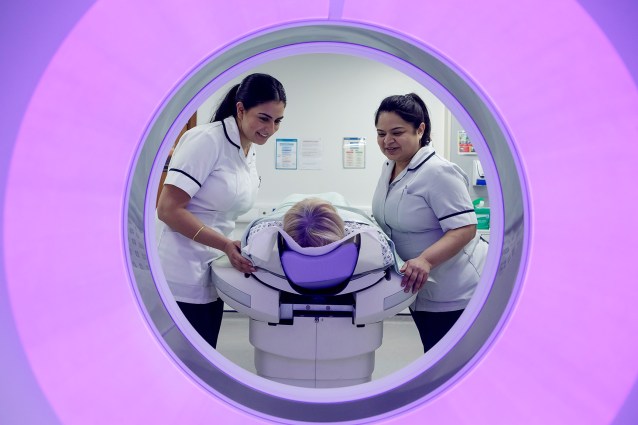
Scanner at the Paul Strickland Scanner Centre charity at Mount Vernon Hospital
I am currently being monitored by the NHS after having day surgery last year to remove a melanoma on my lower back. As part of the cancer recovery treatment I am being checked every three months at Mount Vernon hospital with both a CT and MRI scans to make sure there is no recurrence and having my skin checked by a dermatologist at Hemel Hempstead hospital.
Two weeks ago I had both scans at the Paul Strickland Scanner Centre, run by an independent charity, at the hospital. Imagine my surprise and nervousness when the CT scanner said to me as I was about to go home to stay behind because doctors were taking a look at my CT scan.
Then Luke, a junior doctor at Mount Vernon, turned up to tell me the scan had discovered blood clots in my lung. What was really amazing to me it had been discovered because the scanners at the charity use AI to check CT scanner. The AI showed up something was wrong which led the radiographer to examine the scan more closely to reveal multiple blood clots.
As a result I got instant medical treatment instead of waiting for the standard 14 days for the results of the scan to come back. The doctors and nurses gave me a through check on the spot – blood pressure, an ecg, a blood sample and checks on my breathing before prescribing blood thinners to start treatment that night.
Undetected blood clot produced no serious symptoms
If it was not for AI for the last two weeks I would have had a untreated blood clot on my lung without me knowing anything about it. It was virtually symptomless apart from a dull pain in my upper back when I was driving which I had put down to old age rather than anything else.
What I didn’t know is that Paul Strickland Scanner Centre, a charity which relies on donations, is at the cutting edge of linking AI with radiology. Its first introduction of new AI linked scanners was in 2022 -way ahead of other centres.
At the time Mr Will McGuire, the Deputy Superintendent for MRI at Paul Strickland Scanner Centre, said:“It’s the first time we have used deep learning, often referred to as artificial intelligence, as part of the image acquisition. The scanner software has been trained on thousands of scans. When the radiographer runs the scan, the scanner takes less data from the patient and the ‘Deep Resolve’ software then basically fills in the gaps based on its knowledge. The software packages we will get will both reduce ‘noise’ on scan images and provide radiologists with a better definition image.”
New uses for ” Deep Resolve ” software which could benefit kidney, prostate and breast cancer patients are also being pioneered this year. For the first time MRI scans could analyse bone structure as well as soft tissue speeding up treatment and reducing the need for both CT and MRI scans. The charity is planning to demonstrate this new technique at the European Congress of Radiology this year.
The initiatives by the charity show how dramatic the use of AI could transform services inside the NHS to benefit patients and provide services. I gather from Hillingdon NHS Trust where the hospital is based – though it is run by the East and North Hertfordshire NHS Trust – that there is also a trial using AI among hospitals in North West London to provide instant information after chest X rays which would speed up treatment.
The latest information on the state of public provision of AI came from a report by the Commons Public Accounts Committee after a National Audit Office report reveal very uneven provision.
The report concluded that the government is facing significant challenges to introduce AI across Whitehall and the NHS – with out of date computer systems and a big shortage of skilled staff.
It says :”For AI to be used well, it needs high quality data on which to learn …too often Government data are of poor quality, and often locked away in out-of-date, or ‘legacy’, IT systems, which are partially defined as “an end-of-life product, out of support from the supplier, [and] impossible to update…” An estimated 28% of central government systems met this definition in 2024. Approximately a third of Government’s 72 highest-risk legacy systems still lack remediation funding. The report warns that there are no quick fixes here, and calls for funding for the remediation of this kind of technology to be prioritised.”
“Another barrier to the safe and effective adoption of AI by Government are longstanding and persistent digital skills shortages. Around half of roles advertised in civil service digital and data campaigns went unfilled in 2024, and 70% of Government departments report difficulty recruiting and retaining staff with AI skills. The PAC has long raised concerns about digital skills gaps in Government, and is sceptical that the Department for Science, Innovation and Technology’s (DSIT) planned digital reforms will address the problem.”
Government’s ” sclerotic digital architecture”
Sir Geoffrey Clifton-Brown MP, Chair of the Committee, said:“The Government has said it wants to mainline AI into the veins of the nation, but our report raises questions over whether the public sector is ready for such a procedure. The ambition to harness the potential of one of the most significant technological developments of modern times is of course to be welcomed. Unfortunately, those familiar with our Committee’s past scrutiny of the Government’s frankly sclerotic digital architecture will know that any promises of sudden transformation are for the birds.
“A transformation of thinking in Government at senior levels is required, and the best way for this to happen is for digital professionals to be brought round the top table in management and governing boards of every Department and their agencies. I have serious concerns that DSIT does not have the authority over the rest of Government to bring about the scale and pace of change that’s needed. We hope the recommendations in our report aid the Government in succeeding in bringing public sector systems into the 21st century for their users, where other efforts have failed.”
Perhaps MPs on the committee and NHS government ministers should go and visit the Paul Strickland Scanner Centre at Mount Vernon Hospital in Northwood and see how they have pioneered linking AI to radiology. It is anything but sclerotic and ministers might learn how to avoid some of the pitfalls of the great transformation they are promising. Many patients, including me, would be very grateful if they did.
Daniel Elkeles, moving from CEO of the London Ambulance Trust to NHS Providers. He is the former chief executive of the Epsom and St Helier NHS Trust.
In May Daniel Elkeles will become the £240,000 a year chief executive of NHS Providers, a membership body that covers all hospital, mental health, ambulance and community trusts. His job as NHS Providers will be to “to deliver high-quality, patient-focused care by enabling them to learn from each other, acting as their public voice and helping shape the system in which they operate.”
He will also following the demise of NHS England be a key link between the trusts and Wes Streeting, the health secretary, and the PM Sir Keir Starmer, whom he met in his present role as CEO of the London Ambulance Service.
His brief as NHS Providers say is to “build effective relationships with key stakeholders in central government, with regulators and across healthcare; champion member interests and raise their profile positively in the media.”
His appointment was lauded in the trade magazine the Health Service Journal, while the chair of NHS Providers, Professor Sir Terence Stephenson, said:
“He will spearhead our new strategic vision and help members deliver improvements for patients, service users and the communities they serve during a period of immense change and challenge in the health service.
“We have been through a robust process to find the right individual to provide leadership and support for our members, to influence key decision makers, and inspire and lead our staff team, reflecting our values and our commitment to becoming an anti-racist organisation.” The HSJ went further saying: “During his time at Epsom and St Helier, Mr Elkeles led on plans, and secured funding, to build a brand new £500m specialist emergency care hospital in Sutton.
He also oversaw a “significant improvement” in patient care, quality, finance and leadership, culminating in the organisation being rated as “good” by the CQC.
The CEO also led on initiatives to improve culture and morale, resulting in Epsom and St Helier having strong scores in the staff survey in measures about equality, diversity and inclusion, as well as staff health and wellbeing.”
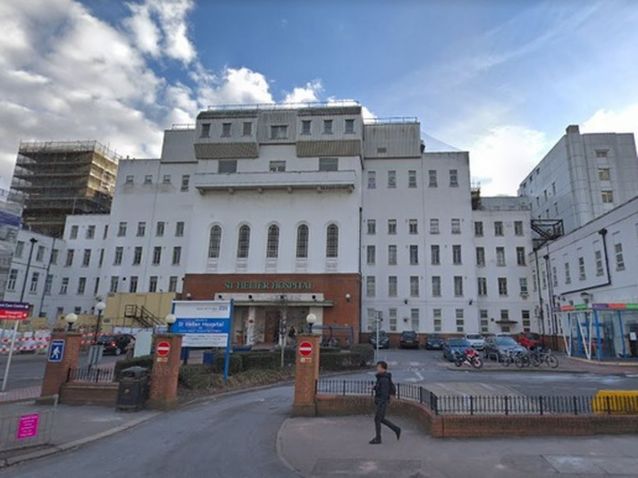
St Helier Hospital
What is missing from this plaudit is that the main hospital in that trust, St Helier, is falling down and in desperate straights with leaky roofs, brown water in the taps, and nothing is going to be done to replace it until 2036 under Labour’s current hospital building programme. Nor does Mr Elkeles appeared to have done anything much about it when he was chief executive.
But far worse this ” robust process” to select him as the best person for the job seems to have missed two rather key and worrying incidents in his career at St Helier. One led to prolonged employment tribunal hearings, the other reached the desk of Sir Robert Behrens, the former health service commissioner.
The employment tribunal case involved an extremely competent doctor who was dismissed after being branded as ” unfit for purpose” – a legal term that doesn’t exist for people -at a hearing organised by the trust. I am not naming her in this article but people may find part of the story familiar to readers of my blog.
What I am concentrating on is the role of the chief executive in dealing with her case.
Among the papers released for the tribunal were private emails between Mr Elkeles and her, which then became public documents.
In one Mr Elkeles offers a deal for her to leave the trust and escape what would amount to a disciplinary hearing if she drops any action against the trust.
He wrote: “We ensure MYT[ Mid Yorks NHS Trust] agree that you can go there and we jointly set up with them the required training and support 2) ESTH will pay your salary for a period of 6-12 months (to be agreed) whilst you are at MYT 3) At the end of the agreed 6-12 months period ESTH will no longer be your employer 4) ESTH agree to cease the MHPS process[ this was a hearing questioning her competence]which means we can find a way to ensure you are re-validated (not my area of expertise but i am sure there will be a way) 5) You need to drop all the actions you are taking against ESTH. If we can agree this then I would hope that everyone can move forward positively.”
When she refused to do this he wrote back: “I made a proposal on how to provide a constructive ending to this process on Friday. I did not expect to receive this type of reply from you which in my view does nothing to try and find a solution to this issue but just perpetuates the current impasse we seem to have reached. I therefore withdraw my offer and any input from me as CEO to resolve this informally. The hearing that is scheduled for Monday and Tuesday next week should continue as planned and reach whatever conclusion the panel believe is appropriate.”
What he was asking was that she withdrew any allegations against the trust of sexism and racism ( she was the sole woman at that level in that department and from an ethnic minority) and also hide a whistleblower claim about an avoidable death of a heart patient there which the trust admitted later in public they avoided reporting to the local coroner.
Her lawyer also produced statistics showing that despite the trust employing, like most London trusts, a very diverse range of people, it did not have a very good record in treating them.
As far as validation was concerned the General Medical Council revalidated her anyway – despite multiple claims of incompetence from the trust which were all dismissed by an independent medical expert asked to examine them.
The second case which involved the widow of a patient who died in agony at St Helier Hospital with nurses refusing to give him pain relief was covered on my blog. You can read the case here.
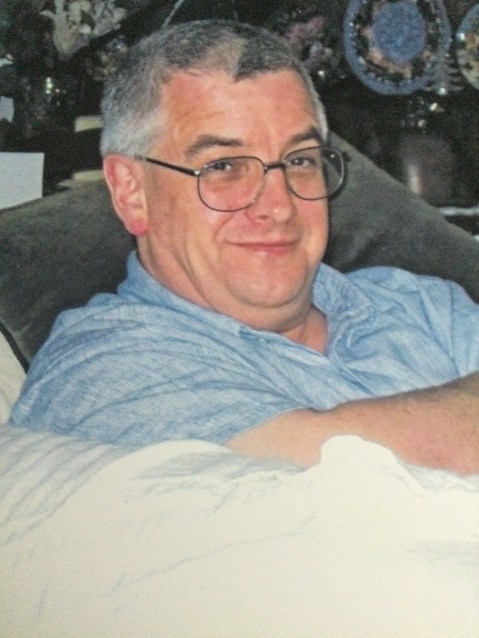
Robert Sheppard: Left to die in agony by St Helier Hospital
Her complaint to the Health Services Commissioner about his treatment led an apology from the chief executive but other matters by the management were brushed under the carpet. This included the fact that Robert Sheppard had picked up a bacterial infection called klebsiella which attacks people with a weak immune system and it was never notified by the hospital to the authorities, In fact his initial death certificate which would had to be provided by the hospital’s doctors airbrushed out that he had the infection.
Wendy , his widow, said:” Dying with dignity was something not given to Robert. I will never forgive St.Helier Hospital. It’s failures towards Robert were ‘swept under the carpet’ by the Hospital management. My complaints were misconstrued to make St.Helier look in a better light and incidents that happened weren’t recorded in Robert’s medical notes so I am told. “
All this raises questions about how Daniel Elkeles will do in his new job. Will he really speak truth to power or will he bury issues from public scrutiny to protect the reputation of the NHS trusts , who are his members? Will patient safety and equality and race issues be tackled with vigour or sacrificed to make sure his organisation gets a good press.




 Westminster Confidential