This week Salford City Radio hosted a special broadcast on the continuing plight of 50swomen and gave interviews to myself and Dr Jocelynne Scutt. Jocelynne also took a petition and letter to Downing Street yesterday calling for the government to implement in line with the UN Convention on the Elimination of all Discrimination against Women and Girls which has still not been fully introduced by successive British governments.
The key point is that mediation to solve the injustice facing some 3.5 million 50s women who waited more than six years to get their pension is possible under civil procedure rules. This was put to the Prime Minister and senior government lawyers in letters yesterday. CedawinLaw see they have a winning hand over this which is why the government don’t want to know over this.There is a team of mediators prepared to act.The All party group on state pension inequality has also raised the issue of mediation with Torsten Bell, the pensions minister but didn’t publish his response.
To emphasise again no legal challenge is required to initiate mediation.
A Top 500-ranked team of mediators is on standby to be considered for the neutral mediation role.
We learned from Waspi that post the Board’s withdrawal of its judicial review – and acceptance of £180,000 – the Government subsequently reneged on an understanding to initiate mediation solely with Waspi Limited.
CEDAWinLAW’s censored winning hand remains in play – no funds nor any legal challenge is required to do so – whilst The One Bright Light prepares to tell the story. Watch this space.
My AI generated picture of Westminster to go with the blog.
Hits on my blog reached just over 230,000 last year not including the full number on Facebook and Linked In which takes the reach of the blog to even higher figures.
The most startling change in 2025 was a sudden interest from China that began in August and finally petered out at the end of the year. Figures from China totalled 128,000 over a five month period with at one stage Beijing having more hits than London. Altogether some 40 Chinese cities downloaded stuff from my site.
What was particularly interesting was that there were old blogs and nearly all were concerned with the same issue – the plight of the 50s women who faced a six year delay in their pensions involving Back to 60, CedawinLaw and WASPI.
The largest number of hits were on a 2019 blog which was cross posted with Byline.Com on the date set for a judicial review won by Backto60. In one year this blog added 12,507 hits taking it to over 136,000.
The second highest hits came on my story that men who “retired” at 60 had all their national insurance contributions paid by the state until they reached 65. This gained another 8,744 taking it to over 83,000.
Other large hits were on the Downing Street pensions robbery, the court of appeal decision and the decision to appeal to the Supreme court.
Two blogs not concerned with the issue but led to large hits from China included the leak of Dame Janet Smith’s report into the BBC’s mishandling of the paedophile Jimmy Savile and a 2015 blog on my statistics that showed my blog on the secret hideout of singer Amy Winehouse and a dispute with David Aaronovitch had driven traffic to the site.
I have talked with people who have had dealings with China who suggest that this was a data scraping exercise connected to planned changes in China’s pensions policy. China has one of the lowest ages for women’s retirement in the world at 50. It is currently running a 15 year plan to raise women’s retirement ages from 50 to 55 and 58 and men’s from 60 to 63. It looks as though the Chinese were sussing out the opposition in the UK.
The blog attracted over 8000 hits from the US, and over 1000 from Germany and Ireland down to single hits from places like Angola, Brunei, Myanmar and Mongolia.
The other big growth was on Linked In whose stats are not fully recorded by WordPress. At the end of the year the organisation sent me a note saying I was in the top five per cent of contributors on the site. This is very pleasing as I have had large number of hits where I have taken up whistleblowing cases, unfair employment tribunal hearings, failures of accountability in the NHS and in the judiciary, and injustice for patients in both the NHS and the coroner’s service.
Since it is read by professionals I have gained a following both at home and abroad which is growing. Let’s hope 2026 sees the reach of the blog to new heights.
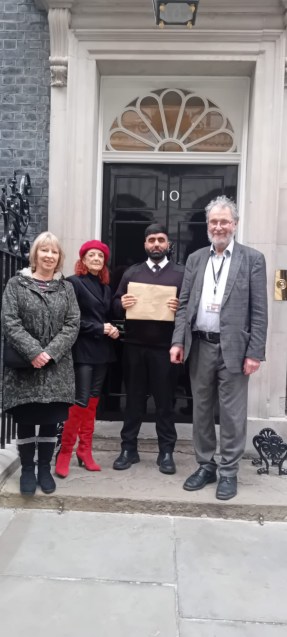
Cedar in Law delegation at Number 10 Downing Street. From Left to Right: Sharon Wheeler, Joycelene Scutt, No 10 doorman and David Hencke
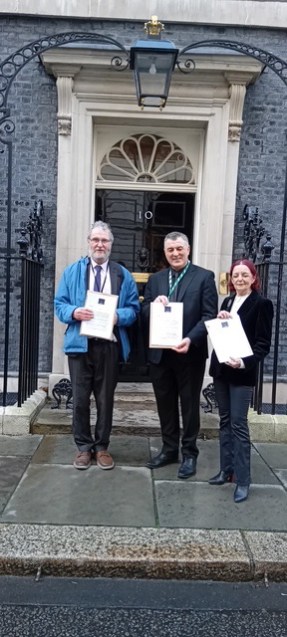
Cedaw in Law returned to Downing Street yesterday to deliver letters to Sir Keir Starmer asking him to intervene in the latest battle to secure justice for 50swomen.
The delegation is repeating their case for mediation and recompense for the discrimination and maladministration over the big rise in the women’s pensions age for 50swomen. One of the letters which would have gone to DWP lawyers also reiterated that all women’s groups should be consulted under the review promised by Pat McFadden, the work and pensions secretary, not just a private arrangement between WASPI and the ministry. WASPI pulled out of their judicial review case to challenge the DWP over maladministration last week accepting a £180,000 payment in full and final settlement from the DWP.
Tonight Joanne Welch, the organiser for CedawinLaw, Jocelynne Scutt, the Australian judge who chaired a tribunal into the issue, and myself, a patron of Cedaw in Law and a lobby journalist, will appear on Salford City Radio, in the constituency of Rebecca Long Bailey, the Labour chair of the All party group on State Pension Inequality for Women.
The link to hear it is here and it is on Ian Rothwell’s show between 6 and 7 pm.
UPDATE: Following publication of this post one issue has been raised by John Halford, Waspi’s lawyer from Bindman’s. He says it is not true that originally you needed permission for both parties or would have to pay £300 to attend the case management hearing. I have checked this back and staff at the administrative court did advise people to do this and told people If no agreement then you need to complete N244 Application form at a cost of £300 to register.This was overruled by the judge on December 2who made it an open hearing. I passed this back to Mr Halford only to find he had blocked me sending a reply. What extraordinary behaviour from a lawyer.
A long awaited decision on the six year battle for redress for the 3.6 million remaining 50s women has been promised by the Department for Work and Pensions by the end of February next year – as part of a deal agreed between the ministry and Waspi Ltd.
Royal Courts of Justice
Under the deal Waspi has dropped its judicial review claim due to be heard next week and accepted an offer by the DWP to pay the Waspi company £180,000 towards its legal costs in bringing the claim.
Most of the manoeuvring to obtain this arrangement has been behind the scenes in meetings between lawyers on both sides. As a result there will be no public hearing in the courts of the arguments where both sides would have put their case under the watchful eye of the Parliamentary Ombudsman who was an interested party. Waspi had been challenging Pat McFadden, the DWP secretary of state, over his decision not to award any compensation following the Parliamentary Ombudsman’s findings of partial maladministration over the communications informing the women.
05/07/2024. London, United Kingdom.Chancellor of the Duchy of Lancaster, Pat McFadden, poses for a photograph following his appointment to Cabinet by Prime Minister Sir Keir Starmer in 10 Downing Street. Picture by Lauren Hurley / No 10 Downing Street
Then rather dramatically Mr McFadden on November 11 change his mind after the discovery of an earlier document which had been overlooked for 18 years revealing that attempts to inform the women had failed. Waspi’s lawyers Bindmans are said to have found it -presumably in the exchange of documents before the hearing. See my coverage of the document on this sitehere.
Before the hearing was dropped Waspi and DWP had the DWP arranged a case management hearing on December 3 with the most extraordinary terms allowing either side to block who would be allowed to attend or have to pay over £300 to obtain the right to attend.
This amounted to secret justice and it is no wonder on the day before the hearing the judge, Mr Justice Swift put out a national statement giving his directions for the case which made it clear it was a public hearing that anybody could attend and there were arrangements for people to hear it remotely.
This scotched the plan for a semi secret hearing so that evening it is clear that lawyers from both sides must have met and agreed to abandon the hearing the next day and Waspi Ltd agreed to pull out alongside the DWP from the two day judicial review.
It is my speculation that it will mean that some arrangement has been agreed under ” a nod and a wink” that the ministry will offer some form of compensation to some of the women. Certainly a seasoned lawyer like John Halford at Bindman’s ,would not have agreed to this without some hint or his client ,Waspi, would have been left in a very precarious position.
Waspi has not been alone in making representations to the government. Enter Edward Romain, a former whistleblower who has set up Blind Justice, a community interest company, to take up injustice cases and has joined joined forces with Cedaw in Law, to fight the case for the women on both discrimination and maladministration. I covered his case against Glyndebourne in an earlier article here. The case is now settled but it also discloses some strange behaviour by lawyers.His website is blindjustice.org.uk .
The day before the planned case review he delivered a recorded letter to Sir Keir Starmer and copied to Pat McFadden staking CedawinLaw’s claim to participate in any mediation process.
He followed this up with a powerful letter to Mr Oliver Towle, a senior lawyer at the Litigation Directorate for the DWP with a copy to the Treasury solicitor.
The letter asks the lawyer to confirm that following the court order that CEDAWinLAW and all other materially affected groups will be included in the consultations from the outset and clarifications of the intended structure and timeline for stakeholder engagement. The letter states
CEDAWinLAW represents the interests of 3.5 million women affected by State Pension Age changes.
The organization has made formal legal submissions and engaged with public authorities over four years.
It has pursued mediation and presented evidence to Parliament, highlighting ongoing advocacy efforts.
It also cites legal precedents quoting past cases covering natural justice, legitimate expectations, Wednesbury unreasonableness ( ie irrational responses), civil procedure rules and international law.
It concludes:”We respectfully submit that any reconsideration that does not include CEDAWinLAW would be procedurally flawed and open to future challenge. We remain available to assist constructively and can provide additional documentation or legal submissions if required. We look forward to your confirmation and to contributing meaningfully to the reconsideration process.”
One curious fact, actions by WASPI and CedawinLaw appear to have come to attention of the Chinese government over the last five months.Altogether I have received over 76,000 hits from China from Beijing and 40 other cities across China data scraping my blogs on the pensions issue.
China has one of the lowest retirement ages in the world. Women can retire at 50, men at 60. I wondering whether the Government is thinking of raising it and is looking at the opposition to it in the UK. President Putin tried to raise the pension age for women some time ago but had such opposition from the Babuskas that he backed down -probably the only reversal he made as President.
The full letter to the government lawyer can be read here.
Pat McFadden, poses for a photograph following his appointment to Cabinet by Prime Minister Sir Keir Starmer in 10 Downing Street. Picture by Lauren Hurley / No 10 Downing Street
The 18 year old research report that derailed work and pension secretary Pat Mc Fadden and forced him to review his decision to pay nothing in compensation to 3.6 million 50s born women is a comprehensive and damning document. No wonder he didn’t go into details in his Parliamentary statement this week on what the Labour government then did not do to inform the women and the first cohort of men who faced a rise in the pension age.
The key finding by researchers on the exercise of sending 16 million letters with automatic pension forecasts was that it was a “ systematic failure to reach the target populations most in need of provision.”
The research is very thorough. It took over a year to do it. It involved covering 16 million letters. Researchers interviewed 11,690 people. It involved both the women in the target 50-59 age group and men aged 59-64. ( 2007 was the year it was revealed that both men and women faced the pension age going up to 66). But it also involved men and women aged 20-49 to see if they were aware of the pension changes.
The first fact discovered was that out of the 16 million letters sent out, staggeringly 11 million went unread.
The report said The APF ( automatic pension forecast) was least effective among those who most needed it:
Those with no pension knowledge: 16% readership
Those without pension provision: 25% readership
Younger people: 20-24% readership
Lower socioeconomic groups: 30% readership
This represents a systematic failure to reach the target populations most in need of intervention.
All the letters did was reinforce people better off people’s decision to take early action to safeguard themselves.
It said This suggests the APF largely reached people who would have acted anyway, providing little marginal benefit.
There was also a Self-Selection Bias.
Those who read the APF were systematically different:
64% already had basic/good pension knowledge
33% already had pension provision
Higher income and socioeconomic status
The APF appears to have reinforced existing advantages rather than closing gaps.
It concluded:” “This research provides rigorous evidence that mass information provision, while well-intentioned, has minimal impact on pension knowledge or retirement planning behaviour. The APF initiative reached 16 million people but meaningfully engaged only about 5 million, with measurable behavioural impact likely affecting fewer than 1-2 million.
It lays down three fundamental truths.
Information Is Not Enough Knowledge deficits are not the primary barrier to retirement planning. The research shows that those with the greatest information needs were least likely to engage with information provided.
Existing Advantages Compound The APF was most effective among those who already had pension knowledge, existing provision, higher incomes, and greater financial capability—reinforcing rather than reducing pension inequality.
Behaviour Change Requires Architecture, Not Just Information The minimal difference between APF and control groups demonstrates that passive information provision cannot drive behaviour change for complex, long-term decisions like retirement plan.
The report did tell ministers what they should do and why it was needed – that included specifically targeting the groups who did not respond in the future and running a systematic campaign to raise awareness of the change. As the Parliamentary Ombudsman found the result was maladministration.
DWP in ministerial flux
The ministry at the time was in flux. The year 2007 saw Peter Hain replaced by John Hutton – now both peers – as work and pension secretaries. The minister responsible for pensions changed as well from Mike O’Brien ( long left Parliament and working as a lawyer) and Dame Rosie Winterton.
There was zilch coverage in the media about its findings – the Iraq War was raging at the time – and it is not clear whether the report was kept for internal use anyway.
What will the impact be? First Pat McFadden says the review would not necessarily lead to the government paying out compensation. Secondly it could affect the judicial review brought by WASPI on the failure to act on the Parliamentary Ombudsman’s report and pay out compensation, as he said he had informed the high court about his decision to review the issue.
This could torpedo the hearing due on December 9 because judges may not want to hear the case if the minister says he is reviewing the situation.
As I have stated many times this would not have happened as CedawinLaw , the other main group campaigning for restitution for women, has said if they had applied instead for mediation and a court ruling to enforce it. But sadly WASPI has always refused to work with other groups wanting to create an impression in the media that they are the only people concerned about the issue.
Also the issue of past discrimination against these women as well as maladministration could have been included in the case. But Waspi do not seem to be bothered about this.
Not so transparent McFadden
There is one other issue to raise. Pat McFadden made a big issue of being transparent in his statement. But in fact he made it difficult for journalists to access this report. Normally when a minister makes a statement – and it will the case in the Budget – all the papers are available in the Vote Office to lobby journalists. In this case this paper was only available in the House of Commons library which can only be accessed by MPs. I would like to thank the anonymous MP who got me a copy.
Since then the library have allowed the report to be available to the public. The link is here.
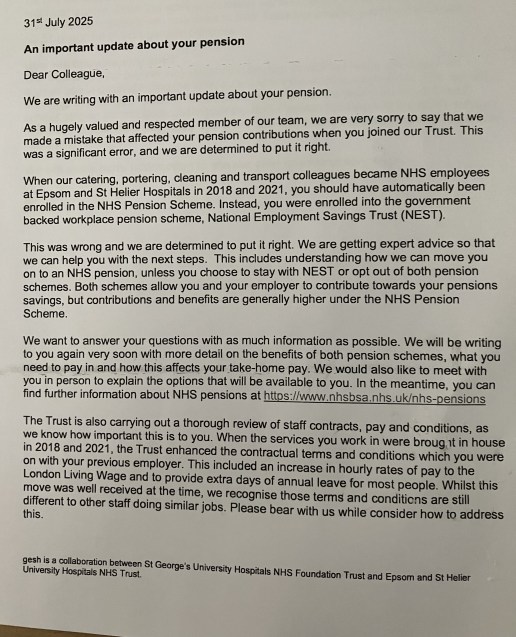
The trust running St Helier and Epsom hospitals in South London and Surrey has admitted it has deprived hundreds of its lowest paid workers their rightful NHS pensions for up to seven years due to a major blunder by its management in signing them up to the wrong scheme.
A letter sent out two weeks ago to catering staff, porters, delivery and transport drivers and cleaners admits it made ” a significant error” when it took the workers back in house in 2018 and 2021 from private contractors.
The move at the time was welcomed by staff as it gave the lowest paid staff higher pay than the going rate by private firms.
It has now emerged that instead of automatically signing staff up to the NHS pension scheme the workers were signed up to an inferior government backed workplace pension scheme, the National Employment Savings Trust (NEST).This pension scheme is aimed at small businesses as well as large private employers.
The letter says that benefits and contributions to the NHS pension scheme are higher.
The trust now part of the St George’s, Epsom and St Helier University Trust employs 5000 staff in the two hospitals – a sizeable number will be low paid staff. The trust will have to compensate workers for this error and has called in the Government Actuary Department to help estimate the scale of the problem which could cost several million pounds at a time when the NHS is squeezed in trying to bring down waiting lists.
The letter also reveals that the new trust has ordered a review of all staff contracts, pay and conditions as a result of the error. It now appears that there are differences between staff doing the same jobs with some receiving extra days leave than others and others on different pay rates.
There is also a suggestion of racism over Sunday working for low paid workers One rate seems to apply for many people from black and ethnic minority workers of £13.86 an hour while Agenda for Change workers, who are mainly white, get £26.31 an hour.
There appears to be a high level of dissatisfaction among lower paid workers with a ballot result for strike action for porters and cleaning staff by their union, the United Voices of the World, just announced of 98 per cent wanting to go on strike. This suggests workers are very unhappy working there.
The trust has one of the highest paid chief executives in the country, Jacqueline Totterdell, who gets £340,000 a year. She and her predecessor, Daniel Elkeles, now chief executive of NHS Providers, were in charge when these errors were made. Jacqueline Totterdell is planning to step down as the NHS faces a big reorganisation under the health secretary, Wes Streeting.
There was an unusual procedure in the courts in the long battle between the Department of Work and Pensions and WASPI last week.
The issue was whether WASPI’s legal costs would be capped in their application for a judicial review over the government’s decision not to award compensation for partial maladministration for 50s women who faced a six year delay in getting their pensions. It led to some pretty strong exchanges between Bindman’s solicitors and DWP lawyers, the latter were vehemently opposed to the cost cap, arguing it was not a public interest issue.
Instead of a hearing last Monday to decide the issue – it was suddenly ” vacated” by the parties concerned and a very senior judge in charge of the administrative court decided to grant the cost capping for WASPI in advance when they bring a case to the courts for permission to have a judicial review. CEDAWinLAW applied to be a friend of the court and submitted documents on the substantive issue on discrimination and maladministration.
CEDAWinLAW said: “As friends to the court, CEDAWinLAW’s Amicus Curaie Intervention and Cost Capping Order applications matter to 3.5million 1950s Women whom we uniquely represent: Thus followed, the submission of our legal documents out of relevant expertise and strong interest in the outcome of Case No AC-2025-LON-000811.
Our purpose is to assist the court by offering impartial information, legal arguments and broader public interest perspectives that are not fully represented by the parties in the case.”
They have had no reply from the court. They have put in a complaint and also written to the judge.
What is extraordinary is the CV of this senior judge. Mr Justice Swift who took the decision shows he is no friend of campaigners and has taken a consistently pro government stance over the years.
A large part of his career was spent as the First Treasury Counsel – known as the Treasury Devil – from 2007 to 2014. The current one is James Eadie who played a prominent and a successful role in defending the government in the judicial review against Backto60 , who fought the Department for Work and Pensions. to claim compensation for 3.5 million 50swomen lost pensions on the grounds of discrimination and maladministration. Their case was never looked at by the Supreme Court who claimed it was ” out of time”.
The whole point of the post is to defend the government from NOT paying out people who sought compensation or redress from government departments, hence him taking the prime role for the DWP. The Treasury is never keen to spend too much money.
More recently he took two the Government’s side on two high profile cases – the deportation of refugees to Rwanda – and the fate of Julian Assange, who is now a freeman. As Wikipedia said:
On 10 June 2022, Mr Justice Swift ruled in favour of the UK Government that the deportation flights of unsuccessful asylum seekers in the UK to Rwanda should be allowed to proceed, as there was material public interest in doing so.[5] He added in his ruling that the risk posed to refugees was “in the realms of speculation”.[6]
On 8 June 2023, Swift ruled in favour of the UK Government, and rejected the appeal of political prisoner Julian Assange‘s legal team, which had filed two appeals before the court against the then Home Secretary Priti Patel‘s decision to extradite Wikileaks founder being indicted by the United States under the Espionage Act. He was later released.
So while WASPI did have a friend at the head of the administrative court it is by no means certain that they will get an easy ride when it comes to getting permission for a judicial review which will require a public hearing. If he had refused the organisation would have been set back as the department could try to get all its costs against them if it won.
In the end the ruling means that the case is being regraded in the “public interest” much as the case for a judicial review the Backto60 case was regarded as a public interest case.
What is staring everyone in the face is why not go for mediation rather than have a long drawn out judicial review which could take years if there are appeals and still needs judicial permission to go ahead.
WASPI set its face against this and not only refused but actively opposed CEDAWinLAW’s attempt to do this through the courts, siding with the DWP’s opposition to this.
Looking at the present situation Angela Madden, who runs the WASPI campaign, appears to be accepting, unlike her bold claims of getting £10,000 for everybody at the Labour Party Conference a few years ago, a token payment so the government acknowledge the maladministration found in the Parliamentary Ombudsman’s report. She in her last message suggested she was not looking for compensation for lost pensions but for the government to accept it needed to pay the women after the Parliamentary Ombudsman’s report.
Yet her members have already raised over £227,000 for a legal case and the organisation wants another £43,000 for what they admit will be a complex hearing. At this rate the legal costs may exceed the award.
In the meantime CEDAWinLAW is applying for observer status in the proceedings.
05/07/2024. London, United Kingdom. Rachel Reeves, Chancellor of the Exchequer poses for a photograph following her appointment to Cabinet by Prime Minister Sir Keir Starmer in 10 Downing Street. Picture by Lauren Hurley / No 10 Downing Street
Last year the biggest hit on this blog was when I condemned the decision by Sir Keir Starmer and Rachel Reeves to abolish the winter fuel allowance for all pensioners except the poorest on pension credit. The blog went viral and currently stands at 188,400 with 129 comments.
The decision – one of the first by an incoming Labour government – was inept, stupid, ill thought out, and rushed – and showed that the Labour government was completely out of touch with its base and its reputation for helping the poorest.
There was a decent case for restricting the payment to the wealthiest members of society who did not need help with their fuel bills. But by setting the figure so low as £11,300 to get it and trying to get people to claim pension credit – which has been a policy failure for years – this was a serious own goal.
The decision to use regulations to do this was attacked by the House of Lords statutory instruments committee – when they examined the detail – and ministers by passed their own benefits advisory committee, the Social Security Advisory Committee, on the flimsiest excuse that they didn’t have time to do this to make sure it could be implemented as an emergency. The committee itself when it finally got to discuss the regulations pointed out it was perfectly capable to look at it at an emergency session. It did this when the last government introduced massive social security changes to cope with lockdown during the pandemic.
The optics also looked bad for any politician. Claiming they had found a huge black hole in government finances it looked as though the first people who would plug the gap were pensioners, many of them surviving on incomes less than £20,000 a year. Pensioners and the disabled also need warm homes in winter probably more than any other people and the government’s claim it was implementing the triple lock to raise pensions was no use in the winter. It would not be paid until the spring when temperatures begin to rise and some would be scrimping and saving to try and keep warm before receiving an extra penny.
The result came back to bite Labour in the spring council elections and Parliamentary by-election in Runcorn, when voters dumped Labour in droves turning to Reform, the Greens and the Liberal Democrats instead.
Labour MPs and activists found this was one of the most cited reasons why people turned against them during the election. As a result Reform could capitalise by gaining control of a swarth of county councils and some mayoralties. The Conservatives were still not trusted by people after their 14 years in government, but to be fair to them they never proposed to cut the winter fuel allowance in the first place.
Luckily for Labour it is four years to the next general election so there is a chance it might be forgotten how stupid they were after four winters. And the mechanism they have proposed to pay the allowance back to nine million pensioners is fair with those earning £35,000 or more having to pay back the money in their annual tax return. The big question is why they didn’t do this in the first place.
The overall policy will still save £450m versus the universal system. But £1.25bn of the £1.7bn projected saving when this policy was announced is gone. Rachel Reeves, the chancellor, was claiming she couldn’t have done this when the government came into power because of the state of the finances, but can now because the situation has improved. She will have to explain this big change in her statement to MPs this week.
In my view the government overall has lost a lot of support by targeting pensioners not only in this way but also in the way it has treated 50swomen who had to wait six years for their pension by completely rejecting any compensation for them and ruling out mediation. I am sceptical that the WASPI campaign will get anywhere by going to court to try and revive the now rejected Parliamentary Ombudsman’s report on partial maladministration.
The issue was always discrimination as well as maladministration and the Ombudsman’s report was a very tepid solution for those who lost tens of thousands of pounds.
And ministers are being dilatory in paying out money to HIV contaminated blood victims and those swindled by the Post Office computer scam. All these affect many in the same age group.
The government has got a lot to do to regain popularity to get a second term in office, but this U turn on the winter fuel allowance is only a start.
Last week Salford City Radio’s Ian Rothwell devoted a whole programme to the CedawinLaw case for mediation to solve the impasse of compensation for the 50swomen who faced a six year delay in getting their pension. Three speakers discussed the issues. Jocelynne Scutt, a former Australian judge and anti discrimination commissioner for Tasmania, gave an update description of the present legal position and how you do not have to court to start a mediation process. Janice Chapman ,a 1950s woman, gives a heart rending account of how women have already been discriminated against before they got their pension and then had to wait six more years before they could get it and how alternatives to work longer are often not possible. I give an interview questioning the wisdom of Waspi’s legal case for partial maladministration and how the All Party Group on State Pension Equality is moving towards insisting that all groups campaign together rather than the division between Waspi and all the other groups which has bedeviled the issue for years.
From right to left Jocelynne Scutt, former Australian judge; Ian Byrne, Labour MP for Liverpool,West Derby and myself a journalist and a patron of CEDAWinLAW.
Waspi threaten further legal action and another judicial review
The present impasse over whether 50swomen should receive any compensation at all after ministers refused to pay must cease.
WASPI who relied on the Parliamentary Ombudsman’s weak findings of partial maladministration to get somewhere between £1000 and £3000 compensation for the 3.5 million women who suffered up to a six year delay in their pensions have been totally defeated and are having to restart from scratch.
CEDAWinLAW, formerly BackTo60, are now pressing to avoid further legal action and go straight to mediation with the government – hence the letter to the PM Sir Keir Starmer, the chancellor, Rachel Reeves and the work and pensions secretary, Liz Kendall.
The government is now facing a two pronged attack over the issue from two groups with different approaches but both are aiming to provide some compensation for the 50swomen.
The approach by CEDAWinLAW is much broader than WASPI which is only concerned with getting some recompense for the partial maladministration Sir Robert Behrens, the former Parliamentary Commissioner for Standards, made in his long drawn out findings even though he conceded that the women were not directly financially affected by their lack of knowledge.
CEDAWinLAW are putting forward a case that the women were both subject to discrimination by being the only group affected by the delay and by the fact that unlike men they did not have the opportunities to build up the numbers of years to get a full pensions by historic discriminatory measures such as being barred from making contributions.
CEDAW is also relying on two key points. The UK under Margaret Thatcher signed up to the UN Convention on the Elimination of All Forms of Discrimination against Women in 1986. This body is monitoring the UK’s progress in meeting the terms of the convention – and the issue of discrimination against 50s women is on their agenda in Geneva and will also be raised next month at a women’s conference on discrimination in New York.
Secondly the UK is moving domestically to accept that mediation is a better way of solving issues across the board rather than clogging up the courts with long running disputes. All this explained succinctly by Jocelynne Scutt, a former Australian judge and a women’s campaigner, in the video below
Now WASPI are planning to do the opposite and engage in a long war of attrition again in the courts against the DWP for throwing out any hope of compensation. Now having covered the long running judicial review by Backto60 from the initial hearing to the Court of Appeal ( the Supreme Court wouldn’t even hear it) this is committing their supporters to years of waiting and a huge financial burden running well into six figures to maintain the fight.
John Halford, head of public law and human rights, Bindmans. Pic credit: Bindmans website
The scale of the issue can be shown by the pre action letter sent to by John Halford of Bindman’s to the DWP. Not only is he is asking the ministry to cancel the decision they made not to compensate the women but he gets involved in a long convoluted argument into why the women should be paid and into the minutie of the detail of various surveys the ministry undertook to make his case.. Given the courts preference to look at precedents he will not be able to escape the DWP making references to the previous judicial review and using it to their advantage to quash such an action. The full text of his letter is reproduced below.
Now buried in this is a U turn by WASPI. The letter states it would like to explore an alternative disputes resolution to solve the problem. This is extraordinary about turn because only last year CEDAWinLAW put forward the same idea and invited WASPI to be an interested party. John Halford sent for all the papers and flatly rejected the approach. Not only that but presumably on the orders of Angela Madden, who runs the WASPI company, decided to side with the DWP against CEDAWinLAW if it came to court. Again the DWP could use it against them if they get a good lawyer.
In many ways this is a very sad tale as no agreement is possible between any of the groups fighting to get justice for the 3.5 million 50swomen. which in the short term will suit the DWP who can play off one group against another. There is also no real leadership from the All Party Parliamentary Group on State Pension Equality for Women led by Rebecca Long Bayley, MP for Salford, who describes herself as a wife, mother and proud Socialist, to bang heads together and go for the government over this.
In the meantime the cohort is starting to die out which will be very convenient for all those MPs and ministers whose inaction just prolongs any justice.
But in the long term this issue, the axing of the winter fuel allowance and what I hear is going to be the biggest assault on disabled people’s benefits in a generation will lose Labour its core support and pave the way for Nigel Farage to be our next Prime Minister.












 Westminster Confidential