A horrendous tale: How a strapping lad was injured for life at work and then fell victim to corporate power and unfair justice

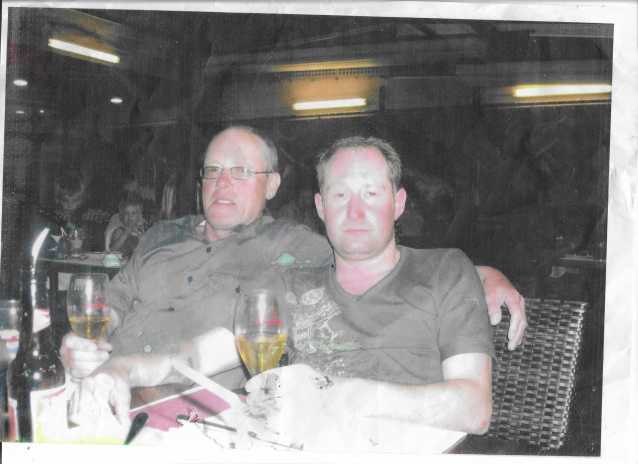
Happier times. Matthew Reynolds (right) enjoying a drink with his late dad, Howard, before his horrendous accident

Matthew Reynolds was a strong strapping lad who earned good money – £80,000 a year – as a welder at the Tata Steel works in Port Talbot, South Wales. He had already bought his own flat and his future was bright.

Then one day as he was welding steel a large heavy refractory brick in the roof of the works came loose and fell 150 feet hitting him on the side of his back. His injuries confined him at the time to a wheelchair, cost him his well paid job, and damaged his spine so he can’t easily move his neck and caused other painful injuries. He had to sell his flat in Port Talbot at a loss ( it was up a flight of stairs) and move back home with his mother in rural Lincolnshire. Today he can barely hobble around, needs help to dress himself and has very little likelihood of getting another job.

This story is not about his injuries -horrendous as they are – but what happened when he tried to claim compensation from Tata Steel so he could live a reasonable life as a disabled person who would always need expensive help and care.

Any reasonable person would expect a multinational company run by a billionaire to pay substantial compensation, especially as the incident had to be reported to the Health and Safety Executive and the company admitted liability.

But in today’s world corporate responsibility is not that straightforward or even ethical. Tata Steel appear to employ health insurers to assess their responsibility and the offer made to Matthew was less than his annual salary – over £50,000 – for a lifelong injury. The figure based on 6 per cent of his claim was recommended by Tata’s health insurers – either coincidently or in line with initial payments offered to sub postmasters.

Just £9500 initial compensation for being left in a wheelchair

As a result he has had to use the county court system for the last SEVEN years to put in a claim and it remains unpaid at the moment. The only money he has received is an initial interim payment of £9500.

Tata, Dousan Babcock, who were managing the site, and Primetals Technologies Ltd- combined to oppose his claim seem to be relying solely on the initial assessment made at accident and emergency department in October 2018 which found no bones were broken but there was serious damage to soft tissue. However three independent specialist doctors have linked other serious damage to himself to the accident. Three and half years later, Mr Caspar Aytott, of Cheltenham Spine Centre found the severe pain had spread from his lower back into his flank, up to his chest into the shoulder and neck with difficulty raising his left arm. This is despite having physiotherapy and two spine injections which had no effect.

Then a rheumatologist found 20 months later that he still had chronic pain and was suffering from fibromyalgia and post traumatic stress disorder due to the accident. A third independent doctor, Karen Simpson, who examined him found he had damaged nerves and wanted him to have rehabilitation which he never got.

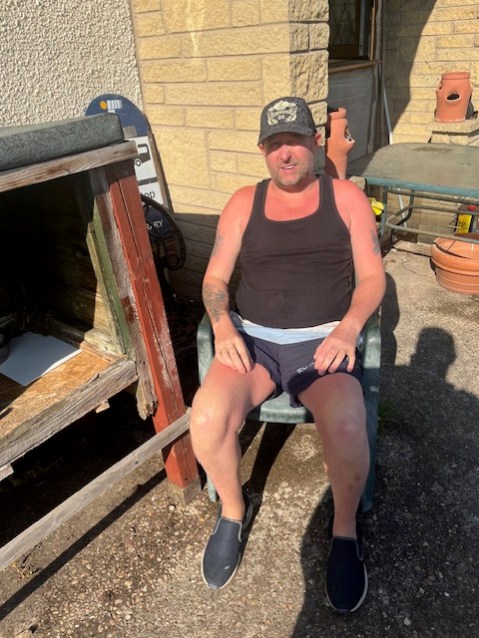
Matthew Reynolds today -now aged 45

What was clear was that he was not returning to full health and getting worse not better. In the meantime his case was dragging on through the slow county court system, which has been heavily exposed by the Commons Justice Committee in a recent report. See my story on this blog here.

During the proceedings that followed his solicitor, supposed to be a family friend who offered to take his case on a ” no win, no fee” basis gave him spectacularly bad advice. This included him cancelling his GMB union subscription, not getting a crucial Health and Safety Executive report on the accident and losing all his original wage slips so a judge could not give him a substantial interim payment at another hearing.

So bad was his role that a judge took a rare decision to remove him from representing Matthew on the grounds of bad communication and mismanagement. There is even an allegation that while representing Matthew he was trying to arrange a dinner with Tata’s leading solicitor in London, Leanne Conisbee.

Matthew and his mother Denniel were meanwhile getting poorer by the minute, racking up the maximum on Matthew’s credit cards, their house faced repossession and a huge bill from their solicitor for handling their case. His mother ended up taking a equity loan on the house. They now rely on food banks to eat and have to pay court fees for every hearing in his case. They have an old Fiat 500 to get around with an adapted front seat as Matthew is in pain if he bends his back.

In desperation Matthew from a wheelchair supervised some men at work to get money for the fees. He did not declare this to court and the lawyers for Tata were tipped off and pounced accusing him of being ” fundamentally dishonest” for not doing so.

After the solicitor had been taken off the case the bundles were returned to Matthew. Included was an email sent to Rodney Fern, a barrister who had tried to prevent the solicitor being removed from the case, which revealed the dirty tricks being prepared by Tata against Matthew.

It read: ” the insurers, as you rightly say, are going to try and starve Matthew Reynolds out. They are not going to withdraw the application on fundamentally dishonesty as this is to be used as a bargaining tool. although it is without any substance.”

Tata’s lawyers said he was ” fundamentally dishonest” in court

I saw it used at Doncaster County Court this year when Matthew tried to get an interim payment. It had to be refused by a sympathetic judge because the law says anybody judged to be ” fundamentally dishonest” cannot be paid. The barrister for Tata was determined he would not get any money.

The situation has now escalated. Last month Matthew asked for a longer period as a litigant in person to prepare for this week’s hearing. He wanted a longer hearing of 10 days, wanted to call 16 extra witnesses including people who witnessed the accident and professional medical people.

All this was refused by both the circuit judge William Hanbury, a former property and local government barrister and senior circuit judge, Mark Gargan. Seven years ago Mark Gargan was found to have given a wrong judgment by the court against a terminally ill claimant in a personal injury claim against a firm when he threw out his case claiming he and his lawyers had ” flagrant disregard” for the rules. The case was reported in the Law Society Gazette here.

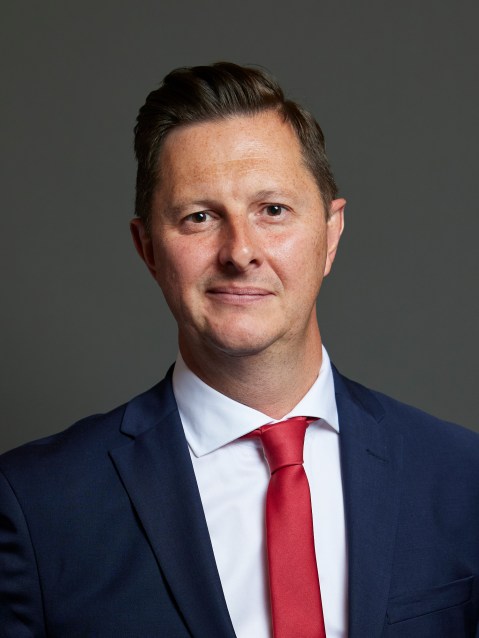
Official Portrait: Lee Pitcher MP Pic Credit: Laurie Noble Photography

The judge took the decision despite receiving a letter from Matthew’s new Labour MP, Lee Pitcher, who represents Doncaster East and the Isle of Axholme.

In it he points out that Matthew, through no fault of his own, has lost his lawyers and is now fighting three large corporations having to navigate ” complex legal proceedings at significant financial and emotional cost”.

He adds: ” it is difficult to see how this can be viewed as a fair and balanced process. That an individual in such a vulnerable position should be left to fight such a case unaided, while the companies involved have already accepted liability, raises serious questions about access to justice.”

“Mr Reynolds has shown remarkable courage in pursuing this case and deserves to be treated with dignity and fairness without.”

His GP also sent a letter to the court saying Matthew was in no fit state to conduct the case and the hearing should be delayed but this was rejected by the judge. Using rather twisted logic the judge rejected this saying even with a delay Matthew would still be in the same state of health in the future – something the big corporations are trying to deny in their case.

He was sent 1500 pages of evidence from the three corporations and given 10 days to digest it and respond before the hearing. He told the judge: ” OK I’ll give these barristers/ solicitors a welding manual. I’ll set them up, give them the equipment ..you’ve got 5-10 days to go for a perfect weld.”

The hearing never went ahead this week. Both Matthew, who had a week of sleepless nights, and his pensioner mother were too ill to attend and drive to the court in Sheffield. I contacted the clerk to the case to find out what would happen next but was told there was no hearing for the rest of the week.

The only new development is that lead solicitor, Leanne Conisbe from Clyde and Co in the City of London has submitted a 74 page victim impact statement – claiming that she and not Matthew had suffered as a result of organising the case. The judge has ruled out his mother putting in a four page victim impact statement.

One-Time
Monthly
Yearly

Make a one-time donation

Make a monthly donation

Make a yearly donation

Choose an amount

£5.00
£10.00
£20.00
£5.00
£15.00
£100.00
£5.00
£15.00
£100.00

Or enter a custom amount

£

Your contribution is appreciated.

Your contribution is appreciated.

Your contribution is appreciated.

DonateDonate monthlyDonate yearly

Please donate to Westminster Confidential

£10.00

Will health minister Karin Smyth spot the need for more radical reform of the General Medical Council to protect clinicians and ultimately patients?

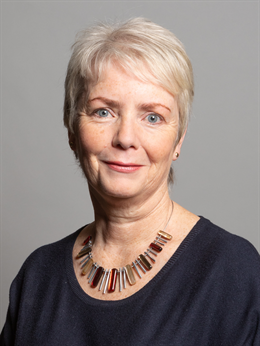
Karin Smyth – health minister responsible for professional regulation reform

The new Labour government is embarking in the first reform of the professional regulation of the General Medical Council for 40 years. This welcome development comes after the GMC extended its scope to cover physician and anaesthesia associates at the end of last year. In theory it will allow the GMC more flexibility to change its rules and allow less adversity among fitness to practice cases involving doctors thus avoiding referrals to the overloaded and often unfair employment tribunals. It also abolishes an arbitrary rule that prevents it looking at cases that are more than five years old.

From my observations of recent complaints against doctors who raise patient safety cases and conversations with doctors who are concerned about referrals to the GMC the whole process needs a radical overhaul. It is also an overhaul that requires some political intervention.

How the GMC handles individual complaints against doctors is by no means transparent. Nor is the GMC directly accountable for their failings and omissions and its workings can be manipulated by individual health trusts. I am about to give you two different examples,

Many doctors think the complaints system is flawed because of a practice of referring the case to the so called ” responsible officer ” to handle it. The responsible officer is often the person who has brought the complaint in the first place – the chief medical officer of the trust. Now the chief medical officer is not what the public might think – the ultimate person protecting medical standards on behalf of patients. He is part of the trust’s management team whose main purpose is to protect the reputation of the trust which may not be in the interest of patients. So surely this is a conflict of interest?

NHS Managers labelled one doctor ” too passionate about patient safety”

There was also an extraordinary experience of a whistle-blower who was a warned by local managers against being too “passionate about patient safety.”

And does the GMC do a thorough job when it investigates.? Doctors are sceptical. In one example it appears the complaints about serious safety issues, were closed at the first step and  not even seen by GMC clinician. The bald reply from the GMC confirmed that to be the case; neither the team had nor did they seek any advice or expert opinion.

The GMC’s current practices enable its staff without clinical knowledge to close clinical concerns in such manner or only with hospital managers’ response, even when the concerns about the said managers are known to the GMC. In one example it appears the complaint was not even seen by fellow clinicians.

Given the whole point, according to many of the doctors who have raised patient issues, is the worry that either patients have already been harmed or more are left  at risk of being harmed by such poor medical practice,  these do not appear to be safe concern closure processes for a regulatory body.

Dr Usha Prasad

There is another side and here I can quote an actual case – as it came up in an employment tribunal – the removal of cardiologist Dr Usha Prasad from the then Epsom and St Helier NHS Trust ( now merged with St George’s Hospital in Tooting, south London.)

Here the GMC faced with 41 complaints from the trust who wanted her removed did do a thorough investigation and checked with very senior cardiologists and exonerated her -including revalidating her working for the next five years.

But the trust’s chief medical officer, Dr James Marsh , refused to accept this, making the fatuous statement that the trust’s medical standards were ” higher than the GMC’s “. This is also ironic as the doctors from that organisation are being revalidated by, no one else but the GMC.

Where a doctor is revaluated the rules should be changed so in those circumstances the GMC’s decision is binding and final and this requires a politician to intervene to make sure this happens. An individual chief medical officer should not have the power to wreck a doctor’s career if their complaint to the GMC is utterly rejected. and not formally appealed against.

I would be very interested to see if other doctors have had similar experiences in both these areas and doctors can contact me on my website  ie either concerns were dismissed without due consideration or the GMC decision was ignored by the managers.  All contact will be treated in confidence unless the doctor wishes to go public.

This is a once in a lifetime reform and we need to get it right for both the benefit of the doctors and the safety of patients who entrust their lives to the NHS.

Karen Smyth, the minister of state for health, has a huge list of responsibilities from this area to cancer care and hospital car parking. The list is here. She needs to focus on this and ask pertinent questions.

One-Time
Monthly
Yearly

Make a one-time donation

Make a monthly donation

Make a yearly donation

Choose an amount

£5.00
£10.00
£20.00
£5.00
£15.00
£100.00
£5.00
£15.00
£100.00

Or enter a custom amount

£

Your contribution is appreciated.

Your contribution is appreciated.

Your contribution is appreciated.

DonateDonate monthlyDonate yearly

Please donate to Westminster Confidential

£10.00
Dysfunctional County Courts are a failure for civil justice, damning MPs report

Norwich County Court

Yet another arm of the court system has failed millions of people who want justice because it is totally dysfunctional, a scathing report by MPs warned this week.

The Commons Justice Committee describes the county court system as the ” Cinderella ” of civil justice, a finding that might be similarly applied to readers of this blog to those experiencing the employment tribunal system.

The report calls for an ‘urgent and comprehensive, root-and-branch’ review is required to address systemic delays and entrenched inefficiencies across its operations. It reveals a decade-long digital Reform programme has fallen well short of its ambition, leaving a myriad of incompatible systems and outdated paper-based processes. It still only covers 23 per cent of cases while the rest of the court cases rely on paper or a mixture of digital and paper.

Andrew Slaughter, the Labour chair of the justice committee, described the situation as one of the most serious problems and said the county court system was ” living in another world” compared to the rest of the country.

The scale of the mess is breath taking and it does not surprise me.

The report says: “We found that the situation in the County Court is dire and requires urgent attention. The court estate is in a state of significant disrepair following years of “chronic underfunding,” with regional variation remaining a perennial issue, and the operations of the court having been failed by a
dysfunctional attempt at digital reform. The Committee found that the problems would be all the greater without the commendable efforts of court staff to operate a system that fails to provide access to justice”

The report describes buildings subject to rat infestations and still containing asbestos and wondered if any of the £220 million allocated to rebuilding the court system had been spent on county courts.

Other problems include access to the courts which amounts to a postcode lottery and the retention of staff when facing a big turnover of people. Examples of the first problem included some courts like Barnet and Romford not responding to inquiries and Mansfield County Court; Brentford County Court;
Darlington County Court ;Edmonton County Court; Hertford County Court; Lewes Combined Court Centre; and Taunton Crown,County and Family Court not permitting people in wheelchairs to access the courts.

The report points out that many people bringing cases to court are litigants in person and says the problems people face needed to be addressed.

The report says: “Despite persistent calls, litigants-in-person are not adequately supported through the court process. The language used in court applications is inaccessible, court procedure is not explained, and there is limited support available. The insufficient data collection on the prevalence of litigants-in-person means the Ministry of Justice cannot understand how to direct and provide the support needed.”

The report reveals that five decades ago in the 1970s this issue was raised and still nothing has been done about it.

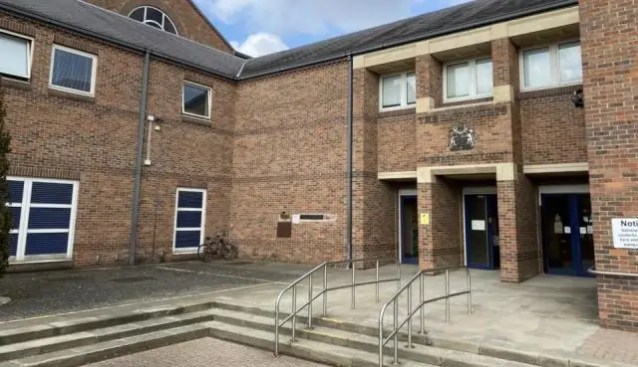
I am at present monitoring one case at Sheffield County Court involving a young welder, Matthew Reynolds, who got life changing injuries after a heavy refractory brick fell 150 feet from the roof of the steel works at Port Talbot. The case has been going on for five years and he still has not adequate compensation as the case is dragged through the county courts in Doncaster and Sheffield. He is facing as a litigant in person expensively paid KC’s by Tata Steel, Babcock and an insurance company who while admitting liability don’t want to pay anywhere near the money he needs for the rest of his life. I intend to write up the full story as it proceeds through the county court system.

Andrew Slaughter, described his case as ” an extreme one”.

His committee is planning to look at the whole issue of legal aid across the legal and inquiry system after the previous Conservative government slashed billions from the legal aid budget.

Andrew Slaughter MP Pic Credit: Official Portrait Parliament

Andy Slaughter MP said: The conclusions of our report make for stark reading: the County Court is a dysfunctional system, that has failed adequately to deliver civil justice across England and Wales. It is the ‘Cinderella service’ of the justice system, evidenced by the reviews currently underway into both sentencing and the criminal courts, while there is a fundamental absence of any equivalent process across civil justice.

With over a million claims each year and a vast jurisdiction, the County Court is where most citizens and businesses encounter the justice system, yet it is beset by unacceptable delays, recruitment and retention issues across frontline staff and the Judiciary, and a complex “patchwork” of paper-based and digital systems.

The causes of the inefficiencies and delays in the County Court are chronic, following years of underfunding, yet what is unclear is how HM Courts and Tribunals Service (HMCTS), together with the Judiciary and the Ministry of Justice, intends to address such a serious situation.

“Justice delayed is justice denied. The Justice Committee recommends an urgent and comprehensive, root-and-branch review of the County Court launched by Spring 2026 to establish a sustainable plan for reducing the systemic delays and inefficiencies entrenched across its operations. It is not tenable to continue without fundamental reform.”

One-Time
Monthly
Yearly

Make a one-time donation

Make a monthly donation

Make a yearly donation

Choose an amount

£5.00
£10.00
£20.00
£5.00
£15.00
£100.00
£5.00
£15.00
£100.00

Or enter a custom amount

£

Your contribution is appreciated.

Your contribution is appreciated.

Your contribution is appreciated.

DonateDonate monthlyDonate yearly

Please donate to Westminster Confidential

£10.00
Top London coroner faces accusation of tampering with an inquest audio and a judicial review on the handling of her hearing into the death of an ITV journalist

Senior coroner Mary Hassell Pic credit: Archant

Judge blocked her attempt to keep her name secret during the hearing

A highly controversial senior coroner is facing serious allegations that she or her staff removed parts of a transcript and recording of her hearing into the death of a talented and hardworking ITV news editor Teresa McMahon who was found hanged at her home four years ago.

Mary Hassell found that she committed suicide and ruled out that she was subject to ” coercive control” by her ex boyfriend, Robert Chalmers, an NHS estates employee, who had previous convictions for violence. Mary Hassell believed the words of the pathologist ,Dr Mohammed Bashir, who examined the body but kept no photographic evidence and discounted domestic violence and Greater Manchester Police who decided from the start that no crime had been committed and never took any photographs either at the scene of her death.

Throughout the hearing this version was challenged by Teresa’s aunt, Lorna McMahon, who was frequently interrupted by Mary Hassell when she raised questions about the competence of Greater Manchester Police in handling the investigation into her niece’s death.

I was present at the hearing at the hearing with many other journalists. My report on it is here.

Yesterday’s hearing at the Royal Courts of Justice was meant to decide whether the court could give her permission to bring a judicial review into Mary Hassell’s hearing claiming her conduct was irrational and procedurally unfair in coming to her verdict.

Teresa McMahon

But the hearing took a completely different turn under Mr Justice Stephen Morris when Lorna McMahon, having obtained both the transcript and audio recording of the hearing said parts of both, covering descriptions of previous violence against her niece by her ex boyfriend had been omitted.

It also emerged from correspondence I have seen from Mary Hassell’s lawyers and a public ruling by a previous judge Mr Justice Kerr, that the coroner had tried to get her name kept out of the public domain during the hearing.

Her lawyers claimed ” it was customary” to be not named. She wanted it done under ” the slip rule” which meant there would be no hearing about the application. The judge ruled this procedure could not used in this way and rejected her application because it raised issues of ” open justice”.

When Mr Justice Morris heard Lorna McMahon’s evidence he weighed up whether to continue the hearing or adjourn it to allow her complaint to be properly looked at and for her to provide evidence from other people at the original hearing – including members of the public and journalists – to back up her claim.

All sides in the case agreed it was an extremely serious allegation which could be viewed as a criminal case of perverting the cause of justice.

Her own lawyer, Jonathan Glasson KC, agreed as such and but added by adjourning the case until the late autumn it meant that the accusations against the coroner were left hanging over her for some weeks.

The judge also made it clear by adjourning the hearing it did not mean that he was convinced about Lorna’s case and said she would need more evidence.

The directions he gave are worth reporting in full:

IT IS ORDERED THAT

  1. The application for permission to apply for judicial review is adjourned

2. By 4pm on 12 August 2025, the Claimant is to file and serve a witness statement, verified by statement of truth, identifying any and all parts of what was said at the hearing of the inquest by the Defendant on 5 December 2024 (“the Hearing”) which she contends have been omitted from the audio recording of the Hearing provided to the Court and the Claimant by email dated 14 July 2025 at 513pm and sent by Payne Hicks Beach LLP (“the Audio Recording”).

3. At the same time as filing and serving her witness statement pursuant to paragraph 2 above, the Claimant is to file and serve any and all witness statement evidence from others (including witnesses called at the Hearing and/or members of the press and/or members of the public) in support of her contention that parts of what was said at the Hearing have been omitted from the Audio Recording.

4 By 4pm on 9 September 2025, the Defendant is to file and serve a witness statement, verified by statement of truth, in response to the evidence filed and served pursuant to paragraphs 2 and 3 above, to include an explanation as to how the Audio Recording was produced.

5.By 4pm on 23 September 2025, the Claimant, if she so wishes, is to file and serve a written statement stating whether, and if so, why, she seeks a further oral hearing for directions in respect of the matters covered by paragraphs 2 to 4 above.

6.As soon as possible thereafter, the matter is to be placed before a judge (if possible, Mr Justice Morris) on the papers to consider directions for the progress of the case, and in particular whether there should be a further oral hearing dealing with the matters covered by paragraphs 2 to 4 above, taking account of all necessary reasonable adjustments.

7 The case to be reserved to Mr Justice Morris, if possible.

8. Costs of the adjournment and of the matters raised above reserved

This is the second recent case where there has been controversy about Mary Hassell’s handling of inquests.

Earlier that year she held an inquest into the tragic death of Gaia Young,25, who  was rushed to accident and emergency at University College Hospital with severe headaches only to die of an unexplained brain condition and doctors have yet to correctly diagnose what was wrong with her.

Again Mary Hassell  patronised and showed no empathy for her bereaved mother, Lady Dorit Young, who had lost her only child ,Gaia, and failed to properly investigate her death. The full story is on the Truth for Gaia website. She even blocked her from making a statement at the inquest. I reported that hearing and you can read about it here.

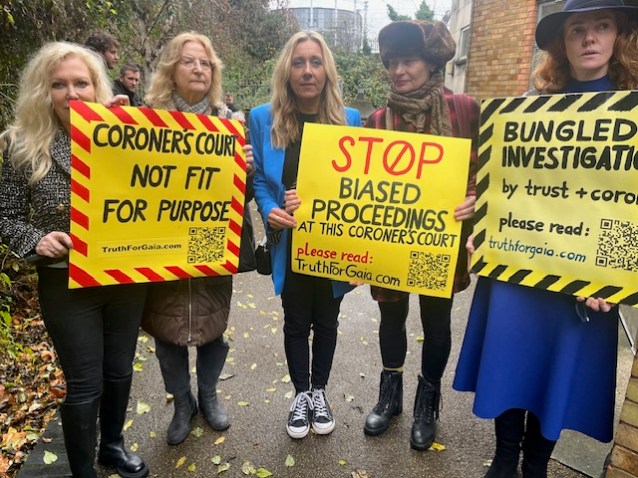
The treatment of both relatives led to a protest outside the coroner’s court during Teresa’s inquest. Pictures are below.

One-Time
Monthly
Yearly

Make a one-time donation

Make a monthly donation

Make a yearly donation

Choose an amount

£5.00
£10.00
£20.00
£5.00
£15.00
£100.00
£5.00
£15.00
£100.00

Or enter a custom amount

£

Your contribution is appreciated.

Your contribution is appreciated.

Your contribution is appreciated.

DonateDonate monthlyDonate yearly

Please donate to Westminster Confidential

£10.00
The story of a Berkhamsted Quaker arrested for protesting about designating Palestine Action as a terrorist group

Sue in the pink dress joining the demonstration on July 5. She later was holding a placard when she was arrested. Pic Credit: London Evening Standard.

My view about the Government’s hasty decision to designate Palestine Action as a terrorist organisation was disproportionate and unwarranted.

It is saying the people who damage property to protest about Britain’s armed support for Israel are equivalent to the Manchester Arena concert bomber who set out to kill and maim as many people he could enjoying a pop concert. This is plainly a ridiculous comparison. If the authorities want to take action against people who damage planes there are already plenty of laws in this country from criminal trespass to criminal damage that could be used. And it is absurd to say anybody peacefully demonstrating in favour of this organisation should go to jail for 14 years.

So unusually I have given space to one of our local people to describe her feelings about being arrested and bailed for demonstrating in front of Ghandi’s statute in Parliament Square last week. She has distributed this to Quakers and I thought it deserved a wider audience. She has not been charged with anything yet so it is reasonable to report this. Journalists who follow the law more closely than me say the fact she hasn’t been charged is because it will have been referred to the Crown Prosecution Service to consider what to do as there are lesser charges that can be brought. Many of the people arrested were elderly and likely to die in prison if the full terrorism sentence was served.

Here is Sue Hampton’s tale:

I was arrested on July 5 at the feet of Gandi’s statute

I was arrested on Saturday 5th July at the feet of the Gandhi statue in Parliament Square, along with three Christian Climate Action friends, among more than twenty others. We were arrested under Section 13 of the Terrorism Act, within hours of the proscription of Palestine Action, for holding a placard that read I OPPOSE GENOCIDE (and) I SUPPORT PALESTINE ACTION. When interviewed at a police station I told the solicitor that I would like, in answer to each question, to say, “I am a lifelong pacifist, a Quaker and follower of Jesus.” Emotionally I regret to say I took his advice and stuck with “No Comment”. After being kept twelve hours I wasn’t charged but given bail conditions and told to report back to Wandsworth Police Station on October 2nd. In my cell I experienced unusually deep peace as well as profound grief.

Palestine Action is a nonviolent direct action group. The Filton 18, still on remand many months after blockading an arms factory, and those who recently disabled a fighter jet with paint, believe in peace and justice. Many Friends will remember Sam Waldron taking a similar action at an RAF base and being acquitted, and before that, the Ploughshares women who damaged a plane destined for East Timor. My own first arrest some years back was for locking on with two other Quakers to block the road to the London Arms Fair. UNICEF says that 50,000 children have been killed or injured in Gaza, yet our government continues to support Israel by supplying parts for missiles, by sharing military intelligence and training Israeli soldiers – while refusing to condemn the war crimes of Netanyahu’s government as genocide. Incredibly, thirteen members of the UK Cabinet, including Keir Starmer, Yvette Cooper and David Lammy, have received gifts from that government.

By lumping Palestine Action together with two violent organisations in the proscription bill, our own government skewed the vote. I seriously believe that the outcome would have been different had our MPs been voting separately on each group. Indeed, my own MP has implied that under those circumstances she would have made a different decision. This is not justice. It isn’t honourable. Like the BBC’s biased new coverage and their decision not to show the documentary they commissioned on medics being targeted in Gaza, it’s wrong.

That’s why I took a spare placard on Saturday and sat with my principled activist friends. I hadn’t been allocated one, and if asked in advance I might, or might not, have been daunted by the potential custodial sentence (up to 14 years) but I wanted to support the protest with a badge. Will people be arrested for wearing badges or T-shirts in support of Palestine Action, for sharing posts on social media, for using any public platform to speak the truth that proscribing a nonviolent protest group is unjust? Although an immediate appeal failed to prevent the law being passed, I do believe that the proscription will eventually be declared unlawful. More importantly, a peaceful resolution to the conflict may yet be found, and the real terror will end.

One-Time
Monthly
Yearly

Make a one-time donation

Make a monthly donation

Make a yearly donation

Choose an amount

£5.00
£10.00
£20.00
£5.00
£15.00
£100.00
£5.00
£15.00
£100.00

Or enter a custom amount

£

Your contribution is appreciated.

Your contribution is appreciated.

Your contribution is appreciated.

DonateDonate monthlyDonate yearly

Please donate to Westminster Confidential

£10.00
Yet another potentially dangerous leak at Sellafield nuclear waste plant

The giant Sellafield site

The Sunday Mirror reports today of yet another potentially serious leak affecting worker safety at Sellafield which was not publicly released two years ago.

A whistleblower told the paper that an elevated level of nitrogen which can cause asphyxiation was released in the most dangerous building on the site – the Magnox nuclear storage facility which is also leaking contaminated water into the ground.

As I reported in Byline Times last month the 100 year clean up is already 13 years behind schedule and £20 billion over budget and its own nuclear safety experts say is becoming increasingly unsafe. The article is here.

What is disturbing is that the whistleblower told the newspaper. “It was most serious because it could have killed somebody. The whole point of having all these safety procedures is to stop people breathing in inert gas, so we can evacuate before there’s a chance of breathing it in.”

The source said the leak in May 2023 was raised as an incident report and “was of a level that needed to be escalated”. But it was not escalated, according to the whistleblower, who added that “no lessons were learned”.

The source said: “There is no confidence or trust in the senior management now. We are dealing with nuclear waste and people are afraid to speak up. The problem is that people are being victimised if they report safety issues.

“Or they are escalated to managers who then try to cover them up or sweep them under the carpet. And that is a really dangerous culture in a place like Sellafield.”

This new disclosure just comes after a report from the Commons Public Accounts Committee that was highly critical of the management at Sellafield and the oversight of the dangerous site by the Nuclear Decommissioning Authority. It was also highlighted safety issues as the buildings reach the end end of their life span and MPs were sceptical of claims by the senior management that relations with staff are improving and a toxic culture of bullying and harassment had been stopped.

Officially Sellafield told the paper:”This was reported and investigated swiftly and thoroughly. Our regulator was informed in line with established protocols,” they said. “Our Safecall system remains independent providing a safe and confidential reporting system for the whole of the NDA group.

“Whistleblowers are respected, protected, and valued and we actively encourage employees to report matters of concern. Without exception, issues raised are taken seriously, investigated appropriately, and treated confidentially. We strongly advise anyone with a concern about a safety event or investigation to report it so we can act on it.”

They added that during routine testing of a nitrogen delivery system in the Magnox Swarf Storage Silo in 2023, a control valve was opened causing a ‘brief increase in flow and pressure of nitrogen’.

‌ The paper reports that Ex-Sellafield HR consultant Alison McDermott raised safety concerns in an employment tribunal in 2021. The management ended and her contract and spent hundreds of thousands of pounds of taxpayers’ money to undermine her concerns at employment tribunals.

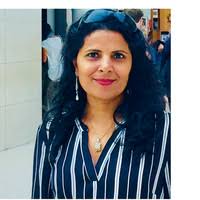
Alison McDermott

Alison, who lives near Ilkley, West Yorks, said: “In my experience, leaders cover up problems and lash out at people who speak out. That’s a terrifying state of affairs at a nuclear site. In my 30 years in HR it’s the most secretive, punitive toxic culture I’ve ever experienced.”

To my mind it suggests that Sellafield still has a very long way to go to convince Parliament and the public that they are handling safety issues properly at this plant.

One-Time
Monthly
Yearly

Make a one-time donation

Make a monthly donation

Make a yearly donation

Choose an amount

£5.00
£10.00
£20.00
£5.00
£15.00
£100.00
£5.00
£15.00
£100.00

Or enter a custom amount

£

Your contribution is appreciated.

Your contribution is appreciated.

Your contribution is appreciated.

DonateDonate monthlyDonate yearly

Please donate to Westminster Confidential

£10.00
Revealed: The ultra Establishment Judge who granted a cost capping order for WASPI without a hearing

Judge Jonathan Swift

There was an unusual procedure in the courts in the long battle between the Department of Work and Pensions and WASPI last week.

The issue was whether WASPI’s legal costs would be capped in their application for a judicial review over the government’s decision not to award compensation for partial maladministration for 50s women who faced a six year delay in getting their pensions. It led to some pretty strong exchanges between Bindman’s solicitors and DWP lawyers, the latter were vehemently opposed to the cost cap, arguing it was not a public interest issue.

Instead of a hearing last Monday to decide the issue – it was suddenly ” vacated” by the parties concerned and a very senior judge in charge of the administrative court decided to grant the cost capping for WASPI in advance when they bring a case to the courts for permission to have a judicial review. CEDAWinLAW applied to be a friend of the court and submitted documents on the substantive issue on discrimination and maladministration.

CEDAWinLAW said: “As friends to the court, CEDAWinLAW’s Amicus Curaie Intervention and Cost Capping Order applications matter to 3.5million 1950s Women whom we uniquely represent: Thus followed, the submission of our legal documents out of relevant expertise and strong interest in the outcome of Case No AC-2025-LON-000811.

Our purpose is to assist the court by offering impartial information, legal arguments and broader public interest perspectives that are not fully represented by the parties in the case.”

They have had no reply from the court. They have put in a complaint and also written to the judge.

What is extraordinary is the CV of this senior judge. Mr Justice Swift who took the decision shows he is no friend of campaigners and has taken a consistently pro government stance over the years.

A large part of his career was spent as the First Treasury Counsel – known as the Treasury Devil – from 2007 to 2014. The current one is James Eadie who played a prominent and a successful role in defending the government in the judicial review against Backto60 , who fought the Department for Work and Pensions. to claim compensation for 3.5 million 50swomen lost pensions on the grounds of discrimination and maladministration. Their case was never looked at by the Supreme Court who claimed it was ” out of time”.

The whole point of the post is to defend the government from NOT paying out people who sought compensation or redress from government departments, hence him taking the prime role for the DWP. The Treasury is never keen to spend too much money.

More recently he took two the Government’s side on two high profile cases – the deportation of refugees to Rwanda – and the fate of Julian Assange, who is now a freeman. As Wikipedia said:

On 10 June 2022, Mr Justice Swift ruled in favour of the UK Government that the deportation flights of unsuccessful asylum seekers in the UK to Rwanda should be allowed to proceed, as there was material public interest in doing so.[5] He added in his ruling that the risk posed to refugees was “in the realms of speculation”.[6]

On 8 June 2023, Swift ruled in favour of the UK Government, and rejected the appeal of political prisoner Julian Assange‘s legal team, which had filed two appeals before the court against the then Home Secretary Priti Patel‘s decision to extradite Wikileaks founder being indicted by the United States under the Espionage Act. He was later released.

So while WASPI did have a friend at the head of the administrative court it is by no means certain that they will get an easy ride when it comes to getting permission for a judicial review which will require a public hearing. If he had refused the organisation would have been set back as the department could try to get all its costs against them if it won.

In the end the ruling means that the case is being regraded in the “public interest” much as the case for a judicial review the Backto60 case was regarded as a public interest case.

What is staring everyone in the face is why not go for mediation rather than have a long drawn out judicial review which could take years if there are appeals and still needs judicial permission to go ahead.

WASPI set its face against this and not only refused but actively opposed CEDAWinLAW’s attempt to do this through the courts, siding with the DWP’s opposition to this.

Looking at the present situation Angela Madden, who runs the WASPI campaign, appears to be accepting, unlike her bold claims of getting £10,000 for everybody at the Labour Party Conference a few years ago, a token payment so the government acknowledge the maladministration found in the Parliamentary Ombudsman’s report. She in her last message suggested she was not looking for compensation for lost pensions but for the government to accept it needed to pay the women after the Parliamentary Ombudsman’s report.

Yet her members have already raised over £227,000 for a legal case and the organisation wants another £43,000 for what they admit will be a complex hearing. At this rate the legal costs may exceed the award.

In the meantime CEDAWinLAW is applying for observer status in the proceedings.

One-Time
Monthly
Yearly

Make a one-time donation

Make a monthly donation

Make a yearly donation

Choose an amount

£5.00
£10.00
£20.00
£5.00
£15.00
£100.00
£5.00
£15.00
£100.00

Or enter a custom amount

£

Your contribution is appreciated.

Your contribution is appreciated.

Your contribution is appreciated.

DonateDonate monthlyDonate yearly

Please donate to Westminster Confidential

£10.00
Exclusive: NHS Trust chief executives who persecute whistleblowers on patient safety win prestigious awards

From L to R: Alex Whitfield, Hampshire Ben Travis, Lewisham Daniel Elkeles London Ambulance

Three of the top 50 NHS chief executives chosen by a panel set up by the Health Services Journal in 2024 as the best people to run the NHS have been involved in attempting to cover up patient deaths and persecuting doctors and nurses who raised the issues.

One of the top three NHS awards went to Daniel Elkeles, as chief executive of London Ambulance Service Trust and is now chief executive of NHS Providers. He was chief executive of the Epsom and St Helier Trust when Usha Prasad, a cardiologist, reported the ” avoidable death ” of a heart patient. He told her to drop her case at an employment tribunal or face an internal disciplinary hearing which led to her being sacked.

I have since been told that Mr Elkeles was involved in an alleged cover up at the London Ambulance Service when a paramedic was suspended during the stressful period of the pandemic. He had alleged bullying, Elkeles said he would investigate but got the person to sign a non disclosure agreement. When it was signed it is said any investigation was dropped.

The second chief executive is Alex Whitfield who heads Hampshire Hospitals Foundation Trust, was involved in the sacking of Dr Martyn Pitman, a well respected obstetrician and gynaecologist, who raised patient safety issues in the already nationally stressed maternity services. The former oil executive is rated the 15th best chief executive.

The lack of care at the hospital in Winchester led to one mother and a baby dying, but Alex Whitfield used the tribunal to claim that Dr Pitman was ” putting patients at risk” rather than supporting the doctor and midwives who were helping patients. Lawyers for the trust monstered Dr Pitman claiming he was a bully for raising these issues.

Julie Dawes, the chief nursing officer at the trust, who also pursued Dr Pitman ,has just been awarded an MBE for services to nursing in the King’s Birthday Honours List.

The third award winner is Ben Travis, chief executive of Lewisham and Greenwich NHS Trust, which the Care Quality Commission, say ” requires improvement.”

Ben Travis was heavily involved in the 2022 tribunal hearings brought by Dr Chris Day, who has fought the trust for 10 years after he raised important patient safety concerns that became associated with two avoidable deaths  in the intensive care unit of Woolwich Hospital, run by the trust. The 2022 tribunal ruled against him despite evidence given by Ben Travis which shown to be untrue, the destruction of 90,000 emails during the hearing and the discovery of fresh documents .which should have been released by the trust to him to help his case.

The results of the last hearing is up for appeal on six grounds next week. He won the right to appeal that some of the findings of the judgment were perverse, that the judgment failed to draw any inferences from the destruction of 90,000 emails and the failure to provide documents that would have helped Dr Day’s case. This in particular followed the disclosure in documents that under oath the chief executive, Ben Travis gave an untrue account about a board meeting and had hidden he had contacted other trust chief executives about Dr Day.

Yet Mr Travis won the award on his personal performance over the last year; the performance of the organisation he led, given the circumstances it is in; and the contribution made to the wider health and social care system.

Award for Diversity

At the same time the trust has won a second award for its equality, diversity and inclusiveness despite its NHS staff report showing that it has a below average rating for the fair promotion of ethnic minority staff and for racial discrimination inside the trust and from members of the public.

The panel who decided the awards for the best chief executives included Dr Rosie Benneyworth, chief executive, Health Service Safety Investigations Body:Steve Brine, former Tory MP for Winchester and former chair, Commons Health and Social Care Committee,; Matthew Taylor, head of the NHS Confederation;Sir Julian Hartley, former chief executive of NHS Providers; Patricia Marquis, executive director for England, Royal College of Nursing and Dr Vish Sharma, chair, BMA’s consultant committee.

It is inconceivable that many of them did not know about the whistleblower cases. Dr Chris Day’s case is high profile; Dr Martyn Pitman’s case was in the national press and Steve Brine was his local MP. Usha Prasad’s case was a long running one.

There is another issue which is worth pursuing in a later blog – how ethnic minorities are treated in the NHS and the level of racial discrimination and whether black and Asian people have fair promotion prospects. Lewisham and Greenwich NHS Trust is not alone

One-Time
Monthly
Yearly

Make a one-time donation

Make a monthly donation

Make a yearly donation

Choose an amount

£5.00
£10.00
£20.00
£5.00
£15.00
£100.00
£5.00
£15.00
£100.00

Or enter a custom amount

£

Your contribution is appreciated.

Your contribution is appreciated.

Your contribution is appreciated.

DonateDonate monthlyDonate yearly

Please donate to Westminster Confidential

£10.00
Lawyers threaten the Judicial Conduct Investigations Office with a judicial review over failure to investigate Judge Lancaster

The logo of the JCIO Pic Credit: Ministry of Justice

The 13 claimants who allege bullying and misogyny by judge Philip Lancaster, most of them women, took their complaints against the JCIO to a new level last week when their all women team of lawyers issued what is known as a ” letter before action” to the investigatory body.

Their lawyers, DFG, standing for Deighton, Pierce and Glynn, have given the JCIO until Monday to reply or face action for a judicial review.

The statement in their letter reads in bold type: “By this Group Complaint, we are therefore requesting the JCIO to open a proper investigation into the cases of all these complainants on the grounds that it is now clear that Judge Lancaster has repeatedly engaged in misconduct in his judicial role over many years.

The misconduct consists of regular bullying of litigants-in-person and legal representatives, including shouting, harsh and inappropriate personal criticisms, intimidation and interruption of evidence.
We make clear that if this longstanding pattern of Judge Lancaster’s misconduct is not properly investigated by the JCIO we intend to challenge that decision by way of judicial review.

As I reported in Byline Times earlier this year ( see the article here) the Good Law Project first announced it was backing the then ten women who had faced bullying and misogynist comments from the elderly judge. Since then they have been joined by men who say they faced the same bullying tone from the judge who sits on the Leeds employment tribunal.

Judge Lancaster

The campaign began after the treatment of Alison McDermott, the now famous whistleblower, who exposed bullying and harassment at Sellafield nuclear waste facility, only to be bullied and rudely treated herself by judge Lancaster and lawyers representing Sellafield and the Nuclear Decommissioning Authority.

Judge Barry Clarke

Barry Clarke, President of the Employment Tribunal system, claimed she was fit to lodge a complaint — despite having no medical qualifications and ignoring a GP’s note saying she was suffering from severe clinical depression. He used this self-made “diagnosis” to deny her an extension, effectively blocking any investigation into Judge Lancaster, even as serious complaints from others were piling up.

The ramifications of what has happened since are causing serious problems for the nuclear waste plant and the judiciary. MPs on the Public Accounts Committee are now sceptical of claims by the top executives at the plant that there is no bullying or harassment and one MP, Anna Dixon, the new Labour MP for Shipley, and a member of the PAC, demanded in public that the chief executive of Sellafield apologise to her for the way Sellafield has behaved to her.

Harriet Harman Pic Credit:BBC

Meanwhile, Baroness Harriet Harman is conducting a separate investigation, with the support of the Bar Standards Board, into sexual harassment at the bar and in the judiciary — and has reportedly taken a direct interest in the Lancaster complaints.

Lawyers have demanded the JCIO does a complete and thorough investigation into Judge Lancaster.

1 A comprehensive review of all complaints submitted against Judge Lancaster, including those previously dismissed without investigation.
2 Statements from each complainant to ensure their full accounts are properly recorded and considered.
3.Interviews with relevant witnesses — including legal professionals, medical experts, accredited journalists, and public observers who attended the hearings and submitted complaints or documentation.
4 Consideration of the Employment Appeal Tribunal’s formal criticisms of Judge Lancaster’s conduct as part of the evidentiary record.
5 An analysis of Judge Lancaster’s written judgments to identify recurring patterns of reasoning, tone, and language indicating systemic bias. We have found consistent indicators of gender bias in descriptions of female claimants versus male respondents, including demeaning language, unsupported
character judgments, and disparate procedural treatment.

Alison McDermott

The JCIO originally said it did not comment on individual cases but now says it considers complaints carefully.

This is not the view of the complainants, their lawyers, and soon I expect if this gets more coverage, the general public.

One-Time
Monthly
Yearly

Make a one-time donation

Make a monthly donation

Make a yearly donation

Choose an amount

£5.00
£10.00
£20.00
£5.00
£15.00
£100.00
£5.00
£15.00
£100.00

Or enter a custom amount

£

Your contribution is appreciated.

Your contribution is appreciated.

Your contribution is appreciated.

DonateDonate monthlyDonate yearly

Please donate to Westminster Confidential

£10.00
Putin’s seizure of 147 leased civil aircraft leads to a multi billion legal victory for firms against insurance companies

President Putin Pic credit: President’s office Russia

Case came as a result of action taken after Russia launched Ukrainian war

An extraordinary ground breaking judgment last week which has received little publicity outside the insurance and legal world has cost the insurance industry, including Lloyds of London, billions of pounds in claims as a direct result of the current Ukraine war.

At the time Russia invaded Ukraine in 2022 Russian civil aviation firms, mainly Aeroflot and S7, a private Siberian airline, were leasing 147 aircraft and 16 spare engines from companies across the world. As soon as this happened the companies wanted their planes back as they came under sanctions against Russia issued by the EU, US, and the UK.

But the move was thwarted by PresIdent Putin who passed a law banning the export of all the planes and the spare engines from leaving Russia and they are still there today.

The decision led to an extraordinary legal case coming before the Commercial Court in London when six of the companies came together to claim against their insurers to get their money back in a joint action that could cost the insurers over £3.4 billion.

Mr Justice Butcher; Pic Credit: Judiciary website

The case which has been quietly rumbling on for five months was a lawyers’ bonanza with more than 50 barristers employed on both sides-. It was heard by Mr Justice Butcher who has issued a 230 page ground breaking judgment covering 100 years of case law.

The six leasing companies were Aercap Ireland: Dubai Aerospace Enterprise, Falcon 2019-1;KDAC Aircraft Trading; Merx Aviation Servicing and Gasl Ireland Leasing A-I. Aercap Ireland, based in Dublin, is the world’s largest aircraft leasing company.

The insurance companies involved included Lloyds,AIG Europe; Chubb European Group and the underwriting group Kiln Syndicate 510. KDAC settled with Chubb before the end of the case. To add to complications under Russian law they had also to have insurance from Russian companies.

S7 – the Siberian Airline which leased many of the jets

The dispute centred round whether the aircraft were covered by ” all risks” policies or ” war risks” polices. The judge ruled that they were covered by “war risks” policies because of the action of Putin in banning them leaving Russia. This will mean the companies will not get all the money they claimed but it will still run to billions of pounds The judge also rejected an argument from the insurers that sanctions against Russia prevented them paying out any money.

The ruling is also significant as it would spark off other claims against insurers and there were 400 leased aircraft in Russia at the time. The insurers have until the end of this week to appeal.

One-Time
Monthly
Yearly

Make a one-time donation

Make a monthly donation

Make a yearly donation

Choose an amount

£5.00
£10.00
£20.00
£5.00
£15.00
£100.00
£5.00
£15.00
£100.00

Or enter a custom amount

£

Your contribution is appreciated.

Your contribution is appreciated.

Your contribution is appreciated.

DonateDonate monthlyDonate yearly

Please donate to Westminster Confidential

£10.00