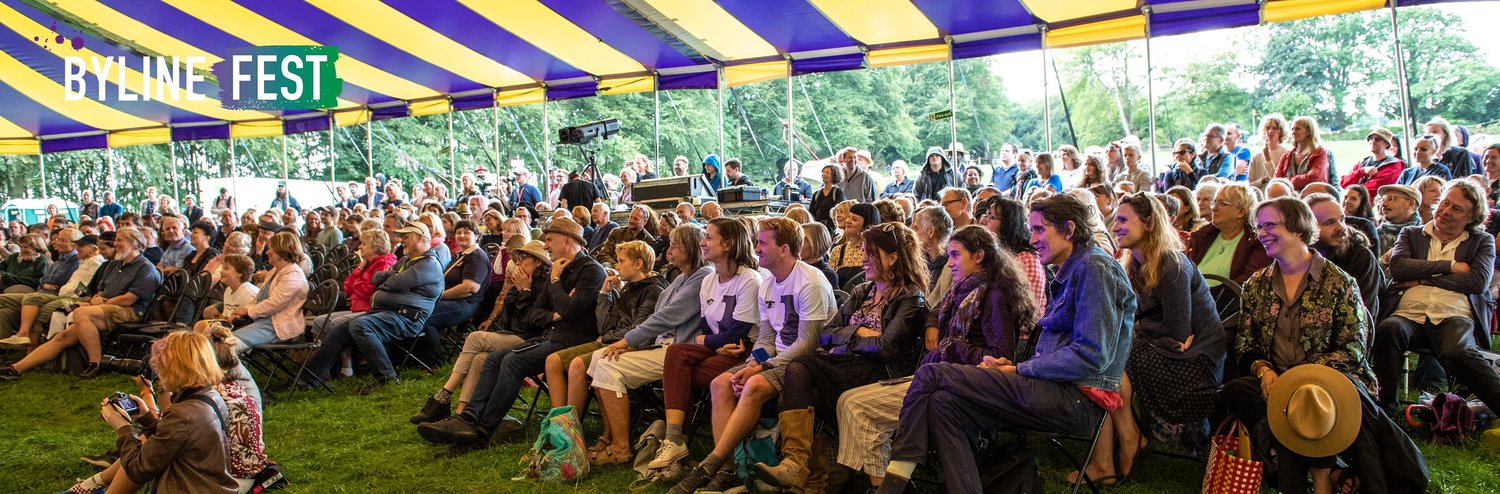
Crowds at the Byline festival. Pic Credit: Byline Festival
While 3.8 million women born in the 1950s are waiting for a decision of the judicial review into their compensation claim against the Department for Work and Pensions about their lost pensions, the August Bank holiday weekend offers them the opportunity to let their hair down.
I will be chairing a panel at the festival in Pippingford Park. Nutley in East Sussex to discuss the issues and facts behind one of the biggest scandals in Whitehall – how such a huge generation of women were cheated out of the pensions – ostensibly in the name of equality.
The dodges and dives taken by successive governments to conceal what was happening , the false facts now being propagated about ever rising longevity and the real hardship being suffered by many of these women who thought they would now be living a life of leisure, will be highlighted in a session on Sunday.
Joining me on the panel will be Professor Jackie Jones, Barrister, Labour MEP for Wales;Dr Davina Lloyd, UN Envoy, Yvette Greenway, CEO, Silence of Suicide and Joanne Welch, Campaign Director, BackTo60.com .
The lively festival put on by Byline Times runs from Friday August 23 until Monday August 26 and will include groups like Pussy Riot ( bad news for Vladimir Putin), The Blow Monkeys, The Feeling, Jerry Dammers and Don Letts.
Other speakers include Luke Harding former Moscow correspondent from the Guardian ( again not good news for Putin), campaigners and journalists Nick Davies, Carole Cadwalladr, Gina Miller, feminists Bonnie Greer and Afrua Hirsch and comedian, Hardeep Singh Kohli.
There will also be debates on issues from the Extinction Rebellion campaign , Brexit, race and civil rights.
The EU British Driving Licence that will disappear. and no longer be valid in the EU and EEA.Pic credit: gov uk
Britain’s 43,000 citizens living in Holland will have to
retake their driving test if they do not apply for a Dutch driving licence by
31 October, according to new No Deal Brexit advice from the Department of
Transport.
In Spain any of the 300,000 British citizens who have not
exchanged their licence by October 31 will have to pass a medical test to
continue driving to get a new licence.
These are just two of a whole plethora of confusing and
chaotic rules that will vary from country to country when the British driving
licence is no longer recognised by the EU.
UK’s 1.3 million citizens living in the 27 countries will face different
rules, time deadlines for applications and compulsory medical checks before
they can drive again in some countries.
Whitehall Brexit redeployment boosts tax credit fraud at revenue and Customs. Pic credit: gov.uk
The Revenue and Customs agency has sacrificed the monitoring
of fraud and error in paying out £22.9 billion a year in tax credits to
millions of people so it can meet deadlines for Brexit.
The switching of 270 civil servants to prepare for Brexit from
checking error and fraud among people claiming tax credits has cost Revenue and
Customs up to £1.46 billion in overpayments, the National Audit Office has
revealed.
The losses are the highest since 2011 and has led to the NAO
qualifying the accounts of Revenue and Customs as inaccurate for the 15th
year running since former Labour chancellor Gordon Brown first introduced tax
credits in 2003.
The losses come on top of figures from the Department for Work and Pensions which disclosed that in the last financial year benefit error and fraud is running at record levels. Altogether the level of known error and fraud in both departments has now been revealed to total a record £7.5 billion.
I am reprinting this article by an Irish academic because it not only finds a way of dealing with major providers like Facebook and Google harvesting personal data for financial gain but could help stop anonymous attacks on people and organisations by spreading hate and fake news.
It has struck me for some time that some of the most vile attacks on people – whether on anti semitism,or directed at survivors of child sexual abuse, on Brexit or the 50s born women courageously fighting for a pension come from anonymous accounts which can’t be easily verified.
This proposes a new way of identifying people before they can get on the internet without the whole system being controlled by the state.
It would stop attempts by people – particularly by those who support paedophiles and regularly abuse child sex survivors on line – being able to hide behind anonymous Twitter handles or claim websites they run are not their responsibility.
And it would make it much easier for the police and other regulatory authorities to identify people behind these attacks and prosecute if necessary. It is an interesting read.
Four ways blockchain could make the internet safer, fairer and more creative
The internet is unique in that it has no central control, administration or authority. It has given everyone with access to it a platform to express their views and exchange ideas with others instantaneously. But in recent years, internet services such as search engines and social media platforms have increasingly been provided by a small number of very large tech firms.
On the face of it, companies such as Google and Facebook claim to provide a free service to all their users. But in practice, they harvest huge amounts of personal data and sell it on to others for profit. They’re able to do this every time you log into social media, ask a question on a search engine or store files on a cloud service. The internet is slowly turning into something like the current financial system, which centrally monitors all transactions and uses that data to predict what people will buy in future.
This type of monitoring has huge implications for the privacy of ordinary people around the world. The digital currency Bitcoin, which surfaced on the internet in 2008, sought to break the influence that large, private bodies have over what we do online. The researchers had finally solved one of the biggest concerns with digital currencies – that they need central control by the companies that operate them, in the same way traditional currencies are controlled by a bank.
Bitcoin was the first application of a blockchain, but the technology shouldn’t stop there.
AnnaGarmatiy/Shutterstock
The core idea behind the Bitcoin system is to make all the participants in the system, collectively, the bank. To do this, blockchains are used. Blockchains are distributed, tamper-proof ledgers, which can record every transaction made within a network. The ledger is distributed in the sense that a synchronised copy of the blockchain is maintained by each of the participants in the network, and tamper-proof in the sense that each of the transactions in the ledger is locked into place using a strong encrypting technique called hashing.
More than a decade since this technology emerged, we’re still only beginning to scratch the surface of its potential. People researching it may have overlooked one of its most useful applications – making the internet better for everyone who uses it.
Help stamp out hate
In order to use services on the internet such as social media, email and cloud data storage, people need to authenticate themselves to the service provider. The way to do this at the moment is to come up with a username and password and register an account with the provider. But at the moment, there’s no way to verify the user’s identity. Anyone can create an account on platforms like Facebook and use it to spread fake news and hatred, without fear of ever being identified and caught.
Our idea is to issue each citizen with a digital certificate by first verifying their identity. An organisation like your workplace, university or school knows your identity and is in a position to issue you with a certificate. If other organisations do the same for their members, we could put these certificates on a publicly accessible blockchain and create a global protected record of every internet user’s identity.
Since there’d be a means for identifying users with their digital certificate, social media accounts could be linked to real people. A school could create social media groups which could only be accessed if a student had a certificate issued to them by the school, preventing the group being infiltrated by outsiders.
Never forget a password again
A user could ask for a one-time password (OTP) for Facebook by clicking an icon on their mobile phone. Facebook would then look up the user’s digital certificate on the blockchain and return an OPT to their phone. The OTP will be encrypted so that it cannot be seen by anyone else apart from the intended recipient. The user would then login to the service using their username and the OTP, thereby eliminating the need to remember passwords. The OTP changes with each login and is delivered encrypted to your phone, so it’s much more difficult to guess or steal a password.
Vote with your phone
People are often too busy or reluctant to go to a polling station on voting days. An internet voting system could change that. Digital currencies like Zerocash are fully anonymous and can be traced on the blockchain, giving it the basic ingredients for a voting system. Anyone can examine the blockchain and confirm that a particular token has been transferred between two parties without revealing their identities.
Each candidate could be given a digital wallet and each eligible voter given a token. Voters cast their token into the wallet of their preferred candidate using their mobile phone. If the total number of tokens in the wallets is less than or equal to the number issued, then you have a valid poll and the candidate with the most tokens is declared the winner.
No more tech companies selling your data
People use search engines everyday, but this allows companies like Google to gather trends, create profiles and sell this valuable information to marketing companies. If internet users were to use a digital currency to make a micropayment – perhaps one-hundredth of a cent – for each search query that they perform, there would be less incentive for a search company to sell their personal data. Even if someone performed a hundred search queries per day they would end up paying only one cent – a small price to pay for one’s privacy.
Blockchain technology started as a means for making online transactions anonymous, but it would be shame for it to stop there. The more researchers like me think about its potential, the more exciting possibilities emerge.
The BackTo60 Flash Dancers from @pandorasboxperformers.com pose in front of Henry Moore’s sculpture, Knife Edge.
BackTo60s new guerrilla campaign to highlight the plight of the 50s born women who are waiting up to six years to get their pension took on a new dimension yesterday – and brought the displeasure of Parliament’s top official, Black Rod.
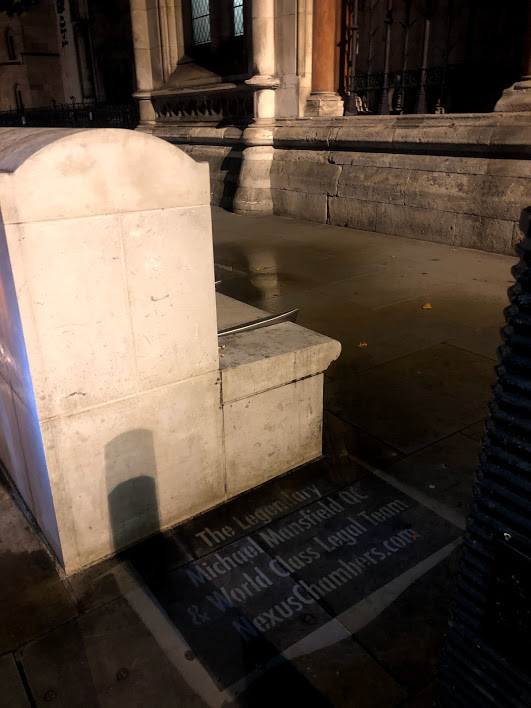
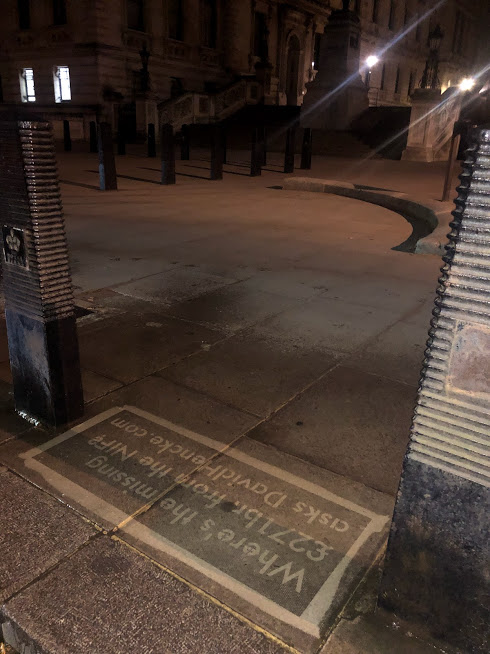
Campaigners engaged Pandora’s Box performers to do a flash mob dance performance on College Green opposite the House of Lords. This is part of a guerrilla marketing campaign that has so far seen images backing the campaign projected onto Parliament and the Bank of England at night and the appearance of campaigning graffiti washed into the pavement outside Portcullis House, the Treasury and the Supreme Court.
But little were they to know that College Green – which might seem to me or you a public green place – is in fact part of the private Parliamentary estate.
So no sooner had the music started and the dancing began, Black Rod, who is The Queen’s representative in the House of Lords instructed one of her 30 staff to come down to remonstrate with BackTo60 organiser, Joanne Welch.
A lively discussion followed only mellowed when the member of staff, Fiona Shannon, who had been instructed to ask the dancers to go, realised she was one of the women born in the 1950s who would benefit from a victory by the campaign.
She then went off however to get reinforcements – allowing the dancers to do a quick encore – before the dancers decided to disappear down a Westminster sidestreet.
Joanne Welch said: ” I genuinely thought this was a public place and didn’t think we needed permission to stage the event. It is used regularly by broadcasters and also has been used by Remainers and Brexiteers to stage noisy demonstrations. I apologise if we needed permission.We will know next time.”
A House of Lords spokesperson said that College Green is part of the parliamentary estate. Any requests for filming or other activity are dealt with by Black Rod’s office on behalf of the House of Commons.
The spokesperson added :”Protests and operating amplified noise equipment are not permitted on College Green. The participants were made aware of this and left voluntarily.”
But not without accompanying their mission.
Not amused: Sarah Clarke,The Lady Usher of Black Rod Pic credit: Parliament.uk
For those curious about Black Rod,the current holder of the office is Sarah Clarke, the first woman appointed to the £93,000 a year post in 650 years.
She organises the State Opening of Parliament and the highest profile part of her role is summoning the House of Commons to hear the Queen’s Speech. She is also responsible for business resilience and planning for the House of Lords, and leads a department that includes the Yeoman Usher and the House of Lords Doorkeepers.
She was appointed last year having previously organised the Wimbledon tennis championships for a number of years.
As the Queen’s representative she now knows that her 1950s British subjects are pretty angry about the loss of their pensions.. Perhaps Her Majesty should be sent a video of Pandora’s Box great performance compliments of BackTo60,
BackTo60 Graffiti on the pavement outside Portcullis HouseThe guerrilla imaging campaign included a projection of one of my blogs on the wall of the Bank of England
DVLA’s advertising campaign to stop the tripling of untaxed cars and vans Pic credit: DVLA & RAC
The abolition of
every car and van in the UK needing to display a car tax disc has led to the
tripling of the number of untaxed cars and soaring prosecutions and fines for
drivers, according to the latest annual report of the DVLA, the Driver and
Vehicle Licensing Agency.
The scale of the problem led to a report from the new auditor
general, Gareth Davies, to be attached to its annual accounts this year after
the agency’s previous unblemished record in collecting car tax became tarnished.
Up to 2014 when the car tax disc was abolished the agency collected up to 99.6 per cent of revenue. Since then the figure has fallen to 98.2 per cent – which might seem small – but is equivalent to an additional 500,000 vehicles evading tax. It is happening because people are telling the DVLA their vehicle is stored off the road but are continuing to use it.
My image and blog on the side of the Bank of England
Disruptive protests are seen mainly but not exclusively as the preserve of the young. Whether it is blocking roads like Extinction Rebellion or organising street protests they are not the natural first choice of people old enough to be grandparents..
Yet the government’s refusal to even discuss any compensation with 3.8 million women born in the 1950s who are now waiting up to six years longer to get a pension has seen the first disruptive action organised by ” oldies” in the capital.
First there was a rally in Hyde Park and march which ended in Parliament Square where spontaneously some of the protestors blocked the road forcing the police to divert traffic for nearly two hours.
Then there has been an extraordinary partnership with young people in a guerrilla marketing organisation to project on to prominent buildings like the House of Commons, the Bank of England and the law courts – slogans demanding action to redress the problem. I am told there are no laws to stop anyone projecting slogans on any building. It also included one of my blogs revealing the Thatcher government’s decision to all but end the Treasury contribution to the National Insurance Fund.
Then in the dead of night graffiti started to appear on the pavements outside prominent London landmarks with slogans as part of the BackTo60 campaign to compensate the women.
Here are some of the pictures:
BackTo60 logo sprayed into the Westminster pavementGraffiti praising the lawyer Michael Mansfield who represented the 50s born women in the judicial review demanding compensation.Logo outside the entrance to Portcullis House, WestminsterGraffiti outside the Treasury.
None of this has been reported in mainstream media. And the public who see the graffiti may be puzzled about what it is all about.
But there is a deeper issue. This particular group of women are a large bedrock of the older generation. They have been until now mainly apolitical, bringing up their families, going to work and living normal lives.
But the total refusal of the government to even discuss the issue has transformed this. Shocked by this attitude they are becoming radicalised and for the government this is very bad news. They did form a large part of the group who traditionally voted Conservative. Very few will vote Conservative at the next general election. Some will vote Labour, some Liberal Democrat, Plaid Cymru or Scottish Nationalist, some the Brexit Party and some not at all.
This means given the antipathy to the Tories among the young that many Tory MPs who think they have secure majority may find themselves out of a job at the next general election. And the government will only have itself to blame for not listening to them.
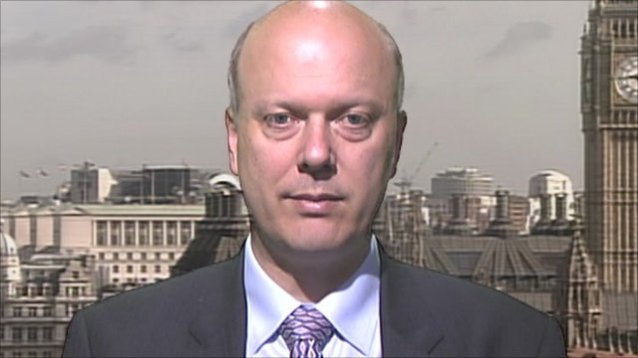
Chris Grayling: Transport Secretary faces fresh contract debacle
Chris Grayling, the transport secretary, is facing a fresh
fiasco over new ferry contracts to bring in goods if Britain leaves the EU on
Oct 31.
The minister known as “Failing Grayling” has already cost
some £3.5 billion in lost revenue and overspending in his three ministerial
jobs since 2010.
A report from the Commons public accounts committee today reveals he just 21 days left to re-order contracts to bring in supplies if either Boris Johnson or Jeremy Hunt sticks to the Oct 31 deadline – deal or no deal.
The annual report that reveals the damning failures of the ministry to keep a grip on benefit and error fraud and the high pay and pensions of the people running the Universal Credit programme
Benefit error and fraud has reached record levels at the
Department for Work and Pensions and it is going to get worse, according to its
own figures released in its annual report for the last financial year.
For the 30th year
running the National Audit Office has qualified the ministry’s £86.6 billion
benefit accounts because it considers them to be inaccurate
The most damning section of the report is on Universal Credit – whose current and previous directors – have just received bonus payments up to £15,000 each for their work.
While MPs were enjoying drinks and snacks in parties and receptions across London last week – I admit I was at one in the gardens of Westminster Abbey – a team of intrepid campaigners from BackTo60 took to the streets with the support Media Gang Guerrilla Marketing.
They stopped outside the Bank of England, The Law Courts in the Strand and opposite the House of Parliament to project images backing the 50s bornwomen campaign. One of my blogs was projected on the Bank of England and the Backto60 logo appeared on the side of Parliament overlooking the Thames.
Certainly if nothing else this campaign is creative – equal to some of the stunts of the younger generation. They should be proud that people never give up campaigning.








 Westminster Confidential