Revealed: Hospital doctors are the top target for the NHS Resolution Practitioner Performance Service

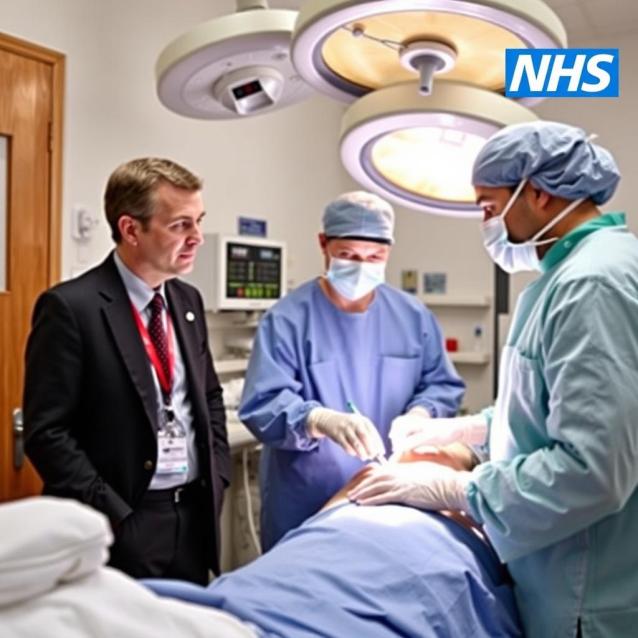
NHS Resolution solicitor overlooking hospital doctors under investigation. An AI image illustrating the situation facing hospital doctors in the NHS

Following my blog on the secret process using NHS Resolution to help hospital managers discredit whistleblowers I decided to ask the advisory body a series of questions on its operations using the Freedom of Information Act.

What emerged was extremely revealing. NHS Resolution hides in its annual report how many hospital doctors are involved by lumping them together with dentists and pharmacists. But the breakdown revealed through FOI reveals it is almost exclusively targeting doctors to advise trusts on how to handle them.

It shows that in the last financial year it advised in cases involving 1168 doctors in England, Wales and Northern Ireland. And the number of cases would be higher – as a number have multiple complaints from managers against them. This compares with 53 dentists and under 5 pharmacists. Indeed the pharmacists involved are so few – it won’t give me an exact number for fear of identifying individuals.

The PPS was last audited in 2019 and the organisation says it was then considered to be adequate and. effective. A more recent review in July this year by Dr Penny Dash looked just at the patient safety and learning role of the organisation and not wider issues.

Nor does NHS Resolution check whether it is given accurate information by managers. It said:” our role is to provide impartial and expert advice which is aimed towards supporting the local management and resolution of performance concerns. We are not a decision-making or an investigative body – in all cases, any decisions about the ongoing management, employment or contractual status of the practitioner rests solely with the healthcare organisation.”

In other words it is there solely to support health managers – who have no duty of candour – and it tries to include doctors by saying managers should tell them about their request for advice. In fact managers can and do ignore this as there is no requirement for them to say anything to the doctor they are investigating. So without hearing the doctor’s case it cannot be genuinely impartial. Also should a practitioner object to the partial advice given by a health manager they are ignored and the body continues to deal with the health manager.

NHS Resolution has not carried out any audit on the effect on doctors who are subject to complaints but it does do occasional research into problems arising on a very small scale. One example in its Insight Publication series last year was looking at whether ethnic minority doctors were badly treated in the NHS.

Involving just 11 doctors it said:”Most participants felt discriminated against based on their ethnicity and/or where they qualified. They felt this was reflected in the way their cases were handled by both their employer and Advice, and the higher rates of concerns raised against practitioners from ethnic minority backgrounds.”

Not surprisingly there was a lot of ignorance of how NHS Resolution’s advice service worked – given that health managers needn’t tell them about it. Again NHS Resolution’s solution was to give advice to managers which they need not take up. The full report is here.

Then there is the question of the phrase, performance. Is it a misnomer? NHS Resolution advice service does not look into the question of performance by doctors – relying on hospital manager for that – and it does not employ people qualified to do so. Many are solicitors, human resources staff and employment law experts and are not qualified to know when say a complex heart operation went wrong or the details of paediatric care. Indeed from doctors who have contacted me the trust often cites uncooperative behaviour and not working well with colleagues as part of its case.

Taken with earlier articles on the role of the General Medical Council a disturbing picture emerges which shows the hospital doctor is always at a disadvantage while the responsible officer – usually the medical director – holds all the cards – using NHS Resolution for advice and reporting the doctor to the GMC. Yet neither body is necessarily equipped to handle this and in NHS Resolution’s case, it is toothless to influence decisions by trusts. It can help to easily ruin a doctor’s career and even ban him or her for life for continuing their careers.

There seems to be a wholly unregulated sector covering NHS Resolution, the GMC and the trusts themselves and certainly no accountability. Patients have no idea how this is handled -yet their safety should be paramount in the NHS. And while NHS Resolution says it works under the direction of the Department for Health and Social Care my research shows it is not clear who regulates them.

If ever there was a case for reform of both systems, now is the time for something to be done.

One-Time
Monthly
Yearly

Make a one-time donation

Make a monthly donation

Make a yearly donation

Choose an amount

£5.00
£10.00
£20.00
£5.00
£15.00
£100.00
£5.00
£15.00
£100.00

Or enter a custom amount

£

Your contribution is appreciated.

Your contribution is appreciated.

Your contribution is appreciated.

DonateDonate monthlyDonate yearly

You can also donate using PayPal on the link below.
https://www.paypal.com/ncp/payment/865JAS3QJ3CGQ

Are there flaws in the new guidance for General Medical Council investigations?

Dr Andrew Hoyle

Reforms without addressing core issues may lead to persistence of key flaws  or omissions in any future changes with risks to patients

Last month I wrote about the government proposing the first major reforms for 40 years in the running of the General Medical Council. My blog was meant as a warning to ministers to scrutinise the changes very carefully because I was sceptical, after talking to a number of doctors, that there were flaws in the changes. You can read the blog here.

Now the GMC has published its new guidance by Dr Andrew Hoyle, an assistant director in the GMC’s Fitness to Practise Team He is both a doctor and a barrister.

In a high minded piece on Linked In and in a blog ( see the article here) he promises greater clarity and consistency .. and fair, flexible and compassionate fitness to practise processes. He also emphasises the GMC’s duty under the 1983 Medical Act to protect, promote and maintain the health, safety and well being of the public, promote public confidence in the profession and promote and maintain professional standards and conduct by doctors.

Now from the patient’s point of view how is this being enacted by a change to one simple process?

The first point is drawing up guidance for the decision makers on whether to proceed. There is a comprehensive list of issues to consider for the decision makers whether to start an investigation into a doctor. But the response to the concern raiser, the guidance does not specify who the decision makers are. Are they fully competent in the field or even sub-field of medicine practised by the doctor to make a sound judgment  about clinical matters? I have heard from some doctors that this is not always the case. On the question of accountability should it not be made public who made the decision and their qualifications to do so. This would reassure the public and the patients that it had been properly investigated.

The current process’s most crucial step, the  “initial triage and closure of concerns” relies on the “opinions” of the GMC postholders who in turn rely on managers. There is no mandatory requirement to immediately investigate serious harms or near miss issues that may have led to consequences to that or other patients.

This is particularly relevant as there is also the issue of the seriousness of the concern. The guidelines suggest that if there is evidence of repeated bad practice this should be relevant to striking off doctors. But there is a second flaw in this process. How does the GMC know about a bad doctor? The answer is because he or she is reported to the GMC by the responsible officer – normally the medical director or chief medical officer of the trust or far less by patients and or colleagues who are more in the know of bad practices but are fearful of consequences. See article in the Lancet.

Therefore the issue the GMC knows about may not be the first one and the GMC cannot verify it with the current approach neither can the complainant know of all issues. 

From earlier blogs I have found this process to be flawed – either because the responsible officer has targeted a doctor who has raised whistleblowing issues – whether patient safety or fraud – to discredit a perfectly good doctor – the case of Usha Prasad, a former cardiologist at St Helier and Epsom hospital is a current example – or covered up bad practice to save the reputation of the trust or private hospital.

The most egregious example of the latter is the case of Mr Ian Paterson, a breast and general surgeon, now serving a 20 year prison sentence after performing unnecessary operations on hundreds if not thousands of unsuspecting patients until a lawyer brought a civil case against him.

The public inquiry into his practice concluded “They were then let down both by an NHS trust and an independent healthcare provider who failed to supervise him appropriately and did not respond correctly to well-evidenced complaints about his practice.”

It went on: “The recall of patients did not put their safety and care first, which led many of them to consider the Heart of England NHS Foundation Trust and Spire were primarily concerned for their own reputation. Patients were further let down when they complained to regulators and believed themselves frequently treated with disdain.”

Imagine how different the outcome for hundreds of patients if this had been first reported by a responsible officer to the GMC – life changing needless operations would have been stopped rather than covered up. What the GMC should demand is that the management of NHS trusts and private hospital groups have to sign a ” duty of candour” putting them on par with doctors who raise complaints. This would require them to notify the GMC about the practices of the doctor involved and meet the legal requirement that the GMC has to protect patients and promote higher standards in the profession. Otherwise the assessment of a serious repeated bad practice is a hollow gesture in many cases.

 However if the GMC has been and appears it is continuing to rely on the Responsible Officers to provide a response can the GMC’s decisions be evidence-based  and safe for public. Even if a small minority of doctors are unsafe or dishonest,  the impact on the patient and profession must be the core of decision.

The third point is when a doctor acts inappropriately or unsafely that can be investigated by the GMC personnel but who are potentially not being regulated by any one and via a process built on reliance on an RO and in at times without transparency or evidence verification and opinion based decisions are taken that can affect lives This does not appear to be a safe approach as multiple scandals continue to occur; suggesting concerns are not really reaching the GMC due to its current system or are being ignored.

The current concern management requires a complete overhaul and not just superficial tweaks

Since I started looking at this issue I have been contacted by doctors across the country about the GMC and I intend to follow this up in a future blog.

One-Time
Monthly
Yearly

Make a one-time donation

Make a monthly donation

Make a yearly donation

Choose an amount

£5.00
£10.00
£20.00
£5.00
£15.00
£100.00
£5.00
£15.00
£100.00

Or enter a custom amount

£

Your contribution is appreciated.

Your contribution is appreciated.

Your contribution is appreciated.

DonateDonate monthlyDonate yearly

Please donate to Westminster Confidential

£10.00

Will health minister Karin Smyth spot the need for more radical reform of the General Medical Council to protect clinicians and ultimately patients?

Karin Smyth – health minister responsible for professional regulation reform

The new Labour government is embarking in the first reform of the professional regulation of the General Medical Council for 40 years. This welcome development comes after the GMC extended its scope to cover physician and anaesthesia associates at the end of last year. In theory it will allow the GMC more flexibility to change its rules and allow less adversity among fitness to practice cases involving doctors thus avoiding referrals to the overloaded and often unfair employment tribunals. It also abolishes an arbitrary rule that prevents it looking at cases that are more than five years old.

From my observations of recent complaints against doctors who raise patient safety cases and conversations with doctors who are concerned about referrals to the GMC the whole process needs a radical overhaul. It is also an overhaul that requires some political intervention.

How the GMC handles individual complaints against doctors is by no means transparent. Nor is the GMC directly accountable for their failings and omissions and its workings can be manipulated by individual health trusts. I am about to give you two different examples,

Many doctors think the complaints system is flawed because of a practice of referring the case to the so called ” responsible officer ” to handle it. The responsible officer is often the person who has brought the complaint in the first place – the chief medical officer of the trust. Now the chief medical officer is not what the public might think – the ultimate person protecting medical standards on behalf of patients. He is part of the trust’s management team whose main purpose is to protect the reputation of the trust which may not be in the interest of patients. So surely this is a conflict of interest?

NHS Managers labelled one doctor ” too passionate about patient safety”

There was also an extraordinary experience of a whistle-blower who was a warned by local managers against being too “passionate about patient safety.”

And does the GMC do a thorough job when it investigates.? Doctors are sceptical. In one example it appears the complaints about serious safety issues, were closed at the first step and  not even seen by GMC clinician. The bald reply from the GMC confirmed that to be the case; neither the team had nor did they seek any advice or expert opinion.

The GMC’s current practices enable its staff without clinical knowledge to close clinical concerns in such manner or only with hospital managers’ response, even when the concerns about the said managers are known to the GMC. In one example it appears the complaint was not even seen by fellow clinicians.

Given the whole point, according to many of the doctors who have raised patient issues, is the worry that either patients have already been harmed or more are left  at risk of being harmed by such poor medical practice,  these do not appear to be safe concern closure processes for a regulatory body.

Dr Usha Prasad

There is another side and here I can quote an actual case – as it came up in an employment tribunal – the removal of cardiologist Dr Usha Prasad from the then Epsom and St Helier NHS Trust ( now merged with St George’s Hospital in Tooting, south London.)

Here the GMC faced with 41 complaints from the trust who wanted her removed did do a thorough investigation and checked with very senior cardiologists and exonerated her -including revalidating her working for the next five years.

But the trust’s chief medical officer, Dr James Marsh , refused to accept this, making the fatuous statement that the trust’s medical standards were ” higher than the GMC’s “. This is also ironic as the doctors from that organisation are being revalidated by, no one else but the GMC.

Where a doctor is revaluated the rules should be changed so in those circumstances the GMC’s decision is binding and final and this requires a politician to intervene to make sure this happens. An individual chief medical officer should not have the power to wreck a doctor’s career if their complaint to the GMC is utterly rejected. and not formally appealed against.

I would be very interested to see if other doctors have had similar experiences in both these areas and doctors can contact me on my website  ie either concerns were dismissed without due consideration or the GMC decision was ignored by the managers.  All contact will be treated in confidence unless the doctor wishes to go public.

This is a once in a lifetime reform and we need to get it right for both the benefit of the doctors and the safety of patients who entrust their lives to the NHS.

Karen Smyth, the minister of state for health, has a huge list of responsibilities from this area to cancer care and hospital car parking. The list is here. She needs to focus on this and ask pertinent questions.

One-Time
Monthly
Yearly

Make a one-time donation

Make a monthly donation

Make a yearly donation

Choose an amount

£5.00
£10.00
£20.00
£5.00
£15.00
£100.00
£5.00
£15.00
£100.00

Or enter a custom amount

£

Your contribution is appreciated.

Your contribution is appreciated.

Your contribution is appreciated.

DonateDonate monthlyDonate yearly

Please donate to Westminster Confidential

£10.00

How the St Georges, St Helier and Epsom Hospital Group fixed the dismissal of whistleblower cardiologist Dr Usha Prasad

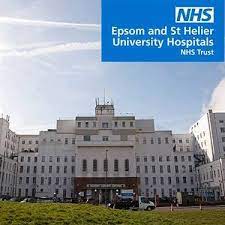
St Helier Hospital

After my blog on the double standards of the Epsom and St Helier University Hospital Trust over its treatment of whistleblowers which included references to Dr Usha Prasad, I received an email from the communications team of the hospital group.

According to the team I had got everything wrong. The whistleblowing case had absolutely nothing to do with her dismissal. They said: ” It is not correct to say Ms Usha Prasad was dismissed for raising patient safety concerns. A disciplinary panel concluded that she should be dismissed for competency grounds, concerns around her practice/conduct and because relationships with key colleagues had broken down. This decision was upheld on appeal.”

Technically they are correct. But if you delve deeper it shows that this disciplinary panel was a completely flawed process – ignoring vital information and chaired by a person whose integrity had already been called into question and falls into a management playbook used by other trusts to get rid of troublesome doctors who raise unwelcome concerns about patient safety.

Even the conclusion of this disciplinary panel used a fake term. The chair concluded that she was ” unfit for purpose”. There is no such term in English employment law – a system can be ” unfit for purpose” but an individual cannot. And this has been raised at the highest level in NHS England by colleagues of her when they met Professor Stephen Powis, the national medical director, who could not explain such a term applying to an individual doctor.

Then there is the issue of competency. The big flaw in this is that after she raised her protected disclosure on patient safety the trust sent 43 complaints about her practice to the General Medical Council .These were organised by Dr James Marsh, then medical director of the Epsom and St Helier University Trust now Deputy Group Chief Executive Officer of the St George’s Group.

Dr James Marsh

Dr Marsh chose close colleague Dr Peter Andrews, a fellow renal physician who worked on the same ward, to investigate the claims, and Dr Ian Beeton, a cardiologist in private practice at nearby St Peter’s Hospital as an “independent” expert. Dr Beeton works with Dr Marsh’s wife, a radiologist at the same hospital. They asked Dr Richard Bogle, the head of the cardiology at the Epsom and St Helier Trust, to file the complaints who also works closely with private cardiologist Dr David Fluck at St Peter’s Hospital.

When it came to the disciplinary hearing the trust brought in Dr David Fluck to sit on the tribunal to judge Dr Usha Prasad. He also worked on joint projects with Dr Marsh.

I leave you to judge whether this was a genuinely independent investigation without any conflict of interest. But when the complaint went to the General Medical Council and was seen by a genuine independent cardiologist in Teesside and formerly at the world famous Papworth Hospital every complaint was thrown out. In fact I am told the GMC looked at the eight most serious complaints and decided there was nothing to see. And not only was it thrown out by the GMC , it decided to validate Dr Prasad as competent to work in any hospital in the UK for the next five years.

This GMC ruling was brushed aside by the disciplinary hearing and ignored by the judge when it came to an employment tribunal hearing later. The only clue came at the tribunal hearing when Dr James Marsh claimed that the trust had higher standards than the GMC. Frankly this was insulting to both the GMC and the eminent cardiologist who thought differently.

The second charge against her is that she couldn’t work with colleagues. Certainly relations with Dr James Marsh did deteriorate over her decision to say an elderly patient who died because the trust did not act on a serious heart condition was an ” avoidable death” and should have been notified to the coroner and the Care Quality Commission. Dr Marsh wanted this conclusion struck out and she refused to do it.

But if this is correct this would apply elsewhere and it doesn’t. Her work at Pinderfields Hospital in Yorkshire and at St George’s is praised by the hospitals and there have been no complaints about her relations with colleagues.

Dr David Ward

Dr David Ward, a close colleague of hers at St George’s, said this: ” I am pleased to say that I worked alongside Dr Usha Prasad when she was a visiting Consultant Cardiologist at St George’s Hospital (now part of the united Trust with Georges-Epsom- St-Helier or GESH). I found her to be collegiate, knowledgeable in general cardiology, skilled in her specialised areas (echo, heart failure etc). She was well-liked by all staff with whom she worked (catheter lab, echo). I (or anyone in the cardiology department at St George’s) never had any concerns about Dr Prasad’s clinical skills or competence and I find it most surprising that St Helier have retrospectively (for that it what it amounts to) found reason to question her abilities, coincidentally or not, after she had raised concerns about patient safety. I suspect this, also known as whistleblowing, is the underlying motive for the profoundly vengeful and unjustified response by the Trust.”

Claire McLaughlan

Finally there is the question of the disciplinary hearing itself. It was chaired by Claire McLaughlan – a profile of her is here – who ran into trouble with a judge at a hearing with cardiologist Dr Mattu, who won his case, for omitting evidence and over an interview for Lewisham and Greenwich NHS Health Trust with whistleblower Dr Chris Day, whose case is still continuing. He found the record of the interview with him had been altered, missing key points. As he had a secret recording of it, she had no alternative but to apologise and change back the record.

One final point. Dr Usha Prasad told me the former CEO of the Epsom and St Helier Trust, Daniel Elkeles ( now chief executive of the London Ambulance Trust) was prepared to “stop” the disciplinary hearing if I was prepared to drop “all you have against the trust; an ET case of whistleblowing detriment and harassment, discrimination”. One wonders how many back door deals take place over patient safety.

One-Time
Monthly
Yearly

Make a one-time donation

Make a monthly donation

Make a yearly donation

Choose an amount

£5.00
£10.00
£20.00
£5.00
£15.00
£100.00
£5.00
£15.00
£100.00

Or enter a custom amount

£

Your contribution is appreciated.

Your contribution is appreciated.

Your contribution is appreciated.

DonateDonate monthlyDonate yearly

Please donate to Westminster Confidential

£10.00

Exclusive: General Medical Council investigation exonerates Dr Usha Prasad of any medical failings

Dr Usha Prasad

Dr Usha Prasad, the cardiologist currently appealing against her dismissal from the Epsom and St Helier University Trust, has been exonerated by General Medical Council of any medical failings or putting patient safety at risk.

The decision by the GMC not only rejected a dossier of complaints from the trust but decided that the issue was closed and will not be re-opened again by the GMC.

The decision is part of a long running saga that has been going on for nine years and heightened by an anonymous letter sent by Dr Perikala, a staff doctor, who made the patient safety allegations in an anonymous letter to the General Medical Council, Care Quality Commission, Daniel Elkeles, the chief executive of the trust and Jeremy Hunt, then the health secretary in 2015.

The GMC initially declined to investigate Dr Perikala’s anonymous complaint but the trust has persisted in pursuing her at the GMC.

dr james marsh pic credit: Epsom and St Helier University Health Trust

I understand Dr James Marsh, the trust’s medical director, and Dr Richard Bogle, the lead cardiologist at the trust, compiled a dossier of no fewer than 43 cases which they claimed should be investigated. The GMC narrowed it down to seven cases and sent them for review to a very distinguished consultant at the James Cook Hospital in Middlesbrough whose career has spanned work at Papworth Hospital and Addenbrooke’s Hospital in Cambridge. The very detailed report came back completely exonerating her of any failings. She has also received glowing references from Pinderfields Hospital where she is currently working as a cardiologist after the Epsom trust dismissed her.

Dr Richard Bogle pic credit:www.richardbogle.com

The GMC’s decision comes just as an internal inquiry into her appeal is under way. This is being heard by Claire McLaughlan   an independent consultant, and Associate Director of  the National Clinical Assessment Service with an interest in the remediation, reskilling and rehabilitation of healthcare professionals. The case was also being followed by Dr Zoe Penn, Medical Director NHS England ,London Region and Lead for Professional Standards. She is sitting on the panel with Claire McLaughlan. Ms Mclaughlan runs a private business with her husband in Hampshire.

The fact that the hearing is taking place now is questionable since Professor Stephen Powis, national medical director of NHS England, told health trusts NOT to hold such hearings when the NHS is under pressure from the pandemic. I checked with the press office of NHS Resolutions and they have supplied me with the guidance for such hearings. They really should only be held if there is an absolute necessity and immediate risk to patient safety. Now with the GMC deciding there is no current and immediate risk to patient safety in Dr Prasad’s case – this makes the hearing even more questionable.

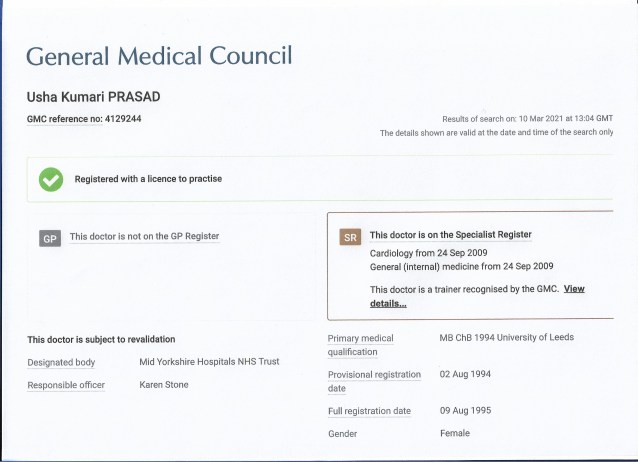
Officially the GMC will not comment on personal cases but they did confirm her clean bill of health entry on their public register which is reproduced below. All entries on this register have to be kept up to date on a daily basis. The saga continues but the case being made by the trust looks pretty weak after this decision by the GMC.

There are three earlier blogs on this issue.

They are: A bizarre tribunal hearing on the treatment of Epsom’s health-trust’s sole woman cardiologist

Top cardiologists back Usha Prasad’s fight against ” badly behaving ” health trust

Botched internal inquiry hearing into Dr Usha Prasad at St Helier Hospital as doctors fight death from Covid- 19


Since this blog was published I have had this strong message of support from Justice for Doctors. Here it is:

Dear Mr. Hencke, you are doing an excellent job by highlighting the problems with our NHS and how splendid doctors like Usha Prasad had been treated. It was very courageous of Usha to challenge the wrongdoings and the harsh decisions by our health institutions at a time when the GMC are calling retired doctors to rescue the overstretched NHS.

Without dedicated and committed doctors like Usha Prasad, our NHS will crumble and collapse. The misleaders and bullies will remain to demolish what goodness is left in our NHS. Unfortunately, most doctors retire or change location whenever they were unfairly challenged. Moving away will not solve the problem but encourage bullies and harassers to thrive and do more damage.

In our view, Dr. Prasad has won the moment she decided to stand firm and challenge the discrimination, the harsh and unfair decisions. We congratulate both of you for raising awareness about what goes on in our hospitals and congratulate Usha for her courage and conviction.
Thank you
On behalf of Justice for Doctors