Stormy scene around tilted scales of justice as judges avoid complaints
Remember the ten brave women I wrote about who are challenging the bullying behaviour of Employment Judge Philip Lancaster? See my blog here. The ones the justice system refused to investigate despite overwhelming evidence?
They’re now in a race against time – and the Judicial Conduct Information Office is playing its oldest trick: delay, delay, delay until they run out of money or miss their deadline.
Here’s what’s happening:
The women issued their Letter Before Action to the Judicial Conduct Investigation Office (JCIO) in September. The JCIO’s deadline to respond under the pre-action protocol was 8 October. They missed it. The women waited another week. They missed that too.
Now the JCIO says they won’t respond until 20 October – leaving barely two weeks before the women must file at court in early November or lose their right to bring these proceedings forever.
Classic establishment tactics. Unlimited taxpayer funding and government lawyers versus women running on crowdfunding and determination.
But here’s why this matters more than ever:
In September 2025, Baroness Harriet Harman KC published a damning report on judicial misconduct. Her conclusions are devastating:
“The problem is the culture of impunity for those at the top who commit misconduct. Those in powerful positions whether at the Bar or in the judiciary who choose to engage in bullying, harassment or sexual harassment can be pretty confident that nothing will be done about it. And that is what must change.”
She identified a “cohort of untouchables” amongst the judiciary and “particular judges who are widely known for making everyone’s lives a misery.”
This is EXACTLY what these women are fighting to expose.
The women need £40,000 total to see this through
They’ve raised £17,335 so far – incredible progress from 472 supporters. But they need £40,000 in total to get this case into court and finish what they’ve started.
Their legal team of outstanding women lawyers at Deighton Pierce Glynn has already slashed fees dramatically. But even at reduced rates, taking on the government is expensive.
What’s at stake:
35,000+ employment tribunal users face these tribunals every year
If this judicial review succeeds, the JCIO will be forced to properly investigate judicial misconduct
Judges who egregiously abuse their power and block the release of the court record will finally face consequences
Whistleblowers will be better protected
This isn’t about these women and whistleblowers getting compensation – their chance at justice has been lost forever. If they win the judicial reivew there won’t be any compensation – just the knowledge that they exposed a corrupt complaint system. And showing judges that they are not above the law.
Every pound counts. They cannot let the judicial establishment win by simply outlasting them financially. Not when they’re this close.
Please help them as they have shown remarkable courage and integrity to do this for the greater good but they can’t do it without further financial help.
Judge Barry Clarke who is president of employment tribunals in England and Wales
The English and Welsh Employment Tribunal system is operating under an extraordinary contradiction that strikes at the heart of judicial accountability: judges accused of misconduct can legally withhold the only evidence that exists against them.
This isn’t a bureaucratic quirk. It’s a fundamental breach of justice that’s destroying lives and making a mockery of the complaints system.
The Case That Exposes Everything
Employment Judge Philip Lancaster faces multiple misconduct complaints from whistleblowers, including Sellafield Whistleblower, Alison McDermott, and many others. The evidence needed to investigate these complaints? The judge’s own handwritten notes from the hearings in question.
Here’s where it gets explosive: Justice Secretary Shabana Mahmood has confirmed to MPs that where no audio recording exists, these judges’ notes constitute the official court record.
Yet Lancaster refuses to release the official court record. The very judicial notes that the Justice Secretary says are the official record. The only evidence that exists of what happened in his courtroom.
In other words, the judge accused of multiple breaches of misconduct and betraying his judicial oath has become the sole gatekeeper of the evidence against himself.
A System Designed to Block Scrutiny
Let’s be absolutely clear about what’s happening here. No other professional under investigation could do this:
Police officers can’t withhold bodycam footage when under investigation
Politicians can’t refuse to release official documents
Doctors can’t refuse to release patient notes
But Employment Tribunal judges can — and do — withhold their notes – the only record of proceedings, even when facing serious misconduct allegations and even though the Justice Secretary has categorically confirmed that the judicial notes are the official court record.
The President’s Defensive Wall
When I pressed Judge Barry Clarke, President of the Employment Tribunal, for answers to this blatant unfairness, the response was revealing. I asked direct questions:
Does he accept that judges’ notes are the official record, as stated by the Justice Secretary?
If yes, what legal authority allows Lancaster to withhold them?
If no, who can intervene?
Instead of answers, I received pages of case law about judicial independence — a concept that was never meant to shield judges from accountability when facing misconduct investigations. Clarke’s office has chosen to defend a practice that subverts open justice rather than confront a shocking flaw that undermines the entire tribunal system.
Clarke defended the practice as a matter of “judicial discretion.” But this is precisely the problem: access to the official court record should never be discretionary. It should be an absolute right. In every other court in the land, parties can obtain transcripts, recordings, or official records of proceedings. But in the Employment Tribunal, Clarke has normalised a system where individual judges become personal owners of public records, free to release or suppress them as they see fit. This isn’t about protecting judicial independence — it’s about placing judges above the law.
The fact that Clarke sees nothing wrong with a judge under investigation controlling access to evidence against himself reveals how deeply this corruption has infected the tribunal system. When the President himself cannot grasp that court records belong to the public, not to individual judges, we’re no longer talking about reform. We’re talking about a system that needs to be torn down and rebuilt from scratch.
“This Is Not Justice — It’s a Travesty”
For Alison McDermott, the Sellafield whistleblower, who is leading a judicial review against Employment Judge Lancaster, the situation is both personal and devastating:
“I was horrified to discover my hearing was not recorded. No audio, no video — nothing. Judge Lancaster, who is facing multiple charges of misconduct, is refusing to release the very evidence that could prove it. In any other profession, this would be seen as obstructing evidence. In the Employment Tribunal, they call it standard practice. We’re not asking for special treatment. We’re simply asking for the official court record of our own hearing. But in Britain’s tribunals, the accused judge gets to be the gatekeeper. When judges can keep secret notes, and then withhold those notes when under investigation, we don’t have a justice system. We have a closed shop where judges police themselves. .This is not justice. It is disgusting perversion of justice and a travesty that denies any possibility of a fair trial.”
The Deeper Rot
This scandal reveals three interconnected failures that should alarm anyone who believes in the rule of law:
First, many Employment Tribunals don’t record their proceedings. In an age where every high street shop has CCTV, our tribunals rely solely on judges’ handwritten notes — notes taken by people who receive no training in accurate record-keeping and face no monitoring of their note-taking abilities.
Second, these unverified notes become the official court record. Your career, your reputation, your access to justice — all hang on a judge’s personal scribbles. Yet you are denied access to them.
Third, when that judge faces investigation, they alone decide whether anyone can see those notes. The accused becomes the gate keeper of the very evidence needed to prove misconduct.
Why This Matters Beyond One Case
This isn’t simply about Judge Lancaster. It’s about a system that has abandoned its most basic principle: open justice. The latest annual report from the Judicial Appointments and Conduct Ombudsman – see here – show that there were 424 complaints against judges last financial year where people contacted the Ombudsman because they were dissatisfied. Of course only a few – 23 – were investigated – the vast majority being thrown out often because it breached the three month time limit for complaints to be heard.
Regional Judges and the President of the Employment Tribunal have also applied this three month deadline rigidly, striking out cases before their substance can even be tested. Campaigners say the effect is to silence victims and protect those in positions of power. And now Baroness Harriet Harman agrees.
Harriet Harman’s Independent Review of Bullying, Harassment and Sexual Harassment at the Bar [see here]was blunt about the flaws. In paragraph 34 she wrote: “There is no benefit in restricting complaints arbitrarily. Indeed, the only practical benefit it has is to protect those engaging in misconduct.” She added it was “surprising that the judiciary confirmed the reasonableness of this time limit after reviewing it as part of the consultation on judicial discipline in 2023.”
Courts must be open to scrutiny. Proceedings must be transparent. The court record. must be accessible. These aren’t optional extras — they’re the key foundations that separate justice from an abuse of arbitrary power.
The Question That Demands an Answer
Either the Justice Secretary is right that judges’ notes are the official court record — in which case Lancaster’s refusal to release them is a scandal that should trigger immediate intervention — or she has misled MPs about how the tribunal system actually works.
There is no third option.
The government cannot claim these notes are the official record while simultaneously allowing judges to treat them as private property, especially when facing misconduct investigations.
A System in Crisis
A tribunal system that allows judges to withhold evidence against themselves cannot command public confidence. A President who defends this practice rather than reforming it has failed in his duty. A Justice Secretary who knows this is happening but doesn’t act has abandoned her responsibility.
The principle is devastatingly simple: without access to the court record, there can be no proper appeals, no effective complaints process, and no real justice.
Until this changes, the Employment Tribunal will remain what it has become: a system where judges facing serious allegations can simply make the evidence disappear.
That’s not judicial independence. It’s judicial impunity.
And in a democracy that claims to value the rule of law, it’s completely unacceptable.
The full letter from his office is here if you want to read it.
Judge Lancaster – the same judge who vilified the now vindicated Alison McDermott- a Sellafield whistleblower over bullying and nuclear safety issues
Judge Philip Lancaster – the controversial employment judge – already facing 16 complaints – nearly all from women – about his handling of their tribunal cases – has now been revealed as having helped a health trust to cover up patient deaths.
An investigation by Michael Buchanan, the BBC’s social affairs correspondent, released yesterday revealed that police are investigating heart patient deaths at Castle Hill Hospital near Hull. His full report which contains disturbing treatment of patients and a “cover up” of the circumstances of their deaths from relatives is here.
The employment tribunal case heard by Judge Lancaster centred around the safety of a procedure called Trans-Catheter-Aortic Valve Implantation (TAVI) – a keyhole surgery method to replace a defective aortic valve in the heart to predominately elderly patients,
The case had been bought against Hull University Teaching Hospitals Trust by consultant cardiologist Dr Thanjavur Bragadeesh, then clinical director of the hospital’s cardiology department, because he had raised safety concerns about the implementation of the procedure which had led to patients deaths.
Dr Bragadeesh
He had first raised the issue in 2020 to little effect and took the trust to the tribunal as a whistleblower in 2023. In fact he was demoted following raising the issues.
Ranged against him were the trust’s chief medical officer, Dr Makani Purva and three consultant colleagues, Dr.Joseph John, Dr Kumar Chelliah and Dr Manish Ramlall.
He brought 29 claims of detriment and 13 protective disclosures. All detriment claims were dismissed by Judge Lancaster as either being out of time or failed claims which were legally irrelevant.
As a result it was never publicly revealed until yesterday by the BBC that at least 11 patients died following procedural failures, with some death certificates failing to mention the surgery at all. Families were never told the truth. Independent reviews confirmed catastrophic decision-making and a mortality rate three times the national average.
Despite Dr. Bragadeesh’s concerns being validated by external reviews, including those by the Royal College of Physicians, the tribunal did not adequately engage with this substantive evidence. The failure to consider corroborative findings from reputable bodies suggests a potential bias in favour of the employer and a reluctance to hold the institution accountable.
Certainly the Judge Lancaster’s judgement reflects this highlighting similar omissions and gas lighting of whistleblowers as seen in other judgements – notably Judge Tony Hyams Parish ignoring the General Medical Council’s revalidation of whistleblower Dr Usha Prasad, then a cardiologist at Epsom and St Helier Trust and the avoidable death of a heart patient. And Dr Bragadeesh is described as having a ” bullying and undermining attitude” to other consultants – just as Dr Martyn Pitman, the obstetrician, who raised patient safety issues in the maternity services at Hampshire Hospitals NHS trust, was portrayed when he lost his tribunal case.
Alison McDermott
Yesterday also saw the damning findings of the Commons Public Accounts committee on Sellafield which showed that Sellafield had paid out £377,000 to staff to end labour disputes and had issued 16 non disclosure agreements to staff to cover up complaints. This vindicated Alison McDermott’s portrayal of the place at risk over nuclear safety and a bullying culture.
Still Sellafield and the Nuclear Decommissioning Authority are using the findings of Judge Lancaster’s flawed judgements to gaslight her.
In a joint public statement they said: “This case has been thoroughly litigated through an Employment Tribunal, Employment Appeal Tribunal (EAT) and the Court of Appeal. It was found that the claims made against Sellafield Ltd in this case were entirely without substance, and there was no basis for claims against the NDA.”
Try telling that to the MPs who wrote the report on Sellafield who say they are not convinced by claims that everything is OK or to the Department for Energy who admonished both organisations and said they must crack down on bullying.
There is a much wider issue to all of this. It is the question of the public accountability. Judge Lancaster is being protected by the Judicial Conduct Investigations Office. Despite a growing pile of complaints from women and from Dr Bragadeesh about his behaviour at tribunal hearings, it refuses to act on any of them. It is also fighting the Information Commissioner to prevent the public and press being able to put in any freedom of information requests.
By doing so they risk bringing the judicial system into disrepute and in my view they lack a moral compass.
If they continue to do this, they are acting as a party to suppressing patient safety in the National Health Service and in the case of Sellafield, because it is such a contaminated and dangerous place, putting the general public at risk.
Baroness Sue Carr, the Lady Chief Justice, and Shabana Mahmood, the Lord Chancellor, who both receive advice from the JCIO, should be wary about ignoring these developments, because at some stage they are going to come back and bite them.
I don’t usually run appeals for money on my blog but I am making an exception in this case because of the huge injustice in the employment tribunal system that allows some judges to insult, berate and patronise women who come before them.
if you want to donate this is the link. DO NOT CLICK ON THE YELLOW BUTTON ON TOP OF THE PAGE WHERE IT SAYS DONATE – as this will go to the general fund for the Good Law Project and not to the women. INSTEAD SCROLL DOWN AND CLICK ON DONATE BY CARD.
To do so they have to get a judicial review against the Judicial Conduct Investigation Office which is both refusing to investigate their complaints and ironically believes it is above our freedom of information laws so it doesn’t have to answer any questions from the press or the public on simple facts like how many complaints there have been against judges. This view is not shared by the Information Commissioner who ruled it should comply with FOI but the Ministry of Justice is planning to appeal this decision.
The case the women want to bring is not just against the bullying Judge Philip Lancaster – but against the whole employment tribunal system which doesn’t allow access to judges’ notes and does not produce court records for all cases and even when it does makes sure it is very expensive to get hold of them.
The women’s case has been taken up by the Good Law Project but the women still have to raise some £13,OOO to cover legal opinions. So far they have raised just over £5000. The case was covered by me in Byline Times here. Now it has been taken up by the BBC programme Look North.
You can see their report below.
BBC Look North coverage of the complaints against Judge Lancaster with interviews with Alison McDermott and Dr Hinaa Toheed.
The treatment of management and diversity consultant Alison Mcdermott, by Sellafield who spent £750,000 on top flight lawyers to oppose her claim at an employment tribunal presided over by judge Lancaster led to her local MP Anna Dixon to request an apology from Sellafield’s chief Euan Hutton at a recent Parliamentary hearing. None was forthcoming. Dr Hinnha Toheed, a GP, tells how she was shouted at 16 times by Judge Lancaster during a maternity discrimination hearing She says: “Judge Lancaster shouted at me 16 times, called my case an “omnishambles” before we had even begun, and showed open bias and contempt throughout the hearing. The experience was devastating. My barrister formally documented his behaviour and submitted a written statement to support my complaint. Yet despite this evidence, the system protected him — and he remains in post to this day.”
She is one of two doctors and a nurse who have put in complaints about Judge Lancaster.
These women need support to get to the position of bringing a judicial review because of the enormous cost of doing so – another barrier against people being able to challenge the judiciary. Their legal team include Emily Soothill of Deighton Pierce Glynn, Dr. Charlotte Proudman, and a prominent King’s Counsel have agreed to capped fees. But they need this money to be able to pay for this advice – and that is why there is a need for this crowdfunder.
II have chosen not to call for any donations for my site on this blog so the money can go direct to the women.
New revelations by the BBC TV journalist Michael Buchanan today show what appears to be serial bullying and abuse towards women claimants by Judge Philip Lancaster at employment tribunal hearings
His news report today reveals that eight women have now separately come forward to say they were badly treated when they presented their cases before the judge since 2018. They describe their experience before him as “patronising, degrading, psychologically abusive, and misogynistic.”
The 67 year old judge who presides over employment tribunal hearings in Leeds is often rude and abrasive towards women and in one case even suggested that a claimant had mental health problems.
One woman claimant Angela Gates brought a case of disability discrimination and constructive dismissal against her employer in 2021.
She says a hearing in front of Judge Lancaster made her feel “like a villain being prosecuted”.
She says: “I felt I couldn’t give my side on anything.”
The four-day hearing was held on Zoom, and Ms Gates, 53, says Judge Lancaster regularly shouted at her, repeatedly telling her to be quiet. She says his behaviour was “appalling and degrading, verging on psychological abuse”, adding: “I don’t believe I’ve been given a fair trial.”
Another woman, who wished to remain anonymous, had similar treatment over a constructive dismissal and unfair treatment case.
“He made my life hell “
She said: He made my life hell,” she recalls. “He’d put his hands on his head, and appeared disinterested in what I was saying. He repeatedly asked why I was asking [my employer’s witnesses] particular questions and raised his voice numerous times. I felt useless.” She is now appealing the ruling.
Seven women are now planning to contact their MPs about their treatment as it is virtually impossible to complain about a judge as the system is rigged against them. You can refer a case to the Judicial Conduct Investigation Office or previously complain to Judge Barry Clarke, President of the Employment Tribunals in England and Wales. Or even to the Senior President of Tribunals, Sir Keith Lindblom. All seem set up to protect judges not complainants. Barry Clarke refused to act and Sir Keith ignored it.
Judge Barry Clarke, President of Employment Tribunals in England and Wales – protecting judge Lancaster from complaints
In a letter written by Alison McDermott, a management consultant, who complained about the way Judge Lancaster treated her in her case against Sellafield and the Nuclear Decommissioning Authority, to Adam Jones of the Judicial Conduct Investigation Office she says:
“It is simply not tolerable the way this judge has conducted himself, whether it is arbitrarily excluding the public, treating me less favourably, allowing bullying in the courtroom, treating me with hostility and contempt, ignoring evidence, attempting to block evidence, actually blocking exploration of evidence, vilifying me, acting partially, and failing to document procedural matters.
” I urge you, therefore, to conduct a thorough investigation into what went so badly wrong in my case and to exhibit, transparency and accountability – behaviours which the legal profession professes to uphold. I sincerely hope that I and the other key witnesses mentioned in this letter of complaint will be interviewed, as would occur with any other formal complaint or grievance investigation. In my experience as a consultant with over 20 years investigating organisational cultures and problems, it is not washing dirty linen in public that causes a problem but allowing it to fester in plain sight.”
Of course the office had no intention of doing such a thing. Judges, as I reported yesterday, are protected because the notes on the cases are kept private even when they are the only official record of the tribunal hearing. It is impossible to get hold of the evidence that would prove a judge was biased and judge Clarke would not reveal how many complaints he has received.
05/07/2024. London, United Kingdom.Chancellor and Secretary of State for Justice, Shabana Mahmood. poses for a photograph following her appointment to Cabinet by Prime Minister Sir Keir Starmer in 10 Downing Street. Picture by Lauren Hurley / No 10 Downing Street
So this leaves the Lord Chancellor to act but as I reported yesterday it is almost impossible to write to her directly – without officials in the ministry of justice or the judiciary intervening.
I would have thought Shabana Mahmood, a highly successful woman with an ethnic minority background, should ask for an investigation into Judge Lancaster. Many of the women who complained about him are from ethnic minorities as well. None of them should have had to put up with such egregious treatment and does the Lord Chancellor want to preside over system where a judge can treat women as dirt.
This is the first blog with me by my newassistant Joseph Eden, a City University journalism graduate, on a speech givenby Alison McDermott, on her horrendous experience as a whistleblower trying to expose bullying and malpractice at Britain’s largest nuclear siteand the appalling treatment she received at the hands of British Justice
Alison McDermott being interviewed by Katy Diggory
by Joseph Eden
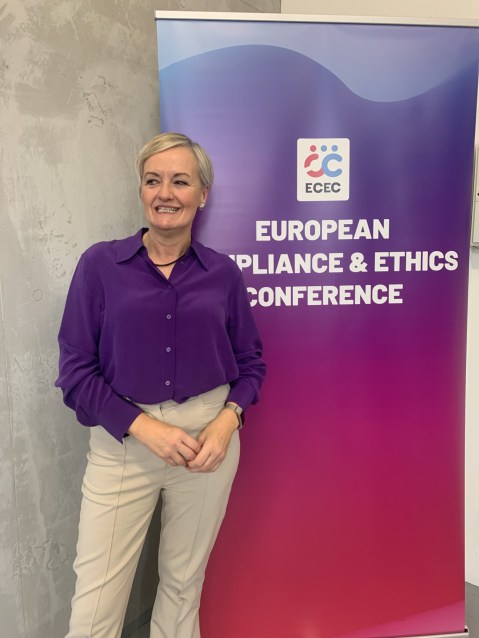
Employment disputes are supposed to be settled in a free and fair way; the reality is much different. In an interview at the 2023 Annual European Compliance and Ethics Conference in Munich, the largest conference dedicated to this subject globally, whistle blower Alison McDermott spoke of her case, and of a system that is awash with discrimination, inequality and abuse – at the expense of those who need it most.
A recap for readers of this blog, Alison told the conference the ordeal Sellafield and its governing body, the NDA, have put her through. After speaking out about serious employee abuses and abject failures within the nuclear facility’s HR department in 2018, HR director Heather Roberts and Lesley Bowen, who was responsible for the company’s EDI strategy, dismissed Alison overnight, citing financial reasons. Later, when Alison pursued litigation, Sellafield changed its tune, instead saying they acted on concerns over her performance, only mentioning financial reasons “to be kind”.
“It just doesn’t stack up”, she told interviewer and communications consultant Katy Diggory. “There is nothing kind about telling someone that we’re sacking you for one reason, and then three months later introducing a new reason when you no longer have a right to reply because you’ve already left”.
In addition, Alison produced a document highlighting Sellafield’s offer of an 18-month contract renewal just one month before her dismissal, which detailed the nuclear site’s perception of her previous work there as excellent and trusted by the executive.
What followed Alison’s dismissal is another damning indictment of the employment tribunal system. From her initial claim to the verdict, Alison recounts the bullying and harassment she was subjected to, labelled a “self-absorbed, self-serving woman” by Sellafield’s barrister, who insinuated she was pursuing her employer purely for financial gain – despite full knowledge of Alison having refused a £160,000 settlement offer.
Her interview at the conference further highlights the egregious power imbalance within the tribunal system. From the contrasting legal budgets of self-funded claimants versus their employers (in this case, an employer whose £670,000 of legal fees were picked up by the taxpayer), to the absence of any court transcript, and the lack of safeguards to protect employees from having reputation-damaging judgements publicly made against them simply for speaking out.
“Imagine being in a boxing ring with your hands tied behind your back and having to absorb punch after punch” was the metaphor Alison used, her experience made even more shocking with Judge Philip Lancaster allowing her former employers to pursue her for the maximum allowed costs.
Sellafield
Research by Greenwich University supports the imbalance Alison described, finding that more than half of all whistleblowing claimants represent themselves at their hearings, usually as a result of financial constraints. At the same time, employers are securing more expert legal representation than ever before.
The conclusions point to a modern landscape at odds with the informal grounds upon which the employment tribunal system was founded. The requirement of an advanced understanding of legal dogma has accompanied the encroachment of major legal firms into the realm of employment law – with employers spending hundreds of thousands of pounds to defend themselves from the claims levied against them.
This calls into question how an individual claimant could ever be able to compete against their bosses. The outcomes of employment tribunal cases indicate that, in practice, they rarely can. Referencing the government’s own tribunal statistics, Alison told the conference that between 2007 and 2021 only 3% of whistle blowers were successful at tribunal, noting that for women, the challenges faced are even more difficult.
“I think it’s incredibly hard for anyone to blow the whistle because of the huge barriers and inequality”, she said. “But research shows that women’s motives are more likely to be mistrusted”.
Need for substantial reform of the Employment Tribunal system
This phenomenon, Alison says, was manifest in her own judgement, with Judge Lancaster determining she was “pursuing some ulterior motive related to her desire to position herself as the champion of inequality within the nuclear industry”. This despite Judge Lancaster having reviewed evidence of Sellafield describing her as already a nationally respected expert in her field of work.
The experience of employment the tribunal system Alison shared with the ECEC stands as a clear example of why it needs substantial reform. Even now, following a successful appeal of her judgement, she is still being pursued by Sellafield for costs.
Alison at the conference
“Their duty is to create an environment where people are free to speak out, but hounding people for costs will obviously have the opposite effect” she said, adding that her tribunal experience has left others at Sellafield, the largest nuclear site in Europe, even more scared to raise concerns than they already were.
Closing her interview, Alison recommended several changes employers could implement, many of which are echoed by those who have gone through the same system. Assuming basic training and policies are in place, she prescribed a confidential way for employees to report concerns, a whistleblowing champion within organisations that values people who speak up, and finally that litigation should only be used as a last resort:
First, “investigate, investigate, investigate” she implored, ideally using external investigators. “I think that would send a very clear message to employees that the company really wants us to speak out.”
For those who want to hear directly from Alison the gruesome experiences of being a whistleblower there is a full video on YouTube of her speech. It is well worth watching.
First hurdle over clearing the way for a two day hearing in January to decide on whether the 13 grounds mean the ruling is overturned
An employment appeal judge has ruled that the decision by Judge Philip Lancaster dismissing whistleblower Alison McDermott’s case against Sellafield and the Nuclear Decommissioning Authority can be challenged now on no fewer than 13 grounds.
This extraordinary ruling on Friday in London by Employment Judge Tucker took less than 10 minutes to grant after she read the submission by Andrew Allen, KC, Alison’s counsel , means practically everything Judge Lancaster decided is open to challenge at an Employment Appeal Tribunal hearing in January. She decided she did not need to hear oral submission from Andrew Allen.
Alison McDermott; Pic credit BBC
In an earlier particularly harsh decision Judge Lancaster had decided that she wasn’t even a whistleblower, for producing, at Sellafield’s request, a damning report revealing serious issues in the HR function including allegations of bullying and harassment. Prior to this Alison had raised repeated concerns about racism, homophobic and foul language and a workforce too frightened to complain to senior management there.
Despite admitting that some of the concerns Alison raised were: ‘very offensive and concerning ” the judge ruled: “The Claimant has not, on the facts, established any alleged disclosure which is properly capable of amounting to a protected qualifying disclosure or the doing of a protected act, or that there is any causal link between what she actually said or wrote.”
It is worth providing a brief recap of what Sellafield and the NDA have done to Alison. She spoke out repeatedly about serious abuses of employees, including abject failures within the HR department, when the HR Director, Heather Roberts dismissed her overnight, allegedly for financial reasons. But when Alison started litigation, Sellafield changed its tune and Ms Roberts said she had had concerns about her performance and had only mentioned financial reasons to be kind.
Sellafield then dragged out litigation for three years before making a last-minute offer of £160,000. When they realised the carrot hadn’t worked, they decided to go on the attack and subjected her to a brutalising cross-examination in which her character and competence were repeatedly vilified until she finally broke down on the witness stand. But even then, they weren’t finished with her. As soon as Judge Lancaster ruled in their favour, they lost no time pursuing her for costs And all of this will have a hugely chilling effect on their 11,000 nuclear workforce.
Judge Lancaster claims he concentrates on anti-discrimination cases
Judge Lancaster, who says he specialises in anti-discrimination cases, went on to support Sellafield’s allegation of “underperformance” describing the report as ” questionable and insubstantial ” and without ” meaningful analysis”. Judge Lancaster completely ignored that management consultants PwC ruled that the HR function was not fit for purpose some three months later.
By then Heather Roberts, then the HR director at Sellafield, had already sacked her on the spot and immediately buried the damning report and admitted to lying about the reasons. Despite knowing that Alison had become so ill and had no income, the judge made a costs order against her and allowed Sellafield and the NDA to put in a claim for £40,000 costs against her.
Now Judge Lancaster’s own judgement will be in the firing line in January when an appeal tribunal examines 13 arguable grounds of appeal. In a skeleton argument, citing a previous judgement, Andrew Allen, KC, finds a plethora of errors in law which led to Judge Lancaster’s bizarre judgement that she was not a whistleblower. One paragraph that encompasses this – citing no fewer that eight grounds that the case could be challenged gives a flavour of this.
“It is an error of law for a tribunal to fail to give adequate reasons for its decisions so as to enable the losing party to understand why she has lost. The EAT has already decided that it is arguable that this tribunal have erred in law: in applying s27 EqA – in failing to recognise protected acts; in applying s109(2) EqA in identifying the correct relationship in dealing with agency; in failing to engage with the Claimant’s submissions in particular on adverse inferences, protected acts and agency; in failing to take a step back and look at the totality of the evidence; in failing to be Meek compliant; in failing to ensure compliance with the overriding objective to ensure that the parties are on an equal footing; in failing to ensure that the hearing was heard in public in failing to recognise that the Claimant has advanced argument on the facts and the law in relation to the agency point; and in failing to comply with the overriding objective in dealing with the case fairly and justly.”
Andrew Allen KC
Andrew Allen, KC also argued that the tribunal had failed to follow the principles of the law in pursuing costs again Alison which says should only be made in exceptional circumstances especially in the case of whistleblowing cases.
This case and Sellafield’s response is attracting wider attention. It is not just the UK press. On Friday, representatives of a prominent Norwegian environmental campaign group, Neptune Networks flew in from Oslo to attend the hearing.
Norwegian national press to follow the case
Neptune Networks has been raising serious concerns about Sellafield for the last two decades and confirmed that they will be attending the main hearing on 17 and 18 January 2020 and they will be accompanied by members of the national Norwegian press.
Finally a little note about Judge Lancaster. He is also the chair of directors of a Christian charity, Spacious Spaces, based in Leeds, which offers treatment programmes for alcoholics and drug takers. Here he is known simply as ” Phil”. This is the note about him on their site.
“Phil Lancaster practised as a barrister, specialising in criminal cases. He is now an Employment Judge dealing primarily with the anti-discrimination laws. He is a member of St George’s Church, where he has been a church warden and served on the parochial church council. He is married with fairly recently grown-up children and a large collection of Bob Dylan cds.”
I find it a little perplexing given his Christian background and commitment to treating drug addicts and alcoholics that he is not concerned about what Alison McDermott exposed about the pressures on staff inside Sellafield who are working in the most hazardous nuclear site in Europe. I also find it deeply disturbing that he made snide and pejorative comments about Alison both during the ET hearing and in the merits and cost judgment.
An example of this is the nasty insinuations he made about Alison when he accused her in the costs judgment of bringing a claim ‘to advance her career across the nuclear sector’ even though she had turned down a £160,000 to bring her claim to court. He also seems oblivious of the huge strain and damage whistleblowers face to their careers when they blow the whistle. If his judgement is found to be so badly wrong by the Employment Appeal Tribunal, there must be some serious questions about justice in the employment tribunal system.
Please donate to Westminster Confidential to allow me to continue my forensic reporting.









 Westminster Confidential