In praise of Dale Vince and Ecotricity: A green entrepreneur backing Labour

Labour donor: Dale Vince Pic Credit: ecotricity

Labour donor: Dale Vince gave £250,000
Pic Credit: ecotricity

The disclosure that an entrepreneur has had the temerity to back Labour with a £250,000 donation has led to the usual  scramble in the national media to discredit the man and his company, Ecotricity. The Telegraph has recently done a thorough job  presenting the multi millionaire as a tax avoider, a greedy guzzler of state subsidies set up by one  former energy secretary, Ed Miliband, and owner of a castle. Presumably since Ecotricity doesn’t appear to advertise in The Daily Telegraph they felt brave enough to publish.

What is entirely missing from the article – and this  is surprising as the Telegraph champions competition –  is  support for a company challenging the energy monopoly. No mention of what his company does for ordinary people – which  you cannot get from the big six privatised and mainly foreign-owned giants who make millions from our gas and electricity bills.

I use Ecotricity for both my gas and electricity. One of my reasons is that I would rather spend my money with a company that has a real track record of investing in renewable energy than fossil fuels.

But take that aside – even though many on the right hate wind farms and believe global warming is a myth – Ecotricity has other plus points. Without wishing to act as an advertisement for Ecotricity – this site has no advertising – it seems to me, whatever faults Dale Vince may or may not have, at least his firm tries to offer the consumer a  better deal.

For a start the Telegraph ignores the fact that unlike any of the big six Ecotricity is  recommended  alongside other small companies by Which? as one of the better service providers.It came first for customer satisfaction as well.

Second it employs people in Stroud,its own HQ to deal directly with its customers.This compares with one of the big six I used in the past that had its call centre in India and lost my account when I moved house.. For nearly a year I wasn’t billed for electricity on my  new Berkhamsted home. When I raised this in India the officious   Eon/Powergen call centre worker demanded I sorted out all the paperwork myself – which I refused to do – and then desperately asked for an address   “any address ” he said to bill me. I was tempted to give him a false one in New York City to celebrate the follies of outsourcing and globalisation but honesty got the better of me.

Unlike the big six Ecotricity accepts direct debits for the actual amount of gas and electricity billed – you don’t have to pay a monthly overestimate for what you might use – a great scam allowing companies to take too much money off you for unused energy and use your loan to boost their own profits.

Fourth, Ecotricity is planning to cut prices by 6.2 per cent this May and promising more later in the year  – more than any of the big six and they never raised their prices in the last tranche either. This is something I have to remind the cold callers from the big six desperate for you to switch to them.

Fifth Ecotricity  gives you a good return on the money if you  invest in them.. It offered seven per cent  (7.5 for customers)before tax and its second issue offered six per cent gross (6.5 for customers) on its oversubscribed bonds – far more than the  four per cent  the” generous” George Osborne  is offering  pensioners in the run up to the election.

Some financial advisers have told me they can only offer these good rates of interest because of taxpayer subsidies. But it seems to me that the subsidies for cleaning up nuclear power waste – provide five times more money for the big six energy providers than the sums going to Ecotricity. Even the Telegraph acknowledges that.

But in a pre-election frenzy no right-wing paper  seems to want to acknowledge that anybody backing Labour can offer better value for money.

Anti Austerity: Time for the Job Creators Allowance

Muhammad_Yunus_-_World_Economic_Forum_Annual_Meeting_2012 (1)This month a radical thinker passed through Westminster and presented an idea that politicians tackling Britain’s economic crisis should sit up and take notice.

Nobel Peace prizewinner Muhammad Yunus was addressing a Commonwealth Parliamentary Association conference on growth and development en route from Bangla Desh to Mexico City. The conference attracted people from as far apart as Somalia and Paraguay and Haiti and Timor-Leste.

Yunus is the man who created an anti-bank bank called the Grameen Bank in Bangla Desh which broke every rule of traditional banking. As he put it : ” I went and talked to the banks and did precisely the opposite of everything they told me.”

His bank was only interested in lending money to the poorest in Bangla Desh – those with nothing so they could start tiny micro businesses. His ideas have now been taken up in developed economies notable the United States in New York and elsewhere.

He has been criticised however by people who say it  is still exploitative and has not worked, The idea has been hijacked by others as this review suggests.

But his bank is extraordinary. he employs no lawyers, has no detailed contracts, and lends to people with no collatoral and yet 99 per cent of the small loans are repaid. Bad news for Price Waterhouse and City lawyers as well as banks.

I was particularly struck by one phrase he tells the unemployed in Bangla Desh to say. ” I am not a job seeker. I am a job creator. I want to start at the top not be exploited at the bottom.”

Now it occurs to me that this might have a lot of resonance to Britain post the crash. Capitalism and bankers are brilliant at helping the haves have even more so they can exploit the have-nots, What about turning the idea on its head and help the have-nots for once.

Britain is rapidly becoming a more unequal society in wealth and jobs. Constituencies near to me like Hemel Hempstead face a job feast this Christmas with Amazon and Royal Mail competing against each other to fill vacancies. Constituencies like Birmingham, Ladywood and Foyle in Northern Ireland face a job famine  with over 11 per cent still out of work.

It also strikes me that among the wasted talent on the dole they must be people capable of learning skills, particularly in the  child or personal caring professions, but can’t get going because they haven’t basic qualifications or access to a few hundred readies to get started. This is why Jobcentre plus in pushing them into low paid work, zero hour contracts, to become the new exploited of companies funded by wealthy private equity groups.

Now if a politician decided that instead he was going to find a way to connect with the dispossessed by setting up a bank only interested in funding them to create their own job – this might have more resonance in the real world than in the current Metropolitan elite.

Traditionally this idea sits with Labour – the party created by trade unions, that believes in social credit organisations rather than Wonga and backs the ideals of the Co-operative movement. But it could equally apply to the Greens and some strands in other parties

What better way to reconnect to the working class than allow him and her to get cash to buy equipment so they can earn some money, even get  a second-hand white van. A veritable Job Creator Allowance.

What about the money for this?  Why not use the huge fines on corrupt banks to kick start the scheme rather than as sticking plaster for the NHS (Labour) or tax cuts (Tory)? What is a more delicious idea than taking money from bloated, arrogant money manipulators and giving it to the very people they wouldn’t give house room?

How would it work? I don’t know but I now know a man who does. He is called Muhammed Yunus. Someone should call him up and put the idea in their party manifesto. He did speak after all in the Attlee Room,  named after one of Britain’s greatest reforming Prime Ministers.

Reflections on Labour: Two women who could help change Britain

Margaret Hodge; A practical route map for Labour

Margaret Hodge; A practical route map for Labour

The most exciting part of political conferences is not the main conference hall but the fringe. It is here that people are much more likely to speak their mind and real issues are debated – not set piece presentations ( even if Ed Miliband forgot a bit of his!).

Two totally unreported contributions came from two of the more feisty women in the Labour – both with strong views.

Angela Eagle, shadow leader of the Commons, chair of the conference and the national policy forum made a refreshingly off message analysis of present British society and where it is going.

Speaking at a Unite union fringe organised by Class (Centre for Labour and Social Studies)- analysing the rapidly widening gap between the mega elite and the ordinary worker – she actually described the present situation in society as ” immoral”.-pointing out that  top directors now earn 130 times more than their workforce.

She also defended benefit claimants -pointing out that the media campaign labelling or libelling them all as scroungers – had meant ordinary people coming to her Wirral surgery were wrongly put on the defensive just because they were claiming from the state.

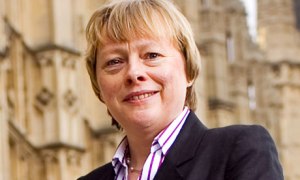
Angela Eagle providing Labour with a  moral compass. Pic credit: The Guardian

Angela Eagle providing Labour with a moral compass. Pic credit: The Guardian

She was on a platform where the speakers were firmly of the view that the present economic situation was unsustainable, companies were hoarding money rather than investing and people could only spend by getting more into debt.

It shouldn’t be surprising that you hear such views at a Labour conference, but it is surprising these days to hear such comments from a member of the shadow Cabinet.

The second feisty contribution came from Margaret Hodge, chair of the Commons public accounts committee. She was speaking on a different platform with the Policy Network Here the issue was how Labour could make a difference by accepting the present economic situation and using public money more effectively.

Superficially  you might think the two women were on  different planets but actually they complimented each other.

Margaret Hodge, with enormous experience of investigating Whitehall scandals, tax avoidance and the dodgy behaviour of private companies providing public services, had a practical route map on how Labour could handle this.

Her solution including forcing the companies to become transparent with the way they spend or misspent our money, using public procurement to secure the living wage for all workers, clamping down far more effectively on tax avoidance including collecting the taxes, and looking at radical five-year plans to innovate public services, rather than the Treasury knee jerk reaction top impose cuts with three months notice.

Ed Miliband would be mad if he did not appoint her to head a new unit with oversight of public contracts if he wins the election – she could then insist on implementing this programme rather than report on the messes left behind by the private sector.

He would also be mad not to promote Angela Eagle into a job where she could influence the direction of public spending. Both women  have enormous talents. Angela provides a moral compass, Margaret a practical route map  out of an increasingly unfair society.


An Ed Balls up on rich pensioners benefits

Ed Balls explaining his balls up on rich pensioners: Pic Courtesy:Left Foot Forward

Ed Balls explaining his balls up on rich pensioners: Pic Courtesy:Left Foot Forward

Update: Since posting this comment  the Labour Party have formally adopted this policy of taking away winter fuel allowances from higher rate pensioners.

 But the Revenue have confirmed that they do  not collate figures showing how many households have higher rate and standard rate taxpayers who are currently eligible for winter fuel payments. They do not need to collect the information as taxpayers are assessed individually. So they don’t know the breakdown. The only figures they have are the number of higher rate taxpayers who are pensioners. He does have  a parliamentary answer from the department of work and pensions based on an estimate for the £100m savings but it does not deal with the situation outlined below.

I am  used to David Cameron shooting from the hip with knee jerk, ill thought out policies to respond to public opinion but I thought that Ed Balls would be cleverer than that.

Evidently not. His latest pronouncement  promises to save £100m by withdrawing winter fuel payments from pensioners who pay higher rates of tax sounds good. Labour expected this to show they are being tough on the rich and offering savings. Actually it will do neither.

As a punter and pensioner who pays higher rate tax because my freelance earnings top up my pension I expected to be one of the people targeted by Ed Balls. In fact it will have zilch effect, a load of old Balls if you like.

Let me explain why. The fuel allowance is currently paid to individual pensioners with a cap of £200 per household. So for a start I only receive £100 of   fuel benefit. The other £100 goes to my wife, also a pensioner, who is a standard rate taxpayer. So his planned saving will be halved anyway in my case.

But it is actually worse than that. My wife became a pensioner before me and was entitled to the full household fuel allowance in her own right. So when I was on The Guardian, our household was receiving then  a £250 fuel subsidy for a short time. What will happen under the Balls changes is that my wife will get back the full benefit of £200 – so we will still continue to receive exactly the same subsidy.

I suspect I am not alone. I know of many people around me in the shires, where in traditional families of that generation the main earner is the male who may well pay high rates of tax. His spouse who brought up the children, and did part-time work instead, would be a  standard rate taxpayer. These wealthy households will continue to get the subsidy.

Now Ed Balls could get round this by imposing a household cap equivalent to the income level set by the higher rate of tax. But if he does this he will run into fresh problems.

The text of his speech reads:  ( see http://www.labour.org.uk/striking-the-right-balance-for-the-british-economy)

“can it really remain a priority to pay the Winter Fuel Allowance – a vital support for middle and low-income pensioners – to the richest 5% of pensioners, those with incomes high enough to pay the higher or top rates of tax?

We believe the winter fuel allowance provides vital support for pensioners on middle and low incomes to combat fuel poverty. That’s why we introduced it in the first place.”

If he does this he will have misled people in this speech because this would mean that two pensioners with say a combined income of £44,000 will lose the allowance – extending the cuts  right into the middle-income group – the so-called ” squeezed middle”. Millions more people will be hit than Labour claims. Or he could change the entire tax system going back to household not personal incomes, which would be enormously costly.

This proposal seems typical of a metropolitan political elite.  Ed Balls and Yvette Cooper are both high rate taxpayers – just like David and Sam Cameron – and would expect to be hit when they reach retirement age – probably 75 by then. But the rest of the country is nothing like that.

Either you are going to hit more households and take away the benefit from standard rate taxpayers or leave a proportion of wealthy households still receiving the fuel allowance. And the Parliamentary answer does not provide the answer to this.

Millionaire donors bankruptcy threat to Labour attracts record interest

Just a short note to thank readers who took this website to record levels this week. Not only did it contribute to a  new  high of 3604 in one day, but the  Labour woes story attracted 3848 hits.

Altogether there were over 6500 hits on the website – the majority about the financial killing by Tony Blair’s millionaire donors  who are still lending the party almost £9m. Particular thanks to Paul Staines whose Guido Fawkes website led to 3100 of the 3848 hits ( and two comments from his nibs on the story )and to those who posted a link on the BBC’s Nick Robinson blog and the Political Betting websites, which attracted nearly another 300 hits. Some 17 also came from the Westminster blog on the  Financial Times which commented on the tale.

The second largest hit was on the story revealing three  directors of AssetCo – the private fire fighting company with contracts in London and the Middle East  were quitting their jobs in the wake of the financial crisis that is hitting the firm. Nearly 1700 people read the piece with a large number of hits referred from the Fire Brigades Union, which is fighting the privatisation of fire services, and 91 from Interactive Investor, the website discussion board for anxious shareholders of the company who have seen their shares drop from nearly 70p to 16p at the last count.

Lowest interest is in the plight of the Lib  Dems –  a piece attracted 96 viewers- a rating comparable to their present polling performance.

Could seven millionaire donors bankrupt Labour?

In denial: Harriet Harman Pic-courtesy http//:thisislondon.co.uk

The Labour Party is sitting on a financial time bomb which could go off at the next general election in 2015.

Tony Blair  made great play when Lord

In the money: Chai Patel pic courtesy:BBC

Levy managed to recruit millionaire donors to the party to end its dominance by union money. The whole thing ended in tears after the ” cash for peerages” scandal. Even though there was not a single prosecution  this brought unwelcome publicity for all concerned.

The result was that some got their money back and the rest agreed to keep their money there to prevent Labour going bust. Everybody thought that the loans were interest free and they were.

But from August 1 last year the seven remaining millionaires started getting an inflation busting 6.5 per cent  on the £8.9m they had lent the party. Not only was this far better than the C0-op Bank’s modest 3.5 per cent charged on a £2m credit facility to the party but nobody anywhere else could get like it from a bank or building society.

The seven remaining millionaires are Sir Richard  Caring, owner of The Ivy restaurant, Soho House and Annabels night club,£2m ;Sir David Garrard, retired City property developer, £2m after he converted £300,000 into a donation; Dr Chai Patel,  former owner of The Priory rehabilitation centre and now running a private equity company, £1.5 m; Rod Aldridge, former founder of outsourcing firm Capita and now running a trust, £1m; Nigel Morris, founder of Capital One, a loans and savings bank £1m; stockbroker, Barry Townsley, £1m and Sir Derek Tulloch, financier and executive chair of the Hong Kong Stock Exchange, £400,000.

Two donors –Nigel Morris and Barry Townsley – according to an Electoral Commission document have upped their interest rate to 6.75 per cent.

One of the outstanding donors, Sir Richard Caring, is now a supporter of David Cameron and has donated some £140,000 in gifts and prizes to party events.

Most of the others now seem to have retired from business and are running trusts and in Rod Aldridge’s case, two academy schools with two more in the pipeline.

Labour’s attitude so far has been ostrich like. Harriet Harman, the deputy party chair, when questioned at the Parliamentary Press Gallery lunch this month  by me about this said this: ” Don’t believe what you read or for that matter what you write.”

Well, Harriet I do believe that Labour’s returns to the Electoral Commission are honest and above-board and that is what they say, for better or worse.  Make up you own mind, see them here.http://registers.electoralcommission.org.uk/regulatory-issues/labpartyloans.cfm.

The horror about this situation is that I calculate that the rolled up interest could add almost another £2m to a party that doesn’t have a lot of cash. It can only be paid back by relying on party members or union donations and is all due plus interest on 30 September 2015.

It also lays the party open to serious repercussions. If I were a particularly mischievous official at Conservative Central Office I might whisper into the ear of my new supporter, Sir Richard Caring, and suggest he might just demand his money back  as Labour is fighting an election.

Labour’s NEC  needs to start planning now how they are going to handle this. Otherwise the People’s Party has put itself at the mercy of some very rich and powerful people with the potential to bankrupt them.