Two damning reports from Parliamentary Ombudsman say Charity Commission failed complainants about sexual abuse

The Parliamentary Ombudsman’s Office today published two reports into the Charity Commission’s handling of separate sexual abuse cases following Parliament’s rare privilege decision last week – see my report here – to compel Paula Sussex, the Parliamentary Ombudsman, to release them in the face of the Commission starting legal action to stop or delay publication.

Both reports highlight the failure of the Charity Commission to implement some of its findings and the total dissatisfaction of the two complainants – Lara Hall, 37 and Damian Murray, who is 66. Both decided to waive their anonymity. I will be publishing a separate follow up story on Mr Murray’s case after he contacted me – particularly after the local media failed to cover it. It is a truly shocking story.

The two cases are different. Lara Hall’s case involves the sexual exploitation by a trustee of a UK charity where she acted as a whistleblower.

Damian Murray’s case involved historic sexual child abuse by a prominent figure in the local community which was concealed by the charity and the college where he worked.

Lara said:

“The Charity Commission’s repeated failures have caused me profound pain and ongoing injustice. Instead of holding a trustee to account for appalling sexual exploitation, it questioned my experience and forced me to relive my worst trauma. How can survivors feel safe reporting abuse if they think they will be treated like I have? 

“By trying to block Parliament from seeing the reports, the Commission attempted to avoid scrutiny – striking at the heart of accountability in our democracy. Even now, it refuses to accept responsibility or act to put things right.

“It is my hope that by bringing the reports to Parliament’s attention action will finally be taken. The Commission must urgently address safeguarding to protect vulnerable people. Right now, it is failing in its core duty.

“It is time for change, oversight, and accountability within the Charity Sector so what happened to me is never repeated. I call on Parliament to hold the Commission to account and restore public trust. People deserve to feel safe approaching charities, and they deserve a regulator that takes safeguarding seriously

Damian Murray said:“For over seven years the Charity Commission has refused to act upon my complaint about the concealment of child sexual abuse.

“The Charity Commission has doggedly resisted all efforts by me, and latterly the Parliamentary Ombudsman, to encourage it properly or promptly to discharge its statutory responsibilities, choosing rather to shield the charity and its Trustees from scrutiny and accountability.

“After much unnecessary time incurred due to this resistance, the Ombudsman’s report has now been laid in Parliament. I trust now that politicians will hold the Commission to account, where I as an ordinary UK citizen failed.

“By stark contrast with the Commission, I very much appreciate the careful, professional and empathetic way that the Ombudsman’s team have dealt with me and with the complex and consequential concerns I have raised.”

Parliamentary and Health Service Ombudsman CEO, Rebecca Hilsenrath KC (Hon) said: 

“The Charity Commission indicated throughout our investigations that they did not agree with our findings.  They have not complied with the bulk of our recommendations, despite our best efforts and our willingness to work with them to ensure compliance.

“It is important that the Commission provides a full apology for their failings and reassures Lara and Damian that they will put things right by complying completely with our recommendations. They have not done this so far. 

“Our report has now been laid in the House of Commons, following the intervention of Parliament last week. The Commission had prevented us from doing so by bringing legal proceedings. We act on behalf of Parliament to hold Government and other national bodies to account for failures, and we have a responsibility to make Parliament aware of cases of non-compliance. I am pleased that Parliament has taken an interest in these cases and has given us the opportunity to bring them to the attention of the House so that it can intervene.

“The purpose of our investigations is always to encourage learning and service improvements. If an organisation looks at what went wrong, it will be able to stop the same mistake from happening again.”

The Charity Commission released a statement criticising the action of Parliament to order publication of the reports.

A spokesperson said: “We have long accepted that there are genuine and important lessons for the Commission to learn from these two sensitive cases, principally in the way in which we communicate with complainants, and we have made improvements to our processes as a result. We have previously apologised to both complainants.

The Commission undertook detailed reviews in each case, as set out by the Ombudsman, and concluded that the overall outcome in each case was sound. In the case of Ms Hall, we had already issued an official warning to the charity concerned. 

But it is our view that by making the decision that we did not comply with certain recommendations in its reports, the Ombudsman has misunderstood our remit and overstepped its role, meaning that its decision making was unlawful.

We respect the work and authority of the Ombudsman, but it is vital that we, in turn, are enabled to do the job that Parliament set us

We have worked hard to seek to resolve the matter with the Ombudsman directly, but this has not proven possible. For that reason, we have brought legal action at the High Court. 

We have not asked the court to block the laying of any report before Parliament. We did, though, ask the Parliamentary committee to delay considering the reports to allow the courts to give judgment on our own and the Ombudsman’s statutory remits first.”

One-Time
Monthly
Yearly

Make a one-time donation

Make a monthly donation

Make a yearly donation

Choose an amount

£5.00
£10.00
£20.00
£5.00
£15.00
£100.00
£5.00
£15.00
£100.00

Or enter a custom amount

£

Your contribution is appreciated.

Your contribution is appreciated.

Your contribution is appreciated.

DonateDonate monthlyDonate yearly

You can also donate via PayPal The link is:
https://www.paypal.com/ncp/payment/865JAS3QJ3CGQ

Exclusive:Rishi Sunak delays appointment of new Parliamentary Ombudsman and throws the organisation into crisis

Sir Alex Allan, board member of the Parliamentary and Health Service Ombudsman. Pic credit: BBC

Email from Sir Alex Allan revealing problem removed from Parliamentary website after I made a press inquiry

Parliament and the Health Service will not have a new permanent Ombudsman from April because the Prime Minister has delayed approving a new replacement who anyway cannot start work at the office because he or she has to give notice to leave their present job.

Details of the crisis at the office are revealed in an email sent on January 29 from Sir Alex Allan, a senior non executive member of the board of the Ombudsman’s office, to William Wragg, Tory chair of the Commons Public Administration and Constitutional Affairs Committee (PACAC).

Sir Alex is a former high flying civil servant who chaired the Joint Intelligence Committee, and was the Prime Minister’s independent adviser on ministerial standards until 2020 when he resigned after Boris Johnson refused to accept his report on Priti Patel, the former home secretary, concluding that her behaviour was bullying.

The email pleads with William Wragg to contact Downing Street to resolve the problem as a matter of urgency.

His email warns:

“As a corporation sole, the organisation cannot operate without an Ombudsman in post. Any delay to the appointment puts the organisation at considerable risk. In particular because key casework decisions could not be taken it puts at risk all of the work to reduce the queue and improve service to complainants. Clarity of the timeline for both the permanent and interim Ombudsman
appointments is therefore pressing.”

A pre-appointment hearing - part of the normal appointment process - had been pencilled in by PACAC to quiz the new Ombudsman but that has been pit back and there is no date for a future hearing. The page announcing the future hearing on the website is now blank.

He goes on: “”I am pleased that the Panel, led by Philippa Helme, has identified a preferred candidate but I am concerned about the apparent delays since then. We have yet to receive confirmation that the preferred candidate has been agreed by the Prime Minister. “

Rebecca Hilsenrath, chief executive at the PHSO

Sir Alex says the board’s preferred solution is to appoint an interim Ombudsman and suggests Rebecca Hilsenrath, the current chief executive who moved there from the Equality and Human Rights Commission, would be the ideal candidate.

But Whitehall has not even approved this. He writes: “We have yet to receive confirmation of this, despite the urgency, which is making it difficult for the organisation to properly plan for leadership change.”

The crisis facing the Ombudsman’s Office raises a whole of questions which I tried to put to them.

This includes questions like whether Rebecca Hilsenrath, if appointed as an interim, will be able to announce case decisions affecting complaints about hospitals and the NHS, or will they have to wait until they have a permanent appointment?

From Sir Alex’s letter it is also clear if neither people are approved by Downing Street and the Cabinet Office, the office would cease to function altogether until this was sorted out.

The impasse could also affect the timing of the publication of the final report by the outgoing Ombudsman, Rob Behrens, on maladministration in 50s women’s delayed pensions. WASPI have been waiting years for its publication and have seen the draft report which has already been leaked on this website. See the blog here.

A PHSO spokesperson said:

“The process to appoint a new Ombudsman is ongoing. We are in discussions about interim arrangements should they be needed. Our important service for the public continues.”

A spokesperson for PACAC said the committee could not comment but the original pre appointment hearing had been scheduled for last month but because they had not had confirmation from the Cabinet Office that the government had approved the appointment no date was fixed. The email should not have published on their website which is why it was taken down. This suggests that Rishi Sunak has been delaying a decision to approve the appointment for weeks.

For those interested the text of the email is published below:

From the Senior Non-Executive, Sir Alex Allan KCB
Sent by Email Only: pacac@parliament.uk
29 January 2024
Dear Mr Wragg,
I am writing to convey my concerns about the slippage in the timetable to appoint a new
Parliamentary and Health Service Ombudsman (PHSO) and to ask for your support, as Chair of the
Public Administration and Constitutional Affairs Committee, in raising these concerns with No 10.
I am pleased that the Panel, led by Philippa Helme, has identified a preferred candidate but I am
concerned about the apparent delays since then. We have yet to receive confirmation that the
preferred candidate has been agreed by the Prime Minister. That meant that the planned preappointment scrutiny hearing had to be cancelled and has not been refixed.
I am aware that, due to the preferred candidate’s notice period, there will be a need to appoint an
interim Ombudsman and that the view remains that this should be Rebecca Hilsenrath, Chief
Executive Officer at PHSO. We have yet to receive confirmation of this, despite the urgency, which
is making it difficult for the organisation to properly plan for leadership change.
As a corporation sole, the organisation cannot operate without an Ombudsman in post. Any delay to
the appointment puts the organisation at considerable risk. In particular because key casework
decisions could not be taken it puts at risk all of the work to reduce the queue and improve service
to complainants. Clarity of the timeline for both the permanent and interim Ombudsman appointments is
therefore pressing,

I have written to Baroness Neville-Rolfe to convey these concerns and I would be grateful if you
would consider raising them with the Prime Minister’s office.
Yours sincerely,
Sir Alex Allan

Senior Non-Executive Director

One-Time
Monthly
Yearly

Make a one-time donation

Make a monthly donation

Make a yearly donation

Choose an amount

£5.00
£10.00
£20.00
£5.00
£15.00
£100.00
£5.00
£15.00
£100.00

Or enter a custom amount

£

Your contribution is appreciated.

Your contribution is appreciated.

Your contribution is appreciated.

DonateDonate monthlyDonate yearly
One-Time
Monthly
Yearly

Make a one-time donation

Make a monthly donation

Make a yearly donation

Choose an amount

£5.00
£10.00
£20.00
£5.00
£15.00
£100.00
£5.00
£15.00
£100.00

Or enter a custom amount

£

Your contribution is appreciated.

Your contribution is appreciated.

Your contribution is appreciated.

DonateDonate monthlyDonate yearly

Please donate to Westminster Confidential

£10.00

Parliamentary Ombudsman to send out confidential draft findings on 50s women pensions next week

A younger picture of Rebecca Hilsenrath

A confidential copy of the provisional findings of the Parliamentary Ombudsman’s report revealing what compensation the 3.5 million remaining 50swomen will get for their delayed pensions will be sent out to selected parties at the end of next week.

This long, long awaited move was announced by Rebecca Hilsenrath, chief executive of the Ombudsman’s Office, to Mps on the Public Administration and Constitutional Affairs Committee yesterday.

Ms Hilsenrath told MPs that this long drawn out investigation had been ” challenging” and the Ombudsman had needed expert legal advice on how to proceed with the report. She said the investigation which began in 2018 had twice been paused because of litigation. These included the judicial reviews brought by ” Backto60″ – now CEDAWinLAW and Waspi . Backto60 had fought the DWP over indirect discrimination in the process and Waspi had wanted the finding of maladministration widened to cover other circumstances which had affected women’s claims.

It was also revealed that the Department for Work and Pensions had contributed to the delay by asking for more time to consider the issues.

Altogether it will have taken seven years before the public release of the report expected in the New Year of the Ombudsman’s findings during which over 250,000 women have died.

John McDonnell, the former shadow chancellor, said these delays and extensions had mean it would mean ” justice delayed becoming justice denied” and pressed the Ombudsman not to grant any more extensions to the DWP or other parties.

The schedule announced by Ms Hilsenrath will give the six ” test case” complainants until Christmas to respond. The provisional findings are also being sent to the DWP and Waspi but not to CEDAWinLaw.

” We will then take into account their views before issuing a final report in the New Year.”, she said.

The announcement yesterday came as the £15,000 crowd funder launched by CEDAWinLAW has already raised over 70 per cent of the cash so lawyers could draw up a strategy to bring a group class action against Mel Stride, the works and pensions secretary, for direct discrimination in the way they handled the raising of the women’s state pension from 60 to 65.

The lawyers handling the case are human rights lawyer John Cooper, KC and David Greene.

John Cooper KC

John Cooper said: “This is an important challenge for so many women in this country. The weight of the evidence indicates a grave injustice to them and we will robustly represent their interests as we move forward with the assistance of a first class legal team”

David Greene is regarded as an expert in bringing Class Actions for groups and cited as one of the best litigators in the City. He is a past President of the Law Society which represents solicitors.

Initially the Parliamentary Ombudsman’s Office said the “as far as we are aware no legal proceedings have been issued so no implications for our investigation.”

Rob Behrens, Parliamentary Ombudsman

Yesterday Rob Behrens, the Parliamentary Ombudsman, changed his position warning that further litigation would delay proceedings for the publication of the report.

Jovelynne Scutt, the former Australian anti discrimination commissioner, who has compiled a report saying the DWP is in breach of international law, says the legal case should have no bearing on the Ombudsman’s report which is mainly about maladministration.

Yesterday Ms Hilsenrath also admitted that the office’s handling of the complaint would be reviewed by the Parliamentary Ombudsman to see what “lessons can be learned” over the long process it has taken. By then Rob Behrens, the current Ombudsman, will have retired and a new one would be in place.

One-Time
Monthly
Yearly

Make a one-time donation

Make a monthly donation

Make a yearly donation

Choose an amount

£5.00
£10.00
£20.00
£5.00
£15.00
£100.00
£5.00
£15.00
£100.00

Or enter a custom amount

£

Your contribution is appreciated.

Your contribution is appreciated.

Your contribution is appreciated.

DonateDonate monthlyDonate yearly

Please donatge to wsestminster Confidential

£10.00

Equality Commission facing waves of strikes from disgruntled staff

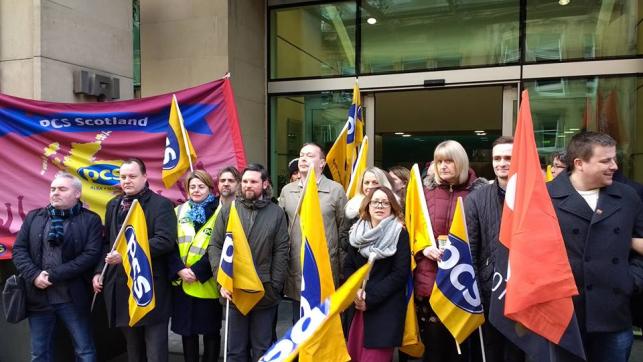
striking Commisison staff in Scotland

Striking Commission staff on Scotland. Pic credit : Commons Space

CROSS POSTED ON BYLINE.COM

The long running bitter dispute between the management and the staff of the Equality and Human Rights Commission has spilled over into a wave of strikes which will run until the day after polling day.

Rolling strikes began in Glasgow this week and will continue in London, Cardiff and Manchester following the sacking of many disabled and black and ethnic minority staff – some by email. One of the worst cases involved  57 year old Markus Caruana, a disabled former flute player in the Corps of Drums with the Grenadier Guards.

Markus Caruana was unfortunate enough to have been both at the Guildford pub bombings in 1974 and the Chelsea Barracks bombing in 1981 which seriously injured regimental bandsmen from the Irish Guards. He was fortunate enough to escape unscathed but later had a  serious disability.  He lost his 75 per cent of his hearing and got  an incurable muscle wasting disease called Marie-Tooth disease (CMT) which affects the nervous system that supports muscles, often weakening the legs and feet.

So ferocious has the sacking policy been  that there are now vacancies at the ECHR even though it has suffered enormous cuts since 2010. But the management have banned any of the sacked staff  from applying for a job.

According to the PCS Union The Commission’s expenditure report for April shows it has spent £90,876 on agency staff in April and £17,900 on recruitment costs. The spending on agency staff is a significant increase on previous months – £44,000 in January, £61,000 in February and £65,000 in March.

A Commission spokesperson, said: “We have greatly reduced our spend on contractors in recent years. Contractors are, however, used when we need certain technical skills and experience that are not available in the Commission. The recent increase has been due to one off costs and no long term rise in spending.”

Of the eight union members issued notices of compulsory redundancy, six are black or minority ethnic, five are disabled and seven are older workers. Four are union reps and one was a lead negotiator opposing the cuts. We are now pursuing legal action against the EHRC for victimisation of trade union representatives.

The management issued a defiant statement  on the existing strike action.

rebeccahilsenrath

Rebecca Hilsenrath: chief executive of the Equality and Human Rights Commission and leading the programme of staff cuts Pic credit: Douglas-Scott co.uk

Rebecca Hilsenrath, EHRC Chief Executive said: “The changes we are making will allow us to respond to the new challenges we face. I am proud of how well our staff have embraced this new way of working and our ambitious programme of work.

“We have made every attempt to end this dispute with the union and have offered them concessions at every stage of talks. We are now focused on delivering our business plan.  We are unclear as to their rationale for continuing action.”

PCS general secretary Mark Serwotka said: “Our members only take strike action as a last resort but management’s reluctance to adequately address their concerns have given them no choice.

“There are vacancies at the Commission and there is no reason why our members can’t have those jobs.

“The fact that the government has cut the Commission to a quarter of its original size demonstrates the Tories’ lack of commitment to equality and human rights issues.

“Further budget and staff cuts would leave the commission toothless at a time when more needs to be done to tackle hate crime and discrimination.”

What is extraordinary about this whole situation is that  the issues that the ECHR is supposed to represent – employment rights, equal pay, the rights of the disabled and  unfair discrimination against black and ethnic minority and gay workers – are all being undermined by their own attitudes to their staff.

If there are to be tribunal hearings – it will mean the reputation of the organisation will be damaged- and all these causes will suffer. This does not look like going away.


Exclusive: How the equality watchdog sacked a disabled army veteran and IRA bomb survivor by email

rebeccahilsenrath

Rebecca Hilsenrath: chief executive of the Equality and Human Rights Commission and leading the programme of staff cuts Pic credit: Douglas-Scott co.uK

donald-trump

Donald Trump : You’re fired. Credit Giphy

CROSS POSTED ON BYLINE.COM

Late last year this blog featured the case of  57 year old Markus Caruana,  who works in corporate communications at the Birmingham office of the Equality and Human Rights Commission.To recap

He is a former flute player in the Corps of Drums with the Grenadier Guards.

Markus Caruana was unfortunate enough to have been both at the Guildford pub bombings in 1974 and the Chelsea Barracks bombing in 1981 which seriously injured regimental bandsmen from the Irish Guards.

He escaped unscathed in both instances but saw three of his friends killed in an IRA attack in Crossmaglen in Northern Ireland.

He left the army in 1985 to become a landscape gardener and then took advantage of a Unison sponsored education scheme to learn to read and write.

He had been a school refuser after being bullied and could hardly read or write or read music but was able to play his  flute because he had a natural memory for tunes.

In 2002 he secured a job with the Disability Rights Commission which later became part of the EHRC.

Sadly he lost his 75 per cent of his hearing and got  an incurable muscle wasting disease called Marie-Tooth disease (CMT) which affects the nervous system that supports muscles, often weakening the legs and feet.

The EHRC had enabled him to have a support worker so he could do his job there – but she is also facing redundancy now he has failed to retain his job.

Yesterday he  and five other disabled people was sacked by email by the EHRC and given 24 hours notice to clear his desk. He was one of ten people made compulsorily redundant by emails from executives from the Commission.

The decision led to a furious reaction from one of the main union representing staff,the PCS.

EHRC says the staff will receive pay in lieu of notice (PILON), but workers did not agree to this because it closes off the opportunity to seek redeployment at the commission or elsewhere in the civil service.

In a letter back to EHRC, the union states: “By imposing PILON you are cutting off this option and effectively consigning BME, disabled, women and trade union members to unemployment. There should only be PILON in cases where the individual concerned has agreed to it.”

Commenting on the cases, PCS general secretary Mark Serwotka said: “It’s absolutely reprehensible that dedicated staff have been sacked and told to clear their desks with a day’s notice.

“That this has happened at the government body charged with upholding human rights and fair treatment in our society is an absolute scandal and we will continue to fight it.”

My own take on it is this. It is quite clear that the head of the EHRC, Rebecca Hilsenrath, is a particularly vindictive person to take action like this – by making it difficult for these people to get other jobs in the civil service.

Her action reminds me a bit of the attitude taken by Donald Trump towards disabled people. I am sure she would make an excellent addition to his staff in Washington though I don’t know whether she would share his locker room talk or not.

I have also written an article for Tribune about the sackings and the future strikes.

The crisis at the heart of Britain’s Equality and Human Rights Commission

David Isaac Pinsent Masons

David Isaac: Chairing a fractured organisation with staff and management now at loggerheads.

rebeccahilsenrath

Rebeacca Hilsenrath: chief executive of the Equality and Human rights Commission Pic credit: Douglas-Scott co.uK

CROSS POSTED ON BYLINE.COM

Human rights – whether it is gay rights, racial discrimination, gender equality, equal pay or disability discrimination – is at the heart of many of the big issues facing modern Britain today.

It is therefore a tragedy that the organisation responsible for monitoring such issues is now a fractured body with management at loggerheads with staff and the main focus of a destructive policy of government cuts by people who appear to believe there is no such thing as society and these rights are not necessarily worth defending.

Today this body came within a hair’s breadth of facing strike action by a frustrated and alienated staff  and the action was only averted by talks at Acas. Contrary to the popular image civil servants do not take strike action lightly – it is only a measure of last resort. So when two unions, the Public and Commercial Services Union and Unite, decided to take such action, things have reached crisis point.

Its crisis is not surprising when a body like this has suffered cut after cut until it is a shadow of its former self and people – including the United Nations – are questioning whether it can have any meaningful role in defending people’s rights.

The  gaping divide can be seen between the  perceptions of management and staff over what is happening there at the moment – I did an article on the forthcoming strike for Tribune last Friday.(unfortunately not on line at the moment) and one on the great divide between management and worker’s salaries for Sunday Mirror earlier which is the subject of a dispute by the Commission ( also not on line at the moment).

The present cuts whereby nineteen of the first 26 posts due to be axed are held by staff in the three lowest paid grades, means the government body responsible for protecting vulnerable workers is itself disproportionately targeting older, ethnic minority and disabled staff. Another 50 are expected to follow.

The union and staff reaction to this is shown by a quote from Mark Serwotka, the genetal secretary of PCS, “The commission is spending hundreds of thousands of pounds on consultants while getting rid of low paid staff who provide daily support to victims of discrimination.

“It is sickening that as division and hate are being fostered in our communities in the wake of the Brexit vote, this Tory government is cutting the staff whose job it is to combat this.”

The management view is the opposite.

A Commission spokesperson said:“It is disappointing that the union have decided to take this action. We have made every effort to work constructively with them on our proposals as we implement our new way of working. We have listened to them throughout the process and acted on a number of their suggestions.

“Like every public sector organisation we have had cuts to our budget.  We need to make savings and we need to change how we work to deliver our strategic plan.  We are confident that any action will not affect the important work we do in protecting and improving people’s rights.”

“We have a very diverse workforce when compared to the wider public and private sectors.  The operating model was consulted on exhaustively with all staff, transparently and with a focus on the most effective structure for the Commission rather than the individuals in the posts affected. In addition to this, there will be a stronger focus on new training and mentoring schemes to support more minority ethnic and disabled staff into leadership positions.”

Given human rights is a central issue in Britain I have decided to forensically examine what is exactly going on at the EHRC. Can the top management justify its large salaries at the taxpayers’ expense? Is running the EHRC just a career option for an elite group of officials and a millionaire lawyer ?  What issues are the EHRC  really taking up and are they effective in doing so? Who are the people they want to sack from their organisation? Is the EHRC  really value for money?:Do they practice what they preach to private industry and the public services?

Fortunately  I have seen a large volume of material from a wide variety of sources – far too much to put in one blog or article – that  allows me to look at such issues. Over the next few weeks I intend to examine this and put it to the EHRC and other scrutiny bodies, like Parliament’s Women and Equalities Committee, which is preparing to examine whether the EHRC is doing a proper job.


Racist and Cruel: The nasty world of the Equality and Human Rights Commission

CROSS POSTED ON BYLINE.COM

The body that is supposed to protect the rights of  ethic minorities, the disabled and women from discrimination and unequal pay is about to behave like some of the worst employers it likes to attack.

Faced with an edict for cuts from wealthy Cabinet minister Nicky Morgan (  a former corporate lawyer with  City  firm  Travers Smith whose partners earn £935,000 a year) millionaire chairman David Isaac  ( a partner in law firm Pinsent Masons) is about to sack some 30 of the lowest paid workers at the Equality and Human Rights Commission.

The decision borders in my view on being  racist and cruel since the very victims will, according to the unions who have access to the redundancy list, be black and/or disabled and have difficulty getting jobs elsewhere. I have written about it this week in Tribune magazine here.

The people administrating the cuts are all wealthy people – either on ” off pay roll ” contracts worth up to £900 a day so they can minimise the tax they pay to the government or highly paid executives like Rebecca Hilsenrath ( £105,000 a year as chief executive – a pay rise of £10,000 in the last year but £30,000 a year less than her male predecessor) after she moved from being chief legal officer for the EHRC. She lives I notice in an expensive part of Hertfordshire like me. She seems to have moved a long way from her commitments given in this interview with a recruitment magazine three years ago.

They will, of course, be totally unaffected by any cuts and will continue to live a very comfortable life. This will be a world away from the people they want to sack who  are already suffering from the cruel policies of this government.Employers will not want the bother of giving disabled people  a job if they can get a fit person to do it.

The policy also has a much wider effect since these people are the very  workers who take up nitty gritty case work that can bring justice for ordinary people who face discrimination on racial grounds,unequal pay,  sacked for being pregnant, or for being gay. In other words it is bad news for ordinary people trying to get justice ( the wealthy friends of the lawyer chairman  and chief executive can afford to employ a lawyer).

Two unions at the EHRC – Unite and the Public and Commercial Services union – are furious about the redundancies which are part of an overall cut of 20 per cent (may be 30 per cent)  being imposed by Nicky ­Morgan, Education Secretary and Minister for Women and Equalities.

In a letter to Maria Miller, chair of the Women’s and Equalities Select Committee, Unite national officer Siobhan Endean said the cuts would turn the EHRC into a “remote, inaccessible think tank.”

She added:  “It is difficult for us to see how the commission can implement a new operating model and fulfil its functions effectively on £16.8 million a year when the Government concluded in 2012 that it needed £30 million a year.”

Of course the Commission disagree . A spokesman said:

“While we do not comment on the detail of leaks, our business plan sets out our intention to develop and implement a new operating model this year which will ensure we have the right structure, people and processes in place to deliver our ambitious plans to tackle discrimination and promote equality of opportunity and human rights.

“We know already that we will need to make significant savings. It is important we involve staff as early as possible. Responsible leadership is about facing up to future challenges not ducking them. Our operating model can help us deliver more impact as well as help us manage difficult change.”

Nice sounding words but I don’t believe them. I think the EHRC is becoming part of the new nasty Britain. It will issue fine words but do nothing practical about the plight of people  because it won’t have the staff to do it. It is all part of turning the country into a place where the wealthy feel comfortable and the  rest have to scavenge to survive. The only added twist is that the well paid people at the top of this pyramid at the ECHR are being paid out of ordinary people’s taxes.