Ukraine: An extraordinary project to revive the history of a once forgotten nation

Video of the full proceedings of the launch at the British Museum

What do you really know about Ukraine? Until Russia started its bloody war to invade the country probably little more than the exploits of the Cossacks and Britain’s role in the siege of Sebastopol during the Crimean War in 1854.

This week I was invited to the British Museum for a press conference to launch a remarkable international project to thoroughly research the history of this little known large country .

History is important to us all. That’s why students in the UK learn about the Romans, the Norman Conquest, Henry VIII, Cromwell, the British Empire, the first and second world wars, and the creation of the National Health Service to name but a few. These pivotal events shape our past and give us a sense of belonging and the interpretation of our past can be a catalyst for changes in the future.

This project – the Ukrainian History Global Initiative – was launched here because it will be based here. It is being financed by a wealthy Ukrainian oligarch, Victor Pinchuk, who owns Interpipe, which makes pipes and railway wheels, six TV stations and Grand Buildings, a London landmark in Trafalgar Square. He is one of the trustees – the others include Carl Bildt who is chair of the trustees and former prime minister of Swedenm and the historian Anne Applebaum, lawyer Philippe Sands, and Ukraine’s most celebrated poet, Serhiy Zhadan. Two generations of Ukrainian historians are contributing tto the project.

The project is enormous and will take three years to complete with no fewer than 90 academic researchers working on the history of Ukraine from across the world going back to its ancient past as well as more recent events leading up to the current war.

Ukraine is not on the periphery of Europe and Asia

What emerges is that Ukraine far from being on the periphery of Europe and Asia played a central role. It had strong links with ancient Greece Its wealthy assets as a bread basket for the world has meant it was invaded by the Nazis in the second world as Hitler wanted the land to feed his country. Russia seems to have its eyes on its land for similar reasons plus its mineral wealth. The Mongols dominated Ukraine for a period and there are strong connections between Poland, Lithuania and Ukraine. Jews, Muslims and Christians also play prominent roles in its development.

This rich background will provide historians with a feast to investigate.

Timothy Snyder, Professor of History at Yale University, who developed the academic concept of the project over the past three years, and is Chair of the International Academic Advisory Council and Member of the Board of Trustees of the Ukrainian History Global Initiative, said: “This Initiative will involve scholars from around the world in several disciplines, using traditional methods as well as new technology that helps us to handle the deep past. ‘Ukraine’ here is to be understood very broadly, as the lands and peoples, from the very beginning. There is much interesting to be said about the origins of our language, about the bronze age, about the Middle Ages, about modernity — from Amazons to Vikings, Ukraine is a territory where our standard view of history can be revised and made more vibrant.”

Please donate to Westminster Confidential to cover my work

One-Time
Monthly
Yearly

Make a one-time donation

Make a monthly donation

Make a yearly donation

Choose an amount

£5.00
£10.00
£20.00
£5.00
£15.00
£100.00
£5.00
£15.00
£100.00

Or enter a custom amount

£

Your contribution is appreciated.

Your contribution is appreciated.

Your contribution is appreciated.

DonateDonate monthlyDonate yearly

Please donate to Westminster Confidential

£10.00
Living with Shadows: How refugees fleeing the horrors of Nazism and Stalinism pass down their angst to future generations

Powerful book is a timely reminder of the trauma of the present day Ukrainian invasion could affect generations to come

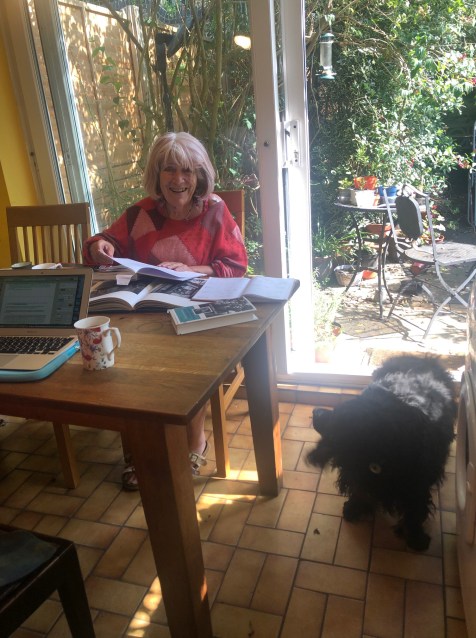
Merilyn Moos, the author, and her dog Rama. Pic credit: Carey

By a curious freak of timing as millions flee the horrors of the Russian invasion of Ukraine a remarkable memoir of earlier horrors of the last century – the rise of the Nazis and Stalinists and their effect on the refugees who fled Germany and Russia – has just been published.

The author Merilyn Moos is the daughter of two refugees who fled the Nazis in Germany to live in the UK and this short book describes in a thematic way her childhood here and how extraordinarily she only found out the full story about her parents’ past after they died.

Her father, Siegi ,was a lapsed Jewish Communist theoretician and director of an agit-prop theatre group performing plays by Brecht and a workers opera in Berlin. He went underground on the night of the Reichstag fire and fled Berlin minutes before the Gestapo raided his flat and walked over 1000 kilometres from Berlin to the Saarland to escape, only catching a train to cross the French border at Saarbrucken.

Lotte , her mother, met Siegi in Berlin and also escaped to the UK. But in 1936 she decided to go alone to Russia to visit a lover and friend , Brian Gould-Verschoyle, just at the time Stalin ordered show trials of Trotskyists. Both were put under house arrest and Brian was sent to Spain to work as an engineer to help the Spanish Communist Party. They were supposed never to communicate again but Lotte ignored this sending him a postcard praising a political group to the left of the Communist Party. This was intercepted by Stalin’s agents, he was kidnapped and put on trial as a Trotskyist and sent to a gulag where he died. She blamed herself for his death, fled the USSR coming back thoroughly disillusioned to the UK only to arrested as a suspected spy.

A rich history denied to their daughter

You would think with such a rich history her parents would tell Merilyn about their past. But as the main point of this memoir reveals, the opposite was true. So traumatic was their past they pretended to her that it never happened. Her parents were overprotective of her and paranoid. She never knew that she was from Jewish heritage until she was a young adult. Her father denied he was a Communist and pretended his family was Swiss. His mother never discussed her relationship with Brian.

As Merilyn says in the book: ” No family photos adorned our walls or mantelpieces. It was as if the three of us had been dropped onto earth by a stork, unencumbered by the ties and rituals of family life.”

She had an unhappy childhood, going to bed early until she was a teen and hardly ever allowed out alone from the house except to go to school. Her parents also did not want to her to become involved with boys and effectively pressurised her to break up up her first serious relationship with a boy after she got to Oxford University. No wonder she hardly spoke or visited them for 20 years.

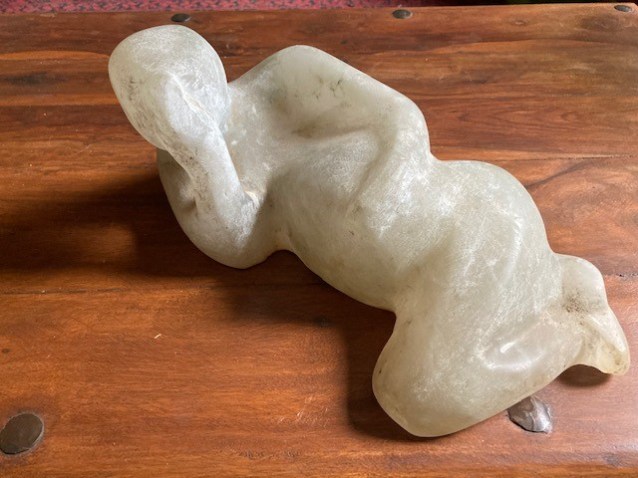
The fascinating part of this book is that despite all of this Merilyn rebelled and followed in her parents footsteps becoming an active trade unionist campaigner and supporter of left wing causes. She is obviously now proud of their hidden past. She also is an accomplished sculptor and I have included one of them in this blog. Her son Josh, is a campaigner on climate change.

Sculpture of a pregnant women by Merilyn Moos

She and her son have been moved by the discovery of her parents real past. One of the most poignant moments in her memoir is how she and Josh traced their history back to Berlin and smuggled their ashes into Germany finding the apartment blocks where they had lived together and scattering the ashes around flower beds and bushes in the courtyard. As she said ” I had brought my parents home.”

This book has real insight into the trials and tribulations of refugees driven out of their country by hostile regimes and the dilemmas they face. Published at the same time as Europe faces its biggest war since the time the Nazis invaded the rest of mainland Europe, one wonders how many Ukrainians feel about their lives as they are driven from their homeland. It is also an intensely personal and honest account of a child of a refugee’s life in the UK and all the better for it.

Living with Shadows by Merilyn Moos. Available from Amazon £8.25

Please donate to Westminster Confidential to allow me to continue my breadth of coverage

One-Time
Monthly
Yearly

Make a one-time donation

Make a monthly donation

Make a yearly donation

Choose an amount

£5.00
£10.00
£20.00
£3.00
£9.00
£60.00
£3.00
£9.00
£60.00

Or enter a custom amount

£

Your contribution is appreciated.

Your contribution is appreciated.

Your contribution is appreciated.

DonateDonate monthlyDonate yearly

Please donate to Westminster Confidential

£10.00
Cameron: Bash the Russians, send in the troops but keep out the Ukrainians

Ukraine in crisis Pic credit: http://media.worldbulletin.net/

Ukraine in crisis
Pic credit: http://media.worldbulletin.net/

As the crisis in Ukraine deepens David Cameron is taking an increasingly belligerent line against the Russians. He is now sending a token number of troops and promising  greater European Union  economic sanctions unless Vladimir Putin backs down.

This policy may well be right and is likely to be  popular, though people might be wary of armed involvement. As he is reported in the Daily Mail on Friday telling Govan shipyard workers :”In terms of what Britain has done, we were the first country to say that Russia should be thrown out of the G8, and Russia was thrown out of the G8. We have been the strongest adherent that we need strong sanctions in Europe and we’ve pushed for those, achieved those and held on to those at every single occasion.” Now we are the first to send some troops.

Not so well reported has been Britain’s views on the  £2.2 billion support  package agreed by the EU including the UK to help Ukraine. As well as agreeing this large sum of money to help the Ukraine the package included measures to cover one of the most controversial areas of EU policy – the relaxation of immigration controls.

As I report in Tribune this week Britain actually signed up to deal which allowed the abolition of visa requirements for Ukrainians across 26 countries in Europe..

Among the measures the EU agreed is to abolish all visa requirements for Ukrainians seeking to come to the EU for any 90 day period in the Schengen zone. This covers 22 countries in the Eu and four others, Iceland, Norway, Switzerland and Liechtenstein ,Only the UK and Ireland have a permanent opt out.

The agreement said: “Mobility is an important area where the Commission believes meaningful, visible, short-term steps should be taken.

“While a number of them depend on the political decisions of the Member States, the Commission is willing and ready to pro-actively facilitate swift and efficient coordination in this area.

It added : ” The Commission fully recognises the importance of mobility and people-to-people contacts for Ukrainian citizens and will support Ukrainian efforts to move forward the visa liberalisation process as quickly as possible in line with the agreed conditions of the Visa Liberalisation Action Plan.”

For other countries the EU agreement says: A “ Visa Facilitation Agreement is in operation between the EU and Ukraine and the Commission encourages Member States to fully exploit its potential. It gives Member States the possibility of choosing from a series of measures, including waiving visa fees for certain categories of citizens. In addition, the Visa Code gives the Member States additional options to waive the visa fees for further categories, such as, for example, children.”

When questioned the Home Office was adamant that it need not follow any of these guidelines. A spokeswoman said the agreement was equivalent to “a memorandum of understanding” between the EU and other member states outside the Schengen area and the UK need not implement anything.

At present the Home Office charges 129 US dollars (nearly £84) for a basic visa for Ukrainians to enter the UK for up to six months including children. Students are charged 234 dollars (nearly £152) and anybody seeking 10 year visa are charged 1150 dollars (nearly £747 ).

What is interesting about this is how David Cameron and Theresa May in the pre-election frenzy  have already  implemented a very tough policy on immigration to rival UKIP.

Such a move might well be popular – and there are real concerns – not least by unions like Unite – that fruit farmers were very keen on having Ukrainians over here as a source of cheap labour.

However I think we should know that Cameron’s warm words to help the desperate plight of the Ukrainians do not apply to having a single poor Ukrainian in Britain. The clampdown has begun and the troops, a token 75, are going in.