Revealed: The next bill for the over 40s: Your social care tax


ImageVaultHandler.aspx

pic credit: parliament.uk

CROSS POSTED ON BYLINE.COM 

Without huge coverage MPs from two influential Parliamentary committees yesterday proposed a new tax system to pay for the burgeoning cost of social care.

The proposal could mean a new hike in national insurance contributions, some redistribution of money going to fund your local council, higher council, inheritance and income tax  and/or abolishing some of the existing universal pension benefits, like the heating allowance or cutting future state pension rises.

Significantly it includes making existing pensioners pay more tax particularly if they are still supplementing their pension by working.

This makes this the first serious policy proposal to deliberately tax people differently depending on their age – and exempting the millennials  at the expense of the elderly. In that it feeds into the current  and my view misconceived debate that millennials are being robbed by wealthy pensioners and the system must be changed to tax pensioners more.

The proposals may well prove to be attractive to the present government which has been trying to create an inter generational wedge between the young and old people – as a sop to the younger generation who have been burdened with huge student loan debts by government policy and can’t afford to buy a home.

No one can deny that the present system for social care is in a mess and is underfunded and it is estimated by the report  using  data from the Institute of Fiscal Studies that spending on  care needs to rise by 3.9 per cent a year just to keep the current severely means tested system which means many cannot get help. It will cost billions more if personal care like the NHS became free at the point of use.

At the moment many people are already paying for care through  local council tax. When people ask where is all the council tax  money  is going – anything from 25 pc to 57pc  is going on social care for the young and old. The average of 37.8 pc according to the report.

The government is also transferring a big tranche of business tax revenue from Whitehall  to the councils and at the same time abolishing grants – but not according to the MPs  earmarking any of this money for social care.

The MPs have done a lot of groundwork – suggesting an independent body should supervise the new earmarked tax-  and have used a citizens assembly to advise them of how they could do it-. The report can be read in full here.

MPs need to tread very carefully over their funding proposals because there is no doubt it could make matters worse for a lot of people.

For a start – and it is picked up by people they consulted – 40 year olds will probably have the expense of  large mortgages, or higher rents, the cost of bringing up children and  may find, if they have had successful careers that they are  paid enough to have to pay back student loans. So they may be even more squeezed.

They have completely ignored the plight of  3.9 million 50s women. – many being forced to work for up to six years – and would now have to pay extra insurance or tax just at the point when they find it difficult to get a highly paid job.

Also by extending national insurance contributions at a higher rate for those who still have a job after turning 65 could well hit people who have taken part time low paid jobs to make ends meet. The MPs also suggest the premium should apply to unearned income and investments held by pensioners – which amounts to a tax on pensioners savings.

The committee talks of  setting an income threshold to make sure some pensioners are exempt – but does not state what this threshold should be.

To my mind there are too many questions  that have not been answered or evaluated for the government to go ahead with this. People should remember that everybody who drew up this report was on an MPs salary of  £77,000 a year, way above many people’s incomes.

Yes we need a debate on how to fund social care – but it shouldn’t be used as part of way to drive a wedge between generations- and we shouldn’t rush into  yet another use for the National Insurance Fund when  they are so many women who have been robbed of a decent pension by the existing system.


Revealed: The £200,000 food bank warehouse in Amber Rudd’s Hastings constituency caused by the Universal Credit debacle

amber rudd

Amber Rudd- former home secretary and MP for Hastings as the Universal Credit debacle rolls out in her constituency

CROSS POSTED IN BYLINE.COM

The  billion pound plus failure of the implementation of Universal Credit is rightly condemned by the National Audit Office in a report published today.

Aimed to save money, get everybody back to work, simplify a complex benefit system and to be easily implemented.  Instead it is going to cost more, is years behind schedule, discriminates against disabled and poorly educated people, and the government has plans to force the elderly not entitled to a pension to have to use it when it  changes entitlement to pension credit ( see my earlier blog here)

But it is also having appalling consequences for food banks, landlords, council and housing association tenants – as the example in Amber Rudd’s constituency ( details down below show).

In the meantime ministers today were patting themselves on the back today how successful it is while senior civil servants behind  it were awarded  bonuses worth up to £20,000 each for its botched introduction ( see an earlier blog  here and  an article in the Sunday Mirror).

The statistics are appalling. According to the NAO :

“In 2017, around one quarter (113,000) of new claims were not paid in full on time. Late payments were delayed on average by four weeks, but from January to October 2017, 40% of those affected by late payments waited in total around 11 weeks or more, and 20% waited almost five months. Despite improvements in payment timeliness, in March 2018 21% of new claimants did not receive their full entitlement on time with 13% receiving no payment on time.

The Department does not anticipate payment timeliness to improve significantly in 2018. On this basis, the NAO estimates that between 270,000 and 338,000 new claimants will not be paid in full at the end of their first assessment period throughout 2018. Those with more complex cases are more likely to be paid late.

The Department expected most claimants would have enough money to cope over the initial waiting period after their claim is submitted (previously six weeks, now five). In reality, nearly 60% of new claimants (around 56,000 a month) receive a Universal Credit advance to help them manage before receiving their first payment.But they have to pay it back which means deducting an average £43 a month from their benefit. 

But while the statistics are bad, the examples are worse.

12363209_1719999128235421_6846245651388343898_o

Hastings Foodbank

Appendix 5 of the report  reveals In  Amber Rudd’s Hastings  constituency for example, according to the NAO Hastings foodbank has increased its opening hours, needs around two tonnes of stock each week to meet demand, and is considering building more storage space, costing £200,000.”

Hastings Citizens Advice pays staff to deliver Universal Support delivered locally. It therefore needs to pay providers regardless of the number of people
that are referred for support. But its income from the Department is not guaranteed so it can’t plan

Hastings Citizens Advice is considering scaling back on what it does in order to cope with increased demand.

Similarly NHS Hastings and Rother Clinical Commissioning Group funds its local advisory services. But this takes time to identify and secure. This hampers the ability of organisations to employ high-quality advocates because of the uncertainty of future funding.

.Hastings and Rother Credit Union no longer accepts Universal Credit claimant because of the complications in dealing with the new benefit and the long time waiting for people to be paid it.

Other areas have also got problems.Landlords are carrying extra debt – Croydon’s rent
collection rate has fallen from 92% to 58%, and its bad debt provision has doubled to £8 million.
Sedgemoor Council  in County Durham reported an increasing unwillingness, even with social landlords, to take on low-income tenants or those claiming Universal Credit.

So the government has piled on misery upon misery for the claimants,. voluntary organisations, food banks, landlords, credit unions, local authorities and health services. Meanwhile ministers on excess of £100,000 a year go home to expensive houses, enjoy fine wines, expensive meals out and luxury holidays while boasting how they are helping the poor. Some sick joke. As Amyas Morse, head of the National Audit Office, said today:

“The Department has pushed ahead with Universal Credit in the face of a number of problems, but has shown a lack of regard in failing to understand the hardship faced by some claimants.

“The benefits that it set out to achieve through Universal Credit, such as increased employment and lower administration costs, are unlikely to be achieved, yet the Department has little realistic alternative but to continue with the programme and hopefully learn from past mistakes.”


A rosy celebration in a London square of good relations between Bulgaria and Britain

Bulgarian 1st Rose jpg

The first  perfumed Damascene rose donated by the Bulgarians to London flowers in Golden Square

While London is shortly to have a nationalistic pro Brexit  demonstration following the “Free Tommy Robinson ”  violent right wing extremist march last weekend, a square in the heart of Soho  was a venue to  celebrate the  opposite to those stirring up hate and prejudice  – a celebration of how the Bulgarians contribute to London life.

Bulgaria Dancers Party

Bulgarian dancers

The Bulgarians took over Golden Square for an afternoon of dancing, singing and speeches from both the London mayor’s office and Tory councillors representing the area in Westminster plus an impromptu speech from me. My grandson Leon thought the dancing was similar in some ways to Irish dancing.


Bulgaria Group Food

A spread of Bulgarian food

There was also a a selection of Bulgarian food – which is influenced by both Turkish and Greek cuisine – and  was offered free to any members of the public who happened to be enjoying the sunshine in the square at the time.

Bulgaria Junior Dancer PartyAnd schoolchildren also performed dances

The contrast between the manufactured  fear of the other in the media  and the attitudes of the people there could not be stronger. And I suspect this is reflected in many other ethnic minority communities. Pictures were supplied by Boyko Boev.

Bulgaria Group Foto Party

The Bulgarians and guests at the celebration

Official figures reveal a disturbing rise in right wing extremism among UK youth

maxresdefault

Scenes from the right wing demo in defence of extremist Tommy Robinson pic credit: You Tube

CROSS POSTED ON BYLINE.COM

The somewhat violent demonstration in London this weekend in support of jailed right wing extremist Tommy Robinson was foreshadowed by figures released under three months ago by the Home Office.

The figures come from the highly controversial Prevent programme which most people see as a plan to catch young people  being radicalised by so called Islamic State and Al Qaeda before they commit atrocities.

What is not  as well known is that the Prevent programme also tackles people radicalised by racist and Fascist organisations who aim to commit violent acts against Muslims, Sikhs and other ethnic minorities, including Africans and East Europeans.

Just over two months ago the Home Office published a report and analysis of the latest figures of who is being targeted.

These are people who if one follows the official guidance are those who  have “vocal or active opposition to fundamental British values, including democracy, the rule of law, individual liberty and mutual respect and tolerance of different faiths and beliefs.”

The disturbing fact is that the latest figures for 2016-17 reveal there has been a RISE in the number of young people radicalised by right wing extremism while there has been a FALL in the number of people radicalised by perversions of Islam.

The report says: “There was a 28% increase in the number of extreme right wing referrals in 2016/17 (968) when compared with 2015/16 (759); whilst referrals for concerns related to Islamist extremism decreased by 26% over the same time (2015/16, 4,997; 2016/17, 3,704).
The proportion of panel discussions [ most serious cases] regarding extreme right wing related concerns has increased by 44%, from 188 in 2015/16 to 271 in 2016/2017. Similarly, the number of individuals receiving Channel support for extreme right wing related concerns has also increased over the same time period by 27% (2015/16, 98; 2016/17, 124).
This is in contrast to individuals receiving support for concerns related to Islamist extremism,which has decreased by 30% between 2015/16 (264) and 2016/17 (184).”

The right wing extremists were almost exclusively male ( 902 out of 968) while only 77 per cent of those monitored for Islamic extremism only 77 per cent were men.

The largest proportion in both groups were teenagers aged between 15 and 20 with right wing extremists being almost exclusively male.

There was also a considerable variation between regions for the two groups.

“Of the 3,704 individuals referred for concerns related to Islamist extremism, the largest proportion was from London (1,039; 28%), whereas of the 968 individuals referred for concerns related to right wing extremism, the largest proportion was from the North East (171; 18%).

Of the 760 individuals discussed at a Channel panel for concerns related to Islamist extremism, the largest proportion was from London (214; 28%), whereas of the 271 individuals discussed at a Channel panel for concerns related to right wing extremism, the largest population was from the West Midlands (47; 17%).”

This suggests a considerable divide in the country – with  multi cultural London having fewer right wing extremists than the deprived North East and the West Midlands where there have been racial tensions.

The general message is that Britain is becoming more divided and that racism and Fascism among the young is rising, particularly in areas where there are fewer people from ethnic minorities.

This was born out by a chat with a person  at the Race on the Agenda conference on mental health reform  in London last week who was dealing with the Prevent programme in Dorset. Here it was in the rural areas where young poorly educated men who had seen few immigrants appeared to be attracted to right wing extremism. The issues raised by  Brexit had also been a factor in highlighting tensions.

Whatever it is this is a deeply disturbing trend and it suggests that focus on the rise of all types of extremism should concentrate equally on right wing racists as much as Islamic extremists.


The Downing Street state pension robbery

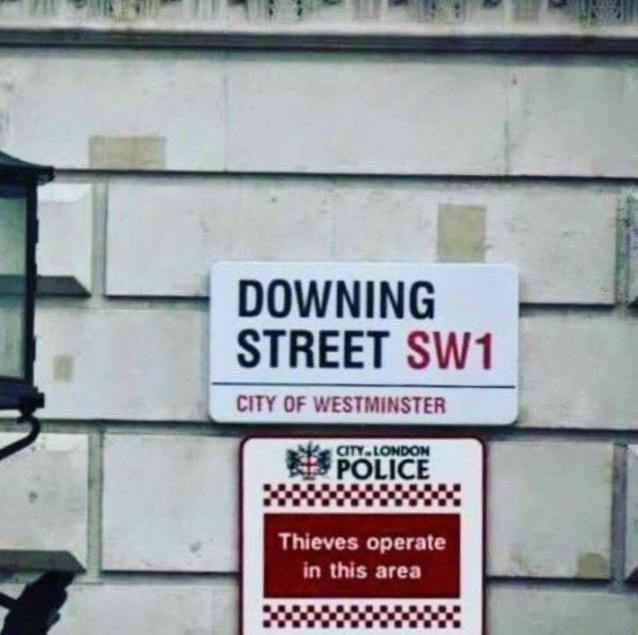
Downing Street thieves

I wonder if Mr Plod has a good sense of humour. It is a good photoshop. Pic Credit: Paul Downes @CallmeDownsie

CROSS POSTED ON BYLINE.COM

The mantra  that we cannot afford to pay the 3.9 million  50s women   their pensions until they are 65 and soon 66 is based on the premise that there is no money in the National Insurance Fund. The big question is why?

I have already in a previous report for #Backto60  shown that the accounts of the National Insurance Fund are in fact in surplus. But detractors point out that they soon won’t be if the government hands back £77 billion owed to the women.

But what if we have reached  this situation because the government has raided a fund  which is 91 per cent spent on pensions for other benefits. And what if the Treasury deliberately decided to  undermine the fund by avoiding paying any money into it?

This is what I have found out by investigating the history of this fund.

The original fund was set up in 1911 by Lloyd George and did not cover pensions – but helped pay  medical bills for wage earners and provided  unemployment benefit for  some workers. Employers and employees had to make compulsory contributions.

Pensions were introduced for those over 70  in 1908 and were means tested and supervised by local councillors. People could be disqualified from getting a pension if they had been imprisoned for ten years, weren’t of good character and were drunkards. The money came from general taxation. There is a House of Commons library report about the act here.

The real major changes came under the Attlee government which set up the welfare state. The National Insurance Act, 1946 introduced compulsory NI for all working people except married women. It set the pension age at 60 for women and 65 for men. Pensions, unemployment benefit, sickness benefit and a maternity allowance and death grant were paid out of it. There is a useful summary in the National Archives here. But it was run as a ” pay as you go ” scheme with money topped by the Treasury.

It is the attack on these provisions which began under the Thatcher government in the 1980s that has led to the 50s women losing out.

An excellent report by the House of Commons library describes what happened. It is worth quoting parts in full.

“In each year from 1948 to 1989, the National Insurance Fund received a grant from the
Treasury, known as the Treasury (or Consolidated Fund) Supplement. The origins of the
Supplement lay in the Beveridge Report, which envisaged a tripartite scheme of contributions to the Fund, whereby the Treasury would pay one third of the cost of unemployment benefits and one sixth of the cost of pensions and other benefits. In practice, the level of the Supplement tended to be around 18% of contribution income, a level at which it was fixed by the Social Security Act 1973.

“From 1980, the value of the Supplement began to decline, reflecting partly the growing level of contribution income and partly the constraining of spending on benefits by the abolition of earnings linking of the pension and other long-term benefits and earnings-related supplements to unemployment benefit. By 1988 the Fund’s contribution income exceeded its benefit expenditure, leading to a steady growth in the balance of the Fund (from £5.3bn in April 1986 to £10.4bn in April 1989 ).

In this context, the then Secretary of State for Social Security, John Moore, stated in 1989 that:

“The tripartite principle is already effectively a dead letter. The rationale behind it has
gone, and the Supplement has been shrinking steadily as a proportion of the Fund’s
income from about one-third in 1948. It now stands at only 5%. We consider that there
is now no need for it all. The £26bn of expenditure from the Fund is fully covered by
contributory income and the abolition of the Supplement will have absolutely no effect
on that expenditure”
“The Supplement was abolished by the Social Security Act 1989.”

It was a disaster – the fund which then  had  big surplus – went heading into the red – as it was now being raided for the full cost of unemployment and sickness benefit at a time of high unemployment.

So in 1993 the Major government had to partly retract by reintroducing a Treasury supplement because money in the fund had fallen by a staggering 50 per cent  due  to benefit pay outs as well as pensions. Pensioners were robbed.

But  the government fixed the rules so it was much less generous than the  system they bequeathed from Attlee. As the report says :

“There are a number of differences between the Treasury Grant and the Treasury
Supplement. First, the levels of Treasury Grant are set by reference to benefit expenditure rather than to contribution income. Second, and more significantly, whereas the Treasury Supplement was paid annually, irrespective of whether it was actually needed to finance a particular year’s expenditure, the Treasury Grant is paid at the discretion of the Secretary of State.

“The amount of Grant paid to the Fund was limited to a maximum of 20% of forecast
benefit expenditure in 1993-94, and to a maximum of 17% of forecast benefit expenditure in subsequent years.”

The truth of the matter is that the rules were skewed so the Treasury never had to pay out any money.  From 1989 to 2014 if the Treasury had returned to its original support  under  the Major, Blair and Brown governments, the Tory Liberal coalition and Cameron’s government, billions of pounds would be available now to help pay the 50s women. Instead as we know successive governments ruthlessly decided to solve the problem by raising the pension age.

In top of this the government also amended the benefits that would be paid out from the fund – including some new benefits like paternity benefit for example.

Anyone who believes the changes that happened – both the removal of Treasury contribution to the fund and the subsequent rise in the pension age – was a happy coincidence is deluding themselves. You can see here  in an article in the Daily Express what  George Osborne, the former chancellor, told investors at the Global Investment conference in 2013. Scroll down to the video

George-Osborne-speaking-at-the-conference-815768

George Osborne speaking at the 2013 Global Investment Conference

He said: “Tackling entitlement costs and the cost of an ageing society is a real challenge for Western democratic societies and in the UK we’ve brought forward the increase in pension age to 66 in this decade; we’ve brought forward the increase to 67 in the next decade and actually because of some reform taken some years ago the female pension age is increasing to 65 as we speak.”

“These changes, when you’re a finance minister, the savings dwarf almost everything else you do.

“They are absolutely enormous savings and they enable you to go on providing a decent retirement income. So you’re not necessarily reducing the entitlement of people who are retired you’re just increasing the age when that entitlement kicks in. ”

“Of course when these were first put into practice these pensions systems life expectations was dramatically less.

“I’ve found it one of the less controversial things we’ve done and probably saved more money than anything else we’ve done.”

Need I say more. The UK has one of the lowest and least generous state pension in the developed world and it has been bought about by making huge savings against 50s women.