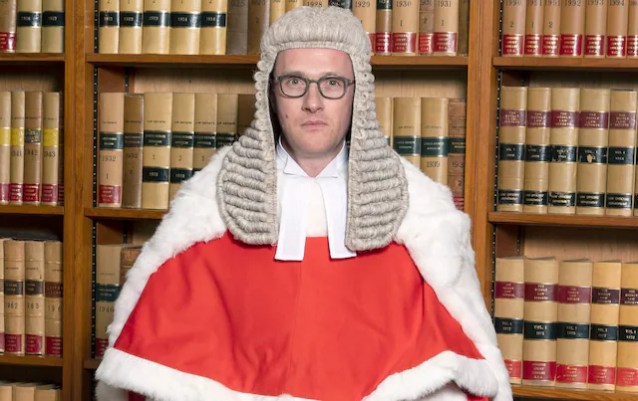
Mr Justice Chamberlain, the head of the Royal Court of Justice’s Administrative Court, has intervened in the case against controversial coroner Mary Hassell by ordering a hearing later this year after months of inaction by the judiciary.
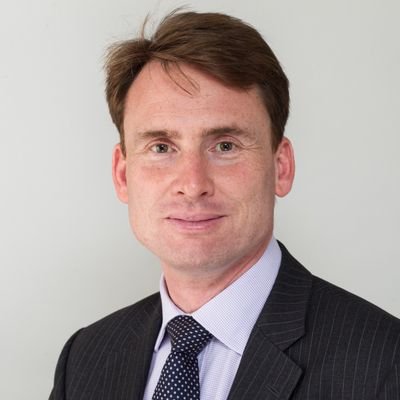
Mr Justice Chamberlain pic credit: Avalon
The allegations that the report of the hearing into the death of ITV news editor Teresa McMahon appeared to be tampered with were brought by her aunt Lorna McMahon at a hearing last July. The judge Mr Justice Stephen Morris took the allegations so seriously that he postponed the judicial review hearing and wanted the matter dealt with speedily later last year. The coroner tried to get her name removed from the hearing but was overruled by the judge saying it was a matter of ” open justice”.
There is a full report of the hearing here. The judge insisted that her allegations must be corroborated by witnesses at the hearing which attracted wide press attention. Two journalists. including myself and a member of the public have come forward saying the text was missing.
Mary Hassell found that the TV journalist committed suicide and ruled out that she was subject to ” coercive control” by her ex boyfriend, Robert Chalmers, an NHS estates employee, who had previous convictions for violence. Mary Hassell believed the words of the pathologist ,Dr Mohammed Bashir, who examined the body but kept no photographic evidence and discounted domestic violence and Greater Manchester Police who decided from the start that no crime had been committed and never took any photographs either at the scene of her death.
The missing text covers when Lorna McMahon was questioning Teresa’s boyfriend after she was frequently interrupted by Mary Hassell.
Court cases involving coroner’s verdicts are very rare and allegations of tampering with the inquest report can be seen as a criminal offence of perverting the course of justice.
Mr Justice Chamberlain looks set to hear the case himself as he ruled that it could not be heard by a deputy high court judge. The full report of the inquest hearing held in December 2024 can be read here.
Stormy scene around tilted scales of justice as judges avoid complaints
Remember the ten brave women I wrote about who are challenging the bullying behaviour of Employment Judge Philip Lancaster? See my blog here. The ones the justice system refused to investigate despite overwhelming evidence?
They’re now in a race against time – and the Judicial Conduct Information Office is playing its oldest trick: delay, delay, delay until they run out of money or miss their deadline.
Here’s what’s happening:
The women issued their Letter Before Action to the Judicial Conduct Investigation Office (JCIO) in September. The JCIO’s deadline to respond under the pre-action protocol was 8 October. They missed it. The women waited another week. They missed that too.
Now the JCIO says they won’t respond until 20 October – leaving barely two weeks before the women must file at court in early November or lose their right to bring these proceedings forever.
Classic establishment tactics. Unlimited taxpayer funding and government lawyers versus women running on crowdfunding and determination.
But here’s why this matters more than ever:
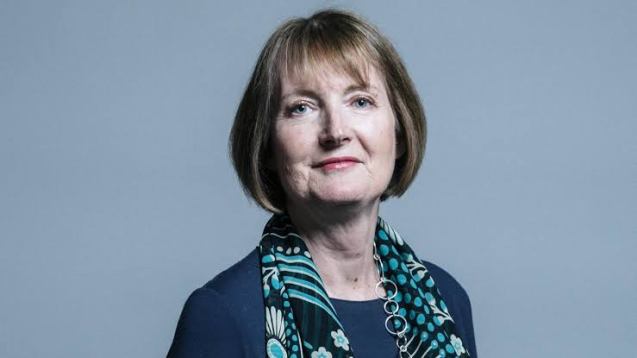
In September 2025, Baroness Harriet Harman KC published a damning report on judicial misconduct. Her conclusions are devastating:
“The problem is the culture of impunity for those at the top who commit misconduct. Those in powerful positions whether at the Bar or in the judiciary who choose to engage in bullying, harassment or sexual harassment can be pretty confident that nothing will be done about it. And that is what must change.”
She identified a “cohort of untouchables” amongst the judiciary and “particular judges who are widely known for making everyone’s lives a misery.”
This is EXACTLY what these women are fighting to expose.
The women need £40,000 total to see this through
They’ve raised £17,335 so far – incredible progress from 472 supporters. But they need £40,000 in total to get this case into court and finish what they’ve started.
Their legal team of outstanding women lawyers at Deighton Pierce Glynn has already slashed fees dramatically. But even at reduced rates, taking on the government is expensive.
What’s at stake:
35,000+ employment tribunal users face these tribunals every year
If this judicial review succeeds, the JCIO will be forced to properly investigate judicial misconduct
Judges who egregiously abuse their power and block the release of the court record will finally face consequences
Whistleblowers will be better protected
This isn’t about these women and whistleblowers getting compensation – their chance at justice has been lost forever. If they win the judicial reivew there won’t be any compensation – just the knowledge that they exposed a corrupt complaint system. And showing judges that they are not above the law.
Every pound counts. They cannot let the judicial establishment win by simply outlasting them financially. Not when they’re this close.
Please help them as they have shown remarkable courage and integrity to do this for the greater good but they can’t do it without further financial help.
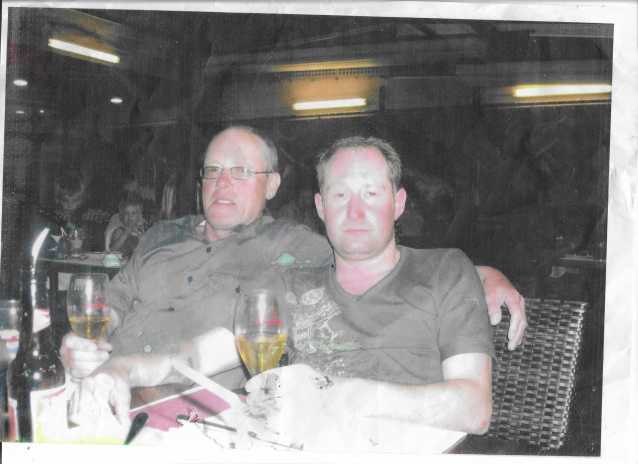
Happier times. Matthew Reynolds (right) enjoying a drink with his late dad, Howard, before his horrendous accident
Matthew Reynolds was a strong strapping lad who earned good money – £80,000 a year – as a welder at the Tata Steel works in Port Talbot, South Wales. He had already bought his own flat and his future was bright.
Then one day as he was welding steel a large heavy refractory brick in the roof of the works came loose and fell 150 feet hitting him on the side of his back. His injuries confined him at the time to a wheelchair, cost him his well paid job, and damaged his spine so he can’t easily move his neck and caused other painful injuries. He had to sell his flat in Port Talbot at a loss ( it was up a flight of stairs) and move back home with his mother in rural Lincolnshire. Today he can barely hobble around, needs help to dress himself and has very little likelihood of getting another job.
This story is not about his injuries -horrendous as they are – but what happened when he tried to claim compensation from Tata Steel so he could live a reasonable life as a disabled person who would always need expensive help and care.
Any reasonable person would expect a multinational company run by a billionaire to pay substantial compensation, especially as the incident had to be reported to the Health and Safety Executive and the company admitted liability.
But in today’s world corporate responsibility is not that straightforward or even ethical. Tata Steel appear to employ health insurers to assess their responsibility and the offer made to Matthew was less than his annual salary – over £50,000 – for a lifelong injury. The figure based on 6 per cent of his claim was recommended by Tata’s health insurers – either coincidently or in line with initial payments offered to sub postmasters.
Just £9500 initial compensation for being left in a wheelchair
As a result he has had to use the county court system for the last SEVEN years to put in a claim and it remains unpaid at the moment. The only money he has received is an initial interim payment of £9500.
Tata, Dousan Babcock, who were managing the site, and Primetals Technologies Ltd- combined to oppose his claim seem to be relying solely on the initial assessment made at accident and emergency department in October 2018 which found no bones were broken but there was serious damage to soft tissue. However three independent specialist doctors have linked other serious damage to himself to the accident. Three and half years later, Mr Caspar Aytott, of Cheltenham Spine Centre found the severe pain had spread from his lower back into his flank, up to his chest into the shoulder and neck with difficulty raising his left arm. This is despite having physiotherapy and two spine injections which had no effect.
Then a rheumatologist found 20 months later that he still had chronic pain and was suffering from fibromyalgia and post traumatic stress disorder due to the accident. A third independent doctor, Karen Simpson, who examined him found he had damaged nerves and wanted him to have rehabilitation which he never got.
Matthew Reynolds today -now aged 45
What was clear was that he was not returning to full health and getting worse not better. In the meantime his case was dragging on through the slow county court system, which has been heavily exposed by the Commons Justice Committee in a recent report. See my story on this blog here.
During the proceedings that followed his solicitor, supposed to be a family friend who offered to take his case on a ” no win, no fee” basis gave him spectacularly bad advice. This included him cancelling his GMB union subscription, not getting a crucial Health and Safety Executive report on the accident and losing all his original wage slips so a judge could not give him a substantial interim payment at another hearing.
So bad was his role that a judge took a rare decision to remove him from representing Matthew on the grounds of bad communication and mismanagement. There is even an allegation that while representing Matthew he was trying to arrange a dinner with Tata’s leading solicitor in London, Leanne Conisbee.
Matthew and his mother Denniel were meanwhile getting poorer by the minute, racking up the maximum on Matthew’s credit cards, their house faced repossession and a huge bill from their solicitor for handling their case. His mother ended up taking a equity loan on the house. They now rely on food banks to eat and have to pay court fees for every hearing in his case. They have an old Fiat 500 to get around with an adapted front seat as Matthew is in pain if he bends his back.
In desperation Matthew from a wheelchair supervised some men at work to get money for the fees. He did not declare this to court and the lawyers for Tata were tipped off and pounced accusing him of being ” fundamentally dishonest” for not doing so.
After the solicitor had been taken off the case the bundles were returned to Matthew. Included was an email sent to Rodney Fern, a barrister who had tried to prevent the solicitor being removed from the case, which revealed the dirty tricks being prepared by Tata against Matthew.
It read: ” the insurers, as you rightly say, are going to try and starve Matthew Reynolds out. They are not going to withdraw the application on fundamentally dishonesty as this is to be used as a bargaining tool. although it is without any substance.”
Tata’s lawyers said he was ” fundamentally dishonest” in court
I saw it used at Doncaster County Court this year when Matthew tried to get an interim payment. It had to be refused by a sympathetic judge because the law says anybody judged to be ” fundamentally dishonest” cannot be paid. The barrister for Tata was determined he would not get any money.
The situation has now escalated. Last month Matthew asked for a longer period as a litigant in person to prepare for this week’s hearing. He wanted a longer hearing of 10 days, wanted to call 16 extra witnesses including people who witnessed the accident and professional medical people.
All this was refused by both the circuit judge William Hanbury, a former property and local government barrister and senior circuit judge, Mark Gargan. Seven years ago Mark Gargan was found to have given a wrong judgment by the court against a terminally ill claimant in a personal injury claim against a firm when he threw out his case claiming he and his lawyers had ” flagrant disregard” for the rules. The case was reported in the Law Society Gazette here.
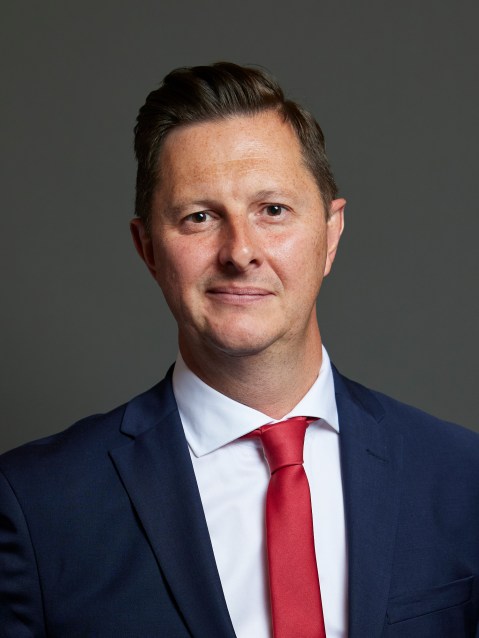
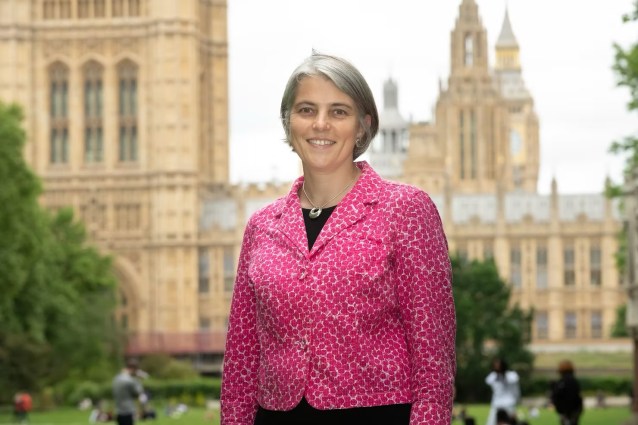
Official Portrait: Lee Pitcher MP Pic Credit: Laurie Noble Photography
The judge took the decision despite receiving a letter from Matthew’s new Labour MP, Lee Pitcher, who represents Doncaster East and the Isle of Axholme.
In it he points out that Matthew, through no fault of his own, has lost his lawyers and is now fighting three large corporations having to navigate ” complex legal proceedings at significant financial and emotional cost”.
He adds: ” it is difficult to see how this can be viewed as a fair and balanced process. That an individual in such a vulnerable position should be left to fight such a case unaided, while the companies involved have already accepted liability, raises serious questions about access to justice.”
“Mr Reynolds has shown remarkable courage in pursuing this case and deserves to be treated with dignity and fairness without.”
His GP also sent a letter to the court saying Matthew was in no fit state to conduct the case and the hearing should be delayed but this was rejected by the judge. Using rather twisted logic the judge rejected this saying even with a delay Matthew would still be in the same state of health in the future – something the big corporations are trying to deny in their case.
He was sent 1500 pages of evidence from the three corporations and given 10 days to digest it and respond before the hearing. He told the judge: ” OK I’ll give these barristers/ solicitors a welding manual. I’ll set them up, give them the equipment ..you’ve got 5-10 days to go for a perfect weld.”
The hearing never went ahead this week. Both Matthew, who had a week of sleepless nights, and his pensioner mother were too ill to attend and drive to the court in Sheffield. I contacted the clerk to the case to find out what would happen next but was told there was no hearing for the rest of the week.
The only new development is that lead solicitor, Leanne Conisbe from Clyde and Co in the City of London has submitted a 74 page victim impact statement – claiming that she and not Matthew had suffered as a result of organising the case. The judge has ruled out his mother putting in a four page victim impact statement.
Judge blocked her attempt to keep her name secret during the hearing
A highly controversial senior coroner is facing serious allegations that she or her staff removed parts of a transcript and recording of her hearing into the death of a talented and hardworking ITV news editor Teresa McMahon who was found hanged at her home four years ago.
Mary Hassell found that she committed suicide and ruled out that she was subject to ” coercive control” by her ex boyfriend, Robert Chalmers, an NHS estates employee, who had previous convictions for violence. Mary Hassell believed the words of the pathologist ,Dr Mohammed Bashir, who examined the body but kept no photographic evidence and discounted domestic violence and Greater Manchester Police who decided from the start that no crime had been committed and never took any photographs either at the scene of her death.
Throughout the hearing this version was challenged by Teresa’s aunt, Lorna McMahon, who was frequently interrupted by Mary Hassell when she raised questions about the competence of Greater Manchester Police in handling the investigation into her niece’s death.
I was present at the hearing at the hearing with many other journalists. My report on it is here.
Yesterday’s hearing at the Royal Courts of Justice was meant to decide whether the court could give her permission to bring a judicial review into Mary Hassell’s hearing claiming her conduct was irrational and procedurally unfair in coming to her verdict.
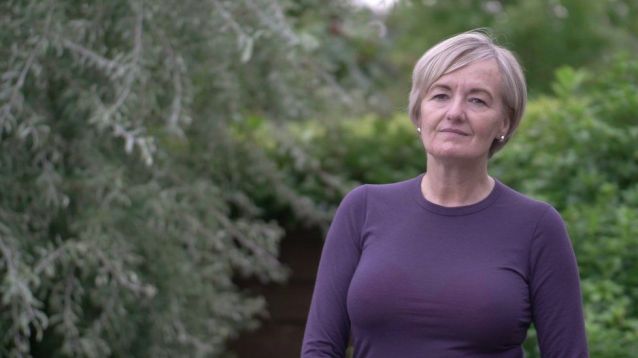
Teresa McMahon
But the hearing took a completely different turn under Mr Justice Stephen Morris when Lorna McMahon, having obtained both the transcript and audio recording of the hearing said parts of both, covering descriptions of previous violence against her niece by her ex boyfriend had been omitted.
It also emerged from correspondence I have seen from Mary Hassell’s lawyers and a public ruling by a previous judge Mr Justice Kerr, that the coroner had tried to get her name kept out of the public domain during the hearing.
Her lawyers claimed ” it was customary” to be not named. She wanted it done under ” the slip rule” which meant there would be no hearing about the application. The judge ruled this procedure could not used in this way and rejected her application because it raised issues of ” open justice”.
When Mr Justice Morris heard Lorna McMahon’s evidence he weighed up whether to continue the hearing or adjourn it to allow her complaint to be properly looked at and for her to provide evidence from other people at the original hearing – including members of the public and journalists – to back up her claim.
All sides in the case agreed it was an extremely serious allegation which could be viewed as a criminal case of perverting the cause of justice.
Her own lawyer, Jonathan Glasson KC, agreed as such and but added by adjourning the case until the late autumn it meant that the accusations against the coroner were left hanging over her for some weeks.
The judge also made it clear by adjourning the hearing it did not mean that he was convinced about Lorna’s case and said she would need more evidence.
The directions he gave are worth reporting in full:
IT IS ORDERED THAT
The application for permission to apply for judicial review is adjourned
2. By 4pm on 12 August 2025, the Claimant is to file and serve a witness statement, verified by statement of truth, identifying any and all parts of what was said at the hearing of the inquest by the Defendant on 5 December 2024 (“the Hearing”) which she contends have been omitted from the audio recording of the Hearing provided to the Court and the Claimant by email dated 14 July 2025 at 513pm and sent by Payne Hicks Beach LLP (“the Audio Recording”).
3. At the same time as filing and serving her witness statement pursuant to paragraph 2 above, the Claimant is to file and serve any and all witness statement evidence from others (including witnesses called at the Hearing and/or members of the press and/or members of the public) in support of her contention that parts of what was said at the Hearing have been omitted from the Audio Recording.
4 By 4pm on 9 September 2025, the Defendant is to file and serve a witness statement, verified by statement of truth, in response to the evidence filed and served pursuant to paragraphs 2 and 3 above, to include an explanation as to how the Audio Recording was produced.
5.By 4pm on 23 September 2025, the Claimant, if she so wishes, is to file and serve a written statement stating whether, and if so, why, she seeks a further oral hearing for directions in respect of the matters covered by paragraphs 2 to 4 above.
6.As soon as possible thereafter, the matter is to be placed before a judge (if possible, Mr Justice Morris) on the papers to consider directions for the progress of the case, and in particular whether there should be a further oral hearing dealing with the matters covered by paragraphs 2 to 4 above, taking account of all necessary reasonable adjustments.
7 The case to be reserved to Mr Justice Morris, if possible.
8. Costs of the adjournment and of the matters raised above reserved
This is the second recent case where there has been controversy about Mary Hassell’s handling of inquests.
Earlier that year she held an inquest into the tragic death of Gaia Young,25, who was rushed to accident and emergency at University College Hospital with severe headaches only to die of an unexplained brain condition and doctors have yet to correctly diagnose what was wrong with her.
Again Mary Hassell patronised and showed no empathy for her bereaved mother, Lady Dorit Young, who had lost her only child ,Gaia, and failed to properly investigate her death. The full story is on the Truth for Gaia website. She even blocked her from making a statement at the inquest. I reported that hearing and you can read about it here.
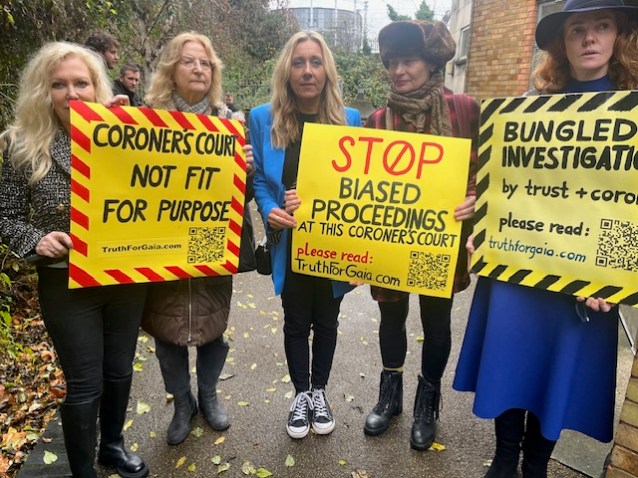
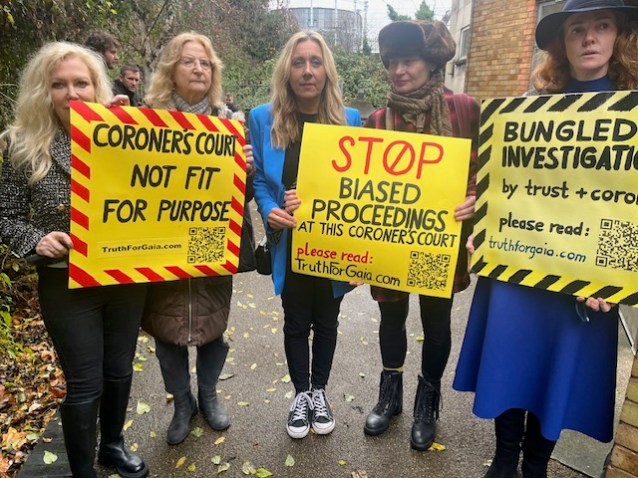
The treatment of both relatives led to a protest outside the coroner’s court during Teresa’s inquest. Pictures are below.
This week the International Court of Justice at The Hague begins a week long public hearing into whether Israel has broken international law in occupied Gaza through its brutal treatment of civilians, medics and aid workers and the Israeli ban on the United Nations aid organisation UNWRA.
Last week I attended a documentary film screening and discussion event organised by the media group Middle East Eye and the International Centre of Justice for Palestinians. The documentary was a searing account of the life and death of paramedics and doctors trying to save lives as Israel bombed the Muslim quarter of Beirut and the villages of Southern Lebanon. The panelists included doctors and volunteers who had worked in Gaza, and an international law expert who made it clear that these attacks were against international law.
The film by Middle East Eye was made with the co-operation of Lebanese workers and an extremely brave woman reporter, Hind Hassan, who embedded herself with emergency ambulance teams going to the latest bombings in Southern Beirut and the surrounding villages at great risk to her own life.
The “double tap” killings
What she discovered was that the Israelis were using a particular brutal bombing technique known as the ” double tap”. First they bombed a building and followed what happened using drones. Then they came back and bombed again just at the moment when ambulances and paramedics arrived to try and rescue victims. The only intention of the second bombing was not to kill Hezbollah but to kill doctors and paramedics at the scene.
The film also showed that many paramedics and doctors slept in Beirut’s hospitals so they could be on call immediately a bomb dropped during the night. The Israeli’s bombed their sleeping quarters killing a number of them. You can watch the video of the film at the top of this article.
The Israeli’s claim the reason they bomb ambulances is that they are used by Hezbollah to transfer arms and missiles not to rescue people – even cartoons are used to illustrate this. The reporter saw no evidence of this when she was working with the ambulance teams and frankly it would odd to load up an ambulance going to a bombed out zone with weapons – they need the space to take back casualties.
The discussion that followed included first hand accounts from medics who had worked in Gaza including Dr Ghassan Abu Sittah, a renowned humanitarian plastic surgeon, who has worked in conflict zones and in Gaza. He has been banned by Israel from returning to the Gaza strip. Dr Victoria Rose, anNHS plastic surgeon and the chair of the UK’s Specialty Advisory Committee on Plastic Surgery Training, who volunteered to work in Gaza and Yasmine Ahmed, UK director of Human Rights Watch.
Some of the statistics that came out during the discussion were terrifying. All Gaza’s hospitals have either been damaged and destroyed, some 512 schools and 12 universities destroyed, 52,000 people killed and some 5,700 people who are now the lone survivor of once large families. The medics and paramedics have been decimated – there are only two pathologists left alive in Gaza and many teachers and journalists have been killed. if all that is not genocide, what is it? It also suggest that the recent killing of Gaza ambulancemen to be dumped in a mass grave is not some professional mistake but part of a strategy to degrade the country and make it uninhabitable.
As I often do on my blogs there is a full report of the panel discussion on Youtube which I have embedded here. It is over an hour long but it will give a proper flavour of the event.
Euan Hutton, chief executive of Sellafield, found himself being called to apologise in public to whistleblower Alison McDermott by her local MP, Anna Dixon at a highly charged hearing of the Commons Public Accounts Committee last week.
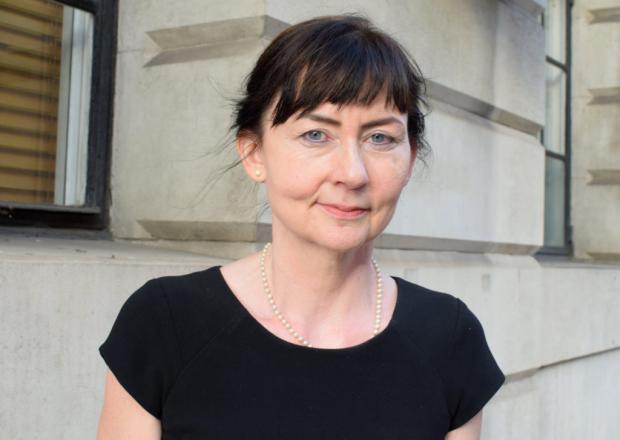
Anna Dixon MP
The chief executive was clearly embarrassed to face questions about spending such a lot of public money to silence the whistleblower after she produced a report about the toxic culture of bullying and harassment at the UK’s biggest nuclear waste plant.
Alison McDermott, a well respected management and diversity consultant, had faced a series of tribunals and costs hearings.which cost Sellafield over £750,000 by employing top flight lawyers.The main hearing was before judge Philip Lancaster, a judge now facing complaints from 10 women, including Alison, for his patronising and misogynist approach to female litigants who appear before him.
Anna Dixon,Labour MP for Shipley, raised the issue at the beginning of the hearing which was to examine Sellafield’s record so far in running down the waste facility over the next 100 years.
She pointed out that Alison had been head hunted through Capita to work for Sellafield and was then employed directly because of her excellent work. After she produced a report revealing a toxic culture of bullying and harassment at Sellafield this all changed and she was removed from Sellafield.
She told him :” I understand that at that time you did not invoke your whistleblowing policy or take a statement, as required by your own policy. Instead, you spent some £750,000 on legal fees. Perhaps you would confirm that. You refused mediation for three years, and pursued Alison for costs twice and lost on both occasions. As you will know, the remit of this Committee is concerned with the proper ethical use of public funds. As the new CEO, Mr Hutton, I would ask you whether you think this was a good use of public money.”
….” I have seen the treatment of other whistleblowers, which is similar to the treatment of my constituent, that has serious detriment to health, mental health and indeed professional reputation. Alison, as you probably recognise, is sitting here in the public gallery. I recognise that you are not willing to say very much. I am disappointed in that, because most of this is historic and in the public domain. I wonder whether you might apologise to her for the way that she has been treated by Sellafield.”
Mr Hutton replied implying that the situation in Sellafield then was ancient history.
“Over the last seven or eight years now, we have made really big strides forward in addressing some of the issues that there were at that time. You might say that I would say that but, in the most recent staff survey, which concluded, I think, a fortnight ago—I only say “I think” because I cannot remember whether it was a fortnight ago—we have seen significant improvement.”
Anna Dixon concluded: “I am going to come back later and challenge whether these problems have really completely gone away. I do not think that I heard an apology, but I hope you will at least agree to meet with me and my constituent, Alison. “
Since the hearing Alison McDermott has written an open letter to Mr Hutton, David Peattie, group chief executive of the Nuclear Decommissioning Authority and Paul Vallance, a non executive director of the NDA saying:
“The PAC’s examination has now raised serious questions about your leadership and your organisations’ management, culture, and safety practices.
I’ve made no secret of the toll this has taken on me. But each time I was faced with the choice between comfortable silence and speaking the truth, I chose the latter— without hesitation. That decision is one I will always carry with quiet pride. I can look myself in the mirror, sleep peacefully, and carry a clear conscience—something that is priceless.
I can’t help but wonder: how do you reconcile your actions?
What kind of man do you see when you look in the mirror? “
The PAC has now to produce a report following the hearing. I somehow think it will not be a glowing endorsement of practices at the UK’s biggest waste facility.
Coroner Mary Hassell now facing bereaved members of two families unhappy about the way she conducts inquests
Teresa McMahon was a well liked news editor for ITV’s Granada Reports who had a first class honours degree in journalism and was based in Salford. From humble beginnings she was rated by colleagues as ” a highly competent news editor, who had worked on and overseen – some of the biggest news stories including the Manchester Arena terror attack, the coronavirus outbreak and Tyson Fury’s world heavyweight championship win.”
Over three years ago she was found hanged at her home in Little Holten, Salford and it took until last week for an inquest to be held. What emerged is that the police “investigation” into her death, the pathologist’s report and the conduct of the coroner who heard the case, Mary Hassell, fell well short of the professionalism and unbiased news values Teresa McMahon had practised during her life.
The hearing itself did not start for an hour after lawyers for Lorna McMahon requested an adjournment because she had not received all the documentation she needed, had no confidence in the robustness of the process and thought her rights to participate compromised procedures under Section 2 of the European Court of Human Rights legislation particularly in relation to domestic abuse.
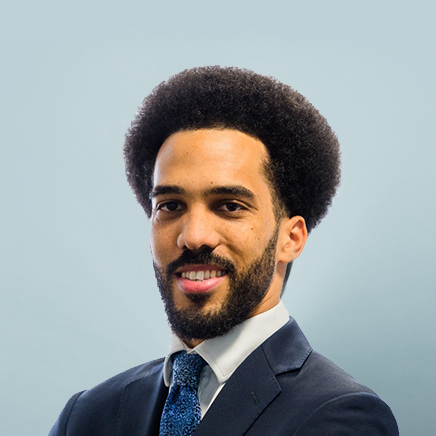
Michael Etienne Pic credit: Garden Court Chambers
Her lawyer, Michael Etienne, from Garden Court Chambers, who acted pro bono, highlighted concerns that coroners did not pay enough attention as to whether domestic abuse by a partner or ex partner led to suicide and cited previous cases. He told the coroner ” the inquest will (or at else is very likely to) fall short in its primary duty to provide a full and fearless inquiry into these important matters.”
All this was rejected by Mary Hassell, the coroner who insisted she would conduct a frank and fearless inquiry.
The hearing had already been moved from Manchester West coroner’s court to Inner London because of a conflict of interest and concern about the involvement of Greater Manchester Police. A senior coroner had recused himself from hearing – hence the delay in hearing the case.
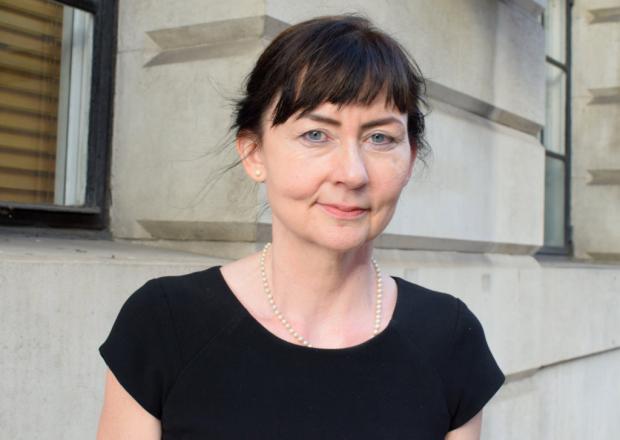
Mary Hassell ” suicide verdict” Pic credit: Archant
Mary Hassell decided that it was a suicide and ruled that there was no coercion or control by her ex partner Robert Chalmers that led to her death.
Mohammed Bashir – no ” Silent Witness” material
For her the star witness was Pathologist Dr Mohammed Bashir. He insisted that the ligature around her neck was consistent with hanging and not strangulation but he knew nothing about her complaint about domestic abuse and said there were no other marks on her body. Extraordinarily he had taken no photos when he examined the body and his evidence was partly contradicted by the policeman who went to the scene who noted bruises on her breast and biceps. Certainly Dr Bashir would not have qualified for a star role in ” Silent Witness.” He was no Dr Nikki Alexander and Lorna McMahon complained that the body had not been examined by a forensic pathologist.
This lax approach was compounded by the so called investigation by Greater Manchester Police. Detective Chief Inspector Gareth Humphries who arrived on the scene and immediately ruled out murder. She was already dead and it was Robert Chalmers, who snapped the cord. Her brother Bernard, who was also there, confirmed that Chalmers had done it by himself,
No pictures taken by pathologist or police
Extraordinarily again he did not take any pictures either and apologised to the coroner for not doing so. “Policy at the time was to take photos if you think there’s a crime. I did not think there was a crime at the time. I could have accessed the digital camera and I did not. I wish I had. If I had, you would have got photos for the answers you seek and I apologise that I did not.”
Instead he read her journal which he found in the bedroom where she expressed her loneliness, lack of contact with her daughter, and a list of complaints about the way her ex Robert Chalmers had treated her.
But only three weeks before this she made a complaint about domestic abuse to a police constable under Clare’s Law and was wrongly told that she had no right to find out whether he ex had convictions for violence. She then withdrew the complaint and police found that they had given her the wrong advice but could not contact her to tell her.
A lot of this came out during the hearing because of persistent questioning by Lorna McMahon not the coroner. She ended up being told off because the coroner did not think her hearing should be an inquiry into the police.
Her ex, Robert Chalmers, was supposed to give evidence but did not turn up. Mary Hassell issued an arrest warrant and he was taken by the police from his home to Bolton Coroner’s Court where he had to give evidence. He is a NHS estates manager working for the trust in Salford.
Her ex was nervous and unprepossessing
He emerged as a nervous, unprepossessing character, replying with monosyllabic answers and denying he was in any way responsible for her death. His only concession was that their relationship was ” volatile” – an under statement given neighbours had witnessed shouting, him being thrown out of her flat, and she tearfully sitting outside her house with her head in her hands. He also denied that he alone had snapped the cord contradicting her father’s statement.
Her father did not give evidence in person either but the coroner accepted a statement from him as he said he was to ill to attend. He painted a sad picture of his daughter being caught up in an alcohol fueled relationship with a man was not good enough for her. But it was also revealed that this man had been his best man at his wedding and he had known him for 25 years.
When his sister, Lorna, complained she could not question him, Mary Hassell accused her of preventing him coming because she had damaged his health by her attitude towards him. It was clear brother and sister did not get on but a coroner should be above that.
The final indignity was a decision by the coroner to first vet Lorna’s statement to the hearing and then ban most of its contents. Her reason was that coroner’s hearings were not a place where either side could try to influence a coroner’s verdict. To my mind this was preposterous. It was obvious that Mary Hassell was a very strong minded woman and the idea that anybody could influence her in any way was absurd. She may even have made up her mind before the full hearing.
I suspect the real reason is that she did not want any more criticism of Greater Manchester Police in public or more details about the behaviour of Teresa’s ex including his past, particularly as this hearing was well covered by the press and TV.
Lorna McMahon (far left) and Dorit Young ( second from right) demonstrate outside the coroner’s court
And it is not the first time she has silenced a bereaved relative. Lady Dorit Young was similarly treated over the death of her only daughter, Gaia. That is why there was a small demonstration outside the coroner’s court whereby Lady Young and her supporters and Lorna combined to protest. You can read about their case on https://truthforgaia.com/ and an earlier blog by me here.
New revelations by the BBC TV journalist Michael Buchanan today show what appears to be serial bullying and abuse towards women claimants by Judge Philip Lancaster at employment tribunal hearings
His news report today reveals that eight women have now separately come forward to say they were badly treated when they presented their cases before the judge since 2018. They describe their experience before him as “patronising, degrading, psychologically abusive, and misogynistic.”
The 67 year old judge who presides over employment tribunal hearings in Leeds is often rude and abrasive towards women and in one case even suggested that a claimant had mental health problems.
One woman claimant Angela Gates brought a case of disability discrimination and constructive dismissal against her employer in 2021.
She says a hearing in front of Judge Lancaster made her feel “like a villain being prosecuted”.
She says: “I felt I couldn’t give my side on anything.”
The four-day hearing was held on Zoom, and Ms Gates, 53, says Judge Lancaster regularly shouted at her, repeatedly telling her to be quiet. She says his behaviour was “appalling and degrading, verging on psychological abuse”, adding: “I don’t believe I’ve been given a fair trial.”
Another woman, who wished to remain anonymous, had similar treatment over a constructive dismissal and unfair treatment case.
“He made my life hell “
She said: He made my life hell,” she recalls. “He’d put his hands on his head, and appeared disinterested in what I was saying. He repeatedly asked why I was asking [my employer’s witnesses] particular questions and raised his voice numerous times. I felt useless.” She is now appealing the ruling.
Seven women are now planning to contact their MPs about their treatment as it is virtually impossible to complain about a judge as the system is rigged against them. You can refer a case to the Judicial Conduct Investigation Office or previously complain to Judge Barry Clarke, President of the Employment Tribunals in England and Wales. Or even to the Senior President of Tribunals, Sir Keith Lindblom. All seem set up to protect judges not complainants. Barry Clarke refused to act and Sir Keith ignored it.
Judge Barry Clarke, President of Employment Tribunals in England and Wales – protecting judge Lancaster from complaints
In a letter written by Alison McDermott, a management consultant, who complained about the way Judge Lancaster treated her in her case against Sellafield and the Nuclear Decommissioning Authority, to Adam Jones of the Judicial Conduct Investigation Office she says:
“It is simply not tolerable the way this judge has conducted himself, whether it is arbitrarily excluding the public, treating me less favourably, allowing bullying in the courtroom, treating me with hostility and contempt, ignoring evidence, attempting to block evidence, actually blocking exploration of evidence, vilifying me, acting partially, and failing to document procedural matters.
” I urge you, therefore, to conduct a thorough investigation into what went so badly wrong in my case and to exhibit, transparency and accountability – behaviours which the legal profession professes to uphold. I sincerely hope that I and the other key witnesses mentioned in this letter of complaint will be interviewed, as would occur with any other formal complaint or grievance investigation. In my experience as a consultant with over 20 years investigating organisational cultures and problems, it is not washing dirty linen in public that causes a problem but allowing it to fester in plain sight.”
Of course the office had no intention of doing such a thing. Judges, as I reported yesterday, are protected because the notes on the cases are kept private even when they are the only official record of the tribunal hearing. It is impossible to get hold of the evidence that would prove a judge was biased and judge Clarke would not reveal how many complaints he has received.
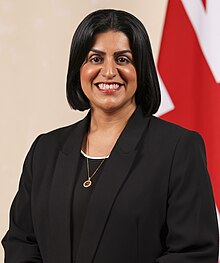
05/07/2024. London, United Kingdom.Chancellor and Secretary of State for Justice, Shabana Mahmood. poses for a photograph following her appointment to Cabinet by Prime Minister Sir Keir Starmer in 10 Downing Street. Picture by Lauren Hurley / No 10 Downing Street
So this leaves the Lord Chancellor to act but as I reported yesterday it is almost impossible to write to her directly – without officials in the ministry of justice or the judiciary intervening.
I would have thought Shabana Mahmood, a highly successful woman with an ethnic minority background, should ask for an investigation into Judge Lancaster. Many of the women who complained about him are from ethnic minorities as well. None of them should have had to put up with such egregious treatment and does the Lord Chancellor want to preside over system where a judge can treat women as dirt.
Yesterday a conference of doctors, patients and journalists held at the prestigious Royal Society of Medicine in London highlighted the appalling treatment of doctors by NHS management who raise patient safety issues to protect patients. Examples were given from doctors who had been dismissed after they raised patient safety issues and how trust managers spend unlimited funds on lawyers to make sure they lose employment tribunal cases, sometimes even aided by the judges hearing them.
The conference arranged by Justice for Doctors, a new organisation representing many of the affected doctors, coincided with a series of articles in The Daily Telegraph, which showed that these are not isolated cases but involve doctors right across the country and is a national problem which trusts are trying to hide.
One of the main organisers is David. E. Ward,, a retired cardiologist from St George’s Hospital, South London, who has already written two guest blogs on this site. I have included his planned closing statement to the conference as a fresh blog from him as it succinctly sums up all the issues that were raised.
By David Ward
First, I would like to thank all the contributors to this historic meeting. In a way it is a celebration of all those oppressed whistleblowers who have spoken up for patient safety.
I would personally like to thank my friend Professor Somerville who has been a driving force behind this and many other ideas to stand up for whistleblowers. Jane and I have been trying to set up a second meeting about Patient Safety for 5 years following the first one in March 2019 when we re-enforced our personal campaign to expose – and do something about – the appalling treatment of doctors who speak up for patient safety also known as ”whistleblowers”. During our campaign we met the Justice for Doctors group who helped to organise this meeting
In the past 3 decades a Hospital Trust with its senior management has accrued the powers to destroy a doctor’s career by imposing restrictions, suspensions, referrals to regulators (GMC, CQC) and, astonishingly, an unfettered power to dismiss. These major life-changing decisions are arbitrary and undertaken, incredibly, without any independent or regulatory oversight. For dismissal, “get out” is apparently sufficient.
Allegations against the victimised doctor may be based on made-up and unsubstantiated claims. If major criteria for dismissal cannot be met there is always the “loophole” of “some other substantial reason” which conveniently does not exclude but also does not mandate any additional explanation.
Doctors who see poor practices, faulty equipment, processes (and the like) are obliged to speak-up by Duty of Candour (HSCA 2008 reg 20). But by speaking up but they may put their careers at risk as we have seen so many times recently.
The “The National Guardian” program introduced by Sir Robert Francis and intended to accommodate doctors who speak-up, evidently does not function as intended. It’s called “marking your own homework”.
Investigations into a whistleblower together with their concerns should be independent of the Trust in which they work and be seen to be so. But evidently, they are not. Furthermore, the Trust managements who make these decisions are themselves unregulated. That doesn’t seem right? Does the phrase “judge, jury and executioner” come to mind? Managers should also be regulated, shouldn’t they?
Arcane procedures such as MHPSappeal hearings can be overseen or conducted by “dodgy” external “agencies” some of which claim spurious credentials. These agencies are, in effect, “hired guns” available and willing – for a fee – to “confirm” the Trust’s unfounded allegations and to assist their aims – to dismiss the “troublemaking” doctor; not because of “incompetence” but because the doctor has “annoyed” Trust management by raising concerns about Patient Safety or something else. The reactions of management are often vengeful, as we have seen.
I know of at least one of these agencies which has appropriated and misunderstood (in a written formal report) the phrase not “fit-for-purpose” to describe a doctor in support a Trust’s decision to dismiss. The agency seemed totally unaware that this is not only fictitious nonsense but possibly libellous. No such phrase exists in English Employment Law. Unfortunately, NHS England has also been duped. I know because I’ve asked – in person.
The Judiciary, in the form of Employment Tribunals may be called into action if the dismissed doctor seeks to restore their career via this route. This is a bad choice by the victim as the evidence confirms. Only 3% of Claimants, “win” – not the most apt word – in this system. Put another way, 97% lose! Is that “open and fair justice”? I think not. Some of the judgments are beyond comprehension.
There are many practices which seem grossly unfair, perhaps deliberately. Some obvious ones stand out:
1. Inequality of arms;the law firms acting for the dismissing Trust are funded by each of us – the taxpayer. The Claimant, the doctor, healthcare worker will have no external source of funds except perhaps by “crowdfunding”. Furthermore, if they lose their case, they may required to pay not only their own legal fees but the law firm’s fees too! That’s not fair. I can show you some law firm invoices which would shock you. The phrase “inequality of arms” doesn’t touch it.
2. “Cost threats”are a notorious device employed to, shall we say, “persuade” a claimant to withdraw their claims before, during or after a Tribunal. It’s another weapon deployed by the Respondent, the dismissing Trust, to force the claimant to surrender and withdraw their claims.
3. Non-disclosure agreements or NDAs,are devices designed to conceal the devious practices used to threaten the claimant (and, as it happens, to suppress evidence). They have no place in inquisitorial proceedings in this context. They should be banned.
4. The Public Interest Disclosure Act (PIDA) 1998; I quote: a worker has the right not to be subjected to any detriment by any act, or any deliberate failure to act, by his employer done on the ground that the worker has made a protected disclosure.
In other words, a doctor cannot be dismissed, for example, for raising patient safety concerns. So, any dismissal has to be attributed to another perceived misdemeanour. Read any recent case and it is evident that the “whistleblowing” or “patient safety” concerns were discounted and irrelevant to the dismissal. It was about an “attitude”, a “manner of speaking” and similar unquantifiable and, in most cases, unverifiable attributions. Ask one of the presenters today.
5. At a time of great need for medical expertise, doctors are still being persecuted and dismissed having committed NO offence. The law firms which spend so much public money to pursue the claimants should have no place in any procedures which are primarily about patient safety. Furthermore, the concerns and the person who raised them should be formally registered and documented, including all steps taken towards a solution. This is not happening. Doctors who raise concerns about patient safety are treated like criminals! This must stop!
6. Last but not least the patient safety concerns, the very things that trigger most of these shenanigans. What happened to those? Well, they get buried and forgotten don’t they. What a wonderful system. All that waste of public funds to destroy a doctor’s career instead of correcting potentially dangerous practices. That is why a register is needed.
The problem is a nationwide one of the same gravity as the “Great Post Office Scandal”. Perhaps NHS whistleblowers need a TV drama-documentary because we have seen how that shifts public opinion and awakens the media with unprecedented force. I’ve already draw up a potential cast list!
Last, there should be a searching, durable, logical and legally sound review of the treatment of ALL whistleblowing related laws and processes. Whistleblowers are the canaries in the coalmine. They do society a favour. They should be praised – not persecuted.
This is the 21st century! What country do we live in?
Thank you all for attending. Thank you to all those who presented. And particular thanks to Dr Salam Al-Sam, Dr Azhar Ansari and the Justice for Doctors group.
UPDATE: Who came and Who didn’t send anyone
Newspapers who sent a reporter: Times, Guardian, Daily Mail, Standard,
Major media who sent a reporter: Sky News
Major media one would have expect to send reporter:
BBC, ITV, GBNews, LBC
Major regulatory professional bodies who were notably unrepresented: (very bad show I think especially as some of their members Fellows were major subject dig the WB scandal). If they didn’t know or just couldn’t be bothered – it’s shameful, either way!
BMA, CQC, GMC, Royal Colleges (all of them, Physicians, Surgeons, Obs and Gynae), National Guardians Office (FTSUG), HMCTS (at least they could have send a junior barrister), Law firms; all those with an obvious interest in oppressing Claimants
UPDATE: In a further twist in this long saga, High Court judge Dame Jennifer Eady, President of the Employment Appeal Tribunalinitially took a decisionnot to read Dr Day’s lettercomplaining about the injustices in the procedure of his tribunal case against Lewisham and Greenwich NHS Health Trust . Now it has been decided that another judge will rule whether she should read the letter. Such a move has been opposed by the trust, who are represented by Old Square Chambers.
Superficially the ruling by Deputy High Court judge Andrew Burns looked like a victory for the long campaigning whistleblower Dr Chris Day to get a fair hearing at his forthcoming Employment Appeal Tribunal. He was granted an appeal on six of the ten grounds presented to the hearing and he was publicly commended by the judge for restoring the employment rights of 54,000 doctors which had been taken away in a sleight of hand by the now merged Health Education England.
But a closer look at the judgement gives a rather different picture. Instead of allowing a full appeal of employment judge Ann Martin’s flawed hearing he introduced caveats and blocked the re-examining of crucial issues. These include examining whether MPs and the press have been misled by the NHS and their lawyers, whether deliberate concealment has occurred and such startling behaviour as a Lewisham and Greenwich health trust communications director destroying mid hearing 90,000 emails that could have helped Dr Day’s defence and subsequently declining to appear as a witness.. It also allowed the health trust’s lawyers to to traduce Dr Day’s public reputation and misrepresent his motives without fear of being dragged before the libel courts or even being properly cross examined about this at the tribunal.
In short Andrew Burns judgement is a ruling equivalent to the infamous “three wise monkeys” carving at a Japanese shrine. He ” sees no evil, he hears no evil and speaks no evil” at that flawed tribunal. And he has been given by Dr Day a chance to review his findings to take account of these omissions.
To put it simply he is blind to Ann Martin’s mishandling of that tribunal, he is deaf to Dr Day’s arguments to put this right, and he is silent about the outrageous behaviour of the trust’s employees and their lawyers, particularly Ben Cooper, KC on traducing Dr Day’s reputation and it being broadcast to MPs, the public and other trusts.
As Dr Day puts in an email accompanying his crowd justice website ” which goes into all the legal details “The Judge has allowed me to have an appeal but taken all my weapons and has blocked key issues being explored.”
Ben Cooper KC
The language used against Dr Day by Old Square chambers lawyer Ben Cooper would be defamatory outside a court room. He is described as ” having an obsessive belief in his victimhood”, accused of an “elaborate rewriting of history by him to fit in with his narrative” and condemned his evidence as ” dishonest and underhand.”
When pressed on this by Dr Day’s barrister Andrew Allen KC at the June 2022 Mr Cooper conceded he had no example of what he meant from Dr Day’s witness statement and Mr Allen was then prevented from cross examining Mr Cooper on Dr Day’s supplementary statement rebutting Mr Cooper’s insults and allegations.
To make matters worse Ben Cooper’s attack on Dr Day’s character has been picked up by a lawyer defending lawyers Hill Dickinson against Dr Day in another case. Dijen Basu, KC from Sergeants Inn Chambers, in a skeleton argument in a case still to be heard said of Dr Day ” The diagnosis of whistleblowitis is a pithy way of describing a man who had developed an obsessive belief in his own victimhood to the point of being prepared to dishonest and underhand in pursuit of what he saw as the virtue of his cause as Mr Cooper described him.”
The irony of this attack is the case revolves around Hill Dickinson depriving 54,000 junior doctors of their whistleblowing rights whilst not revealing key commissioning contracts in disclosure the firm were paid to draft. Now who was really being dishonest and underhand!
As Dr Day purchased the transcript of Ann Martin’s tribunal he has been able to point out that cross examination of Ben Cooper’s claims was halted by the judge but she went on to allude to Ben Cooper’s argument against Dr Day in her public judgement. Dr Day argued that this a breach of court procedure but the judge did not agree.
Judge Andrew Burns did agree he had made a mistake in describing Dr Day’s withdrawal in a previous hearing in this long dispute as being caused by duress rather than misrepresentation.. This was when his lawyer Chris Milson, without his instructions, tried to negotiate a settlement which included a confidentiality clause. Dr Day was able to get Judge Burns to accept that his case was not one of duress but one of serious allegations of misrepresentation from a number of lawyers whose accounts of the infamous settlement of the Day Case in 2018 do not add up.
Dr Day has now written to Judge Dame Jennifer Eady, President of the Employment Appeal Tribunals, asking her to intervene.
He writes: “It may come as no surprise that I and large numbers of doctors feel deeply let down by the way the EAT has handled my case over the last 10 years. I believe its decisions have not been logical and have ignored evidence, pleadings and important appeal points. I believe the most likely explanation for this is the EAT’s failure to manage properly the conflicts of interests and human factors that have come into play when Judges have dealt with certain issues in my case affecting their legal colleagues.”
He goes on: “The destruction, concealment and ignoring of large amounts of evidence at the June 2022 ET hearing of my case and the obstruction of 2 of our proposed cross examinations was widely reported and shocked people. Many were expecting these obvious issues to be dealt with decisively by the appeal tribunal. Instead, I have had to get into an argument with the EAT about whether such extraordinary conduct is enough for me to advance procedural unfairness as a ground of appeal”
He adds: “I am seriously considering whether I can proceed with an appeal in this court whilst the EAT refuses to answer” these points.
A check on social media of Judge Burns X account by 54,000 doctors, a group who campaign for the whistleblowing rights of junior doctors reveals how closely 3 of the lawyers involved on both sides of the Day settlement are connected socially.
Judge Andrew Burns, a former lawyer at Devereux follows and is followed by Chris Milsom – Dr Day’s lawyer in a previous 2018 case that settled ; he follows Old Square Chambers, which has a leading role in pursuing whistleblowers; Martin Hamilton, managing partner, Capsticks who Dr Day alleges misled MPs and the Board of Lewisham and Greenwich about his case and settlement. Other followers include Nadia Motraghi, KC, another Old Square Chambers that was against Dr Day, who also pursued Dr Usha Prasad, a whistleblower cardiologist at Georges and Epsom St Helier NHS trust.
Dame Jennifer Eady
Finally it turns out that judge Dame Jennifer Eady – whom Dr Day is relying on to adjudicate about this – is a former lawyer at Old Square Chambers from 1990 to 2013. During her time at Old Square Chambers, for 13 years from 2000, Ben Cooper KC, and from 2004 Nadia Motraghi were colleagues. It would be amazing if they don’t know each other very well as they practised in the same field.
So how will Dr Day get a fair hearing when three of the lawyers he is accusing of misleading on the settlement are so closely linked to the judge and the final arbiter is their former colleague now in an all powerful position to control the entire employment appeal tribunal system.
My final point from covering a number of whistleblower tribunals is that I am disgusted at the way very senior professional lawyers seem to enjoy denigrating, insulting, and belittling the careers of eminent doctors whose main concerns are to protect the public from bad medical practices which endanger lives.







 Westminster Confidential