Will your complaint get heard as the Government forces the Parliamentary Ombudsman to curb its service?

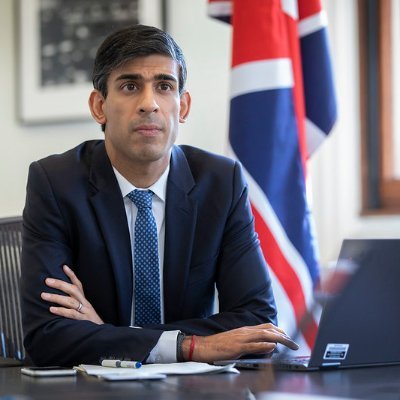
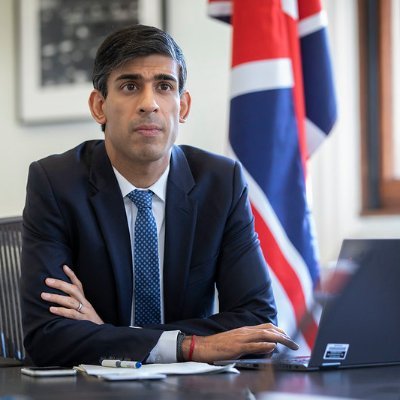
Rishi Sunak: Postponing the cash to improve the Ombudsman service

The Parliamentary Ombudsman has already – as I wrote in an earlier blog – faced a critical report from MPs on the way it handles some of its work.

And Michael Gove, the Cabinet Office minister, has also turned down any prospect of new legislation to modernise the service by combining its work with the local government and social care ombudsman.

Not content with that, Rishi Sunak, the Chancellor, has now postponed a three year funding programme which would have allowed it to introduce changes to improve matters.

Instead The Treasury has decided to give it just one year’s worth of funding and instructed it to concentrate on handling complaints arising out of Covid 19 pushing aside other grievances..

Details of this latest bad news has not been put out in any press release by the Ombudsman but has been hidden away in the correspondence section of the House of Commons Public Administration and Constitutional Affairs Committtee.

A letter from Rob Behrens, the Parliamentary and Health Service Ombudsman, to William Wragg, the Tory chair of the committee, reveals the not very bright future for people wanting to take the NHS to the Ombudsman or for the 1950s born women hoping for compensation for maladministration over the six year rise in the date they could claim their pension.

In the letter Mr Behrens says “We will postpone the launch of PHSO’s new three-year strategy until we can secure the three-year funding settlement necessary to deliver it. Instead, we will use 2021-22 as a bridging year to lay the foundations for the new strategy and focus on addressing the significant operational challenges facing PHSO’s service.”

Severely affected by Covid – 19

He goes on to describe what next financial year will be like:

“PHSO’s service has been severely affected by the ongoing COVID-19 situation in a number of ways, from the impact of school closures on the availability of staff, to pressures on the NHS that mean services are taking longer to respond to PHSO’s requests for information.
“As a result, PHSO is closing substantially fewer cases than usual and, in turn, this means a growing number of complainants are waiting for their case to be allocated to a caseworker.
“Although we have started to recruit some more caseworkers, it takes a minimum of six months to train new staff and even with additional caseworkers, it is clear that complainants will face increasingly long wait times unless we take further action.”

Delaying revealing the size of the complaints waiting list

I asked the Ombudsman to give me details of how many cases they were and how long they were taking. I also asked about the size of the waiting list. Simple questions enough if they are on top of the job. Instead they have decided to turn it into a Freedom of Information request which will give them a month or two to reply. I will report back when I have the figures.

In the meantime the letter says: “This means we will prioritise the quality and productivity of PHSO’s core complaints-handling service. We will also use 2021-22 to carry out preliminary work to support the new three-year strategy, such as improvements to some of PHSO’s core systems and processes, and highlighting
opportunities for Parliament to make essential improvements to PHSO’s legal framework, such as removing the MP filter.” The latter point is that all complaints have to go through MPs at the moment.

The whole situation is not good at all. But I am not surprised that the government is not keen on funding or modernising the service. A more efficient service will bring to light injustices – which means a bad press for government services – and ministers don’t like bad publicity. Far better to deprive the Ombudsman of cash and keep the announcement hidden in the correspondence column of a committee.

How journalists and bloggers can counter Covid 19 misinformation during the pandemic

The Ethical Journalist Network held a thought provoking webinar this week where experts gave top tips for journalists in writing up stories, read by millions of people, about the latest scientific and factual developments in the current world wide pandemic. As a member of the EJN UK committee myself I am reproducing the report written by Ali May, a fellow member of the committee. As he says it is an issue of life and death.

If you click on the headline it will take you to the EJN website where you see the original article ( reproduced below), learn more about the charity and read about other key issues journalists cover. Here is the full recording of the session chaired by investigative journalist James Ball.

A complete recording of the panel for those who want to delve into the issues.

EJN panel shares expert tips for journalists on tackling Covid-19 misinformation

By Ali May, EJN UK Committee member

As vaccines effective against the novel Coronavirus begin their global rollout, tackling misinformation, disinformation and earning public confidence could not be more starkly an issue of life and death.

This was the theme of a panel for the Ethical Journalism Network chaired by EJN trustee and Bureau of Investigative Journalism global editor James Ball, in which experts explored the role of journalists in tackling disinformation, the communicating of public health messages, and online fact-checking during this key phase of response to the Coronavirus pandemic.

What should journalists do to tackle misinformation, where are such myths coming from, and how can reporters avoid inadvertently becoming vectors for health misinformation? Professor Sir David Spiegelhalter, Kate Wilkinson, Nina Jankowicz, Anjana Ahuja and Marianna Spring joined Ball to share their insights.

A wave of misinformation about Coronavirus on social media has evolved over the past year, observed BBC Specialist Reporter Marianna Spring who covers disinformation and social media.

“At the beginning, it was lots of panicked viral WhatsApp messages, voice notes, lots of really understandable concern about what was going on about lockdowns, about how you could cure or prevent Coronavirus and while it was often spread quite innocently, its impact could often be really quite bad, giving people bad health advice, advice at a time when they most need good advice and resulting in direct harm. And as the pandemic went on, you started to see the human cost of that misinformation,” she said.

The same sentiment was reflected in comments by Nina Jankowicz, the author of How to Lose the Information War.

“Disinformation is not just silly memes on the internet. It’s not just fringe groups, talking about fringy things, but it has offline harm. And I think over the last year, we have seen case after case after case of that harm being borne out in real life.”

She pointed at the case of Ukrainians evacuated from Wuhan in the early days of the pandemic whose return caused riots in the country, with their bus attacked.

In such a tricky environment, the importance of fact-checking has become vital. And it comes in different forms, depending on the context. Fact-checking sometimes needs to play a diplomatic role, according to Kate Wilkinson, deputy chief editor at Africa Check.

“You sometimes have to act as a bit of a bridge between what’s happening on the ground, and what the scientific community thinks is worthy of their time and attention,” she said, “What can be difficult though, is when you go to an expert, a scientist, or a doctor who is understandably under quite a lot of pressure and stress, and you take what they consider to be quite ridiculous concepts or ideas, and you want half an hour of their time to actually unpack it. So, you can explain accurately why that can’t be the case, you sometimes get a mismatch between what the public is really fervently believing and what the experts or the scientists believe is worth their time or worth debunking.”

Editorial judgement becomes much more important at times of crisis. In the middle of a global pandemic, journalists have to make “a nuanced judgment about where the balance of evidence lies,” said science journalist Anjana Ahuja, a contributing writer for the Financial Times.

“Deciding what to platform is important,” she said, “There’s no point me putting up something quite frivolous just to knock it down, because that actually just circulates the idea further.”

Professor Sir David Spiegelhalter, author of the Art of Statistics, said there was reason to be optimistic, caused by the side effects of the pandemic.

“The relationship between the media and experts has matured,” he said, “experts have become, hopefully, better at expressing uncertainty, about inadequacy of explaining that the evidence isn’t good enough to be confident either way.”

He hoped that journalists will “realise that science is a hotly disputed area, that basically, there’s a lot of uncertainty, there are groups with different opinions that never been aired in public.”

Tips for journalists, shared by the panellists:

  • Get in there first. Counter the misinformation before people hear it on WhatsApp.
  • Don’t try to use tricks to be trusted. Demonstrate trustworthiness on a purely ethical basis.
  • Think carefully about what issues are worth legitimising by covering, and how issues might need to be reframed. In the case of climate change, Ahuja says ‘I decided to reframe it in my writing as climate emergency or crisis. Because it suggests that with climate change there is no question. The extent is how much do we need to worry about it? It’s happening.’
  • Meet people where they are in a language that they understand.
  • Approach people and the issues they hold strongly with empathy. Disinformation and conspiracy theories online can have a significant impact on people. Understanding the legitimate concerns and fears often explain why they’ve sought out those conspiracies, or where they have been preyed upon or conned into believing them. Separate those who are victims or casualties of online falsehoods and conspiracies from those often very small number of committed activists or bad actors who are deliberately looking to exploit that nervousness or that concern.

How rip off Rishi manipulated National Savings punters only to dump on them when it suited him

Rip of Rishi Sunak – the manipulative chancellor

In November I wrote a blog castigating Rishi Sunak, the Chancellor, for his introduction of “rip off ” rates for safe savers – many of them pensioners – who have National Savings accounts.

As I said at the time; ” Effectively Rishi Sunak, the Chancellor, is making sure that millions of savers and those who have a flutter on the Premium Bonds subsidise the government’s multi billion pay outs by losing money every year they invest.”

Now thanks to the House of Commons Treasury Select Committee – which took up the issue of the low rates -and also poor customer service, record levels of complaints and long waits hanging on their phone lines – his whole dastardly plot has been exposed.

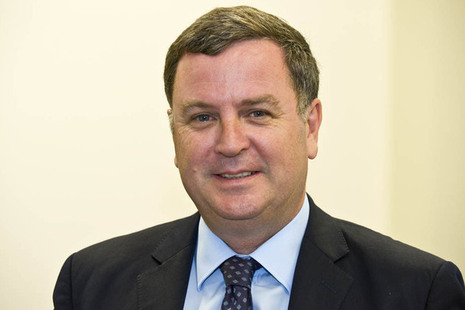
Mel Stride MP pic credit: gov.uk

Mel Stride, Conservative chair of the committee, decided to write to Ian Ackerley, Chief Executive of National Savings and Investments, demanding an explanation.

Today the committee has published his reply with a tough comment from Mr Stride about what happened.

” damage may have been done to NS&I’s reputation”

He said: “An exodus of savers from NS&I when it cut interest rates in November was foreseeable and so it is disappointing that the average time to answer a customer’s call was 19 minutes that month.

I would like to thank Mr Ackerley for his frank response, but the damage that may have been done to NS&I’s reputation over the last few months is worrying.

“NS&I has a big role to play in helping the Government fund the costs of the coronavirus recovery scheme and it will need to work hard to win back customers.”

But what is really interesting is Mr Ackerley’s explanation of how these changes in interest rates came about.

Ministers took decision not to cut interest rates

After Rishi Sunak became chancellor and pandemic took hold he decided to deliberately to attract savers to get the government out of a spending hole.

As National Savings says:

“In March 2020, in response to the Covid-19 pandemic, HM Treasury asked NS&I to provide proposals for how NS&I could quickly provide additional funding beyond the £6 billion target to support the Government’s increased borrowing requirement. …A proposal was made to Ministers to reverse the decision to implement interest rate reductions to NS&I’s variable rate products that were announced in February (before the Covid-19 pandemic had taken hold) and which were due to come into effect on 1 May 2020. “

“Ministers made the decision to proceed with this plan and on 1 May, only interest rate reductions on NS&I’s fixed term products came into effect. Variable rate product interest rates were left unchanged.”

By September it had been too successful. ” There was unexpectedly more cash in the savings market and much of this money came to NS&I – £38.3 billion in net inflows from March to September 2020 – this was a greater level of Net Financing than in the previous three years combined.”

Plan to drive savers away

So a decision was then made deliberately to drive savers away by introducing rock bottom rates because he no longer needed it.

National Savings said: “Based on previous patterns, we expected that a proportion of customers would withdraw their money. However, as many were newer customers who had come to NS&I when we were offering ‘best buy’ rates, the scale of the outflows and the timing of customers cashing in their holdings happened earlier than expected.
“A combination of factors has impacted our customer service operations which has been stressful for some customers and staff. We did not intend for this to happen but we do not believe that the situation could have been predicted.”

What happened was a rise in complaints, people waiting nearly 20 minutes on the phone to contact them and general disatisfaction with the service.

What is not said though is that the government will not want people to continue saving when the pandemic is over. They will need to spend to revive the economy. What better way to empty savings accounts than to make them so unattractive that people lose money keeping cash there.

So the real story is that this government is deliberately manipulating punters to suit its own interests -putting money away when they can’t spend it during the pandemic – and forcing them to spend it when the pandemic is over. They must take the average saver to be a fool.

Revealed: The poor health in old age scandal

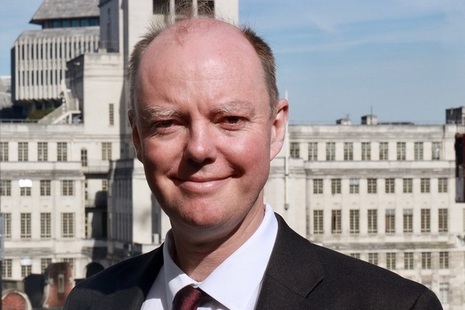
Professor Chris Whitty, chief medical officer, gave evidence on the damning statistics effecting the healthy living prospects for the elderly Pic credit: gov.uk

Today the House of Lords published an extremely worrying report into the prospect for millions of elderly people being able to enjoy a healthy old age.

I had not realised that Theresa May’s government had committed in 2017 to the Ageing Society Grand Challenge – a promise by 2035 that everybody in the country should be able to enjoy an extra five years good health in retirement. I have a feeling like the notice of the first raising of the pension age it has had little publicity.

Readers of my blog who have followed the BackTo60 campaign to get 3.8 million women born in the 1950s full restitution for their lost pensions will greet this aim with a hollow laugh – given there is growing anecdotal evidence that many women in their early 60s are already falling ill while working before they can even claim their pension. I wrote a blog about the figures in 2018 – see here.

But what this report confirms is not only that life expectancy has flatlined since 2011 but prospects for a healthy retirement has got worse particularly for the poor. The report reveals that the chances for a man to get an extra five years healthy retirement will take not 14 years as promised by the challenge but an incredible 75 years. They will be long dead by 2096.

For a woman it is actually worse – chances of having an extra five years healthy retirement is receding and getting worse by the day.

Figures in the report confirm what the Office for National Statistics has disclosed that Britain is slipping down the league table of advanced countries for those living longer – with men, who on average die earlier than women, have a higher increase in longevity than women. See my blog on this here.

Growing equality gap between rich and poor areas

But what is deeply disturbing is the huge gap between those in wealthy and deprived areas.

The report says: “In England in the period 2016–18, the difference in life expectancy between the most and least deprived areas was 9.5 years for males and 7.5 years for females. The differences in healthy life expectancy are 18.9 years for males and 19.4 years for females.”

The report notes: “the health situation is somewhat similar to other countries that have experienced
political, social and economic disruption and widening social and economic inequalities.” The report also noted that “in some of the key social determinants, inequalities are widening in England”.

The largest killer of men is heart disease and for women it is Alzheimer’s Disease and dementia. Heart disease deaths are falling while dementia is on the rise which explains the changes in longevity.

In a 2016 analysis of 20 countries, females in the UK had the lowest rate of improvement in life expectancy, followed by those in the USA. For males, the UK had the second-lowest rate of improvement,
after the USA.

The report concludes:” Inequalities in healthy life expectancy are stark, with people in the least deprived groups living more than 18 years longer in good health than those in the most deprived groups.”

This also hit ethnic minorities very badly as evidence given by Professor Chris Whitty , the chief medical officer to peers. He told them: “People from ethnic minorities are more likely to live in poverty in older age; 29% of Asian or Asian British people and 33% of Black or Black British people over the age of 65 live in poverty, compared with 14% of White people.”

Will it get better or worse?

So what is to be done and will it get worse ? For a start it will get worse because of Covid19 as the report was mainly written before the pandemic took hold and it is known that Covid killed disproportionately larger numbers of the elderly saving the DWP over £600m a year in pension payouts. In a postscript to the report the peers from science and technology committee say both short term and long term effects are an unknown.

On the positive side new technologies and robotics and new drug trials to treat diseases promise to make life better for the elderly provided they can access them.

Peers warn that unless growing inequality is tackled by the government – these benefits could widen the gap between rich and poor as wealthier pensioners would be able to benefit while the poor would be left behind.

The report also exposes the lack of a government strategy at the top to tackle this.

Peers say: “The Government is not on track to achieve the Ageing Society Grand Challenge mission to ensure five years of extra healthy life by 2035 while reducing inequalities, and does not appear to be monitoring progress towards the mission. It is hard to see how the target could be met without significant changes to the way it is managed.”

For those who criticise the House of Lords as an irrelevant institution – this report shows the House working at its best – it is a very thorough, well researched report – drawing attention to an overlooked issue and warning the government that it needs urgently to act to take this seriously. Whether it will, given the complacency of some ministers, is another matter.

The full report can be accessed here.

Boris Johnson’s and his Cabinet cronies real Christmas message to you all

I am looking forward to a wonderful Christmas. Click on the link below.

This is a revised link using You Tube after someone who did not like this got Facebook to take down the original. I wonder why and who did it.

There is not much more I can say about this except it is beyond satire. Some of us might just think it is really what goes on in their minds.

How on earth could the Bank of England lose track of £50 billion of our money?

Specimen £20 note – where have they all gone? Pic credit: James Oxley Bank of England

Bizarre story about the missing money

Today a report from MPs revealed the extraordinary fact that the Bank of England doesn’t know where £50 billion of its bank notes are.

It also revealed that since the Covid 19 lockdown the number of notes issued by the Bank of England is at an all time record. Yet this is at time when contactless payments by credit and debit cards are also at an all time high and many shops do not want to accept any cash at all.

Already a year before the Covid 19 led to lockdowns and smashed the economy some 7.4 million people – mainly in the 18-34 year age group were estimated to have virtually stopped using cash altogether.

So what is happening? We both can’t have a growing number of people no longer using cash yet record numbers of banks notes in circulation. There is something strange going on and the Bank of England seems remarkably complacent about it.

As Meg Hillier, Labour chair of the Commons Public Accounts Committee, which produced the report says:

” £50 billion of sterling notes – or about three quarters of this precious and dwindling supply – is stashed somewhere but the Bank of England doesn’t know where, who by or what for – and doesn’t seem very curious. It needs to be more concerned about where the missing £50 billion is. Depending where it is and what it’s being used for, that amount of money could have material implications for public policy and the public purse.  The Bank needs to get a better handle on the national currency it controls.”

There is some curious speculation in the report. They wonder whether the people who traditionally like payments in cash – window cleaners, gardeners, the odd job man or woman are salting away the money. Or is it because – as I have reported before – that Rishi Sunak, the Chancellor, is offering such appalling interest rates for savers – that they are keeping the cash under the mattress?

Are criminals sorting away the cash?

Or is it something darker like criminals using the cash for nefarious purposes -or has the money been salted away in tax havens or are the Russians or Chinese siphoning off the cash hoping the British economy implodes?

The MPs are demanding the Bank of England investigates so we should have an answer early next year.

The same report also highlighted quite a different problem – that people in poor and rural areas have difficulty accessing this huge amount of cash in the system.

In September, the National Audit Office said that the Treasury, Bank of England, Royal Mint, the Financial Conduct Authority and Payments Systems Regulator need to coordinate more effectively so that people have access to cash.

But the number of cash machines are declining and the Post Office is not open all hours. so people can’t always access cash.

The Royal Mint is losing money striking coins as well.

The report said: “The Mint’s UK coin production has reduced by 65% over the last ten years, from about 1.1 billion coins made in 2010–11 to 383 million in 2019–20. This reflects the overall fall in production demand over the period, although production volumes increased in some years, for example between 2012 and 2016 with the issue of new 5p, 10p and £1 coins replacing stock already in circulation.”

Mass dumping of coins

It revealed that people have also been dumping coins in massive amounts. The report said:

“A Mint-run exercise to recall the old £1 coin, as an increasing counterfeit risk, led to an unexpectedly huge return of coins of all denominations as households and businesses emptied their stocks of coins. This led to a large increase in coin stocks and a consequent reduction in the number of coins that needed to be produced.”

But there still is some demand for coins.

The report said: “It now expects the Treasury to ask it to manufacture new 2p coins in the next 6 months and more £2 coins within the next 3 years. Nevertheless, the Mint expects the increase in demand to be temporary, and that the long-term impact of the pandemic will be to exacerbate the decline in coin use.”

Meanwhile it has lost millions of pounds for the last three years in minting new coins as it coins as it costs more than their face value to produce them.

The scary chaotic privatised Covid-19 national survey and me

The ONS survey promises they could not fulfill

Inside story of how the government can’t even organise a Covid- 19 survey let alone sort out the pandemic

Much has been said of the government’s expensive muddle and mishandling of the Covid -19 pandemic where millions if not billions of taxpayer’s cash has gone down the drain. Contracts have gone to the Vote Leave chumocracy, apps have failed, people have unnecessarily died in care homes and it has been bonanza time for private firms.

What has been missed is that while all this is happening the Department for Health through the Office for National Statistics and Oxford University have undertaken a randomised survey of 220,000 people to find out about the spread of Covid -19.

This is not just a once off questionnaire but those taking part in each household can opt to participate for a year. For the first month they are swabbed once a week and then monthly. The aim is to provide the government with a detailed picture of the pandemic’s progress and once approved the effectiveness of any new vaccines.

The scheme has been branded with trustworthy names – who would object to helping researchers at Oxford University or the Office for National Statistics.

Private company bonanza

But in fact the work is yet another bonanza for private companies and labs just like test and trace. What could possibly go wrong?

Well it did and this blog is my personal experience and my wife Margaret’s experience.

It started with a package being posted through our front door.

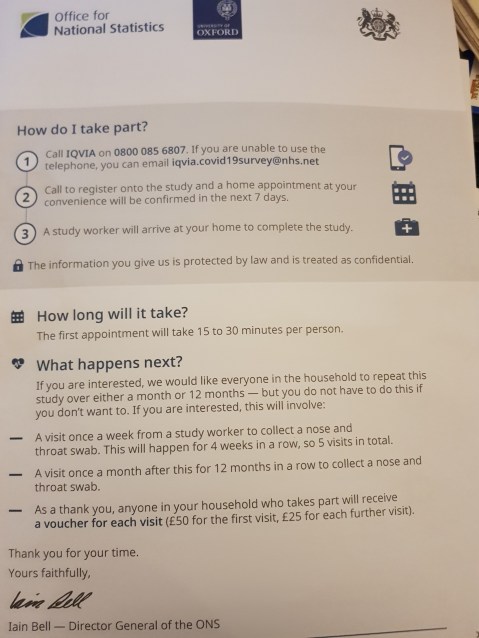
We were invited to ring a free number to sign up. Then within a week you would have an appointment. A pleasant socially distanced study worker would turn up, take your details, show you how to administer your own swab and send it off to a lab. You would get the result – if positive – within 24 to 72 hours from Public Health England. If it was negative you wouldn’t hear. You would also be eventually paid £50 in vouchers for the first visit and £25 for subsequent visits.

Sounds a doddle. It wasn’t.

First try and ring up and get an answer. I got through on the sixth attempt. And it is not to Oxford University but to IQVIA, an American multinational based in Durham, North Carolina, not Durham, England, with an income of $11.11 billion – effectively a health care data mining company. They have set up offices in the UK and guess what they are under staffed – hence the difficulty in getting through.

I was told to expect a call from NatCen, a private social research company, based in London that were in charge of appointments.

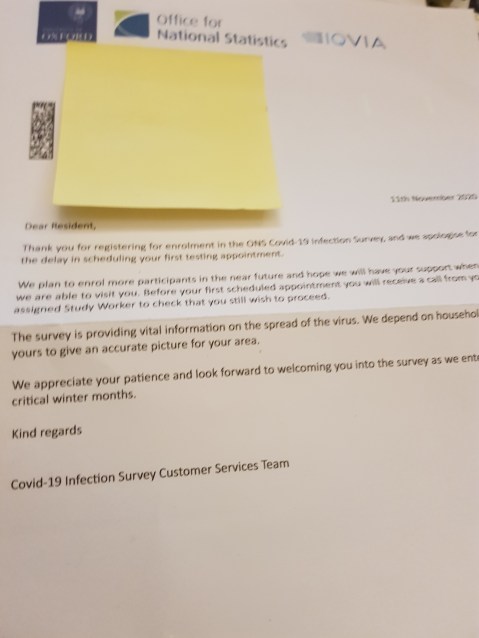
Rhe survey organisation must have been going wrong – they sent out this standardised apology to me and plenty of others.

A week went by, two, three, then a month and nothing. Finally there was a knock on the door and a genial man called Kirk asked me who I was.

” We have been trying to ring you for weeks and couldn’t get you. We got someone else who was already on the programme”, he told me

The reason was simple. The mobile number they had for me was not remotely like mine – they had put in someone else’s in their records

The came the swab – straightforward. We were told if we heard nothing after 48 hours we would be in the clear.

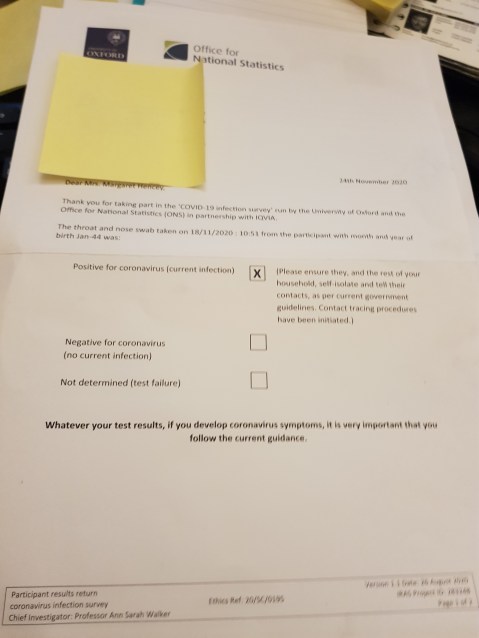
Then SIX days later we took a call from Hertfordshire County Council. It was for my wife – we are both in our 70s – she was Covid 19 positive . She had to self isolate for another four days. I was negative but had to self isolate for another seven.

The woman didn’t seem to know why we had been tested together, didn’t know about the national survey, and then told my wife not to have another swab in case it was a false positive.

This was scary because my wife did not have ONE SYMPTOM, no temperature, no cough, nothing. But we had to quickly cancel a hospital outpatient appointment for that day and cancel a visit due the next day from a physiotherapist.

The advice from Herts County Council was contradicted the next day by another study worker pointed out that the survey required people who were positive to take another test. He was puzzled that she – given we are part of the vulnerable group susceptible to Covid 19 – had no symptoms. He could not explain why we had been contacted by Herts County Council and not Public Health England.

Even after we got the invalidated result they still sent us the wrong result ( Note they spelt our surname wrong

After scary days of waiting to see if anything developed we had another call from IQVIA. It was to tell us that Lighthouse Laboratories – the privatised mega lab consortium – set up by  Medicines Discovery Catapult Ltd and UK Biocentre Ltd- who tested the swab had got it wrong. She was not positive and the test had been invalidated because the lab had used the wrong compounds to test it.

Nor were we the only ones – an entire batch – was wrong. Imagine the distress this would cause.It wasn’t the first time either. The Independent reported in September that tens of thousands of people had been cleared of Covid- 19 by the same labs when they were positive.

We now await our promised vouchers. I see they are provided by Sodexo – a private company which I remember was responsible for the hopeless failed privatisation of the probation service. They also provide child care vouchers. I wonder what they can to do to muck things up. I can’t wait.

Dumped at 50: The grim post pandemic warning from statisticians

Amanda Speedie – one of the millions who would like to retire but now also hit by the job crisis caused by Covid 19.

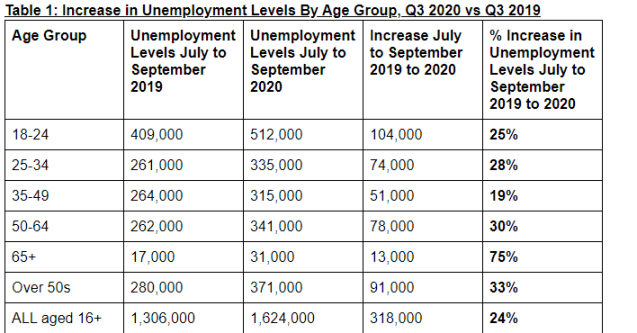
While the headlines concentrate on soaring youth unemployment the biggest rise in jobless totals are among the over 50s.

Figures from the Office for National Statistics analysed by the group, Rest Less, a jobs and community site for the over 50s. reveal unemployment has soared among this group by a staggering 33% year on year – the biggest percentage increase of all age groups and significantly more than the national average increase of 24%.The figures below tell the story.

Other figures shows that those furloughed over 50 who will later lose their jobs will be 80 per cent women. See this research here. And for the group I have championed through BackTo60 – the women born in the 1950s – who are now waiting up to six years to get their pension – the prospect of getting a job even if they wanted one will be worse.

But this is not just a tale about statistics. It is about human beings whose lives are being made more of a misery during this nasty Covid- 19 period.

One of those is Amanda Speedie, a resourceful and articulate 61 year old, who lives in Cornwall over the border from Plymouth. She was one of the women who did not find out until 2011 that she couldn’t retire at 60. She has since been dismayed by the failure of the judges decision on the BackTo60 court case. She had also tried using a local WASPI template to see if she could claim from the Ombudsman but that got nowhere.

She told me: ” When the decision was made it passed me by I was too busy bringing up a family, didn’t read newspapers ands rarely looked at TV news. If they had written to me I would at least have known”.

She is now divorced but well qualified-having worked in a variety of roles from estate agency to medical secretary to customer service and admin roles. She worked at one stage as a shift supervisor of the River Tamar toll plaza.

No full time job since 2012

She hasn’t had a full time job since 2012. She survives on two small private pensions – worth £40 a week – and by taking on some gardening work for which she earns £45 a week.  She occasionally takes on sewing repair and alterations which might bring her in an extra £10 or £20 a week. She doesn’t qualify for any of the government payments.

Her real passion is to become a writer .Amanda studied for a BA in English with Media Studies and graduated with the MA in Professional Writing in 2007.

She has however some very strong views about what women in their 60s should do and that does not include work.

Rishi Sunak: didn’t even reply to letters about 1950s women poverty

” Many women are single, they can’t get jobs and even if they can haven’t the energy to do full time work ( I did a full time job for five weeks and came home exhausted every night and had to give it up) They suffer health issues and lose their energy after the menopause. Older people also face discrimination from employers who are not keen to employ them.”

She has written twice to Rushi Sunak, the Chancellor, suggesting that he introduced an allowance equal to the pension for women in their 60s. She has had no reply.

” Women could then do things they might want to do like volunteering or looking after their grandchildren or take a part time job if they wanted.”

lost generation

What is alarming is that generation born in 1960s are hitting the same problems. Rest Less had another case of a women in her 50s.

Claire Cassell is 54 from Willenhall near Birmingham.  She lives with her husband.  For nearly three years, Claire was working as a receptionist for a legal firm. 

She was furloughed at the beginning of lockdown and didn’t hear anything from her employer until May when she was notified that they were hoping to get back to work soon. 

By July she hadn’t heard anything more and texted her boss to find out if they were going back to work.  He simply replied ‘No’. 

At the end of August, she received an email telling her her role was at risk of redundancy.  She was made redundant on 1 September.  She is entitled to Job Seeker’s Allowance until March but as her husband works, she cannot claim Universal Credit.
Since then, Claire has applied for 200 jobs and has had two disastrous Zoom interviews.  She says she has a lot to give an employer and has 12 years of work still in front of her.

What this suggests is life is going to get much harder for the middle aged – who might have to face a decade or more of impoverished lives – before they get their pension. The government’s solution is to raise the age before you can get a state pension to 67 and then 68, and some pressure groups like Iain Duncan Smith’s Centre for Policy Studies would like it to be 75 asap – knowing he as an ex minister and his wife will retire on a huge state pension provided by Parliament and Whitehall.

Crisis in the tax office: The cost of Covid 19 to HM Revenue and Customs

Chancellor to make a statement this week

Tax revenue down £70 billion while tens of billions spent saving jobs and the economy

Just before the first phase of Covid 19 peaked HM Revenue and Customs had a very good year. Tax revenues had peaked at £636.7 billion from more national insurance contributions, a record target of 95.3 per cent of tax due had been paid and £36.9 billion had been recovered from tax fraud and evasion. Then Covid hit.

Now as the Chancellor prepares his latest spending statement the latest annual report and accounts of HMRC and a National Audit Office report qualifying the accounts a very different picture is emerging. To give you an idea the Revenue lost £70 billion in tax revenue in five months.

The Covid-19 pandemic turned HMRC upside down and at least three planned targets will be missed this year. Just like the Department for Work and Pensions thousands of staff were moved to help handle the pandemic. But the pandemic also means a big loss of revenue , the cancellation of plans to combat firms who avoid tax by using the black market and an expected increase in money lost through fraud and error on working tax credit.|

On working tax credit it says: “As we no longer accept new claims to tax credits (with limited minor exceptions), our work to restrict error and
fraud now focuses on existing awards.. ..The continuing need to divert compliance staff to support other departmental pressures means we expect not to meet the 5% maximum target for 2019 to 2020.”

On collecting tax it says:” Due to the impact of the COVID-19 outbreak, the end of year HMRC debt balance for March 2020 is £2.5 billion higher
than forecast, coming in at £22.4 billion, significantly over the forecast of £19.9 billion… It is anticipated that the economic impact of COVID-19 will continue into financial year 2020 to 2021 as customers find it increasingly difficult to fulfil their tax obligations.”

black market tax avoidance

And on tackling black market tax avoidance – called conditionality in tax office jargon – it says:” Budget 2018 said that the government would consider legislating to introduce conditionality at Finance Bill 2019-20.
However Budget 2020, which was delayed from autumn 2019, announced that the legislation would be included in Finance Bill 2020-21. Internal milestones were adjusted to work towards that revised timetable.”

You have to turn to the report by the NAO to find out the real impact of Covid-19 on the tax offices. For a start offices were deserted. 80 per cent of the 50,000 staff worked from home and as a result the public faced long delays in getting through to HMRC because only 7000 had secure phones to handle queries.

People kept waiting on the phone

From March 2020 there was an increase in the time HMRC took to answer telephone calls, peaking at 14:59 minutes in May and improving to 9:15 minutes in June 2020.

Like DWP large numbers were switched to working on Covid-19 work.

“At the peak, in May 2020, of 58,592 full-time equivalent staff, 9,097 (16%) were reallocated to COVID-19-related roles. Of the two largest groups of staff, 25.2% of staff in the customer services group were allocated to COVID-19-related work in April 2020 and 17.3% of staff from customer compliance group were allocated to COVID-19 in May 2020.”

Numbers have since fallen but will probably have gone up again with the second wave. The key schemes were the Coronavirus Job Retention Scheme, Self Employed scheme and “Eat to Help Out”. The Job Retention Scheme is thought to have been targeted by organised crime and billions of pounds may have been defrauded. See my article in Byline Times.

As a result “yield from its tax compliance activities is likely to
reduce in 2020-21. For comparison purposes, HMRC achieved a compliance yield of some £7.5 billion in the period April to June 2020, 51% less than the yield of £15.4 billion achieved in the same period in 2019-20.”

tax losses

The detail over tax losses is daunting. Some £70 billion between April and August this year -£38 billion alone from VAT. Some £13.5 billion from tax and national insurance; Another £10 billion from Corporation tax and over £4 billion from fuel duties as people stopped travelling.

Receipts recovered at the end of the first lockdown in July and August, particularly VAT by £10 billion.

HMRC: Pic credit: David Palmer

However a tables in both report also reveal how much HMRC is paying out and how much they don’t how much it will cost. The furlough scheme was £39bn up to September; Eat Out to Help Out cost them £522m for August, Payments to the self employed cost £13bn but they don’t yet know the real cost of a host of projects. Some £1.5m was set aside for putting up basic working tax credit by £1045 for the tax year but figures for the claims are not available. Another £200m was put aside for repaying employers contributions to statutory sick pay but we don’t know how much was spent.

At least eight other measures spending figures are not available – these include the concessions on stamp duty for homer buyers, deferring tax payments for the self employed, VAT reductions on food and accommodation, exempting personal protective clothing from VAT, and cutting import duties on essential medical equipment.

We do know that as of June £28 billion of VAT was deferred.

Finally the Department’s bad record of recovering payments on working tax credits led its annual accounts to be qualified by the auditor general.

Some £1.11 billion was overpaid or almost 5 per cent of all payments and it will get worse this year. But because staff disruption over Covid 19 we won’t know this year’s figure until next June. Covid-19 could currently slow the transfer of people from working tax credit beyond the current delayed deadline of 2024.

Only 10 people switched to universal credit

Just TEN people instead of an expected 2000 transferred to Universal Credit last year under a new pilot project. The project has now been halted. Covid 19 did encourage a number of people to voluntarily transfer after the rates were temporarily raised.

Meanwhile the huge expense of preparing for Brexit – temporarily stalled by Covid 19 for part of the year – is now estimated to have cost £516m in the last tax year and there are now 6,100 staff working on it. Altogether since the referendum it has cost not far short of £800m because they have to prepare for so many scenarios.

Only eight weeks to go to Boris Johnson’s border chaos day

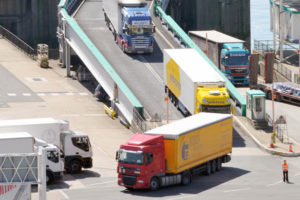
Lorries leaving ferries at a British port. Pic credit: National Audit Office

A damning new report has come from Parliament’s financial watchdog, the National Audit Office, on what to expect at the ports on January 2 whether the country leaves the EU with a deal or no deal.

Despite spending a humungous £1.41 billion for new infrastructure and IT systems – which wouldn’t be required if we had stayed in the EU – it looks like we are heading for chaos because we are still not properly prepared.

Instead of having to process some 55 million customs declarations a year Customs and Excise will have to handle 270 million.

And some 219.5 million tonnes of freight crossed the border between the UK and EU in 2019 and only between 30 and 60 per cent of lorries are prepared for the change.

And guess what? With eight weeks to go the government doesn’t know how much trade there is between the UK and Northern Ireland which is subject to the new Northern Ireland protocol that Boris Johnson signed last year. This will require new documentation and registering with a new import control service. And again the government doesn’t know how many firms have to sign up pointing to potential chaos on sea routes across the Irish sea between Wales, Scotland and England.

worst case scenario

And in the worst case scenario there could also be queues of up to 7000 lorries trying to access the Channel ports.

The scale of the exercise in Whitehall is shown by the number of departments involved As the report says:

“This includes HM Revenue & Customs (HMRC), the Department for Environment, Food & Rural Affairs, the Home Office, the Department for Transport, and the Border and Protocol Delivery Group (BPDG) and Transition Task Force (TTF), which are both situated within the Cabinet Office. BPDG is responsible for coordinating government’s preparations in relation to the border and TTF has oversight of overall EU Exit preparations, following the closure of the Department for Exiting the European Union in January 2020.”

Auditors have also engaged with departments within the
Northern Ireland civil service which have the most significant roles in relation to the Northern Ireland Protocol.

The picture is not pretty. The first wave of the Covid-19 pandemic led to a three month pause in ministerial meetings to organise the new border regulations and as a result many of the new customs declarations will be delayed until July 2021 rather than January. Yet for political reasons the Cabinet would not extend the transition period,

computer glitches

Then there is a good chance of computer glitches in the operating of the new system at all ports. The report says:

“Integrating the processes, IT systems, infrastructure and resources to operate together for the first time from 1 January 2021 is inherently complex and high-risk. In addition third parties, such as ports and community software providers, who need to develop new software
which integrates with new or changed government systems, have been given very little time in which to prepare and are unlikely to be able to do so in time for 1 January 2021. “

Can you imagine the mess there will be on the first day and it won’t just be teething problems.

The government is hoping to get round it by appointing customs intermediaries – at a cost of £84 m – to help firms negotiate the new system. But it has started slowly, not all the money to appoint them has been used and Whitehall has given the plan a red light because they fear it would not be ready in time.

Covid-19

Also the present second wave of Covid-19 could make matters worse as firms will have to cope with that and a new system. The report says:

“The emergency response to COVID-19 has placed strain on local authorities, industry and supply chains’ ability to plan and put in place contingency arrangements. Disruption at the border maybe harder to manage if it also happens alongside further COVID-19 outbreaks and a background of economic uncertainty.”

Details of the Northern Ireland arrangements are partly in the hands of the Northern Ireland government. But report says: “Its ability
to take forward this work has been severely hampered by the ongoing
negotiations and, in the case of infrastructure, the lack of clarity about
the level of checking that will be required.”

Boris the Bodger

The final picture is dire. The report says:

“It is very unlikely that all traders, industry and third parties will be ready
for the end of the transition period, particularly if the EU implements its
stated intention of introducing full controls at its border from 1 January 2021.”
If the EU keep to its word and the government is as unprepared as this report suggests – the chaos with lorries stranded in new overflow car parks, delays and confusion in operating the system and computer systems failing all on the same day will be very bad news. Boris the Builder will become Boris the Bodger and no one will thank him for the mess.