50s women pensions: Will rival attempts to speed up compensation for the 3.6 million work?

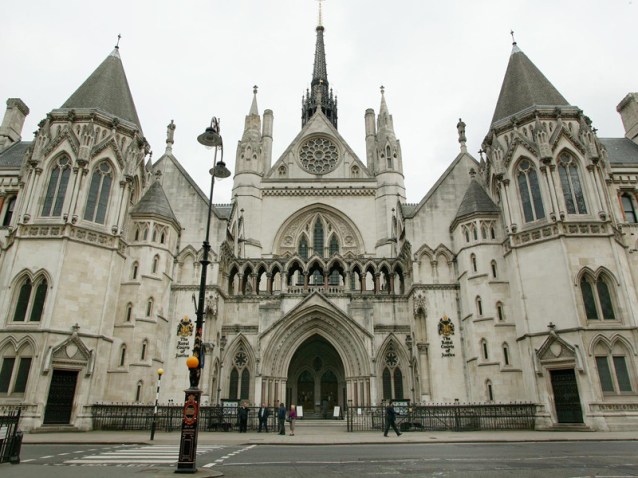
Royal Courts of Justice

While I have been away there have been significant developments in the long battle to get justice for the 50swomen who lost tens of thousands of pounds through maladministration, discrimination and lack of communication over the six year rise in their pension age.

Like everything in this long tortured tale the developments have not been straight forward.

Basically two separate initiatives have been launched. WASPI after first going along the route of seeking justice for 50swomen through Rob Behrens the Parliamentary Ombudsman, suddenly turned on him threatening him with a judicial review and launching a crowdfunder to fight him which raised nearly £150,000.

Alternative Disputes Resolution

Backto60, as the only organisation that campaigns for full restitution for the women, launched a plan to call for an Alternative Disputes Resolution, to negotiate a settlement with Mel Stride, the secretary of state for works and pensions, to end this long running dispute which has angered so many women who feel cheated by the DWP. This is backed by 54 MPs, petitions that have attracted 87,000 signatures and a Parliamentary motion.

Both the initiatives I suspect followed the leaking of the Ombudsman’s first and second stage reports on the issue on this blog. Without them becoming public the 3.6 million women affected would not have known the full and frankly paltry proposals by the Ombudsman to solve this dispute. And I have not forgotten senior people from Waspi pressing me to remove the posts so the reports would remain part of a private discussion between them, the Ombudsman and selected MPs rather than allowing the 3.6 million victims the opportunity to read them. And the second one is still not published.

The reason that I suspect WASPI turned is that it was becoming clear that the compensation would be meagre and limited – the DWP could decide ( as they have following other Ombudsman’s reports) that only the six complainants would automatically get compensation of £1000 and some 600 will have to fight for it .It looked a far cry from the promise by Waspi’s chief spokesman, Angela Madden at last year’s Labour conference of between £10,000 and £20,000 for everybody. That is still a lot less for many people owed up to £50,000.
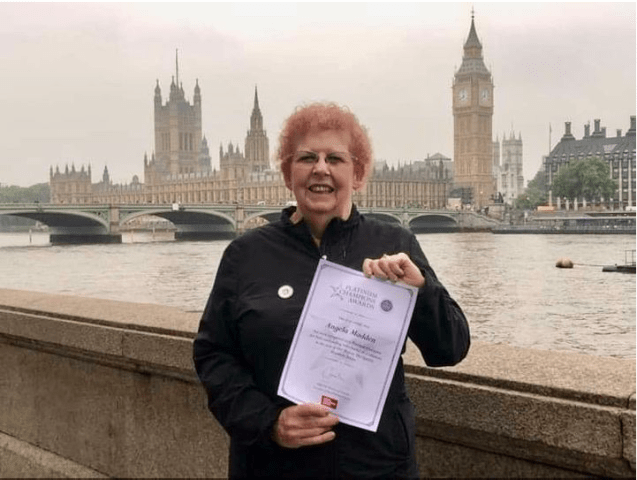
Angela Madden WASPI

Now developments have moved fast on this proposal. It is clear that WASPI, the Ombudsman and teams of lawyers from Bindman’s and Blackstone Chambers have come to a compromise which ended up in the high court last week. Reading the order from Judge Kirsty Brimelow it is clear that parts of the Ombudsman’s second stage report are quashed. These deal with the latter part of the report which rejected any financial compensation for women whose well being and life choices were affected by the delay and did not acknowledge the impact of the DWP pausing sending out letters to women.

The section was admitted by the Ombudsman to have been legally flawed by not taking everything into account.

Crowdfunder page

Since then WASPI have issued on their Crowdfunder page a series of ten conditions which ,it says, the Ombudsman should fulfill.

“WASPI will not be passively waiting for its outcome. At each stage we will be pressing the Ombudsman not only to complete his investigation in a way that is as rapid as possible but also thorough and fair. We will also be raising concerns about this with MPs, particularly those who sit on the Public Administration and Constitutional Affairs Committee (PACAC) which oversees the Ombudsman’s work. And we will turn to our lawyers for their expert input when responding to the Ombudsman’s draft reports and if we have concerns his investigation may be derailed again.”

The Ombudsman has been more cautious. He has agreed that he will show Waspi and the complainants his proposed changes and accept comments before finally presenting his report to Parliament.

A spokesperson committed them to looking at the report again adding” We don’t currently have a timeline, but we want to resolve the investigation as swiftly as possible, so any mechanism for remedy can be implemented for those affected.”

Now while this is happening Back to 60 pursued a different tack. The key issue for them has been the People’s Tribunal which looked into the plight of the 50swomen under the UN Convention on the Elimination of Discrimination against Women (CEDAW) Tribunal held last year and the judgement given by Judge Jocelynne Scutt which ruled that the women had suffered both maladministration and discrimination.

Jocelynne Scutt

Some critics have tried to say the tribunal and the report are irrelevant because they have no standing. Given that the deputy chair of CEDAW in Geneva gave evidence to it and the judge was one of Australia’s first discrimination commissioners, such criticism seems rather ridiculous. to put it mildly.

The judge took a strong view that Parliament had a moral duty to this. “Government and Parliament have a responsibility to face up to and acknowledge the grave wrong done. There is no room for obfuscation or quibbling. Historic discrimination requires relief. There is a moral imperative to right this wrong. The law is on the side of 1950s women.”

Sir George Howarth

Sir George Howarth, Labour MP for Knowsley, who chairs the Alternative Disputes Resolution project has already written to Mel Stride, asking to come to a meeting. The organisers have also invited Waspi who have not replied.

What is missing is what the DWP will do. It has registered as an interested party to the proceedings over the ombudsman’s report but did not send lawyers to the hearing last week.

Any question to ministers on these developments is met with the answer that it is ” neutral” and would not comment because of the legal proceedings.

This is not surprising , the DWP can’t commit to implementing the Ombudsman’s findings if it doesn’t know what they are. The proper procedure will be after the final report is published.

Will these initiatives work?

The stumbling block for Waspi is that the Ombudsman cannot compel the DWP to accept his findings – even if he does everything Waspi wants. This is one reason why legislation needs updating to strengthen his power which the government is reluctant to do.

The disputes procedure cannot get off the ground without the DWP agreeing to come either.

We could be left with a stalemate with the DWP playing one side against the other and sadly it will still mean women will not get the compensation they badly need. Difficult and confusing times lie ahead.

Please donate to Westminster Confidential

£10.00

One-Time
Monthly
Yearly

Make a one-time donation

Make a monthly donation

Make a yearly donation

Choose an amount

£5.00
£10.00
£20.00
£3.00
£9.00
£60.00
£3.00
£9.00
£60.00

Or enter a custom amount

£

Your contribution is appreciated. Please donate to continue my work

Your contribution is appreciated.

Your contribution is appreciated.

DonateDonate monthlyDonate yearly


Disciplined: The Adelaide train driver who said he locked disabled people on a train if they used the wrong carriage

Our visit to Australia using a wheelchair to get around six big cities has been a heart warming experience. Visiting Darwin,Brisbane,Sydney, Melbourne, Adelaide and Perth we found staff in museums and galleries and the Northern Territories Parliament extremely helpful. Pavements had dropped kerbs and public transport was disabled friendly with spaces for wheelchairs on trains.

Margaret on the Adelaide metro – trouble free on the way in – the problem came on the way back

It was therefore completely unexpected and out of character when we ran into trouble on the Adelaide metro system – not with the train but its driver.

Each four coach metro train has two carriages with spaces for wheelchairs. On the way back at Adelaide City station I put Margaret in the nearest carriage and as the platform was level with the train it was no problem. When we reached the terminus Outer Harbor where the QM2 was docked the train is higher than the platform so I expected the driver to put down a ramp.

“You have got in the wrong disabled carriage”

We saw him put a ramp down for a wheelchair in a carriage nearest his cab. And other passengers alerted him to our need. What happened next was unbelievable. He came up to us saying we had got in the wrong disabled carriage and he was not going to let us out.Instead he said he was going to lock us in and we would have to return to the City station – a 40 minute journey – and start again He said he did this to other disabled passengers if they broke the rules.

There followed a short stand off as I refused to take my finger off the button that kept the door open before he finally relented and said as we were visitors to Adelaide he would put a ramp down but we were not to do it again This took less than 5 minutes but he still complained that he had lost part of his meal break.

The situation was all the more worrying because we had only 20 minutes to board the boat and if he had sent us back we would be stranded in Adelaide.

Good ending

This has had a good ending. I decided to complain to the metro authority using their website It was easy to use and contained information so I could identify the exact train service. They promised to reply within ten days but replied in three thanking me for providing accurate information. Not only did I receive an apology for the distress but they said they had identified the driver and given him a talking to. They also said appropriate action had been taken against him.

This restored my faith in the way the authority handled the complaint and made us feel disabled people were respected there.

It was also good to see the authority taking the issue seriously and replying promptly. There were no quibbles and I hope the individual reflects on his egregious behaviour and no longer thinks he can treat disabled people in this uncaring and disrespectful way.

Vibrant Papua New Guinea contemporary art exhibition which slams and praises politicians tackling asylum seekers

Captain Cook looks down on the Papua New Guinea people Painting by Mathias Kauage

Queensland’s Art Gallery is well known for its collection of Aboriginal art. But when we visited it on a day stop in Brisbane what attracted us was a special free exhibition of contemporary Papua New Guinea artists called Kin, reflecting the close relationships among the country’s painters.

It celebrated the work of Mathias Kauage and more recent painters and was a riot of vibrant colours and political messages touching on issues like refugees now right at the heart of debate in Britain. It included a remarkable painting of Captain Cook looking down on residents of Papua New Guinea – see above.

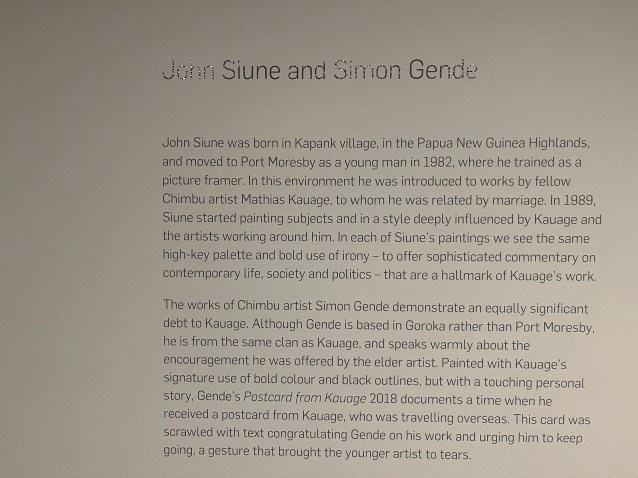
Detailed caption of two modern Papua New Guinea painters who have followed through from Mathias Kauage
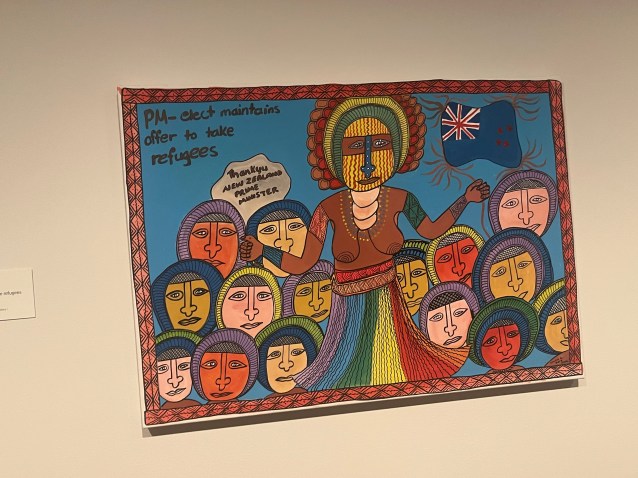
A painting celebrating the former New Zealand Premier welcoming refugees

The paintings don’t shy away from tackling political issues particularly on the red hot issue in the UK and Australia on asylum seekers and refugees. A particular striking picture praises Jacinda Arden accepting and helping refugees.

One wonders how the painters would portray Suella Braverman and Rishi Sunak -both brown British politicians deporting largely brown and black asylum seekers from the shores of the UK. Perhaps the UK’s leading art gallery Tate Britain should commission them to paint a series to counteract the baleful influence of Right wing Aussie politician Tony Abbott on stirring up hate and resentment in this country.

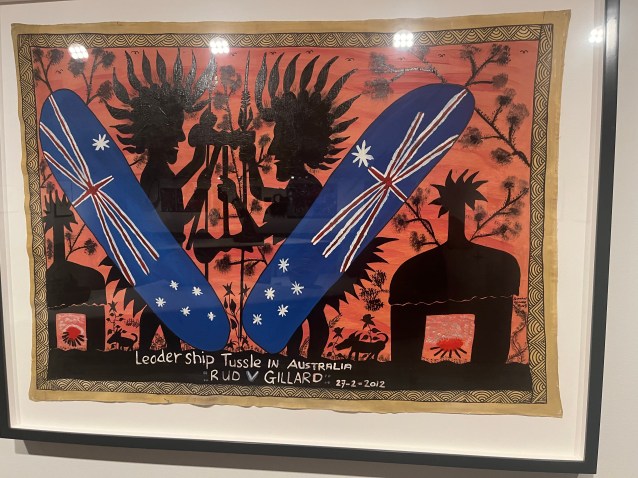
Dramatic portrayal of the 2012 Australian general election struggle

Two other striking paintings by the group stand out. One is a painting of the Left v Right Australian general election where the combatants are portrayed as Aboriginal chiefs.

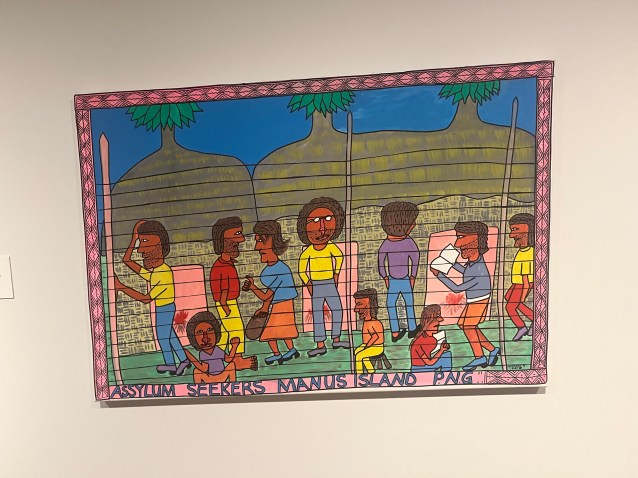
Another is of refugees kept in a holding camp in Papua New Guinea similar to the UK plan for one in France.

Australia’s harsh holding camp for migrants and asylum seekers

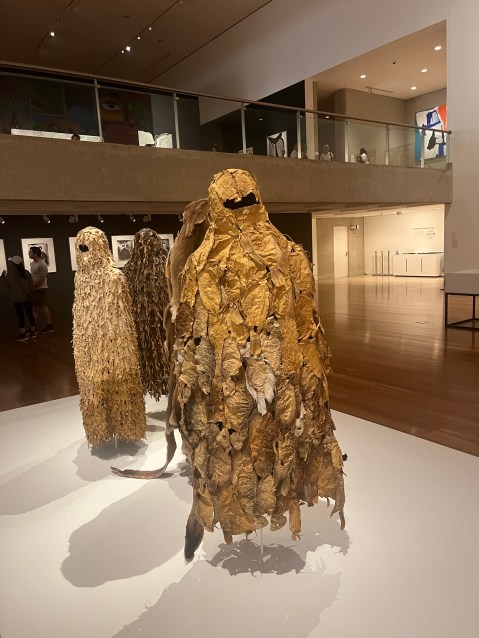
Two other striking exhibits in-the exhibition including a remarkable sculpture representing people literally getting under other peoples skins and an amazing collage by an Iranian born artist now living in America using decorative images used by Pakistani lorry drivers to beautify their vehicles .

a striking exhibit using different skins
Amazing collage by an Iranian painter

The growing scandal of the multi billion pound payments owed to pensioners and claimants by the DWP

Readers of my blog will be familiar with the scandalous story of the billions owed to 50s born women who both suffered maladministration and direct discrimination over the raising of the pension age from 60 to 66.

But what has emerged over the past year appears to show that this is part of a pattern where pensioners and disabled people are frankly swindled out of their money by the incompetence, maladministration and meanness of top management and politicians who run the Department for Work and Pensions.

Far from the 50swomen being an isolated case where mistakes were made those at the top of the DWP administration appear to have a playbook to deprive people of their rightful pensions and benefits, especially if they happen to be women. Nearly all the cases hit women much worse than men and as I have highlighted before – men have had privileges denied to women – such as the long running auto enrolment scheme that allowed men to have their national insurance contributions paid by the state from 60 to 65 while denying women any such privileges.

One of the worse cases which saved the state billions was a decision not to pay out extra pensions to people whose firms had contracted them out of Serps – an old style second pension- so they lost out of a Guaranteed Minimum Pension still payable in the public sector. A lot will have been women

The blog I wrote on this – despite being fiendishly complicated to explain- attracted over 15,000 hits – yet only two people got any compensation as the DWP made it difficult to claim.

Time to sign this petition

Christopher Thompson, a retired expert on this, has put up a petition to Parliament to protest about this and restore the indexation, but sadly only 311 people have signed. If everybody who read the blog signed it it would force the government to have to explain to Parliament why they did it. So please sign if you can.

Then there was the case of 237,000 pensioners – again a lot of them women – cheated out of £1.46 billion from their pensions – by miscalculations by the ministry raised by former pensions minister, Sir Steve Webb. The department is slowly trying reimburse them – some have decades of extra pension owed -but it will take at least to 2024 before it is completed.

Now Sir Steve has found another scandal which only affects women who should have received credits for looking after children from the late 70s. He has launched a campaign Mothers Missing Millions to try and get women’s pensions raised to make up the money – in one case a women was not credited with 14 years contributions.

And you have to add the scandal of the 118,000 disabled people put on a lower rather than benefit rate where the ministry has declined to compensate them – only giving money to the one person who complained to the Parliamentary Ombudsman. Even the Ombudsman has been silenced by the ministry who refuse to budge on this issue -leaving him appealling to MPs for help.

Time for an inquiry into the running of the DWP

What I am saying here is if you put all these cases together it is quite clear there is a pattern of underpayment and maladministration where the department do their best to avoid doing anything about it. It is without doubt discriminatory against women and suggests that ministers don’t want to pay them.

It is time women pressed all MPs to take up these issues. There is a strong case for an inquiry into the running of the DWP – there are too many cases for this to be just a coincidence.

Please donate to Westminster Confidential to allow me to continue my investigative work

One-Time
Monthly
Yearly

Make a one-time donation

Make a monthly donation

Make a yearly donation

Choose an amount

£5.00
£10.00
£20.00
£3.00
£9.00
£60.00
£3.00
£9.00
£60.00

Or enter a custom amount

£

Your contribution is appreciated.

Your contribution is appreciated.

Your contribution is appreciated.

DonateDonate monthlyDonate yearly
Please donate to Westminster Confidential

£10.00

Parliamentary Ombudsman’s plea to MPs to summon the DWP and the Environment Agency for failing to compensate people

Amanda Amroliwala chief executive of the PHSO

Rob Behrens, the Parliamentary Ombudsman, has asked the Commons Public Administration and Constitutional Affairs Committee (PACAC) to intervene on his behalf and summon the heads of the Department for Work and Pensions and the Environment Agency to appear before them to explain why they are ignoring his findings and refusing to compensate people.

The plea came during a hearing of the committee last week to examine the organisation’s progress and future plans to handle complaints. The committee also heard how the Ombudsman was hamstrung by the failure of the Cabinet Office to pass new legislation to give him greater powers and the latest progress in the 50swomen maladministration claim. More about this below. All these issues highlight weaknesses I have raised in previous blogs.

The DWP case involves 118,000 disabled people who suffered from years of benefit maladminstration . I wrote about this in August- see here. The complaint came from Ms U – via the London borough of Greenwich welfare rights office- who was put in the wrong lower category of the employment support allowance despite being in very poor physical and mental health with little or no savings The Ombudsman ordered the Department to pay her £7500 compensation and five years of arrears totalling £19,832.55 plus interest.

A National Audit Office investigation found that 118,000 people were in the same boat and should have been compensated alongside her following the Ombudsman’s ruling. But the DWP decided only to pay her and ignored everyone else. The pay out would have run to millions of pounds and the DWP decided it would ignore the Ombudsman because legally they can.

The second case involves one family but it is one of the most egregious cases I have heard in Whitehall. The case has been going on for 12 years and involves admitted maladministration by the Environment Agency over the issue of a water licence for a micro hydro project in Bradford on Avon, Wiltshire. The Earl family who renovated a tumbledown watermill to use for the scheme was supposed to receive substantial compensation decided by an independent assessor appointed by the Environment Agency. who bungled their case. The money owing could amount to £3m as interest has piled up and the EA has refused to follow through the Ombudsman’s finding for years.

John McDonnell MP

MPs also raised the issue of the Ombudsman’s lack of powers. John McDonnell, the former shadow chancellor and a Labour member of the committee, has tabled a question to the Cabinet Office asking why they have not introduced legislation to do this. The issue is raised in an earlier blog here.

Mr McDonnell asked Robert Behrens:”Can you explain the practical implications of the Government’s lack of support for legislative reform? How does that hold you back from adhering to the Venice principles, which the Government have signed up to ?”

He told him: “Two of my counterparts have the power of own-initiative investigation. In cases like Windrush, the maternity scandal in hospitals or the issues with mental health, we could go out and look at an issue without it being complained about. We could resolve that issue before it went to a long-standing independent or public inquiry. The peer review panel said that other ombudsman schemes in Europe use that and have used it in Covid to good effect.”

He went on: “If you have 16 public service ombudsmen in the United Kingdom, it means that people do not know where to go. It means the profile of my office and other offices is lower than it would otherwise be. That is not satisfactory in terms of being the only organisation in the public service that provides redress free of charge to citizens. That is very important.”

He added that he saw no reason why a government could not introduce a bill to do all this straight after the next general election.

MPs Question chief executive on 50swomen pension investigation

Amanda Amroliwala, chief executive of the Parliamentary Ombudsman, was closely questioned by three MPs, Ronnie Cowan, SNP, John McDonnell and Lloyd Russell-Moyle, both Labour, on the maladministration complaints over the delay in paying 3.6 million 1950s born women.

On Stage 2 of the report, which has already been leaked on this website see here, she said: “We have not
finalised that stage of the report yet. We are in the process of receiving and analysing the very extensive comments that we have had from the Department and from the complainants who have brought the complaints to us”

RONNIE Cowan, SNP MP for Inverclyde

Under further questioning she added: “We are looking at how those will need to change the
provisional views that are not yet public but that some individuals have had sight of. We will do that as soon as possible.” She would not commit a date for this report and the proposed remedy will be published except ” hopefully” between January and March next year. She was also quizzed on the level of compensation. Ronnie Cowan pointed out it could be anything from nothing to £10,000 but if it was maladministration only the top level was much less than £10,000 .She would not be drawn on how much this is likely to be.

John McDonnell reflected the frustration among MPs about the long delay in the Ombudsman producing a final report. “You can understand the scale of interest and concern there is amongst Members of Parliament. You will have seen that from the early-day motions. There is not an MP without a constituent who has been affected. The concern that people have is because of the age of many of our constituents. Some of them have already passed away. Others may not be here to receive any form of redress, if we delay beyond the next quarter of next year.”

There is another elephant in the room that was not discussed. If the DWP is refusing to pay 118,000 benefit claimants their compensation, why should they pay any of the 3.6 million 50swomen a penny beyond the six test cases who complained?

Please donate to Westminster Confidential to allow me to continue my reporting.

One-Time
Monthly
Yearly

Make a one-time donation

Make a monthly donation

Make a yearly donation

Choose an amount

£5.00
£10.00
£20.00
£3.00
£9.00
£60.00
£3.00
£9.00
£60.00

Or enter a custom amount

£

Your contribution is appreciated.

Your contribution is appreciated.

Your contribution is appreciated.

please donate to Westminster Confidential

£10.00

Updated Direct Discrimination: Former Judge Jocelynne Scutt’s report published on the 50swomen pension delay

Former judge Jocelynne Scutt today published her full report on the plight of 1950s women who have waited up to six years to get their delayed pension. As expected it provides copious arguments why the women have been cheated, why the 50swomen were the first group targeted and contains some heart rending cases. You can download the report here. It is a large file as the report runs to 155 pages including appendices.

Here is the entire speech by Jocelynne Scutt to MPs in Parliament this week. This explains the logic of her argument.

The full speech from Jocelynne Scutt to MPs

Some 3.8 million women suffered direct discrimination by the Tory government’s decision in 1995 to raise the pension age, of women to 65 and then 66, MPs and peers will be told at a briefing in Parliament today.

This is the main finding of a big report by Jocelynne Scutt, a former Australian judge who served on the Fiji bench and was Tasmania’s first Anti Discrimination Commissioner. She now teaches law at the University of Buckingham and is a member of both the Australian Labor Party and the British Labour Party and is a Labour councillor in Cambridge.

Her report followed a hearing by the CEDAWinLAW People’s Tribunal last July which specifically looked into the plight of 50sborn women where some of the women and Dr Elgun Safarov, vice chair of the UN Convention for the elimination of all forms of discrimination against women and girls (CEDAW) from Geneva, gave evidence. The UN committee is currently challenging the UK government to explain its failure to write the convention into UK law some 36 years after Margaret Thatcher ratified it.

The ruling in the report to be published in due course is much tougher than the case put forward by two members of BackTo60 in the court hearings following the judicial review. Then lawyers argued that the women had suffered indirect discrimination as their opportunities to pay contributions into the National Insurance fund, among other issues, to qualify for a full pension were not equal with men.

Jocelynne Scutt argues that this was not indirect discrimination but direct discrimination of a specific group of women who had been singled out to wait for their pension while everyone else was unaffected. It has also to be taken into account that 9.8 million men over 60 who decided not to claim unemployment benefit were given free auto-credits which ensured that nearly all got a full pension for life. It was going to be offered to women until 2018 but that idea was swiftly scrapped.

Every one of these women – many who have worked since the age of 15 as well as bringing up a family- was promised by the government when they started work that they could retire at 60 and planned to do so. And given the Department for Work and Pensions told the courts that it was not obliged under the 1995 Act to tell them personally this had changed – this only came in when men were affected by a rise in their retirement age.

Jocelynne Scutt has already delivered the report to Rishi Sunak at Downing Street. She argues that 50s women were treated unfavourably from the start. The 1995 decision did not affect any women born in the 1940s, targeted the 1950s women while those born in 1960s and 1970s onwards had much longer to adjust. The Parliamentary Ombudsman’s report agrees there was partial maladministration in that 50s women were not properly informed. In fact hardly anyone was properly informed until it all changed with men and women facing a rise in their pension age to 66.

Full restitution must be honoured – Jocelynne Scutt

Jocelynne Scutt says “Government and Parliament have a responsibility to face up to and acknowledge the grave wrong done. There is no room for obfuscation or quibbling. Historical discrimination requires relief. There is a moral imperative to right this wrong. The law is on the side of the 1950s-born women. 1950sborn women alone are the group targeted. This is a debt of law and honour. Full restitution is the only proper legal, ethical and moral outcome. Full restitution must be honoured.

The briefing is in the House of Commons at 2.0pm today.

Please donate to Westminster Confidential to allow me to continue my forensic reporting.

One-Time
Monthly
Yearly

Make a one-time donation

Make a monthly donation

Make a yearly donation

Choose an amount

£5.00
£10.00
£20.00
£3.00
£9.00
£60.00
£3.00
£9.00
£60.00

Or enter a custom amount

£

Your contribution is appreciated.

Your contribution is appreciated.

Your contribution is appreciated.

DonateDonate monthlyDonate yearly
Please donate to Westminster Confidential

£10.00

How the Tories keep our Parliamentary Ombudsman powerless – while telling the rest of the world they back the highest standards

Rob Behrens Parliamentary Ombudsman

A high powered peer review of the Parliamentary Ombudsman has exposed the hypocrisy and double standards of the present UK government towards people having the right to redress from bad and unfair public and NHS treatment.

The report released from an international panel of Ombudsmen , an academic and a UK housing ombudsman concludes with a polite but damning assessment of the failure of the government to keep its word to strengthen the Ombudsman’s powers. Members of the panel included both the Greek and Israeli Ombudsmen and a respected academic, Professor Robert Thomas, Professor of Public Law, University of Manchester.

The UK is a member of the Council of Europe Venice Commission which lays down what are known as the ” Venice Principles” – an international standard to guarantee the independence of the Ombudsman and the human rights of people to have direct access to the Ombudsman to make complaints about their treatment by public services.

The UK then co-sponsored a UN resolution incorporating these standards for the entire world – telling every country that Britain was in the lead on this issue.

But then under successive Tory governments of Boris Johnson, Elizabeth Truss and Rishi Sunak nothing has not only been done but ministers have taken active steps to thwart reform.

The most obvious example is Michael Gove, who used his power in the Cabinet Office, to block any bill-even a draft bill- coming before Parliament to the despair of the Commons Public Administration and Constitutional Affairs Committee (Pacac) which under a Tory MP wanted this to happen.

The situation is remarkably similar to the government’s attitude towards the UN Convention on the elimination of all discrimination against women and girls (CEDAW) which Margaret Thatcher ratified in 1986 and had still not been properly implemented 40 years on . This is now the subject of a review from the convention in Geneva which criticises the UK for not implementing it properly and is demanding answers.

The conclusions of the peer review couldn’t be clearer:

Professor Rob Thomas Pic credit: Administrative Justice Council

“The ‘Venice Principles’ lay down a set of international standards and principles on the protection and promotion of Ombudsman institutions. These have been accepted by the UK, as a member of the Venice Commission of the Council of Europe in 2019. They were also adopted by the UN in a motion co-sponsored by the UK Government in 2020.

” In several respects, PHSO’s legal framework complies with the ‘Venice Principles’, but not in other respects. PHSO’s statutory framework is now out of date and widely seen as being unnecessarily restrictive. PHSO is also out of line with other UK Ombudsman offices, which possess powers that PHSO does not.
“This means that citizens in some parts of the UK do not have the same rights as others. We are aware that reform of the Ombudsman is a long standing and unresolved issue, although it has become an increasingly urgent matter which makes the work of PHSO more difficult. PHSO is doing everything it can reasonably do to make the argument for reform. What is required is action from the UK Government and Parliament. Any reform must maintain PHSO’s direct reporting line into Parliament to preserve its absolute independence from Government.

Andreas Pottakis, Greek Ombudsman and President the International Ombudsman Institute -Europe

The report backs this up with a traffic light (red, amber, green) system of points where it measures the consistency and performance of the Ombudsman with the Venice principles.. Nearly all the red and amber points are caused by the failure of the government to legislate to strengthen the Ombudsman.

The government does not meet the principle that “Any individual or legal person, including NGOs, shall have the right to free, unhindered and free of charge access to the Ombudsman, and to file a complaint.” Instead a complaint has to be filtered by an MP or in the case of the NHS there has to be a “safe space” for administrators to look at the complaint before the Ombudsman can act.

There is no legal provision to protect whistleblowers who contact him. He, unlike his Welsh, Scottish and Northern Ireland Ombudsmen cannot initiate investigations. It is not clear whether he has full powers to force people to respond to him and certainly his recommendations don’t have to be followed by the government if he finds maladministration. There is not proper protection for his position by law and even the recruitment of a successor is limited, so not all people can apply.

Venice Principles give Ombudsman right to recommend changes to the law

The Venice Principles give him the right ” to have the power to present, in public, recommendations to Parliament or the Executive, including to amend legislation or to adopt new legislation” and this is definitely not allowed in England – otherwise he could go further on the case of the 50swomen who lost their pensions for up to six years.

Now you might think the Ombudsman would make a great deal out of this report to press the government to expand his powers or show up ministers for failing to keep their obligations to an international agreement they signed.

But the heading on his website is “World’s first official international ombudsman review finds UK service is robust and good value “. Yes the report does make good points about improvements in the running of the Ombudsman’s |Office but its fundamental objection is given muted coverage – buried down in the copy.

Further down the press release Rob Behrens, the Parliamentary Ombudsman, says: “The peer review rightly says that the UK is out-of-step with other modern Ombudsman services in terms of our statutory framework. Without powers of own initiative, I am hamstrung from investigating many systemic issues that no one is looking at. Legislative reform of the UK Ombudsman service would mean fewer barriers to justice and more opportunities to prevent injustice happening in the future.”

I think a more gutsy Ombudsman would fight his corner better -particularly as this government is on the back foot when it comes to defending decent public services and upholding standards in public life.

A more cynical explanation is that the government don’t want the public to have greater rights to complain as they are fearful of more bad administration and scandals coming to light But they want the rest of the world to think Britain is a beacon of good government in this area -knowing this is a lie.

Please donate to Westminster Confidential so I can probe reports like this and continue my forensic reporting.

One-Time
Monthly
Yearly

Make a one-time donation

Make a monthly donation

Make a yearly donation

Choose an amount

£5.00
£10.00
£20.00
£3.00
£9.00
£60.00
£3.00
£9.00
£60.00

Or enter a custom amount

£

Your contribution is appreciated.

Your contribution is appreciated.

Your contribution is appreciated.

DonateDonate monthlyDonate yearly
Please donate to Westminster Confidential

£10.00

Andreas I. Pottakis

Delivered to Downing Street: Jocelynne Scutt’s tribunal report on the horrors facing #50swomen who faced delayed pensions

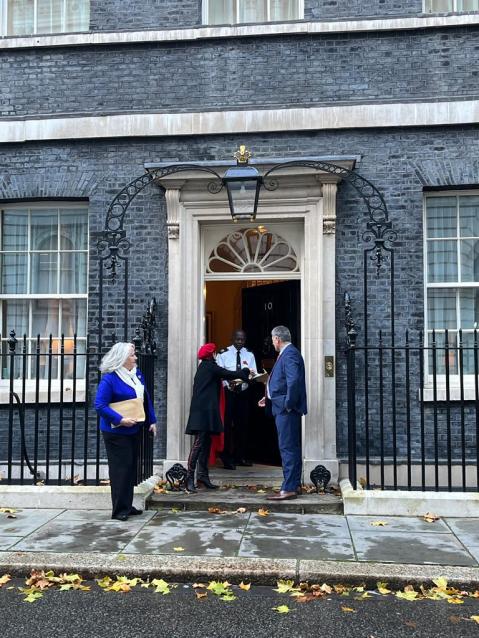
Jocelynne Scutt, president of the Convention for Ending all Discrimination Against Women (CEDAW) Tribunal, yesterday delivered her report on the plight of 50s born women to Rishi Sunak, the new Prime Minister, at Downing Street.

The report, to be officially published at the end of this month, is the latest move to press for full restitution for the women who had to wait 6 years to get their pension. It is timely reminder to the government which is about implement big tax rises and spending cuts that this issue will not go away for the 3.6 million people who lost out.

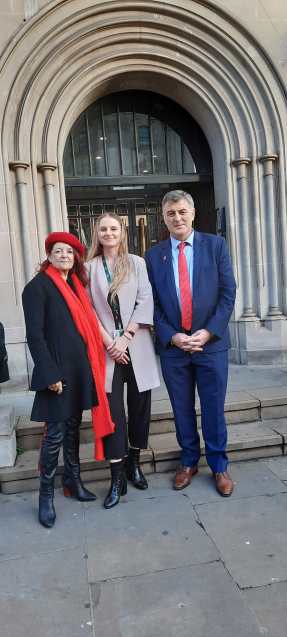
Jocelynne Scutt, President of the CEDAW Tribunal; Janet Chapman, Ian Byrne’s Parliamentary Assistant, and Ian Byrne, Labour MP for Liverpool, West Derby, who tabled a Parliamentary motion call for full restitution, pictured outside Parliament

Jocelynne Scutt gave a speech outlining the main issues and Ian Byrne wholeheartedly backing the campaign. See it on a video here.

Ian Byrne’s Parliamentary motion now has 75 signatures from MPs. The latest MPs to sign include more Labour MPs such as Qureshi Yasmin, Bolton, South East; Karl Turner, Kingston-upon-Hull, East: Dan Jarvis, Barnsley Central; and Khalid Mahmood, Birmingham, Perry Barr and Clive Betts, Sheffield South East.

Liberal Democrat transport spokesperson, Wera Hobhouse and MP for Bath is the first member of the party to sign.

The issue is very popular in Northern Ireland with all MPs in the Democratic Unionist Party signing plus a member from Social Democrat Labour Party and the Alliance. Eight MPs from Scottish National Party have signed and two from Alba Party. There are also a number of ex Labour MPs now Independents have signed, the latest being Dr Rupa Huq, MP for Ealing Central and South Acton.

It is noticeable that not a single Conservative MP has signed the new motion though many signed the motion in the last Parliament calling for full restitution.

Please donate to Westminster Confidential to allow me to continue my forensic reporting and campaigning.

One-Time
Monthly
Yearly

Make a one-time donation

Make a monthly donation

Make a yearly donation

Choose an amount

£5.00
£10.00
£20.00
£3.00
£9.00
£60.00
£3.00
£9.00
£60.00

Or enter a custom amount

£

Your contribution is appreciated.

Your contribution is appreciated.

Your contribution is appreciated.

DonateDonate monthlyDonate yearly
Please donate to Westminster Confidential

£10.00

Pension Justice stalemate: WASPI and Backto60 step up rival campaigns just as the new Chancellor Jeremy Hunt plans new spending cuts

Jeremy Hunt, the new chancellor of the Exchequer

And a Parliamentary Petition is laid to change another pension injustice affecting millions

The chaotic and collapsing government of Liz Truss is facing rival demands to settle the long running dispute affecting 3.6 million 1950s born women demanding compensation for maladministration and inequality over the six year delay in paying their pension.

Ian Byrne, the Labour MP for Liverpool, West Derby, has tabled a motion supporting Backto60’s demand for full restitution of the lost money – up to £50,000 in some cases- payable through a special temporary Parliamentary measure – to avoid changing the 1995 Pensions Act which set the higher retirement age for women.

Ian Byrne MP

Some 35 MPs have backed him including the former Labour shadow chancellor, John McDonnell, who got Labour to back a £58 billion compensation package in the 2019 election campaign; former Labour leader, Jeremy Corbyn and host of other Labour MPs, including Ian Lavery, Tony Lloyd, Mike Amesbury, Richard Burgon and Clive Lewis. It is also supported by Alison Thewlis, the SNP Treasury spokesperson and Chris Stephens, SNP Fair Work and Employment spokesman. Two members of the Democratic Unionist Party, Jim Shannon and Gregory Campbell, also backed the motion. The full list is here.

Chloe Smith, work and pensions secretary

The initiative from Waspi involves getting its members to send a template letter to their MP asking them to back their version of compensation for 50s women. For avoidance of any doubt here is the full text which would be sent to Chloe Smith, the new work and pensions secretary.

Chloe Smith MP

Secretary of State

Department for Work and Pensions

Caxton House

Tothill St

London, SW1H 9NA

XX October 2022

Congratulations on your appointment as Secretary of State!

I write in the hope that you may be able to ‘reset’ the government’s relationship with the Women Against State Pension Inequality (WASPI) campaign, whom I met during the Summer Recess.

Parliamentary answers (see UIN14559) confirm that no Minister in your department has met the campaign since 2016, which is something I am hoping that you and colleagues will be prepared to put right.

As you will know, last year the Parliamentary and Health Service Ombudsman has found that the Department was guilty of maladministration, in failing to communicate significant changes to the State Pension Age, which were legislated for in 1995.  Specifically, the PHSO has concluded “the opportunity that additional notice would have given them to adjust their retirement plans was lost…DWP failed to take adequate account of the need for targeted and individually tailored information… Despite having identified there was more it could do, it failed to provide the public with as full information as possible.

While the PHSO is continuing to investigate the harm caused to women born in the 1950s, as a result of this maladministration, CEO Amanda Amroliwala has also made clear that the government need not wait for further reports before making an offer of compensation.  In a letter to our parliamentary colleague, Andrew Gwynne, she said, “We must now consider the impact of these failings on the women affected and what recommendations may be needed to remedy any associated injustice. We have suggested to the Department for Work and Pensions that they consider being proactive in this respect”.

Meanwhile, WASPI have recently commissioned research which establishes that, by the end of this year, 220,000 women will have died waiting for compensation since their campaign began in 2015.  Sadly, another woman dies every 14 minutes.

I have been struck during my conversations with the campaigners that they are therefore extremely pragmatic about achieving a resolution quickly.  They are not looking for a long fight with the government, preferring to accept a fair, fast one-off sum for those whose retirements have been devastated by mistakes made at DWP.  Specifically, they are not looking to receive ‘lost’ pension amounts, but rather to be compensated for the maladministration at DWP, which caused them to take decisions they might not otherwise have taken, had they been given proper notice of changes to the law.  Quite sensibly, they are suggesting higher levels of compensation for those given the shortest notice of the longest delay to receipt of their State Pension.

They have been through four stages of complaint at DWP and now face two further stages of the PHSO process.  All the while more of the women affected die waiting, so they are keen to see the proactivity suggested by the PHSO from your department.

Would you prepared to meet with me and with Angela Madden, the Chair of the campaign, together – both so that you can understand the (surprisingly reasonable and pragmatic) position of the campaign, and that they can hear directly from you?

While both they and I recognise that you could not make immediate commitments in any such meeting, I do believe it would be helpful to open a dialogue now rather than have the group getting more and more frustrated that government will not talk to them.  The PHSO’s ongoing investigation is not a reason to postpone discussion, since the substance of maladministration has already been confirmed.

At some point, government (of whichever political stripe) is going to be required by the Ombudsman to make an offer of compensation, so it makes sense to begin the conversation now rather than brooking further delay, during which time – sadly – more and more of the affected women will pass away.

WASPI want compensation for maladministration and nothing for restitution

The letter is a massive reduction on the demands made by the MPs. For a start they want NO rather than FULL restitution for the up to £50,000 lost by 3.6million pensioners. Instead they want an unspecified payment before the Ombudsman decides what level of compensation for maladministration. There is no mention of the £10,000 to £20,000 a head compensation promised by Angela Madden to the 50 people attending the Labour Party fringe meeting last month.

There also is a misconception that the Department for Work and Pensions is required by the Ombudsman to meet them after he has issued his report. This is not true the Ombudsman has no power to require anybody to follow his decisions – as has been shown ( see below) in another case where millions of pensioners have been cheated out of a Guaranteed Minimum Pension also promised in the 1990s.

Finally the letter speaking for the 3.6 million people say they are “reasonable and extremely pragmatic people” quite happy to accept a fast buck settlement of few quid to end this dispute. This is not reflected in the comments I receive on this site.. People are livid, angry, despairing of politicians and feel deliberately cheated by the Establishment of what they see rightly as their dues. They are fed up about being thought to be a soft touch just because they are older women. They are prepared to take on the government and refuse to vote for any politician determined to deprive them of their lost pensions.

New petition on Guaranteed Minimum Pensions

Meanwhile a Parliamentary petition has been tabled by Chris Thompson, a retired pensions expert, to restore indexation for a guaranteed minimum state pension for people outside the public sector.

“I want the Government to change the law to reinstate uprating of state pensions in respect of contracted out occupational pensions known as Guaranteed Minimum Pensions (GMP).

“I believe it is not fair that the DWP ceased to uprate state pensions in respect of certain pension entitlements when the new state pension was introduced. I believe this with done without adequate consultation or notice, and should be reversed. “Sign this petition

This followed a victory for two people after they complained of maladministration ( sounds familiar) by the DWP in not informing them of the change depriving them of indexation when the new pension came into force. The Ombudsman laid down what the DWP should to inform people of their rights, but the DWP has not followed this through properly and refused to engaged with anyone. Over a lifetime this could be worth thousands of pounds of lost pensions – and I urge 50swomen to sign this to put more pressure on the DWP. You might be entitled to extra compensation as well as your claim for your lost pensions.

Finally I don’t like to be the harbinger of bad news -but the total disaster of Liz Truss’s government – means we are now going to be faced with a further two years of austerity after she wrecked the British economy.

Sadly this will mean that the government will be extremely reluctant to compensate other people on top of subsidising people’s energy bills and introducing measures to balance the books. I see Angela Madden has managed to get a meeting with former Tory leadership candidate Penny Mordaunt, the current leader of the Commons, who appears to be involved in a plot to topple Truss with Rishi Sunak. The trouble is it is the DWP who are the ministry who will decide this – and they have just been asked by Jeremy Hunt to impose more cuts on top of long term savings to sack 91,000 civil servants across Whitehall. I can’t see them having any interest in settling this at the moment.

One bright spot will be a report by Australian judge Jocelynne Scutt is expected to pull together all the injustices in this case following the tribunal earlier this year. The report is imminent.

Please donate to Westminster Confidential to allow me to continue my forensic reporting

One-Time
Monthly
Yearly

Make a one-time donation

Make a monthly donation

Make a yearly donation

Choose an amount

£5.00
£10.00
£20.00
£3.00
£9.00
£60.00
£3.00
£9.00
£60.00

Or enter a custom amount

£

Your contribution is appreciated.

Your contribution is appreciated.

Your contribution is appreciated.

DonateDonate monthlyDonate yearly
Please donate to Westminster Confidential

£10.00

That confidential Ombudsman’s report on 50swomen pensions summary in full: For the benefit of all WASPI members

Rob Behrens, Parliamentary Ombudsman

My reporting and coverage of the confidential provisional Parliamentary Ombudsman’s Report into the maladministration has caused considerable controversy particularly among the people at the top of Waspi. People who follow me on Backto60 have been very grateful for keeping them informed. People on Waspi have objected to me publishing it at all and have kept their members in the dark about its contents. Robert Behrens, the Parliamentary Ombudsman, is constrained by law from publishing it while his investigation continues. People at the top of Waspi have accused me of only publishing snippets which undermine Waspi’s case.

To dispel any doubts here is the full summary of his findings (the report is 298 paragraphs long) – though there is a link in a comment on my previous blog to the full report in the comments section. You can see the Ombudsman makes it clear that maladministration over a 28 month period ” caused complainants unnecessary stress and anxiety and meant an opportunity to lessen their distress was lost.  For some complainants, it also caused unnecessary worry and confusion.” But it rejects that ” this maladministration led to the financial losses complainants claim.”

In other words it has no intention of compensating people who have lost up to £50,000 through the changes or anywhere near this. Need I say more. Here is the summary.

Provisional views

Reference: SPA (stage 2) Complained about:           Department for Work and Pensions                           Independent Case Examiner

The issues we are considering and our provisional views

  1. In July 2021 we issued the report for stage one of our investigation into complaints about the adequacy of DWP’s communication of changes to State Pension age, and associated issues.  We found that maladministration led to a delay in DWP writing directly to women about changes to their State Pension age. 
  • We are now working on stage two of our investigation.  This stage is considering complaints about:
  • DWP’s communication of changes to the number of qualifying years National Insurance contributions required for a full State Pension
    • DWP’s complaint handling
    • the Independent Case Examiner’s (ICE’s) handling of complaints about DWP’s communication of State Pension age changes.  
  • It is also considering the impact of any failings by DWP and ICE, including the injustice arising from the maladministration identified during stage one of our investigation.   
  • This document sets out:
  • a summary of our provisional views
    • the evidence we are considering
    • our analysis so far of DWP’s communication of changes to National

Insurance qualifying years, including o background 

  • what should have happened – the relevant standards 
    • what did happen o our provisional views
    • our analysis so far of DWP’s and ICE’s complaint handling, including o what should have happened – the relevant standards
      • what did happen o our provisional views

our analysis so far of injustice

Summary of our provisional views

  • The evidence we have seen so far suggests timely and accurate information was available about the change in eligibility criteria for a State Pension, including how someone’s National Insurance record links to how much State Pension they can claim once they reach State Pension age.  Research showed the majority of people knew about the changes.
  • However, research also showed that too many people did not understand their own situations and how State Pension reform affected them.  The gap between awareness and understanding was highlighted by the Work and Pensions Committee and the National Audit Office. DWP does not appear to have used research and feedback to improve its service and performance.  In this respect, DWP does not seem to have demonstrated principles of good administration.  We think that was maladministration. However, we do not think this maladministration led to the financial losses complainants claim.
  • Before 2016, people built up ‘qualifying years’ towards a Basic State Pension by paying National Insurance or through, for example, receiving benefits credits towards their National Insurance record.  Some people paid National Insurance to build up entitlement to an earnings-related State Pension on top of the Basic State Pension.  The earnings-related State Pension was called the Additional State Pension.  
  • Not everyone paid National Insurance towards the Additional State Pension.  Some people who joined personal or occupational pension schemes ‘contracted out’ of the Additional State Pension when they joined those schemes. While they continued to build up qualifying years for a Basic State Pension, they gave up their entitlement to the Additional State Pension. So, a person who had always contracted out would have been entitled to the Basic State Pension and their personal or occupational pension when they reached State Pension age, instead of being entitled to the Basic State Pension and Additional State Pension.
  • From April 2016, the new State Pension replaced the Basic State Pension and the Additional State Pension.  The full rate of the new State Pension is higher than the full rate of the old Basic State Pension.  People who were contracted out of the Additional State Pension before April 2016 but have reached or will reach State Pension age after April 2016 may not be eligible for the full rate of new State Pension.  A ‘contracted out deduction’ is made when calculating their starting amount of new State Pension to reflect the fact they contributed less into the National Insurance system in return for a personal or occupational pension. 
  1. Transitional arrangements introduced with the new State Pension mean that none of the complainants – or people like them – will get less State Pension under the ‘new’ rules introduced in April 2016 than they would have got under the ‘old’ ones.  DWP compares what they would have been entitled to under the old system and what they are entitled to under the new system, and they get the higher of these amounts.  The transitional arrangements also allow them to do things to add to their starting amount of new State Pension if it is lower than the full rate.  Having considered the complainants’ individual circumstances, we do not think they have lost any opportunities to add to their starting amount. 
  1. We also do not think maladministration in DWP’s communication of changes to State Pension age more likely than not led to all the financial, health, domestic and emotional consequences complainants claim. Complainants told us they made choices they would not have made if they had known their State Pension age had changed, and described the financial, family and health consequences those choices have had.  However, some of their choices had already been made by the time DWP should have written to them about changes resulting from the 1995 Pensions Act.  We do not think women lost opportunities to make different decisions, if those decisions had already been made by the time DWP should have written to them.
  1. However, we think an additional 28 months’ notice would have given complainants opportunities to consider, for example, saving, looking for work or changing job.  While there is too much we cannot now know for us to be able say what would have happened, it seems that some women are left not knowing whether they could have been in a different financial position, and whether they could have avoided the health and emotional consequences they claim.  We think that not knowing is an injustice resulting from maladministration in DWP’s communication about State Pension age.
  1. We also think the anger and outrage complainants feel about not having as much notice of their State Pension age as they should have, could have been avoided if DWP had written to them when it should have.  Their sense of anger and outrage is a further injustice resulting from maladministration in DWP’s communication about State Pension age.
  1. We think some aspects of DWP’s complaint handling reflected applicable standards.  But, DWP does not appear to have adequately investigated or responded to the complaints it was considering, or avoided unnecessary delay.  In these respects, DWP does not seem to have demonstrated principles of good complaint handling.  We think that was also maladministration. 
  1. We think maladministration in DWP’s complaint handling caused complainants unnecessary stress and anxiety and meant an opportunity to lessen their distress was lost.  For some complainants, it also caused unnecessary worry and confusion.
  1. We think ICE’s complaint handling reflected applicable standards and guidance.  ICE appears to have acted within the scope of its remit, which is set out in its contract with DWP. We note, however, our view that the contract meant ICE could not address complainants’ key concern that they did not have as much personal notice of changes to their State Pension age as they should have.
  1. Finally, we think ICE should have said that it could not determine whether or not DWP had written to individual complainants who said they had never received a letter about their State Pension age, instead of telling them it was more likely than not they had been sent a letter.  But even if ICE had appropriately balanced the evidence in this way, we do not think the shortcoming in its handling of this issue was significant enough to be a failure to ‘get it right’.

Please donate to Westminster Confidential to allow me to continue my forensic reporting and investigations.

One-Time
Monthly
Yearly

Make a one-time donation

Make a monthly donation

Make a yearly donation

Choose an amount

£5.00
£10.00
£20.00
£3.00
£9.00
£60.00
£3.00
£9.00
£60.00

Or enter a custom amount

£

Your contribution is appreciated.

Your contribution is appreciated.

Your contribution is appreciated.

DonateDonate monthlyDonate yearly

Please donate to Westminster Confidential

£10.00