I don’t usually run appeals for money on my blog but I am making an exception in this case because of the huge injustice in the employment tribunal system that allows some judges to insult, berate and patronise women who come before them.
if you want to donate this is the link. DO NOT CLICK ON THE YELLOW BUTTON ON TOP OF THE PAGE WHERE IT SAYS DONATE – as this will go to the general fund for the Good Law Project and not to the women. INSTEAD SCROLL DOWN AND CLICK ON DONATE BY CARD.
To do so they have to get a judicial review against the Judicial Conduct Investigation Office which is both refusing to investigate their complaints and ironically believes it is above our freedom of information laws so it doesn’t have to answer any questions from the press or the public on simple facts like how many complaints there have been against judges. This view is not shared by the Information Commissioner who ruled it should comply with FOI but the Ministry of Justice is planning to appeal this decision.
The case the women want to bring is not just against the bullying Judge Philip Lancaster – but against the whole employment tribunal system which doesn’t allow access to judges’ notes and does not produce court records for all cases and even when it does makes sure it is very expensive to get hold of them.
The women’s case has been taken up by the Good Law Project but the women still have to raise some £13,OOO to cover legal opinions. So far they have raised just over £5000. The case was covered by me in Byline Times here. Now it has been taken up by the BBC programme Look North.
You can see their report below.
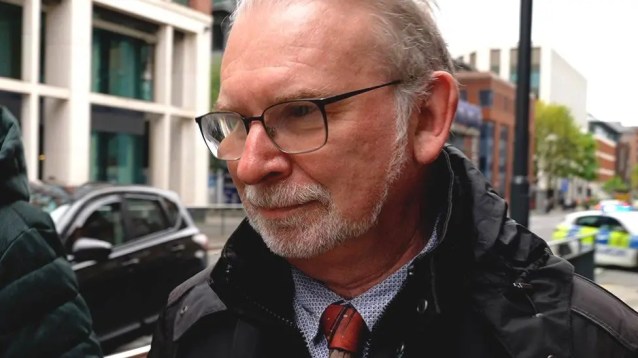
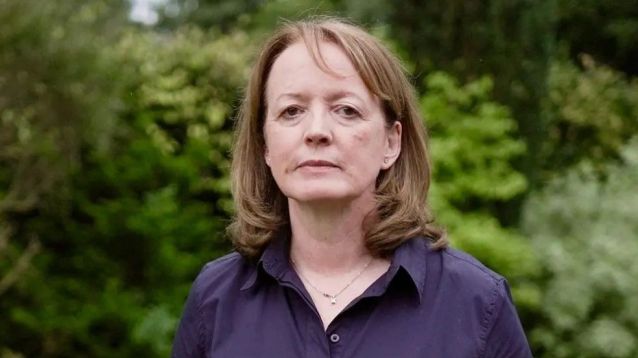
BBC Look North coverage of the complaints against Judge Lancaster with interviews with Alison McDermott and Dr Hinaa Toheed.
The treatment of management and diversity consultant Alison Mcdermott, by Sellafield who spent £750,000 on top flight lawyers to oppose her claim at an employment tribunal presided over by judge Lancaster led to her local MP Anna Dixon to request an apology from Sellafield’s chief Euan Hutton at a recent Parliamentary hearing. None was forthcoming. Dr Hinnha Toheed, a GP, tells how she was shouted at 16 times by Judge Lancaster during a maternity discrimination hearing She says: “Judge Lancaster shouted at me 16 times, called my case an “omnishambles” before we had even begun, and showed open bias and contempt throughout the hearing. The experience was devastating. My barrister formally documented his behaviour and submitted a written statement to support my complaint. Yet despite this evidence, the system protected him — and he remains in post to this day.”
She is one of two doctors and a nurse who have put in complaints about Judge Lancaster.
These women need support to get to the position of bringing a judicial review because of the enormous cost of doing so – another barrier against people being able to challenge the judiciary. Their legal team include Emily Soothill of Deighton Pierce Glynn, Dr. Charlotte Proudman, and a prominent King’s Counsel have agreed to capped fees. But they need this money to be able to pay for this advice – and that is why there is a need for this crowdfunder.
II have chosen not to call for any donations for my site on this blog so the money can go direct to the women.
Last week Salford City Radio’s Ian Rothwell devoted a whole programme to the CedawinLaw case for mediation to solve the impasse of compensation for the 50swomen who faced a six year delay in getting their pension. Three speakers discussed the issues. Jocelynne Scutt, a former Australian judge and anti discrimination commissioner for Tasmania, gave an update description of the present legal position and how you do not have to court to start a mediation process. Janice Chapman ,a 1950s woman, gives a heart rending account of how women have already been discriminated against before they got their pension and then had to wait six more years before they could get it and how alternatives to work longer are often not possible. I give an interview questioning the wisdom of Waspi’s legal case for partial maladministration and how the All Party Group on State Pension Equality is moving towards insisting that all groups campaign together rather than the division between Waspi and all the other groups which has bedeviled the issue for years.
This blog arose from the recent case highlighted by the Health Services Journal of Dr Susan Gilby, the former chief executive of the Countess of Chester hospital in giving evidence to the Thirlwell Inquiry about the resistance from senior NHS people she faced trying to admit mistakesthere. This is the hospital where a nurse Lucy Letby was found guilty of murdering seven babies and is now trying to get the case reconsidered. The CEO ultimately left the trust in late 2021, shortly after Letby’s trial began. An employment tribunal this month found she had been unfairly forced out by the trust and Mr Ian Haythornthwaite, the former chairman because she had raised concerns about his bullying behaviour. He resigned after the verdict.
Dr Susan Gilby Pic credit: BBC
Dr Susan Gilby is brave. Her experience is in keeping with many others who have raised concerns including patient safety issues. Dr David Drew’s comments ( See HSJ 08.44, 25 Feb) are spot on: the whole play book is sanctioned from above (NHSE and probably higher). Some colleagues and I have spoken to NHSE on several occasions (including in person, at Wellington House, SE London). We have nothing to show for it other than placations and weaselly words. Action, there is none.
Regarding NDAs (anon HSJ 13.39) in relation to healthcare and the NHS, they should be banned. They are “lawful” means of concealing (potentially very important) evidence which therefore cannot be tested in court. That’s the raison d’être of NDAs, isn’t it? And this is England, in the 21st century! And yes, Sir Robert Francis tried but was evidently misguided (see his 290 odd recommendations!). Jeremy Hunt did nothing to improve the “status” of NHS whistleblowers; if anything he made it worse by ignoring the problem and trying to belittle them.
On the Lucy Letby case there are now several authoritative sources seriously questioning the safety of the judgment (see Google). Let us hope that these processes will be allowed to evolve openly and unhindered.
It is high time the NHS leadership, politicians (West Streeting MP, SoS Health, are you listening?) reviewed the whole process of the treatment of NHS whistleblowers (they are “canaries in the coal mine”, right?).
If Trusts were banned from dismissing a doctor (or any Healthcare worker) who has “blown the whistle” or raised patient-safety issues (not “because” they have raised those concerns as that is banned by PIDA) it would save £millions. It would avoid hugely expensive law firms (of course taxpayer funded in the rôle of defending a Trust), Employment Tribunals and all the disastrous personal and professional consequences these Tribunals’ ill-considered decisions may lead to. Another consequence would be to eliminate the unfair and unnecessary loss of competent and sorely needed highly skilled doctors, (see Dr Chris Day’s case, Health Service Journal and elsewhere – its beyond belief but true). Training a doctor takes years, dismissing them takes minutes.
Employment tribunal system unaccountable
The Employment Tribunal system is unaccountable (well, if it is, it is to another branch of the judiciary, the Employment Appeal Tribunal process; marking one’s own homework?). It is heavily biased and has no place evaluating or investigating “patient safety issues” which it doesn’t understand. Neither does it understand the modus operandi of the NHS and medical matters (I won’t rehearse those arguments here – but for a start no offences have been committed and no laws broken by raising safety issues). In fact, raising safety concerns is not only strongly encouraged by professional medical bodies, but also part of a doctor’s code of conduct.
Internal management of “whistleblowing” matters are unregulated and unsupervised by an independent body. They are akin to “marking your own homework” because they are directed by the Trust CEO and perhaps some “chums” who can be relied on to give a favourable opinion. This is hardly appropriate, is it? WB may lose their jobs, their careers, £0000’s. Their professional and personal lives may be destroyed all in a process funded by the taxpayer. How is that “fair and open justice”? It is not!
The last thing a WB wants to do is go to an Employment Tribunal presided over by a “dodgy” ET Judge who delivers questionable judgments and pay “dodgy” law firms £000s for a <3% of winning (whatever “winning” means; if it comes it usually does so at the end of a spiral of losing first ET, appeal at EAT, lose EAT appeal. A “win’ may mean the case is referred back to the ET and round and round we go! This is the gist of things anyway. No wonder dismissed doctors are strongly advised (not by lawyers of course) to give the ET circus a miss, save their hard-earned money instead of paying extortionate fees to law firms and take the less stressful path of getting on with their lives. (NB The Tribunal step could be all but eliminated at a stroke by banning dismissal of a doctor who has raised patient safety issues).
If a Hospital Trust doctor raises patient safety concerns, history tell us they are very likely to suffer serious detriments in the form of restrictions, disciplinary hearings, pay cuts, referred for MHPS investigations concerning contrived allegations of incompetence or whatever, and suspensions as part of a vindictive reaction of Trust management who have (for some reason) taken offence. Instead, should they not be promptly investigating and correcting the shortcomings, how they were raised and by whom? If these adverse rill-informed reactions can be stopped there is hope for progress. One consultant, a colleague, was submitted to a flawed MHPS process (using an external agency) which supported the Trust’s claims of “incompetence” by alleging the doctor was not “fit-for-purpose”. (Further information provided upon request). As far as I know the confabulated charge of “not-fit-for-purpose” does not exist in (English) Employment law, but it was accepted without question by the Trust and the doctor was dismissed. As the saying goes, “You pays your money and you takes your choice”, (Aldous Huxley, Brave New World). The Trust had achieved its aim – to secure dismissal of a “difficult” doctor through what can only be described as a “corrupt” process. I asked people at NHS England if the charge of not “fit-for-purpose” was legitimate. NHSE claimed it was. I’ve searched online and checked with lawyers and found nothing to support its legitimacy. Ten years later that doctor is still fighting for their career. (And no doubt many others).
New laws and regulations to deal fairly with whistleblowing issues are URGENTLY required! The whole process is corrupt and in serious need of a profound and far-reaching review. The current system is ineffective but, more importantly, it is destructive.
A ground breaking decision by the Information Commissioner which would lead to the end of secrecy around the behaviour of judges will soon be tested in one of the highest tribunals in the country.
For years the Judicial Conduct Investigations Office, which, among other matters investigates complaints against judges, has claimed it is a private independent body which is not subject to the Freedom of Information Act, which covers the rest of Whitehall and the courts. It tells anyone who puts in a request that a reply will be discretionary and refuses to give the information.
And the Ministry of Justice, which is subject to the Freedom of Information Act, if asked the same information sidesteps the issue by saying it doesn’t hold the information.
Now John Edwards, the Information Commissioner, has blown the JCIO’s defence apart by saying it is a public body and like the rest of government should have to answer freedom of information requests.
Information Commissioner backing complainants
By doing so, he is backing at least two complainants who have taken their cases through tribunals plus numerous other people who have sought to get into the public domain how many judges are subject to complaints. The whole matter is going to be settled in an appeal to the Upper Tier Tribunal after a judge ruled that the decision by the Information Commissioner has to be included in the proceedings.
The Ministry of Justice, on behalf of the JCIO, is seeking to squash the decision. No date has been fixed yet for the hearing.
The Information Commissioner’s says: “the Lord Chancellor and the Lord Chief Justice (now Lady Chief Justice)are jointly responsible for judicial discipline’. The JCIO, therefore supports not just the Lord Chief Justice but also the Lord Chancellor in relation to such matters.
“This highlights how the structure of the JO and JCIO is not simply to support the judiciary, with wider public functions included within its ambit. The Commissioner further notes that the Judicial Appointment and Conduct Ombudsman, the statutory office sitting at the head of the complaints process of which the JCIO is part, was added by parliament to the scope of FOIA. In the Commissioner’s view, it seems unlikely that it would have concluded that the operation of part of this process should fall in scope of FOIA, with others outside of it.”
“Based on the summary above, the Commissioner’s conclusion is that the JCIO is part of the JO, which, while operating at arms length in practice, is still part of the MOJ for the purposes of FOIA. In light of this, it is not necessary for the JO or JCIO to be listed separately in Schedule 1 FOIA for it to be within scope of the legislation.”
He adds:” Any information request made to the JCIO is effectively a request made to the MOJ and should be treated as such. This is important in order for the MOJ to carry out its functions under FOIA, and to enable individuals to exercise their statutory right to public information.”
Judge Philip Lancaster
The Information Commissioner’s decision is very important because of its context that judges are being protected by senior members of the judiciary from any scrutiny about their behaviour. The BBC and this blog have already reported that judge Philip Lancaster, an employment judge, has received as many as 12 complaints from women who have appeared before him that he is patronising, biased and rude towards female litigants. See my blog here.
Barry Clarke, President of the Employment Tribunals in England, steadfastly refuses to entertain any criticism of his judges thereby blocking any information about complaints. And Baroness Sue Carr, the Lady Chief Justice, appears to be equally protective.
So this ruling while not likely to see the naming of judges will be able to provide the context of just how many complaints there have been and upheld and show the scope of the problem.
From right to left Jocelynne Scutt, former Australian judge; Ian Byrne, Labour MP for Liverpool,West Derby and myself a journalist and a patron of CEDAWinLAW.
Waspi threaten further legal action and another judicial review
The present impasse over whether 50swomen should receive any compensation at all after ministers refused to pay must cease.
WASPI who relied on the Parliamentary Ombudsman’s weak findings of partial maladministration to get somewhere between £1000 and £3000 compensation for the 3.5 million women who suffered up to a six year delay in their pensions have been totally defeated and are having to restart from scratch.
CEDAWinLAW, formerly BackTo60, are now pressing to avoid further legal action and go straight to mediation with the government – hence the letter to the PM Sir Keir Starmer, the chancellor, Rachel Reeves and the work and pensions secretary, Liz Kendall.
The government is now facing a two pronged attack over the issue from two groups with different approaches but both are aiming to provide some compensation for the 50swomen.
The approach by CEDAWinLAW is much broader than WASPI which is only concerned with getting some recompense for the partial maladministration Sir Robert Behrens, the former Parliamentary Commissioner for Standards, made in his long drawn out findings even though he conceded that the women were not directly financially affected by their lack of knowledge.
CEDAWinLAW are putting forward a case that the women were both subject to discrimination by being the only group affected by the delay and by the fact that unlike men they did not have the opportunities to build up the numbers of years to get a full pensions by historic discriminatory measures such as being barred from making contributions.
CEDAW is also relying on two key points. The UK under Margaret Thatcher signed up to the UN Convention on the Elimination of All Forms of Discrimination against Women in 1986. This body is monitoring the UK’s progress in meeting the terms of the convention – and the issue of discrimination against 50s women is on their agenda in Geneva and will also be raised next month at a women’s conference on discrimination in New York.
Secondly the UK is moving domestically to accept that mediation is a better way of solving issues across the board rather than clogging up the courts with long running disputes. All this explained succinctly by Jocelynne Scutt, a former Australian judge and a women’s campaigner, in the video below
Now WASPI are planning to do the opposite and engage in a long war of attrition again in the courts against the DWP for throwing out any hope of compensation. Now having covered the long running judicial review by Backto60 from the initial hearing to the Court of Appeal ( the Supreme Court wouldn’t even hear it) this is committing their supporters to years of waiting and a huge financial burden running well into six figures to maintain the fight.
John Halford, head of public law and human rights, Bindmans. Pic credit: Bindmans website
The scale of the issue can be shown by the pre action letter sent to by John Halford of Bindman’s to the DWP. Not only is he is asking the ministry to cancel the decision they made not to compensate the women but he gets involved in a long convoluted argument into why the women should be paid and into the minutie of the detail of various surveys the ministry undertook to make his case.. Given the courts preference to look at precedents he will not be able to escape the DWP making references to the previous judicial review and using it to their advantage to quash such an action. The full text of his letter is reproduced below.
Now buried in this is a U turn by WASPI. The letter states it would like to explore an alternative disputes resolution to solve the problem. This is extraordinary about turn because only last year CEDAWinLAW put forward the same idea and invited WASPI to be an interested party. John Halford sent for all the papers and flatly rejected the approach. Not only that but presumably on the orders of Angela Madden, who runs the WASPI company, decided to side with the DWP against CEDAWinLAW if it came to court. Again the DWP could use it against them if they get a good lawyer.
In many ways this is a very sad tale as no agreement is possible between any of the groups fighting to get justice for the 3.5 million 50swomen. which in the short term will suit the DWP who can play off one group against another. There is also no real leadership from the All Party Parliamentary Group on State Pension Equality for Women led by Rebecca Long Bayley, MP for Salford, who describes herself as a wife, mother and proud Socialist, to bang heads together and go for the government over this.
In the meantime the cohort is starting to die out which will be very convenient for all those MPs and ministers whose inaction just prolongs any justice.
But in the long term this issue, the axing of the winter fuel allowance and what I hear is going to be the biggest assault on disabled people’s benefits in a generation will lose Labour its core support and pave the way for Nigel Farage to be our next Prime Minister.
Sir Brian Langstaff, chair of the infected blood inquiry
Lawyers representing thousands of haemophiliacs who unknowingly got hepatitis, HIV and Aids from blood transfusions provided by drug addicts and criminals in the United States in one of Britain’s biggest health scandals could be gagged from publicly criticising compensation payments.
A new draft contract proposed by the Infected Blood Compensation Authority (ICBA), the body set up by the government to pay out an estimated £11.8 billion by 2029 ,could take legal action for ” reputational damage” if lawyers publicly criticise the authority’s actions without their permission.
The ICBA, despite its name, is not a public body, but a private contractor to the Cabinet Office, so it intends to impose a standard contract on people who deal with it.
The draft clauses read;
15.7.1 not make any press announcement or other public statement or publicise the Contract or any part of it in any way, or make any public statement about the Scheme, without the prior written consent of the Buyer [the Cabinet Office] and must take all reasonable endeavours to ensure that Supplier Staff do not either; and
15.7.2 not (and must ensure its Subcontractors do not) embarrass the Buyer or IBCA or otherwise bring the Buyer or IBCA into disrepute or diminish trust placed in the Buyer or IBCA (“Reputational Damage”) by engaging in any act or omission which is reasonably likely to diminish the trust that the public or Scheme Applicantsplace in the Buyer and/or IBCAor impacts the reputation of the Buyerand/or IBCA,
This effectively amounts to a comprehensive “gagging clause”, specifically prohibiting lawyers from making “any press announcement or other public statement” about the scheme without prior Cabinet Office approval. Firms would also be required to ensure their staff comply with these restrictions.
The ICBA is seeking requirements that could compel law firms to take specific actions or make public statements at the IBCA’s direction to mitigate perceived reputational damage, regardless of whether any breach has occurred.
One law firm said; “On any basis this variation is unacceptable to us for professional, ethical and regulatory reasons. This firm is instructed by individual clients to provide individual, independent legal advice regarding the scheme and will continue to do so.”
The Haemophilia Society, which also supports victims, is consulting lawyers about what action it should take to counter these proposed restrictions.
The Cabinet Office has told people that these are standard clauses in procurement processes for private companies being paid taxpayers money, but that they are in conversations with IBCA but could not confirm the outcome.
The issue follows negative publicity over problems with interim compensation payments to people which generated criticism of the IBCA.
An IBCA spokesperson said:
“We are committed to supporting the infected blood community, and are working with legal providers currently to agree contracts that will provide support for those claiming.
“The legal providers are not restricted in the legal advice they deliver to people claiming compensation, and we provided amended terms to clarify this.
“We welcome an open discussion with all those who are impacted by infected blood, and those who represent them.”
Years of cover ups
Given the history of the infected blood scandal which dates back to the 1970s, culminating in the recent interim report by Sir Brian Langstaff, there have been years of cover -ups. People were never informed that their relatives were infected, there were attempts to use ” commercial confidentiality” to hide the source of the contamination, and this will not add to public trust or increase transparency.
So far £1 billion has been paid out in £100,000 interim payments and the IBCA is just starting to pay full compensation to other people.
Nick Thomas-Symonds, Minister for Cabinet Office, updated Parliament with IBCA’s latest compensation figures this week.
113 people have been invited to start their compensation claim
84 people have accepted their invitations and submitted their claim
23 offers of compensation have been made, totalling £34.4m
So far 14 people have accepted their offers with more than £13.3m paid in compensation
New laws will also be passed by the government extending payments to relatives of infected blood victims, which could lead to an extra 140,000 people claiming.
The new Labour government took until nearly Christmas to announce that it was not going to give the 3.5 million remaining 50s women a penny in compensation for their six year wait for a pension.
The result I am sad to say could have been predicted as both Labour and the Conservatives were determined from the start to avoid a pay out by delaying tactics and a refusal to discuss mediation.
It was left to MPs to continue the fight whose parties were either not in a position to pay out the money because they were not in government or didn’t have the power to pay out state pensions in the first place.
This is both a scandal and a tragedy for the women. They have been let down by ministers, the judiciary, civil servants,the Parliamentary Ombudsman, MPs, and even some of their own advocates, especially by bad decision making by WASPI, who took a route to secure compensation that was bound to fail.
Liz Kendall
Ministers have continually procrastinated over the pay out- either by claiming the Ombudsman’s report was so complex they had to study it in detail – the Tories under Mel Stride, then works and pensions secretary or Labour – under Liz Kendall, his Labour successor, that she needed more time..
The judiciary also played their part in delaying any decision and ignoring whether there had been discrimination against the women despite Margaret Thatcher signing up to the UN convention on the Elimination of All Forms of Discrimination Against Women in 1986. Only one judge, the Hon Justice Lang, a woman judge born in the 1950s, got the significance of the challenge facing this group of women by accepting all the issues raised by barristers Michael Mansfield and Catherine Rayner that it was age and sexual discrimination as well as maladministration. She understood the simple fact that although the decision was taken in 1995 to raise the women’s pension age to be equal with men, it was only now that the effects were being discovered.
The rest of the judiciary in the High Court and the Court of Appeal rejected this and the Supreme Court took the insulting decision that the case was out of time – having spent years already going through the court system.
Civil Servants in the Department for Work and Pensions were equally hostile – they didn’t believe in the women’s case, didn’t want to pay them and one senior civil servant went as far to accuse the women of committing fraud by wanting to claim.
The then Parliamentary Ombudsman.Sir Robert Behrens, produced a mouse of a report, reneged on his duty to make recommendations on the maladministration issue, leaving it to MPs knowing that ministers and civil servants were hostile to any payment.
Most MPs facing a prolonged lobbying campaign from WASPI, organised by Higginson Strategy, came behind the Ombudsman’s weak report and ignored the discrimination issue and later a proposal for mediation.
Making matters worse
To make matters worse the campaign for restitution was divided and split into various groups wanting different things and disagreeing over personalities. There was no united front. WASPI tried to control the agenda by focusing on maladministration. This was a false move as anybody would have known that the Parliamentary Ombudsman in the UK, unlike other countries, can be ignored by government and it cannot enforce its recommendations. So when the weakened report for partial maladministration came out, ministers knew they need not abide by it.
Why I supported Backto60 and CEDAWinLaw, is because they were prepared to put their money where their mouth was, did go to court and employed international experts to make their case, like Dr Jocelynne Scutt, a former Australian judge, to produce a well argued report showing that the case involved discrimination. What is appalling is that issue has been ignored by the national media who have airbrushed any mention of such a solution.
Later CEDAWinLAW moved to get mediation between the groups and the government – and invited everyone to joint them. WASPI looked at it and refused – I can only assume they don’t want any mediation to solve the issue.
Instead they are still flogging the dead horse of the Ombudsman’s Report – which the Government has already rejected- to MPs on the All Party group examining the issue and to the Commons works and pensions committee which is investigating the issue.
The result is I am afraid the women will still get nothing. Only by making a move for mediation will they get anywhere. And they will have to raise the money to force it through the courts as ministers don’t want to know. I know there is already an organisation prepared to act as mediators. What we need is the resolution of people to act or live forever without getting one penny out of the DWP.
Parliament’s watchdog, the National Audit Office, has qualified last year’s annual accounts of the Department for Business and Trade, for failing to providing accurate estimates of the money needed to compensate the Post Office victims of the Horizon scandal and overspending its budget by over £200m.
The disclosure is the latest blunder in the handling of the scandal where hundreds of postmasters were wrongly accused of fiddling their books and some spent time in prison for crimes they did not commit Instead there was a cover up by the Post Office when the computer system was at fault.
Gareth Davies, the head of the National Audit Office, who audited the ministry’s accounts, says the omission to provide Parliament with the correct figures and the £208m proposed overspend on the scheme amounted to a breach of the ministry’s spending limits and has been classified as irregular spending.
Kemi Badenoch. Pic credit: Gov uk
The decision to pay out compensation to the postmasters and quash their convictions happened when Kemi Badenoch, now the Tory Party leader, was business secretary. She was the sole shareholder of the Post Office under the present constitutional arrangement for running the business.
Last year the government set up compensation schemes for the postmasters – one to compensate them for the money they lost through the computer misrepresenting their accounts and another to compensate those who had been wrongly convicted.
What the accounts revealed is that the ministry did not hold enough data to properly estimate how much compensation it would have to pay out and put forward to MPs estimates to approve its spending that were not accurate – hence the overspend.
Under the first scheme the Horizon Shortfall Scheme (HSS), which is intended to support those who accounts were falsified by the computer system , Individuals who qualify can choose to either accept a fixed sum of £75,000 or opt for full assessment by an independent advisory panel.
The Post Office is inviting current and former postmasters to apply if they wish to but haven’t yet done so, as there will be a closing date for the scheme. It has advised the ministry that it anticipates a response rate of approximately 25-30% and that the majority of new claimants will accept the fixed sum offer. However, the auditors say due to the limited amount of available data on which to base this estimate, the eventual outcome could vary significantly.
Under the Horizon Conviction Redress Scheme (HCRS) intended to compensate individuals who had their convictions overturned. Because this scheme is in its early stages, there is limited data upon which to base an estimate of future settlement values.
But the ministry just assumed that the proportion of applicants who choose to accept the fixed sum offer (rather than submit a full claim for detailed assessment) will be similar to the take-up rate for those who had their convictions overturned by the court and are being compensated through the Overturned Conviction (OC) scheme; It also assumed that the average settlement value for those choosing not to accept the HCRS fixed sum award will be significantly lower than its equivalent estimate for OC claimants.
Neither of these propositions could prove to be accurate because the period for claiming compensation is not over. And by estimating an extra £208 million to be spent on the second scheme led to the ministry breaching its obligation to tell Parliament how much it intends to spend.
The Department for Business and Trade said:”This issue took place as a direct result of the decision to rightfully offer further redress to Horizon scandal victims, at a time when the high volume and complexity of claims meant there was significant uncertainty on the cost estimates.
“We have acknowledged this to the NAO and remained determined to ensure that all affected postmasters receive the financial address they deserve to right these historic wrongs’
A further £1.8 billion has been provided since these accounts were reported.
Hits on my blog jumped from 219,000 in 2023 to over 358,000 last year. This will be an underestimate because it does not include thousands of additional hits on Linked In, particularly where I highlighted bad practices in employment tribunals and hideous unjust treatment of whistleblowers by NHS trusts and other state and private organisations including Sellafield and a Network Rail contractor.
By far the biggest interest was in a blog I wrote on the decision by Rachel Reeves, the Chancellor, and Sir Keir Starmer, the PM, to abolish the winter fuel allowance for all people claiming the state pensions – leaving it only available to a rump of pensioners claiming pension credit. This attracted an astonishing 187,400 hits on the site plus nearly 20,000 on Facebook and Linked In and reflected the fury among pensioners and the shock that a Labour Government should target people earning little more than £11,300 a year as its first priority for cuts. The ineptitude of this decision is not likely to go away and both well off ministers are still oblivious of the damage they have caused. The blog is here.
Throughout the year there was continual interest in the plight of the 3.6 million 50swomen who faced up to a six year delay to get their pension with tens of thousands of hits on stories detailing every twist and turn of this sorry saga. The year ended with total defeat for the WASPI campaign, when Liz Kendall, the new Labour works and pensions secretary, blocked compensation payments to any of the women despite a partial maladministration ruling by a weak former Parliamentary Ombudsman, Sir Robert Behrens. An older blog showing how much successive government’s saved by cutting Treasury contributions to the NI fund got another 2,444 hits this year.
IF ministers think this is the end of the story they are sorely mistaken as the fight by CEDAWinLAW will continue this year since they have international backing and ministers could have to face a call for arbitration despite the suspension of a potential court case.
Dr Chris Day
The other big issue on this blog which attracted thousands of hits was the appalling treatment of whistleblowers particularly in the NHS. Trusts are spending hundreds of thousands of pounds employing expensive lawyers to hound and ruin the careers of doctors who expose patient safety issues which trust managers want to bury. By highlighting individual cases when they come before employment tribunals I am building up a bigger picture of injustice and even corruption in NHS trusts and exposing barristers and solicitors who are enhancing their careers and bank balances by pursuing consultants and doctors who are brave enough to stand up for patient safety in the NHS. These included last year cardiologist Dr Usha Prasad, obstetrician, Martyn Pitman; emergency doctor, Dr Chris Day plus nurses at the Lewisham and Greenwich NHS Trust. The latest Chris day blog is here
Alison McDermott
I also highlighted the on going scandal at Sellafield where whistleblower and management consultant, Alison McDermott exposed bullying and harassment which put nuclear safety at risk only to be pursued by expensive lawyers working on behalf of the management to silence and humiliate her. The behaviour of employment judge Philip Lancaster, who heard the case, is now under scrutiny as six women have brought complaints about his behaviour towards women claimants. The blog is here.
Northiam part of the site
One particular story which attracted interest was an in depth investigation into the running of a small parish council in East Sussex, Northiam, where a ruling clique of councillors harassed and pursued anybody raising questions about dubious practices that followed a loan of £1.4 million from Michael Gove, the former Tory levelling up secretary, to allow the council to purchase ta former Blue Cross animal sanctuary for the village. This now the subject of an investigation by the external auditor the council. It attracted over 10,200 hits – 8000 of them locally. The blog is here.
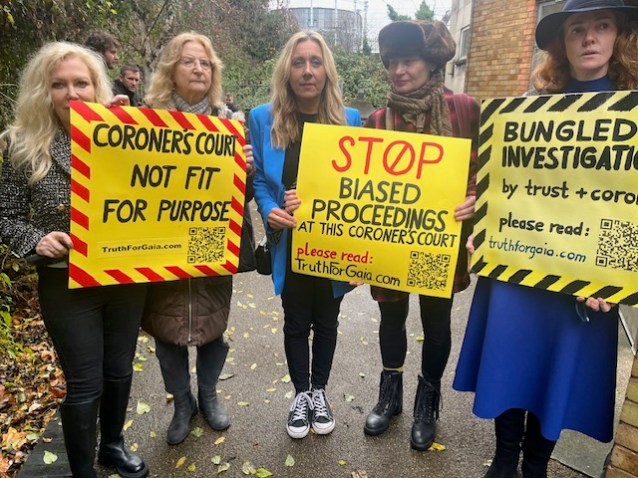
Protest outside Mary Hassell’s coroner’s court
Finally I turned my attention to the coroner service after one particular coroner, Mary Hassell, appeared to me to the cross a red line in her treatment of bereaved relatives who were either banned or censored from making statements at both her inquests. Both were heartbreaking cases- one involving a mother losing her only daughter 17 hours after being admitted to University College Hospital in London, the other involving the death of a TV journalist who had complained of domestic abuse by an ex partner who had a record of violence.the blogs are here and here.
Expect more investigations this year as I take up more cases.
Coroner Mary Hassell now facing bereaved members of two families unhappy about the way she conducts inquests
Teresa McMahon was a well liked news editor for ITV’s Granada Reports who had a first class honours degree in journalism and was based in Salford. From humble beginnings she was rated by colleagues as ” a highly competent news editor, who had worked on and overseen – some of the biggest news stories including the Manchester Arena terror attack, the coronavirus outbreak and Tyson Fury’s world heavyweight championship win.”
Over three years ago she was found hanged at her home in Little Holten, Salford and it took until last week for an inquest to be held. What emerged is that the police “investigation” into her death, the pathologist’s report and the conduct of the coroner who heard the case, Mary Hassell, fell well short of the professionalism and unbiased news values Teresa McMahon had practised during her life.
The hearing itself did not start for an hour after lawyers for Lorna McMahon requested an adjournment because she had not received all the documentation she needed, had no confidence in the robustness of the process and thought her rights to participate compromised procedures under Section 2 of the European Court of Human Rights legislation particularly in relation to domestic abuse.
Michael Etienne Pic credit: Garden Court Chambers
Her lawyer, Michael Etienne, from Garden Court Chambers, who acted pro bono, highlighted concerns that coroners did not pay enough attention as to whether domestic abuse by a partner or ex partner led to suicide and cited previous cases. He told the coroner ” the inquest will (or at else is very likely to) fall short in its primary duty to provide a full and fearless inquiry into these important matters.”
All this was rejected by Mary Hassell, the coroner who insisted she would conduct a frank and fearless inquiry.
The hearing had already been moved from Manchester West coroner’s court to Inner London because of a conflict of interest and concern about the involvement of Greater Manchester Police. A senior coroner had recused himself from hearing – hence the delay in hearing the case.
Mary Hassell ” suicide verdict” Pic credit: Archant
Mary Hassell decided that it was a suicide and ruled that there was no coercion or control by her ex partner Robert Chalmers that led to her death.
Mohammed Bashir – no ” Silent Witness” material
For her the star witness was Pathologist Dr Mohammed Bashir. He insisted that the ligature around her neck was consistent with hanging and not strangulation but he knew nothing about her complaint about domestic abuse and said there were no other marks on her body. Extraordinarily he had taken no photos when he examined the body and his evidence was partly contradicted by the policeman who went to the scene who noted bruises on her breast and biceps. Certainly Dr Bashir would not have qualified for a star role in ” Silent Witness.” He was no Dr Nikki Alexander and Lorna McMahon complained that the body had not been examined by a forensic pathologist.
This lax approach was compounded by the so called investigation by Greater Manchester Police. Detective Chief Inspector Gareth Humphries who arrived on the scene and immediately ruled out murder. She was already dead and it was Robert Chalmers, who snapped the cord. Her brother Bernard, who was also there, confirmed that Chalmers had done it by himself,
No pictures taken by pathologist or police
Extraordinarily again he did not take any pictures either and apologised to the coroner for not doing so. “Policy at the time was to take photos if you think there’s a crime. I did not think there was a crime at the time. I could have accessed the digital camera and I did not. I wish I had. If I had, you would have got photos for the answers you seek and I apologise that I did not.”
Instead he read her journal which he found in the bedroom where she expressed her loneliness, lack of contact with her daughter, and a list of complaints about the way her ex Robert Chalmers had treated her.
But only three weeks before this she made a complaint about domestic abuse to a police constable under Clare’s Law and was wrongly told that she had no right to find out whether he ex had convictions for violence. She then withdrew the complaint and police found that they had given her the wrong advice but could not contact her to tell her.
A lot of this came out during the hearing because of persistent questioning by Lorna McMahon not the coroner. She ended up being told off because the coroner did not think her hearing should be an inquiry into the police.
Her ex, Robert Chalmers, was supposed to give evidence but did not turn up. Mary Hassell issued an arrest warrant and he was taken by the police from his home to Bolton Coroner’s Court where he had to give evidence. He is a NHS estates manager working for the trust in Salford.
Her ex was nervous and unprepossessing
He emerged as a nervous, unprepossessing character, replying with monosyllabic answers and denying he was in any way responsible for her death. His only concession was that their relationship was ” volatile” – an under statement given neighbours had witnessed shouting, him being thrown out of her flat, and she tearfully sitting outside her house with her head in her hands. He also denied that he alone had snapped the cord contradicting her father’s statement.
Her father did not give evidence in person either but the coroner accepted a statement from him as he said he was to ill to attend. He painted a sad picture of his daughter being caught up in an alcohol fueled relationship with a man was not good enough for her. But it was also revealed that this man had been his best man at his wedding and he had known him for 25 years.
When his sister, Lorna, complained she could not question him, Mary Hassell accused her of preventing him coming because she had damaged his health by her attitude towards him. It was clear brother and sister did not get on but a coroner should be above that.
The final indignity was a decision by the coroner to first vet Lorna’s statement to the hearing and then ban most of its contents. Her reason was that coroner’s hearings were not a place where either side could try to influence a coroner’s verdict. To my mind this was preposterous. It was obvious that Mary Hassell was a very strong minded woman and the idea that anybody could influence her in any way was absurd. She may even have made up her mind before the full hearing.
I suspect the real reason is that she did not want any more criticism of Greater Manchester Police in public or more details about the behaviour of Teresa’s ex including his past, particularly as this hearing was well covered by the press and TV.
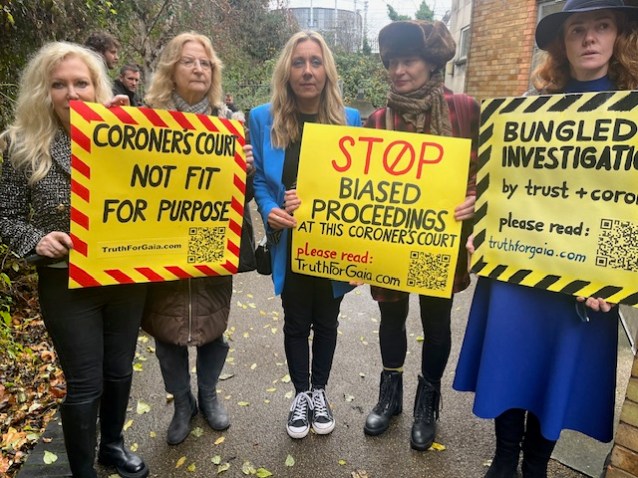
Lorna McMahon (far left) and Dorit Young ( second from right) demonstrate outside the coroner’s court
And it is not the first time she has silenced a bereaved relative. Lady Dorit Young was similarly treated over the death of her only daughter, Gaia. That is why there was a small demonstration outside the coroner’s court whereby Lady Young and her supporters and Lorna combined to protest. You can read about their case on https://truthforgaia.com/ and an earlier blog by me here.