Covid-19: How the year of the bus became the year of bust

Pic Credit: Wes Hicks – Unsplash

2020 was supposed to be the Year of the Bus. A newly elected Tory government promised £220m to improve services which had been in decline since 2010 when another newly elected Tory led government created the cuts.

The initiative ticked every election promise box. It was going to reverse service cuts – mainly in the shires as part of levelling up. It was going to produce a brilliant new demonstration package of co-ordinated bus and train services in Cornwall – one of the poorest areas of England. It was going to be green -promising the first total electric powered bus service in an English city. It was going to be faster with more dedicated bus lanes and expressways and it was going to be easily accessible by introducing a national data system for services and fares available on the internet.

Then came Covid 19. And as a new National Audit Office report revealed on Friday the bus plan crashed off the road.

unglamourous buses

Buses have never been a glamourous subject. As the NAO report shows they are mainly used by the poor, over 70s, the 17-21 age group before they get their own wheels and single women seeking a safe way home.

It also suffered huge service cuts and big fare rises for many of its passengers outside London. A useful map in the NAO report shows how passenger traffic has declined by an average of 10 per cent between 2010 and 2019 – falling highest in places like Tyne and Wear, Lancashire, Teesside, East Sussex and Lincolnshire but rising in Bristol and Brighton and Hove.

Pic credit: Suzy Hazelwood Pexels

Some 3000 routes have disappeared with bus mileage down from 243 million to 112 million and the average local authority support for services dropping 38 per cent with 42 authorities slashing expenditure by over 50 per cent. Some of the worst examples are West Yorkshire, Surrey and Northamptonshire. Average fares went up 18 per cent between 2010 and 2019.

free bus pass

The biggest cost to local authorities has been the free bus pass – now estimated at £650m a year – a national service – but funded by the local authority where you live. Funding from central government to bus operators has dropped from 31 per cent to 24 per cent between 2010 and 2019.

One of the problems is that since the de-regulation of services the government has had little control – so it can make a lot of noise about improving services – but it can’t force private operators to do it. The plan for a national data system for bus timetables and fares – depends on whether individual operators want to spend the money.

When Covid 19 hit the government was faced with a dilemma – only key workers were encouraged to use public transport – slashing revenue. The government did provide extra cash in tranches to bus companies to keep them going. But it also raided its shiny new support budget to improve services.

The plan for a co-ordinated Cornwall transport service from Plymouth to Penzance was dumped.

So was the money put aside to restore cut services. And it looks like – despite interest from 50 different towns and cities – to be the first to run an all electric bus service – is being delayed by Whitehall inertia.

And other promises to improve express bus services = especially in the West Midlands – have been undermined by the operators themselves.

First Worcester cut service

One check I did on Google First Worcester company had created a furore by halving the number of express buses between Worcester and Birmingham north of Bromsgrove – forcing people to use more expensive services elsewhere. Yet this is an area given priority in the government’s new bus plan and it happened before the Covid 19 crisis hit.

There are some bright spots. Bristol has improved passenger use by 36 per cent. Nottingham has increased bus use and invested in clean bio gas buses and new trams by imposing a work car parking levy. And London, which was not examined in this report, has seen bus use up 89 per cent.

The lesson is clear to all. Grandiose plans to ” level up ” the poorest parts of the country are going to be very expensive if they are to work. And if they don’t deliver there will be a political price to pay for falsely raising people’s hopes. You have been warned.

A millionaire’s wife wins a 95 per cent divorce settlement against a ” lamentable” husband -Landmark Court of Appeal decision

Richard Rothschild and his new lover US model Sherra Pic credit: Instagram and Champion News

Decision to back ex wife by three male judges is greeted with surprise by The Sun and the Daily Mail who were sympathetic to a ” millionaire left penniless “.

This month the Court of Appeal took a rather extraordinary decision to award virtually all the money made by a business couple to his wife after being told a harrowing tale that she had been driven into huge debt caused by continual litigation from the husband and his mother.

Charmaine Le Souza was awarded £1.73m and a disputed £2.3 million condominium in Florida by the Court of Appeal. Her husband was left with £26,000.

Her husband who changed his name to Richard Rothschild in 2016 – he is not related to the Rothschild banking family- was said in the court to have spent nearly £1m in litigation to try to prevent his wife getting the whole business or the apartment forcing her into £900.000 debt – which are rising at £7000 a month with interest.

He was backed by his 76 year old mother, Wanda. who took an active role in pursuing his wife after her son moved in with a young former Playboy model, Sherra Michelle.

Mr Rothschild – original name Richard Pierzchalo-Piasecki – and Mrs de Souza got together at university in 1995 and had been married for 16 years. They have two children aged 9 and 13.

They married in 2005 and separated, in what the judge described as “highly acrimonious circumstances”, in 2016. The judge treated “the relationship as one of 21 years with the quality of the relationship premarriage being indistinguishable from that post-marriage”.

Their two children were said to have “suffered grievously as a result of the breakdown of the marriage”.

What followed was three years of ” destructive litigation ” against the wife including a claim dismissed by a judge that the mother owned the business and even proceedings under the 1980 Hague Child Abduction Convention after the husband abducted the children from Florida to England just after his wife had moved to America with her family.

Her lawyer told the court that the mother and husband lost successive cases but never paid any of the costs, never let the houses they owned in London, never took a job for three years, went on a spending spree to use up assets. Last December a family court judge ruled that the wife should get the business worth £1.85m and the properties in London and he should keep the £2.3 million apartment in Florida. But he laid down conditions that he should pay £225,000 to his ex wife in lieu of her getting her share, If he didn’t the property would be sold and the money given to his ex wife.

When both parties got to court on July it was discovered that he had transferred the flat to his mother without telling his or her lawyers in defiance of the court order.

The appeal was nearly cancelled as a result but went ahead and the three judges ruled that he should have less than he was awarded last December.

The judges argued that given she had a mountain of legal debt to pay off as a result of his actions and they didn’t believe he would contribute financially to the upbringing of his children when they were back in Florida – the award was not as generous as it looked. The business which was successful would provide her with a living.

Meanwhile he intends to marry the young model. She defended him after the case blaming unfair courts in the UK for his downfall.

She commented in the Daily Mail: “Rich and I are getting married no matter what. I stuck by him through all of these legal battles and I am here to stay. We have a real Soulmate connection that is pure and genuine. Rich is a born entrepreneur and he will always take care of his family and the ones he loves. I feel like the luckiest girl in the world to be with someone as kind, intelligent, handsome, loyal and good-hearted as Rich. Thank you to all of my friends and fans who see our true love for what it is and have supported us since day one. Charmaine we hope you find happiness soon too and stop punishing your children. Not letting Rich see his kids for 3 years is unacceptable.”

The ruling by the judges however will go into case law – and does suggest that in future women will get more than just a half share of the assets -if the man spends three years in vindictive litigation against the woman.

The chances of living longer are getting shorter – new Office of National Statistics figures show only small rise in longevity

Is the DWP not telling the truth over the rise in people living longer?

One of the biggest issues about funding future state pensions and the incessant demands for raising the pension age is the fact that we are all going to live longer. This ministers argue is going to be too expensive for new generations paying into the national insurance fund and therefore retirement should continue to rise, possibly eventually to 75.

This argument was used ruthlessly by the Department for Work and Pensions in the judicial review against the appellants supported by the BackTo60 campaign for not compensating any of the 3.8 million women who have seen their pension age rise from 60 to 66.

To justify this ministers always quote figures up to 2011. The reason why they use this year as a comparator is that it was last year of any big rise in longevity which had risen for decades.

Since then the rise has flattened – in one year it actually fell – and last year was the first in five years that showed a small rise. Next year the ONS is warning will be the first year they will have figures of the effects of Covid-19 – and the hint is that longevity will fall because of the disproportionate deaths among pensioners.

The figures released by the ONS in this report yesterday cover three years from 2017 to 2019 – which statisticians say is more reliable than taking one year in isolation.

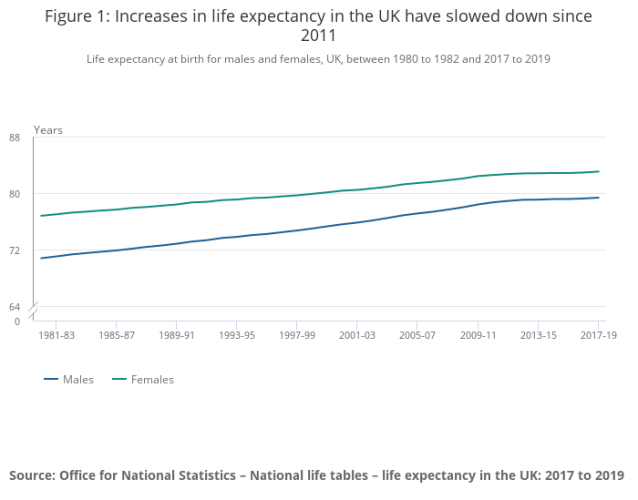
As you can see from this graph from the report illustrates longevity has largely flatlined. Women still live longer than men – but the greatest beneficiaries of rising longevity have been men. They are steadily catching up with women and the report wonders whether the huge drop in men smoking and moves from manual and agricultural work to less physical work in the office or behind a computer is the reason for this.

The report says: “Following decades of steady increases in life expectancy in the UK, a marked slowdown in the rate of improvements has been observed since 2011. Between 2002 to 2004 and 2009 to 2011, life expectancy at birth in the UK increased each year by an average of 16.7 weeks for males and 12.7 weeks for females. In contrast, between 2010 to 2012 and 2017 to 2019, these improvements slowed to an average of 6.3 weeks and 4.2 weeks per year for males and females respectively.”

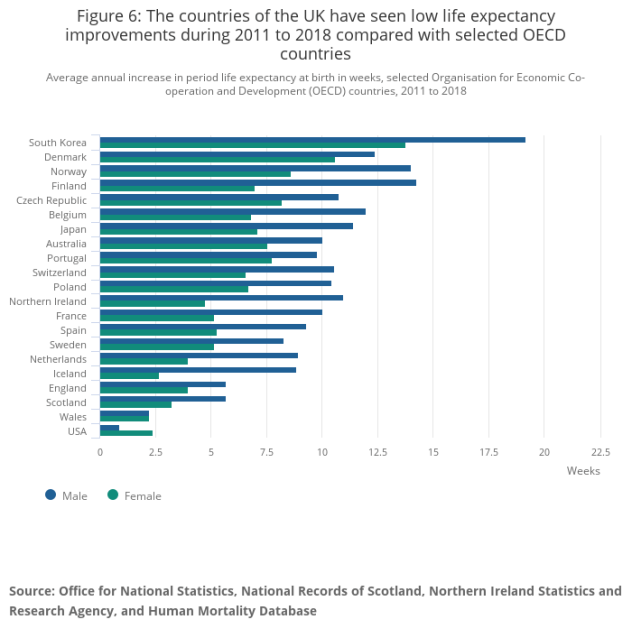
The report also reveals another startling fact. When you compare the UK to many other developed countries both men and women have lost out big time in the longevity stakes. The countries that make up the UK (with the exception of Northern Ireland) are all near the bottom of the table only beaten by the United States.

Near Bottom of the league UK

Top of the league is fast growing South Korea followed by Denmark, Norway and Finland. The figures are for the number of extra weeks people can expect to live – comparing 2018 with 2011. Note again with the exception of Wales and the USA men have been the biggest gainers not women.

So while we all are being expected to wait longer for our pension in the UK, our extra weeks of life expectancy fall well below many comparable developed countries. We are being cheated – or at least not given the full facts – by our political leaders. So don’t believe any facile claims we have a world beating system for pensioners. Far from it.

Now the figures for this small rise in longevity are not uniform throughout the UK.

Another report says:

  • The lowest regional life expectancy for both males and females in 2017 to 2019 was observed in the North East; the North East’s life expectancy at birth was also lower than in the countries of Wales and Northern Ireland but higher than in Scotland.
  • Males living in the four most southerly regions of England had life expectancies at birth exceeding 80 years, whereas regions of the midlands and the north fell short of 80 years; London exceeded the North East region by almost three years.

Women live longest in the Outer Hebrides

The largest local area increase in life expectancy between 2009 to 2011 and 2017 to 2019 for males at birth was in Westminster, while for females it was in Scotland’s council area of Na h-Eileanan Siar. ( better known as the Outer Hebrides).

Live longer in London, die sooner in Blackpool

The statisticians comment:

“The rate of growth in life expectancy in London continues to surpass that occurring in other regions and the constituent countries of the UK. This has resulted in London now having the highest life expectancy for both males and females among regions in England.

“Four of the top five local areas with the highest male life expectancy in 2017 to 2019 were London boroughs, while three were for females. Since 2001 to 2003 traditional deprived parts of London such as Tower Hamlets, Newham and Hackney have seen strong gains in life expectancy over the time series. In fact, 17 of the top 20 local areas with the strongest growth in male life expectancy since 2001 to 2003 were London boroughs. This contrasts with Ceredigion where male life expectancy has only grown by 0.8 years since 2001 to 2003. These patterns add to the growing inequality observed across different areas of the UK over the past decade.”

inequality

This is heightened by other observations :

“Overall, for the UK, the difference was 11.3 years between Westminster, with the highest life expectancy at birth, and Glasgow City, with the lowest.

” For females, the local area gap in life expectancy at birth in England was 7.7 years between Westminster (87.2 years) and Blackpool (79.5 years), meaning Blackpool was the lowest in England for males and females. In Scotland, the gap stood at 5.5 years between East Renfrewshire (84.0 years) and Glasgow City (78.5 years). “

These findings must call into question whether there should be such a rush to raise the pension age – since the UK is both lagging behind other countries in life expectancy, has a huge inequality between the prosperous South and London and the North East ( Red Wall MPs please note). Finally the DWP is misrepresenting what is happening – both in its evidence to the judicial review over the raising of the pension age for women and to the nation as a whole. Longer life expectancy is tailing off not growing anywhere near the rate it did when decisions were made to raise the pension age.

Assetco: The negligent privatisation audit that has cost Grant Thornton over £20m in damages

Top accountancy firm loses appeal over failing to spot forged documents in huge London fire brigade privatisation scandal

A London fire engine -once owned by Assetco

The big four accountancy firms make a fat living from auditing the large number of private companies taking over public services.

But a Court of Appeal ruling last month suggests that if they don’t do the job properly they could now face huge damages claims from directors of companies who were duped by their negligent auditing.

The Assetco saga has been extensively covered on this blog. It involved the sale and leasing of the entire fire engine fleet of London and Lincolnshire to a gang of spivs and fraudsters – who were last known to still be evading justice nearly a decade after swindling investors and conning the London Fire Brigade. The Fire Brigades Union also took up the issue on behalf of its members.

ban after causing fraud

A separate investigation by the Financial Reporting Council found Assetco’s chief executive John Shannon ” causing or facilitating fraud. He was banned as practising as a chartered accountant  for 16 years – a new British record – fined £250,000 and ordered to pay £300,000 in costs.

Raymond “Frank” Flynn (former Chief Financial Officer) for  banned from practising for 14 years and Matthew Boyle (former Financial Controller) for 12 years. Additionally, £150,000 and £100,000 respectively have been imposed and they share paying  part of the £400,000 costs bill.

Grant Thornton, and the accountant who audited the company Robert Napper,  has led to a £3.7m fine for  both of them for professional misconduct. ( Napper was fined £120,000) Neither Grant Thornton nor Mr Napper made any financial gain out of the scandal. The accountant took early retirement and now lives in a bucolic Oxfordshire village developing his hobby as a wine buff.. See here.

Now the Abu Dhabi directors of Assetco who took over in 2011- straight after the London and Lincoln operations collapsed have successfully sued Grant Thornton for £22m and their case has been upheld by the Court of Appeal.

The first trial lasted 20 days, involving extensive evidence from factual and expert witnesses and consideration of a large volume of documents and of 877 pages of written submissions as well as oral submissions.

Grant Thornton appealed but lost the case. The court was told that if Grant Thornton had audited the accounts properly they would have found evidence of forged documents which inflated the value of the firm.

Fraudster John Shannon when he was boss of Assetco

The court were told Mr Shannon and Mr Flynn told GT that the “unitary payments” due under the London Contract had increased by nearly £47,000 per month (£564,000pa) from April 2009 and produced documents to establish it. The statements were dishonestly made, and the documents were forged. It was only on the basis of these alleged payments that the London Contract appeared to be profitable.

Grant Thornton argued unsuccessfully that they couldn’t be responsible for all the losses. The judges found in the company’s favour.

The Financial Reporting Council did pass its findings to the Serious Fraud Office but so far it appears nothing further has happened. Mr Shannon has thought to have moved to Thailand while Mr Flynn remains in Northern Ireland.

The most important development is this judgement could form a major piece of caselaw if any other major accountancy firm does not do its auditing job properly. It is a big shot across the bows of the big four accountancy firms to be more diligent.

Revealed: Dramatic rise in benefit and disability claims from women born in the 1950s

Disclosure undermines ministry claim of no link between poverty and bad health and loss of state pension

DWP case undermined by new figures


Days after the Court of Appeal rejected the judicial review brought by the BackTo60 campaigners the House of Commons library produced a set of previously undisclosed figures showing huge leaps in the numbers of 50sborn women claiming universal credit[UC] or Jobseekers allowance[JSA] and employment and support allowance [ESA].

Claims for UC and JSA – which of course were non existent when the pension age was 60 – have gone up by an average of 382 per cent between 2013 and 2019. The figures are still relatively low (from 7582 to 36,531) but the trend is overwhelmingly upwards. It also excludes those who are battling on or using up savings rather than claim.

Claims for ESA – a difficult benefit to claim unless you are hospitalised and involving a 25 page questionnaire and work capacity assessment – have soared by 185 percent – to reach 205,385 -over the same six year period.

The figures are bound to be a huge underestimate as they take no account of the rule change that allowed people to claim the benefits if they had to stay at home because of Covid 19 this year. But they do allow a direct comparison during the period when the only big material change for this group of women was the loss of their state pension.

The disclosure of these figures -obviously not available at the time of the hearing – does undermine the forceful case made by Sir James Eadie, QC, who represented the Department of Work and Pensions, that any poverty or ill health suffered by these women could not be linked to the rise in the pension age to 66.

They also back up the argument made by Mr Mansfield who is quoted in the judgement:
” It is not uncommon for women born in the 1950s to have contracted various ailments and health problems by the time they reach their early 60s, because of the environment they lived in during their early years.  He said further that it is common for women in this age group to be living in straitened circumstances particularly if they are now single, with part time jobs at best and working for low pay. 

” It is also very common for them to be caring for elderly and infirm parents.  He argued that the lack of state pension means that they have to resort to makeshift measures to make ends meet, selling their houses, using up their savings and cutting back on any non-essential spending so that they are not in a position to enjoy their retirement years.”

But the judges concluded: ” there is no sufficient causal link here between the withdrawal of the state pension from women in the age group 60 to 65 and the disadvantage caused to that group. 

” The fact that poorer people are likely to experience a more serious adverse effect from the withdrawal of the pension and that groups who have historically been the victims of discrimination in the workplace are more likely to be poor does not make it indirectly discriminatory to apply the same criterion for eligibility to everyone, if that criterion is not more difficult for the group with the protected characteristic to satisfy.”

The figures also provide a useful constituency by constituency breakdown – showing an unequal distribution of the misery caused by ill health and failure to get as job depending on where you live. The guide would provide a very useful campaigning tool if people wish to lobby their MP over the bad treatment of 50s born women over their loss of pensions – as they can quote the figures back at their MP.

These are some of the top increases and the names of the MPs who were elected at the last election.

Unemployment biggest percentage constituency rises

Knowsley 1388 pc rise from 8 to 119 George Howarth ( Lab)

Newcastle North 1347 pc rise from 6 to 88 Catherine McKinnell (Lab)

Morecombe and Lunesdale 1300 pc rise from 6 to 84 David Morris (Con)

Birmingham Yardley 1270 pc rise from 10 to 137 Jess Phillips (Lab)

Wells 1220 per cent rise from 5 to 66 James Heappey (Con)

Disabled and ESA biggest constituency percentage rises

Glasgow North East 315 pc rise from 214 to 889 Anne McLaughlin (SNP)

NE Hampshire 300 pc rise from 32 to 128 Ranil Jayawardena (Con)

Linlithgow and East Falkirk 292pc rise 149 to 584 Martyn Day (SNP)

Brecon and Radnorshire 292 pc rise from 77 to 302 Fay Jones (Con)

Leeds NE 291pc rise from 89 to348 Fabian Hamilton (Lab)

Glasgow SW 287pc rise from 205 to 794 Chris Stephens (SNP)

Interestingly Martyn Day is the one MP who challenged Boris Johnson about the court judgement at Prime Minister’s Questions on Wednesday.

The full report is available here. You need to download the table on working age benefits 2020 to get all the info on the big increases in payments. There is also an up to date breakdown of the numbers of 50sborn women living in individual constituencies.

So again we yet have another disclosure backing up the case for the 50swomen to get their pensions.

50s Women to apply directly to Supreme Court to ask them to hear pensions case

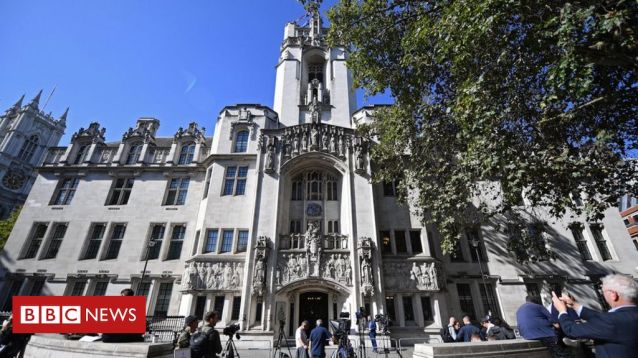
Supreme Court; Pic Credit:BBC News

Lawyers for Backto60 and the two complainants decided today to apply to the Supreme Court for permission to bring their case to the highest court in the UK.

The decision was taken after two of the Judges in the Court of Appeal, who heard their case,  Lord Justice Sir Nicholas Underhill and Lady Justice Dame Vivien Rose, refused permission for them to go to the Supreme Court.

Applicants are allowed to go to the Supreme Court directly to plead their case to be heard if they are turned down by the Court of Appeal.

The decision was announced by Joanne Welch, the founder of Back to 60, appropriately during an interview with the BBC radio programme Woman’s Hour.

The decision comes after the Court of Appeal comprehensively rejected their case in a judgement announced on Tuesday. The judges ruled that the first judge , Ms Justice Lang, should not have allowed the judicial review to go ahead because it was a long time after the 1995 Act raising the pension age for women was passed. They agreed with the arguments put forward by Sir James Eadie, the Treasury Counsel, on behalf of the Department for Work and Pensions that they had been adequately consulted about the rise in the pension age from 60 to 65 announced in 1995 and later extended to 66 under the Pensions Act in 2011.

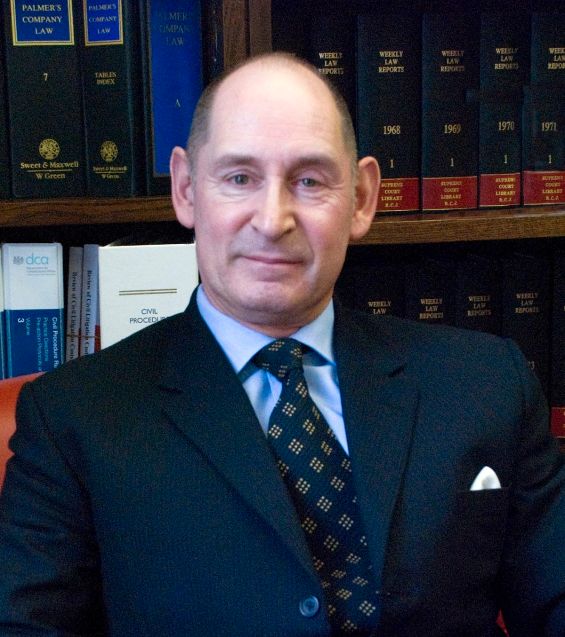
Some 3.8 million women were affected by the change which Michael Mansfield, Henrietta Hill and Adam Straw, argued amounted to both direct and indirect age and sex discrimination and had led to women born in the 1950s being driven into poverty and ill health. This was rejected by the judge, chaired by Sir Terence Etherton, Master of the Rolls.

Joanne Welch told Woman’s Hour “I know that Julie Delve and Karen Glynn have been actively considering next steps. I believe that they are going to go ahead with an application for permission to have this heard in the Supreme Court”.

Plans to ask the Supreme Court to hear the case are now being drawn up by the legal team after Joanne Welch confirmed that the decision was taken at a meeting today.

50s women pension judgement: How the Court of Appeal rejected their case

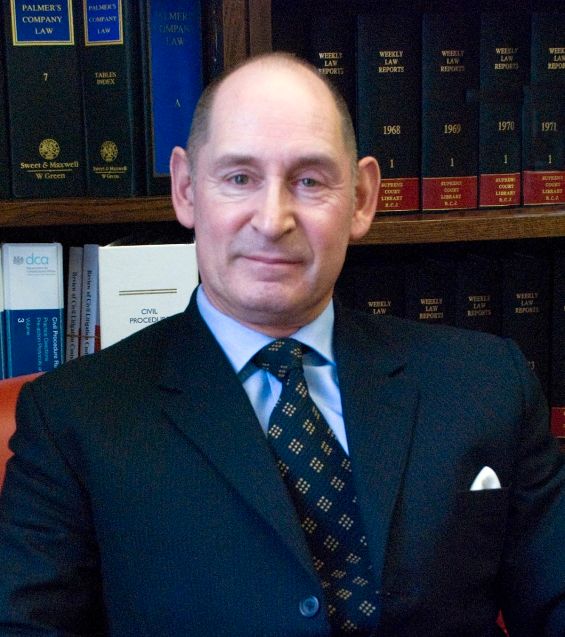
Sir Terence Etherton, Master of the Rolls

I have spent this morning reading the 21,000 word judgement of the Court of Appeal led by the Master of the Rolls, Sir Terence Etherton.

For the faint hearted I warn you this will make grim reading. But I think the women who have fought so hard to get their pensions back need to be properly informed about the logic used by the judges to come to their decision. It doesn’t mean I agree with it.

Their judgement will cause widespread misery and angst for the women themselves and total delight for the government, ministers, the Department for Work and Pensions and the small number of vocal detractors, mainly from the financial advice and private pensions industry, who didn’t want the women to get a penny.

Appeal on four grounds

The appeal was on four main grounds each of which were dismissed by the judges. Since it is a judicial review it depended a lot on case law which ranged from an immigration case, the bedroom tax, to a sex change case and to EU law and the Convention of Human Rights. It even included a novel way of approaching the law to consultation from Michael Mansfield QC.

To a lay person the case law might sound bizarre but the aim of the lawyers representing the women is to draw out rulings from these diverse set of cases to benefit the cause of the 50swomen to get their money back.

The four grounds for appeal were age discrimination according to an article from the European Convention of Human Rights; indirect sex discrimination or sex/age discrimination;notification and delay.

On the first case the judges rejected it. – citing they could not overrule an Act of Parliament.

“Despite that evidence and despite the sympathy that we, like the members of the Divisional Court, feel for the Appellants and other women in their position, we are satisfied that this is not a case where the court can interfere with the decisions taken through the Parliamentary process. “

They did concede that women got lower state pensions than men.

Women pensioners’ life expectancy – a strain on public fiances

“DWP figures in August 2018 for the mean weekly amount of state pension for men was £158.87 and for women £131.27.  Though they may have shorter life expectancy, men will still receive much more state pension than women even taking into account that women live for two years longer.  That does not, however, undermine the point that the SSWP [ Secretary of State for DWP] makes that longer life expectancy for women places a strain on public finances,(my emphasis) even if they would have received a lower pension over the years 60 – 65 than a man would receive.”

They rejected the indirect and age/ sex discrimination saying any EU directives allowing a differential age for men and women were a temporary measure.

women carry out 60 per cent more unpaid work than men

The judges note the argument that 50s women are hard done by. They quote facts” that women carry out an average of 60 per cent more unpaid work than men; 86 per cent of single parents are women and single parents have a higher risk of poverty than any other household type.  In the 50 – 64 year old age group, women are much more likely to give up work than men because of caring responsibilities.  The Appellants submit that it is therefore indirectly discriminatory, subject to the question of justification, for the state pension to be withdrawn from them because their gender adversely affected their ability to earn a living.”

But they recoil from accepting the arguments for fear that a victory would lead to a flood of new demands from other groups.

“it becomes clear what a significant expansion of the law would result from such a broad application … It is undoubtedly the case that many groups have traditionally suffered discrimination in the workplace because their protected characteristic meant that there were fewer opportunities open to them for advancement in stable, well-paid work.  That is the case not only for women but for disabled people, for lone parents, for some BME groups and for transgender people.”

They conclude that the state pension is a universal not a means tested benefit therefore it should not be used to right problems caused by discrimination – that should be left to other measures in the political field.

“In our judgement.. there is no sufficient causal link here between the withdrawal of the state pension from women in the age group 60 to 65 and the disadvantage caused to that group.  The fact that poorer people are likely to experience a more serious adverse effect from the withdrawal of the pension and that groups who have historically been the victims of discrimination in the workplace are more likely to be poor does not make it indirectly discriminatory to apply the same criterion for eligibility to everyone.”

DWP gave ” adequate and reasonable notification”

On consultation they buy the argument from the DWP that there was enough consultation going back to 1991 when the pension age change was first debated and they cast doubt on even sending a direct mail to everyone on the grounds that people might not read it anyway..

” We therefore dismiss Ground 3 of the appeal on the basis that there was no duty to notify those affected by the change in state pension age and that the Divisional Court were entitled to conclude as a fact that there has been adequate and reasonable notification given by the publicity campaigns implemented by the Department over a number of years.”

Criticism of Ms Justice Lang

Finally they condemn Ms Justice Lang for allowing the judicial review in the first place on the grounds that it was already out of time.

They castigate her for extending the time limit.

“Unlawful legislation is not a continuing unlawful act in the sense that the time limit for challenging it by way of judicial review rolls forward for as long as the legislation continues to apply.  If that were the test, there would effectively be no time limit for challenging primary or secondary legislation or for that matter administrative conduct which continues to affect a claimant unless or until the action is withdrawn or revised.”   

Lawyers for BackTo60 have asked the judges for permission to appeal their judgement.

Their judgement today shows what a big struggle it is to convince people of their case but it doesn’t meant it is wrong to fight this injustice for 3.8 million people.

Top international experts join the People’s Tribunal campaign to end discrimination against women and girls

Aim is to write the UN Convention on the Elimination of Discrimination Against Women [CEDAW] into UK domestic law.

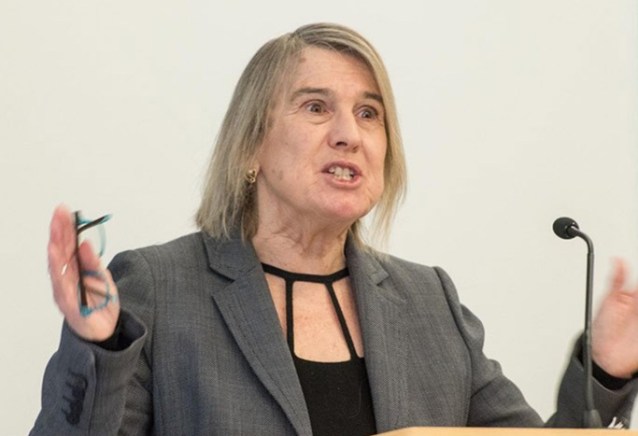
Meghan Campbell: Pic credit Birmingham University

Nearly 40 years ago Margaret Thatcher signed the UK up to the UN convention to end all discrmination against women but successive Tory, Labour and coalition governments have never passed the convention in British law.

Now in an age when the Boris Johnson led Tory government is trying to renege on international law agreements during European Union negotiations and opt out of parts of the European Convention on Human Rights it will face the wrath of women and girls who feel they have been treated as second class citizens for too long in the UK.

The movement has grown out of the far too long campaign by BackTo60 to get women born in the 1950s compensation for the loss of their pensions from the age of 60 which will be decided at a Court of Appeal hearing on Tuesday on grounds of discrimination.

The issue of inequality under CEDAW was an issue in the court case – but because it is not part of British domestic law – it is difficult issue to argue.

Now it looks like with real support from international figures and human rights lawyers that the Conservative government is going to face a campaign that will make the BackTo60 fight look like a sideshow.

It will begin with the setting up of a People’s Tribunal under John Cooper QC and renowned human rights lawyer who was Chair of the International Steering Committee and Prosecutor at the Iran Tribunal in The Hague and is named by The Times as one of the top 100 lawyers in the country.

Andrew Byrnes Pic Credit: Oxford University Law Faculty

Now he is joined by three international experts. One is Andrew Byrnes, Professor of Law of Law at the University of New South Wales, Sydney, Australia, where he served as Chair of the Australian Human Rights Centre from 2005 to 2017.

He is an expert on both People’s Tribunals and CEDAW . With Gabrielle Simm (a senior law lecturer at the University of Technology, Sydney) he recently published the edited collection Peoples’ tribunals and international law (Cambridge University Press, 2018) and forthcoming publications includes chapters on the work of the UN Committee on the Discrimination against Women and the UN Committee against Torture, as well as the protection of economic and social rights through the parliamentary process.

He also was involved in the drafting of the CEDAW Optional Protocol, the Convention on the Rights of Persons with Disabilities, and is working with the Asia Pacific Forum of National Human Rights Institutions in current UN discussions about a possible new convention on the human rights of older persons. 

The second international expert who will join the advocacy team is Meghan Campbell, an Associate Professor at the University of Birmingham and Deputy Director of the Oxford Human Rights Hub. Her monograph, Women, Poverty, Equality: The Role of CEDAW (Hart 2018) was shortlisted for the Socio-Legal Scholars Association-Early Career Research Prize. The bookoffers an interpretation of the Convention on the Elimination of All Forms of Discrimination Against Women (CEDAW) to demonstrate how equality and non-discrimination can address the harms of gender-based poverty.

Professor Christine Chinkin Pic credit Twitter

The third international expert is Professor Christine Chinkin CMG FBA is Professorial Research Fellow in the Centre for Women, Peace and Security, where she leads three major projects: ‘A Feminist International Law of Peace and Security’ funded by the AHRC, ‘Gendered Peace’ funded by the ERC and the UKRI GCRF Gender, Justice and Security Hub. Professor Chinkin was Director of the Centre for Women, Peace and Security from 2015-2018.

 She co-edited the book ‘The UN Convention on the Elimination of All Forms of Discrimination against Women: A Commentary’ and authored the chapter on violence against women and girls. She was scientific advisor to the Council of Europe Committee that drafted the Convention on Violence against Women and Domestic Violence (the ‘Istanbul Convention’), the most far-reaching international treaty aimed at tackling violence against women and domestic violence.

Hannah Wilson Pic credit: Women’s Link

She will be joined by Hannah Wilson who works for Women’s Link Worldwide, an international human rights organisation which seeks to use the power of the law to promote social change which advances the rights of women and girls, particularly those facing multiple inequalities. She is based in Madrid and has recently raised issues about the poor conditions of workers harvesting strawberries in Huelva Spain who are mainly women and women’ rights in Rwanda.

Bright energetic women

In addition the People’s Tribunal have recruited a number of new bright energetic women legal associates as volunteers who are starting out in their careers after graduating. They include Isabelle Ehiorobo, a Law graduate from the University of Sussex; Shauna Lyttle who read history at King’s College London and is now completing a graduate LLB and Natalie Payne a recent LLB graduate from the University of Warwick, ( my former university) beginning a postgraduate study in Human Rights Law in 2020.

When the tribunal gets going it will be on a much broader canvas than the BackTo60 campaign. It will raise issues about poor working conditions, poverty, job discrimination, domestic abuse as well as pension discrimination among many others. It should prove a catalyst making discrimination against women a mainstream issue. It will also be a big fight with the government to get legislation on the agenda.

In the meantime the group has a spanking new website which can be reached here. The campaign is just beginning.

Former Minister X v. Ryan Giggs and Sir Philip Green : Parliamentary hypocrisy or protecting a complainant?

Parliamentary Privilege: All right for some

Today I am reproducing a blog by Alistair Parker, a solicitor, with the firm, Brett Wilson LLP, a specialist media and professional litigation solicitors, on the issue surrounding the former Tory minister under police investigation for the alleged rape and sexual assault of one of his female staff.

My position has been that he should not be named – solely to protect the claimant who requested anonymity not to spare him embarrassment. But what this article highlights is the hypocrisy over the use of Parliamentary privilege by MPs – they use Parliamentary Privilege to name other prominent people, whether it is a famous footballer or a well known businessman, knowing they cannot be sued. But when it is one of their own the shutters come down and Parliament protects them as they are supposed to be honourable members.

The irony is that probably every MP and every lobby journalist knows his name but keeps quiet – perhaps only telling curious close friends. Thanks to Brett Wilson LLP for giving me permission to reproduce the blog. The link to their media blog is here.

Suspect anonymity: The hypocrisy of parliamentary privilege – Alistair Parker

1 August 2020 marked the parliamentary revelation that a sitting MP had been arrested by police on suspicion of rape, sexual assault and controlling and coercive behaviour. All offences were alleged to have taken between July 2019 and January 2020 against the MP’s former staffer. Police confirmed the suspect was a male Tory in his 50s, and a former minister. Subject to police guidance, the name of the man was not revealed. This is because he has not been charged and is still under investigation, with a police bail date now extended until early November 2020. 

A man suspected of a serious sexual offence therefore remains a serving MP. He has not had the Tory whip removed or been sanctioned at all, (apparently) for fear that this would identify him. Indeed, his anonymity has been carefully guarded by all sides of the House. Is this a proper observance of the right to pre-charge anonymity, or can we detect a whiff of hypocrisy?

Parliamentary privilege, which by Article 9 of the Bill of Rights 1689 guarantees that “the freedom of speech and debates of proceedings in parliament ought not to be impeached or questioned in any court or place out of parliament”, has long allowed members of Parliament, be they in the Commons or the Lords, to name criminal suspects in these situations.

Both peer and MPs have on occasion exploited this privilege, even identifying individuals who were protected by court injunctions:-

In 2011, then Liberal Democrat MP John Hemming named Ryan Giggs as the footballer who secured an anonymised injunction to prevent publication of allegations he had an affair with a former reality TV star.

Also in 2011, Mr Hemming revealed that the banker Sir (as he then was) Fred Goodwin had obtained a super-injunction protecting his identity in relation to an alleged extra-marital affair. The Liberal Democrat peer Lord Stoneham poured oil on the fire adding “How can it be right for a super-injunction to hide the alleged relationship between Sir Fred Goodwin and a senior colleague?” he asked. “If true it would be a serious breach of corporate governance and not even the Financial Services Authority would know about it.”

In October 2014, Labour MP Jimmy Hood used parliamentary privilege to make serious accusations against Sir Leon Brittan (both have since passed away). Mr Hood said “By the way, the current expose of Sir Leon Brittan, the then home secretary, with accusations of improper conduct with children will not come as a surprise to striking minors of 1984”. Sir Leon was posthumously cleared of any wrongdoing once it was finally established these allegations were among the prolific lies of Carl Beech. 

In November 2018, Labour peer Lord Hain used Parliamentary privilege to name Sir Philip Green as the ‘anonymous businessman’ who had used Non-Disclosure Agreements in settling numerous claims of bullying and sexual harassment with five complainants. This was despite the fact the High Court had maintained the injunction preventing publication of Sir Philip’s name and also that two of the five complainants supported this. We wrote about this matter at the time

The past decade therefore shows that UK politicians, in both houses, have been prepared to use Parliamentary privilege even when it:-

– Breaches civil court orders with impunity,
– Reveals personal details such as extra-marital affairs of high profile individuals, and
– Names a suspect in a serious criminal investigation, where the allegation turned out to be provably false.

Fast forward to the present day: The complainant of ‘Former Minister X’ has apparently been lobbying for his identification by urging MPs and peers to use parliamentary privilege to put his name into the public domain. If this is true, she is doing so despite the strong chance it will result in her own identification.

However, this led to an unprecedented response last week, when the Speaker of the House stepped in to urge MPs not to do so. Sir Lindsay Hoyle warned MPs that “while the investigation is ongoing, I believe that it would be wholly inappropriate for any further reference to be made to this matter in the House, including an attempt to name the member concerned.”

Sir Charles Walker MP: Former chair of the procedure committee which ruled MPs who are arrested should not be named Pic credit: Twitter

Indeed, back in February 2016, the cross-party Procedure Committee voted to end the tradition of the automatic naming of any MP who had been arrested. Its Chairman at the time, Tory MP Charles Walker said that MPs “should have the same rights to privacy as any other citizen, and in future their names should not be put in the public domain if they were arrested, unless this was directly connected to their role as an MP”. It seems Mr Walker had not considered the irony that the right to privacy of “any other citizen” can be trampled on via the use of parliamentary privilege. 

The conclusions we can draw are that, in the last decade, various parliamentarians have been happy to use parliamentary privilege to name and shame those being investigated for crimes and those embroiled in personal civil proceedings – even where they have court orders protecting their anonymity. However, when the ‘shoe is on the other foot’ and the accused party is himself a parliamentarian, it seems the House of Commons is a zealous believer in the right of pre-charge anonymity.

In simple terms, if you are being investigated of a crime, then any parliamentarian can publicly name you without any consequence to themselves. But if you name a parliamentarian who is in a similar predicament, get ready for formal legal consequences.

Although the identity of “Former Minister X” remains a mystery, surely the pattern of politicians protecting themselves could not be any clearer.

Judgement on Court of Appeal for 50s born women pensions fixed for September 15

Royal Courts of Justice

The Court of Appeal has announced that the long awaited judgement on the Backto60 case covering 3.8 million women who had to wait up to six years for their delayed pension will be made on September 15.

The judgement will be delivered by email to the two claimants on behalf of BackTo60 campaign and the Department for Work and Pensions. The judgement will be put on the judiciary website.

The official notice published today reads:

NOTICE
Take notice that on TUESDAY, 15 SEPTEMBER, 2020 at 10.30, Judgment will be given in the following.
APPEAL

From The Queen’s Bench Division
(Administrative Court and Divisional Court)
FINAL DECISIONS
C1/2019/2914 The Queen on the application of Delve & Anr -v- The Secretary of State for Work and Pensions.

Covid-19 Protocol:  This judgment will be handed down remotely by circulation to the parties or their representatives by email, release to BAILII and publication on the Courts and Tribunals Judiciary website. The date and time for hand-down will be deemed to be TUESDAY, 15 SEPTEMBER, 2020 at 10.30.

A copy of the judgment in final form as handed down should be available on the Judiciary website (www.judiciary.uk) or BAILII shortly thereafter but can otherwise be obtained on request by email to the Judicial Office.

The decision will be on the merits of whether the DWP handled the policy change properly and whether the women suffered discrimination not on the merits of the plight of the women.

If the judges decide that there were faults in the system the women will have won and be entitled to compensation. If they decide that the DWP acted properly within the law they will lose.

The case has received the attention of three of the most powerful judges in the Court of Appeal.

Sir Terence Etherton, Master of the Rolls

They are the Master of the Rolls, 69 year old Sir Terence Etherton; Lord Justice Sir Nicholas Underhill, 68, and Lady Justice Dame Vivien Rose,60.

The DWP engaged Sir James Eadie known as the ” Treasury devil” – one of the most powerful lawyers employed by the government, to argue their case.

Michael Mansfield

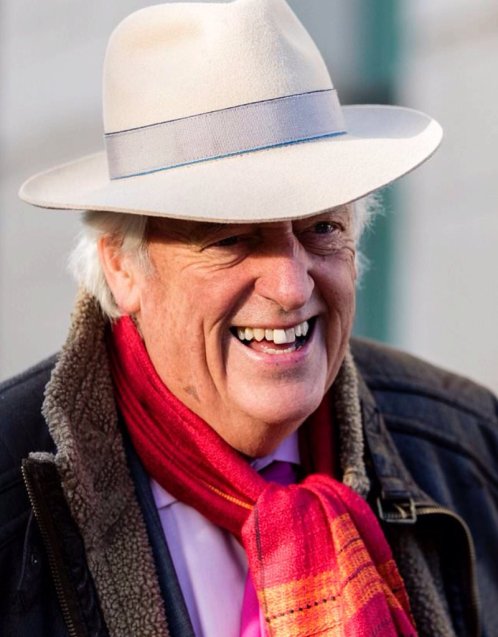
BackTo60 brought in Michael Mansfield, one of the leading human rights lawyers as part of their team.