Revealed: 32 years of benefit payment failure by the Department of Work and Pensions

DWP celebrating 32 years of inaccurate accounting

Yesterday while all eyes were on Boris Johnson’s ” Build,Build, Build ” speech the Department for Work and Pensions slipped out their annual accounts for the last financial year.

In what looks like a classic “cover up ” job to bury bad news, the ministry probably did not want the world to know that their accounts had been censured for material inaccuracy for the 32nd year in a row.

The reason is the failure of the ministry to be able to account for unacceptable levels of fraud and error in the huge number of benefit payments. Billions of pounds have been overpaid to claimants through fraud and mistakes by claimants and errors by officials. And billions of pounds have been underpaid by officials to claimants because they have made mistakes in calculating people’s benefits.

The latest figures are a record for every year since John Moore, was social security secretary under Lady Thatcher in 1988.

It shows that ” Excluding State Pension, the estimated rate of overpayments has increased again to 4.8% (£4.5 billion) of estimated benefit expenditure, from a restated rate of 4.4% (£3.8 billion).

“The estimated rate of underpayments, excluding State Pension, has decreased to 2.0% (£1.9 billion), from its estimated rate of 2.2% (£1.9 billion) in 2018-19. The rate of overpayments in 2019-20 is the
highest estimate to date.”

The worst benefit is the new hated Universal Credit which has suffered from both overpayments and underpayments and claimants have to wait five weeks before they can get it. Since the payment depends on claimants’ monthly varying income the scope for inaccurate reporting of the money is large.

The report says: “For Universal Credit, the estimated rate of overpayments increased from 8.7% to 9.4%. This is the highest recorded overpayment rate for any benefit other than Tax Credits (administered by HMRC), which peaked at 9.7% in 2003-04.”

“Underpayments rates have fallen for Universal Credit, Employment and Support Allowance and Pension Credit, and the estimated rate for Housing Benefit has increased. Personal Independence Payment has the highest rate of underpayments at 3.8% of expenditure in 2019-20. This rate has not changed from 2018-19.”

But the small print of the report also reveals how the Department calculates this. It takes samples of benefit payments to arrive at these figures but the National Audit Office reveals that 61 per cent of the benefits paid out to claimants are based on recalculated estimates for the previous year.

Some other omissions are staggering. The Department has never checked whether payments are accurate for claimants on Disability Living Allowance for 16 years – last done in 2004-05.

More extraordinary the Department has never checked whether money paid out to 12 million pensioners is accurate or not since 2005 – that is 15 years ago.

Instead the department maintains there is no serious fraud or underpayments in pensions – calculating it as just £300 million out of an annual payment of £98.6 billion.

Given this year we had a case this year of a 94 year old pensioner being owed a staggering £117,000 because of 34 years of underpayments, I find this complacency mind blowing.

I also think the National Audit Office, as their auditors, is remiss in not asking for an update.

Next year’s estimate of benefit fraud and error is likely to even more out of kilter thanks to Covid 19 as the ministry have got rid of staff monitoring fraud to be able to pay out the 2.6 million claims for universal credit.

And although the department is said to be investigating 143,000 suspicious claims under Covid 19, it can’t follow them up because it can’t visit them at home.

Gareth Davies, the head of the NAO, said :

“I am concerned that fraud and error in benefit payments have risen again. Fraud and error have a real cost, both for those who face deductions from their income due to overpayments and because it reduces the public funds available for other purposes.

“As the Department takes on a set of unprecedented challenges arising from COVID-19 it is more important than ever that my qualification is not seen as business as usual and the Department responds in a cost-effective way to minimise risks of fraud and error.”

Next year I am certain will be the 33rd year the ministry accounts are questioned and found wanting.

Exclusive: The 4.6 million men who “retired” at 60 to get a pension top up paid by the taxpayer

DWP’s extraordinary disclosure

Successive governments extended a 1983 “men only national insurance subsidy” for 35 years and broke a promise to women born in the 1950s to offer them similar terms

More than 4.65 million men aged over 60 have had the last five years of their national insurance contributions paid by the state, the Department for Work and Pensions has disclosed.

The scale of the payments has been kept quiet by the Department for Work and Pensions for 37 years. It was only revealed last week when Myfanwy Opeldus, one of 3.8 million women facing now a six year delay to get her pension, got the admission from the ministry through a Freedom of Information request. She is a BackTo60 supporter and had been pursuing the government over this issue

The scheme was launched by the Thatcher government in 1983 when it was reeling from large scale unemployment even after its popularity had soared through victory in the Falklands War. Extraordinarily the scheme was only wound up in 2018 just two years ago and 35 years after it was launched.

Thatcher ‘s first government: Lord Carrington, foreign secretary, Margaret Thatcher and Sir Geoffrey Howe. Pic credit : BBC The Thatcher Archive

The scheme- called auto credits – was announced in the 1983 Budget by the late Sir Geoffrey Howe , then Chancellor of the Exchequer, as one of four measures to get down the unemployment count which was over three million.

In his March Budget he announced:

“Some 90,000 men between the ages of 60 and 65 now have to register at an unemployment benefit office if they wish to secure contribution credits to protect their pension rights when they reach 65. From April, they will no longer have to do this.

Even if those concerned subsequently take up part-time or low-paid work on earnings which fall below the lower earnings limit for contributions, their pension entitlement will be fully safeguarded. ( my emphasis)”

Unemployment did fall and was half that level by 2018 when the scheme was dropped.

Yet neither successive chancellors Nigel Lawson, John Major , Norman Lamont,Kenneth Clarke , Gordon Brown or Alistair Darling did anything to repeal it.

In fact under Kenneth Clarke in 1993 the opposite happened. He decided as 50s born women were going to face waiting longer for their pensions, they should get some help. This was adopted by Labour in a leaflet issued in 2002 on pensions which announced it would be extended to 50s women from 2010 when the pension age for women started to rise.

But the Brown government then reneged on this in 2009 after the financial crisis.

Promises to 50s women reneged

An explanatory memorandum to changes in pension legislation said :

“When the Government published its plans for state pension age equalisation in 1993, the intention then was that as women’s pension age increased gradually to 65, autocredits would become available to them on the same basis as for men. This was in part to compensate for the increase in the number of years women would otherwise have to pay National Insurance contributions for in order to qualify for a full basic pension.

” This approach has since been reviewed, for two reasons. Firstly, the qualifying age for Pension Credit (the income-related benefit currently payable to men and women at 60 without jobseeking conditions attached) is set to increase to 65 by 2020 in line with female state pension age. Without the proposed change, autocredits would increasingly apply mainly to people who could afford not to work or claim benefit….

“Secondly, the reduction in the number of qualifying years needed for a full basic pension to 30 and the improvements in the crediting arrangements for carers under the measures introduced by the Pensions Act 2007 will mean that the need for autocredits to protect state pension entitlement will be significantly reduced….

” This instrument amends the Credits Regulations to provide that autocredits will be available to men only for the tax years in which they have reached what would be pension age for a woman of the same age, up to and including the last tax year before the one in which they reach age 65. Men born on 6 October 1954 or later,…, will not qualify for the credits.”

This meant it was phased out in 2018.

Meanwhile the new Tory and Liberal coalition elected in 2010 decided to raise the pension age further to 66 and also planned a new pension raising the qualification period to 35 years. The main architect was the pensions minister , Steve Webb, who moved a top job at Royal London Insurance. In an article in the Telegraph in September 2017 he backed men who could have overpaid NI contributions to claim the money back. He is now a financial consultant with Lane Clark and Peacock.

Yet another scandal

Now this entire scandal is yet another example of unfair treatment to 50s women.

The woman who raised this with the DWP is one of a number who has not got enough national insurance contributions to get a full pension. She falls short by three years and will have to pay them £3000 to make up the years to get another £400 a year.

A man – one of the 4.65 million who was covered by auto credits- would have to pay nothing. That is hardly fair. And he could take a low paid job and still not pay NI contributions as they would be covered by the state.

More seriously it does knock a hole in the DWP case that the raising of the pension age was an equality measure to create a level playing field with men.

It is hardly a level playing field if men on this huge scale are getting their national insurance contributions for free. What started as a measure for 90,000 ended up helping 4.6 million. No wonder the DWP were not happy to have to disclose this.

Roll on the appeal to the judicial review brought by BackTo60. Michael Mansfield could have a field day with these new facts.

The damning FOI reply from the DWP that revealed the 4.6 million figure

Coronavirus: Why more than ever BackTo60 were right to challenge that judicial review decision over #50sWomen pensions

My radio interview which is now on the BackTo60 site

One of the most disturbing things coming back to the UK after nearly three months is how the country is now gripped in an inevitable lock down without any sign of an exit – as this nasty virus – Covid-19 – takes a grip on the nation.

For women and men in their 60s the situation is particularly dire. They should be protected but are not. Instead they have the problems of either being pushed out of work and put at the mercy of the hopeless and half finished Universal Credit system or the government’s long delayed payments for the self employed for any money.

They know they are a high risk group recognised by the World Health Organisation ( WHO) but they are caught between surviving on savings or going out to work – including for the NHS and in care homes – knowing they stand a greater chance of getting the virus. The two scenarios I illustrated in my article for Byline Times.

But probably the most pleasing thing that happened while I was away was the decision of the Court of Appeal to grant an appeal from the two 50swomen on behalf of BackTo60 on all grounds after the disappointing judicial review decision. which rejected their case.

The women I know have a long wait until July for the hearing but if they hadn’t taken this step they would be nowhere under this present Tory government.

The applicants at the time would not have known how damaging the coronavirus would be but fortunately they got their right to appeal before the courts closed down to hear most new cases. The latest situation at the Court of Appeal can be seen in their latest briefing( April 17).

The fact that BackTo60 has got an appeal on all grounds is significant given the judicial review rejected their case on all grounds and the judge who decided this also wanted to stop an appeal.

Lawyers for the claimants were confident that they could win permission to appeal – and they were right.

At the time detractors – many of whom should have known better – were making wild claims about the crowd funding appeal – which was set at a specific figure on the advice of the lawyers- and trying to stir up animosity against BackTo60. They did not succeed and the result is the issue remains very much alive.

The other key result is that for the government the issue will have to be faced again – ministers have not succeeded in squashing the campaign in the courts. The government knows it will have to argue its case again and 3.8 million women will have a voice at the Royal Courts of Justice to say why they were mistreated and swindled out of their pensions.

I have given a radio interview which is also on BackTo60 and you can listen to it at the top of this blog.

50s women dancing in front of the Royal Court of Justice after the judge granted their request for a judicial review the first time

Big pay out for 3.8 million 50swomen will never happen – Tim Loughton MP

Tim Loughton MP

The All Party Parliamentary Group on Women’s State Pension Inequalities is to be revived and will try and persuade the Tory government to make a offer to the 50swomen.

Tim Loughton, Conservative MP for Worthing East and Shoreham, used his response to the Queen’s Speech, to say both he and Carolyn Harris, Labour MP for Swansea, East will approach ministers again to try and get some money. Mr Loughton was returned with an increased majority while Carolyn Harris saw her majority severely reduced.

If the deal is anything like the last one it is likely to cost some £2 billion and probably only cover a small portion of the women who may get £73 a week. Before the election Mr Loughton said as a condition BackTo60 would have to drop its legal action against the Department of Work and Pensions, according to the Daily Express.

Image
Tim Loughton’s appeal before the election

He used his latest speech to attack Labour for offering to spend £58 billion over five years to remedy the situation describing it as having ” disgracefully raised false hopes in vulnerable women. “

This is the full extract of his speech on the issue:

“It is an issue that featured rather disgracefully during the election campaign, and it is that of the so-called WASPI women.

Many on this side and, of course, on the other side have championed the case of the 1950s pension women who were hit disproportionately by those changes in the pension age under previous Governments. Many of us have been lobbying the Government to acknowledge that disproportionate disadvantage and to do something about it.

I will call on the Government again and, working with my co-chair of the all-party group on state pension inequality for women, we will continue to put pressure on the Government to acknowledge that and do something about it.

The Labour Opposition’s uncosted promise of £58 billion, which did not appear in their manifesto, disgracefully raised false hopes in vulnerable women.

That amount was almost half the NHS budget, and it was never going to happen. I do hope that we can come up with a realistic, deliverable, doable offer for those women who have suffered and are suffering disproportionately, because that is the right thing to do. “

His speech cut no ice with BackTo60. They are to continue pressing ahead with their application for an appeal in the New Year to get full restitution for the women with the support of the trade unions.

Unison, the largest public service union, are donating £700 to the cause on top of the £80,000 already raised.

Meanwhile I expect some more lobbying from Connect Public Affairs and Waspi to press for a reduced deal. Below is an example sent to me of an earlier lobbying campaign captured in Portcullis House in the House of Commons.

John McDonnell explains the Labour pensions offer to 50swomen over more than tea and sympathy.

John McDonnell with Azhar Ali, Labour candidate for Pendle, explaining the offer to some of the women

For those who are following the fight by all groups to get compensation for 3.8 million women who have waited up to six years for their pensions, here is a detailed video with John McDonnell, the Shadow Chancellor on how he intends to implement the £58 billion package

There are a number of new points revealed in this video.

  1. Labour is looking at offering both a weekly payment and a yearly lump sum depending on whether the women would like it.
  2. The implementation of the plan would begin as soon as Labour enters government.
  3. Labour has already talked to Whitehall civil servants so they can work up the scheme immediately Labour gets into office.
  4. Every woman will get a letter to prevent the previous debacle under successive governments where women did not hear of the offer
  5. He discloses he has talked to Michael Mansfield, the QC, who is drawing up the appeal for BackTo60 who are seeking full restitution to make sure it cannot be legally challenged.
  6. Labour ruled out means testing the offer because they found it would be complicated and expensive to do this and would delay payments. Bad luck economist Frances Coppola your idea wouldn’t work
  7. Yes it would mean Theresa May and Harriet Harman would get payments – but because it is taxable they will have to pay a big chunk back.
  8. Means testing would also break the principle that it is a national insurance based payment – based on entitlement not a benefit.
  9. He reveals the BBC had great difficulty understanding what the deal was about and why he had decided to pay it.
  10. Finally for tech lovers the end of the video he talks about introducing a national free broadband system – citing a small tech company in a rural area which devises new games – but can’t expand because of the poor quality broadband in its area. He points out this will be a boost for business.

On Byline Times: Labour ambush the Tories over 50swomen pensions:is it an election game changer?

Standing firm for full restitution for 50swomen

This article unlike my earlier one on the offer of compensation to 3.8 million 50swomen looks at the political moves that led Labour to make this offer which is not full restitution. It asks whether it is going to be a game changer in the 2019 General election? Read it in full on Byline Times here.

Labour’s new deal for 50swomen’s lost pensions: What does it mean?

Crowds of BackTo60 supporters after the judicial review hearing

Labour today broke through the political barrier of just offering tea and sympathy for 3.8 million women who had to wait up to six years for their pensions.

And coming only 24 hours after Boris Johnson announced that the Conservative Party would not give a penny in compensation to any of the women affected by this appalling scandal it is a major advance.

First the positives. It is a huge improvement on the offer available from the All Party Parliamentary Group on the issue co chaired by Tim Loughton, the Tory MP for Worthing East and Shoreham and Carolyn Harris, Labour MP for Swansea,East. The sums are obvious. Tim Loughton is on record of seeking £2 billion compensation, Labour is offering to spend £58 billion over five years.

From what I could gather – despite both MPs declining to answer any of my questions – it would have meant probably only £73 a week on benefit for women who have still not gained the pension in two years time and nothing for the rest, who form the vast majority of people involved.

It is also – and this is very important considering the age of people involved- to start pretty soon if Labour is elected. This compared with the previous APPG proposal with no firm date for implementation and the longer the delay, fewer people would have got anything.

As John McDonnell, shadow chancellor, said: ” “We will introduce it as rapidly as we probably can and we will try to ensure the payments are made promptly. …… we are hoping that people will appreciate the sense of injustice and anger that these women feel about the changes that were imposed upon them.”

And it is helpful for people who had relied on the now outdated married woman’s national insurance contribution to build up their pension entitlement since to get compensation Labour is treating all cases as though they paid the full national insurance stamp which would increase their entitlement.

It is also by far the best offer on the table for the December 12 election as it compares with nothing from the Conservatives and an offer from the Liberal Democrats to obtain compensation through the Ombudsman. Again that would depend when the Ombudsman considered the case and whether he decided to award any compensation.

Now the pitfalls. First it is paid at the rate of £100 a week over five years for all those born before 6 April 1955 rather than a lump sum. It is also taxed. As one of the arguments by the numerous detractors from the private pension industry -is that it should be means tested, very wealthy people will have to return, under Labour, half the payment to the state. Those who are really poor will get it tax free – because there is no tax next year on the first £12,500 of income. And this limit will probably rise over the period.

Second the scheme is complicated and the amount of compensation will be different for each individual.

Broadly it looks as though compensation will rise from a month’s loss of pension (£400) to a maximum of £31,379 for those born up to April 5 1955. It would then gradually fall again until disappearing altogether for those born after April 5 1960. The figure paid out will fall from £100 a week to a lower sum depending on a person’s date of birth from 6 April 1955.

In general terms this means that those born up to April 5 1955 will fare better than those after- though those born in the rest of 1955 will still get high compensation.

What this mean for those born earlier and have or about to get their pension that they will be guaranteed an extra £100 a week for up to five years depending on their birth date.

What the deal is not full restitution given that some women have lost up to £50,000. However Back to 60, have raised enough money through their crowdfunder, to continue their legal action and are seeking permission at the Court of Appeal to appeal the ruling.

The fact that BackTo60 went to the courts prompted Labour to prepare a much more generous offer for the 50swomen – their briefing makes it clear that this was in their mind.

” It’s a one-off historical redress for a historical wrong, so the state will be expected to find the money, just as it would do if the Government lost a court case.”

This is the opposite to the view of Guy Opperman, the pensions minister, who takes the position ” we act within the law” and the defeat means no money need ever be paid.

The fact that both Unison and Unite unions supported full restitution was also hugely influential in Labour’s thinking.

Labour’s manifesto has promised talks with all groups before it is implemented which will give all 50swomen representatives the chance to comment and discuss the implementation of the scheme.

Last night Waspi Ltd – which has not wanted full restitution – and ” We paid in, you pay out ” were advising their supporters to back Labour at the general election.

BackTo60 which never intended to advise its voters which way to vote – will produce a comparative guide to all the offers from the main parties to 50swomen and leave it to their supporters to draw their own conclusions on how they wish to cast their votes.

John McDonnell, Shadow Chancellor of the Exchequer, said
“We’ve prepared a scheme to compensate these women for a historical wrong. It’s one that they were not been able to prepare for and for which they’ve had to suffer serious financial consequences for as a result.

“Some of them have been hit by a combination of poverty and stress, having lost out on what they had contributed towards. These changes were imposed upon them by a Tory-led government. So we have a historical debt of honour to them and when go into government we are going to fulfil that debt.”

John McDonnell to announce Labour’s plans for WASPI women on Sunday – Shadow Cabinet minister’s leaked Facebook message

Andrew Gwynne’s message that suggests more to come

The Labour Party is to flesh out details on Sunday of how it will financially compensate some 3.8 million women many of whom are enduring enforced poverty after having to wait up to six years to get their basic state pension.

The party’s manifesto yesterday pledged full support for the women and promised talks if it wins the next general election to draw up a compensation package.

But it did not put any cash figure on what it would pay the women or make any provision in the Grey Book to fund it.

This is in sharp contrast to a pledge given to pensioners living overseas in places like Canada, South Africa, Australia and New Zealand and many Caribbean countries which is fully costed in the manifesto. It would come into force in April and could £500m spread over four years. This is a victory for the all party group that campaigned for the pensioners and will mean their pensions would get their first uprating for years. If Britain leaves the EU pensioners living there would also get a permanent uprating rather than just for three years under the Tories.

The failure to mention any money for the women last night provoked a furious reaction from the women with many tweeting their anger to John McDonnell, Labour’s shadow chancellor and others saying Jeremy Corbyn had lost their vote.

Andrew Gwynne Pic Credit: andrewgwynne.co.uk

However one woman challenged Andrew Gwynne, the party’s shadow communities secretary, warning that Labour’s manifesto announcement did not ” look good”.

Gwynne replied: ” Yes John McDonnell is making an announcement on Sunday about how we will honour the pledge on Page 75 of the manifesto to the 1950s women. the costings are separate to the grey book.”

I have since heard from sources that this is indeed the case but Labour are being tight lipped again about what they are going to announce.

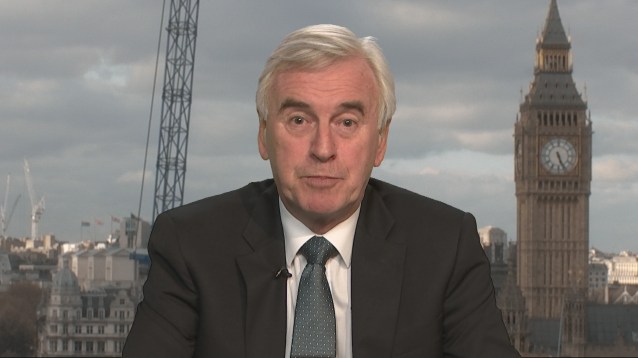
John McDonnell; Shadow Chancellor Pic Credit: Channel 4 News

The full manifesto section reads:

Pensions

People work hard for most of their lives and deserve a decent retirement free of financial stress and insecurity.

Under the Tories, 400,000 pensioners have been pushed into poverty and a generation of women born in the 1950s have had their pension age changed without fair notification.

This betrayal left millions of women with no time to make alternative plans – with sometimes devastating personal consequences.

Labour recognises this injustice, and will work with these women to design a system of recompense for the losses and insecurity they have suffered.

We will ensure that such an injustice can never happen again by legislating to prevent accrued rights to the state pension from being changed.

The Conservatives have repeatedly raised the state pension age despite overseeing a decline in life expectancy. Labour will abandon the Tories’ plans.

All I can say is that John McDonnell better come up with something concrete rather than warm words or else they are going to be 3.8 million women voters who are going to be bitterly disappointed, judging from the tweets I have seen, and Labour could well lose many potential votes on December 12 – not only from them – but from their spouses and families.

Frankly I am bit puzzled why they are doing this and prolonging the suspense..

Tory election strategy: Don’t pledge anything to 3.8 million 50s born women who lost their pensions

Pic credit: Sky News

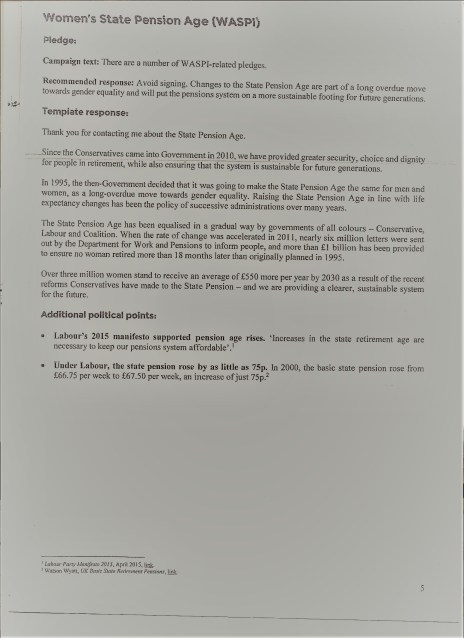
A leaked document in today’s Guardian revealed what Conservative Central Office has said to all its Parliamentary candidates on how to avoid giving pledges to people during the election campaign.

It covers a wide variety of issues including Brexit, the NHS, trade deals, Voter ID, private schools, rivers, climate change and shooting. But a special section has been devoted to the Waspi campaign showing that MPs are acutely aware of the demands of 3.8 million who are waiting up to six years for a pension.

The section reproduced below includes a template letter to be sent to anybody inquiring what the Conservative candidate’s views are on paying women. So you needn’t bother writing as this will be the reply. It is more about future pensions – claiming that by 2030 pensioners will be £550 a year better off under the Conservatives. It also contains a 20 year old attack line on Labour reminding people that Gordon Brown once raised pensions by only 75p a week in 2000.

The Tory advice to all candidates: Don’t sign any pledge to any WASPI or BackTo60 group

Rather extraordinarily there is one pledge all candidates can sign – that is supporting any rural sport especially shooting. Here candidates are free to support any pledges. This is almost Trumpian in its advice – put guns before pensioners.

The two legal views on the rights of 3.8 million 1950s women to get full restitution for their lost pensions

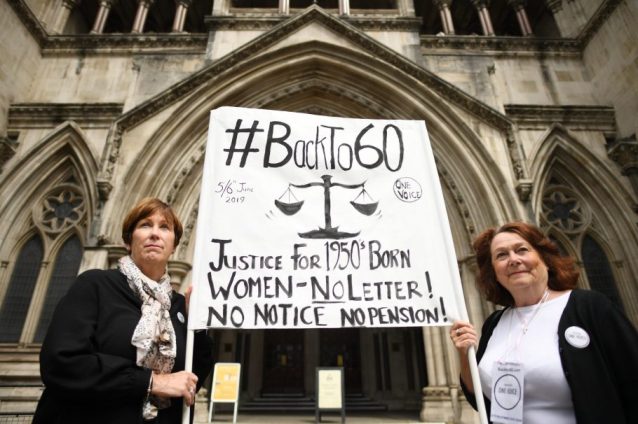
BackTo60 outside Royal Courts of Justice

The decision by Lord Justice Irwin and Mrs Justice Whipple to dismiss ALL claims of discrimination and failure to inform 3.8 million women born in the 1950s about the rise in their state pension age from 60 to 66 is in total contrast to the decision of Mrs Justice Lang who granted ALL the claims to be heard four months ago.

Obviously there is a big difference between permission for a judicial review to be granted so the case can be argued than a judicial hearing where the arguments are tested.

Nevertheless this startling contrast to me suggests that there are grounds for an appeal because the two judgments are so far apart. That is presumably why the two judges did not ban an appeal.

To remind people Mrs Justice Lang decided that even though the 1995 Pensions Act was passed 24 years ago the effect of the implementation of the Act was happening now and therefore this issue was subject to judicial review. She also agreed that both age and sex discrimination could be part of the hearing, and the issue on whether government action was contrary to EU directives on social security and whether people had been adequately informed about the changes.

The two judges have rejected all of this and upheld the case put by the Department of Work and Pensions in its entirety. No wonder the DWP is cock a hoop today.

They describe any challenge to primary legislation passed over 20 years ago as ” fatal” and they have published in detail all the attempts by the DWP to inform people. They have included discussions from 1993 onwards about changing the law as part of informing people.

But they abrogate any responsibility on whether the DWP did a good job or not. ” We are not in a position to conclude that the steps taken to inform those people affected by the changes to the state pension age for women were inadequate or unreasonable”.

They have also accepted the DWP’s argument that it was under no obligation to tell people at all and certainly not to individually informing anybody about the change because it was not written into the law.

This ruling should be a red line for MPs to insist in the future that any Parliamentary legislation that affects millions of people must include a clause requiring a ministry to individually inform the people affected in language they can understand and in good time.

Goodwill or good sense is obviously not enough to be left in the hands of individual ministers. It must be made mandatory that people are told.

The arguments over whether government action in handling the rise in the pension age contradicted EU directives amounted to age and sex discrimination or indirect legislation are complex.

But broadly the judges have accepted the DWP’s interpretation of the wording so as to exclude the changes to the pension age from any such directives.

They have also ruled out the role of the UN Convention on the Elimination of Discrimination against Women from having any bearing on the case.

” We have not been assisted by reference to CEDAW, it adds nothing to the claimaint’s case”, they say.

Their main argument is that the 1995 Pensions Act removed an advantage (my emphasis) that women had over men at the time they retired and anyway the decision was part of primary legislation which could not be challenged.

Jackie Jones, Labour MEP for Wales and an expert on CEDAW, says the judges have misunderstood the purpose of CEDAW which could make a possible grounds for appeal.

In her view the Judges did not consider the cumulative effect of unequal laws in the past on this particular group of women who were denied contributing to their own pensions when they worked part time which is one of the issues covered by CEDAW.

The judges also ruled out the recent victories in civil service and firefighters pensions having any bearing on the case because they involved transitional arrangements for work pensions rather than their right to a state pension.

Despite the harshness of the judgement the immediate effect has been to create widespread sympathy for the plight of the 50swomen in the media, among the general public and brought finally to national attention the whole issue.

It has also galvanised campaigners to fight on and with a general election on the horizon to put politicians in all political parties under pressure. It could cost the government, if it does nothing, 3.8 million votes from people who reliably go down to the polling station.