Brian Altman: The scuba diving prosecutor who “speared” Milly Dowler’s killer

brian-altman-qc-320x289

Brian Altman – new lead counsel for the independent child sexual abuse inquiry. Pic credit: 2 Bedford Chambers

CROSS POSTED ON BYLINE.COM

The announcement this week that former Treasury counsel Brian Altman has been appointed lead counsel  from March to the much troubled Independent Inquiry into Child Sexual Abuse should be  good news for survivors.

The man has a formidable reputation as a forensic prosecutor and a particularly strong line in bringing criminals to justice in  ” cold case ” murders.  For once the phrase ” highly experienced”  used by the inquiry chair, Alexis Jay, is no exaggeration.

He has yet to get a cameo role as a lawyer  in ” Silent Witness” – though he did appear in a BBC 4 Real Crime and Punishment series ( sadly no longer available on BBC i-Player.).He has received much praise from journalists who regularly cover Old Bailey trials for the way he ensnares defendants who hope to escape justice for unspeakable crimes.

His case list of successful prosecutions is impressive. They include the notorious serial killer and rapist Levi Bellfield who murdered  teenager Milly Dowler and  killer Colin Ash-Smith convicted 21 years after he murdered 19 year old Claire Tiltman.

He has also prosecuted in a joint British and Dutch investigation  of canal murderer John Sweeney who killed and dismembered former American model and photographer, Melissa Halstead, in Holland in 1990, and disposed of her remains in a Rotterdam canal, and Paula Fields in London in 2000, whose dismembered body parts were found in the Regent’s Canal in 2001.

He has a string of other murder cases – where he both defended and prosecuted killers – and successfully prosecuted terrorists-including  those involved in a disrupted Islamic state terror plot and Syrian trained terrorists planning attacks in the UK.

He is familiar with the workings of the security services  and bad behaviour by MPs – he once advised on whether to prosecute one for expenses fraud – and his client list include members of a Middle  East Royal Family – though not disclosing whether it is the Saudi Arabian one or not. For a full list see his entry on his  chambers website here.

All this should bode well  for those who want forensic examinations of some of the most highly contentious cases that will be looked at by the child sexual abuse inquiry. This will in time include the Westminster paedophile ring, Greville Janner and the Leicestershire institutions involved in child sexual abuse and some of the more contentious child sex abuse scandals in London.

Historic child sexual abuse is also a ” cold case ”  issue – so this quote should comfort the sceptics.

“For cold case murders, he is the go-to barrister because he is able to draw together all the small pieces to provide a coherent analysis, and he knows these cases so well that there is nothing the defence can come up with to outfox him. He is completely relentless, extremely personable and a great team player”; “He is a master of detail who never makes a mistake.” Chambers & Partners 2016 (Crime)

Frankly  the inquiry after all the row surrounding the departure of his predecessor, Ben Emmerson, could do with a boost. Given there is also outside pressure – thankfully resisted by Theresa May who set it up – to try and get the government to close the inquiry down because of its scope and cost, this is doubly important.

Brian Altman in his Linked In profile also lists two hobbies – scuba diving and travel. I can well understand  he will sometimes want to get away from it all after all this work pressure.

He is  coy about where he has travelled and where he has scuba dived. He tells me one of the places he has not yet visited is Australia’s Great Barrier Reef – the largest scuba diving place in the world.

Given he is probably lead counsel for the largest child sex abuse inquiry in the world- perhaps he also should also get some time off to relax there as well soon.


The 60 year old shame of Home Office treatment of sexually and physically abused child migrants

8058822-3x2-940x627

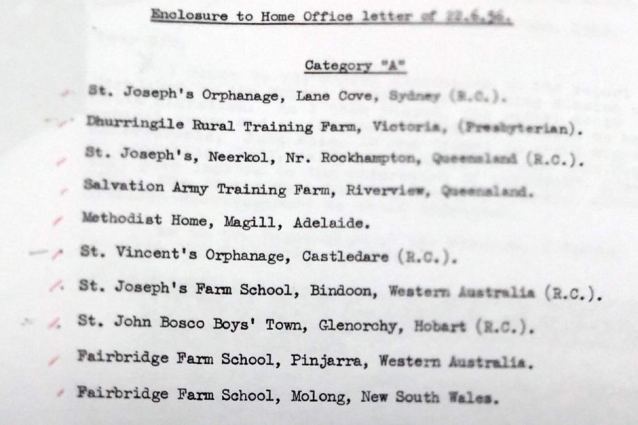
The list of homes the Home Office is said to have known abused children; Photo credit: ABC News

CROSS POSTED ON BYLINE.COM

Next month the Independent Inquiry into Child Sexual Abuse will hold a hearing into how British children were shipped abroad to  Australia, Canada and Southern Rhodesia ( now Zimbabwe) where they were subject to appalling physical and sexual abuse.

One of the people who has submitted evidence to the British inquiry has already raised issues about his treatment at one of these homes, Fairbridge Farm School,New South Wales in Australia.

David Hill  was interviewed by  the Guardian last year in Australia and tells a horrific story of a place where people were poorly educated and fed,brutally treated and some sexually abused. He went out with his brother in 1959 from Eastbourne in Sussex.

He has been one of the people who eventually prospered becoming chairman and managing director of the Australian Broadcasting Corporation. ABC carried a report on his decision to send evidence here.

But his most damaging evidence is that he might not have gone there if the Home Office had acted on information they  received three years earlier after a visit of UK MPs to Australia. In 1956 they came on a fact finding mission to find out about conditions in those schools.

The result, according to evidence submitted to the inquiry. is that the Home Office were given the names ( see above in a memo) of ten schools that should have been put on a blacklist and no British children should have been sent there.

But the Home Office appeared to  do nothing even though they decided that  the schools would need a ”  complete metamorphosis ” to be fit to accept children. So they appear to have ignored the findings so they could keep the migrant programme going – where British children from poor backgrounds were offered a new chance in life. Their decision was no better than when a whistleblower, Lucy Cole Hamilton, alerted the Home Office over a decade earlier about conditions at Fairbridge Farm and warned them not to send British children there. As a report by Sanchia Berg for the Today programme revealed in 2009 the decision was to “lay by ” and do nothing.

I am hoping that this callous attitude – which seems extended today by the Home Office and Theresa May’s view that we should all but ignore the plight of immigrant children seeking asylum in the UK – is thoroughly examined by the inquiry.

The inquiry’s own research report points out the whole area is remarkably under investigated.As it states no inquiry has ever undertaken a proper  and sustained  analysis of the failings of this huge programme and properly investigated whether some of the children were sexually abused by people in institutions before they were sent abroad.

Gordon Brown has apologised in 2009 about the way the children were treated. But it was enormous programme – some 150,000 children participated and it began in the early 17C when children were sent to Virginia – though some of the largest programmes were after the second world war. It did not stop until the 1970s.

A lot of questions need to be answered – not least from the one posed by David Hill about the role of the Home Office in the late 1950s.


Exclusive: Disabled army veteran and IRA bomb survivor targeted for the sack by human rights watchdog

david-isaac-pic-credit-bbc

David Isaac, chair of the Equality and Human Rights Commission, and agreeing to sack disabled and black people who work for his organisation.

rebeccahilsenrath

Rebeacca Hilsenrath: chief executive of the Equality and Human Rights Commission and leading the programme of staff cuts Pic credit: Douglas-Scott co.uk

CROSS POSTED ON BYLINE.COM

This is a story of the human cost of the Government’s cruel policy of saving money at any cost that is being pursued by a watchdog that is supposed to champion human rights in Britain.

The Equality and Human Rights Commission – despite strong staff and union opposition- is pursuing a policy of slashing staff. Its own equality impact assessment reveals that the cuts are to fall on the very people it is supposed to defend. Some 75 per cent of black people and the majority of disabled  people are said to have “failed” an initial assessment to keep their jobs. Most of the winners are young, able bodied and white.

But it is not just about statistics, it is about people.

One of the people who seems certain for the chop is  57 year old Markus Caruana,  who works in corporate communications at their Birmingham office.

He is a former flute player in the Corps of Drums with the Grenadier Guards.

Markus Caruana was unfortunate enough to have been both at the Guildford pub bombings in 1974 and the Chelsea Barracks bombing in 1981 which seriously injured regimental bandsmen from the Irish Guards.

He escaped unscathed in both instances but saw three of his friends killed in an IRA attack in Crossmaglen in Northern Ireland.

He left the army in 1985 to become a landscape gardener and then took advantage of a Unison sponsored education scheme to learn to read and write.

He had been a school refuser after being bullied and could hardly read or write or read music but was able to play his  flute because he had a natural memory for tunes.

In 2002 he secured a job with the Disability Rights Commission which later became part of the EHRC.

Sadly he lost his 75 per cent of his hearing and got  an incurable muscle wasting disease called Marie-Tooth disease (CMT) which affects the nervous system that supports muscles, often weakening the legs and feet.

The EHRC had enabled him to have a support worker so he could do his job there – but she is also facing redundancy now he has failed to retain his job.

Lois Austin, a full time official for the PCS union, which is fighting the cuts, said: “The Equality and Human Rights Commission are targeting some of the most highly competent disabled and black people for this new round of cuts.

” He is just one of a number of disabled and black people, some with young families, who are losing their jobs.

” If this was a private company the EHRC should be prosecuting them for discrimination. Instead they are setting an example for other firms who want to dump the disabled to save costs and the bother of employing them.

The EHRC  take is this. A spokesperson said:

“Whilst we cannot discuss individual cases, we deeply regret having to reduce our headcount as a result of budget losses, but like every public sector organisation we have had cuts imposed on us. We have strongly resisted these cuts, but believe the changes we are making will ensure we can still deliver our ambitious programme.”

In my view the EHRC’s stance is a hostage to fortune. They tell and could even prosecute firms who discriminate  against disabled people. If I were an unscrupulous employer I could now tell them to get stuffed – saying they are only following what the EHRC do rather than

say – which is to dump expensive and bothersome people who need support workers – to save money and increase my profits.

Britain’s  human rights body should hang its head in shame for what it is doing to its own disabled staff.


Bumped by Trump: How Whitehall used the US elections as cover for £1 billion military spending blunders

donald-trump-pic-credit-cnn

Donald Trump Pic credit: CNN

CROSS POSTED ON BYLINE.COM

One of the oldest tricks in the Whitehall playbook is to use a major event as cover to publish unpalatable or embarrassing news.

It means the media are diverted by the event and don’t notice the announcement or report.

It worked an absolute treat for the Ministry of Defence and the Treasury over the US elections to hide two very bad news stories for them. They couldn’t believe their luck when Trump unexpectedly won.

The Ministry of Defence took advantage on polling day to slip a very embarrassing announcement about money for war veterans pensions and disability payments. Evidently the previous July the Treasury, believe it or not, forgot to include in its spending statement the proper  money to pay them this year. As a result they will have to raid the contingency reserve for emergency payments to make sure these veterans have the money.

Mark Lancaster, parliamentary secretary to the ministry, admitted the error in a written statement to the Commons just as Parliament rose on November 8  describing the failure to disclose it as an “inadvertent publishing error”.  It involved a staggering £438,193,000 in the Armed Forces Pensions and Compensation scheme which is available to serving and former personnel who are injured in military service including in Afghanistan and Iraq.

The second cover up by the Ministry of Defence came on results day. This was an embarrassment to the image of the Ministry of Defence. For years they have endured criticisms on cost overruns on equipment, bad spending decisions and lack of control.

Last year this was all meant to change. A new agency the Defence Equipment and Support, was supposed to take control  and rein in all these errors. It describes itself as a bespoke agency in charge of equipment and projects for the armed forces.

Well it seems to have deliberately chosen  the US election day to publish its first report. The reason I suspect is that the National Audit Office has qualified its accounts and made a stinging attack on its performance. The NAO can only release this when the report is published and the agency chose election day to do it.

The report by Amyas Morse, the Comptroller and auditor General is damning.Some £499 million of public expenditure cannot be properly accounted for.

“I have qualified my opinion on the financial statements due to a limitation on the scope of my audit because DE&S has been unable to provide me with adequate evidence to enable me to confirm whether or not the private sector support costs, other programme costs and the related trade and other payables balance shown in the financial statements are free from material misstatement.

“I believe this situation has arisen because the Agency’s financial management systems, processes and controls for these transactions and balances are not yet sufficiently well developed to meet the Agency’s needs.”

Examples include having to manually insert some 100,000 changes into the computer programme because it had not  been drawn up properly. And reporting money for the wrong year.

Luckily in both cases MPs are not going to let the matter rest- and come back to the issues

Nia Griffith, the shadow Defence  Secretary has attacked the government for putting at risk funding to help military veterans warning that they must be given an urgent reassurance that they will not lose money.

Anne Marie Trevelyan, Conservative MP for Berwick on Tweed and a member of the  Public Accounts Committtee, said :“At a time when we are seeing a lot of change in the Ministry of Defence, causing a great deal of anxiety for those who are serving, it is very disappointing to see Defence Equipment & Support has not got to grips with financial management.

“At the same time there are serious issues with service family accommodation, highlighted by the Public Accounts Committee which would benefit from a much smaller investment.

“This points to a lack of joined-up financial planning in the Ministry and raises concerns about whether the department is delivering value for money across the board.”

Quite right. Whitehall must not get away with playing games with how it discloses it is spending our money. I have written a news article for Tribune magazine on this.


Will the national body that prides itself on conciliation end up in a bitter dispute with itself?

sir-brendan-barber1

Sir Brendan Barber, chairman of Acas, Pic Credit: Acas

CROSS POSTED ON BYLINE.COM

Acas – the Advisory, Conciliation and Arbitration Service – is a body  that nobody normally can take offence. Like motherhood and apple pie, it is seen as a virtuous organisation that promotes peace,harmony, and fair play in a warring world between workers and bosses over  jobs,pay and  conditions.

So it might seem unlikely that such a body could end up in a bitter dispute with its own staff. But that is exactly what is starting to happen following a decision – completely unprompted by government – to make radical changes to its services to the public.

These include cutting the number of advisory helplines from 11 to 4, closing its office in Liverpool, which employs 50 people, and according to the union, downgrade work so lower paid people provide both advice and  conciliation work.

The helpline is particularly popular with workers and employers alike. According to its annual report 96 per cent of its users would recommend its service to a friend and 94 per cent thought the people on the end of the line were  really knowledgeable about its work.

Acas appears to have decided to streamline its services as part of an efficiency measure anticipating that perhaps Whitehall – which funds 90 per cent of its work – will start cutting its budget.

According to its officials all this is to be achieved without shedding any jobs.

A spokesman said :“Acas has undertaken a thorough review on how to best meet the needs of its customers across the country whilst securing better value for money for the taxpayer.

“Our national Helpline service is being reorganised into four central locations across the country and Acas North West will have a single area office in Manchester in line with our other regions across the country.

“There are no plans to reduce the number of Acas staff due to these changes so our customers will still receive the same high quality service from Acas North West and our national helpline service.”

The unions however don’t believe this. The Public and Commercial Services Union, which represents along with the FDA, its staff, is talking of going to a tribunal to accuse Acas, of all things, of failing to consult its own staff.

The PCS union say the conciliation service in London is at risk and the future of Acas’s head office functions and the future role of the Certification Officer – the official that policies union disputes  and registers trade unions – is under review.

It also accuses Acas – rather like the Equality and Human Rights Commission -of making black workers take the brunt of the changes – and believes they will.lose their jobs. Acas insists that those working in Liverpool will get jobs in Manchester – and they will pay their fares to their new office.

This potential dispute is all the more interesting because the current chairman, Sir Brendan Barber, who is backing the changes, is the former general secretary of the TUC, the body that champions workers and unions.

So far the TUC is silent about its views on the change. But one of its union members, Mark Serwotka, general secretary of PCS is not.

He says: “With the Tories ploughing on with damaging cuts and trying to undermine trade unions, Acas’s employment services are needed more than ever.”

“It should demonstrate best practice, not behave like a rogue employer by putting jobs at risk and creating uncertainty, stress and anxiety.”


The Brexit court case: Much ado about nothing

daily-mail-enemies-of-the-people

The absurd and despicable take by the Daily Mail on the court judgement

CROSS POSTED ON BYLINE.COM

The reaction to the High Court decision saying that Parliament should be able to debate and trigger Britain’s application to leave the EU has been both depressing and ludicrous.

Newspapers like the Sun, Daily Mail and Daily Telegraph have treated the judges as ” enemies of the people ” just for having the temerity to lay down what is a perfectly valid constitutional decision.

They have NOT ruled that Britain should never leave the European Union but only that our leaving should follow proper constitutional procedures.

The papers have whipped up popularism on a totally false premise and played to the ignorance of people about what is actually happening.

The people who voted to leave the European Union should be delighted not furious about what has happened.

Their main case for leaving the EU was that they didn’t want to be ruled by Brussels and wanted to take back our sovereignty to rule ourselves.

Well what has happened. A British court composed of British judges has ruled that a British Parliament should have the last word and decide how we leave the EU. Brussels or any other foreign power has not said a word.

That seems perfectly reasonable to me. We are a Parliamentary democracy who elect MPs to pass laws and take up issues on our behalf. What we had earlier this year was a referendum not a general election in which the people decided to leave the EU. Therefore it  is Parliament not the government that should be guardian of that referendum.

The last general election was won by a party that promised a referendum on whether we should leave the EU, not on a mandate that we will leave the EU – you had to vote UKIP for that.

The other criticism of media coverage of this ruling is the  despicable attack on both the person who brought the case and on the judges themselves. Anybody has a right to bring a case and the idea they should be pilloried for doing so is anathema to democracy.

And the attack on the judges – particularly the homophobic criticism of one of them – was absolutely beyond the pale. What right has the Daily Mail to highlight that one of the judges was gay. Do we have ruling that no gay judge can pass judgement in this country? That is utterly despicable – worthy more of Donald Trump than Paul Dacre.

There is another profound reason why Parliament should make the final decision. Yes we voted to leave the EU but nobody was given a clear picture of how we were going to leave the EU during the referendum. The No camp did not have a plan.

So given there  about 57 Heinz varieties of doing so – it is right that our MPs and for that matter peers under the present system  should  debate  how we are going to do it and question the government on their plans.

The government is arguing that to do so would give away their hand. This is ridiculous and untenable. If the government think they can negotiate in secret  they misunderstand the role of the press in this country and Europe. their plans will inevitably be leaked and when it comes to the negotiations to leave in Europe- journalists will have the resources to tap officials from 28 countries to find out what is going on. Theresa May is living in cloud cuckoo land if she thinks she can keep a lid on it.

So what is all this sound and fury about this decision by the judges – in my view it is much ado about nothing. People should grow up and accept in a mature democracy the issue should be debated and decided in the best forum to safeguard our sovereignty- Parliament.


Are German State Railways exploiting train drivers in Britain to put lives at risk?

db-cargo-freight-train-in-uk

A DB Cargo UK train in the UK. Pic Credit: Flickr

CROSS POSTED ON BYLINE.COM

Earlier this month I  wrote an article for the Sunday Mirror about exhausted freight train drivers going over danger signals because they were asleep at the wheel.

The source was a highly respected but until then completely unnoticed report from Whitehall’s Rail Accident Investigation Branch. It followed two cases of drivers last year “momentarily falling asleep ”  while driving huge  freight trains on the Great Western main line near Reading.

The report made damning reading of the way DB Cargo UK, the Doncaster based British subsidiary of  state railway Deutsche Bahn, was treating its  train drivers with little concern for their  welfare and for that matter rail safety.

The report revealed that a combination of long shifts – ten hours at a time – and rest facilities which were ” unfit for purpose ” –  two sofas in a  brightly lit corridor – meant that drivers had little or no sleep. One driver hadn’t slept for 19 hours when he went over the danger signal. Another came to a halt where a luckily empty high speed passenger train was due to cross its path on the way to London Paddington. It was stopped by automatic train signals.

“Evidence gathered during the current investigation found widespread dissatisfaction with the standard of the drivers’ facilities at Acton train crew depot relative to equivalent facilities at other depots.

“The RAIB’s inspection confirmed that the designated rest facility at Acton was not conducive to napping because of the amount of noise, its location (being on a through route between other rooms), and the unsuitability of the furniture for napping.”

“Drivers’ rosters fell outside the guidance in respect of maximum duration for a night shift, minimum rest period between night shifts and clockwise rotation of shift start times,” says the report.

“The shifts being worked by both drivers when the incidents occurred involved starting in the middle of the night (00:48 hrs for Driver A and 23:51 hrs for Driver B) and working a relatively long shift (10 hours and 57 minutes for Driver A; 9 hours and 38 minutes for Driver B). Driver A was working a sixth consecutive shift, five of which were similar night duties.”


They also found staff reluctant to  complain.

“The RAIB also found a perception among some drivers that management are not sympathetic to drivers being fatigued and that controllers might pressurise drivers into continuing working in order to meet operational demands. Driver A stated that he experienced such pressure concerning a turn of duty in September 2015.”

The train drivers union,ASLEF, is campaigning for train drivers to be treated like truck drivers by allowing them to have greater rest periods.

You certainly could not drive a lorry for the length of time you can drive a train because tachographs would record that you had broken the law. And the driver who had not slept for 19 hours would have been stopped driving a car because his fatigue would probably register the equivalent of having too much alcohol in the blood.

DB Cargo UK say they have taken action to tackle the rosters and to provide newly refurbished facilities in another building in Acton for staff to have a nap.

Lee Bayliss, Head of Safety and Risk at DB Cargo UK, said: “Fatigue is an issue we take very seriously and we have implemented robust processes and policies to manage it. This includes establishing a Fatigue Working Group to integrate best practice from the Office of Rail Regulators and the Railway Safety Standards Board in order to continually improve procedures and standards.”

However while the report revealed the company did have regular safety meetings they were not well attended which suggested they did not command much priority.

The report shone a light on a hidden side of the rail industry. People are already fed up with the performance of some privatised firms running passenger trains – enough to make rail nationalisation popular again.

The freight side is overlooked but on this evidence it might suggest Labour should look at extending their pledge to freight.- particularly if foreign state rail companies behave like this. After all, both passenger and freight share the same tracks.


The crisis at the heart of Britain’s Equality and Human Rights Commission

David Isaac Pinsent Masons

David Isaac: Chairing a fractured organisation with staff and management now at loggerheads.

rebeccahilsenrath

Rebeacca Hilsenrath: chief executive of the Equality and Human rights Commission Pic credit: Douglas-Scott co.uK

CROSS POSTED ON BYLINE.COM

Human rights – whether it is gay rights, racial discrimination, gender equality, equal pay or disability discrimination – is at the heart of many of the big issues facing modern Britain today.

It is therefore a tragedy that the organisation responsible for monitoring such issues is now a fractured body with management at loggerheads with staff and the main focus of a destructive policy of government cuts by people who appear to believe there is no such thing as society and these rights are not necessarily worth defending.

Today this body came within a hair’s breadth of facing strike action by a frustrated and alienated staff  and the action was only averted by talks at Acas. Contrary to the popular image civil servants do not take strike action lightly – it is only a measure of last resort. So when two unions, the Public and Commercial Services Union and Unite, decided to take such action, things have reached crisis point.

Its crisis is not surprising when a body like this has suffered cut after cut until it is a shadow of its former self and people – including the United Nations – are questioning whether it can have any meaningful role in defending people’s rights.

The  gaping divide can be seen between the  perceptions of management and staff over what is happening there at the moment – I did an article on the forthcoming strike for Tribune last Friday.(unfortunately not on line at the moment) and one on the great divide between management and worker’s salaries for Sunday Mirror earlier which is the subject of a dispute by the Commission ( also not on line at the moment).

The present cuts whereby nineteen of the first 26 posts due to be axed are held by staff in the three lowest paid grades, means the government body responsible for protecting vulnerable workers is itself disproportionately targeting older, ethnic minority and disabled staff. Another 50 are expected to follow.

The union and staff reaction to this is shown by a quote from Mark Serwotka, the genetal secretary of PCS, “The commission is spending hundreds of thousands of pounds on consultants while getting rid of low paid staff who provide daily support to victims of discrimination.

“It is sickening that as division and hate are being fostered in our communities in the wake of the Brexit vote, this Tory government is cutting the staff whose job it is to combat this.”

The management view is the opposite.

A Commission spokesperson said:“It is disappointing that the union have decided to take this action. We have made every effort to work constructively with them on our proposals as we implement our new way of working. We have listened to them throughout the process and acted on a number of their suggestions.

“Like every public sector organisation we have had cuts to our budget.  We need to make savings and we need to change how we work to deliver our strategic plan.  We are confident that any action will not affect the important work we do in protecting and improving people’s rights.”

“We have a very diverse workforce when compared to the wider public and private sectors.  The operating model was consulted on exhaustively with all staff, transparently and with a focus on the most effective structure for the Commission rather than the individuals in the posts affected. In addition to this, there will be a stronger focus on new training and mentoring schemes to support more minority ethnic and disabled staff into leadership positions.”

Given human rights is a central issue in Britain I have decided to forensically examine what is exactly going on at the EHRC. Can the top management justify its large salaries at the taxpayers’ expense? Is running the EHRC just a career option for an elite group of officials and a millionaire lawyer ?  What issues are the EHRC  really taking up and are they effective in doing so? Who are the people they want to sack from their organisation? Is the EHRC  really value for money?:Do they practice what they preach to private industry and the public services?

Fortunately  I have seen a large volume of material from a wide variety of sources – far too much to put in one blog or article – that  allows me to look at such issues. Over the next few weeks I intend to examine this and put it to the EHRC and other scrutiny bodies, like Parliament’s Women and Equalities Committee, which is preparing to examine whether the EHRC is doing a proper job.


Robert Halfon v Jeremy Corbyn: The battle for the working class vote

CROSS POSTED ON BYLINE.COM

Jeremy Corbyn’s success in attracting tens of thousands of new Labour supporters was given a rare  accolade this week at the Conservative Party Conference.

Robert Halfon, Tory MP for Harlow and the skills minister, told a Conservative  Party fringe meeting  organised by Respublica how the Labour leader had attracted these people because they saw him representing  their ” moral and ethical ” values and being fair minded rather than representing ” the privileged few”.

No doubt this would lead to a furious denial  from the Labour right wingers like Ben Bradshaw and Tristram Hunt – who see the whole exercise as a  1980s rerun of ” Reds under the Beds”  and  some predictable squealing from the Tory right who probably believe it should be a criminal offence to join a trade union.

But it was an intelligent assessment if you are a Tory at a time when capitalism is associated with unbelievable greed, inequality, globalisation and you are about to start an experiment  with Brexit that could lead to  uncertainty and an economic downturn.

For if there is another economic crisis the public- and particularly the young  -could easily turn against capitalism if it continues to crush and impoverish the working class at the expense of global multi billionaires. And Jeremy Corbyn will be ready and waiting.

Halfon’s pitch – which was reflected  in Theresa May’s speech – was basically to say unions were a good thing and should be given more power and influence in the board room. The arguments for collective bargaining  were made at this meeting – and the argument that where unions and management collaborated in other countries there was more prosperity and growth for more people.

Halfon is a member of the Prospect union and the union’s moderate general secretary Mike Clancy  was speaking at the same meeting and telling a few home truths to Tories.

Ha, ha , you might say from the party that has just passed the most vicious anti trade union laws in Western  Europe, penalised the poor and disabled ( Halfon is disabled too) and vilified people as scroungers. And it has also seen post Brexit a ferocious attack on immigration and immigrants that has led to the death of a Polish worker in Halfon’s constituency.

But what we are seeing under May and Halfon is a new battle of ideas to woo ordinary workers and families. The Tory Party is once again transforming itself – away from the uber Metro Notting Hill Set of Cameron, Gove and Osborne – to   Essex and Berkshire – combining an appeal to working class  Essex man and  middle class Berkshire woman. It always does this to maintain what it wants – to stay as the party of government.

But there is a very big elephant in the room called Brexit and in my view the conference was in total denial about it. We are going to curb immigration, tell the European Union what we want, build world wide markets for goods and services, and nobody will challenge us. Our newly trained doctors will be barred from emigrating until they have served time in the NHS, while foreign doctors will disappear from hospitals.. Our young people will spend their summers picking strawberries and hops in the UK rather than travelling  – like they used to a century ago – to bar EU workers from doing the same jobs.

And any opposition from people with different.viewpoints will be silenced. No doubt we will send a gunboat to any foreign power that dares challenge us like Palmerston in the nineteenth century.

Really? As the Daily Mail didn’t say this week, the Tories will be living in la la land if they believe this.


Call General Election now: What Ed would tell Theresa

ed-balls

Ed Balls Pic Credit: Wikipedia

CROSS POSTED ON BYLINE.COM 

I went to  an unusual book launch by a politician this week. Instead of a self serving glowing account of their great achievements (pace Tony Blair and Peter Mandelson to name but two) this book by Ed Balls is refreshingly  honest – it talks about his political mistakes (intended or otherwise).

Ed Balls – who probably will become more famous for his performances  on Strictly Come Dancing than his role in promoting tax credits – suffered the ” Portillo moment” at the last General Election when he was unexpectedly defeated by the Tories. Indeed he revealed  BBC Panorama had unsuccessfully tried to get him to do a programme with Michael Portillo on this very fact and compare and contrast how high flying politicians feel when the electorate rejects them.

Organised by the Strand Group  (see report ) at Kings College, London Ed Balls admitted many mistakes – such as he could have handled better the sacking of Sharon Shoesmith, the former head of Haringey’s childrens’ services, over the notorious torture and death of Baby P.

He was also critical of May’s failure of leadership over Brexit and also warned that when governments have a weak opposition the media narrative is all about splits in the government – hence the obsession about the Blair Brown split when Iain Duncan Smith led the Tory party. So if the Labour row continues May could find life difficult as the media hone in on Tory Brexit splits.

One experience Gordon Brown and Theresa May share is that both of them have been anointed Prime Minister – neither faced a campaign against rivals and both took office without winning a general election.

In his book Ed Balls describes the botched attempt to call a general election immediately after Gordon became leader. Ed writes at the time ” the ‘risk’ of going for an early general elecrion was nowhere near as risky as deciding not to.”

But Labour dithered – first talking up an early election – and then knocking it down.But the result was devastating and certainly Brown made a mistake in not  acting  earlier and more decisively.

As Ed concludes on the day Brown backed off from an election: ” A dismal day in October, a day from which Gordon’s premiership and the togetherness and trust of his closest advisers and confidants never recovered.”

So what would Ed advise Theresa to do now. I asked him this when I got him to sign a copy of his book.

His answer was frank. She should call an election  setting out her  own manifesto and then be able to choose her own Cabinet.

Given the troubles she will face with colleagues – and potential new rows over decisions like Heathrow, HS2, Brexit, immigration etc and the current divisions within Labour it might be good advice for the Tories. She has a much smaller majority than Gordon Brown inherited from Blair.Otherwise she might regret it like Gordon Brown.

I wonder if she might surprise us all by announcing it at the Tory Party Conference?