A stormy tribunal case around Bradford City Hall. An AI generated image.
The Employment Tribunal system is being dragged kicking and screaming into the 21st century yet still fails to deliver on open justice or provide what should be a basic expectation: a recording or transcript of public proceedings. Many claimants navigating the painfully slow-moving appeals process cannot obtain recordings because their original hearings predate the introduction of the recording system. The only alternative—the judge’s notes—will never be released, according to the Judicial Conduct Investigation Office.
Labour MP Anna Dixon recently raised this as a serious issue again at a Public Accounts Committee meeting in Parliament. Officials were unable to ,provide an answer.
Now a new problem has emerged: corrupted recordings. This latest case involves a 2024 hearing at Leeds Employment Tribunal between former Bradford Council employee Noreen Taylor and the authority, presided over by Judge Neil Maidment. Taylor had been employed as a contracted employment hub coach in the Children’s services Skills House team
Judge Maidment dismissed Taylor’s case, where she had raised serious concerns including safeguarding failures affecting children, notably by one staff member; data protection breaches involving children; misuse of European funds and recruitment irregularities. The recruitment irregularities emerged after evidence and were accepted by the respondents. Applicants were encouraged to apply for two jobs – a business manager and programme services manager – that had already been filled a month earlier.
Taylor said she had suffered years of detrimental treatment by senior staff there, many of whom have now left. But it was not until the first day of a 14 day trial that the council accepted 9 out of 13 protested disclosures.
Astonishingly, when she stated her lawful right to contact her MP and report these issues to police, she was warned against doing so.
Judge described claimants racism fears as ” jovial fun”
Taylor, who is from an ethnic minority background, was singled out in a business meeting with her white British colleagues. During the meeting, she was repeatedly referred to as “your inner chimp, Noreen your chimp,” and everyone laughed—except Taylor. She later confirmed via texts and phone calls with her colleagues that she had been visibly upset and distressed by these comments. The judge did not agree and described it as ” jovial fun”.
This incident occurred after Taylor had raised whistleblowing concerns, in what appeared to be an attempt to shut her down. The business manager, who had been involved in recruitment irregularities, was supported by the Assistant Director of Children’s Services. This detrimental racial treatment of Taylor continued for months, ultimately affecting her health. The manager later explained in an internal meeting that his reference to The Chimp Paradox was intended to refer to a behaviorial psychology book, not as a racist remark aimed at Taylor
Taylor, who was experiencing disability-related health issues, due to the onslaught of bullying and harassment within Children’s services was ultimately dismissed on ill health capability grounds, this was after she was kept as a NIL pay employee for years until the council covered up and prevaricated, intimidated, harassed and even trespassed into her house shown on CCTV and to the ET Judges at Leeds.
The judge ruled that her dismissal was due to ill health, and not her whistleblowing activity. Despite her protected disclosures being linked to a long list of detriments, she was subject to exclusion, harassment, gas lighting when she raised concerns. She was removed from the business team and her IT access and her work email address was stopped.
She was a litigant in person pitched against the fourth largest local authority who had the money and access to barristers to fight her. It took the authority from late 2020 until the 14 day trial in April 2024 to accept any of her protective disclosures. But she was determined to continue for the sake of getting vulnerable children justice.
During the preliminary hearings, she says one of the judges referred to the head of legal team on first name terms and did not recuse himself. Later it was found out the judge was employed by the council as a consultant. This judge threatened to strike out all her whistleblowing claims at the request of the council’s lawyers but did not succeed. She had been unable to get the Judicial Conduct Investigations Office to investigate her complaint, because it came too late as she had only three months to complain.
In May 2024 Taylor says the judge appeared to do a U turn by portraying her in a negative way after accepting at a preliminary hearing there was a case to answer particularly over the safeguarding issues.
Transcripts of hearing withheld for 2 years
Taylor immediately decided to appeal but encountered months of obstruction and delays in obtaining the hearing transcript. She needed the transcript to challenge evidence given by a staff member (and to lodge a complaint about the conduct of the judge) Even after Conservative MP Robbie Moore who represents Keighley and Ilkley became involved the claimants request for a transcript was sent again in December 2024 but clerks gave varying excuses making each and every one more suspect, yet from May 2024 to end of 2025 it will be almost 2 years the transcript has been withheld by Leeds ET by current Regional Judge D N Jones.
For a July Employment Appeal Tribunal hearing, she enlisted veteran whistleblower Alison McDermott to act as a McKenzie friend.
At the Rule 3.10 hearing—which determines whether an appeal can proceed—Taylor explained her inability to obtain the transcript. The EAT judge was sympathetic, telling her: “I don’t have the power to order the lower courts to produce it because it’s an administrative matter, but I can direct a letter to the acting regional judge explaining you have an appeal and that the transcript is required. I am content if you’re applying to adjourn today’s hearing until the trial transcript is provided.”
Taylor has now been informed she cannot have the transcript because the recording SENT BY LEEDS ET is too damaged. Acolad, which processes court recordings, told her: “Unfortunately, our back office advised the disc was too damaged to extract any information as it wasn’t possible to upload the audio from the disc to the system.”Acolad have emailed and written to Leeds ET on numerous occasions and have been ignored for months since July 2024.
Without the transcript, Taylor cannot proceed with her appeal application. This extraordinary situation points to either gross incompetence or negligence at Leeds Employment Tribunal—another example of a broken system. Staff should know whether a recording is functioning properly. Taylor says: “It is outrageous that a whistleblower who raised serious concerns about child safeguarding can be denied my right to appeal because the tribunal failed in its basic duty to maintain a proper record of proceedings. This isn’t just administrative failure—it’s a perversion of justice that makes a mockery of the entire tribunal system.
How can justice be seen to be done when there is no verifiable record of what was said? This goes to the heart of the rule of law and the principle that courts must be accountable and transparent.”
But for the whistleblower it is another dead end and an impediment to get any justice.
Meanwhile the justice department continues to obfuscate over the provision of court records to claimants.
On 20 March 2025, Anna Dixon MP asked the Ministry of Justice two questions at the Public Accounts Committee. Simple questions. Pre-notified questions.
“How can people receive a fair trial if a record of proceedings is not made available to them?”
“How can judges block access to those records when they themselves are being accused of misconduct?”
Dr Jo Farrar, the Permanent Secretary, talked about “court productivity.” Gemma Hewison, Director General, said: “We’ll have to write to the Committee.”
They couldn’t answer. Because the answer is indefensible.
An alleged horse murder, police protection at a parish meeting and council office and notice board defaced with hated filled graffiti
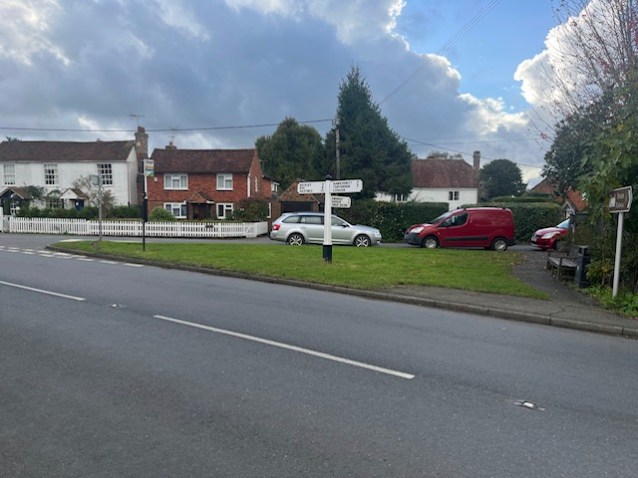
You could not imagine a more bucolic English scene. Beautiful rolling Sussex countryside, white painted country cottages, a heritage steam railway running by the village and Bodiam Castle, an imposing moated medieval ruin dominating the valley.
But this quintessential sleepy English village hides some of the most vicious in fighting by former and sitting parish councillors and their friends involving hate filled Facebook posts, false allegations, dodgy contracts, one sided council investigations, favours for friends, while Sussex police and the Rother District Council try to pretend nothing is happening here.
If this was inner city London or Birmingham such battles would be factional or party political. But here it is not politics but rival personalities who either want to control events or who are convinced dirty business is afoot in secret meetings.
A Midsomer Murders village?
If there is a script for this story it could either be an Agatha Christie novel or an episode of Midsomer Murders. So far only a grazing horse has died, but given the tensions here one wonders whatever will happen next.
So how has this happened? The trigger for all this is a remarkable pot of gold given to this little village by the former Tory Cabinet minister Michael Gove. As levelling up secretary he approved a massive £1.4 million loan in 2019 to enable the parish council to purchase a former Blue Cross animal rescue centre so the village could use its ample green acres for community use.
There had been much consternation in the village when the Blue Cross decided to close and sell the site as the original land had been donated by a local farmer and it was a valued part of the village as well as providing much employment.
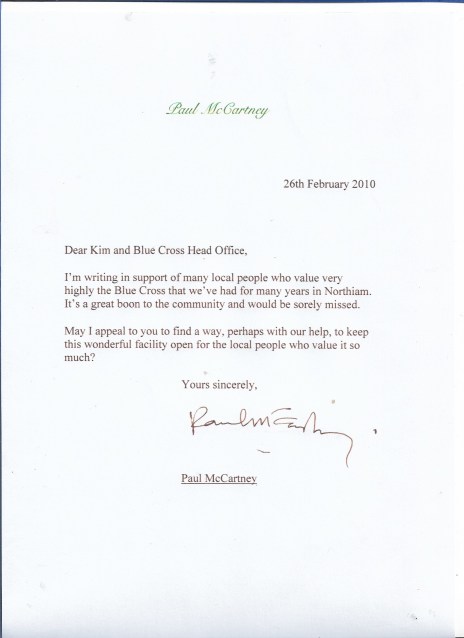
The parish council was united in wanting this centre. Before they bid to buy it former Beatle Sir Paul McCartney came to the village with the chief executive of the Blue X centre to see if it could be saved. He even offered to underwrite the cost but the organisation was determined to close it.
His earlier letter of support for the Blue X Centre before it closed is here:
The purchase of this 34 acre greenfield site has meant that all the residents face an extra parish council precept on top of their council tax to pay back a Public Loans Work Board loan backed by the Treasury for the next 50 years.
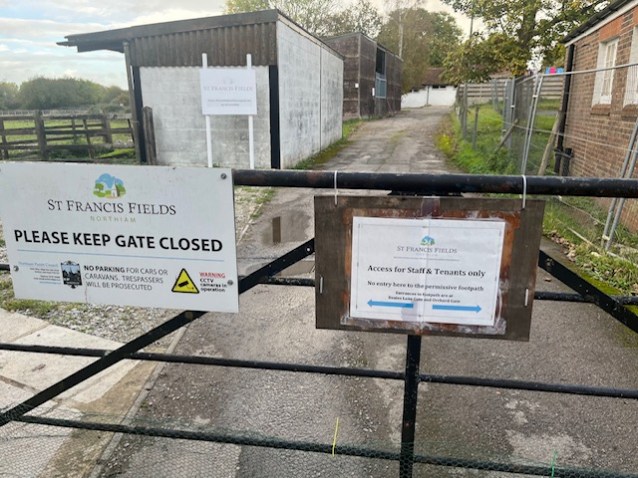
Horses looked after by Lauren Sapsted graze on the former Blue X site – known as St Francis Fields
The row emerged about what to do with the land once it was owned by the council. At the time when all was sweetness and light a proposal was drawn up by then councillor Penny Farmer with the aim of providing local facilities for local people with talk of a riding school, workshops and local people being allowed to graze their own horses and allowing a small number of new houses to rent to local people who couldn’t afford Sussex’s rocketing house prices. These would have been built on an ‘exception site’ basis and was limited to an initial build of six.
Then councillor Penny Farmer, who has an equine background was also asked to provide costings of how the stabling and grazing could be made to work so that government loan would be affordable while allowing public use and her costings were included in the proposal to the government, to help convince them to grant the loan. The proposal and map of the huge site is here–https://docs.google.com/document/d/1PJLomhPMtDrIGl3yNsnQofsjlJDopvPcRQcYpiIW_24/edit?pli=1
The first sign of things going wrong was when it was decided to hand over the running of the site to a non profit making Community Interest Company with a clause saying the directors could take profits from developments on the site and it was allowed to keep all the revenue from the site to spend as it saw fit.
The big issue with the CIC is that as a corporate body, it has cost the parish council more money than they have created or put back into the project. The Parish Council “grants” them £1500 a year, they use an office and storage space as well as land owned by the Parish Council rent free which the council could otherwise rent out and they have not achieved anything the Parish Council couldn’t have done itself despite not having “power of competence”. Last financial year – they got double the grant -two tranches of £1500. They also rent unknown land/buildings on the site to unknown people for £1460 a year – there is no record as to who or what this is all about at the Parish Council; it has never voted or agreed to this use. The latest accounts are here.
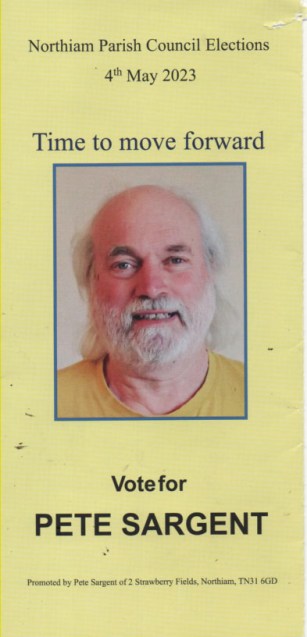
Pete Sargent
When it was set up it soon emerged that other councillors had different ideas and one in particular Pete Sargant, who chaired the council at the time and is still a member, was seen by opponents as the ” village Godfather figure”. He is a smooth talking man with a lot of friends in the village but rather like Macavity in the musical Cats it is his friends who do a lot of the arrangements. Macavity is not there.
Pete Sargent said: “Several of them stated that they would be interested in helping set up the CIC and so I called them all together and asked them if they would like to set up the company, which they duly did. They chose themselves.”
This is not entirely true. Judith O’ Connor, the chair was tipped for the post in advance while Carolyn Pierce, previously a councillor, who had worked on the Blue X rescue centre for 20 years, was denied a post when she requested one. It is said by Jon Streatfeild. a former chairman of the council ,that Sargent kept the book with the directorships to himself for six months until all the posts were filled, mainly to members and friends of his in the local Bonfire Society and the Village Hall Trust.
Later when one councillor, Ben Dallimore, in 2022 demanded to see the minutes kept at the parish council office, the then clerk to the council, Nicola Ideson, threatened to call the police, started messing up files and tried to make out she was being physically threatened and harassed and pushed him out of the office. He had the foresight to have recorded the conversation and when she complained he made it clear he had recorded it. In February 2023, she contacted the Information Commissioner’s Office to say that as a Parish Councillor, he had recorded her at work and she wanted a copy of the data. After some arguing back and forth with the ICO about the nature and purpose of the recording, he gave her an edited copy of the recording which only contained her information..
It soon emerged there was a reason for this secrecy. For instead of planning new community facilities the first thing that happened was an approach to a housing developer suggested by retired architect, Julian Luckett, partner of Judith O’Connor, who chairs the CIC and an administrator of the Northiam Facebook page.
Jennifer Owen Construction Ltd, a local firm, had already built expensive £500,000 four bedroomed detached homes in the village, and was contacted by Pete Sargent’. He said: “I contacted Mr Malcolm Edmonds, the MD of Jennifer Owen Construction Ltd to discuss possible options on part of a field to which they owned the access. This plot was less than one acre in size, so 3% of the total site rather than 33% as suggested. Initial contact was by email due to lockdown and so a site meeting was impossible. A year later when I was no longer a Councillor he made contact again. I forwarded their email to the new Chair of the Council and the Chair of the CIC, both of whom decided that they did not want to follow it up at that time.”
This turns out not be quite true. A memo from Georgina Jackson, a later parish clerk, reveals there was a secret meeting with the firm to develop one field where there was access and it was not to build cheaper rented homes for ordinary local people but expensive new homes.
Sargent had also written an internal report where other areas of the site could be considered as ‘brown field’ and therefore considered for development. This was in spite that he had given assurances, including in TV interviews and in emails to the government, that the proposed purchase of the site was to save it from development, as well as providing a community asset.
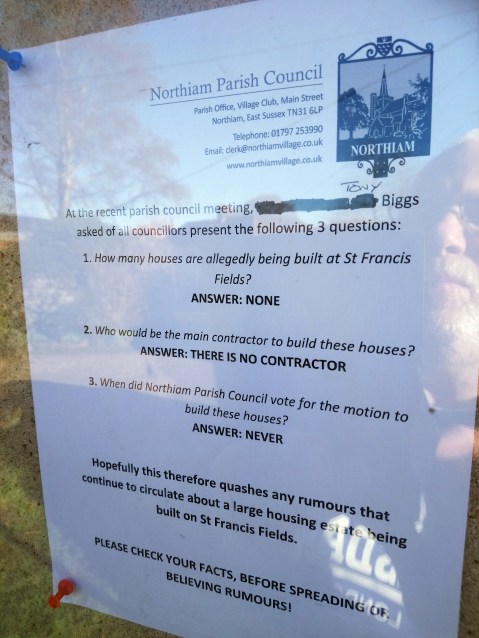
The development foundered because the firm discovered the homes would have to be marketed as leasehold because the parish owned the land and it would not get the best price. The firm was also worried it would have to go out to competitive tender and it could lose the contract. The company was not interested in developing the whole site, despite rumours to the contrary.
A fake Northiam Parish flyer was put out to worried residents about this when news leaked out.
The clerk took legal advice about this and was advised this would have been illegal if they had gone ahead and the parish council could have been prosecuted for breaking the terms of Gove’s loan.
But there was a much bigger row on the horizon that was to lead to nasty consequences for anyone who objected. During the pandemic a decision was made to lease 10 acres of the site to a horse trader, Lauren Sapsted, who would keep horses for wealthy owners, on the site, while at the same time blocking a local resident who wanted to graze her two horses on community owned land.Several other local horse owners were also turned away. The exclusivity clause in Sapsted’s lease meant that local residents were barred from using much of the site and none of the equine facilities including the sand schools, even though they were funding it through the council tax.
The deal only open to her was she would pay the parish £12,000 a year to lease the land and the parish council even agreed to pay half her £3000 legal costs and she would pay a small sum every month to repay the loan. It was renewable. The loan was not disclosed to the full council. It turned out that the deal could have been illegal because it broke procurement rules and a planning restriction by Rother District Council that forbade commercial activity on the land. Pete Sargent defends it as done during the pandemic and claims that 50:50 arrangement on legal fees is ” common practice”.
Events took an extraordinary turn when the lease came up for renewal . After her horse died Lauren Sapsted demanded the parish paid for security cameras to be put up on the land which costing £14,000 – more than the annual rent. The parish council demurred in drawing up such a contract but unknown to them Sue Schlesinger, chair of the parish council at that time and sister in law of the famous Hollywood director, John Schlesinger who made Midnight Cowboy, secretly made a separate contract granting this without telling the council after Lauren asked her to do it.
The security cameras never came and the shenanigans over the two contracts were too much for Lauren and she left 18 months later leaving the parish with no income and moved her business elsewhere. Sue Schlesinger resigned but has lately been re-elected to the council.
Entrance to Lauren’s Sapsted’s leased business
Lauren still claims her horse was murdered today and the two former councillors are to blame.
There was also a nasty consequence to all of this. When Lauren discovered Alice, a valuable pregnant horse, had been found dead, she was convinced it had been murdered in the night and blamed two councillors, Penny Farmer and Jon Streatfeild , a former chair of the council, for killing it because she had been erroneously told that they wanted to take over her business. Councillor Robert Maltby, a friend of Sargent, gave Lauren the report which he obtained from Sargent of Penny’s 2019 submission, which had originally been requested by Sargent, saying it was her current plan in 2022.
The murder allegation was not just village gossip it was put up on the Northiam and Nearby Facebook page by Lauren on the 16th May 2022.The site administrator, none other that CIC Director Judith O’Connor allowed this post to remain.
You can also see the shock of local people who now believed they were scumbags. Lauren called Sussex police asking them to open a murder investigation. They found no evidence. To do this the councillors -one of them a middle aged lady – would have got up in the dark middle of the night and tramped across fields. Two people questioned this. One, Ben Dallimore, a former councillor, was up in the middle of that night because he and his wife had a new baby. Their house is close to the field and they heard nothing. Another resident was surprised because if strangers were nearby, their dogs immediately start barking. They heard nothing either.
Jon Streatfeild – former chairman of Northiam Parish Council
Then the real harassment began. The parish managed to get sympathetic support from two top officials at Rother District Council to investigate then councillors Penny Farmer and Jon Streatfeild. Lorna Ford, chief executive, and Lisa Cooper, a monitoring officer, got a lawyer from Chichester District Council to prepare a report saying Streatfeild was guilty of leaking the confidential contract with Sapsted which revealed the arrangements for the lease and it was not in the public interest. They paid the lawyer £12,000 for the report but there are no records of their agreement or how much time was spent on the report which sounds highly irregular for a local authority. The finding contradicted later legal advice obtained by Jon Streatfeild that said the deal with Sapstead broke the law – so it was in the public interest for this to be released.
Separately when the police inquired about concerns brought by Jon Streatfeild about what was going on at Northiam, Lorna Ford sent emails to the police that everything was fine there.
Another report was commissioned by the parish council – at a cost of another £12,000 from an independent firm – which was skewed not to include any investigation into the relationship between the parish council and community interest company – which was central to the development and subject of concerns. This was prepared just before a public meeting in Northiam where Streatfeild and Farmer were treated as pariahs, including being spat at by people who believed they were horse murderers.
So bad was this meeting that at a future hustings meeting in the village last year Sussex Police arranged security to protect them – Penny Farmer , a former police officer, was so worried she did not attend.
Last year Streatfeild was defeated in the parish elections as most people believed the allegations. But he also had to put up with further stress. His front garden was sprayed with weedkiller, a parish noticeboard was covered in graffiti denouncing him, and two stalkers appeared to harass him at his place of work.
One, Michael Court was served with an adult ASBO by the police to keep good conduct for the next two years. Another Richard Smith, an ex policeman, came into the pub where he worked part time and denounced him in front of all the pub customers – obviously hoping he would get the sack. But this has not happened.
All these details of the harassment has been put to the police and the Rother District Council. The official statement from Sussex Police is completely defensive.
Rosie Ross, divisional commander at East Sussex police replied: “As a journalist you will know the rules around personal data and sharing of such data. This request is in the context of named individuals and actions we may have taken to either safeguard or sanctions used, as and such cannot be shared. Even if it were a Freedom of Information request, it would be exempt under s40 FOIA for these same reasons.”
We actually didn’t need to put in a request as we have seen the terms of the order against Michael Court and there were plenty of witnesses to the incidents.
Rother District Council was equally defensive.
A Rother District Council spokesperson said: “The district council has a duty to put in place arrangements to manage complaints against elected members for the town and parishes. We deal with all code of conduct complaints diligently and fairly in relation to all complainants, and we believe we have done so in this case.
“It would not be appropriate to comment in detail on individual code of conduct complaints as they are confidential.
“However, we have repeatedly advised Mr Streatfeild and others of the limited powers that Rother District Council has to become involved in matters relating to other councils, especially with regards to matters such as the Blue Cross Site. We have advised Mr Streatfeild how best to pursue those complaints via organisations which do have the power to intervene, including the police.”
Rother District Council have not investigated any complaints brought against Peter Sargent, even though he helped instigate the proposed development of the land after publicly stating that the loan was for a community asset, lent parish council money without the knowledge of other councillors to help cover Sapsted’s legal bills which is unlawful and brought a complaint for criminal damage on the site, on the very day that we visited it to research this article and witnessed no such criminal damage.
Again we have seen all the details involving the Rother District Council officers involved and have published this in the public interest.
One bizarre reaction from Sussex Police was to suggest the complaints went to the National Audit Office, the Parliamentary watchdog that scrutinises Whitehall. Since the abolition of the Audit Commission by the Tories, which did scrutinise parish councils as well as larger bodies, there is no body that has the power to regulate local government.
As a result the NAO said it could not conduct inquiries into parish councils like the now defunct Audit Commission. But Adeel Shah, the NAO’s FOI and Correspondence Officer gave Jon Streatfeild very useful advice. He said the answer was to go to the external auditor of the council and helpfully looked up who was responsible.
Now the external auditor, PKF Littlejohn LLP, based in London, is looking at Northiam Council following two separate complaints. One is from Penny Farmer, which is challenging the whole way the council is managing its budget and whether certain earmarked funds, such as for a sewer outlet, are being raided, and whether the parish could run out of money.
Ben Dallimore on holiday
Another is from Ben Dallimore, another former councillor, about how money has been promised to Wealden Traditional Construction Ltd for the design plans of the new Football Pavilion to be claimed back from S106 ( money given by builders Persimmon )held by Rother DC. The contract to build the new pavilion will be worth £300,000.
Now the main employee of this company is local villager John Cusden, who plays for Northiam Football Club. His application was supported by retired architect, Julian Luckett and Pete Sargent. Companies House records show that his own company, Wealden Design and Build Limited has just gone bust and is in the hands of a liquidator. The new company is registered at the same address in Rye that the old company recently moved to. It has one new director, Charles Dawson, but its website praises the work of John Cusden over the last 10 years when he was director of the bust company.
A letter from the external auditor has now raised 11 procedural issues that led to the granting of the money which the council must answer. It also discloses that the external auditors may have received more than two complaints.
Mr Dallimore is now facing the same treatment as meted out to Jon Streatfeild. He has been recording council meetings and did some filming after one was held in private. The council are now discussing with Rother District Council whether they can impose restrictions on his activities by imposing the equivalent of an adult ASBO.
Mr Sargent did not want to comment on these complaints. His case is that he is the victim of harassment not the other councillors. The only evidence we could find about this is that someone scratched on the council office that it was ” The Bank of Pete Sargent” – of which there is no evidence that he has ever taken money for himself.
We have done this long special report to illustrate what has happened to local government at parish pump level now there is no official scrutiny by national bodies and local media has disappeared in this part of East Sussex. The irony is the lack of scrutiny has led to people putting too much on the internet so there are a wealth of documents to stand up exactly what has been going on in Northiam.
Michael Gove has left the new Labour government plans to revive a smaller version of the Audit Commission to regulate local government again. The new government need to act not only to police the growing number of technical bankruptcies in big local councils but to ensure that smaller bodies don’t end up being run by cliques helping each other out. The police and bigger authorities are obviously not up to the job and the NAO has much bigger fish to fry in policing waste and dodgy deals in Whitehall.
Met Police says it was not a crime for council staff to proposition children for sex in 1984
Keith Hinchliffe, the child sex abuse survivor, who got his predator sentenced to six years in jail 40 years after he abused him for three years , is facing an uphill battle with the Met Police and the London borough of Richmond to get compensation or even recognition there was a problem.
The Met Police are describing his allegation that he was propositioned for sex by a member of staff at Grafton Close Children’s home as ” not a crime” and the council have employed lawyers and insurers to say it did not fail in its duty of care to look after him.
Keith’s abuser, Phillip Saunders, had open access to the children’s home where he took him out to sexually abuse him and the member of staff propositioned him when she invited him to her flat in return for saying she would help him leave the home early.
Documents show the Met Police has reviewed the allegations he made in 1984 which resulted in ” no further action” but came to the same conclusion again. The documents show that at first Richmond Council tried to say there was no evidence that he was at the home and then because he was not certain whether her name was Christine or Linda they could not trace anybody.
But the most damning finding was that the Met concluded that no crime existed in the first place.
The report said: “You stated ..that you had been propositioned but that the suspect had not touched you or physically sexually abused you. You stated that it was verbal comments only. I agree that crimes of such nature are fully within the public interest, however, there has to have been a crime committed for that interest to exist.”
Detective Sergeant Alex Woolley of the Met Police Child Sex Abuse Investigations Team, wrote to him saying: ”
“In relation to what happened you at Grafton Close, this report has been closed and classified as a “no crime”. “Clearly the conduct of the member of staff is entirely unacceptable. However, we have to apply the law as it was at the time that the incidents happened. This happened before the Sexual Offences Act 2003 and so we have to consider what legislation is available to us in the 1980s.” Keith Hinchliffe was very dissatisfied by the decision and has appealed to the London Mayor’s Office for Policing and Crime (MOPAC) for a review of the case at the end of October when Saunders was convicted. The office has accepted his complaint but warned him it could take 8 months to get a reply because of a backlog of complaints against the Met.
Richmond’s response has been even more negative. First they questioned whether he had ever been at Grafton and said there were no records showing he was there. Then by pursuing the issue with his local MP and a Freedom of Information request the South London Legal Partnership found a log confirming he had been admitted to Grafton Close and discharged six weeks later. But it said all the social work records at that time had been destroyed. It refused to release any documents on the Fernbridge investigation by the Met into child sexual abuse at Grafton Close home in 2015 which the authority did confirm it had co-operated with the police on the grounds that they were too sensitive because they contained details of third parties involved.
When he persisted in pursuing Richmond over this the council turned the case over to lawyers in Nottingham, Browne Jacobson, an Anglo-Irish firm, who cover business, government and health issues.
The firm in a letter this month set out to demolish Keith’s claims of negligence or breach of duty of care at Grafton Close. It cited case law to exonerate social workers who may be involved in his case and also said he had to meet stringent tests to bring any claim that the staff failed to protect him. One of them included he couldn’t produce documents to show the council’s policies at the time – since the council has destroyed all the records.
You can’t bring a negligence case if there was no duty of care -Richmond Council’s lawyers
The lawyers also said he was out of time to bring a case and they would challenge this in court. They were also sceptical of whether the conviction of Saunders would help. The lawyers wrote to him saying ” a claim in negligence cannot succeed if there is no duty of care in the first place”.
It goes on to say the council have neither admitted or denied the conviction of Mr Saunders but would need a certification of conviction or indictment.
The firm warned him they had agreed to represent Richmond if he brought a case and that he could incur substantial costs and he should take independent legal advice.
Since publication of the first blog I have been contacted by one other resident at Grafton Close suggesting there was a woman member of staff at Grafton Close who did sleep with at least one of the boys there. What Keith is exposing is a cess pit of behaviour which the Met and Richmond Council want to forget.
I don’t think Keith is going to give up on this so I expect there will be further developments. Watch this space.
Keith Hinchliffe. He contacted me and gave me permission to use his name to encourage other survivors to come forward and get justice in the courts and compensation.
Judge described him as ” an immensely impressive witness, honest, reasonable and composed under pressure”
A child sex abuse survivor has got justice 40 years after he was groomed and sexually assaulted by a paedophile who went on to commit other offences against boys in Holland and a girl in Kent.
Philip Saunders, 67, was sentenced to six years in jail, with the judge saying only a rule that sentences had to reflect the law in the 1980s stopped him from giving him an even longer sentence.
Keith Hinchliffe, now 54, was abused at Saunders home, in his car, in his office at night, at Wembley Stadium and his predator was given open access to Grafton Close children’s home in the London borough of Richmond to take him out to abuse him when he was put in care.. The abuse continued for three years starting when he was 12 until he turned 16. Saunders was 27 at the time.
His case raises questions again about the role of Richmond Council under Liberal Democrat control and the Met Police in the 1980s who took no effective action to stop paedophiles abusing children in the borough. Grafton Close is the same home where a Roman Catholic priest, Tony McSweeney, was jailed for three years for indecent assault after escaping justice for 35 years following a fresh Met Police investigation in 2015. Like Saunders, McSweeney was able to take boys out of the home with the help of John Stingemore, then the deputy manager of the home, who was already a convicted paedophile. Stingemore died before the case got to court. See my blog on this here.
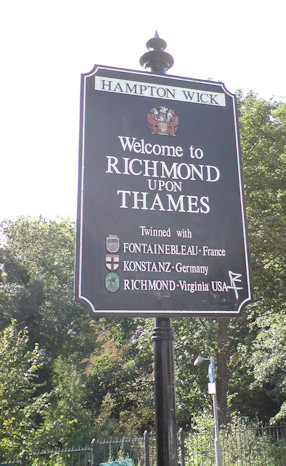
Richmond on Thames Council sign
Keith reported the incidents to the Met police when he was at Grafton Close care home in 1984 and allegations that he had been propositioned for sex as a 15 year old by a woman staff worker at the home. The Met interviewed him and decided to take no further action.
Keith plucked up courage in 2019 to report the abuse again after seeing the BBC investigation into paedophile Jimmy Saville and went to the NSPCC who reported it to Thames Valley Police.
Unlike the Met, Thames Valley Police took his claims seriously and the case went to Reading Crown Court where Saunders tried to deny everything but he was convicted last October and sentenced in December.
The judge, recorder John Ryder, in his sentencing remarks in court, told the whole grisly story. He revealed that Saunders, after abusing Keith, went over to the Hague and sexually abused two boys in his care and was sentenced to two years and six months in jail. In 2005 in Maidstone he was jailed for four years for three indecent acts with a young girl, the daughter of his current wife.
Saunders got access to Keith and his family because he was his sister’s boyfriend for about a year. The judge described how he got Keith to stay overnight at his home in Langley and then asked him to sleep in his bed because he claimed the spare bed was broken. The abuse began overnight and then he was given expensive gifts. This included a microcomputer – rare in 1982 – a Raleigh bike and a Michael Jackson DVD, Thriller. He also exploited the boy’s passion for fast cars taking him to test drives and shows.
” unusually expensive gifts were to groom him for sex abuse”
As the judge said: “giving unusually expensive gifts coveted by an adolescent boy and exploitation of his interests were a means of grooming him to sex abuse.”
He also took pictures of him with an Instamatic camera naked or dressed up at his home, in his car, at work and at Wembley Stadium where he took him to see an American football match.
Keith told the Judge if he didn’t comply Saunders , who is six foot four inches tall, became violent.
The judge says he said: “If I didn’t do things, he would let me know. Arm behind back- pain” .”Rebuffed once and pinned to floor and decanter of scotch all over my face as punishment and made to pleasure him again.”
Other times he was plied with drink, forced to watch pornography and forced to perform oral sex on him. These events made Keith feel both fear and shame and he started skipping school. The judge summed up his evidence as finding “relationships hard. No friends. Initial abuse hard, aftermath is life changing. Did not finish education. Rebelled. Hated the world and everything around me. Navigated life without education guidance and to relive events in court and answer challenges again and again – had almost broken him.” His changed behaviour led him to be put into care by Richmond council.
He was too ashamed to tell his family and feared his father, an ex merchant navy man, would take it out on him if he knew. He has now told his mother, his present wife and has children of his own and has a job as a furniture maker. But he told the police he now regretted never taking exams at school and getting a good job because of the constant abuse from Saunders.
The judge said:
“I found Keith Hinchliffe an immensely impressive witness, honest, reasonable and composed under pressure about [a] sensitive and damaging experience. Impressive man.” He described him as an ” insightful and measured in expression”. “Trauma and fear and shame shaped his personality and altered [his] outlook on the world.”
The judge was highly critical of Saunders for trying to deny the whole story and showing no remorse for what he had done.
” You continue to deny any sexual activity at all with him.{You] told PSR author only interested in adult female relationships. That assertion is completely contradicted by the facts in the Holland conviction. I have no doubt on the basis of evidence I heard from KH at trial – he suffered substantial and serious psychological harm as result of your actions. {You] abused a position of trust in relation to him.”
The police interview with Keith revealed he partly came forward because he had seen in the media that perpetrators of historic child sexual abuse were now being caught and jailed.
Despite securing a conviction against Saunders he is now having to fight the Met and Richmond Council to get redress. They won’t admit they did anything wrong in the 1980s or had a duty of care towards him. In the second part of this grisly story I will be revealing their responses to him.
Those who follow my tweets that record local by-election results over the last year should not be surprised by this week’s council election results. For the past year they have been revealing shock upsets where either the Green or Liberal Democrat candidate unseats a sitting councillor – more often a Tory rather than a Labour one – with a jump in their vote share by anything from 30 to 50 per cent.
Boris Johnson – facing an all party pincer movement
Labour a year ago was still losing councillors to the Tories in by-elections in Red Wall and Midland seats. It is only in the last few months as the Partygate scandal developed that Labour started holding those seats and occasionally taking a seat back from the Tories.
What the local elections showed this week is that these startling by-election gains by the Greens and the Liberal Democrats are not a flash in the pan but part of a new trend. It also confirmed that Labour is back in business, has largely halted its decline in local government seats, consolidated its firm grip in London,, recovered from an all time low in Scotland, and yes, made gains in the North of England in Cumbria and Lancashire and stopped the rot in the North East. And it has made spectacular gains in Wales and become a force again in the South of England.
Sunderland symbolic of the halting of the Tory surge
The symbolic Labour council for me in the North was Sunderland. This was a council the Tories were keen for Labour to lose – and previous gains by the Tories and Liberal Democrats made this feasible as Labour’s majority had been cut. The Tories put money into winning seats – Johnson came up to the North East – even if he confused Tyneside with Teesside. What happened? The Tories did not gain a single seat and Labour managed to hold on with reduced majorities. Instead the Lib Dems took a seat off the Tories and Labour – winning by that surge in vote share that has become familiar in council by-elections.
The two symbolic Lib Dem council victories for me are St Albans and Gosport. The Lib Dems just controlled the Hertfordshire city before the local elections and had also taken the Parliamentary seat from the Tories in 2019. But this week’s election saw a Liberal Democrat landslide. The city has 56 councillors – 50 of them are now Liberal Democrat after they gained 20 seats overnight wiping out Labour and reducing the Tories to just four councillors.
Gosport was another extraordinary result for the Lib Dems. I know the town from sitting on the Gosport War Memorial Hospital inquiry. It is a fiercely working class, Tory naval town, heavily pro Brexit leaning even towards UKIP at one time. Yet the Remain supporting Liberal Democrats have taken control and ousted the Tories. This with Somerset , Woking and Hull going Liberal Democrat show a big change.
For Labour in the South the fact they now have a big majority on Worthing Council in West Sussex is also an extraordinary result. Some five years ago Labour won its first seat for 50 years and now they control the authority. The other extraordinary victory is Westminster. Dame Shirley Porter, now 91,- the Tory leader fined for gerrymandering the council to prevent Labour ever winning in the 1980s – must be cursing the result in Israel now Labour have a working majority.
Rise of the Greens
The other factor in the mix is the rise of the Greens. Though they control no council fewer and fewer authorities do not have a Green councillor – after this election . Here their appeal is potentially dangerous to both the main parties. The emphasis on green issues is subconsciously boosting their brand among people fed up with the old two party system. They can simultaneously appeal to the radical elements who left Labour after Jeremy Corbyn was banished from the Parliamentary party – and to rural Tories concerned about the demise of the countryside. No wonder one right wing Labour supporter suggested undemocratically that people expelled by Labour should be banned from joining another party. Thus the Greens can win seats in Sheffield, North Tyneside, Newham and West Oxfordshire, Sussex and Rutland all in the same year.
There is one person who is going lose out altogether by these converging trends – Boris Johnson. He is facing a pincer movement. His chances of further gains in the Red Wall area have been stymied, he has gone backwards in Scotland and Wales and his heartland Blue Wall seats are now seriously threatened by the Liberal Democrats in places like Esher and Walton and in places like Worthing and Southampton by Labour.
In my view, these local election results have created the perfect storm to undermine Boris Johnson.
Please donate to my blog so I can continue my forensic analysis of the political scene and my investigations.
A new scandal was revealed in the House of Lords this afternoon which could affect tens of thousands of the poorest pensioners already cheated for decades of the right money for their pension.
The underpayments running to tens of millions – exposed by Sir Steve Webb, the former Liberal Democrat pensions minister – is slowly being sorted out by officials at the DWP though as this blog exposed earlier with the most complicated cases being delayed under a secret ” drop and go ” scheme to get the numbers up.
Baroness Stedman- Scott
The minister Baroness Deborah Stedman-Scott revealed that so far £60.7 million had been paid out to 9491 people cheated of their full pension – suggesting that some of the payments must be pretty large.
Extraordinarily she could not give a gender breakdown – which led to a rebuke from Labour peer Lord Jeff Rooker who accused her of hiding the fact that vast majority must be all women.
But then came the killer blow. In answer to a question to another former pension minister, Baroness Ros Altmann, Baroness Stedman-Scott confirmed that the poorest pensioners who got the money -mostly in their 80s and 90s – would cease to get their fees paid by local councils if they got more than £23,250 in England
Hidden bonanza for care home owners
Instead they would have to pay privately until their pension savings money fell below £23,250. Given that many care homes charge differential rates for people residing there – local authority rates are often lower than private rates – this could even be a new bonanza for care home owners – as they could get more money for providing the same services.
Baroness Ros Altmann raised the issue
This “pay out and grab back” scheme was universally condemned by peers of all parties. Not one supported Baroness Stedman-Scott who was looking increasingly uneasy at having to admit this.
She hinted that in rare cases the DWP could make a special payment to a pensioner or that local authorities could perhaps waive individual fees.
“Special payments under the DWP discretionary scheme are not routinely made to those who have been underpaid state pension. However, under exceptional circumstances, such as where severe distress has been caused by the way an individual case has been handled, a case may be referred for consideration of a special payment.”
This got no purchase with the peers. The most critical comment came from Lord Forsythe of Drumlean, another former Tory minister, who accused the government of ” hiding behind the skirts of local government” rather than take national responsibility for the change.
Lord Rooker raised the issue of 50s women and the government’s ” holiday” from funding the national insurance fund
Lord Rooker linked this action to the failure to pay out the 50s women when the pension age was raised to 66.
“The noble Baroness talks about “people” and “persons”, but we are talking about women. When was the last time tens of thousands of men were short-changed with their pension? I do not recall that happening. When the Government took their long-term holiday from paying into the National Insurance Fund, they deprived hundreds of thousands of women of the pension that they were entitled to. Why cannot that be redressed?”
Government ignores answering who is to blame at the DWP
Conservative peer Baroness Patience Wheatcroft, a former journalist, wanted to know who in the DWP was responsible for this failure to pay so many people the right pension.
“My Lords, when more than £60 million that should have been paid has not been paid, surely somebody should be held responsible in the end for that error. In the private sector, the sum of £60 million would be taken very seriously. Can the Minister tell us, therefore, who was ultimately responsible for this failure to pay such a large sum of money?”
The minister couldn’t – she just blamed it on a computer failure.
She did promise under pressure to approach both the Treasury and Therese Coffey to see if the government could introduce regulations for councils to ignore the pension back payment. But admitted she might get short shrift from the Treasury.
All this points to another blow for the 50s born women when and if they get compensation in the future. By that time many may well need social care -only to find out that they will have to give back their payments to cover their care home costs.
Please donate to Westminster Confidential so I can continue my forensic coverage.
Yet another disturbing report from the Independent Inquiry into Child Sexual Abuse highlights a national failure to tackle gangs sexually exploiting vulnerable children.
The findings of this investigation led me to me to pose the question in the headline. The report’ s conclusion is damning: “Children are sexually exploited by networks in all parts of England and Wales in the most degrading and destructive ways. Each of these acts is a crime. This investigation has revealed extensive failures by local authorities and police forces to keep pace with the pernicious and changing problem of the sexual exploitation of children by networks.”
The question is why. The report took evidence from six diverse areas in England and Wales – Durham, Swansea, Warwickshire, St Helens, Tower Hamlets and Bristol.
What was particularly alarming is that in two – the London borough of Tower Hamlets and Swansea – there was a denial of the existence of any gangs at all. I would really be surprised that such organised gangs did not operate in the borough or elsewhere.
Indeed the report cites two instances where complaints were not taken forward.
“In Swansea, there was a police investigation into serious sexual assault against CS-A25 which led to the arrest of two males but no further action was taken due to evidential difficulties. • In Tower Hamlets, in the case of CS-A22, the child made disclosures of assault and rape but these allegations did not lead to prosecution. Although a number of named potential perpetrators were added to a crime report and suspects database, the report was closed. Some information was passed to the local force but there is no evidence of any arrests.”
Perpetrators finding new way to exploit children
The report says: “Parental neglect, substance misuse, domestic violence or mental health issues may increase the vulnerability of children to sexual exploitation. Around half of the case study children were in care and more than a third had complex disabilities or neurodevelopmental disorders. “It is widely recognised that alcohol, drugs and actual or threatened violence against the child, their friends and family are often used as a means to groom and coerce children. Perpetrators are finding new ways, including through mobile phones and other devices, social media and dating apps, to groom and abuse ever younger children.”
It goes on: “Research suggested that many complainants report dissatisfaction with the responses of local authority staff and police officers to the sexual exploitation they faced and these themes were reflected in some of the experiences of the case study children. Some felt unprotected by care home staff failing to intervene when they knew or suspected that the children were being sexually exploited. Others were frustrated that those who had sexually exploited them were not held accountable through the criminal justice system.”
The report also highlights a worrying lack of data on who the exploiters are which has led people to blame South Asian males behind the gangs because of some high profile cases.
Poor data collection on the ethnicity of perpetrators
The report says: “Some of the high-profile child sexual exploitation prosecutions have involved groups of South Asian males. There has been heated and often polarised debate about whether there is any link between ethnicity and group-based child sexual exploitation. Poor data collection on the ethnicity of perpetrators or victims fuels that debate and makes it difficult to identify whether there is any such link. It also hampers the ability of police and other services to provide culturally sensitive responses, interventions and support.”
The report recommends that the law should be strengthened so that when two or more people found guilty of sexual exploitation they should get an aggravated sentence.. It also wants both English and Welsh guidance strengthened and tool kit to handle sexual exploitation should be updated and strengthened.
Professor Alexis Jay, who chaired the inquiry, said: “The sexual exploitation of children by networks is not a rare phenomenon confined to a small number of areas with high-profile criminal cases.
“We found extensive failures by local authorities and police forces in the ways in which they tackled this sexual abuse.”
Please donate to Westminster Confidential to allow me to continue my forensic investigations
Sir Keir Starmer: Labour’s bad record in council by-elections
Council by election results are not always a guide to a party’s performance in a general election because local issues can determine how people vote. But they are a guide to how the most politically active think since the people who vote are likely to be those most interested their local community. They are also a guide to how each political party can get their vote out and are real results – not an opinion poll.
Whatever way you put it this summer- with a couple of exceptions- has been a disaster for Sir Keir’s Starmer’s new model Labour Party. As well as the high profile Parliamentary loss of Hartlepool to the Tories, only just holding on to Batley and Spen and the collapse of the Labour vote to the Lib Dems in Chesham and Amersham it is the local council by-election results that have been particularly bad.
Since this is against the background of a pretty incompetent Tory government facing allegations of corruption and mucking up people’s summer holiday arrangements by constantly changing the rules and causing confusion about what, if any, rules to follow to keep safe from Covid 19, it is no mean achievement for Labour to lose more electoral support.
The by-election results also show that underneath the serenity of a successful and well organised NHS vaccination programme the political scene is pretty volatile. Council seats that should have naturally stayed under the same party’s control are falling to other parties with enormous changes in vote share. The trouble is that in England and Scotland Labour is not the beneficiary. The exception is Wales. In the one Welsh by-election in the Rhondda, Labour did do well with the Tory share falling significantly.
The pattern that is emerging for Labour- from both the Midlands and the North- is that the Tories are consolidating the gains they made in 2019 and wooing the working class vote in once safe Labour areas. If this continues Labour under Starmer might lose more Parliamentary seats in a snap election in 2023 than Corbyn lost in 2019 and the Conservative Home dream list of scores of fresh Tory gains in Yorkshire , the North East, and the East and West Midlands become reality. In Yorkshire alone this means 11 seats could go.
Tories consolidating 2019 election gains
Examples of consolidation include Tory by-election wins from Labour in Grimsby, Bassetlaw and Sandwell and North East Lincolnshire. In Sandwell the Tory share of the vote was up 20 pc, the Labour share down 13.7 per cent. In Bassetlaw, the East Retford South seat saw the Labour share down 47 per cent and the Tory share up 25 per cent with the intervention of an Independent.
Even more concerning for Labour should be by-election results in Leicester, Harlow and Basildon. In Leicester Tories gained their first seat on the council with an 18 per cent rise in vote share while Labour slumped nearly 16 per cent. With the full council up for election next year, the Tories are hoping for large scale gains and possibly one of the city’s Parliamentary seats soon.
In Harlow and Basildon Tories took council seats in Labour areas like Pitsea in Basildon and Mark Hall in Harlow. The Labour vote share was down 16 pc in Basildon and Tories up nearly 15pc. In Basildon the Tory share was up 24 per cent enough to take the seat from Labour who kept a 41 per cent vote share. These new towns used to have Labour councils and Labour MPs like Hemel Hempstead in Hertfordshire. In Hemel there are now no Labour councillors.
Greens having remarkable results
The Tories are on the defensive in rural England and the South and West of England. But the main beneficiaries are the Liberal Democrats and the Greens. The Greens had a remarkable result in Somerset going from nowhere to 64.9 per cent vote share when the Liberal Democrats did not contest the seat. They held on to a seat in Staines just outside London, and gained seats in Aldeburgh in Suffolk and Mid Sussex from the Tories. In Aldeburgh they just pipped the Tories with a 26 per cent rise in vote share and in Balcombe, Mid Sussex they won a little more convincingly with a 13 per cent rise.
Lib Dems winning “safe” Tory council seats
The Liberal Democrats also did well winning seats from the Tories in Knaresborough, King’s Lynn, all with big swings in their vote share ( 28pc in King’s Lynn and 20 per cent in Knaresborough). In some seats the Labour vote switched to the Lib Dems, in other cases it remained steady but the Lib Dems leapfrogged Labour. The Lib Dems also took a seat from the Tories in Cobham in Dominic Raab’s Esher constituency with a 18.4 per cent rise in vote share. Labour did benefit on East Devon council when the voters switched to Labour when the Lib Dems did not stand winning a seat at Honiton.
In Scotland Labour lost a council seat to the SNP on West Lothian council, Vote share was down by nine per cent.
What does this all mean? Difficult to gauge from a clutch of by-election results, but it does suggest the electorate is particularly volatile and not necessarily enamoured with the Tories in rural areas. But it shows Labour has a long way to go.
The worst scenario would be if the Labour Party continued to haemorrhage votes to the Tories in the provincial cities and to the Greens and Liberal Democrats elsewhere. In the end the internal disputes could lead to the Socialist members permanently switching to the Greens and the moderate members switching to the Liberal Democrats. It would mean the end of Labour as a mainstream party. It hasn’t come to that yet, but could be unless Labour comes forward with a much more aggressive and thought provoking agenda.
The independent Inquiry into Child Sexual Abuse today published its worst ever findings of the scale of child sexual abuse in the United Kingdom. It looks like large numbers of paedophiles got away with the mass sexual abuse of children.
An investigation into Lambeth Council’s children in care revealed that over 700 children had alleged they had been sexually abused and treated as worthless by council staff. And this is certainly an underestimate. The scandal continued from the 1960s right through to the late 1990s.
The report which only looked at five of the council’s closed homes makes incredibly grim reading. The report said:
Cruelty and sexual abuse ” hard to comprehend”
“It is hard to comprehend the cruelty and sexual abuse inflicted on children in the care of Lambeth Council over many years, by staff, by foster carers and their families, and by volunteers in residential settings. With one or two exceptions, a succession of elected members and senior professionals ought to have been held accountable for allowing this to happen, either by their active commission or complicit omission. Lambeth Council was only able to identify one senior Council employee, over the course of 40 years, who was disciplined for their part in this catalogue of sexual abuse.”
It goes on: “By June 2020, Lambeth Council was aware of 705 former residents of three children’s homes in this investigation (Shirley Oaks, South Vale and Angell Road) who have made complaints of sexual abuse. The biggest of these homes – Shirley Oaks – was the subject of allegations against 177 members of staff or individuals connected with the home, involving at least 529 former residents. It was closed in 1983.
“Frontline staff employed to care for these most vulnerable children frequently failed to take action when they knew about sexual abuse. In so many cases they showed little warmth or compassion towards the child victims, who were left to cope with the trauma of their abuse on their own.
Hostile and abusive treatment of black children
…”There were many black children in Lambeth Council’s care. In Shirley Oaks in 1980, 57 percent of children in its care were black. During 1990 and 1991, 85 percent of children who lived at South Vale were black. Racism was evident in their hostile and abusive treatment by some staff.
” Shirley Oaks and South Vale were brutal places where violence and sexual assault were allowed to flourish. Angell Road systematically exposed children (including those under the age of five years) to sexual abuse.
“Nor did foster care routinely provide a safe alternative for children in care. For many years, foster carers were not adequately vetted by the Council and were not the subject of criminal record checks.”
Some of the cases described are horrendous.
Children screaming at night while they were raped
“LA-A307 was taken to Shirley Oaks at the age of nine. He described hearing other children screaming at night and he himself routinely experienced violence and sexual assault, including being photographed whilst being raped.
LA-A147 was in the care of Lambeth Council in the 1990s and 2000s, from the age of three. Over ten years, she was placed in nine children’s homes and with four sets of foster carers. She described being raped by a foster carer’s teenage son at the age of nine, and was also frequently sexually abused by older men she met whilst in care. By the age of 13, she had developed a drug addiction and was “selling herself” to fund it.
LA-A2 was found dead in a bathroom at Shirley Oaks in 1977. Lambeth Council did not inform the coroner that he had alleged being sexually abused by Donald Hosegood, his ‘house father’. In the course of Hosegood’s employment at Shirley Oaks, six out of eight children looked after by him and his wife alleged sexual abuse by him.
LA-A7 described sexual abuse by three male members of staff, including two from South Vale. Two of them separately photographed him at their private homes when he was either naked or wearing only his underwear. One of them, Leslie Paul, was convicted of indecent assaults against LA-A7.”
Only six perpetrators prosecuted
Extraordinarily just SIX people have been successfully prosecuted by the police, meaning that hundreds of people must have got away with the vile sexual abuse of children.
All this took place against a background of fraud, corruption, racism, nepotism by both staff and some councillors. Those who tried to stop it were intimidated and threatened. The report shows even two chief executives, Herman Ouseley and Henry Gilby were the subject of intimidation.
Lord Ouseley – staff bugged his home and office when he was chief executive and his family was threatened
“Lord Ouseley described how both his office and home were ‘bugged’ at the instigation of one of his own staff. He also received threats to his family. Mr Gilby’s office was the subject of a serious arson attack. His home and office were broken into and computer records were stolen during a time when he was attempting to deal with corrupt practices. Dame Heather Rabbatts was Chief Executive from 1995 to 2000. She described how she inherited a Council with a culture of “fear and sexism and racism”. No witness identified which individuals or groups were the driving force behind this vicious and regressive culture, but there was little doubt that a succession of leading elected members were mainly responsible, aided and abetted in some instances by self-serving senior officials.”
The inquiry has decided to ask the Met Police to investigate whether there are grounds for a criminal investigation into Lambeth Council’s actions when providing information to the coroner about the circumstances surrounding LA-A2’s death.
Richard Scorer, specialist abuse lawyer at Slater and Gordon, who is representing the sister of a teenage boy who killed himself in a care home after making allegations of abuse against staff member Donald Hosegood, told Mail On Line: ‘It is clear from today’s report that Lambeth Council deliberately withheld information from the coroner in order to give the impression that our client’s brother was happy in care.”
All in all this report shows why it was necessary to have a full scale inquiry into child sexual abuse – which despite naysayers trying to deny the extent of the problem – was obviously rampant in some parts of the country. The council has apologised .The real tragedy is that so many people have got away with it leaving their victims with broken lives.
Ex Tory minister and MP for Salisbury Robert Key is one of the people supporting the Independent revolt. This is one of five podcasts he did criticising the system.
City’s former loyalist Tory MP and minister backs the revolt
UPDATED: The newly formed Independents did win their first seat on the council withAnnie Riddle winning a seat in Harnham. But the other candidates failed to win a seat. However the composition of the council has change radically. It was 15 Conservatives, five Labour, one Liberal Democrat, one Independent.It is now no longer a Tory majority council. The new council is now 11 Conservative, 6 Labour, 6 Liberal Democratand one Independent.
The City of Salisbury is not a natural place to start a revolution. Indeed in the seventeenth century it staged a Royalist revolt against Cromwell and kidnapped its High Sherriff. The last Bishop of Salisbury to be murdered by an unruly mob was William Ayscough in 1450. And apart from the horrendous Novichok murder and attempted poisonings by Russian spies it is not a place normally associated with sudden dramas.
So it is all the more surprising that this city of 45,000 people which has returned Conservative MPs without fail since 1924 should suddenly be facing a challenge to its Tory status quo in this week’s local elections.
And even more extraordinary that a man who is advocating change is former Tory minister and a long standing former Tory MP for Salisbury, Robert Key. One of the most loyal Tories for over 50 years he now says ” in his old age he is becoming a revolutionary.”
The reason for this sudden grass roots rebellion is local government reform. Whereas much is said about devolution to Scotland, Wales and Northern Ireland, at the local level power is being taken away from England’s towns and small cities like Salisbury, by the creation of mammoth unitary authorities like Wiltshire and Dorset. And more are to come soon in further local government reform. So Wiltshire is governed by officials in Trowbridge, Dorset by Dorchester etc.
It also does seem extraordinary that a city with a cathedral should have no more power than a small rural village parish council in remote Lincolnshire.
Salisbury Cathedral
Judging from public reaction many people agree. A brand new Facebook page called Save our Salisbury (SOS) has attracted 2600 members and an energetic former journalist and sub editor, Annie Riddle, is among eight Independent candidates standing for the City council. There is also an independent, an ex detective inspector, Mike Rees, challenging the Tory police commissioner for Wiltshire
The current 23 member council has 16 Tories, 5 Labour and one Liberal Democrat. By putting one independent in each of the eight wards – the candidates are telling people to give one of their three votes ( in most cases) to an Independent and not a political party.
What’s the point?
Annie Riddle says in her own blog; “all the main parties have had trouble putting up a full complement of candidates for the local elections in May – largely, I think, because people are disillusioned and ask: “What’s the point?” Now I’m going to put my money where my mouth is, so to speak, and try to do something to help our community by standing as an independent candidate for the city council in Harnham.”
And it seems to be admitted by the Tories themselves with people like John Brady, former chair of Salisbury Conservative Association saying:
“It is the officers who make the decisions (recommendations). They know that councillors are transient and as with Harnham, where councillors persuaded them to take a proposed development off the Strategic Plan, officers reinstated it as soon as they could when dealing with a different councillor (cabinet member). “All the ‘consultation’ that has to be done is a complete waste of time as I know that this is merely a way of allowing locals to let off steam.”
The situation in Salisbury is not unique. Pressed by issues like houses left empty and an unpopular road closure scheme and people having no say are among the local flash points. A number of small towns in other parts of England are doing the same.
Revolts in other towns
Frome in Somerset in 2015 replaced all its Conservative councillors with Independents for Frome and re-elected them again in 2019. Alderley Edge First in Cheshire did the same – re-electing them on a 42 per cent poll ( high for a parish council) in 2019. Uttlesford near Stansted Airport in Essex, is an Independent majority council – the impetus being concern over the expansion of Stansted Airport.
And some have taken seats from Labour controlled councils such as Ashfield in Nottinghamshire and the mayor of Middlesbrough where an Independent took over from a Labour mayor.
In the last large scale local elections in England in 2019 – across the country Independents gained 250 seats – while the Conservative and Labour parties fell back.
National interest in this year’s elections will be on how Labour and Tories do – whether it is Tory gains in ” Red Wall” seats in the North and Midlands – or whether Labour can make gains elsewhere. The Liberal Democrats and Greens performances will be analysed in areas where they made progress last time.
But beneath all this lies a generally unreported interesting trend in towns and cities – local people standing on local issues – often revolting against the major parties and Big Brother councils in places miles away from where people live. Who said democracy was dead?















 Westminster Confidential