Labour’s devastating summer of appalling council by-election results

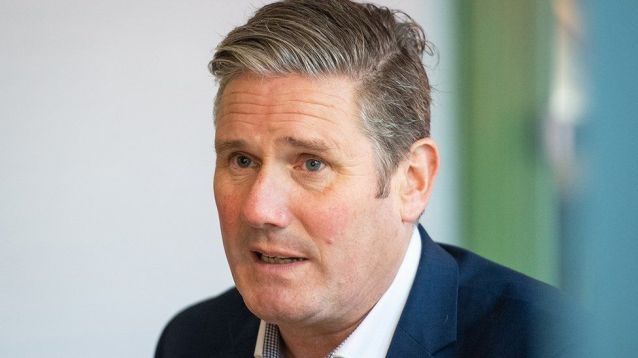
Sir Keir Starmer: Labour’s bad record in council by-elections

Council by election results are not always a guide to a party’s performance in a general election because local issues can determine how people vote. But they are a guide to how the most politically active think since the people who vote are likely to be those most interested their local community. They are also a guide to how each political party can get their vote out and are real results – not an opinion poll.

Whatever way you put it this summer- with a couple of exceptions- has been a disaster for Sir Keir’s Starmer’s new model Labour Party. As well as the high profile Parliamentary loss of Hartlepool to the Tories, only just holding on to Batley and Spen and the collapse of the Labour vote to the Lib Dems in Chesham and Amersham it is the local council by-election results that have been particularly bad.

Since this is against the background of a pretty incompetent Tory government facing allegations of corruption and mucking up people’s summer holiday arrangements by constantly changing the rules and causing confusion about what, if any, rules to follow to keep safe from Covid 19, it is no mean achievement for Labour to lose more electoral support.

The by-election results also show that underneath the serenity of a successful and well organised NHS vaccination programme the political scene is pretty volatile. Council seats that should have naturally stayed under the same party’s control are falling to other parties with enormous changes in vote share. The trouble is that in England and Scotland Labour is not the beneficiary. The exception is Wales. In the one Welsh by-election in the Rhondda, Labour did do well with the Tory share falling significantly.

The pattern that is emerging for Labour- from both the Midlands and the North- is that the Tories are consolidating the gains they made in 2019 and wooing the working class vote in once safe Labour areas. If this continues Labour under Starmer might lose more Parliamentary seats in a snap election in 2023 than Corbyn lost in 2019 and the Conservative Home dream list of scores of fresh Tory gains in Yorkshire , the North East, and the East and West Midlands become reality. In Yorkshire alone this means 11 seats could go.

Tories consolidating 2019 election gains

Examples of consolidation include Tory by-election wins from Labour in Grimsby, Bassetlaw and Sandwell and North East Lincolnshire. In Sandwell the Tory share of the vote was up 20 pc, the Labour share down 13.7 per cent. In Bassetlaw, the East Retford South seat saw the Labour share down 47 per cent and the Tory share up 25 per cent with the intervention of an Independent.

Even more concerning for Labour should be by-election results in Leicester, Harlow and Basildon. In Leicester Tories gained their first seat on the council with an 18 per cent rise in vote share while Labour slumped nearly 16 per cent. With the full council up for election next year, the Tories are hoping for large scale gains and possibly one of the city’s Parliamentary seats soon.

In Harlow and Basildon Tories took council seats in Labour areas like Pitsea in Basildon and Mark Hall in Harlow. The Labour vote share was down 16 pc in Basildon and Tories up nearly 15pc. In Basildon the Tory share was up 24 per cent enough to take the seat from Labour who kept a 41 per cent vote share. These new towns used to have Labour councils and Labour MPs like Hemel Hempstead in Hertfordshire. In Hemel there are now no Labour councillors.

Greens having remarkable results

The Tories are on the defensive in rural England and the South and West of England. But the main beneficiaries are the Liberal Democrats and the Greens. The Greens had a remarkable result in Somerset going from nowhere to 64.9 per cent vote share when the Liberal Democrats did not contest the seat. They held on to a seat in Staines just outside London, and gained seats in Aldeburgh in Suffolk and Mid Sussex from the Tories. In Aldeburgh they just pipped the Tories with a 26 per cent rise in vote share and in Balcombe, Mid Sussex they won a little more convincingly with a 13 per cent rise.

Lib Dems winning “safe” Tory council seats

The Liberal Democrats also did well winning seats from the Tories in Knaresborough, King’s Lynn, all with big swings in their vote share ( 28pc in King’s Lynn and 20 per cent in Knaresborough). In some seats the Labour vote switched to the Lib Dems, in other cases it remained steady but the Lib Dems leapfrogged Labour. The Lib Dems also took a seat from the Tories in Cobham in Dominic Raab’s Esher constituency with a 18.4 per cent rise in vote share. Labour did benefit on East Devon council when the voters switched to Labour when the Lib Dems did not stand winning a seat at Honiton.

In Scotland Labour lost a council seat to the SNP on West Lothian council, Vote share was down by nine per cent.

What does this all mean? Difficult to gauge from a clutch of by-election results, but it does suggest the electorate is particularly volatile and not necessarily enamoured with the Tories in rural areas. But it shows Labour has a long way to go.

The worst scenario would be if the Labour Party continued to haemorrhage votes to the Tories in the provincial cities and to the Greens and Liberal Democrats elsewhere. In the end the internal disputes could lead to the Socialist members permanently switching to the Greens and the moderate members switching to the Liberal Democrats. It would mean the end of Labour as a mainstream party. It hasn’t come to that yet, but could be unless Labour comes forward with a much more aggressive and thought provoking agenda.

Exclusive: How Marks and Spencer banned this 85 year old Covid shielding woman from shopping with them for life

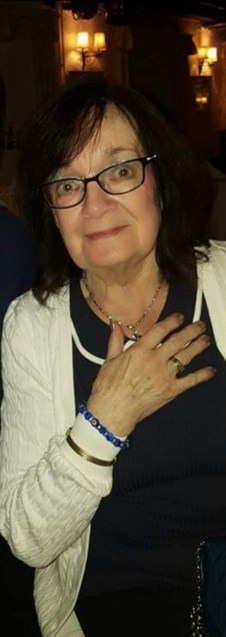
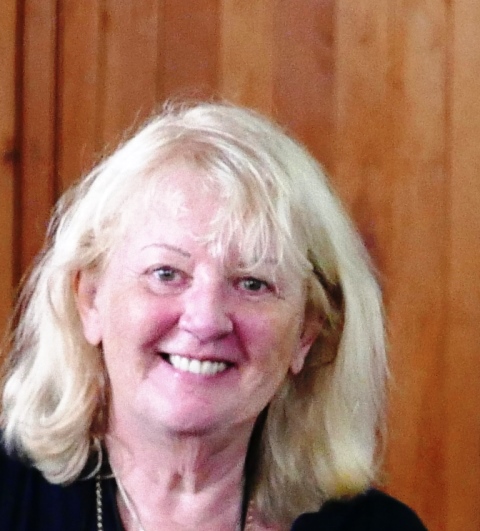
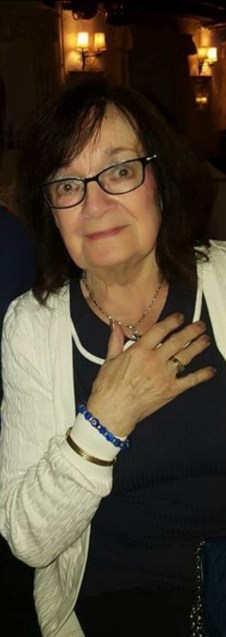
Patricia Stewart

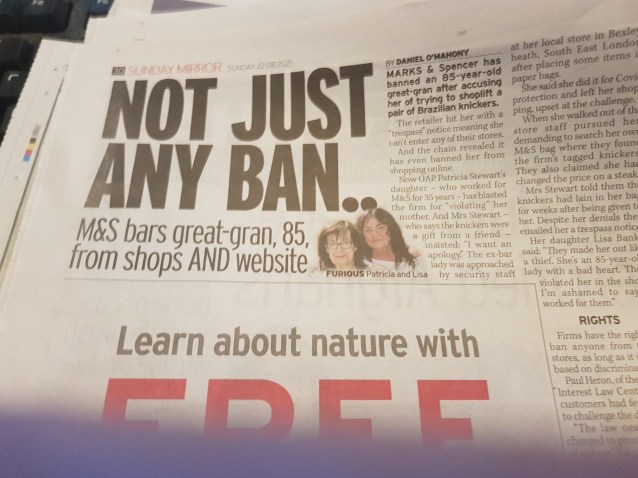
This is Patricia Stewart an 85 year old woman. She spent the first five months of the lockdown shielding from Covid 19 as she is a vulnerable person. Last autumn during the period when the first lockdown was lifted she ventured out to shop for the first time. As a M&S customer for over 60 years she went to her favourite branch in Bexleyheath shopping mall. What happened next is hardly believable but raises a lot of civil liberties issues.

Patricia Stewart was nervous about going round a public store for the first time. She went to the customer services desk and exchanged a babywear item for a bra. She then went round the food hall but being worried about Covid starting putting packaged food items into plastic bags. This attracted the attention of a security guard who told her not to do this.

According to details released by M&S following a subject access request by her relatives he ” deemed it as shoplifting “. She was then followed by a male manager and female colleagues. Now feeling thoroughly uncomfortable she approached the till four times and then changed her mind and decided to leave the trolley full of shopping and go out of the store.

M&S Brazilian knickers- a smoking gun?

She was followed into the shopping mall by the manager and a female colleague and while she was sitting on a bench waiting for a taxi they challenged her in public and demanded her name and address She refused to give it to them so they proceeded to search her shopping bag. They found none of the food shopping but did discover a pair of M&S Brazilian knickers without a receipt. They claimed they had been watching her on CCTV and saw her change a label adding that a customer had also complained about her.

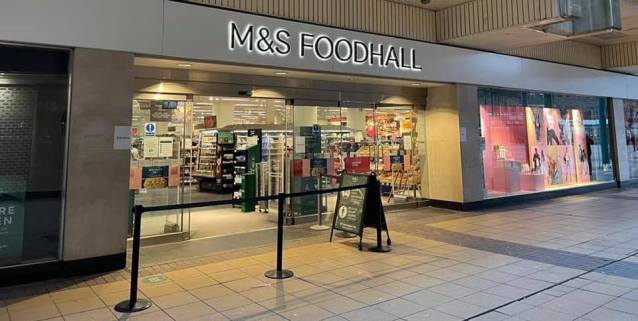
Marks and Spencer store in Bexleyheath. Pic credit: M&S Facebook page

They then proceeded to serve her with a ” trespass order” – a device used by many stores to keep out suspect shoplifters without going to court – not only from the Bexleyheath store but from any store in the country and on purchasing anything from M&S on line for the rest of their life.

The ban has been challenged by her two daughters who asked to see the CCTV and for evidence of the other customer’s complaint. When challenged M&S couldn’t provide the CCTV to prove their allegation because according to them ” it wasn’t recording properly”. Nor could they produce the customer who complained.

But M&S stuck to their story and have now ended any correspondence with them -pointing out they are not regulated by anybody and therefore nothing else can be done.

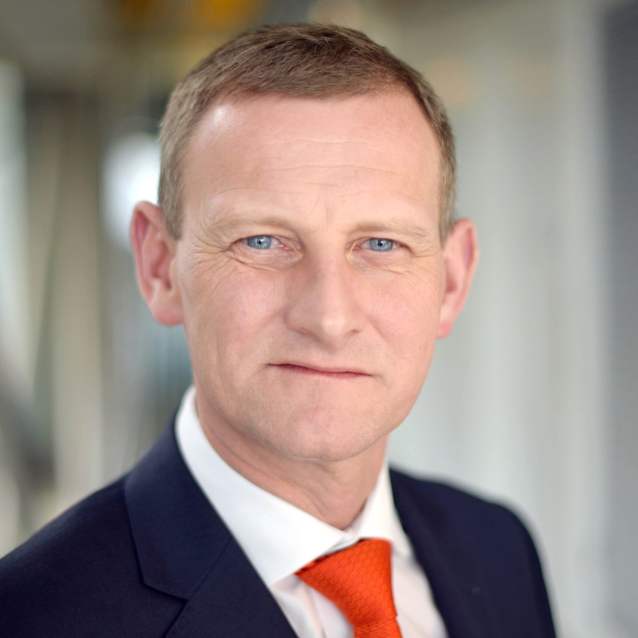
Steve Rowe, chief executive, Marks and Spencer

I decided to investigate this and approached M&S Corporate Press for comment. Six weeks after failing to reply to me I escalated my inquiry to Steve Rowe, chief executive of M&S, who has ignored my email. Therefore I can’t put their response.

There are two issues here which are connected. First of all the particular case and the use of trespass orders and secondly how they can be enforced. The retailer is allowed to use them because their store is private property. A search on the internet reveals they could be quite common – for example someone complained in Bristol about being banned by M&S. And nobody knows how they can be enforced – one theory which sounds too fanciful to me – is that M&S are secretly using facial recognition cameras in their stores. The other is that the M&S Sparks card – both offers you treats but is used as a surveillance card to monitor customers. Since M&S would not respond to my questions all this is speculation.

The Sparks card was used by M&S in this case as proof of her not purchasing the knickers – they revealed in an email that they have records of many of her purchases going back two years but insisted they had no personal file on her. But according to her the knickers were purchased by a friend as a gift – so they wouldn’t be on her purchase list.

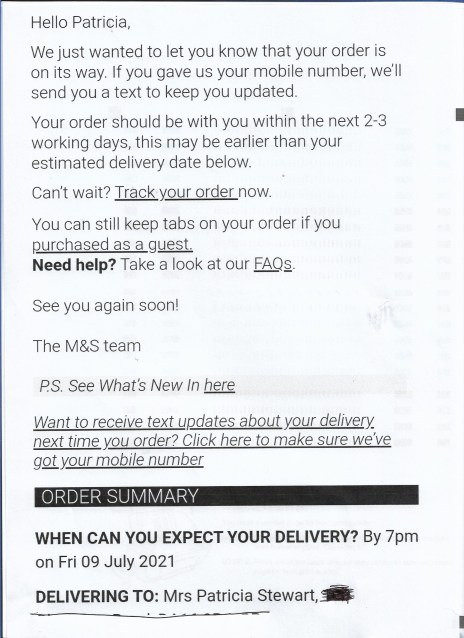
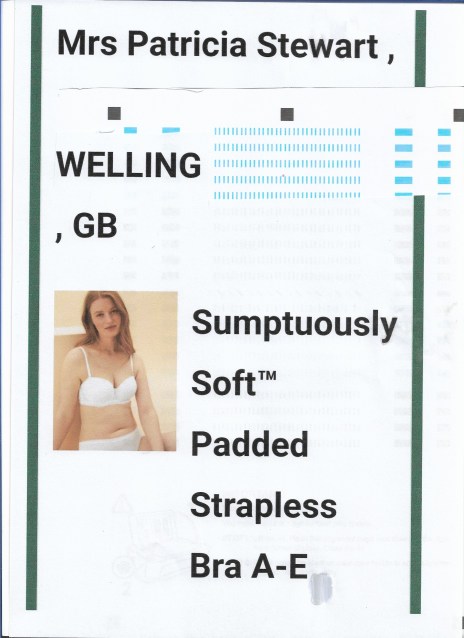
Failing to get a reply from M&S the relatives and I decided that we could test out the ban. First she decided to order a bra on line without using a Sparks card – and guess what she received a cheery note from the company telling them it was on its way and it was delivered last month. (see above)

She has since then shopped in three other M&S stores without any problem but has not returned to Bexleyheath.

This raises the question whether these ” trespass orders” can really be enforced or just used to intimidate people believing they can be banned. I would certainly have thought they would have to have an elaborate system to enforce them nationwide – that might be challenged by GDPR.

The other matter is a civil liberties issue – from what I have got from the subject access request – M&S would have had a flimsy case if they went to court. So why should they be judge and jury in deciding people’s individual liberties?

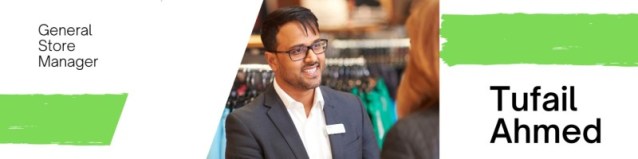
Tufail Ahmed, general manager of the Bexleyheath store. The store is the South East London Academy store, leading business initiatives and educating store teams across the region

According to their memos M&S believe their staff behaved with ” integrity” in banning her. Tufail Ahmed, the manager of the Bexleyheath store, who must be locally responsible for this, has a Linked In page in which he says:

 “M&S Manager of the Year 2018/2019. With nearly 20 years of retail experience working for leading retailers in various roles, I know that change is a very normal place in retail. I am now part of the change at M&S, leading and inspiring people to be the very best.

” My long term aim is to be an influential member of a business’ senior leadership team, that is what I am currently working towards.”

I suspect relatives of Patricia Stewart might beg to disagree.

As for Steve Rowe, who has built his entire career with M&S, his silence on the matter is deafening. He looks about the age to have elderly relatives, I wonder if he would like them to be treated like Patricia Stewart.

Dumped at 50? Disturbing figures as furlough comes to an end

Rishi Sunak, will the furloughed over 50s ever get back to work?

On the day Chancellor Rishi Sunak cuts the support to companies using the furlough scheme to 60 per cent of the wages paid to the 1.9 million people still on furlough, some very disturbing figures are beginning to emerge on the make up of the numbers left.

Both the think tank Resolution Foundation and Rest Less report that it is the older generation rather than the young that are not getting called back to work.

While headlines have concentrated on the serious issue of the mental health of the young who cannot find work, official figures reveal a growing problem for the old.

HMRC data shows that younger workers have been leaving furlough most quickly, with the share of under 18 staff furloughed falling from 13 per cent in May to 7 per cent in June, and from 10 to 6 per cent for those aged 18-24. One-in-ten workers aged 65 and over were on furlough – the highest share of any age group. The Foundation has warned of older workers being ‘parked’ on furlough as younger workers return to work as hospitality reopens.

London remains the furlough capital of Britain, with nine of the ten local authorities with the highest furlough rates in the capital, including Newham and Hounslow where around one-in-eight workers are still on the Job Retention Scheme.

Rest Less, a digital community and advocate for the over 50s, analysed Coronavirus Job Retention Scheme (CJRS) Statistics issued by the government on 29 July and found that the total number of furloughed jobs fell from 2.4 million to 1.9 million between May and June* – a fall of 590,000.

Proportion of over 50s furloughed is rising

Whilst the number of furloughed roles fell across all age groups, the proportion of over 50s on furlough has been steadily increasing this year, rising from 27% in January to 34% in June. In contrast, the proportion of under 30s on furlough fell from 29% to 21% in the same time period.

Both sets of figures show that those over 50 are going to find it harder to get a job and build up enough years to claim a full state pension between the age of 50 and 666 or 67 when they can claim the state pension. Being out of work also means that they won’t qualify for a second work based pension either – possibly forcing them to have to claim pension credit if they can.

Charlie McCurdy, Economist at the Resolution Foundation, said:

“The number of furloughed employees has fallen below two million for the first time as the economy continues to reopen. But that is higher than many expected, and a cause for concern as the scheme is wound down.”

Fresh wave of redundancies

Stuart Lewis, Founder of Rest Less, commented: “The country is reopening, and the total number of people on furlough is falling quickly – by three million since the beginning of the year.  However, the recovery is clearly not working for everyone, with more than 630,000 people aged over 50 still on furlough and waiting to find out if they have a job to go back to.  This is in addition to the 568,000 over 50s claiming job seeking or out of work benefits. 

When the furlough scheme draws to a close next month, we’re expecting it to be accompanied by a fresh wave of redundancies and another spike in unemployment levels – delivering another blow to workers in their 50s and 60s.


Faced with significant age discrimination in the recruitment process, and no Government equivalent to the Kickstart scheme for older workers – the implications of redundancy for workers in their late 50s or early 60s can be significant.

‘Once made redundant, workers over the age of 50 are two and a half times as likely to be in long term unemployment than their younger counterparts. Rather than being able to top up their pensions in those crucial years before retirement, many will find themselves having to dip into what pension savings they do have – leading to a significant drop in long term retirement income for decades to come.”

Yet the government seems obsessed with continuing to raise the pension age when it is becoming clear that the old generation are facing the greatest difficulty in getting jobs. A new generation will be living in poverty with failing health and that poverty will not end when they eventually get their pension.

Damning inquiry report reveals 40 years of horrendous child sexual abuse and racism by Lambeth Council in London

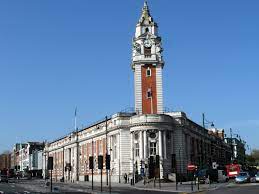
Lambeth Town Hall

The independent Inquiry into Child Sexual Abuse today published its worst ever findings of the scale of child sexual abuse in the United Kingdom. It looks like large numbers of paedophiles got away with the mass sexual abuse of children.

An investigation into Lambeth Council’s children in care revealed that over 700 children had alleged they had been sexually abused and treated as worthless by council staff. And this is certainly an underestimate. The scandal continued from the 1960s right through to the late 1990s.

The report which only looked at five of the council’s closed homes makes incredibly grim reading. The report said:

Cruelty and sexual abuse ” hard to comprehend”

“It is hard to comprehend the cruelty and sexual abuse inflicted on children in the care of Lambeth Council over many years, by staff, by foster carers and their families, and by volunteers in residential settings. With one or two exceptions, a succession of elected members and senior professionals ought to have been held accountable for allowing this to happen, either by their active commission or complicit omission. Lambeth Council was only able to identify one senior Council employee, over the course of 40 years, who was disciplined for their part in this catalogue of sexual abuse.”

It goes on: “By June 2020, Lambeth Council was aware of 705 former residents of three children’s homes in this investigation (Shirley Oaks, South Vale and Angell Road) who have made complaints of sexual abuse. The biggest of these homes – Shirley Oaks – was the subject of allegations against 177 members of staff or individuals connected with the home, involving at least 529 former residents. It was closed in 1983.

“Frontline staff employed to care for these most vulnerable children frequently failed to take action when they knew about sexual abuse. In so many cases they showed little warmth or compassion towards the child victims, who were left to cope with the trauma of their abuse on their own. 

Hostile and abusive treatment of black children

…”There were many black children in Lambeth Council’s care. In Shirley Oaks in 1980, 57 percent of children in its care were black. During 1990 and 1991, 85 percent of children who lived at South Vale were black. Racism was evident in their hostile and abusive treatment by some staff.

” Shirley Oaks and South Vale were brutal places where violence and sexual assault were allowed to flourish. Angell Road systematically exposed children (including those under the age of five years) to sexual abuse. 

“Nor did foster care routinely provide a safe alternative for children in care. For many years, foster carers were not adequately vetted by the Council and were not the subject of criminal record checks.”

Some of the cases described are horrendous.

Children screaming at night while they were raped

“LA-A307 was taken to Shirley Oaks at the age of nine. He described hearing other children screaming at night and he himself routinely experienced violence and sexual assault, including being photographed whilst being raped.

LA-A147 was in the care of Lambeth Council in the 1990s and 2000s, from the age of three. Over ten years, she was placed in nine children’s homes and with four sets of foster carers. She described being raped by a foster carer’s teenage son at the age of nine, and was also frequently sexually abused by older men she met whilst in care. By the age of 13, she had developed a drug addiction and was “selling herself” to fund it.

LA-A2 was found dead in a bathroom at Shirley Oaks in 1977. Lambeth Council did not inform the coroner that he had alleged being sexually abused by Donald Hosegood, his ‘house father’. In the course of Hosegood’s employment at Shirley Oaks, six out of eight children looked after by him and his wife alleged sexual abuse by him.

LA-A7 described sexual abuse by three male members of staff, including two from South Vale. Two of them separately photographed him at their private homes when he was either naked or wearing only his underwear. One of them, Leslie Paul, was convicted of indecent assaults against LA-A7.”

Only six perpetrators prosecuted

Extraordinarily just SIX people have been successfully prosecuted by the police, meaning that hundreds of people must have got away with the vile sexual abuse of children.

All this took place against a background of fraud, corruption, racism, nepotism by both staff and some councillors. Those who tried to stop it were intimidated and threatened. The report shows even two chief executives, Herman Ouseley and Henry Gilby were the subject of intimidation.

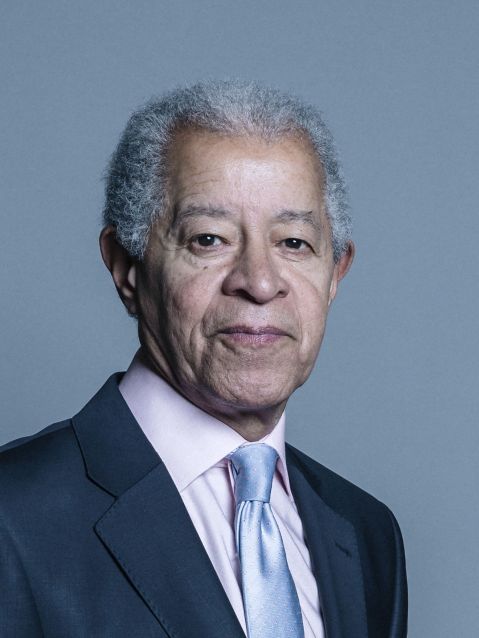
Lord Ouseley – staff bugged his home and office when he was chief executive and his family was threatened

“Lord Ouseley described how both his office and home were ‘bugged’ at the instigation of one of his own staff. He also received threats to his family. Mr Gilby’s office was the subject of a serious arson attack. His home and office were broken into and computer records were stolen during a time when he was attempting to deal with corrupt practices. Dame Heather Rabbatts was Chief Executive from 1995 to 2000. She described how she inherited a Council with a culture of “fear and sexism and racism”. No witness identified which individuals or groups were the driving force behind this vicious and regressive culture, but there was little doubt that a succession of leading elected members were mainly responsible, aided and abetted in some instances by self-serving senior officials.”

The inquiry has decided to ask the Met Police to investigate whether there are grounds for a criminal investigation into Lambeth Council’s actions when providing information to the coroner about the circumstances surrounding LA-A2’s death.

Richard Scorer, specialist abuse lawyer at Slater and Gordon, who is representing the sister of a teenage boy who killed himself in a care home after making allegations of abuse against staff member Donald Hosegood, told Mail On Line: ‘It is clear from today’s report that Lambeth Council deliberately withheld information from the coroner in order to give the impression that our client’s brother was happy in care.”

All in all this report shows why it was necessary to have a full scale inquiry into child sexual abuse – which despite naysayers trying to deny the extent of the problem – was obviously rampant in some parts of the country. The council has apologised .The real tragedy is that so many people have got away with it leaving their victims with broken lives.

The “systemic maladministration ” facing the disabled applying for Personal Independence Payments -official findings

Margaret Kelly Northern Ireland Ombudsman

Northern Ireland ministry and Capita under fire

An absolutely damning report has been issued by Margaret Kelly, the Northern Ireland Ombudsman on the way hundreds of thousands of disabled people between the ages of 16 and 64 are assessed to see if they qualify for personal independence payments.

This two year investigation into the benefit is the first made by the Ombudsman using new powers under Northern Ireland legislation giving their Ombudsman the power to initiate inquiries if the Ombudsman thinks something is going wrong. This type of inquiry would be illegal in England, Scotland and Wales because Ombudsman do not have the same powers.

In Westminster Michael Gove, the Cabinet Office minister, is currently refusing to even introduce draft legislation to give Rob Behrens, the Parliamentary and Health Service Ombudsman. similar powers to start his own inquiries.

The findings apply to the 250,580 people who applied for the benefit in Northern Ireland but as the NI Ombudsman’s Office says ” there are many similarities to PIP across other parts of the UK.”

The report – which examined 100 cases in minute detail, made extensive inquiries of the ministry and Capita, and looked at statistics governing appeals concludes there has been ” systematic maladministration” by the Northern Ireland Department for Communities and Capita, who were administering the assessments.

Not “one off mistakes”

The report says these were not one off mistakes. Instead she” identified repeated failures which are likely to reoccur if left unremedied. It is therefore my view that there is more work to be done to improve the experience and outcomes for claimants, the robustness of decision making and public confidence in the system.”

She has made some 33 recommendations and has given the ministry and Capita six months to rectify them. She can’t compel the ministry to implement them but has said she will do a follow up report to see what they have done. The report also went to members of the Northern Ireland Assembly.

Ms Kelly said:
“Too many people have had their claims for PIP unfairly rejected, and then found themselves having to challenge that decision, often ‘in the dark’, and on multiple occasions, while not knowing what evidence has been requested and relied upon to assess their entitlement.

” Both Capita and the Department need to shift their focus to ensure that they get more of the PIP benefit decisions right the first time, so that the most vulnerable people in our society get access to the support that they need, when they need it. Furthermore, it will safeguard public resources by reducing both the time and costs associated with examining the same claim on multiple occasions.”

The report reveals a serious lack of leadership and guidance from the ministry, poor communication with claimants and a failure to get key additional medical information which would have helped them get the benefit. As a result many of them had their applications turned down only to appeal and get the benefit – at a cost of some £14m to the taxpayer. If the ministry and Capita had got the information in the first place there would have not have been the need for an appeal.

Capita had an incentive NOT to get further medical information to help claimants

She also discovered that disability assessors working for Capita had a perverse incentive NOT to get additional information to help the claimant because they would get a bonus if they completed the application quicker and getting extra information slowed down the process.

Capita were also criticised for poor communications with health professionals as well as claimants. When evidence was requested from Health Professionals named by the claimant, the request letters sent by Capita were often poorly completed and did not specify what information was sought.

In face to face assessments, the evidence from the consultations was often the primary and in some cases the only source of evidence relied upon by the Disability Assessors when providing their advice to the Department.

I came across this report because of a link to my blog from UKAJI, the United Kingdom Administrative Justice Unit, who have reviewed the long report. Their article is here.

I concur with their review which was impressed with the high standard of the research and the bar it set for future Ombudsman investigations.

To my mind this again shows the current weakness of the Parliamentary Ombudsman in Westminster. The present Ombudsman can only investigate complaints and therefore is left with a much narrower remit. By having powers to do a broad ranging investigation, much more detail can be investigated and issues that governments don’t want to address can be highlighted. Hence the conclusion in this report that the disabled have been subject not just to maladministration but ” systemic maladministration”. I bet disabled claimants are similarly treated in the rest of the UK but nobody has the resources to properly investigate their poor treatment. Let’s see what happens in Northern Ireland following this devastating report.

Tory MPs “egregious behaviour” in pressurising judges to hide their lobbying for convicted sex offender colleague

Charles Elphicke , former MP and sex offender

If ever there was a case of one rule for the well connected and another for ordinary plebs, the exposure of this ruling out today by the House of Commons Standards Committee is a great example.

It centres round the conviction of Charles Elphicke, the former Tory MP for Dover,  of three counts of sexual assault on two women in July last year and sentenced in last September to two years in prison. He is currently appealing the case.

The MPs had given glowing character references for Mr Elphicke in the hope of mitigating his sentence and became alarmed when newspapers wanted the judge involved in the case to release the names of everybody who had given character references for him.

So instead of publicly objecting the MPs decided to write on Commons notepaper to Dame Kathryn Thirwall, Senior Presiding Judge for England and Wales, and Dame Victoria Sharp, President of the Queen’s Bench Division, copied to Mrs Justice Whipple. Mrs Justice Whipple had heard the trial of a former Member, Charlie Elphicke, and was to hear and decide on an application to release the pre-sentencing character references.

Natalie Elphicke MP – organised the letter for her husband

The five Tory MPs were Mrs Natalie Elphicke, the former MP’s wife; Sir Roger Gale, former Cabinet minister, Theresa Villiers, Adam Holloway and Colonel Bob Stewart. Natalie Elphicke organised the letter.

The MPs said  to disclose the references would be a “radical change to judicial practice” which “could have the [sic] chilling effect and harm the criminal justice system”. 

They got a stiff reply from the Private Secretary to the Lord Chief Justice of England and Wales November to the letter stating that “It is improper to seek to influence the decision of a judge in a matter of which he or she is seized in this way. [ … ] It is all the more regrettable when representatives of the legislature, writing as such on House of Commons notepaper, seek to influence a judge in a private letter and do so without regard for the separation of powers or the independence of the judiciary”.

Their names- along with life peer Lord Freud- became public when Mrs Justice Whipple released them in a court ruling.

Theresa Villiers MP – as a barrister should have been aware it was an improper act

The Standards Committee ruled today that what the MPs” by acting as they did risked giving the impression that elected politicians can bring influence to bear on the judiciary, out of public view and in a way not open to others. Such egregious behaviour is corrosive to the rule of law and, if allowed to continue unchecked, could undermine public trust in the independence of judges.”

The committee recommends that three of the MPs Mrs Natalie Elphicke, Sir Roger Gale, and Theresa Villiers be suspended from the House for one sitting day, and should apologise to the House by means of a letter to the Committee.

Sir Roger Gale -Unrepentant ” I would do it again”. Pic credit: Twitter

The other two MPs, Bob Stewart and Adam Holloway – who decided to sign the letter after glancing at it for 20 seconds- should apologise to the House of Commons in a personal statement.

The committee recommends all five Members should also apologise to the Lord Chief Justice of England and Wales by letter copied to the Committee. The terms of all the apologies (both by letter and by personal statement) should be agreed in advance by Mr Speaker and the Chair of the Committee.

Four of the five MPs have been contrite about bringing Parliament into disrepute after being summoned by the committee – but Sir Roger Gale has refused to apologise and said he would do it again. He told the committee: “I would find a different way of doing it, but would I do it again—would I seek to achieve the same effect? Yes, I would”.

The report points out that Theresa Villiers is an experienced Member of the House, a trained barrister, and a former Secretary of State for Northern Ireland. “We would have expected a Member of her seniority and experience, with legal expertise, to have been particularly aware that her actions in this case were an attempt improperly to interfere in judicial proceedings.”

Earlier this year Lord Freud was ordered by the Lords Commissioner for Standards to apologise and make a statement. A report was published on my blog here.

Parliamentary Ombudsman officially says maladministration over 50s women pensions – but it will still be a long wait for justice

Amanda Amroliwala, Deputy Ombudsman Pic Credit: Parliamentary Ombudsman

Rob Behrens, the Parliamentary Ombudsman, today published his report finding there was maladministration by the Department for Work and Pensions in issuing advance warnings over the rise in the pension age for women born in the 1950s and 1960s.

The report – as previously revealed on this website – is little changed from its draft version – and still insists that up to 2005 there was no maladministration over telling the women that their pension age would rise. After that the report says there were delays.

Amanda Amroliwala, Parliamentary and Health Service Ombudsman CEO, said: “After a detailed investigation, we have found that DWP failed to act quickly enough once it knew a significant proportion of women were not aware of changes to their State Pension age. It should have written to the women affected at least 28 months earlier than it did.

‘We will now consider the impact of these failings, and what action should be taken to address them”

The decision to publish the first part of the investigating before announcing whether the women will be compensated is unprecedented. But according to the press office ” this is because it is the most important investigation we have done” and ” there is a lot of public interest”.

The report is now laid before Parliament and MPs will be able to press the government about its findings.

Andrew Gwynne MP

Andrew Gwynne, joint chair of the All Party Group on the State Pension Inequality for Women, said:

This report is a landmark moment in the ongoing fight for 1950s women to receive justice, and a vindication of what campaigners have been saying for years. The PHSO has conducted a thorough investigation of a number of complaints and found that there were failings in the actions of the DWP in communicating changes to State Pension.

The DWP must urgently address these findings and advise 1950s women what actions they will take to right the wrongs committed by successive Governments. For too long 1950s women have been ignored, and this must change.”

The question is now what will happen next. The report is the first part of a three stage process.

What happens next?

The next stage will be to examine how badly the women were affected by this process. According to the press office this may not be just examining how the six complainants were affected but will look wider. It is not clear at this stage how this will be done and how long it will take.

Then there is a third process -deciding how much compensation the women will get. It will be nothing like the sums of money women lost – often adding up to as much as £50,000 – but is more likely to be hundreds or low thousands.

Again it is not clear whether the Ombudsman will publish these two processes separately or just issue a final report.

My guess – and it is only a guess- is that this may take a year.

Even when it is published the Department for Work and Pensions will need time to respond and a lot will depend on the timetable the Ombudsman gives them to respond and compensate people.

If I take previous cases involving the DWP- the six will get their compensation within a month- while the remaining millions will have to wait. Also the Ombudsman cannot compel the DWP to compensate them – but pressure from MPs should ensure that people will eventually get the money.

The 3.8 million women and those born in the 1960s are still a long way from justice despite this ruling today.

Previous stories on my blog on this issue are:

https://davidhencke.com/2021/06/07/exclusive-parliamentary-ombudsman-proposes-to-say-maladministration-by-dwp-over-the-rise-in-the-womens-pension-age/

https://davidhencke.com/2021/06/12/50s-women-pensions-flaws-in-the-parliamentary-ombudsmans-preliminary-maladministration-report/

I haven’t gone into much detail on the report as you would have read it when I published the draft on June 7.

Those who want to see the report It is here.

England’s buses “expensive, unreliable and dysfunctional” – damning findings of a former UN human rights expert

Bus stop image; Pic credit: Pexels Suzy Hazelwood

A report out today by Philip Alston, the former United Nations rapporteur on human rights, condemns the outcome of Margaret Thatcher’s privatisation of the country’s bus services for denying rights to the people of the UK. He came to the UK to interview people about bus services and contacted some of the bus companies.

In a stinging review he finds that many people have lost jobs and benefits, faced barriers to healthcare, been forced to give up on education, sacrificed food and utilities, and been cut off from friends and family because of a costly, fragmented, and inadequate privatized bus service that has failed them.
“Over the past 35 years, deregulation has provided a master class in how not to run an essential public service, leaving residents at the mercy of private actors who have total discretion over how to run a bus route, or whether to run one at all,” said Philip Alston, who authored the report with Bassam Khawaja and Rebecca Riddell, Co-directors of the Human Rights and Privatization Project at New York University’s Center for Human Rights and Global Justice. “In case after case, service that was once dependable, convenient, and widely-used has been scaled back dramatically or made unaffordable.”

He describes the form of privatisation as the most extreme possible – with the exception of London where Transport for London has overall control of how private operators run services.

He is also critical of the government’s new bus strategy started by Grant Shapps, the transport secretary, saying merely tinkers with the existing system, offering ineffective half measures that fail to address the structural cause of the
country’s bus crisis.

Philip Alston getting people’s views at a public meeting in Newham, East London. Pic credit: Bassam Khawaja

Some of the points in the report.

“People living in London, Scotland, Wales, and Northern Ireland can get a concessionary pass to travel for free on buses at the age of 60, an important measure that guarantees older people access to transport. But in England outside London, the government has tied the bus pass to the female state pension age—which was changed from 60 to 66, severely penalizing those on the cusp of retirement who had every expectation that they could rely on a pension and a free bus pass in the next phase of their lives. The UK government should rectify this injustice

“The abysmal state of the bus system in many rural areas is perhaps the strongest argument against a deregulated, for-profit approach to public transportation.

” There is no reason why rural parts of the United Kingdom cannot have a functioning bus service. The Zurich region of Switzerland guarantees villages of 300 people or more at least an hourly service seven days a week. In North Hesse, Germany, bus routes reach all communities with more than 200-250 residents on at least an hourly basis, with ambitions to double public transport use by 2030. Notably, none of these systems rely on an unregulated market to provide this essential service.”

He makes a strong case for bus services to be returned to public ownership and for Parliament to lay down minimum standards for the provision of bus services.

This really is a damning indictment of the state of bus services in England and it has human rights implications because women, people with disabilities, the poor and those living in rural areas cannot access services or get jobs because of poor transport. As usual ministers are pretending they provide good services while other similarly rich countries -like Switzerland and Germany -provide services that English people can only dream about. In the meantime the bus operators make good profits by not providing the services they need.

Philip Alston hears from people affected in Newcastle-upon-Tyne. Pic credit: Bassam Khawaja

Worst audit report for the Department for Work and Pensions in 33 years

A damning loss of control of Universal Credit payments has meant that the Department for Work and Pensions has received a drubbing from the ministry’s auditors, the National Audit Office, and led to its accounts being qualified for 33rd year in succession.

While the ministry has been praised for its swift response to the pandemic by uplifting Universal Credit by £20 a week and coping with a doubling of people on the benefit, the grim costs to the ministry’s finances are revealed in its annual report.

Overpayments on Universal Credit have skyrocketed, criminal gangs have targeted business payments and the ministry has had to set aside £1 billion to pay 132,000 pensioners who have been underpaid their pensions for up to 30 years.

A new problem of identity theft of some 5000 claimants has also hit Universal Credit leaving some claimants losing benefit for weeks.

Overpayments hit record £8.3 billion

DWP estimates it overpaid £8.3 billion of the £111.4 billion that it spent on benefits in 2020-21, an increase of £3.8 billion on the previous year. The rate of overpayments increased from 4.4% in 2019-20 to 7.5% in 2020-21. Nearly all of the increase in fraud and error was on Universal Credit. DWP estimates it overpaid £5.5 billion of Universal Credit (14.5%) and underpaid £540 million (1.4%).

The NAO reports: “DWP has identified four key fraud and error risks within Universal Credit that it needs to tackle, as they are the largest causes of fraud and error. It is looking to improve controls over incorrectly reported self-employment earnings, savings, living arrangements and housing costs. It has also identified several organised criminal attacks during the pandemic, with fraudsters targeting Universal Credit in particular and making claims in other people’s names.

The Department is owed £5 billion of overpayments, placing additional strain on its resources and potentially causing uncertainty and hardship to claimants. It is not sure how much of its estimated loss of £8.4 billion in 2020-21 it will recover, as it has attempted to recover only 10% of the estimated loss in the last 5 years.”

The ministry is now having to bring in more staff to sort out the fraudulent claims and a criminal investigation has been launched.

On the underpayment of pensions the ministry has promised to pay the people by the end of next year.

Gareth Davies, NAO head ” fraud and error at record levels”

The NAO report says: “The Department commissioned a root cause analysis to understand the cause of these underpayments. This analysis identified a range of process and control issues including poor staff training, instructions and quality review that led to the underpayments. These issues have also affected the Department’s initial work to quantify and rectify errors. The Department has asked the Government Internal Audit Agency to review State Pension legislation to ensure there are no further entitlements that may be underpaid.”

“The impact of this underpayment on the individual pensioners is significant, and it is vital the Department learns lessons to avoid systemic underpayments in the future and correct past underpayments.”

Gareth Davies, the head of the NAO, said:

“I am concerned that the level of fraud and error in the benefits system continues to increase year on year, now reaching its highest level since records began. This has a real impact on public funds and on those who face deductions to their income due to overpayments.

“I recognise that the pandemic and the resulting surge in the number of claimants has increased DWP’s exposure to fraud and error. It must now review all cases that could have been subject to fraud during this time, whilst continuing to progress our past recommendations on how to reduce fraud and error.”

Top retired Cardiologist calls for whistle blowing to be a “routine and acceptable practice” throughout the NHS

Dr David E Ward, retired cardiologist

This is a guest blog by David E Ward, a distinguished retired cardiologist, formerly at St George’s Hospital, South London, in response to my last blog on the case of Dr Chris Day and a series of blogs on the case of Dr Usha Prasad

The treatment of bona fide whistleblowers working in the British NHS is egregious and primitive. This is amply exemplified by many publicised WB cases over the last 2 decades: Dr Raj Mattu, Dr David Drew, Dr Kevin Beatt, Mr Peter Duffy, Dr Chris Day, Dr Usha Prasad and many others (see Google). Just think for a second or two – is it appropriate to threaten the career, the livelihood, the families of these honest doctors who were only doing the “right thing” by drawing attention to what they honestly perceived were remediable shortcomings? In fact, it is required of doctors to report any perceived shortcomings (Hippocratic Oath and all that and more recently with the “Duty of Candour”).

How is it possible – in the democratic UK – to threaten a doctor with such punitive costs that they are forced to withdraw their legitimate claims or risk potential bankruptcy? Isn’t this behaviour something we might associate with some autocracies toward the east? In the case of Dr Chris Day, the sum spent on pursuing (persecuting) him must now be more than £1,000,000! All to extinguish the career of an honest doctor who sought only to improve the care of patients in his unit. Wouldn’t it have been more sensible (litotes here) to spend that huge sum of money on improvements to the unit in question? (see CrowdJustice, http://54000doctors.org/blogs/timeline).

Successive health secretaries did ” little or nothing” to help whistleblowers

Jeremy Hunt, former health secretary now chair of the Commons health and social care committee

Successive Health Secretaries have done little or nothing to support whistleblowers. Jeremy Hunt (yes, he who did so much damage to the NHS; see Caroline Molloy, http://www.openDemocracy essay) asked Sir Robert Francis QC to report on the issue (see Google) but then ignored most of his recommendations or feebly implemented some (for example, the Freedom to Speak Up Guardian which doesn’t really work, to say the least). The last SoS for Health and SC did nothing at all to support WBs to my knowledge (OK, there is a pandemic). The present one has probably never heard of any of the names listed above or even what whistleblowing within the NHS means! What is more disturbing is that other powers-that-be, for example the NHS Medical Director, the Head of the NHS (whoever that will soon be), other Ministers etc, seem to take no interest in this problem, none whatever. The Health and Social Care Select Committee could take an interest but it is chaired by Jeremy Hunt – who is too occupied with his own self-importance and whose record as SoS speaks for itself – so I don’t expect any action there. Perhaps these grandees are too far removed from day-to-day whistleblowing in the NHS. It wouldn’t take much time to find out what is happening at grass roots.

Time to create a public register of whistleblowing cases

Some tentative suggestions:

1. Create a register of WB cases. Whistleblowing investigations are almost invariably secretive. Why? Apart from clinical details what else need to be anonymised? All reported and ongoing whistleblowing cases should be logged in an open and accessible register kept by an independent (is that possible?) body, preferably independent of the Trust and possibly the NHS and its Byzantine structures. Progress of a case should be openly documented and questions may be submitted. Resolved cases would be available, uncensored, for retrospective scrutiny. Openness might deter shady deals behind closed doors (yes, they do happen). Above all the external investigators should be accountable to the Trust and their own professional organisations.

2. Make cost threats unlawful. No Hospital Trust should be permitted to use the threat of costs against a “little person” (i.e., doctor) who cannot possibly equal the financial power of the taxpayer-funded persecution to defend themselves (yes, for it is us, the taxpayer, who pays the bill for the outrageous sums mentioned above to “thwart” the WB but we have no say whatever in the process). If money is to be spent in this process it should be wisely and fairly spent and shared equally between the participants, that is the victim (the doctor) and the aggressor (the Trust).

3. Make Internal hearings demonstrably independent of both parties. All WB cases which are subject to “internal” hearings (for example Maintaining High Professional Standards panels) are vulnerable to potentially corrupt processes (as some of the above cases probably have been). They should be heard by independently appointed persons (this will require some checking because as we have seen not all so-called “independent” chair-persons are quite as independent as they may appear – see Dr Usha Prasad blogs here) and open to external scrutiny by independent authorities or suitably qualified persons. Minutes of internal hearings should be made accessible. (Employment Tribunal proceedings are already largely in the public domain).

Make falsified evidence a criminal offence

4. Make falsification of evidence by either party an offence (I think there is a name for this beginning with “P”). If defence of a whistleblowing claim by a Trust is found to be untrue or contain false or falsified “evidence”, or in some other way is dishonest (there may be some of that in some of the ongoing current cases mentioned above…) there should be appropriate retribution for the Trust and managers involved. Incidentally, it is usually managers who instigate the persecution and recruit the heavy (taxpayer-funded) lawyer-supported defence without accepting any personal responsibilities themselves. Also, the use of public money in this way could be regarded as fraudulent and a misuse of taxpayer funds.

5. Ensure the original WB claim is clearly stated. The original concern which prompted the WB to speak out should be clearly and concisely stated in language that the “man on the Clapham omnibus” (Lord Justice Greer, 1932) can understand. It should never lose its primal status. It defines the whistleblower in the first place. WB have, by definition, concerns about the environment in which they are working. They make what is termed a “protected disclosure” (Protected Disclosures Act 2014, Health Act 2004). It is remarkable that these concerns are not infrequently submerged (or completely forgotten) by the ensuing investigative process – which is often more about the Trust and its managers avenging a perceived insult by the WB than seeking solutions.

Health Trust managers use lawyers to “crush honest doctors”

Lastly, what is it that Trusts’ and their managers are so keen to defend seemingly at any cost? Very expensive lawyers are used to “crush” an honest doctor, the “little person”. A defence possibly costing much more than it would to correct the shortcomings exposed by the WB in the first place. Is it the Trusts’ or its managers’ reputations that are at stake? Would the CQC ratings be adversely affected if the Trust was found to be at fault? Are there hidden misdemeanours which might be revealed? Why do these proceedings always come across as a potential “cover-up” by the Trust? Shouldn’t the grossly disproportionate defensive stance itself raise serious questions worthy of further investigation?

It is high time the treatment of NHS whistleblowers is once again raised at the highest level (for example, in the House of Commons following the example of Sir Norman Lamb, see report above). Too many professional lives (not only doctors but nurses, physios etc) are being destroyed for no good reason. This is bad news at any time but in the middle of a pandemic it is nothing short of scandalous. Whistleblowing in the NHS is not taken seriously enough and may be a factor persuading some doctors to voluntarily leave the profession before time. In an open liberal society with everyone working for the good, “whistleblowing” should be a routine and acceptable practice. Sadly, it is cause of great distress and stigma.