
The decision by Lord Justice Irwin and Mrs Justice Whipple to dismiss ALL claims of discrimination and failure to inform 3.8 million women born in the 1950s about the rise in their state pension age from 60 to 66 is in total contrast to the decision of Mrs Justice Lang who granted ALL the claims to be heard four months ago.
Obviously there is a big difference between permission for a judicial review to be granted so the case can be argued than a judicial hearing where the arguments are tested.
Nevertheless this startling contrast to me suggests that there are grounds for an appeal because the two judgments are so far apart. That is presumably why the two judges did not ban an appeal.
To remind people Mrs Justice Lang decided that even though the 1995 Pensions Act was passed 24 years ago the effect of the implementation of the Act was happening now and therefore this issue was subject to judicial review. She also agreed that both age and sex discrimination could be part of the hearing, and the issue on whether government action was contrary to EU directives on social security and whether people had been adequately informed about the changes.
The two judges have rejected all of this and upheld the case put by the Department of Work and Pensions in its entirety. No wonder the DWP is cock a hoop today.
They describe any challenge to primary legislation passed over 20 years ago as ” fatal” and they have published in detail all the attempts by the DWP to inform people. They have included discussions from 1993 onwards about changing the law as part of informing people.
But they abrogate any responsibility on whether the DWP did a good job or not. ” We are not in a position to conclude that the steps taken to inform those people affected by the changes to the state pension age for women were inadequate or unreasonable”.
They have also accepted the DWP’s argument that it was under no obligation to tell people at all and certainly not to individually informing anybody about the change because it was not written into the law.
This ruling should be a red line for MPs to insist in the future that any Parliamentary legislation that affects millions of people must include a clause requiring a ministry to individually inform the people affected in language they can understand and in good time.
Goodwill or good sense is obviously not enough to be left in the hands of individual ministers. It must be made mandatory that people are told.
The arguments over whether government action in handling the rise in the pension age contradicted EU directives amounted to age and sex discrimination or indirect legislation are complex.
But broadly the judges have accepted the DWP’s interpretation of the wording so as to exclude the changes to the pension age from any such directives.
They have also ruled out the role of the UN Convention on the Elimination of Discrimination against Women from having any bearing on the case.
” We have not been assisted by reference to CEDAW, it adds nothing to the claimaint’s case”, they say.
Their main argument is that the 1995 Pensions Act removed an advantage (my emphasis) that women had over men at the time they retired and anyway the decision was part of primary legislation which could not be challenged.
Jackie Jones, Labour MEP for Wales and an expert on CEDAW, says the judges have misunderstood the purpose of CEDAW which could make a possible grounds for appeal.
In her view the Judges did not consider the cumulative effect of unequal laws in the past on this particular group of women who were denied contributing to their own pensions when they worked part time which is one of the issues covered by CEDAW.
The judges also ruled out the recent victories in civil service and firefighters pensions having any bearing on the case because they involved transitional arrangements for work pensions rather than their right to a state pension.
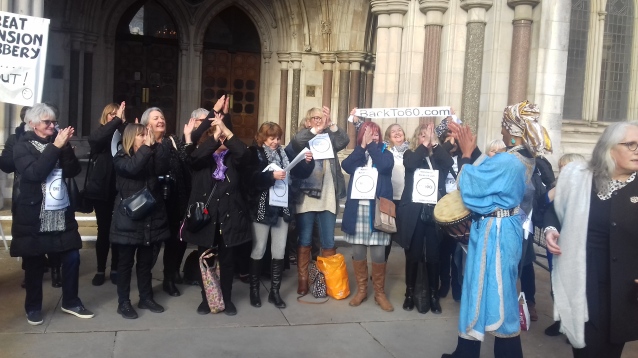
Despite the harshness of the judgement the immediate effect has been to create widespread sympathy for the plight of the 50swomen in the media, among the general public and brought finally to national attention the whole issue.
It has also galvanised campaigners to fight on and with a general election on the horizon to put politicians in all political parties under pressure. It could cost the government, if it does nothing, 3.8 million votes from people who reliably go down to the polling station.





 Westminster Confidential