A psychiatrist’s damning indictment of 500 years of racism – now revived by Trump and 9/11

suman1

Suman Fernando. Pic credit: http://www.sumanfernando.com

CROSS POSTED ON BYLINE.COM

Suman Fernando is a gentle soft spoken  consultant psychiatrist, lecturer and honorary professor at the London Metropolitan University.    The 85 year old is not the sort of person at first sight to produce such a searing critique of racism in the UK and the US and the baleful role psychiatrists have had in treating ethnic minorities in both countries.

His book released at  the end of last year and launched by ROTA – Race on the Agenda – looks at both the history of racism which he dates from 1492 when the Spanish finally  removed the Moors from Europe and the role of psychiatry in treating ” mentally ill”  black and brown patients over a very long period.

The book is particularly relevant as Theresa May has  quietly decided to review the UK’s mental health laws  which cover some of these issues – signalling her intent by  holding a meeting of psychiatrists at Number Ten Downing Street.

It also comes at a time when the election of Donald Trump, the rise of Islamophobia in the wake of 9/11 and to an extent, the worst excesses of some people supporting Brexit, has seen a revival of popular nationalism and in the US, white supremacists.

He traces racism from the bloody Inquisition in Spain through the development of the slave trade, the rise of eugenics leading to Nazism,  the Imperialist destruction of other cultures by colonisation to the ” rivers of blood” speech of Enoch Powell as Britain faced an immigration wave in the 1960s and 1970s.

His  thesis is that – mainly because of the 1970s race relations legislation in Britain – overt racism has until recently been replaced with a form of institutional racism and psychiatry is no exception to the rule.

Indeed some of the worse psychiatric theories to treat people as seen by superior whites as ” the other” came from this profession. This was the profession that applied the concept of  ‘Drapetomania’  to slaves in the USA, the primary symptom being a persistent urge to run away.  The implication was Black Afro-Caribbeans were supposed to be happy and content as slaves  and had mental problems if they wanted their freedom.

In Britain the book provides numerous examples of how different ways of dealing what is an obvious imbalance in the number of Afro-Caribbeans being sectioned compared to white Britons. Attempts to change treatment or properly research the issue by black psychiatrists were undermined in a typical British way – their work was subsumed by more conventional psychiatrists or their findings were ignored.

He also reveals  how attempts to change matters politically were undermined. Tony Blair  appointed Paul Boateng – now Lord Boateng- as the first minister for mental health in 1997. At the time he was known to be  strident in wanting to change the treatment of black Afro Caribbeans like himself- but within months he was squashed.

Since 9/11 the danger is that racism is on the rise with Muslims rather than Afro Caribbeans as the main target. That is why the timing of this book is relevant in the context that the mental health legislation is being revised. Already psychological research is being used as a basis in the Prevent programme to decide whether teachers or NHS staff, their pupils and their patients, should be reported to the authorities if they show signs of radicalism.

The next slippery step would be to decide that these people are insane – and should be sectioned rather than prosecuted. This is not as fanciful as it sounds. Under  Labour there was a move to classify stalkers of VIPs as a mental illness and Jack Straw when he was home secretary is said to have considered whether paedophiles should be classified as insane rather than criminals.

That is why this book is so interesting because it tells how deep seated racism is among white Europeans  and how insidious the present system is in dealing with the ” other” – from stop and search to sectioning.

The one sad thing is that the book itself has been “Ghettoised” – it has been pigeon holed by the publisher  as part of ” contemporary black history ” when it is much more of an account of how contemporary British and US society has reached such a view on black and brown people.

The German publisher has created another ghetto by price – Palgrave Macmillan have priced it at a ridiculous £67.99 or £53.99 as an e-book. Amazon have a Kindle version at £45.19. So I suggest you try and get it in a public library or if you are a student make sure your university library has got one.

Institutional Racism in Psychiatry and Clinical Psychology. Suman Fernando


50s pensioners: Time for you to put the boot into your local councillor at May’s elections

ballot-box

Waspi Pensioners :Time to use your vote wisely Pic credit: BBC

CROSS POSTED ON BYLINE.COM

The 3.9 million 50s pensioners have a great opportunity to get their views across at the local elections to be held on Thursday May 3.  Elections will be held in all 32 London boroughs, 34 metropolitan boroughs, 68 district/borough councils and 17 unitary authorities.  There are also elections for mayors in the London boroughs of Hackney, Lewisham, Newham, Tower Hamlets and just outside London in Watford.

Local elections are of course about local matters. However the performance of political parties at local elections is always judged by the media as a snapshot of national voting intentions. Also the attitude of local councillors towards the plight of women denied their pensions for up to six years could well be symptomatic of their attitude towards other injustice issues.

You can do this by first getting on top the House of Commons library constituency estimates of the 3.9 million people affected here

Go to the end of the summary and download the constituency estimates ( You will need Excel on your computer).Then look up your constituency and the total number of people affected. You will find it is thousands in your constituency.

Next go onto  the  Wikipedia link at the end of the report and see if your council has elections. Then go on to the council’s site and chase up your ward councillors.

Challenge them to  put pressure on their MP to get government policy changed so you will get your money. If they refuse vote for the nearest challenger who will.

So where are the key places where 3.9 million women can make their votes count. Here are some good examples with all the links  set out for you.

In London where all the seats are up for grabs, the most obvious place to register a protest vote is Barnet. There are 18,200 women affected in the borough and the council is narrowly Conservative who oppose any change or concessions to the women.

The ruling Conservative group has a majority of one (32 Conservative, 30 Labour and one Liberal Democrat) in 2014. You can check the result for the ward you live here. 

Another is the London borough of Hillingdon where there are 16,100 women affected and it is represented by two high profile MPs, Boris Johnson, the foreign secretary, and John McDonnell, Labour’s shadow chancellor. The current council has 42 Conservatives and 23 Labour. You can get a ward breakdown here.

And for a different slant the Royal London borough of Kingston has 12,000 women affected (though some are in Richmond) and a council with 28 Conservatives, 18 Liberal Democrats and 2 Labour councillors – a Conservative majority of eight. You can check your ward here.

Some of you may find yourself in Richmond as  Tory Zac Goldsmith’s Richmond Park constituency straddles both boroughs.

Conservatives have a bigger majority in Wandsworth with 41 seats topping Labour’s 19 and there are 11,900 women affected living there. You can find your ward here.

A longer shot is the London Borough of Bexley which has 45 Conservative,15 Labour and three UKIP councillors. But it has 15,200 women affected. A run down on your local ward councillors is here.

.Milton Keynes in Buckinghamshire is currently not under any party control. It has 25 Labour councillors, 18 Conservatives, 13 Liberal Democrats and one UKIP councillor. One third of the council is up for election. There are 14,400 women affected in the borough. So it will provide an ideal opportunity to put all the parties on the spot. You can check your ward here.

Calderdale also has a third of the council up for election. The council which covers Halifax and the surrounding area has 12,900 women affected. The council is also not under any party control. The council has 23 Labour members, 21 Conservatives , 5 Liberal Democrats and two Independents. You can find your ward here.

The full list of councils where elections are being held is here.

They include big cities like Manchester, Birmingham, Hull, Leeds, Liverpool, Newcastle upon Tyne as well as smaller places like Hastings, Gosport, Portsmouth, South Lakeland, Maidstone, Huntingdon and West Lancashire.


Gove takes the lead in a Whitehall Brexit spending spree to bypass Parliament

michael gove

Michael Gove – top of the great Brexit spenders- and first to use a dodge to bypass Parliament.

CROSS POSTED ON BYLINE.COM

The government is planning a Brexit spending spree  this year without any say by Parliament.

Hundreds of millions of pounds of taxpayer’s money will be spent  setting up   bodies  to replace work done by the European Union some using a Whitehall  wheeze devised by a Treasury mandarin to get round  scrutiny by MPs.

Michael Gove, the environment secretary, is poised to be the first to use the new  system to allow ministers to spend large sums of money on Brexit without the approval of Parliament.

Very simply the dodge involves turning on its head a procedure called an accounting direction – normally used  when a senior mandarin -wants to challenge spending by a minister as illegal or questionable. It was most famously used when a senior civil servant questioned aid to pay for  Malaysia’s Pergau Dam – when he discovered the money was being authorised by Margaret Thatcher as part of a secret defence deal. It was also used to question extra costs on the Millennium Dome under Tony Blair. More recently a civil servants challenged the government paying for a survey requested by a UKIP council in Kent.

Now Whitehall mandarin Richard Brown has devised a scheme which will allow ministers to get round Parliament by using the same procedure to spend money on Brexit without waiting for legislation to be passed by Parliament. The letter is here. 

It has been sent to 25 ministerial departments, 20 non ministerial departments and over 300 agencies.

It followed a letter from the Treasury and the Department of Exiting the EU which also allowed ministries to raid the contingencies fund without waiting for laws to be passed.

Both senior civil servants are claiming that the requests for extra cash will be known to Parliament as they have informed the chairs pf the public accounts committee and the public administration committee. Some people might think that in all the huge coverage of Brexit they might be overlooked.

Today  Civil Service World reports that a massive £245million has been routed by a supplementary estimate to spend money on Brexit with Michael Gove’s Defra department taking the lion’s share of £67m closely followed by HM Revenue and Customs with £47m and £42m for the Home Office to work out a new immigration system.

On top the permanent secretary of Defra, Clare Moriarty, has asked Michael Gove to approve £16m of cash for a whole series of projects without waiting for legislation.

These are:

The new national import control system for animals, animal products and high risk food and feed. Scheduled to commence building: mid-January 2018. Estimated cost before Royal Assent: £7m.
– Delivery of new IT capability to enable registration and regulation of chemical substances placed on the UK market. Scheduled to commence building: February 2018. Estimated cost before Royal Assent: £5.8m.
– Delivery of systems for the licensing and marketing of veterinary medicines. Scheduled to commence building: end-January 2018. Estimated cost before Royal Assent: £1.6m.
– Development of a new catch certificate system for UK fish and fish products being exported to the EU on Exit. Scheduled to commence: building end-January 2018. Estimated cost before Royal Assent: £1.0m.
– Development of a UK system to manage the quota of fluorinated gases and ozone depleting substances required under the UN Montreal Protocol. Scheduled to commence: March 2018. Estimated cost before Royal Assent: £0.5m.
– Development of data exchange arrangements to identify the movement of EU and third country vessels in UK waters and the movement of UK vessels in EU or third country waters. Scheduled to commence: April 2018. Estimated cost before Royal Assent: £0.1m

This gives a small glimpse of how complicated the change will be. One mistake and Britain could be thrown into chaos as it has relied on the EU for authorisation and will have to sign up for everything again , including international conventions.

Imagine what would happen if there are errors in the licensing of veterinary medicines for example. It could mean that it will be illegal for your pet to get the proper medicine from the vets.

Also it reveals that large sums of taxpayers money are going to have to go on new bureaucracies to administer all this.  So where will be the Brexit dividend?

And all this is being pushed  out ” under the counter” by mandarins and ministers. If the coverage of errors and waste endemic in Whitehall are anything to go by, Britain could easily face total chaos after 2019. It’s going to be a hell raising time as we leave the EU.


Revealed:The over budget safeguarding system that doesn’t know if your kids are safe from sexual predators

disclosure and barring service

Disclosure and Barring Service Pic Credit: gov.uk

CROSS POSTED ON BYLINE.COM

Another day, another waste of taxpayer’s money on a scheme run by private contractors that was meant to cut costs for employers but has ended up with a huge unforeseen bill for the taxpayer.

While the privatised part of the probation service has had to be bailed out by the Justice ministry, at the same time the Home Office is having to pay out hundreds of millions of pounds to keep on track the digitalisation of the Disclosure and Barring Service.

This is the service that provides proof that people working with children do not have criminal records, and aren’t paedophiles so children and vulnerable adults can be safe. The service -like many others- had been run by Capita.

The government in 2012 decided to digitalise the service – promising big savings for employers, and a new updating service transferring the cost to the person seeking the job.

By this year the Home Office thought the number of disclosure certificates needed by employers would drop by a massive 67 per cent as 2.8 million people  seeking work with children would pay out £13 a year for an update of their certificate negating the need for new certificates. The cost of certificates to employers was expected to be cut.

As a National Audit Office report  released recently shows nothing of the sort happened.

Instead only 900,000 people decided to do this. Why? Because normally the employer pays for the certificate so it costs the applicant nothing.

As a result the NAO says: “The update service is losing DBS £9 for every sale. DBS’s 2016-17 Annual Report and Accounts report that the update service costs DBS £22 but is priced at £13 per paying applicant per year. ”

Then the 2,250 profit making firms who check the identities – from GB Group plc and  Atlantic Data Ltd to Capita Resourcing Ltd. make much more money from processing full certificates than checking updates. So they never promoted the service on their websites.

But there was far worse to come. The government appointed Tata to modernise the service and  build a new IT system  and then promptly changed the specification of what was needed. This resulted in delays and led to a one year extension for Capita which was running the service. Payouts totalling £26m had to be made to Tata for the delays and changes.

And then costs rocketed by £229 million and it is now three and half years late. Bizarrely because people have not switched  to the update service the DBS has got extra income worth £304m. Tata and Capita are still making profits. Rewards for failure at a cost to employers.

So who lost out? First employers who were promised cheaper bills – each certificate costs them £56.

But also us. There is one thing the DBS don’t do. After supplying the information about a potential employee, they never check whether the employer does disbar him or her. Since the whole point of this huge process is to protect children and vulnerable adults from predators and violent abusers you might have thought they would check up.

And given the current fashion where people who claim to be sexually abused might not be believed or labelled fantasists – I don’t think we should wait for a horrible incident to find out.


50’s Women:”Nobody will see their pension entitlement changed by more than 18 months” – Theresa May’s crass error

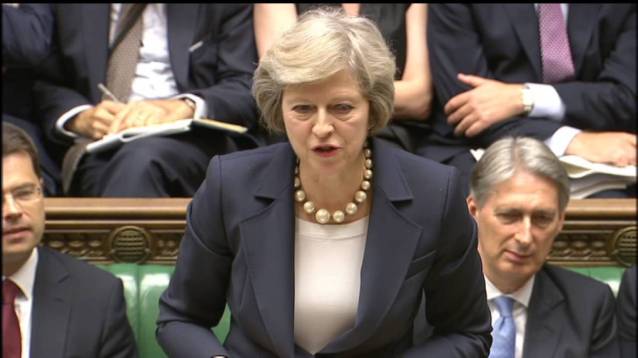
theresa may in parliament

Theresa May in Parliament Picture YouTube

CROSS POSTED ON BYLINE.COM

There was an extraordinary error by the Prime Minister, Theresa May, when she was challenged by Ian Blackford, the Scottish Nationalist leader, at Prime Minister’s Questions in Parliament today.

Mr Blackford used one of his two questions to raise the plight of the 3.8 million WASPI women who have been hit by the government’s  decision to raise the pension age from 60 to 65, then 66 and 67.

Mr Blackford asked: “Yesterday we celebrated the achievements of the suffragette movement, which was about democracy, equality and fairness for women.

“However, today in the United Kingdom, 3.8 million women are not receiving the pension to which they are entitled. A motion in this House last November, which received unanimous cross-party support—the vote was 288 to zero—called on the Government in London to do the right thing. Will the Prime Minister do her bit for gender equality and end the injustice faced by 1950s women.”

The Prime minister replied:

“As people are living longer, it is important that we equalise the pension age of men and women. We are doing that, and we are doing it faster. We have already acted to give more protection to the women involved. An extra £1 billion has been put in to ensure that nobody will see their pension entitlement changed by more than 18 months. That was a real response to the issue that was being addressed. If the right hon. Gentleman wants to talk about equality, he has to recognise the importance of the equality of the state pension age between men and women.”

What this showed is what 3.8 million women waiting up to SIX years for their delayed pension have yet to get the message across. Theresa May just thinks you have a little wait of 18 months. And this £1.1 billion  concession is just a future cost to the government over the next two years, no money has been paid out yet.

This ignorance – caused by her only taking into account the changes in 2011 affecting the rise in the pension  age from 65 to 66 for both men and women – shows how ignorant the Prime Minister is.  Considering she is in that age group herself – but guaranteed to get a large Parliamentary and Prime Ministerial pension in her right-plus a big payout for her wealthy hubby – shows the gulf between the Metropolitan elite and the ordinary person. Mo misery for her in her old age.

But it was good news that the SNP leadership were taking women pensioners plight seriously. About time Labour and Liberal Democrats did the same.

UPDATE:  Ian Blackford said today (Thurs) : ” The Prime Minister’s reply was outrageous. She was being economical with the truth. We are all know there have been some horrible cases as a result of this policy and something will have to be done.

“I am not just sympathetic I will not let this matter go.”

Later Guy Opperham, under secretary for works and pensions, made a statement in Parliament saying  the government were  not going to do anything and would fight any legal challenge by the 3.8 million people to change its mind. He was cagey about announcing the last date when people who were never told about the change until years afterwards could complain about maladministration.

Watch him and the short debate that followed here

Guy Opperman has a majority of 9,286 over Labour in his Hexham constituency in Northumberland. There are 6000 constituents who are 50s women and have suffered from a policy he has no intention of changing. If they all switched to his nearest challenger he could lose his seat. That is up to you.

IMPRESS reject arbitration and compensation claim from ex MP over Esther Baker investigation story on this blog

esther baker

Esther Baker

CROSS POSTED ON BYLINE.COM

The press regulator, Impress, has refused a request for arbitration and compensation from former Liberal Democrat MP, John Hemming, over an article published on this blog last September when the Crown Prosecution Service decided not to  issue criminal proceedings against the ex MP and two other people over allegations of child sex abuse from Esther Baker.

The article reported, almost in full, statements issued by Staffordshire Police and the ex MP after the decision was announced by the CPS. The CPS concluded there was ” insufficient evidence ” to proceed, the ex MP said he had been the subject of false allegations.

Since then Esther Baker has appealed the CPS decision and a ruling is expected some time in the autumn.

This blog is not directly covered by the regulator, IMPRESS, but because I cross post articles on the independent platform, Byline, it is indirectly covered since Byline has agreed to be regulated by IMPRESS.

IMPRESS’S regulatory committee ruled  that the article  on its own could not been seen  as Mr Hemming claimed as ” harassment”. And it dismissed his claim for compensation by saying that any  alleged harm caused to Mr Hemming  by this article was ” trivial ” and ” too insignificant to meet the  test ” for a claim.

For the record  and to prevent other people putting  any spin on this decision this is the text of the ruling sent to Byline:

“I am writing to advise you that an IMPRESS Regulatory Committee recently met to consider John Hemming’s request for arbitration. Having carefully considered his request in accordance with the IMPRESS procedures they have decided that the request is not suitable for arbitration under the CIArb/IMPRESS Arbitration Scheme. The reasons for their decision are set out below.

Reasons for Board arbitration suitability decision:

Rule 8.3 of the IMPRESS Regulatory Scheme requires the Board to make an administrative assessment of whether a claim is covered by the scheme. For the avoidance of doubt, this decision is not based on an assessment of the merits of a claim.
Rule 46 of the Regulatory Scheme Procedures provides six administrative criteria that need to be satisfied before a claim can be accepted under the scheme.

The Board considered each of these in turn:
(i) The claim is made against a publisher regulated by IMPRESS.
The Committee was satisfied that the claim was made against a publisher (Byline) that was regulated by IMPRESS at the time of the act complained of (6 September 2017).
(ii) The claim is related to one of the areas of law covered by the scheme.
The Committee was satisfied that the claim related to an area of law covered by the scheme, namely defamation and harassment. With regards to the claim for harassment however, though this related to one of the areas covered by the scheme, the Committee determined that the claim for harassment did not satisfy the relevant test. This was because, under a claim for harassment, a ‘course of conduct’ required two or more events to be characterised as such. The claimant therefore could not bring a claim against the publisher for the publication of one article.
(iii) The claim is not a pre-publication matter where it is appropriate for it to be directed to the courts.
The Committee was satisfied that the claim did not relate to a pre-publication matter where it was appropriate for it to be directed to the courts.
(iv) The claim provides a clear statement setting out the harm or financial loss suffered by the claimant.
The Committee was not satisfied that the claim clearly set out the harm or financial loss that the claimant had suffered as a result of the published article. It noted that the claimant largely relied on the fact that the article was part of a wider campaign against him which he accepted that Byline was not a party to.
(v) The claim describes a specific action or activity of a publisher that has caused the alleged harm or financial loss.
The Committee was not satisfied that the claimant adequately described how it was the article published by Byline that caused the alleged harm and loss to the claimant. This is because, although the claimant identified specific harm and loss caused by the ‘wider campaign’, the claimant failed to specify any harm or loss which arose as a direct result of the article published by Byline. The Committee determined that any harm or loss caused to the claimant by the publisher was trivial or incidental in conjunction with the remainder, and was thus too insignificant to meet the test.
(vi) The claimant explains why the complaint is not suitable for resolution by the IMPRESS complaints procedure.
The Committee accepted that given that (i) the complaint did not, on the face of it, appear to engage the Standards Code and (ii) the claimant sought financial compensation as a remedy, it was not suitable for resolution by the IMPRESS complaints procedure.
In conclusion, the Committee decided that the claimant’s request for arbitration should be refused on the grounds that parts (iv) and (v) of the test were not met.