MPs slam complacent equality watchdog and the government over “rife ” ageist discrimination

ImageVaultHandler.aspx

The Equality Act: Government complacency is allowing rife discrimination in the workplace against the over 50s Pic credit: Parliament UK

CROSS POSTED ON BYLINE.COM

A damning report from the  Commons women and equalities committee has attacked the country’s equality watchdog and ministers for their complacent attitude in tackling age discrimination in the workplace and elsewhere.

The report released by the all party committee of MPs warns that the talents of up to one million women over the age of 50 are being wasted by outdated employment policies. Its strongly worded condemnation of the Equality and Human Rights Commission and ministers responsible for equality follows what can only be described as a pretty lack lustre response from both.

Chair of the Women and Equalities Committee, Maria Miller MP, said:

“Without effective intervention from the Government and EHRC, we cannot see how discriminatory practices against older people in employment, that we know are rife, will be tackled. That’s why I find the responses we have received today disappointing as we had hoped they would have worked together to agree specific enforcement actions across both the public and private sectors.

Our Committee will be taking follow up action to make sure we get the change that is desperately needed.”

The response from MPs highlights what they see as a failure to implement the  2010 Equality Act. They are particularly scathing of the failure by the EHRC which has powers – which appear to be rarely used – to use enforcement procedures  against employers who have ageist recruitment policies.

The lack of the use of its powers is worrying given that campaigners for 50s women who are waiting up to six years to get a pension also want the EHRC to use its powers to remedy what they see as discrimination against this group. This group who are being forced to look for work until they are 65 – are facing a double bind of  finding employers don’t want them while the state won’t give them a pension.

They have even had the facetious suggestion from Guy Opperman, the pensions minister, that they take jobs as apprenticeships at £3.60 an hour while they wait until they get a  pension.

The EHRC today said it would take action – even though this seems to be confined to fine words rather than deeds.

A spokeswoman  said: ““Everyone has the right to work and the right to a working environment that allows them to achieve their full potential. We have taken and will continue to take robust enforcement action, using all of our statutory powers, to tackle unlawful discrimination and ensure that no one is excluded from the workplace. This includes enabling Britain’s employers to benefit from the talent and contributions of workers of all ages.

“The right to request flexible working should apply from day one in all jobs and we have stressed the need for employers to make their workplaces accessible for everyone, including older people, parents and carers. We have also sought to tackle bias in recruitment by taking action against discriminatory adverts that request characteristics or terms that are associated with a particular age group.”
MPs are particularly angry that the government will not enact section 14 of the Equality Act – which would allow people to bring multiple ground cases against employers who discriminate against them. Thus an older woman could not bring a case on both age and sex – she has to choose one or the other.

Both former women’s minister Harriet Harman and the Fawcett Society have condemned ministers for not doing this. The government says it won’t do it because it increases burdens on business and promises more research in its response. One has to ask as this legislation was passed by Parliament – there must have been some research already behind it – so this is a pretty lame excuse.

The government uses the same excuse of putting too much a burden on employers to make it mandatory for firms employing over 250 people to publish an age breakdown of staff. Yet Whitehall already does it.

Altogether this is a pretty pathetic response from both the government and the watchdog to a serious issue. But I am very glad that the committee is also very dissatisfied and intends to pursue both organisations to come up with something better. You can get the full report here.
Exclusive: Case for Judicial Review for BackTo60 challenge to government on pensions set for November 30

royal-courts-justice-passes-misuse-602677

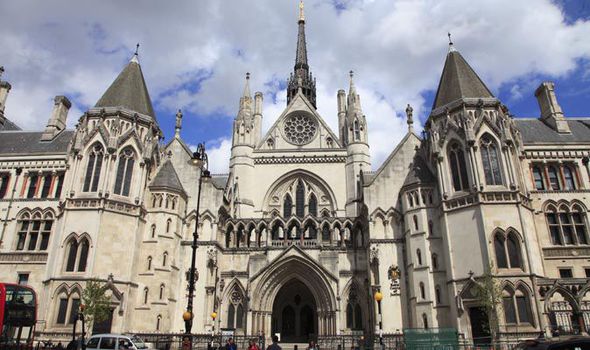
Royal Courts of Justice – venue for handing in the papers for a judicial review for the 50s women

CROSS POSTED ON BYLINE.COM

The High Court is to hear the case for a judicial review into the government’s mishandling of the raising of the pension age for 50s women on November 30.

The court granted a two hour hearing today.This means that Michael Mansfield and his team will argue the merits of the case for a judicial review.

The Department for Work and Pensions will oppose any judicial review.  The judge  will decide whether it can go ahead.

The granting of a two hour hearing  is significant in the sense that the court has decided that the merits of both sides of the argument  must be examined thoroughly. Previously the court had thought that 30 minutes was enough to hear the arguments – suggesting that it could be turned down without much debate.

The announcement is a victory for the lawyers arguing the  case and for BackTo 60 in taking such an uncompromising stance. The government has so far refused to budge an inch in recognising the grievances of the 3.8 million women who have lost out – some of them living in dire poverty as a result.

The case will be backed up by the paper from Jackie Jones, a law professor at the University of the West England She has produced the report,  which shows that this group of women have suffered discrimination contrary to an international  convention signed by successive UK governments. It is not a legal document but it is an expert opinion.


The day the women fighting for their pensions brought Westminster to a standstill

20181010_162148.jpg

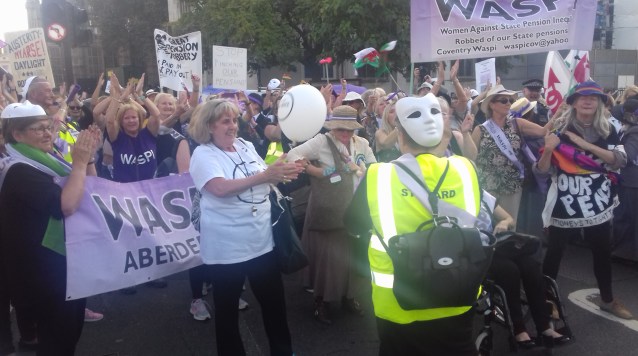
50s women reclaiming the street outside Parliament

CROSS POSTED ON BYLINE.COM

A decade ago this would have made headline news. Hundreds of  50s women deprived of their pensions until they reach 65 or 66 blocked the road in Parliament Square for over an hour yesterday. The police – just five of them – had to divert traffic away from Parliament as they sang slogans deriding Theresa May  from ” We paid In,  U Pay Out ” to ”  Hey, Hey, Theresa May, Theresa May, how many women who have you robbed today ” in an extraordinary display of anger at successive governments decisions to raise the women’s pension age from 60 to 66.

The noise  from the vibrant  demo drowned out irritated van drivers, bus drivers and motorists tooting their horns as they were stuck on the one way system round the Square. But the women were more than a match for the motorists, the police and certainly are making an impact on MPs.

The decision to block the road was not planned  and taken spontaneously by some of the protesters and led to a traffic jams right up Whitehall. Even Fiona Bruce, the BBC newscaster had to flag down a passing police car to get to Millbank to present the six o’clock news.

The protest  began with a 1000 strong rally in Hyde Park bringing together Backto60, Waspi and the ” We Paid In, U Pay Out” groups under a #One Voice and ” shoulder to Shoulder ” banner. Groups from as far away as Aberdeen, Cornwall, Wales, Tyne and Wear and Derby came to London to voice their anger.

It has got the backing of the Fawcett Society, the Women’s Equality Party and the SOS Initiatives  who have highlighted the desperate plight of the women , some of whom have contemplated suicide or self harm.

What was  clear at Westminster is that it is attracting support from senior people in the leadership of both the Labour Party and the Scottish Nationalist Party, the two biggest opposition groups in Westminster. John McDonnell’s office sent over a senior researcher and unless I was mistaken, Laura Alvarez, wife of Jeremy Corbyn, who keeps a low profile but I would bet will be telling the Labour leader about the strength of feeling there.

20181010_155332.jpg

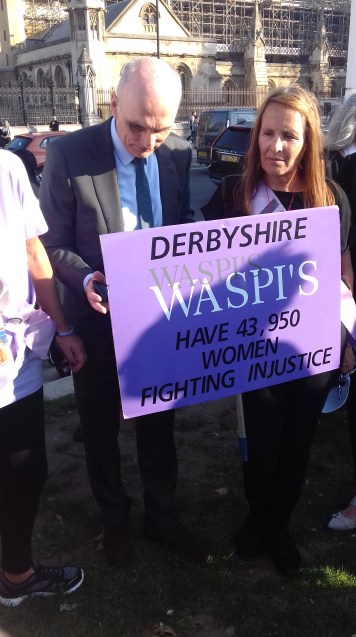
Chris Williamson examines the Derby Waspi banner

Other Labour MPs there included Chris Williamson, the Labour MP for  Derby North;Laura Smith, shadow Cabinet Office minister and MP for Crewe and Nantwich; Battersea MP Marsha de Cordova; and a number from Scotland and the Midlands. Two prominent Scottish Nationalists, the Westminster leader Ian Blackford and Mhairi Black also pledged support. Tory MPs were noticeable by their absence.

What is clear is this issue which I fully support – I did address the rally myself on the key issues- is now going places. This weekend it made the mainstream media, the next stage must be inside the courts and Parliament itself.

20181010_153227.jpg

The protesters arrive at Westminster 


Exposed: The worldwide hypocritical stance by successive UK ministers on women’s rights and their pensions

CEDAW-logo

The logo of the convention on the elimination of discrimination against women

EXCLUSIVE TO THIS BLOG AND BYLINE.COM

A damning academic expert opinion on successive UK government’s failure to meet its international obligations to  1950s women hit by the rise in the pension age is to be presented in court soon as part of an application for a judicial review of the decision

Jackie Jones, a law professor at the University of the West England , has produced the report,  which shows that this group of women have suffered discrimination contrary to an international  convention signed by successive UK governments. It is not a legal document but it is an expert opinion.

The full brief  can be clicked on  here. AMICUS BRIEF 10 September 2018

The reports conclusion’s are stark :

 “The effect of the mechanisms in issue in this case have a discriminatory effect on women born in the 50s, adversely impacting on older women’s health, economic and social life in that the voluntary use of the mechanisms have the effect of failing to provide adequate access to pensions for women and therefore must be removed and full restitution substituted. “

Margaret Thatcher’s government in 1986 took the decision to sign up to the Convention on the Elimination of All Forms of Discrimination against Women (known as CEDAW)  – an international treaty adopted by the United Nations General Assembly and now recognised by 189 countries. In 2004 Tony Blair’s government went a step further and accepted an optional protocol and  UK ministers of all parties have played an active role in its international work for many years.

The UK’s treaty obligations mean that we are signed up, as the report says, to “women’s equality within society, in both the public and private spheres, obligating States to formulate policies, laws and programmes to advance women and promote substantive equality (equality in outcome, not only equality of opportunity) as well as from refraining from actions that will put women in a worse position.

“It includes alleviating economic disadvantage as a result of persistent structural inequality and remedying past injustices that had and continue to put women in a disadvantageous position vis-à-vis men. ”

The report argues that the UK is in breach of its international treaty obligations in three main areas over the treatment of 50s women.

The rise in the pension age from 60 to 65 and then 66 for women was far more drastic than for men who  faced a one year rise in 2020 compared to a six year rise for women. The implementation of the taper which meant women had to wait longer and longer for their pension  and it was made worse by the failure of the government to inform individuals how the decision would affect them. And finally the decision targeted one particular group – those born in the 1950s in a much more drastic way than anybody else – and successive governments have failed to even consider reviewing its effects.

The report says : “The imposition of the mechanisms resulted in women born in the 50s’ access to pensions being postponed, in some cases for years, despite the fact that women born in the 50s had a life-long expectation and had been repeatedly told that they would be entitled to their State pension at 60.

“The effect of the State measures of delay in being able to access State-sponsored pensions has meant a decrease in income for women born in the 50s as well as obligating women born in the 50s to continue to work or to find employment in order to make up any shortfall in pensions. This has led to substantial financial insecurity for the women so affected.

By their actions, the State has discriminated against these women because they are women as the measures only seriously adversely affect women born in the 50s, made the economic and health position of women born in the 50s significantly worse and thereby have infringed their human rights and fundamental freedoms as proscribed by CEDAW. “

In my view the ministers involved are hypocrites. Margaret Thatcher,as Britain’s first women prime minister, deserves praise  for signing the country up to the new convention.

But then her social security secretary, John Moore, within two years started undermining the position of  women  – first by withdrawing Treasury money to the  National Insurance Fund – leading eventually to  a shortfall  of  £271 billion – this included not only pensions but the funding of maternity allowances.

Then John Major’s government took the decision to raise the pension age rather than start paying money again into the fund which would have more than covered the current £77 billion to restore pensions for the 50s women. Successive governments  including Theresa May’s either did nothing or made matters worse by raising the pension age further claiming there was no money.

Meanwhile on the international stage Britain was portraying itself as a world leader in women’s rights with ministers attending the international convention meetings.

Since 1997 when Tony Blair created the position of minister for women in the Cabinet – the following prominent women politicians have held this job. which they combine with other duties. The Labour politicians are Harriet Harman, Baroness Jay,  Patricia Hewitt,the late Tessa Jowell and  Ruth Kelly.

The Tories are Theresa May, Maria Miller, Nicky Morgan, Justine Greening,Amber Rudd and Penny Mordaunt , the current minister who is also international development secretary.

These women should be backing the case for 50s women if they have a shred  of integrity and want to live up to the ideals of a convention signed by Margaret Thatcher which commits the country to the advancement of women.

CEDAR is already planning to hold the UK to account in February for breaching its commitment to women over austerity – 86 per cent of benefits cuts fall on women.

With the judicial review of the raising of the pension age and this international pressure over the UK’s discrimination against women over benefit cuts the scene is set for a perfect storm for the UK government.


A No Deal Brexit could leave nearly 500,000 expatriate Brits with frozen pensions like those living in Canada and Australia

brexit and state pensionCROSS POSTED ON BYLINE.COM

Last year  it looked like the 474,000 expatriates who retired to 27 European  Union countries had their pension increases protected forever and a day. A deal which meant the UK would sign up to the EU Social Security Convention  guaranteeing pension payments both to British expatriates abroad and EU citizens remaining in the UK.

There was only one caveat “nothing is agreed until everything is agreed,” which would prevent this happening and  the  government’s aim is the commitment would be reflected in the Withdrawal Agreement with the EU. This was emphasised in the White Paper on Brexit in July.

But now the spectre of a No Deal Brexit is again being raised everything is being thrown into the air. Supporters like Liam Fox talk of a country thriving on new free trade but what about the social cost? What is clear is that without a signed withdrawal treaty Britain appears to fall out of the social security convention – and as EU arrangements superseded most national arrangements the automatic rise in pensions goes as well.

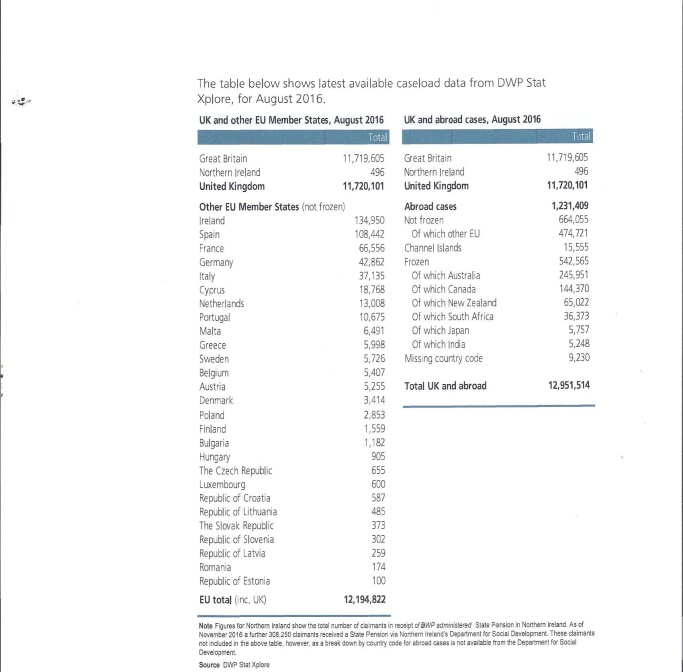
The House of Commons library have just produced two new reports on the issue. One published in July on Brexit and state pensions provides an accurate summary of the present situation. You can download it here. Another published this week provides the latest analysis of frozen pensions overseas. You can get it here.

There is a current official breakdown of the situation for both  unfrozen pensions in EU countries and the Channel Islands and frozen pensions elsewhere at the end of this blog.It shows that EU  countries make up the vast majority of uprated pensions.

The government has only limited agreements with overseas countries to allow Brits who settle there to get uprated pensions. Outside the EU  the UK has agreements with Barbados; Bermuda; Bosnia-Herzegovina; Croatia; Guernsey; Isle of Man; Israel; Jamaica; Jersey; Mauritius; Montenegro; the Philippines; Serbia; Turkey; the United States of America; and, the former Yugoslav Republic of Macedonia. The rest of Europe includes Switzerland and Norway. The US agreement also covers American Samoa, Guam, the Northern Mariana Islands, Puerto Rico and the US Virgin Islands.

For those who could be confined to a frozen pension the results can be dire. And they get worse the longer you live. An expatriate living to the age of 90 in Canada would have to live on just £41.15 a week while someone who went to live in Canada in 2015 would be on just over £110.15 a week.

Ian Andexser, chairman of the Canadian Alliance of British Pensioners, said:

“The UK continue to adopt a 70 year old policy which makes no sense, is unfair and in violation of the Commonwealth charter. If you are British and live in Niagara Falls USA, you get a fully indexed pension. If you live 400 yards away in Niagara Falls , Canada, you do not!”

An even more complex situation exists in Australia where they have a means tested pension and even getting Britain to pay up part of your state pension if you have already left the country is problematic.

The latest Commons guide on frozen pensions shows campaigners – once they have lost their case for any uprating – are unlikely to get it back. Successive British governments have refused to change the rules on grounds of costs and the spurious claim that the rises caused by  British inflation rates should not apply to other countries which had different rates of inflation. If that were the case the same would apply to people living in the European Union or Mauritius where people do benefit from British inflation.

The cost to do this is about £500 million a year and opposition parties – notably the Liberal Democrats – have backed the change only to renege on it once they got into office. Indeed the only change that followed the Pensions Act that  created the new pensions system was a minute extension of the uprating to pensioners who had retired to Sark in the Channel Islands.

So Brits in the EU better keep abreast of what does happen in the EU negotiations. They need to ensure that there is an agreement with the EU. The expatriates in Australia, Canada, South Africa and Jamaica, to name   few of the frozen pension  states can only  get redress by either pressurising British politicians or by pressuring their newly adopted country to demand Britain fulfils its obligations by refusing to sign a trade deal until it does.

overseas pensions

Mobility on the marshes: Two cheers for Natural England and the Norfolk coast path

20180804_105304.jpg

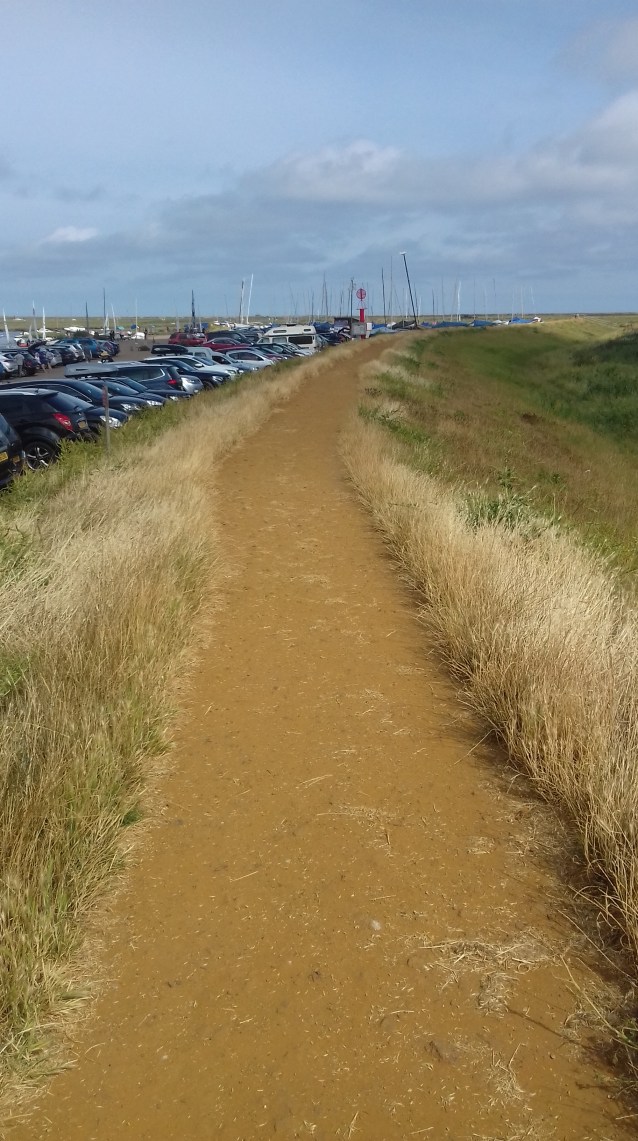
The new wheelchair and mobility scooter friendly surfaced path from Blakeney towards Cley

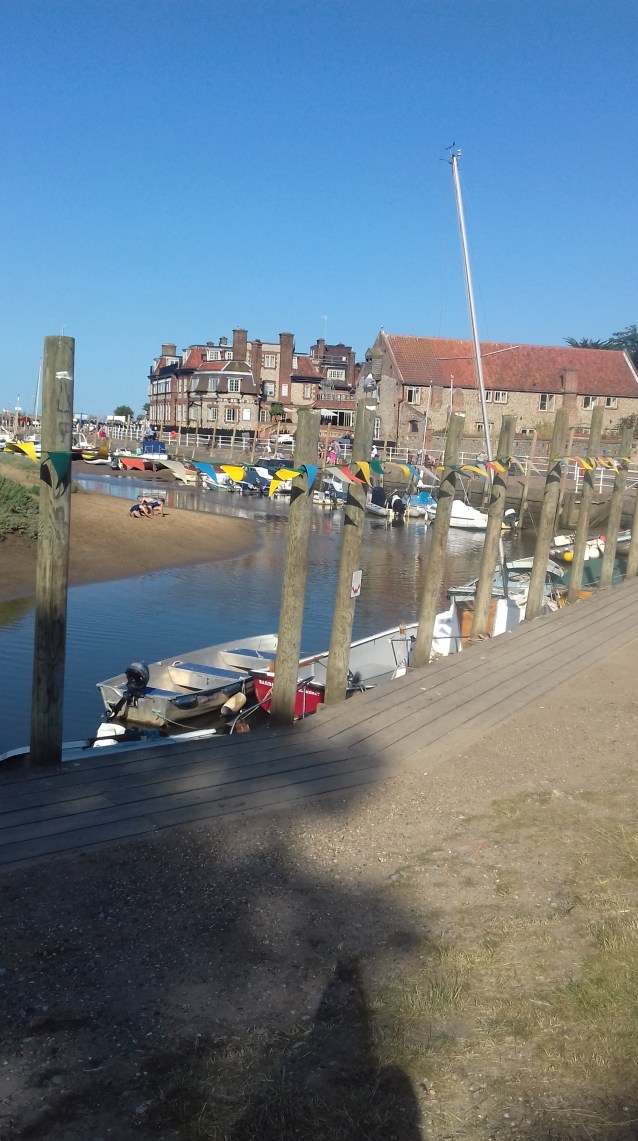
Blakeney on the North Norfolk coast is home to one of Britain’s more unusual natural wildlife reserves – the salt marsh. These  vast muddy flat expanses are  regularly flooded by the sea- and are home to a large variety of sea birds, ducks and migratory geese and perfect places for many unusual plants and flowers.

To really appreciate these large areas  caught between the land and see you need to be able walk for miles between Norfolk coast towns and villages. For some years my wife, Margaret and I have  been able to do precisely that -walking four or five miles  often in a refreshing stiff breeze and ending up in a local hostelry eating  fresh crab sandwiches before returning back to Blakeney.

Since she had a stroke this is no longer possible and I thought the marshes would be largely out of bounds.


20180802_173046.jpg

The quay at Blakeney

However having just returned from Blakeney I discovered that Natural England who are responsible for England’s network of long distance footpaths and the local North Norfolk Area of Outstanding Beauty have started making the place far better accessible for the disabled.

They have started to convert part of the  Norfolk coast path going from Blakeney to Cley  and from Blakeney to Morston Quay to make it wheelchair and mobility scooter accessible – allowing disabled people to get out into the marshes which previously  only able bodied people could make the  trip.

Unfortunately the new surface does not go all the way to Cley- and the beginning of the Morston Quay route has been blocked off by builders renovating local cottages necessitating a diversion- hence only two cheers- but it is a good start.

There are also two good links on the web that disabled people will find helpful. The Norfolk Coast Partnership has an activity map here.

And there is a partially complete guide to wheelchair access to the path here on the national trail website.

20180803_172939.jpg

A typical creek on Blakeney Marshes

Given the present dire situation for disabled people with many losing benefits as a result of the government’s austerity programme – this is one good piece of welcome news for any disabled person contemplating a staycation this summer -once the temperatures have dropped from their present high level.

Judicial Review of government’s handling of 50s women pension changes lodged at High Court

royal-courts-justice-passes-misuse-602677

Royal Courts of Justice – venue for handing in the papers for a judicial review for the 50s women

CROSS POSTED ON BYLINE.COM

Back to 60, the campaigning group  who are supported by 738,000 of the 3.9 million 50s women waiting up to six years to get their pensions, lodged a claim  at the High Court against the  Department for Work and Pensions yesterday.

This is the first stage of taking real action to put right the injustice suffered by the women ever since the government embarked on a policy of continually raising the pension age.  It will be followed by a High Court hearing where a judge will be asked to allow the review to go ahead. It is bound to be challenged by the government which is determined not to pay up but ministers will have to justify their actions.

Backto60 lodged the documents with only 48 hours to spare as the courts  start their  summer recess tomorrow and  the courts will not hear cases  until  after October 1.

The move is the culmination of action taken by the group which now involves support  on the issue from the Equality and Human Rights Commission, which intends to raise the issue at the United Nations, the Fawcett Society and  other ampaigners.

A legal statement from Binberg Peirce & Michael Mansfield QC reads:

“The basis of the legal challenge is that the pension policy implemented by successive governments in respect of women of a particular age group (those born in the 1950s) constitutes a gross injustice and is discriminatory.  The impact on the economic, social and mental well being of these women, who rightly enjoyed a perfectly legitimate expectation of satisfactory provision in retirement, has been devastating.

“The extent of individual distress and hardship is only now becoming evident through real stories of women around the UK. It is deeply ironic that all of this is done in the name of equalisation and equality, when the very means employed to achieve this are themselves discriminatory.

“It is intended that the current pension policy be subjected to both public and judicial scrutiny and, therefore, steps are now being taken towards mounting a judicial challenge.”

At the same time Stephen Lloyd, Liberal Democrat MP for Eastbourne, whose coalition government made matters worse for 50s women by backing an acceleration of the rise in pension ages, has finally got a meeting on behalf of Waspi with the Ombudsman to discuss whether there was maladministration in not informing women.

His comment is picked up by Frances Martin:

stephen lloyd

The government is going to face challenges from all sides this autumn.


Whitehall’s shameful database of women’s pathetic state pensions

DWP-Department-for-work-and-pensions-500x320

Department for Work and Pensions – still misleading  the public on the huge gap between men and women pensioners

CROSS POSTED ON BYLINE.COM

In May this year  Which? Money published the  results of access the consumer organisation had  to the entire  Department for Work and Pension database on pensions. The headline result press released by Which ? Money here  was that women  are worse off now than men  by a staggering  £29,000 over a 20 year old period.

The disclosure led Harry Rose, Which? Money editor, to warn : “Our evidence shows how variable people’s state pension payments still are. Many pensioners will be shocked by the differences in average payouts to men and women and those qualifying under the old and new systems.”

The issue is worth raising because just last week the Department of Work and Pensions published its annual report ( more to come in a future blog) which despite Which? Money findings  from the DWP’s own database perpetuates the myth that some how today’s pensioners are living the high life with little or no housing costs and longer and longer life expectancy.

tTjCgYZl_400x400

The agenda is clear – paving the way in five years time for yet another rise in the pension age – and totally ignoring the present plight of 50s women denied pensions for up to six years . Add the fact that it could take decades now before men and women receive an equal pension. The average , despite the new state pension, is still 18 per cent, below a typical male pension.

The figures revealed by the Which? Money from the DWP are extremely  alarming if you are a woman. If you are a man you can be complacent – not only did you get a  good deal under the old system you are the main beneficiary of the new one.

The biggest  group of beneficiaries (8.4 million) – getting on average £142 a week- are today’s pensioners who have a long national insurance contributions and qualified for an earnings related pension. Of these 4,958,000 are men and  3,417,000 are women.

Above this on an average of  £174 a week are the spouses of these recipients who died. and they inherited their spouses NI contributions to top up their pension They are 1,454,040 women and 276,960 men – the only category where women  do better. Sadly  they have to lose a partner  to achieve it.

Much lower at £145 a week are those whose spouses died but they themselves did not have a pension  – again most are women –  679,995 to just 2045 men.

Those unfortunate enough not to be entitled to get a pension get just an average of £63 a week  based on their partner’s NI contributions – again there are 545,905 women to 1095 men.

The best off are the new state pensioners – after changes came into force in 2016  and they also had protected money to top up the new pension. They get £181 a week. But 79 per cent of these are men – 142,080 to 17,920 women. The reason for this is directly due to the plight of the 50s women who ceased to qualify for pensions at 60 and many are still waiting for one.

As anyone can see this is woefully unfair to women.  It suggests there is a long way to go to get equality  with men even when women eventually get their pension.

There is also a divide where the money is paid out – highest state pensions – between £153 and £154 a week – are paid out in East Hertfordshire, High Wycombe and Aberdeen. Lowest ( between £128 and £140 a week) – are paid in the London borough of Newham, Leicester, Manchester and Cornwall.

And there are huge differentials if you go abroad. Expatriats living now in Australia, Canada and New Zealand get frozen pensions averaging between £41 and £44 a week.

Those in Europe get pension increases every year  – bringing Spain to an average of £107.76 a week and France to £104.39 a week.

Curiously 10 UK nationals who retired  to Azerbaijan – part of the old Soviet bloc – get  an average of £127 a week.

Don’t ask me why but I did discover this website which tells you how to avoid pension  taxes by putting your money into an Azerbajiani off shore fund. According to the article 2400 British expats have done this and they don’t have to live there and participate in traditional Azerri sports such as ox wrestling or javelin throwing either. They can live in Malta and have the money paid into Azerbaijan to avoid tax. My guess is these must be high rollers who qualify for  a state pension.

Perhaps the government  should investigate this instead.


Official figures reveal a disturbing rise in right wing extremism among UK youth

maxresdefault

Scenes from the right wing demo in defence of extremist Tommy Robinson pic credit: You Tube

CROSS POSTED ON BYLINE.COM

The somewhat violent demonstration in London this weekend in support of jailed right wing extremist Tommy Robinson was foreshadowed by figures released under three months ago by the Home Office.

The figures come from the highly controversial Prevent programme which most people see as a plan to catch young people  being radicalised by so called Islamic State and Al Qaeda before they commit atrocities.

What is not  as well known is that the Prevent programme also tackles people radicalised by racist and Fascist organisations who aim to commit violent acts against Muslims, Sikhs and other ethnic minorities, including Africans and East Europeans.

Just over two months ago the Home Office published a report and analysis of the latest figures of who is being targeted.

These are people who if one follows the official guidance are those who  have “vocal or active opposition to fundamental British values, including democracy, the rule of law, individual liberty and mutual respect and tolerance of different faiths and beliefs.”

The disturbing fact is that the latest figures for 2016-17 reveal there has been a RISE in the number of young people radicalised by right wing extremism while there has been a FALL in the number of people radicalised by perversions of Islam.

The report says: “There was a 28% increase in the number of extreme right wing referrals in 2016/17 (968) when compared with 2015/16 (759); whilst referrals for concerns related to Islamist extremism decreased by 26% over the same time (2015/16, 4,997; 2016/17, 3,704).
The proportion of panel discussions [ most serious cases] regarding extreme right wing related concerns has increased by 44%, from 188 in 2015/16 to 271 in 2016/2017. Similarly, the number of individuals receiving Channel support for extreme right wing related concerns has also increased over the same time period by 27% (2015/16, 98; 2016/17, 124).
This is in contrast to individuals receiving support for concerns related to Islamist extremism,which has decreased by 30% between 2015/16 (264) and 2016/17 (184).”

The right wing extremists were almost exclusively male ( 902 out of 968) while only 77 per cent of those monitored for Islamic extremism only 77 per cent were men.

The largest proportion in both groups were teenagers aged between 15 and 20 with right wing extremists being almost exclusively male.

There was also a considerable variation between regions for the two groups.

“Of the 3,704 individuals referred for concerns related to Islamist extremism, the largest proportion was from London (1,039; 28%), whereas of the 968 individuals referred for concerns related to right wing extremism, the largest proportion was from the North East (171; 18%).

Of the 760 individuals discussed at a Channel panel for concerns related to Islamist extremism, the largest proportion was from London (214; 28%), whereas of the 271 individuals discussed at a Channel panel for concerns related to right wing extremism, the largest population was from the West Midlands (47; 17%).”

This suggests a considerable divide in the country – with  multi cultural London having fewer right wing extremists than the deprived North East and the West Midlands where there have been racial tensions.

The general message is that Britain is becoming more divided and that racism and Fascism among the young is rising, particularly in areas where there are fewer people from ethnic minorities.

This was born out by a chat with a person  at the Race on the Agenda conference on mental health reform  in London last week who was dealing with the Prevent programme in Dorset. Here it was in the rural areas where young poorly educated men who had seen few immigrants appeared to be attracted to right wing extremism. The issues raised by  Brexit had also been a factor in highlighting tensions.

Whatever it is this is a deeply disturbing trend and it suggests that focus on the rise of all types of extremism should concentrate equally on right wing racists as much as Islamic extremists.


The Downing Street state pension robbery

Downing Street thieves

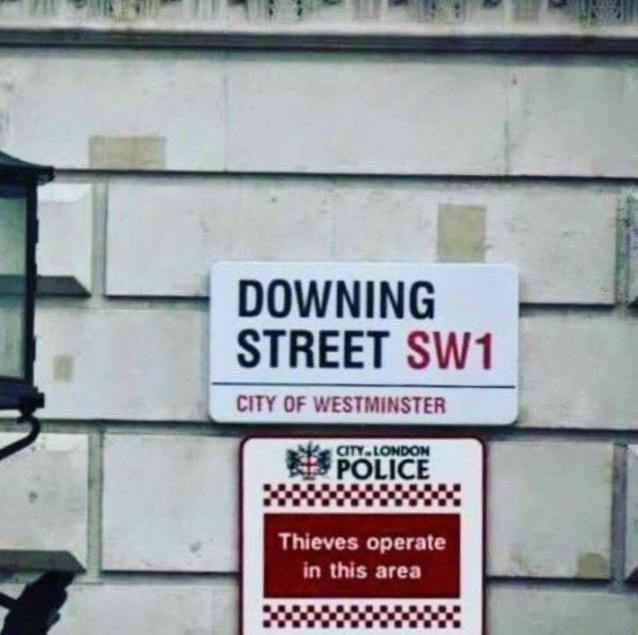
I wonder if Mr Plod has a good sense of humour. It is a good photoshop. Pic Credit: Paul Downes @CallmeDownsie

CROSS POSTED ON BYLINE.COM

The mantra  that we cannot afford to pay the 3.9 million  50s women   their pensions until they are 65 and soon 66 is based on the premise that there is no money in the National Insurance Fund. The big question is why?

I have already in a previous report for #Backto60  shown that the accounts of the National Insurance Fund are in fact in surplus. But detractors point out that they soon won’t be if the government hands back £77 billion owed to the women.

But what if we have reached  this situation because the government has raided a fund  which is 91 per cent spent on pensions for other benefits. And what if the Treasury deliberately decided to  undermine the fund by avoiding paying any money into it?

This is what I have found out by investigating the history of this fund.

The original fund was set up in 1911 by Lloyd George and did not cover pensions – but helped pay  medical bills for wage earners and provided  unemployment benefit for  some workers. Employers and employees had to make compulsory contributions.

Pensions were introduced for those over 70  in 1908 and were means tested and supervised by local councillors. People could be disqualified from getting a pension if they had been imprisoned for ten years, weren’t of good character and were drunkards. The money came from general taxation. There is a House of Commons library report about the act here.

The real major changes came under the Attlee government which set up the welfare state. The National Insurance Act, 1946 introduced compulsory NI for all working people except married women. It set the pension age at 60 for women and 65 for men. Pensions, unemployment benefit, sickness benefit and a maternity allowance and death grant were paid out of it. There is a useful summary in the National Archives here. But it was run as a ” pay as you go ” scheme with money topped by the Treasury.

It is the attack on these provisions which began under the Thatcher government in the 1980s that has led to the 50s women losing out.

An excellent report by the House of Commons library describes what happened. It is worth quoting parts in full.

“In each year from 1948 to 1989, the National Insurance Fund received a grant from the
Treasury, known as the Treasury (or Consolidated Fund) Supplement. The origins of the
Supplement lay in the Beveridge Report, which envisaged a tripartite scheme of contributions to the Fund, whereby the Treasury would pay one third of the cost of unemployment benefits and one sixth of the cost of pensions and other benefits. In practice, the level of the Supplement tended to be around 18% of contribution income, a level at which it was fixed by the Social Security Act 1973.

“From 1980, the value of the Supplement began to decline, reflecting partly the growing level of contribution income and partly the constraining of spending on benefits by the abolition of earnings linking of the pension and other long-term benefits and earnings-related supplements to unemployment benefit. By 1988 the Fund’s contribution income exceeded its benefit expenditure, leading to a steady growth in the balance of the Fund (from £5.3bn in April 1986 to £10.4bn in April 1989 ).

In this context, the then Secretary of State for Social Security, John Moore, stated in 1989 that:

“The tripartite principle is already effectively a dead letter. The rationale behind it has
gone, and the Supplement has been shrinking steadily as a proportion of the Fund’s
income from about one-third in 1948. It now stands at only 5%. We consider that there
is now no need for it all. The £26bn of expenditure from the Fund is fully covered by
contributory income and the abolition of the Supplement will have absolutely no effect
on that expenditure”
“The Supplement was abolished by the Social Security Act 1989.”

It was a disaster – the fund which then  had  big surplus – went heading into the red – as it was now being raided for the full cost of unemployment and sickness benefit at a time of high unemployment.

So in 1993 the Major government had to partly retract by reintroducing a Treasury supplement because money in the fund had fallen by a staggering 50 per cent  due  to benefit pay outs as well as pensions. Pensioners were robbed.

But  the government fixed the rules so it was much less generous than the  system they bequeathed from Attlee. As the report says :

“There are a number of differences between the Treasury Grant and the Treasury
Supplement. First, the levels of Treasury Grant are set by reference to benefit expenditure rather than to contribution income. Second, and more significantly, whereas the Treasury Supplement was paid annually, irrespective of whether it was actually needed to finance a particular year’s expenditure, the Treasury Grant is paid at the discretion of the Secretary of State.

“The amount of Grant paid to the Fund was limited to a maximum of 20% of forecast
benefit expenditure in 1993-94, and to a maximum of 17% of forecast benefit expenditure in subsequent years.”

The truth of the matter is that the rules were skewed so the Treasury never had to pay out any money.  From 1989 to 2014 if the Treasury had returned to its original support  under  the Major, Blair and Brown governments, the Tory Liberal coalition and Cameron’s government, billions of pounds would be available now to help pay the 50s women. Instead as we know successive governments ruthlessly decided to solve the problem by raising the pension age.

In top of this the government also amended the benefits that would be paid out from the fund – including some new benefits like paternity benefit for example.

Anyone who believes the changes that happened – both the removal of Treasury contribution to the fund and the subsequent rise in the pension age – was a happy coincidence is deluding themselves. You can see here  in an article in the Daily Express what  George Osborne, the former chancellor, told investors at the Global Investment conference in 2013. Scroll down to the video

George-Osborne-speaking-at-the-conference-815768

George Osborne speaking at the 2013 Global Investment Conference

He said: “Tackling entitlement costs and the cost of an ageing society is a real challenge for Western democratic societies and in the UK we’ve brought forward the increase in pension age to 66 in this decade; we’ve brought forward the increase to 67 in the next decade and actually because of some reform taken some years ago the female pension age is increasing to 65 as we speak.”

“These changes, when you’re a finance minister, the savings dwarf almost everything else you do.

“They are absolutely enormous savings and they enable you to go on providing a decent retirement income. So you’re not necessarily reducing the entitlement of people who are retired you’re just increasing the age when that entitlement kicks in. ”

“Of course when these were first put into practice these pensions systems life expectations was dramatically less.

“I’ve found it one of the less controversial things we’ve done and probably saved more money than anything else we’ve done.”

Need I say more. The UK has one of the lowest and least generous state pension in the developed world and it has been bought about by making huge savings against 50s women.