Is social media fuelling hatred and contempt in Britain?

jo cox mp

The late Jo Cox MP. Pic credit: BBC

CROSS POSTED ON BYLINE.COM


The killing of MP  Jo Cox has caused many people to pause and question whether political debate is becoming too callous and extreme because of the  way social media and Twitter in particular encourage polarised views.

Today’s Inforrm blog carries a very thoughtful article from Sharon Coen, a senior lecturer in media psychology at Salford University. Her article as you can see here is mainly framed about political debate.

However what she says says about politics can easily be extended to the way trolls treat women and survivors of child sex abuse.

As she says on politics: “The adversarial communication style we see in politics today is certainly counterproductive and polarises opinions. Disagreement is great and is at the heart of democracy. But, as political scientist Susan Bickford argues, it is only by really listening to other people’s positions, not just discarding them, that the democratic process can be successful. And – as in face to face interaction among politicians or televised debates – the internet has proved so bad at enabling people to listen to each other that there are now attempts to redesign the way we communicate online to make us better listeners.”

On social media she says:

“Social media …is a double-edged sword. On the positive side, it fosters political engagement both on and offline. For example, in a small (unpublished) study I conducted, I found that when people used the internet to debate and comment on news online, they were also more likely to be politically active in the real world. Again, this is in line with other research in the area.

“But (my emphasis in bold) social media also fosters polarisation. People tend to connect to like-minded people – and engage with content that reflects their pre-existing attitudes and beliefs. Social media focuses political debate even further around individuals who have active profiles on social media sites. It can effectively put a big neon target on them, attracting more personal abuse from those who disagree with them.”

She goes on:”The recent launch of the Reclaim the Internet campaign has highlighted the amount of abuse individuals (and women in particular) are subjected to online. The issues of cyberbullying and cybermisogyny are ones that deserve serious consideration for the negative impact they can have on the recipients of such abuse.”

In my view this aggressive stance by some people – often more aimed at women than men – is becoming particularly nasty with MPs like Jo Cox (before she was killed) and Jess Phillips, Mp for Birmingham, Yardley, being recent targets.

I am also thinking of child sex abuse survivors like Esther Baker – whose allegations are the current subject of a police investigation – who has suffered egregious abuse on line from people who claim not to beleive her.

It is time that these bullies and cowards put up and shut up. They should think before they tweet. Would they say  that to a person’s face in public? If not why say it on line behind some anonymous or not so anonymous twitter handle? Their actions also encourage  more hate and division but most of them are not man enough ( yes they are mostly men!) to stand up in public and say what they think.

The problem  is that this type of behaviour is beginning to have nasty consequences and turning this country into a nasty place to live.

 

Where’s St Helena? It’s off Jersey isn’t it?

St Helena Pic Credit St Helena government

St Helena: in the South Atlantic not off Jersey. Pic Credit: St Helena Government

CROSS POSTED ON BYLINE.COM 

A rather amusing aside was missed by the national press and the BBC when they reported on the scandal last week of  St Helena’s  spanking new £285m airport which can’t be used by jets because it is too windy to land.

True they had fun with the video of a British Airways  jet having to abort a landing because of the wind. So no chance yet of a new tourist boom because the only way there is by a six week journey on an ageing mail boat.

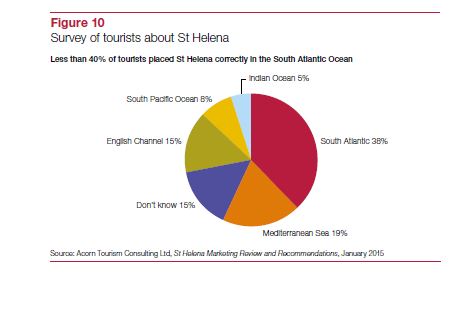
But they missed an extraordinary table hidden in a report commissioned by the St Helena government about where the island was located.

The National  Audit Office reports  that a marketing company- Acorn Tourist Consulting – asked lots of savvy long haul tourists where  is St Helena.

Extraordinarily 19 per cent put the island in the Mediterranean – perhaps near Malta or Cyprus.

Another 15 per cent put the island in the English Channel – perhaps confusing Jersey’s St Helier with St  Helena.

Another 8 per cent thought it was a tropical paradise in the South Pacific – perhaps near Fiji!

And another 5 per cent thought it was in the Indian Ocean – somewhere near Sri Lanka perhaps.

And 15 per cent admitted  honestly they hadn’t a clue.

This left just 38 per cent who correctly identified it as a rocky island in the South Atlantic.

Mind you it might be as well that the Department of International Development has mucked up the project. Not only will it give it time for the island to find a jet that could land safely there but it will give isolated  St Helena a bit longer to prepare for the tourist hordes.

For the same company which discovered the ignorance of British tourists has issued another health warning about going there.

It warns: “There will be new expectations of St. Helena as a destination. In just over 4 hours the tourist will have flown from South Africa to the Island. No time to adjust, reflect, read, and prepare for arrival as they do at the moment. This is likely to make visitors more demanding and less forgiving. They will start to lose sight of the remoteness and challenges an island 1,200 miles off the coast of Africa and 1,800 miles from Brazil faces.

Today, very few tourists leave St. Helena disappointed, but this may change once tourists start arriving by air. St. Helena then runs the risk of over-promising and under-delivering, and this will lead to some tourists returning home and not passing on in a positive way that most effective form of marketing – word of mouth.”

 Perhaps it might be better to look for St Helena off Jersey after all.
St Helena

The report’s findings in the National Audit Office report

Why all the UK should see this brilliant exhibition on the Calais Jungle

CROSS POSTED ON BYLINE.COM

Until June 22 there is an extraordinary exhibition of art, sculpture,photographs, documents, multi media  and sound on the Calais jungle migrant camp.. It is at the London Newcastle Arts Project Space in Shoreditch,London.

Wanderers 1

An amazing sculpture at the entrance to the exhibition. It looks like a mass of people but each of them is an individual. A fitting symbol for the exhibition.

© Nikolaj Bendix Skyum Larsen

The exhibition tells the story of the huge migration from the Middle East, Afghanistan, and North Africa to Calais and the people involved.It is probably the biggest issue in the whole of Europe today.

It is both a harrowing and uplifting showing the strength of the human spirit in the face of extreme adversity. There are evil people, neo Fascists,nasty people smugglers, and thugs who exploit and deride them  but there are also many ,many caring human beings who are prepared to help them on their way to a better, safer life.

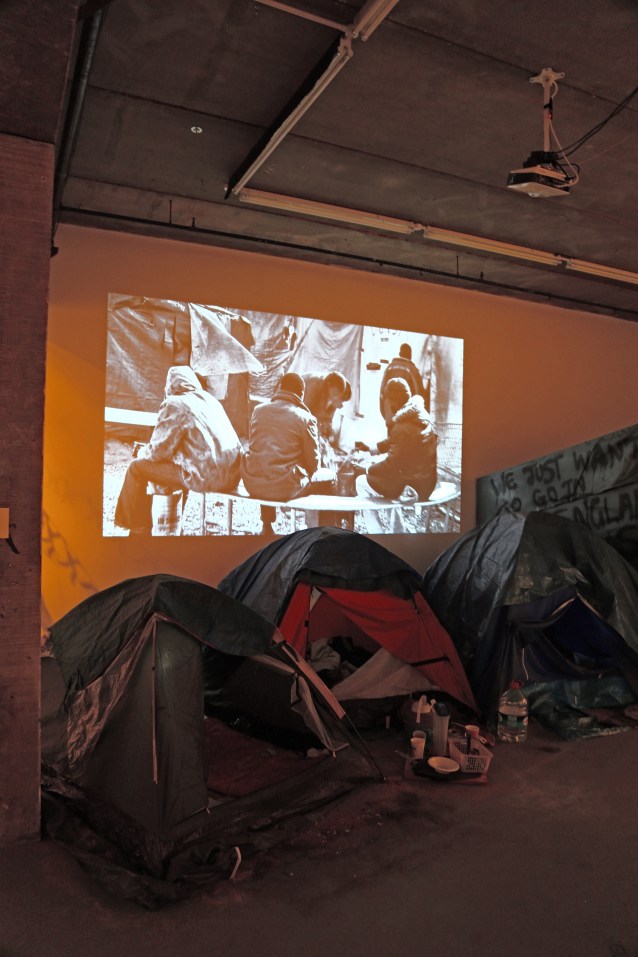
What is extraordinary about this exhibition is that much of the art comes from the very people themselves as a way of expressing their own plight. And the squalid Jungle is  a place where people play music, dance, paint,cook,and create as well try to survive.

Call me by my name 9 hi res

These are the tents they livedin. Picture

© brandingbygarden.


Everyone who has any humanity should see this exhibition – especially the people who denigrate them as hordes or swarms of people. They are people like them. It is antidote to the crass debate on Brexit.

And denying them a safe haven is also denying our country the benefit of their enormous talents – many are highly educated and many have discovered new talents on the way. Worse the plight of unaccompanied children aged from 8 to 14 or 15 is something this country cannot ignore – and thanks to the efforts of Alf Dubs ( Lord Dubs) who pushed Theresa May, the home secretary, to allow them to come in – there is some hope  for a few now. But there needs to be more.

Call me by my name 11

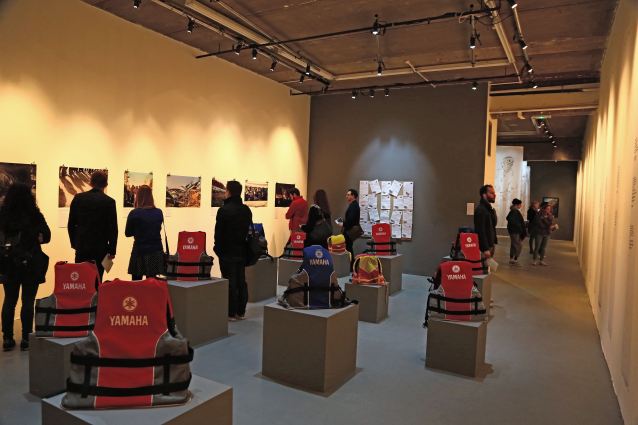
These lifejackets were taken from the beach in Greece. Believe it or not the smugglers gave them fake lifejackets, they don’t float.

© brandingbygarden.


At a very moving reception where the organisers- through the Migration Museum Project – was attended by asylum seekers – and some who had managed to be smuggled into Britain. They mingled with students, artists and campaigners looking at the exhibits.

Museums and art centres in Britain you should thinking of staging this exhibition so the people  across the United Kingdom can see the whole story. How about some of you rising to the challenge.

Call me by my name 3 med res (1)

The sculpture as you enter the exhibition. © brandingbygarden.

Are expensive libel cases on the way out?

CROSS POSTED ON BYLINE.COM

Some fascinating new  official figures  showing a startling decline in the number of new libel cases have been  revealed on the excellent media law blog Inforrm.

They show a 40 per cent drop in the number of new libel claims in the Royal Courts of Justice between 2014 and 2015 from 227 to 135. Admittedly 2014 had a large number of  new cases but the blog points out that there has been a steady decline in libel actions since 1992. You can read the blog and see the statistics  in full here.

The introduction of the new Defamation Act is the biggest change to libel in the last two years which aimed to reduce the number of claims by establishing ways of settling issues without coming to a full trial in court.

The jury is still out on how effective this new legislation is. But it appears that the huge cost of mounting a libel trial and a cap on damages that will be awarded to the person defamed has had a chilling effect.

As the blog said: ” Even with costs budgeting, both parties’ cost of a libel case taken to full trial are likely to be of the order of £700,000 (for example, Stocker £682,000; Yeo£716,000).

Damages are effectively capped at £275,000 for the most serious possible libel (see Barron v Vines [2016] EWHC 1226 (QB)) but, in practice, even after a contested trial awards rarely exceed £100,000.

It has also been suggested that the Reynolds qualified privilege defence (now “Publication on Matter of Public Interest” under section 4 of the Defamation Act 2013) has, by encouraging journalistic responsibility, reduced the number of egregious libels and so the number of actions.”

Frankly this is all good news for bloggers who are threatened with libel cases from big and powerful commercial interests and powerful figures. Are they going to spend up to £700,000 with all the attendant publicity of a trial to take on a blog when the most they could get back might be less than £100,000? And they would have no chance of recovering their money either.

What this doesn’t disclose is whether the rich and powerful are using other means to silence critics particularly bloggers. This big drop in cases has been accompanied by a big rise in the number of people using the ” right to be forgotten ” imposed by the European Court to get Google to remove serious criticism of individuals from its search engine on the net.

This is a far cheaper and effective way of silencing critics. As Inforrm  reported earlier :

” Large numbers of delisting requests are now being made under the Google Spain ruling. Google’s most recent transparency report indicates that it has received 400,564 removal requests and has removed 42.6% of URLs covered by them.  Google has received 48,979 requests from the United Kingdom and has removed 184,115 URLs (38.6% of those requested).”.

Given the internet is peppered with defamatory statements about people could this be a new and more secretive way of silencing criticism? It avoids the publicity of a libel trial and there appears to be no appeal and  no easy way of knowing this has happened.

Could this be the new way -arguing privacy – the rich and powerful stop legitimate criticism and damning disclosures about their past?

1000 miles of Russian Reflections:Why the Russians don’t think Putin is an ogre

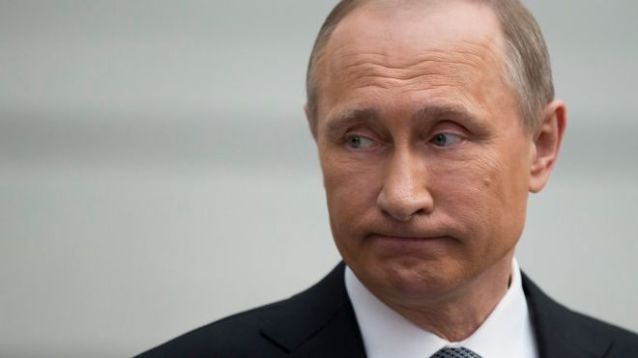
President Putin; Pic credit BBC

President Putin: Pic Credit: BBC

CROSS POSTED ON BYLINE.COM

It is popular in Britain to think of Putin as a dangerous ogre. That is hardly surprising after the poisoning of Alexander Litvinenko in London and the assassination of opposition politician, Robert Nemstov. And the revelations kept from the Russian public about Putin and other prominent people’s secret offshore funds revealed in the Panama papers. Let alone Russia’s position on gay rights.

After travelling some 1000 miles along  waterways from St Petersburg to  Moscow on a very adventurous  and exhausting trip organised by Viking cruises it would strike me that it would be very short sighted to think that the West could simply bully and threaten Russia.

In 13 days the trip takes in two major cities and five centres in rural Russia. There are lectures on Russia’s bloody history from the Vikings through the Romanovs to Communism, a frank debate on present day Russia, lessons in Russian, vodka and Russian food tastings and a punishing schedule of included and optional excursions, morn,noon and night.

For all the misgivings about him, Putin appears to be popular. He gained some 64 per cent of the vote in a criticised election (down from 75 per cent before) in 2012.Outside Moscow the main contenders were not the liberal reformers but  the Communists who  got 17 per cent of the vote. Liberal reformers did better in the capital.

Ask our guides on the trip – and one of them voted for the Communist  presidential candidate- and they would say Putin has brought them stability (despite much higher inflation there than here) and also defended Russian interests.

The Crimea vote to rejoin Russia is popular and seen as righting a wrong created by Khrushchev in the 1950s when he handed it over to Ukraine. The Russians don’t forget the battle of Sevastopol.

The real villains for the Russians  are Western hero Gorbachev and Yeltsin.  Gorbachev is seen as a major destabilising factor over perestroika and Yeltsin for creating poverty and chaos through his shock capitalist therapy.

As one guide put it: ” Under Yeltsin we had money but no goods. Now we have lots of goods and not enough money.”

Another put it: ”  Gorbachev was rather like Thatcher. Both were seen as world statesmen  abroad but both were loathed by a lot of people in their own country.”

And one should not  underestimate Russian determination to defend their homeland. Our visit coincided with Russia’s equivalent of Armistice Day – Victory Day over the Nazis in their 1941-45 War. Some 27 million Russian died.

It is also used by Putin to show off the latest military equipment. But in St Petersburg ( and also in Moscow) – the most poignant moments were the thousands of people marching with placards and pictures  of relatives (often grandfathers) who had died in that conflict. They are called the ” immortal regiment” and it has grown from a grassroot gesture. to  one of the main ways to remember and honour the dead.

The one school we visited in  the small rural town of Kirillov (7000 people) also had large displays  commemorating former pupils who died in the 41-45 war.The town  also has had a statue of Lenin, a huge fortified monastery favoured by Ivan the Terrible and a rebuilding project for its local church used by the Communists as a drinks warehouse.

The other striking feature is the rise of Russian Orthodox Church. Not only have old ones that survived been restored but new ones built in the old style where they were blown up by Stalin. Church attendance  at seven per cent is probably little higher than in the UK, with more people attending at Christmas and Easter or for weddings and funerals. Nor is it confined to just the revival of Christianity – synagogues have been re-opened and other religions tolerated

.Moscow has a new  enterprising  high tech Jewish museum in an old art deco bus garage – the only place where I have experienced the Old Testament with surround sound in 3D . You get a bit wet during Noah’s flood and experience  what  a plague of locusts is like.

And yes there is much greater disparity of wealth. Moscow’s eight lane  highways are perpetually jammed by foreign cars bought by Russians. The River Neva outside St Petersburg is lined with huge new dachas – the  Toad Halls of the nouveaux riches. There are almost as many 4×4’s as in Berkhamsted.

And Yaroslavl – an old city some 160 miles from Moscow – where the aristocrats retreated from Napoleon after Moscow was captured in War and Peace – has a UNESCO World Heritage city centre. But nearly all its 600,000 inhabitants have jobs in industry. Uemployment is  1.4 per cent – though this is not typical for all Russia.

And the Russians appear to have stopped demolishing Communist statutes and buildings – the Moscow port where out ship docked has a huge Stalin designed building complete with a  spire topped with Red star and hammer and sickle. The 1937 hall is to  be restored and refurbished not demolished.

Russia wants to become a major tourist destination. The West ought to adopt a more sophisticated approach to dealing with Putin who is no fool Carrots and sticks may be better than aggressive containment.. By being ultra aggressive all they will do is unite the Russian people against the West while at the moment I found them both curious and  welcoming to Western visitors.


Is Lowell Goddard moving towards a ” Show Trial ” over the Westminster Paedophile Ring?

lowell goddard

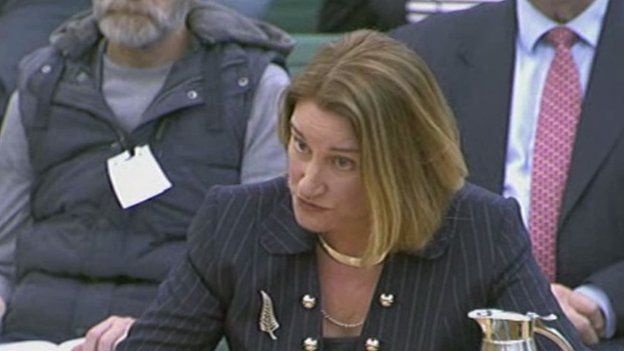
Justice Lowell Goddard giving evidence to House of Commons home affairs committee today. Pic credit: BBC

CROSS POSTED ON BYLINE.COM

Last month I  highlighted Ben Emmerson’s opening address to the Goddard Inquiry in which the leading counsel raised the argument of examining false accusations of child sex abuse and finding  against those who made them – effectively putting ” survivors on trial “.

I wrote: “this threat …must be very real for survivors who may want to give evidence in highly contentious cases. If  it does – sometime down the route – look at the Westminster paedophile ring – will ” Nick ” be expected to testify and face questions from lawyers for Harvey Proctor  who is alleged to be his abuser ( and vociferously denies it)- at the risk that a ” court” will decide he could be publicly condemned for going to the police in the first place.”

Now Lowell Goddard has confirmed this in an otherwise finely balanced statement issued surprisingly on All Fools Day ( but then she is a New Zealander and may not have known).

In it she says:

“. I am committed to ensuring that we hear all relevant testimony, including from victims and survivors as well as from those affected by false allegations of abuse. As I announced in November last year, the Inquiry intends to explore the balance which must be struck between encouraging the reporting of child sexual abuse and protecting the rights of the accused.  

I am determined to get the process of the Inquiry right.

I will ensure that all relevant evidence is considered. As is standard practice in public inquiries, questions to witnesses will normally be asked by Counsel to the Inquiry whose role will include, where necessary, the exploration of witness credibility. Affected parties will not ordinarily be permitted to ask questions of witnesses directly, but as I said in my Opening Statement in July 2015, affected parties are entitled to make an application to ask direct questions and I will grant those applications if fairness requires it. “

Yes there is a point here but the press seem to have immediately interpreted this to mean that  Harvey Proctor will have his day in court so he can condemn ” Nick” and ” Nick’s ” credibility will be judged by Lady Goddard and Ben Emmerson.

I am not going to comment further on Proctor’s case  but  draw attention  to another scenario.

Dame Janet Smith’s conclusion on the Jimmy  Savile scandal at the BBC concluded that  paedophiles were both very clever and manipulative ( Harvey Proctor’s lawyers please note this is not a reference to him).

Now just imagine if Bishop Peter Ball had appeared before Goddard after he had been first cleared but well before his recent conviction as a sex offender in a fresh police investigation.

Justice Goddard and Ben Emmerson would have heard what a decent and well respected chap he was from George Carey, Archbishop of Canterbury, Tory Mp, Tim Rathbone, Lord Justice Lloyd and ex Tory minister Sir Tim Renton. What chance would any  survivor have against such a phalanx of the great and good to be ” credible” let alone ” credible and true”. I can just imagine the line of questioning from Ben Emmerson and he wouldn’t be hauling the former Archbishop of Canterbury over the coals.

And how utterly stupid Lowell Goddard and Ben Emmerson would have looked when a subsequent police inquiry found the Bishop guilty.

The pitfalls of handling the Westminster paedophile allegations in such a way should be clear to see and the inquiry better think very carefully about how they are going to do it. And survivors again the  Latin words ” Caveat Emptor” – buyer beware – should be utmost in their minds  before taking part in such an inquiry.


Facebook to challenge sex offender’s right to privacy and excessive damages in Northern Ireland test case

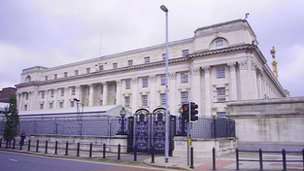
Belfast High Court

Belfast High Court Pic Credit: BBC

CROSS POSTED ON BYLINE.COM

An extraordinary judgement which I reported last year  banning a Facebook page about a convicted paedophile and awarding  him £20,000 damages for harassment is to be challenged in the courts next week.

Facebook is challenging  this decision in the Northern Ireland Court of Appeal claiming the damages awarded to the  sex offender were excessive and he could not reasonably expect privacy following his conviction for offences in the courts.

The case arose after  Joseph McCloskey set up a Facebook profile page called ” Keep Our Kids Safe from Predators 2 ” which posted information about a convicted sex offender called CG.

None of the information published  by McCloskey was private. It was all in the public domain at the time of CG’s conviction. CG’s solicitors complained to Mr McCloskey  who immediately removed all postings relating to CG.

The posts are said to contain threats of violence against the paedophile which judge took particular exception.

But the lawyers weren’t satisfied and went to court claiming the sex offender had been harassed on Facebook and his human rights breached by the publication on Facebook.

The judge found against the campaigner and Facebook and awarded the sex offender £20,000 damages for harassment.

Facebook is now challenging this judgement. There is an  excellent report on the Inforrm blog by trainee barrister Aiden Wills which goes into the legal details of Facebook’s challenge.

Facebook is particularly challenging the judge’s ruling that it should have had detailed knowledge and awareness of what Mr McCloskey wrote -pointing out that such a ruling would mean they would have to have detailed knowledge of every article put up on a Facebook site and whether it could be considered illegal. The case promises to be an interesting one.

UPDATE: The judge has reserved judgement on the case after a two day hearing. Joseph McCloskey did not attend the court as there was a dispute as to whether he was entitled to legal aid.


Google bows to EU law and removes right to search for delisted posts

erase past

Right to be Forgotten? Pic Credit: Index on Censorship.

CROSS POSTED ON BYLINE.COM

From Monday people in the UK and the rest of the European Union will no longer be able to bypass a ban on searching for information which an individual has asked to be removed from the net by Google.

Until now the removal of information by hundreds of thousands of people can easily be circumvented by searching on Google.com, the US version of the search engine.

However as the Inforrm blog reveals Google will block anyone with an IP address in Europe from seeing delisted posts. The full statement from Google is here. It will also be retrospective.

The decision is a victory for privacy campaigners though Inforrm thinks it may not go far enough for some.

Nearly 50,000 people  in the UK  are among the 400,000 who have requested for information to be removed. As Inforrm reports:

” Large numbers of delisting requests are now being made under the Google Spain ruling. Google’s most recent transparency report indicates that it has received 400,564 removal requests and has removed 42.6% of URLs covered by them.  Google has received 48,979 requests from the United Kingdom and has removed 184,115 URLs (38.6% of those requested).”.

While one can understand that people should have the right to remove false information from search engines what concerns me is  there is little transparency. One does not know who has requested the removal of the information and what information has been removed. Google just issues a statement to say that some posts are no longer available. Of course the post remains but people will have difficulty in finding it unless they subscribe to a particular blog.

Google has attempted with a FAQ to explain the main points behind the decision to delist – and there appears to be a view that there where there it is obviously not in the public interest or the person is a political  or public figure the request will be denied.

Google’s ban will not be foolproof – networks like Tor which is also used by the dark web – could mask the IP address of a person searching for the information. I suspect that investigative journalists will use this more as a new way of bypassing this ban if they want to do thorough searches.


Holding Tony Hall, BBC director general to account over Savile

BBC director general Tony Hall

BBC Director General Tony hall. Pic Credit:BBC

CROSS POSTED ON BYLINE.COM

The press launch of Dame Janet Smith’s forensic review into Savile’s  predatory activities at the BBC was an impressive affair.

Survivors are naturally disappointed that she failed to land a terminal blow on senior management at the BBC. They did not have the satisfaction of seeing heads roll for Savile getting away with sexually or indecently assaulting 72 people at different BBC venues or in private flats after attending BBC events. But it was not a whitewash.

It was impressive for two reasons. Dame Janet is a formidable performer ( as I found out when I tried to sneak  two questions past her) and had a  real grasp of the issues of why Savile had been able to get away with his monstrous behaviour for decades.

Tony Hall – who looked visibly moved after reading her horrific findings – did not take the easy way out. He did not as I feared say this was a dark period for the BBC but now everything was OK  after new measures had been taken to protect children and encourage whistleblowers. He took it on the chin the modified conclusion of Dame Janet that there could be another manipulative, charming, clever paedophile still working at the BBC or any other major organisation. He also pledged to do something about it.

Dame  Janet who in my view gratuitously threw away half her terms of reference dealing with recommendations for new child protection guidelines has laid down a pretty tough schedule to make sure something is really done at the BBC.

As she says  “My recommendation is that within, say six months of this report, the BBC should set out its official response to all the reports and should explain what its current rules, policies and procedures are in respect of each of the areas which have been open to criticism and demonstrate that these apply current best practice.”

“…the BBC should.. commission an independent audit of the operation of those rules, policies and procedures. It should set out the timeframe in which each of these areas will be subject to audit, how the audit will be undertaken and should confirm that the results of each audit will be made public. Further, it should undertake now to make any changes to procedures recommended by those audits to ensure that it maintains best practice in these extremely important areas.  ”

She also called for greater commitment to whistleblowers  at the BBC and for the BBC to change its hierarchy and stop its worship of “Talent” who  like Savile seemed to be able to get away with anything as a BBC VIP.

Tony Hall has to be held accountable to do all of this. His contrition should not been seen as a one day wonder. He owes it to brave journalists like Meirion Jones and Liz MacKean,  who were determined to expose Savile but were thwarted by the BBC establishment. He owes it, above all to all the survivors, and any future victim of sexual abuse on BBC premises.

All this will come when the BBC is under enormous pressure to cut costs savagely  under Charter Renewal and with Rupert Murdoch seeking to destroy the BBC as a  formidable media player. But the promises he made to survivors must be carried out.

He also ought to commit the BBC to playing a much bigger role in investigative journalism and use its resources to bear down remorselessly on issues like child sex abuse and corruption that need exposing. The pressure for  that won’t come  from Dame Janet.

I got the impression yesterday that investigative journalists were not Dame Janet’s favourite people. She thought that an accurate and comprehensive leak of her report  on a  issue of  major importance in a publicly funded institution was not in the public interest. Really?

A bloody nose for Keith Vaz: Met Police cleared in “Jane” rape case

CROSS POSTED ON BYLINE.COM

What I suspected was a flawed finding by the Commons Home Affairs Select Committee into the Met Police’s investigation of the allegations by ” Jane” that she had been raped as a teenager by Leon Brittan has now been proved correct.

An independent review by Dorset Police of Met Police’s investigation into the case – slipped out in an appendix to a report from the committee – has upheld that the investigation was “necessary, proportionate and fully justified despite the significant passage of time.”
This contradicts the critical findings of MPs who preferred to rely on the evidence given by  Det Chief Inspector Paul Settle  rather than senior Met officers. Their description of Paul Settle’s conduct as ” exemplary ” now looks a trifle hollow.

His decision not to interview the late Lord Brittan despite this being standard procedure in the case of rape allegations is unsurprisingly not described as ” exemplary conduct” by Dorset Police.

Instead They say: “The initial SIO was, by his own admission, inexperienced in rape investigation and whilst he appropriately sought specialist assistance and referred the case for Early Investigative Advice, he drew an early erroneous conclusion that the offence of rape was not made out, due to his perceived issues with consent.

” The reviewer concludes that there were ample reasonable grounds to conduct an investigative interview of LB and that the enquiry could not be properly progressed without doing so. Such action was necessary, proportionate and justified and far from unlawful  (their emphasis) as was contended by the SIO when he subsequently gave evidence before the Home Affairs Select Committee.”

“The Early Investigative Advice file lacked essential detail and was incomplete. It is surprising that a relatively junior member of staff made the decision to close this case without auditable reference to senior command.”

Their views  about ” Jane” are also significant.

They say:”The complainant provides a fairly compelling account of events. She is a competent witness,who displays no malice in her motivation.

Her accounts of her situation in 1967 are corroborated and it is plausible that she was moving in similar social circles to LB. The early disclosures in later years provide some consistency in her account and she appears to have little to gain from making a false allegation.There is some ambiguity surrounding the issue of consent, which would prove difficult before a properly directed jury.”

Her case  was superbly reported by Mark Conrad for Exaro. I met her and her husband and would agree with Dorset police’s assessment.

There were mistakes notably taking a broken tape recorder to interview Leon Brittan when it was eventually done – but it does not deserve the highly biased report in the Mail on Sunday on the findings.

Keith Vaz has opportunity to make amends. Perhaps he could either apologise or clarify his position on this investigation when the Met Police Commissioner Sir Bernard  Hogan Howe appears before him on February 23.