Lansley’s outrageous ban covering up risks in his NHS reform

Today the information commissioner publishes his findings to Parliament on the outrageous veto by Andrew Lansley in preventing publication of the NHS risk register.(see – report here http://bit.ly/MfEPVi )

The health secretary would have us believe that the public and the press are so naive that they must not be seduced in his words  by ” sensationalised reporting and debate ” of its findings.

In other words this is all right from Cabinet ministers and senior officials to read all the risky details  of his reforms – but the public must be treated like children, not capable of understanding the issues. What patronising piffle!

What I really suspect is that Mr Lansley does not want the public to read the full facts – something that when in opposition his Cabinet colleague, transport secretary,Justine Greening, rightly disagreed when it came to the risks of building a further runway at Heathrow.

But now in government it is of course all different, no one must know the real consequences of Mr Lansley’s decisions. I am delighted that Chris Graham, the Information Commissioner, stood firm on this one.

 But I suspect this decision is all part of an attempt by the government to row back on freedom of information. It fits in with Lord O’Donnell’s claim that if this goes on – it will have a chilling effect on discussion. The establishment both in the form of Jack Straw, Tony Blair and now Andrew Lansley, would love a world where we all lived in deference to ministers and senior civil servants.

No doubt charges for FOI will soon follow. Frankly if the government is planning to revert to a closed society, there is one simple solution. The risk register must be leaked.

Exclusive: Millionaire Francis Maude: the bad bill payer

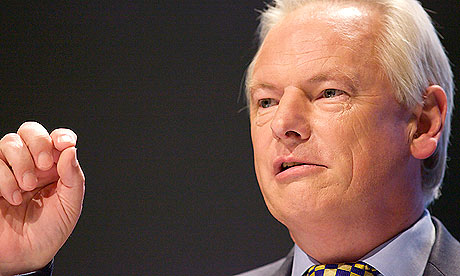
Francis Maude: Difficulties in paying his taxpayer funded bills on time

Do you fall behind with the gas and lecky?Forget to pay your TV licence and struggle to pay charges? Well spare a thought for poor struggling millionaire Francis Maude who just can’t seem to get his act together when it comes to paying his bills.

The man  was rightly castigated  last week over his ill-judged and downright dangerous public advice to stockpile jerry cans. But there is another side to his character which is equally surprising – his record for paying bills on time.

Hidden on the Parliamentary website following the great expenses scandal is an extraordinary documentation of the time when he owned a flat  in Imperial Court in Kennington, south London between 2007 and 2009. ( anoraks can peruse all Francis Maude’s bills at http://bit.ly/Hbu1Vo )

At the time he was severely criticised by the Daily Telegraph ( see http://tgr.ph/HkjDGC ) for purchasing the flat for £430,000- with a £345,000 mortgage- and claiming all the interest when he owned a house outright in Denny Crescent nearby. As a previous blog disclosed he also got a mortgage on this house and let it out to Tory special advisers – Maude’s madrassa – as it became known.

What the documents also  reveal is an amazing lax attitude to paying his gas, electricity  and telephone bills and service charges.  Not just  the delays in paying out the cash but being threatened with disconnection  and legal action for non-payment.

In August 2007 he was threatened with a termination notice for not paying a £36 telephone bill.

At the beginning of 2009 he received a letter from Kevin Roxburgh, head of energy debt collections, at British Gas because he hadn’t paid his £188.24 gas bill for over a month. The letter asks whether he has payment difficulties and tells him about direct debit.

EDF his electricity supplier also suggests he might like to pay by direct debit because of his overdue payments.

Finally he is threatened with legal action for an overdue bill of over £2600 from his landlords. They write to him warning that his long delay has already led to administration charge of £29.37.

The letter warns:” We request that you settle the amount outstanding within 14 days of the date of this reminder in order to avoid incurring additional costs or further legal action.”

The irony about this is that all his bills were being paid anyway by the taxpayer – he didn’t have to pay a penny as he could claim them back through his Parliamentary expenses.

Yet somehow he couldn’t  get his act together to send them a cheque. Finally the records show that he learns there is something easier called direct debit – and two years after moving into the flat actually sets up direct debit payments for his TV licence and  utility bills. This man is supposed to be a world-class banker -the ex md of Morgan Stanley. And he is charge of getting more efficiency in business payments to the government. God help us.

Why charging for Freedom of Information requests will be utterly wrong

Freedom of Information: Charges will put it under threat

This blog was written for the London School of Economics British politics and policy website (the link is http://bit.ly/H7C8lD) and is now up on the site. I have reproduced it here for my followers who may miss it  at the LSE.

It must be very tempting in these times of austerity for government to introduce charges for freedom of information (FOI) requests. Tempting it might be but it would be utterly wrong.

Giving evidence to the Commons Justice select committee’s post legislative inquiry into the FOI Act, I got the strong impression that some Conservative MPs might want to do this. The example of the Republic of Ireland which has introduced charges for requests, internal reviews and appeals to the Information Commissioner, has provided an excuse.

The fact that the new act has been a resounding success with the public, journalists and also private businesses is not a reason to introduce charges. My reasons for not going down this road are not such much to do with limiting the public’s right to know – although as Ireland has shown – this would be the inevitable consequence. They are more fundamental.

As a taxpayer I am obliged – I have no choice – to fund public services from my income. Therefore if I wish to know whether my money has been spent wisely and people have taken the right decisions – I should have the right to ask questions and ferret for information. As a journalist rather than a private citizen I have more time to do this – it is part of my job – and the information I discover can be communicated to thousands, if not millions, of people.

As one recent example showed – the disclosure under FOI that Ed Lester, the chief executive of the Student Loans Company, had found a legal way to avoid tens of thousands of pounds of tax – it can even lead to alerting ministers to something they were unaware.

To introduce charges would in effect be double taxation. I would be charged once for providing the service and again if I wished to find out what officials and ministers had done with my money. This is why I believe it is unacceptable.

A more subtle variant of charging is a suggestion that private citizens still receive the free service but commercial organisations like the media, private firms and official bodies paid the cost of the request – which could be anything up to £600. Again it would unfair and also unworkable. Businesses, law firms and the media – unless they are near bankrupt – pay their share of taxes to the government and again would be charged twice for seeking to find out how and why their money was spent.

It would also be completely unworkable to run such a two tier system. There is nothing to stop me as a journalist, or indeed any business person, asking a friend to put in a FOI and getting it sent to their address. And there is no way officialdom could find out, unless they subject every private requester to a ninth degree inquisition every time they asked a public body for information.

It would be a nightmare scenario for the public sector to police and make officials extremely unpopular with the general public. It might even lead them to face legal complaints, such as falsely accusing individuals of avoiding charges.

What is required urgently is an extension of the freedom of information act to the private sector when it provides public services. The government has an active policy of encouraging private providers – whether charities, mutual or commercial companies – to provide public services. Francis Maude, the Cabinet Office minister, in an address to the Policy Exchange think tank said that turning state provided services into mutuals owned by the staff might indeed be as widespread as privatisation of state industries in the 1980s Thatcher government.

At present the mechanism for extending FOI to new bodies is rather cumbersome – requiring a designation under the Act by ministers – usually following a consultation period. This is woefully inadequate to cope with a major shift from public to private sector providers in Whitehall, local government and the NHS. One simple solution would be to include a standard clause in any private sector provider contract saying that if the company accepted public money to run a public service they would automatically be subject to FOI requests about that particular service.

No doubt they would be a howl of protest from the business community about new burdens and costs to running the service, but given the multi million pound size of most contracts it would be a small price to pay. And if it was a standard contract it would mean that there would be a level playing field for contractors bidding for the work. It could also be confined only to the services they provided in the public sector and not to normal business contracts.

This would bring within the scope of FOI private train operators and bus companies who take taxpayers subsidies but are at the moment outside the act. It would also encourage these bodies to provide a more efficient service since they would have an incentive not to encounter the wrath of the travelling public every time they failed to provide a public service.

The public could also question and challenge the companies when they cut service provision to prove they had a case and also ask for detailed policy on protecting public safety. Similarly, it would provide the public with some protection as the NHS expands the use of private hospitals for operations as they are outside the scope of the act.

The act does require an overhaul in this area. But MPs on the committee should resist the temptation to call for charges to use the act as this would be unfair to the general public and to taxpayers. The right to demand information on services you are required to pay for without being charged is a fundamental human right that should be non-negotiable, even in the present financial climate.
Website passes 100,000 views

This website in just over two years has now hit the 100,000 mark – 100,130 to be precise if you must know. This is far higher than I expected but then I didn’t intend to write over 100 blogs in the same period.

The home page itself has had over 16,000 hits. But for the record the six most popular stories are the tale on Blair’s donors getting 6,5 per cent interest on millions of pounds of loans to Labour (4324 hits); the abortive attempt to criminalise bloggers in Barnet (3433); the armchair audit of Brian Coleman, Barnet Tory councillor and chair of London fire brigade (2843); the Ed Lester tax scam (2785); Francis Maude’s ” House of the Rising Spads” (2702) and the  privatised London fire company Assetco facing a  financial crisis (2592).

 The most popular pic on the site- believe or not – is a joint of roast beef -used to illustrate the true blue Tory rebels fighting Cameron ( an amazing 20,000 views).

 Special thanks to the many people who boosted these figures including Guido Fawkes site, Political Scrapbook, Broken Barnet (Mrs Angry ),Mr Mustard,Liberal  Conspiracy,the London Fire Brigades Union,Political Betting, the Guardian and many others.

So far this year the site has had over 15,000 hits – compared to 17,000 for the whole launch year 2010. Interesting times.

Is the BBC the British Tax Avoidance Corporation?

BBC now in row over paying 3,000 people through personal service companies

The BBC has disclosed that around 3000 people on the Corporation’s books are paid through personal service companies – the same system used until banned by the Treasury by Ed Lester, the Student Loans Company chief, to avoid paying tax or national insurance at source.The full story is in Exaro News at http://www.exaronews.com It comes from a Freedom of Information request by David Mowat, the Conservative MP for Warrington,South and only covers part of the picture.
Altogether the BBC across the globe has 20,000 directly paid employees and 12,000 freelancers – 3,000 of them through personal service companies.
The figures are an underestimate since it does not include many of the BBC’s commercial companies and all of BBC’s talent – defined by them as ” people who appear in presenting or journalistic roles on our television, radio and online.”
So none of the high paid presenters will be in this breakdown nor will be people employed on many of the BBC’s commercial activities. Nor are people supplied through Reed Personnel who can choose to be paid through a personal service company, and BBC has decided to keep their numbers secret.
This means the figure must be much, much higher. A breakdown provided by the BBC – suggests that more than half the 3,000 are taking less than £26,000 a year, which suggests that they are genuine freelance. Another 1300 or so earn over £26,000 – 318 over £50,000 – and of these five earning over £150,000 and 31 over £100,000.
The BBC insist that none of them are permanent staff and like the government point out that none of them are being paid illegally.
A BBC spokeswoman said:”In the main they are hired to do specific jobs for a fixed period of time such as directing, editing and other craft skills. When a person is contracted in this way it is their responsibility to organise their tax arrangements directly with the HMRC. This is entirely in keeping with HMRC regulations and is standard practice across broadcasting and many other industries.”
However there are other questions to be answered. Why are the BBC not doing the same review as Whitehall in finding out whether all these contracts are genuine? David Mowat is right when says the BBC management should do this.
And why can’t we find out what the BBC Talent is paid – rather than the BBC sheltering behind an exemption through their Freedom of Information Act aimed to protect journalists; sources not disclose their pay – since it is paid by the licence payer.
Also rather disturbingly two prominent journos (one ex BBC)have told me the BBC tried to encourage them to be paid through personal service companies when they did not want to do it. Is this pressure from the BBC to avoid having to pay national insurance and encouraging possible tax avoidance. We should be told.

Buried in the Budget:Freelance company tax rules ” shake up ” on way

Almost entirely missed by the press coverage of the Budget this morning, George Osborne, the Chancellor, announced a radical review of  freelance  tax employment rules through what is known as IR 35.

Not mentioned in his speech – the changes were hidden away in the full Budget document. The full story of this change written by Alison Winward  and Frederika Whitehead is on the Exaro news website  at http://www.exaronews.com.

For those worried by the changes to the IR 35 rules   the official Treasury document uses the dreaded word simplification – the same phrase used by the Chancellor to impose a ” Granny Tax ” – a  future loss of  income for 4.5 million pensioners  by freezing tax allowances for most of  those who have  incomes above the state pension. Like pensioners this could affect millions of people.

The full section in the Treasury  reads:

 ” Personal service companies and IR35

 The Government will introduce a package of measures to tackle avoidance through the use of personal service companies and to make the IR35 legislation easier to understand for those who are genuinely in business.

This will include: strengthening up specialist compliance teams to tackle avoidance of employment income; simplifying the way IR35 is administered;

and subject to consultation, requiring office holders/controlling persons who are integral to the running of an organisation to have PAYE and NICs deducted at source by the organisation by which they are engaged. (Finance Bill 2013)”

Basically Hmrc are giving a warning that the  wheeze that enabled Student Loans Company chief Ed Lester to hold one official position in Whitehall, will be banned everywhere. It will also effect local government, the NHS and now the private sector, as people won’t be able to claim it as freelance earnings through a  personal services company. They will have to go through PAYE and pay national insurance.

There is at least a year’s grace before this happens – as legislation is planned for next year’s finance bill – and implementation could be delayed until 2014.

In the meantime the small print announces a crackdown from Hmrc on freelances who use this method. The revenge of Danny Alexander, chief secretary of the Treasury, who missed the whole Ed Lester arrangement when he personally approved all high paid Whitehall staff, looks like being rather more widespread than people anticipated.

Margaret versus the mandarins

Margaret Hodge: Standing Up for MPs' and the public's rights

Watch out for a major speech by Margaret Hodge, chair of the Commons public accounts committee, at Policy Exchange in London this Thursday on the accountability of Whitehall to Parliament.

This is going to be a historic moment for the relationship between MPs and mandarins and I am not expecting the doughty chairman of Parliament’s most powerful committee to pull any punches. I also expect it to ignite a big debate.

 It is also important moment for people who believe that Parliament is just a talking shop. This is because it will show that MPs want action on the way our taxes are spent and even more so on who pays their taxes.

 It is also about the honesty and integrity of Dave Hartnett, the head of the Inland Revenue (HMRC), and his attempt to get away with telling lies to MPs on a deal with one of biggest bankers, Goldman Sachs.

The story of this dispute is published today by Exaro News at http://bit.ly/zHz7pP or on the Exaro News website http:// www.exaronews.com .

 Suffice to say it reveals a massive tussle between Lord O’Donnell, the former Cabinet Secretary and Mrs Hodge over whether civil servants are accountable to MPs or ministers – going to heart of the matter of whether MPs can stand up for us as taxpayers.

 Lord O’Donnell ,who wrote the letter days before he retired ,has accused the Public Accounts Committee of  publicly humiliating a senior law official at the revenue by making him swear on the Bible before giving evidence. He talks of widespread anger in Whitehall and in the legal profession about this.

 But he ignores the reason – that the man’s boss, Dave Hartnett, had misled Parliament over a sweetheart tax deal he negotiated with Goldman Sachs saving them possibly billions in tax. He pretended it was nothing to do with him.

 This is why people should back Margaret Hodge, her committee which includes very equally strong minded MPs like Tories Richard Bacon and Stephen Barclay in standing up for MPs and the public’s rights.

 Thursday will light the blue touch-paper at Policy Exchange. If there are any seats left go and watch and hear. It’s free.

Save FOI: Putting the case to MPs

 I am giving evidence to Mps on the House of Commons Justice Committee on Tuesday as part of their inquiry into the future of freedom of information. I shall be there alongside three  other journalists – Martin Rosenbaum from  BBC News, Doug Wills, from the Evening Standard, and David Higgerson, from Trinity Mirror Regionals. I shall be there on behalf of the National Union of Journalists, who have put a submission to the committee and as someone who regularly uses FOI for both my blog and for Eaxro News, the investigative news website.

We will be asked a wide range of questions on FOI. If any  journo or blogger has any point that they think should be raised about FOI you can put a comment upon this site. Please keep any comment short and succinct. I don’t promise to be able to raise everything but it would  be good to know of any burning issues which may have escaped me.

The hearing starts at 11.15am and will be broadcast live  on the internet and will also be saved for other broadcasts.

Hacking scandal:Trevor,You don’t have to bribe people to get scoops

The Sun's Trevor Kavanagh: Defender of the Press? Pic courtesy : digitalhen

Trevor Kavanagh, the Sun’s most vociferous associate editor, has launched an extraordinary attack on the police operations which led to the arrest of a number of very senior Sun journalists. Using language I normally associate with my former employer, The Guardian, he condemns the police for disproportionate action and speaks of a police state and witch hunts against News International. (See http://bit.ly/we4MKo )

 My heart bleeds for him in one sense. Yes, you are right, it doesn’t take dawn raids and 20 police officers to arrest one unfortunate Sun hack. As far as I know they are not the equivalent of armed drugs gang. I am sure you wrote lots of articles in the Sun condemning the tactics of the Scotland Yard’s  former  assistant commissioner, John Yates, when he used the same approach against Lord Levy and Blair’s Downing Street staff in the ” Cash for Honours ” investigation. (this needed investigating but some of the tactics were disproportionate.)

Where I do quarrel with him is his implication that somehow allegations of bribing police officers ( which I gather is the reason for all this) is an essential tool of journalism to expose scandals to save Britain from turning into a corrupt cesspit.

It isn’t. If you think so it sends out all the wrong messages and puts journalism in the dock – and encourages a culture where money is the main motive and moral outrage irrelevant.

Without meaning to be pompous, I have just managed to get by in a long journalist career without paying anyone ( other than professional journalists who are making a living from passing on information) and still produced the odd exclusive.

I may appear to be naive at times but nobody needed paying to expose the ” cash for questions” scandal in the 1990s nor that Peter Mandelson had taken an undeclared £373,000 home loan from a  fellow minister.

Nor did any money change hands in the latest scandal of Ed Lester, the student loans company chief, and his tax affairs – just one  morally outraged source, a few beers, and a well targeted freedom of information request.

Of course, not all leaks are based on moral outrage. Base motives and deadly sins could be involved. By removing money from the equation – it gets rid of one motive and also stops people ” over egging” the information to make more cash.

My main disagreement with you is there has been something wrong in the practice of journalism and it does need cleaning up. I haven’t a clue whether these journalists  are guilty or innocent – or in doing their jobs have been corrupted by a culture that ended up being corrupt itself.

But I think you are being a little too disingenuous to suggest the fabric of investigative journalism is about to collapse because of these actions. There are many other practices  – not least the current financial collapse of newspapers – that are much more deadly.

Brian Coleman: “Human Rights-My Backside!”

Brian Coleman - no to human rights

Tory councillor Brian Coleman – standing for election again this May as London Assembly Conservative member for Barnet and Camden – is at it again!

 In an interview for a foreign TV station he is making it clear again that he wants stringent controls over everybody who blogs on the internet – after the failed ” complaint” by his local council Barnet to try and get local blogger Derek Dishman fined and registered under the Data Protection Act for publishing public details about the views of Barnet officials on their own websites. If successful Barnet would have prevented bloggers writing anything about anyone except their own family and housemates -without being licenced by the DPA.

In an extraordinary interview – see www.youtube.com/watchv=0uuj1il43xg&feature=youtu.be  the councillor demands censorship and libel action against bloggers- and evidently beleives they don’t have right to criticise him or anyone else without bweing taken to court.

 What is worse it appears after this youtube except was put up on the website t00manycuts.blogspot.com  followed a comment on Twitter Mr Coleman successfully moved to have the authors removed from their Twitter account. I don’t quite know what  the tweet said but it was not flattering and it may to do with the fact that he is living a subsidised Methodist housing charity flat while claiming £128,000 a year council allowances from four authorities and organisations.

Coleman has never responded to the accusations – but always been happy to condemn poorer people who complain about rising rents.

 Curious to know what David Cameron, Grant Shapps ( the local government minister) and Boris Johnson might think of his views on human rights and the internet. But if you are planning to vote for him, he is obviously standing on a platform of removing human rights from all Barnet and Camden citizens. Great platform for a democracy!

 Let him know  your views on this> he is contactable on

toomanycuts.blogspot.com