The end of summer time is about to cause new divisions across Ireland as the UK opts out and the Republic of Ireland is expect to have to opt in to a new European Commission directive Pic Credit: Articular/ Freepik
I have done a story today on Byline Times on an issue that will further divide the communities in Ireland – proposed changes by the European Commission to cease putting the clocks forward and back every year. It is coming to a head just as the UK is close to leaving the European Union. You can read it here.
The decision by Lord Justice Irwin and Mrs Justice Whipple to dismiss ALL claims of discrimination and failure to inform 3.8 million women born in the 1950s about the rise in their state pension age from 60 to 66 is in total contrast to the decision of Mrs Justice Lang who granted ALL the claims to be heard four months ago.
Obviously there is a big difference between permission for a judicial review to be granted so the case can be argued than a judicial hearing where the arguments are tested.
Nevertheless this startling contrast to me suggests that there are grounds for an appeal because the two judgments are so far apart. That is presumably why the two judges did not ban an appeal.
To remind people Mrs Justice Lang decided that even though the 1995 Pensions Act was passed 24 years ago the effect of the implementation of the Act was happening now and therefore this issue was subject to judicial review. She also agreed that both age and sex discrimination could be part of the hearing, and the issue on whether government action was contrary to EU directives on social security and whether people had been adequately informed about the changes.
The two judges have rejected all of this and upheld the case put by the Department of Work and Pensions in its entirety. No wonder the DWP is cock a hoop today.
They describe any challenge to primary legislation passed over 20 years ago as ” fatal” and they have published in detail all the attempts by the DWP to inform people. They have included discussions from 1993 onwards about changing the law as part of informing people.
But they abrogate any responsibility on whether the DWP did a good job or not. ” We are not in a position to conclude that the steps taken to inform those people affected by the changes to the state pension age for women were inadequate or unreasonable”.
They have also accepted the DWP’s argument that it was under no obligation to tell people at all and certainly not to individually informing anybody about the change because it was not written into the law.
This ruling should be a red line for MPs to insist in the future that any Parliamentary legislation that affects millions of people must include a clause requiring a ministry to individually inform the people affected in language they can understand and in good time.
Goodwill or good sense is obviously not enough to be left in the hands of individual ministers. It must be made mandatory that people are told.
The arguments over whether government action in handling the rise in the pension age contradicted EU directives amounted to age and sex discrimination or indirect legislation are complex.
But broadly the judges have accepted the DWP’s interpretation of the wording so as to exclude the changes to the pension age from any such directives.
They have also ruled out the role of the UN Convention on the Elimination of Discrimination against Women from having any bearing on the case.
” We have not been assisted by reference to CEDAW, it adds nothing to the claimaint’s case”, they say.
Their main argument is that the 1995 Pensions Act removed an advantage (my emphasis) that women had over men at the time they retired and anyway the decision was part of primary legislation which could not be challenged.
Jackie Jones, Labour MEP for Wales and an expert on CEDAW, says the judges have misunderstood the purpose of CEDAW which could make a possible grounds for appeal.
In her view the Judges did not consider the cumulative effect of unequal laws in the past on this particular group of women who were denied contributing to their own pensions when they worked part time which is one of the issues covered by CEDAW.
The judges also ruled out the recent victories in civil service and firefighters pensions having any bearing on the case because they involved transitional arrangements for work pensions rather than their right to a state pension.
Despite the harshness of the judgement the immediate effect has been to create widespread sympathy for the plight of the 50swomen in the media, among the general public and brought finally to national attention the whole issue.
It has also galvanised campaigners to fight on and with a general election on the horizon to put politicians in all political parties under pressure. It could cost the government, if it does nothing, 3.8 million votes from people who reliably go down to the polling station.
The row over whether hedge fund and City trader backers of Boris Johnson could make hundreds of millions of pounds by speculating on a No Deal Brexit reached Parliament today when the government was challenged by the Opposition parties to explain whether this amounted to a conflict of interest or breach of the ministerial code by the PM. Read the full tale on Byline Times.
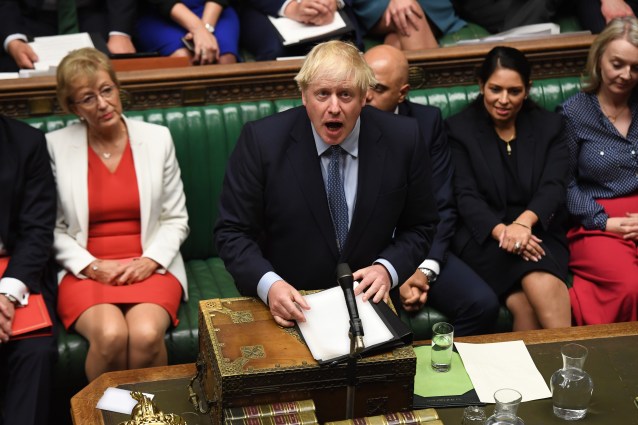
Boris Johnson in full flood on his Parliamentary statement on the Supreme Court. Pic Credit: UK Parliament/ Jessica Taylor
Given the enormous interest into Johnson’s determination to leave the EU on October 31, there are questions about the huge hedge fund and City trader financial backing for his leadership campaign this deal when they stand to make billions of pounds on shares and the potential collapse of the pound. Read my story on Byline Times here.
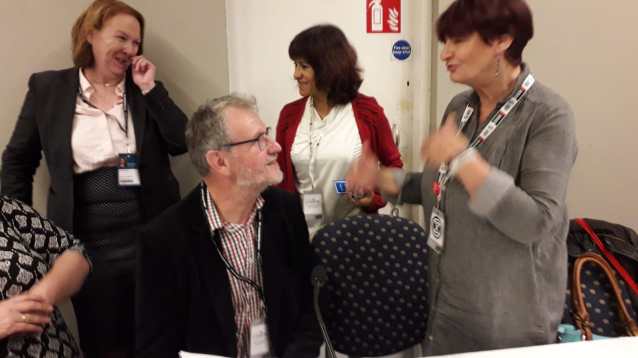
In conversation at the private meeting. Left to Right: Moira Ramage, prospective Labour Parliamentary candidate for Paisley and renfrewshire South;myself; Laura Alvarez and Baroness Blower
Senior Labour figures are preparing to improve their offer
to compensate 3.8 million women born in the 1950s who are facing hardship by
having to wait up to six years for their pensions.
John McDonnell, the shadow chancellor, indicated that the
party is now looking at a new offer as the general election approaches.
He made the comment
after a private meeting at Labour’s annual conference this week organised by his
office which enabled leading figures from campaigning organisations fighting
the women’s cause to pitch their case to senior people from the Labour Party.
The meeting came as the two largest trade unions affiliated
to Labour, Unison and Unite, backed the case for full restitution for the
women. Len McCluskey, leader of Unite, personally endorsed full restitution, in
a tweet. The party is also discussing putting the offer in its general election
manifesto.
Among the leading figures at the meeting were Laura Alvarez, the wife of Jeremy Corbyn: Andy Whitaker and Rory Macqueen respectively head of strategic communications and chief economic adviser at John McDonnell’s office; Mike Amesbury, shadow employment minister, and Fran Springfield, co chair of Labour’s disability organisation and one of the people drawing up the party’s manifesto. Mr McDonnell came to the end of the meeting.
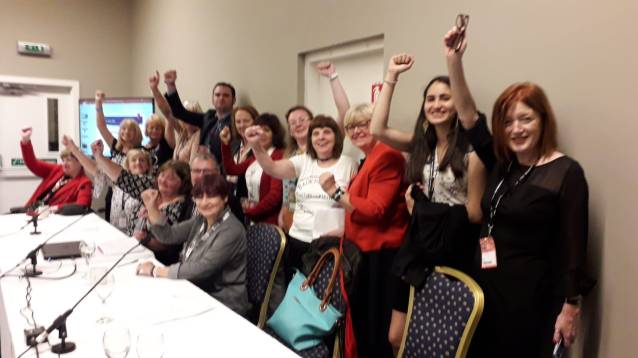
The whole cast of #50swomen and their supporters at the meeting pose for the camera
The organisations represented included BackTo60, Waspi
Scotland, Waspi Ltd and Waspi 2018.
They were backed up
by two women from Unison in Wales, Lianne Dallimore and Mac Hawkins who also
addressed the meeting.
Jackie Jones, Labour MEP for Wales, also pressed the case
for full restitution and explained how it come done by a special temporary measure
through Parliament using the UN Convention on the elimination of all forms of
discrimination against women (CEDAW) which was ratified by Margaret t5hatcher
in 1986. This allows the money to be paid without amending the present pension
age of 66 for men and women.
At present Labour’s offer is confined to backdating payments
for two years from 66 to 64 for 1950s
born women but no further compensation.
Labour is also waiting the result of the judicial review held in June where Michael Mansfield, QWC put the case for full restitution for all 50s women. It has now been announced it will report on October 3 – next Thursday.
Among other people who attended the meeting were Christine Blower, former general secretary of the National union of Teachers, who is about to be ennobled as Baroness Blower; Labour MP for Ipswich Sandy Martin; Labour MEPs Jude Kirton-Darling and Richard Corbett. Moira Ramage, prospective Labour candidate for Paisley and Renfrewshire South.
From Left to right: Unison’s national pensions officer, Alan Fox; Jackie Jones, Labour MEP for Wales; Sian Stockham, senior vice president Unison and Gloria Mills, national secretary, equalities,Unison.
At the TUC I was commissioned to write an article for Union News, the website that reports on all trade union action, about Unison’s decision to back the 1950s born women for the full restitution of their pension from the age of 60.
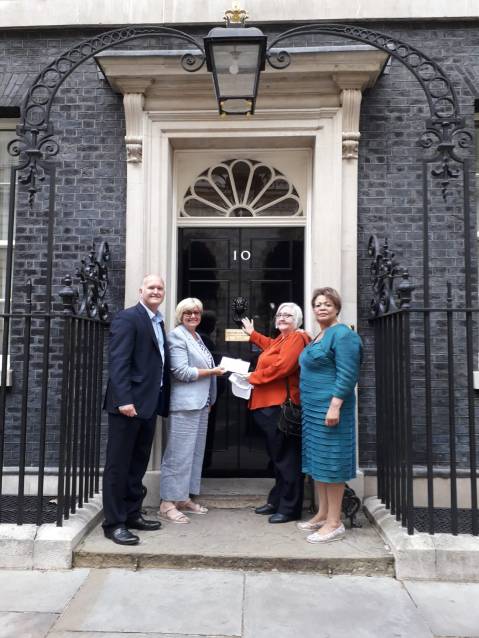
Unison were keen enough to support the BackTo60 campaign to come to Downing Street to hand in a letter to Boris Johnson, supporting their case which has been backed by a Parliamentary motion, started by Anna McMorrin, Labour MP for Cardiff, North and now signed by 190 MPs from all parties.
Next week Unison will be backing the campaign at a fringe meeting supporting the cause of the 3.8 million women at the Labour Party conference on Tuesday in the Metropole Hotel, Brighton.
You can read my article on the Union News website here.
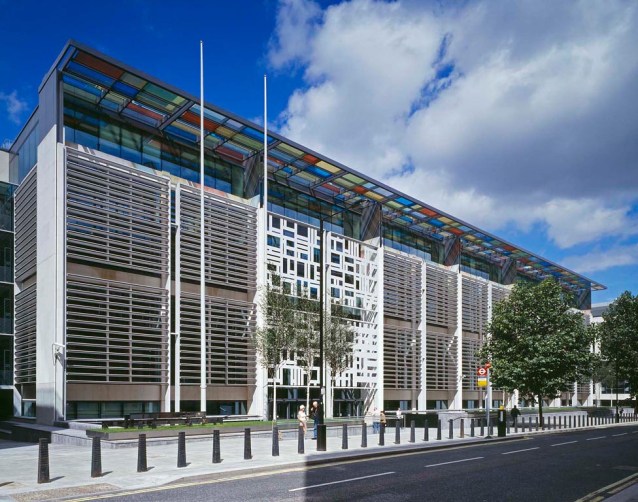
Home Office HQ: MPs accuse the ministry under Theresa May of ” entirely unacceptable” behaviour in handling the problem
MPs today accused the Home Office of learning nothing from another “Windrush” scandal over their treatment of 50,000 overseas students from outside the EU and European Economic Area who were said – many wrongly – of cheating in oral English language tests to get a university place.
The Commons Public Accounts Committee said it is “staggered” by the uncaring attitude of the Home Office over the fate of thousands of students who were accused five years ago and had their visas cancelled or voluntarily left the country as a result. Others had to spend thousands of pounds to win court cases against the government to prove their innocence.
Whitehall claimed ” administrative error” for all the secrecy
Whitehall is condemned yesterday by a powerful all party committee of MPs for being over secretive over the award of nearly £100m of management consultants contracts to handle Brexit.
The Commons Public Accounts Committee accuses Whitehall of breaching government guidelines in making public contract details, awarding nearly all the work to just six companies and covering up some of the contracts.
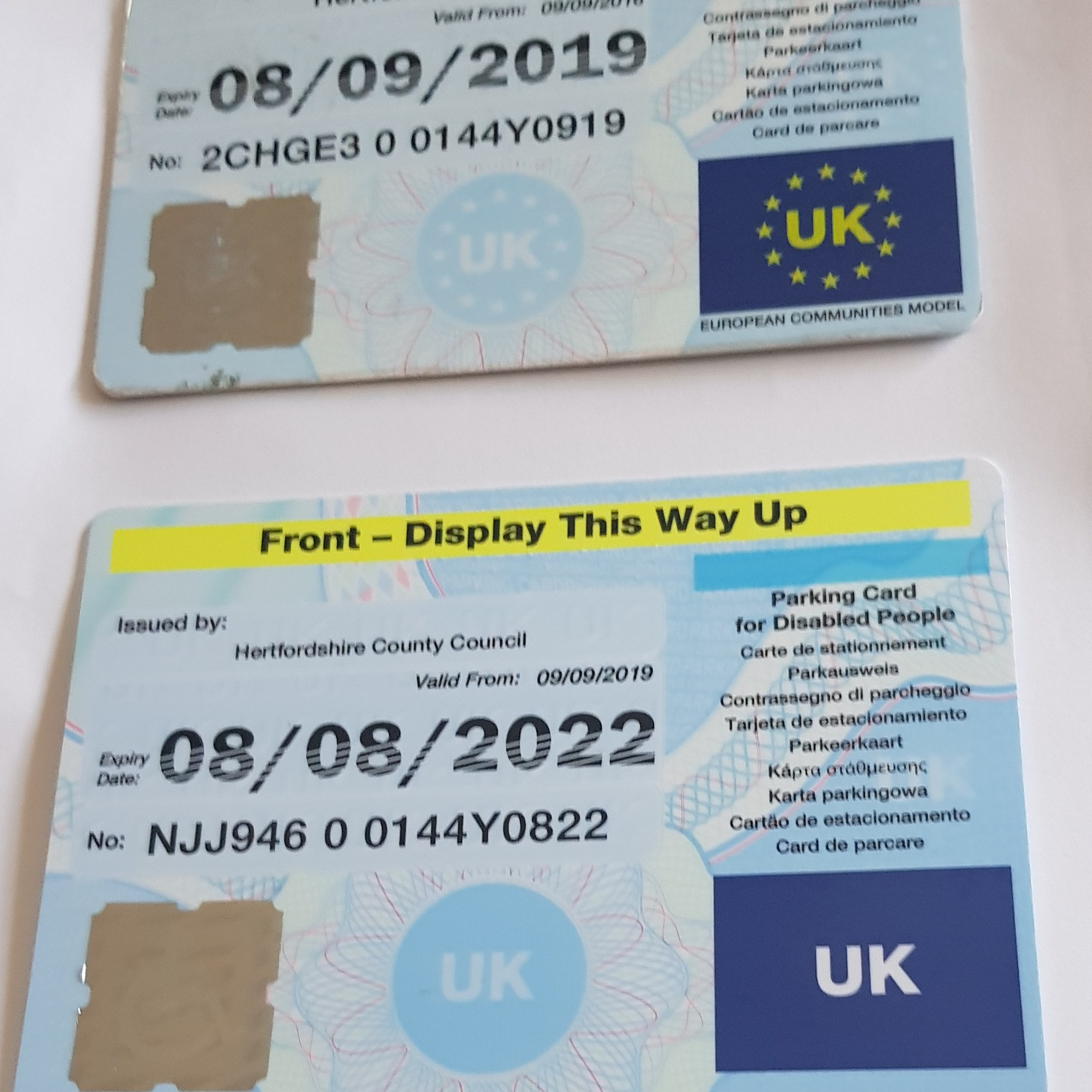
Government jumps Brexit by removing EU symbols from blue badges.
As you can see from the picture above the Government has sneakily already decided that Britain has left the EU as far as 2.35 million disabled blue badge holders are concerned.
My new card for my wife issued this week has been stripped of its EU symbols even before we have left the EU. It appears to reassure people by using nine foreign languages to describe it as a disabled parking card.
But investigating the real position of disabled driving post a ” No Deal ” Brexit this is totally misleading and could easily end up with holiday makers being fined in some European countries for illegal parking.
At present as a member of the EU all UK blue badge holders can get concessionary parking in virtually all European countries. If they hire a car they can take the blue badge with them as it is not tied to a particular vehicle. And the Independent Living advice site thinks nothing has changed. It says:
“It is not likely that Brexit would lead to the UK changing the format of the Blue Badge, so there is no obvious reason why it would not continue to be recognised across Europe, in the same way as those issued in Switzerland and Norway. “
However a more detailed investigation on a disabled motorists site paints a different picture.
It shows that once Britain leaves with a No Deal using this card will vary from country to country. In Spain, Switzerland, Denmark, Sweden, Ireland, Iceland, Norway,Austria, Poland,Luxembourg, Romania and Cyprus there will be no problem.
But in France, Croatia, Finland,Leichenstein and Latvia the card won’t be recognised because we are from a third country.
In Germany you will have to notify the local council or police and get a card to park as a disabled driver.
And it may not be recognised in Holland, Belgium or the Czech Republic because it does not have a disabled wheelchair sign on the card.
In Malta and Portugal you must apply in advance for a special card if you want to use it. At present as a member of the EU you have no problems and can use the Blue Badge Card.
In Italy you have to check with the local council – it will vary from city to city where you can use your card. At present you can use it everywhere. The same applies to Lithuania and Hungary.
In the UK it is being left to the local council’s discretion whether they want to recognise blue badges from other EU or European Economic Area countries.
So far as I can see the government does not seem to have thought about it at all – most advice dates from 2008 and 2013 on Whitehall websites.