Revealed: The shocking hidden world of child sexual abuse in faith organisations – new inquiry report

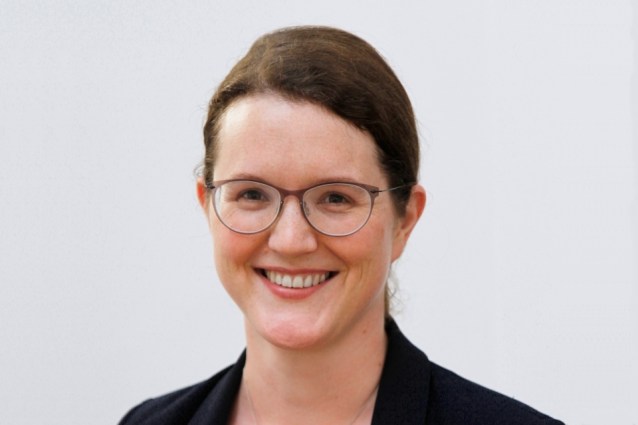
Professor Alexis Jay, chair of the inquiry

After some highly critical reports into the cover-up of appalling child sexual abuse in the Church of England and the Roman Catholic Church the Independent Inquiry into Child Sexual Abuse has now produced a new report into other faith organisations in England and Wales – notably Muslim and Orthodox Jewish faith groups, and the Jehovah’s Witnesses. It also covers a wide range of other faiths from the Methodists and Baptists to Buddhism and Sikh religions.

The report contains more horrific tales of abuse by people in charge of these organisations, their denial and cover up of what is happening, their failure to safeguard vulnerable children and the lack of measures to ensure proper inspection of the schools they run.

Worse of all after holding this inquiry the IICSA reveals that they don’t know the extent of the problem in these faith organisations because a number of them don’t want to co-operate with state institutions. Even police forces don’t keep records of how many recorded child sex abuse cases there have been in these faith organisations. And some of them even don’t carry out basic security checks on the people they employ to make sure they do not have criminal records.

Abuse at an Orthodox Jewish community

Examples of the horrific abuse stories include Todros Grynhaus, a prominent member of the Charedi Jewish community in Manchester and a Rabbi’s son. He sexually abused over 20 years two girls and a boy – one girl regularly between the age of seven and 15. Only when one of the girls went to Israel and told a rabbi there did the abuse become known and Grynghaus was offered counselling. Two years later when she was 18 she told prominent Jewish members of the Charedi community and was offered £5000 compensation and told not to go to the police or she would be regarded as a Moiser – what we know as a snitch – by informing on another Jew. When he faced charges Grynghaus fled the country on a forged passport and had to be extradited from Israel. Eventually the case did go to court and Grynghaus in 2015 was sentenced to 13 years in jail. But only after one of the rabbis was compelled by a judge to give evidence.

Abuse at a Muslim Madrassah school

Another example involved years of abuse at a Muslim madrassah school -held in a home- of a girl from the age of the age of eight to 11 by the 16 year old teenage son of the family ending in her rape. When she told of the case at the age of 14 she was abused as ” a tart” and a “slag” by the Muslim community who did not want the boy’s family disgraced. Eventually it did go to court and he went to prison for a year.

Four year old girl sexually abused at a Jehovah’s Witnesses Bible class

Another example involved the sexual abuse of two young girls by a member of the Jehovah’s Witnesses during Bible classes. One of the girls was as young as four and the abuse continued until she was nine. Peter Stewart was a ministerial servant in Kingdom Hall responsible for the organisation. He was arrested in 1994 when another person accused him of sexual assault. The girl did not tell her mother for six years about the sexual abuse and only decided to tell her after he was released from prison for the first offence. By the time the police got around to arresting him, he had died. The mother pursued a civil claim against the Jehovah’s Witnesses and won the case – despite the organisation fighting the claim.

The report goes into detail about the failure of many faith organisations to protect and train people in safeguarding and take the issue seriously rather than try and cover it up. In the three cases above the organisations tried to cover up what had happened and not take responsibility.

Two immediate recommendations

The report makes two immediate recommendations . They are that all religious organisations should have a child protection policy and supporting procedures;

and  that the government should legislate to amend the definition of full-time education to bring any setting that is the pupil’s primary place of education within the scope of a registered school, and provide Ofsted with sufficient powers to examine the quality of child protection when undertaking inspection of suspected unregistered schools.

It estimates that 250,000 children are given supplementary education by faith organisations and none of the schools need to be registered or inspected.

They also have some long term proposals that will appear in a further report. These include whether mandatory reporting of child sexual abuse should be introduced; whether criminal checks should be compulsory for all faith organisations; and whether child protection policies should be compulsory for every faith organisation.

Professor Alexis Jay, Chair of the Inquiry said:

“Religious organisations are defined by their moral purpose of teaching right from wrong and protection of the innocent and the vulnerable. However when we heard about shocking failures to prevent and respond to child sexual abuse across almost all major religions, it became clear many are operating in direct conflict with this mission.

“Blaming the victims, fears of reputational damage and discouraging external reporting are some of the barriers victims and survivors face, as well as clear indicators of religious organisations prioritising their own reputations above all else. For many, these barriers have been too difficult to overcome.”

“We have seen some examples of good practice, and it is our hope that with the recommendations from this report, all religious organisations across England and Wales will improve what they do to fulfil their moral responsibility to protect children from sexual abuse.”

Time for a Women’s Rights Law and real radical change – CEDAW President’s report

Jocelynne Scutt, President of the CEDAW People’s Tribunal

A major blueprint for how the United Kingdom can transform its laws to end all forms of discrimination against women and properly implement the UN convention ratified by Margaret Thatcher in 1986 has been published by the CEDAW People’s Tribunal.

The 252 page report written by Jocelynne Scutt, with the backing of a researcher team,, proposes to end the piecemeal implementation of parts of the UN Convention Eliminating All Forms of Discrimination, both in national law and in different parts of the UK.

Its conclusion said: “The proposal now made by the CEDAW People’s Tribunal that the United Kingdom seize the opportunity now presented to it and introduce a Women’s Bill of Rights into the United Kingdom Parliament provides
a real opportunity to do this – create a climate where women’s rights are truly recognised as human rights, and human rights as women’s rights – with the United Kingdom taking the lead.”

it says it is time to replace fine words by politicians on women’s rights with deeds and includes comprehensive proposals backed up by research for almost every conceivable area of British life to improve the rights of women. Indeed in the space of one article it is impossible to encompass every area of this report – you will have to read and study it for yourself.

The shortcomings of the Equality Act

Some of the more dramatic findings reveal shortcomings in the 2010 Equality Act – which is probably the UK’s major contribution to women’s rights – both in sections that have never been implemented and the fact that its provisions don’t apply to Northern Ireland – which the present government insists should remain an integral part of the UK.

To back up that last point the report said:
” No devolved authority to have the power to undercut or reduce the provisions, extent or scope of the Women’s Bill of Rights and to address any potential conflict or proposal by any devolved authority to do so, the UK Act to include a provision prohibiting its terms from being excised from operation in the devolved jurisdictions. This provision to be based in the principle herein stated, namely that all women of the United Kingdom, wherever residing, are entitled to equal rights without being deprived of them by reason of residency in any devolved jurisdiction.”

But it does not rule out as Scotland and Wales introducing their own legislation both to improve any UK Act or if the government doesn’t introduce any legislation for Scotland and Wales to go ahead with their own law as they are proposing to do now.

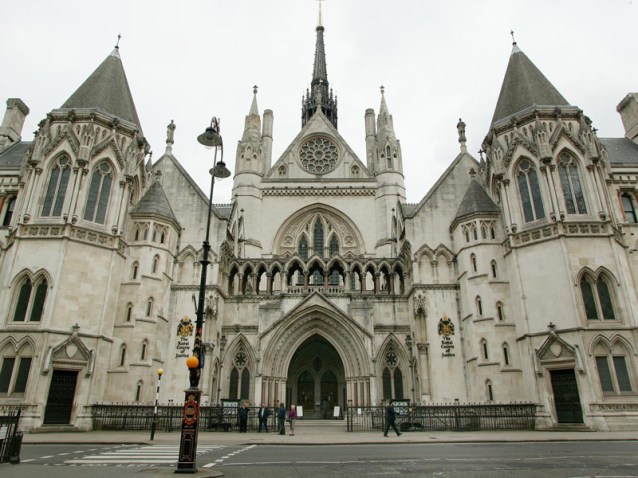
Royal Courts of Justice – time judges learnt about CEDAW

The report also insisted on widespread training for lawyers and public officials on what CEDAW means.

“That the Women’s Bill of Rights include a provision making it mandatory for members of the judiciary and magistracy at all levels to receive education and training on an initial and regular basis, including remaining up to date with CEDAW jurisprudence, and that this provision extend to all holders of public office, whether by appointment or election, in international, national and local bodies and authorities.”

This is a point I felt during the Court of Appeal hearing on the judicial review of women’s pensions that the judges did not seem to have a clue about CEDAW – and in my view this contributed to their decision to throw out the case.

It also makes it mandatory for every piece of legislation to have a gender impact assessment and for all government departments to have a gender impact assessment for every new policy they introduce. Since women are the majority in this country I would have thought that to be essential.

The report picked up that many women do not understand their rights because it is not presented in simple and clear language and the information is not available ( take the 50swomen case in informing women about the rise in the pension age for example).

The ” whole person ” approach to women’s rights and discrimination

There is also a failure to connect discrimination against women to other serious forms of discrimination. As the report said:

“The discrimination of women based on sex and gender is inextricably linked with other factors that affect women, such as race, ethnicity, religion or belief, health, status, age, class, caste and sexual orientation and gender identity. Discrimination on the basis of sex or gender may affect women belonging to such groups to a different degree or in different ways to men. States parties must legally recognize such intersecting forms of discrimination and their compounded negative impact on the women concerned and prohibit them.”

Where is particularly bad the report said the government should use “special measures” – specific legislation to address the problem – to end this inequality.

The report looked at major policy issues such as Brexit, climate change, the Covid 19 pandemic and the Windrush scandal and how they affected women.

It quoted evidence on how these separate issues impacted on each other. One passage read:

“The evidence further provided a snapshot view of the rise in hostility in the lead-up to, the confirmation of, and the continuing aftermath of Brexit. The Covid pandemic has exacerbated this, in that because Black and minoritised women (along with their male counterparts) have been in the forefront – both as doctors, nurses, healthcare workers and cleaning staff in hospitals, and suffering from being more susceptible to the virus – this has militated against their interests in the community, too – drawing racist attacks as if they are to blame because of that greater susceptibility”.

It tackled controversial issues such as migration, asylum seekers, women being detained in prison and made strong recommendations on how to deal with these issues. And it dealt with the lack of equal pay for women, and being forced by the partners into credit debts -coining the phrase ” sexually transmitted debt.”

” Sexually transmitted debt”

“This term, coined by lawyer Jenny Lawton and barrister Emma Swart recognises the position of women who, believing
their signature does not ‘count’ and under pressure that is difficult or impossible to counter, sign contracts – including mortgages and guarantees – at the behest of husband or partner, plunging them into debts they did not envisage, from which they do not profit, and which they did not wish to accumulate. Not infrequently, this occurs with the complicity, to a greater or lesser degree and even amounting to collusion, with banks or other financial providers.”

It also looked at faith marriages among the South Asian community which are not recognised by civil law and how they can lead to polygamous marriages, trafficking and women left with nothing in a divorce settlement.

This gives you an idea both of the breadth of issues covered by the tribunal and the need for widespread reform in many areas to give women full rights. And I haven’t touched on violence against women and domestic abuse.

This is truly a major document and a basis for major campaign to change the entire approach to women’s rights. Read it, digest it, and go forward and campaign for change.

UPDATED: CEDAW IN LAW goes to Downing Street to petition Boris Johnson to introduce a REAL Women’s Rights Bill

UPDATED: WITH FULL ROTHERS RADIO PROGRAMME ON CEDAW

Today a group of women from the CEDAW People’s Tribunal led by its president, former judge Dr Jocelynne Scutt went to Downing Street to petition the Prime Minister, Boris Johnson to introduce a comprehensive women’s rights bill.

This is the latest move in a campaign to persuade the government to implement the UN Convention to End All forms of Discrimination Against Women ratified by Margaret Thatcher as long ago as 1986.

It would pave the way for proper gender sensitive legislation and transform the rights of women still fighting for equal pay, equal treatment and better protection from, domestic violence, rape and abuse.

Above is a video now on You Tube of the event. I came along to report it for this blog

Dr Scutt was accompanied by four of the many legal assistants who helped the campaign. They are Katie Capstick, Pietra Asprou, Clara Guitau and Sara Vincezotti.

The event was organised by the steering committee involving Ann Fenner, Kris Gibson, Michaela Hawkins, Louise Matthews, Davina Lloyd and Joanne Welch.

One intriguing insight. The handing over of the petition was delayed a little as Boris Johnson, who was in residence, had to dash outside from No 10 to No 9 Downing Street. He was in the middle of the virtual G7 summit at the time with Afghanistan on his mind. No doubt once he got to see the petition it would remind him that there were also issues like women’s rights in the UK which are not going to go away either.

The next step shortly will be the publication of the report from the People’s Tribunal. There is also a radio interview with me, Joanna Welch and Davina Lloyd tonight who both organised the tribunal with the amazing help of human rights lawyers from Garden Court Chambers.

Ian Rothwell special programme on Salford City Radio

Special programme on BackTo60 and CEDAW; Interviews with Dr Davina Lloyd, chair of the CEDAW Tribunal Steering Committee; Joanne Welsh and myself talking about how the moves in Scotland and Wales are complementing the work of CEDAW. Press on the button below to hear the entire programme ( one hour)

Enjoy the programme and thanks to Ian Rothwell and Salford City Radio for allowing me to put it on my blog.

Marks and Spencer shamed: Sunday Mirror follows through my story of the 85 year old given a lifetime shopping ban

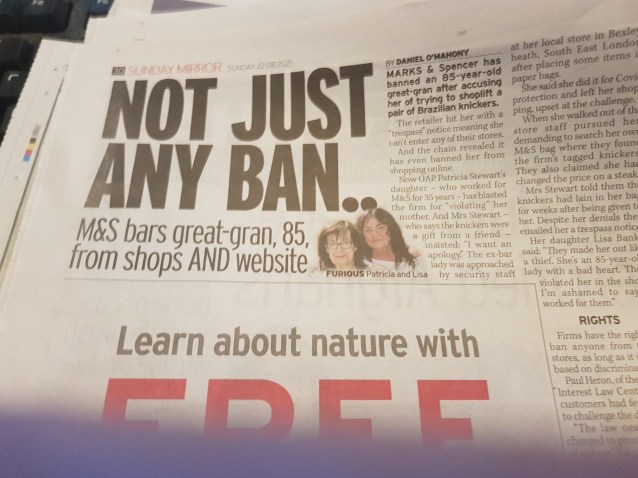
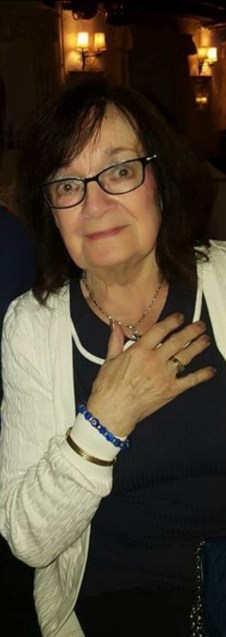
Sunday Mirror story on Patricia Stewart

Following my story on this blog on August 5 on the outrageous life time shopping ban given to a 85 year old Covid shielding woman by Marks and Spencer I decided it deserved wider publicity.

So I contacted the Sunday Mirror and I am delighted to say today’s paper includes a report of the incident and the ban.

Marks and Spencer did adopt an incredibly arrogant attitude in refusing to comment to me on why they justified the ban by ignoring my request as a journalist to the press office. I noticed when the Mirror rang they had to give a one line statement saying ” They cannot discuss individual cases. Excluding a customer is only done in rare circumstances.”

Patricia Stewart

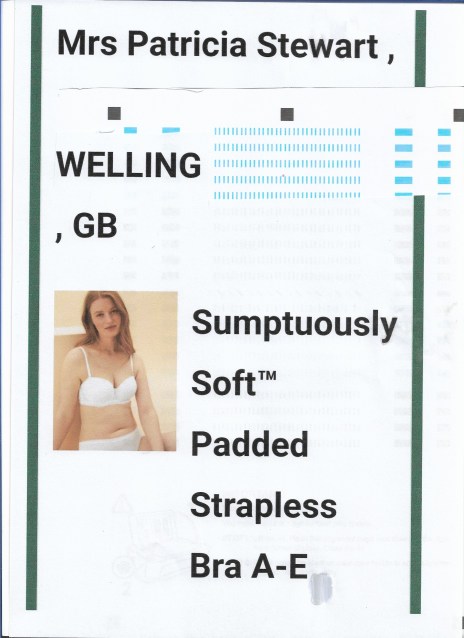
As I said in my previous blog Patricia Stewart was obviously confused going round their Bexleyheath store and left her shopping there. The manager and his colleague who followed her out of the store and searched her shopping bag then seized on a pair of Brazilian knickers without a receipt and ” presumed” it was stolen. This evidently is enough for M&S to ban her for life shopping with M&S ever again. Her explanation is that she intended to get them exchanged as they were a gift from a friend but she had forgotten to bring the receipt.

Trespass Orders

I also notice they won’t tell the Mirror how they enforce the ban. From a trial run by her relatives where she ordered stuff directly on line and visited three other M&S stores away from Bexleyheath, it looks like to me as meaningless outside Bexleyheath. There is an interesting thread here on the Legal Beagles website -which describes someone else being banned at M&S in Harrow, north London. The ban covered ” unusual behaviour”.

You can see from it the person got really worried. M&S seem to take a rather overbearing attitude to some of their customers. Either they should prosecute if it is shoplifting or offer to help if someone is confused

Exclusive: “Frightening” DWP letter to pensioners: Report for telephone interview or we can stop your pension

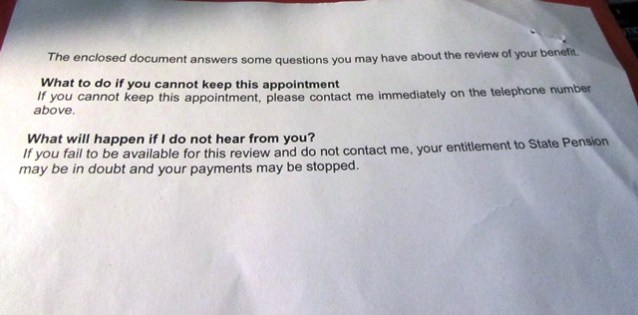
The ” frightening” DWP letter ( the telephone numbers of the pensioner and the official and his name have been blacked out

This a picture of the offending page 2 of the DWP letter

The headline in this story is a paraphrase of an extraordinary letter to be sent out to 15,000 people randomly chosen by the Department for Work and Pensions. Some 180 pensioners are being contacted this month.

The ministry has mounted an exercise to check fraud and error in payments for the state pension alongside universal credit, attendance allowance, PIPs, carer’s allowance, pension credit, housing benefit, and the employment and support allowance. It is run by the Performance Measurement Team. The ministry are asking people on other benefits to send them original documents showing their savings, pay slips, rent books and tenancy agreements.

It comes as the ministry faces a potentially damning report from a National Audit Office inquiry into the underpayment of state pensions to tens of thousands of women under the old state pension system replaced in 2016.

The NAO want to know how these mistakes occurred , what is being done to put them right and what lessons have been learnt. The NAO made it clear yesterday it had nothing to do with this exercise mounted by the DWP.

This also comes on top of a finding of “maladministration” by the Parliamentary Ombudsman over the ministry’s failure to inform 3.8 million 50swomen adequately about the rise in the pension age from 60 to 66.

The letter reproduced above is pretty insensitive to say the least – since it will be going to elderly people aged anywhere from 66 to their 80s and 90s.

Onus put on pensioners not the DWP

As you can see it puts the onus on pensioners to answer questions correctly-with the threat of prosecution or fines if they don’t.

” You have a personal responsibility to make sure all the information you give during the call is correct and complete.

If it isn’t and we pay you too much money you may have to pay the money back. You also risk being prosecuted or having to pay a financial penalty.”

But it gets worse. Under the heading What will happen if I do not hear from you it says:
If you fail to be available for this review and do not contact me, your entitlement to State Pension may be in doubt and your payments may be stopped. ( Bold type my emphasis).

This is “coercive and threatening language”- Rosie Brocklehurst

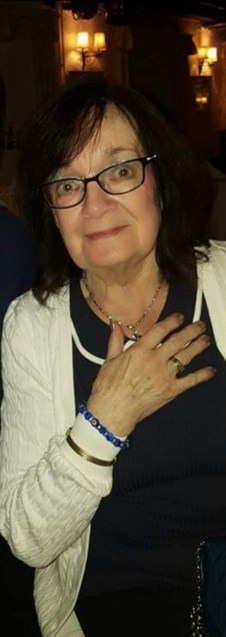
Pensioner Rosie Brocklehurst

Rosie Brocklehurst from St Leonards, is one who got the letter and contacted me.

She saId: “There could be 15000 terrified pensioners receiving this letter all of whom are being threatened with having their state pension. stopped if they do not “make themselves available.” This is abusive coercive and threatening language in my lexicon.”

She is 71.  She said: “The letter they send out is couched in language that is designed to frighten and certainly frightened me. I am not well and have had a chronic condition for 18 months. I have no other income but state pension and pension is not means tested. I am married and claim nothing else but my pension..”

Two points First you have to claim your pension but the calculations are done by the DWP. So if the figure is wrong it is not your responsibility, it is theirs and there is a history of the ministry getting things wrong.

The second is you are entitled to your pension. There is no way the DWP or anybody else can take it away from you. Whoever drafted that letter should have changed it for pensioners. I suspect that it may be illegal for the government to stop pension payments which they have already calculated. Certainly if the grounds are not agreeing to be interviewed.

I have contacted the DWP press office but they took over two days to reply. This is their reply;

“We urge people not to worry. We would only suspend payments in very specific circumstances such as where a pensioner has died and we are continuing payments.

“These reviews, introduced in 1997, take a sample of claims from across several benefits to help us identify cases where the department has paid the wrong amount.”

“The wording of our letters is kept under constant review.”

However what does it not say is that the state pension was exempt from all reviews since 1997. A decision to include it was taken in February this year. No explanation was given why the ministry suddenly decided to include it.

Labour’s devastating summer of appalling council by-election results

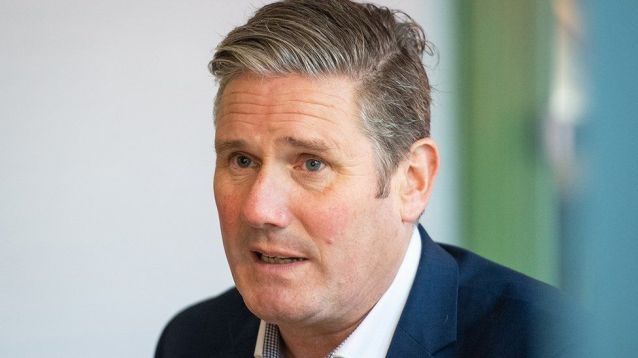
Sir Keir Starmer: Labour’s bad record in council by-elections

Council by election results are not always a guide to a party’s performance in a general election because local issues can determine how people vote. But they are a guide to how the most politically active think since the people who vote are likely to be those most interested their local community. They are also a guide to how each political party can get their vote out and are real results – not an opinion poll.

Whatever way you put it this summer- with a couple of exceptions- has been a disaster for Sir Keir’s Starmer’s new model Labour Party. As well as the high profile Parliamentary loss of Hartlepool to the Tories, only just holding on to Batley and Spen and the collapse of the Labour vote to the Lib Dems in Chesham and Amersham it is the local council by-election results that have been particularly bad.

Since this is against the background of a pretty incompetent Tory government facing allegations of corruption and mucking up people’s summer holiday arrangements by constantly changing the rules and causing confusion about what, if any, rules to follow to keep safe from Covid 19, it is no mean achievement for Labour to lose more electoral support.

The by-election results also show that underneath the serenity of a successful and well organised NHS vaccination programme the political scene is pretty volatile. Council seats that should have naturally stayed under the same party’s control are falling to other parties with enormous changes in vote share. The trouble is that in England and Scotland Labour is not the beneficiary. The exception is Wales. In the one Welsh by-election in the Rhondda, Labour did do well with the Tory share falling significantly.

The pattern that is emerging for Labour- from both the Midlands and the North- is that the Tories are consolidating the gains they made in 2019 and wooing the working class vote in once safe Labour areas. If this continues Labour under Starmer might lose more Parliamentary seats in a snap election in 2023 than Corbyn lost in 2019 and the Conservative Home dream list of scores of fresh Tory gains in Yorkshire , the North East, and the East and West Midlands become reality. In Yorkshire alone this means 11 seats could go.

Tories consolidating 2019 election gains

Examples of consolidation include Tory by-election wins from Labour in Grimsby, Bassetlaw and Sandwell and North East Lincolnshire. In Sandwell the Tory share of the vote was up 20 pc, the Labour share down 13.7 per cent. In Bassetlaw, the East Retford South seat saw the Labour share down 47 per cent and the Tory share up 25 per cent with the intervention of an Independent.

Even more concerning for Labour should be by-election results in Leicester, Harlow and Basildon. In Leicester Tories gained their first seat on the council with an 18 per cent rise in vote share while Labour slumped nearly 16 per cent. With the full council up for election next year, the Tories are hoping for large scale gains and possibly one of the city’s Parliamentary seats soon.

In Harlow and Basildon Tories took council seats in Labour areas like Pitsea in Basildon and Mark Hall in Harlow. The Labour vote share was down 16 pc in Basildon and Tories up nearly 15pc. In Basildon the Tory share was up 24 per cent enough to take the seat from Labour who kept a 41 per cent vote share. These new towns used to have Labour councils and Labour MPs like Hemel Hempstead in Hertfordshire. In Hemel there are now no Labour councillors.

Greens having remarkable results

The Tories are on the defensive in rural England and the South and West of England. But the main beneficiaries are the Liberal Democrats and the Greens. The Greens had a remarkable result in Somerset going from nowhere to 64.9 per cent vote share when the Liberal Democrats did not contest the seat. They held on to a seat in Staines just outside London, and gained seats in Aldeburgh in Suffolk and Mid Sussex from the Tories. In Aldeburgh they just pipped the Tories with a 26 per cent rise in vote share and in Balcombe, Mid Sussex they won a little more convincingly with a 13 per cent rise.

Lib Dems winning “safe” Tory council seats

The Liberal Democrats also did well winning seats from the Tories in Knaresborough, King’s Lynn, all with big swings in their vote share ( 28pc in King’s Lynn and 20 per cent in Knaresborough). In some seats the Labour vote switched to the Lib Dems, in other cases it remained steady but the Lib Dems leapfrogged Labour. The Lib Dems also took a seat from the Tories in Cobham in Dominic Raab’s Esher constituency with a 18.4 per cent rise in vote share. Labour did benefit on East Devon council when the voters switched to Labour when the Lib Dems did not stand winning a seat at Honiton.

In Scotland Labour lost a council seat to the SNP on West Lothian council, Vote share was down by nine per cent.

What does this all mean? Difficult to gauge from a clutch of by-election results, but it does suggest the electorate is particularly volatile and not necessarily enamoured with the Tories in rural areas. But it shows Labour has a long way to go.

The worst scenario would be if the Labour Party continued to haemorrhage votes to the Tories in the provincial cities and to the Greens and Liberal Democrats elsewhere. In the end the internal disputes could lead to the Socialist members permanently switching to the Greens and the moderate members switching to the Liberal Democrats. It would mean the end of Labour as a mainstream party. It hasn’t come to that yet, but could be unless Labour comes forward with a much more aggressive and thought provoking agenda.

Exclusive: How Marks and Spencer banned this 85 year old Covid shielding woman from shopping with them for life

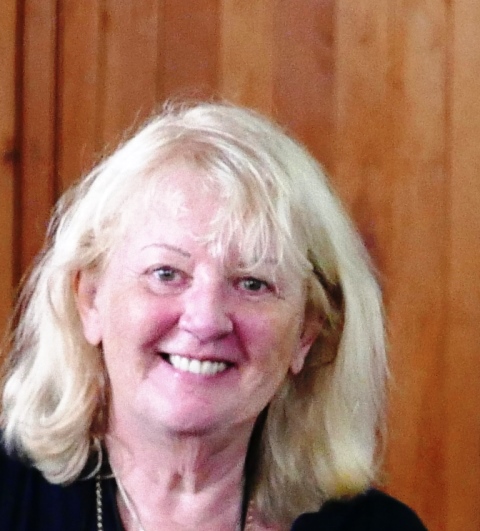
Patricia Stewart

This is Patricia Stewart an 85 year old woman. She spent the first five months of the lockdown shielding from Covid 19 as she is a vulnerable person. Last autumn during the period when the first lockdown was lifted she ventured out to shop for the first time. As a M&S customer for over 60 years she went to her favourite branch in Bexleyheath shopping mall. What happened next is hardly believable but raises a lot of civil liberties issues.

Patricia Stewart was nervous about going round a public store for the first time. She went to the customer services desk and exchanged a babywear item for a bra. She then went round the food hall but being worried about Covid starting putting packaged food items into plastic bags. This attracted the attention of a security guard who told her not to do this.

According to details released by M&S following a subject access request by her relatives he ” deemed it as shoplifting “. She was then followed by a male manager and female colleagues. Now feeling thoroughly uncomfortable she approached the till four times and then changed her mind and decided to leave the trolley full of shopping and go out of the store.

M&S Brazilian knickers- a smoking gun?

She was followed into the shopping mall by the manager and a female colleague and while she was sitting on a bench waiting for a taxi they challenged her in public and demanded her name and address She refused to give it to them so they proceeded to search her shopping bag. They found none of the food shopping but did discover a pair of M&S Brazilian knickers without a receipt. They claimed they had been watching her on CCTV and saw her change a label adding that a customer had also complained about her.

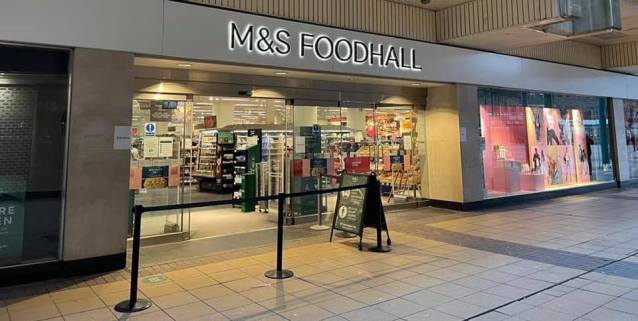
Marks and Spencer store in Bexleyheath. Pic credit: M&S Facebook page

They then proceeded to serve her with a ” trespass order” – a device used by many stores to keep out suspect shoplifters without going to court – not only from the Bexleyheath store but from any store in the country and on purchasing anything from M&S on line for the rest of their life.

The ban has been challenged by her two daughters who asked to see the CCTV and for evidence of the other customer’s complaint. When challenged M&S couldn’t provide the CCTV to prove their allegation because according to them ” it wasn’t recording properly”. Nor could they produce the customer who complained.

But M&S stuck to their story and have now ended any correspondence with them -pointing out they are not regulated by anybody and therefore nothing else can be done.

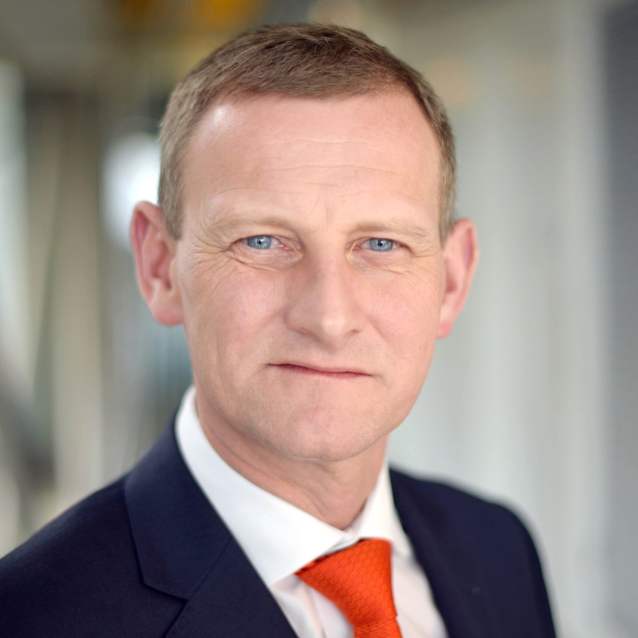
Steve Rowe, chief executive, Marks and Spencer

I decided to investigate this and approached M&S Corporate Press for comment. Six weeks after failing to reply to me I escalated my inquiry to Steve Rowe, chief executive of M&S, who has ignored my email. Therefore I can’t put their response.

There are two issues here which are connected. First of all the particular case and the use of trespass orders and secondly how they can be enforced. The retailer is allowed to use them because their store is private property. A search on the internet reveals they could be quite common – for example someone complained in Bristol about being banned by M&S. And nobody knows how they can be enforced – one theory which sounds too fanciful to me – is that M&S are secretly using facial recognition cameras in their stores. The other is that the M&S Sparks card – both offers you treats but is used as a surveillance card to monitor customers. Since M&S would not respond to my questions all this is speculation.

The Sparks card was used by M&S in this case as proof of her not purchasing the knickers – they revealed in an email that they have records of many of her purchases going back two years but insisted they had no personal file on her. But according to her the knickers were purchased by a friend as a gift – so they wouldn’t be on her purchase list.

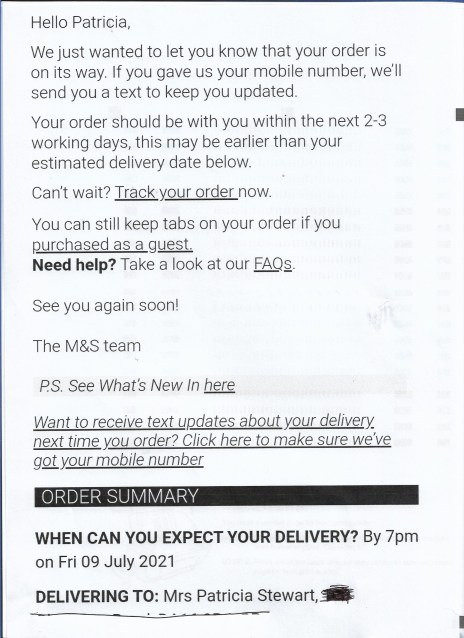
Failing to get a reply from M&S the relatives and I decided that we could test out the ban. First she decided to order a bra on line without using a Sparks card – and guess what she received a cheery note from the company telling them it was on its way and it was delivered last month. (see above)

She has since then shopped in three other M&S stores without any problem but has not returned to Bexleyheath.

This raises the question whether these ” trespass orders” can really be enforced or just used to intimidate people believing they can be banned. I would certainly have thought they would have to have an elaborate system to enforce them nationwide – that might be challenged by GDPR.

The other matter is a civil liberties issue – from what I have got from the subject access request – M&S would have had a flimsy case if they went to court. So why should they be judge and jury in deciding people’s individual liberties?

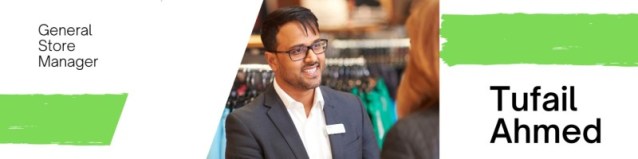
Tufail Ahmed, general manager of the Bexleyheath store. The store is the South East London Academy store, leading business initiatives and educating store teams across the region

According to their memos M&S believe their staff behaved with ” integrity” in banning her. Tufail Ahmed, the manager of the Bexleyheath store, who must be locally responsible for this, has a Linked In page in which he says:

 “M&S Manager of the Year 2018/2019. With nearly 20 years of retail experience working for leading retailers in various roles, I know that change is a very normal place in retail. I am now part of the change at M&S, leading and inspiring people to be the very best.

” My long term aim is to be an influential member of a business’ senior leadership team, that is what I am currently working towards.”

I suspect relatives of Patricia Stewart might beg to disagree.

As for Steve Rowe, who has built his entire career with M&S, his silence on the matter is deafening. He looks about the age to have elderly relatives, I wonder if he would like them to be treated like Patricia Stewart.

Dumped at 50? Disturbing figures as furlough comes to an end

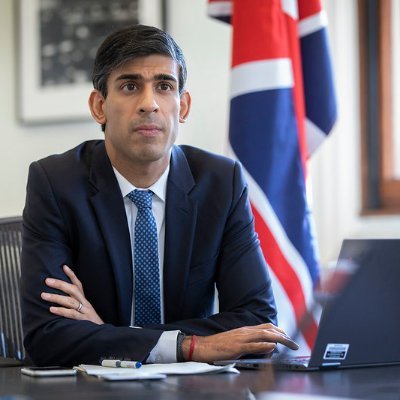
Rishi Sunak, will the furloughed over 50s ever get back to work?

On the day Chancellor Rishi Sunak cuts the support to companies using the furlough scheme to 60 per cent of the wages paid to the 1.9 million people still on furlough, some very disturbing figures are beginning to emerge on the make up of the numbers left.

Both the think tank Resolution Foundation and Rest Less report that it is the older generation rather than the young that are not getting called back to work.

While headlines have concentrated on the serious issue of the mental health of the young who cannot find work, official figures reveal a growing problem for the old.

HMRC data shows that younger workers have been leaving furlough most quickly, with the share of under 18 staff furloughed falling from 13 per cent in May to 7 per cent in June, and from 10 to 6 per cent for those aged 18-24. One-in-ten workers aged 65 and over were on furlough – the highest share of any age group. The Foundation has warned of older workers being ‘parked’ on furlough as younger workers return to work as hospitality reopens.

London remains the furlough capital of Britain, with nine of the ten local authorities with the highest furlough rates in the capital, including Newham and Hounslow where around one-in-eight workers are still on the Job Retention Scheme.

Rest Less, a digital community and advocate for the over 50s, analysed Coronavirus Job Retention Scheme (CJRS) Statistics issued by the government on 29 July and found that the total number of furloughed jobs fell from 2.4 million to 1.9 million between May and June* – a fall of 590,000.

Proportion of over 50s furloughed is rising

Whilst the number of furloughed roles fell across all age groups, the proportion of over 50s on furlough has been steadily increasing this year, rising from 27% in January to 34% in June. In contrast, the proportion of under 30s on furlough fell from 29% to 21% in the same time period.

Both sets of figures show that those over 50 are going to find it harder to get a job and build up enough years to claim a full state pension between the age of 50 and 666 or 67 when they can claim the state pension. Being out of work also means that they won’t qualify for a second work based pension either – possibly forcing them to have to claim pension credit if they can.

Charlie McCurdy, Economist at the Resolution Foundation, said:

“The number of furloughed employees has fallen below two million for the first time as the economy continues to reopen. But that is higher than many expected, and a cause for concern as the scheme is wound down.”

Fresh wave of redundancies

Stuart Lewis, Founder of Rest Less, commented: “The country is reopening, and the total number of people on furlough is falling quickly – by three million since the beginning of the year.  However, the recovery is clearly not working for everyone, with more than 630,000 people aged over 50 still on furlough and waiting to find out if they have a job to go back to.  This is in addition to the 568,000 over 50s claiming job seeking or out of work benefits. 

When the furlough scheme draws to a close next month, we’re expecting it to be accompanied by a fresh wave of redundancies and another spike in unemployment levels – delivering another blow to workers in their 50s and 60s.


Faced with significant age discrimination in the recruitment process, and no Government equivalent to the Kickstart scheme for older workers – the implications of redundancy for workers in their late 50s or early 60s can be significant.

‘Once made redundant, workers over the age of 50 are two and a half times as likely to be in long term unemployment than their younger counterparts. Rather than being able to top up their pensions in those crucial years before retirement, many will find themselves having to dip into what pension savings they do have – leading to a significant drop in long term retirement income for decades to come.”

Yet the government seems obsessed with continuing to raise the pension age when it is becoming clear that the old generation are facing the greatest difficulty in getting jobs. A new generation will be living in poverty with failing health and that poverty will not end when they eventually get their pension.

Damning inquiry report reveals 40 years of horrendous child sexual abuse and racism by Lambeth Council in London

Lambeth Town Hall

The independent Inquiry into Child Sexual Abuse today published its worst ever findings of the scale of child sexual abuse in the United Kingdom. It looks like large numbers of paedophiles got away with the mass sexual abuse of children.

An investigation into Lambeth Council’s children in care revealed that over 700 children had alleged they had been sexually abused and treated as worthless by council staff. And this is certainly an underestimate. The scandal continued from the 1960s right through to the late 1990s.

The report which only looked at five of the council’s closed homes makes incredibly grim reading. The report said:

Cruelty and sexual abuse ” hard to comprehend”

“It is hard to comprehend the cruelty and sexual abuse inflicted on children in the care of Lambeth Council over many years, by staff, by foster carers and their families, and by volunteers in residential settings. With one or two exceptions, a succession of elected members and senior professionals ought to have been held accountable for allowing this to happen, either by their active commission or complicit omission. Lambeth Council was only able to identify one senior Council employee, over the course of 40 years, who was disciplined for their part in this catalogue of sexual abuse.”

It goes on: “By June 2020, Lambeth Council was aware of 705 former residents of three children’s homes in this investigation (Shirley Oaks, South Vale and Angell Road) who have made complaints of sexual abuse. The biggest of these homes – Shirley Oaks – was the subject of allegations against 177 members of staff or individuals connected with the home, involving at least 529 former residents. It was closed in 1983.

“Frontline staff employed to care for these most vulnerable children frequently failed to take action when they knew about sexual abuse. In so many cases they showed little warmth or compassion towards the child victims, who were left to cope with the trauma of their abuse on their own. 

Hostile and abusive treatment of black children

…”There were many black children in Lambeth Council’s care. In Shirley Oaks in 1980, 57 percent of children in its care were black. During 1990 and 1991, 85 percent of children who lived at South Vale were black. Racism was evident in their hostile and abusive treatment by some staff.

” Shirley Oaks and South Vale were brutal places where violence and sexual assault were allowed to flourish. Angell Road systematically exposed children (including those under the age of five years) to sexual abuse. 

“Nor did foster care routinely provide a safe alternative for children in care. For many years, foster carers were not adequately vetted by the Council and were not the subject of criminal record checks.”

Some of the cases described are horrendous.

Children screaming at night while they were raped

“LA-A307 was taken to Shirley Oaks at the age of nine. He described hearing other children screaming at night and he himself routinely experienced violence and sexual assault, including being photographed whilst being raped.

LA-A147 was in the care of Lambeth Council in the 1990s and 2000s, from the age of three. Over ten years, she was placed in nine children’s homes and with four sets of foster carers. She described being raped by a foster carer’s teenage son at the age of nine, and was also frequently sexually abused by older men she met whilst in care. By the age of 13, she had developed a drug addiction and was “selling herself” to fund it.

LA-A2 was found dead in a bathroom at Shirley Oaks in 1977. Lambeth Council did not inform the coroner that he had alleged being sexually abused by Donald Hosegood, his ‘house father’. In the course of Hosegood’s employment at Shirley Oaks, six out of eight children looked after by him and his wife alleged sexual abuse by him.

LA-A7 described sexual abuse by three male members of staff, including two from South Vale. Two of them separately photographed him at their private homes when he was either naked or wearing only his underwear. One of them, Leslie Paul, was convicted of indecent assaults against LA-A7.”

Only six perpetrators prosecuted

Extraordinarily just SIX people have been successfully prosecuted by the police, meaning that hundreds of people must have got away with the vile sexual abuse of children.

All this took place against a background of fraud, corruption, racism, nepotism by both staff and some councillors. Those who tried to stop it were intimidated and threatened. The report shows even two chief executives, Herman Ouseley and Henry Gilby were the subject of intimidation.

Lord Ouseley – staff bugged his home and office when he was chief executive and his family was threatened

“Lord Ouseley described how both his office and home were ‘bugged’ at the instigation of one of his own staff. He also received threats to his family. Mr Gilby’s office was the subject of a serious arson attack. His home and office were broken into and computer records were stolen during a time when he was attempting to deal with corrupt practices. Dame Heather Rabbatts was Chief Executive from 1995 to 2000. She described how she inherited a Council with a culture of “fear and sexism and racism”. No witness identified which individuals or groups were the driving force behind this vicious and regressive culture, but there was little doubt that a succession of leading elected members were mainly responsible, aided and abetted in some instances by self-serving senior officials.”

The inquiry has decided to ask the Met Police to investigate whether there are grounds for a criminal investigation into Lambeth Council’s actions when providing information to the coroner about the circumstances surrounding LA-A2’s death.

Richard Scorer, specialist abuse lawyer at Slater and Gordon, who is representing the sister of a teenage boy who killed himself in a care home after making allegations of abuse against staff member Donald Hosegood, told Mail On Line: ‘It is clear from today’s report that Lambeth Council deliberately withheld information from the coroner in order to give the impression that our client’s brother was happy in care.”

All in all this report shows why it was necessary to have a full scale inquiry into child sexual abuse – which despite naysayers trying to deny the extent of the problem – was obviously rampant in some parts of the country. The council has apologised .The real tragedy is that so many people have got away with it leaving their victims with broken lives.

The “systemic maladministration ” facing the disabled applying for Personal Independence Payments -official findings

Margaret Kelly Northern Ireland Ombudsman

Northern Ireland ministry and Capita under fire

An absolutely damning report has been issued by Margaret Kelly, the Northern Ireland Ombudsman on the way hundreds of thousands of disabled people between the ages of 16 and 64 are assessed to see if they qualify for personal independence payments.

This two year investigation into the benefit is the first made by the Ombudsman using new powers under Northern Ireland legislation giving their Ombudsman the power to initiate inquiries if the Ombudsman thinks something is going wrong. This type of inquiry would be illegal in England, Scotland and Wales because Ombudsman do not have the same powers.

In Westminster Michael Gove, the Cabinet Office minister, is currently refusing to even introduce draft legislation to give Rob Behrens, the Parliamentary and Health Service Ombudsman. similar powers to start his own inquiries.

The findings apply to the 250,580 people who applied for the benefit in Northern Ireland but as the NI Ombudsman’s Office says ” there are many similarities to PIP across other parts of the UK.”

The report – which examined 100 cases in minute detail, made extensive inquiries of the ministry and Capita, and looked at statistics governing appeals concludes there has been ” systematic maladministration” by the Northern Ireland Department for Communities and Capita, who were administering the assessments.

Not “one off mistakes”

The report says these were not one off mistakes. Instead she” identified repeated failures which are likely to reoccur if left unremedied. It is therefore my view that there is more work to be done to improve the experience and outcomes for claimants, the robustness of decision making and public confidence in the system.”

She has made some 33 recommendations and has given the ministry and Capita six months to rectify them. She can’t compel the ministry to implement them but has said she will do a follow up report to see what they have done. The report also went to members of the Northern Ireland Assembly.

Ms Kelly said:
“Too many people have had their claims for PIP unfairly rejected, and then found themselves having to challenge that decision, often ‘in the dark’, and on multiple occasions, while not knowing what evidence has been requested and relied upon to assess their entitlement.

” Both Capita and the Department need to shift their focus to ensure that they get more of the PIP benefit decisions right the first time, so that the most vulnerable people in our society get access to the support that they need, when they need it. Furthermore, it will safeguard public resources by reducing both the time and costs associated with examining the same claim on multiple occasions.”

The report reveals a serious lack of leadership and guidance from the ministry, poor communication with claimants and a failure to get key additional medical information which would have helped them get the benefit. As a result many of them had their applications turned down only to appeal and get the benefit – at a cost of some £14m to the taxpayer. If the ministry and Capita had got the information in the first place there would have not have been the need for an appeal.

Capita had an incentive NOT to get further medical information to help claimants

She also discovered that disability assessors working for Capita had a perverse incentive NOT to get additional information to help the claimant because they would get a bonus if they completed the application quicker and getting extra information slowed down the process.

Capita were also criticised for poor communications with health professionals as well as claimants. When evidence was requested from Health Professionals named by the claimant, the request letters sent by Capita were often poorly completed and did not specify what information was sought.

In face to face assessments, the evidence from the consultations was often the primary and in some cases the only source of evidence relied upon by the Disability Assessors when providing their advice to the Department.

I came across this report because of a link to my blog from UKAJI, the United Kingdom Administrative Justice Unit, who have reviewed the long report. Their article is here.

I concur with their review which was impressed with the high standard of the research and the bar it set for future Ombudsman investigations.

To my mind this again shows the current weakness of the Parliamentary Ombudsman in Westminster. The present Ombudsman can only investigate complaints and therefore is left with a much narrower remit. By having powers to do a broad ranging investigation, much more detail can be investigated and issues that governments don’t want to address can be highlighted. Hence the conclusion in this report that the disabled have been subject not just to maladministration but ” systemic maladministration”. I bet disabled claimants are similarly treated in the rest of the UK but nobody has the resources to properly investigate their poor treatment. Let’s see what happens in Northern Ireland following this devastating report.