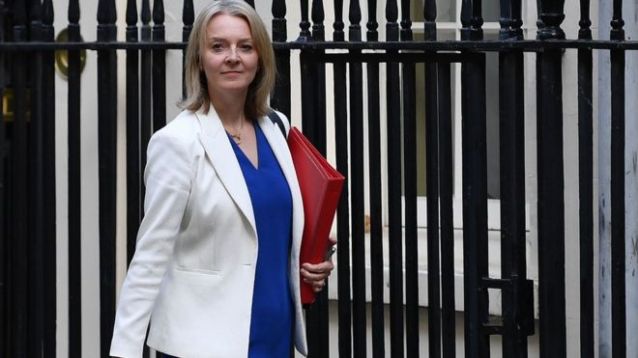
We are now getting used to Boris Johnson’s blustering empty slogans on current problems – whether it’s Covid 19 or Brexit. What I hadn’t realised until today it is obviously standard Cabinet speak for this government – as Liz Truss, the international trade secretary and women and equalities minister, has just done the same.
Her much trailed speech at the Centre for Policy Studies was full of crowd pleasing right wing jibes bashing the Left and talking of so called unrepresentative groups campaigning for black and ethnic minorities, gays and women but getting nowhere.
But when it came to what she wanted to offer it was pretty thin gruel. She is moving the Equalities Hub from London to the North and asking the Social Mobility Commission to research the geographical disparities across the country. Wow!
motherhood and apple pie
And some of the speech read – forgive me for being sexist – like ” motherhood and apple pie”.
“Now is the time to root the equality debate in the real concerns people face, delivering quality housing, cutting commute times, improving public transport, ending discrimination in our offices, factories and shop floors, and improving our schools so every child has the same chances in life,” she opined.
Politicians have been spouting these platitudes for decades. No one is going to stand on a platform of let’s build a new generation of slums, slash public transport and cut school budgets – even if the result of some policies -under Tory governments- has been to do this.
The truth is we already know what has happened to the North and the South West without any more research. I know having looked at life expectancy figures that people in posh Kensington live much longer than those in Blackpool. I have been to Sunderland and Skelmersdale and seen the narrow life chances of people who live there. And by the way if the Tories are so worried about the North- why did both places miss out on Robert Jenrick’s largesse in his town fund scheme- in favour of Cheadle and Southport ( both Tory marginal seats unlike the former two).
Rugged individualism
It is what she going to do about this that matters. Her solution seems to be that rugged individualism will solve the lot and miraculously lift the masses out of years of deprivation. Yet to have a big impact it has to be a big partnership involving local councils, communities and diverse interest groups. She seems to suggest that one compartmentalises equality -looking at social and economic class – and ignoring whether they are black, gay, women or white working class males. In a bizarre sort of way her analysis is almost Marxist – though she would be a million miles away from his solution.
She also doesn’t seem to know that she already possesses the power to do this under the Equality Act.
One reaction from Nell Andrew, GMB National Equality and Inclusion Officer ( no doubt one of those Lefties she doesn’t like) was:
“If Liz Truss is serious in her ‘new fight for fairness’, she could start by enacting Section 1 of the Equality Act that was passed in Parliament 10 years ago and which successive Tory administrations have refused to act on. This would force public institutions to adopt effective polices to reduce the inequalities that result from class or socio-economic barriers.
“A drastic move away from recognising peoples lived experience, ignoring qualitive evidence, is a dangerous use of smoke and mirrors to attack equality and human rights legislation.
“All major equality and employment laws came about because of workers and communities organising around issues like racism, sexism and homophobia; fighting for more equal rights for everyone. “
Dr Meghan Campbell from the Oxford Human Rights Hub
fracturing equality
Dr Meghan Campbell, Deputy-Director of the Oxford Human Rights Hub, and an expert on the UN Convention on the Elimination of All Forms of Discrimination Against Women,(CEDAW) put it this way:
“Today’s statement appears to fracture equality between identity characteristics (race, gender etc) and socio-economic equality. The water-tight division between different types of equality is both misleading and highly strained. There are complex interactions between race, gender, disability, migration status, geography, religion, sexual orientation, gender identity and poverty. Historically marginalised groups have higher rates of poverty and political and social exclusion. “
“While there are some encouraging aspects focusing in on geographic equality and poverty, but these should not be pitted against race or gender equality as equality is not a zero-sum game.
” Poverty cannot be fully addressed without transforming the institutions and norms that perpetuate poverty against women and people of colour. The statement seems to be moving back to a very individualised vision of equality that ignores how larger structures, norms and institutions can trap people into disadvantage. “
So I am not impressed. If I am very cynical just a week ago she as equalities minister got advance warning that the UN CEDAW committee in Geneva has decided to seek the UK’s response on discrimination in relation to women as the Supreme Court decides whether to hear the Back To 60 pension discrimination case. I wonder if this among other matters prompted her rushed public response.
Peers accepted last week a highly critical report from the House of Lords Conduct Committee, chaired by Lord Mance, a former Supreme Court judge, that the peer was guilty of ” bullying” and” harassment” of a security guard and of ” homophobic ” attacks on two gay MPs.
The peer believes he is the subject of persecution by Stonewall because he opposes same sex marriage and even accused Lucy Scott-Moncrieff, the Lords Commissioner for Standards, as biased against him because she supported Out4Marriage a charity that supports gay marriage. She has made it clear that this did not influence her judgement one jot.
Lord Maginnis of Drumglass , a former Ulster Unionist MP who sat as an Independent, had a row with a security guard, Christian Bombolo, when he forgot his security pass and demanded to be let into Parliament without one. The exchange became so toxic that an MP who witnessed the incident, Hannah Bardell, SNP MP for Livingston, intervened only to be attacked by the peer using homophobic language.
Like Pollard MP : Pic credit: Twitter
The second incident happened at a meeting of the Armed Forces All Party Parliamentary Group which was chaired by Luke Pollard, Labour MP for Plymouth, Sutton. The dinner meeting broke up before Lord Maginnis could ask his question and he blamed Luke Pollard for this.
The report says: “Later in the evening Lord Maginnis sent an email to James Gray MP (the Chair of the APPG), copied to a number of other parliamentarians and to my office, with the subject heading “Discrimination by Homos”.
“Mr Gray replied saying the Mr Gray replied describing Lord Maginnis’s conduct at the meeting and the content of his email as “completely and utterly unacceptable”.
He requested that Lord Maginnis withdraw his remarks and apologise, without which he would not be welcome at any future APPG events.
Lord Maginnis replied that Mr Pollard was “obviously part of the ongoing campaign against me because of MY views on the matter relating to the Cameron initiative [same-sex marriage]” and that he was “getting somewhat irked by being discriminated against so, as for any apology, forget it!”
But Lord Maginnis attended the next meeting which led to another complaint being lodged by Toby Perkins, Labour MP for Chesterfield, who was also a member of the group.
“Unapologetically homophobic and aggressive “
The report says: “Before the meeting began, he saw Lord Maginnis in conversation with James Gray MP. He later understood that Mr Gray had told Lord Maginnis he could not attend the event due to his previous conduct towards Luke Pollard. “According to Mr Perkins, Lord Maginnis “quickly responded aggressively refusing to leave and implying that the Chair would have to physically remove him”. He overheard Lord Maginnis saying “I am not going to be bullied by queers.” Mr Perkins said that Lord Maginnis’s “entire tone was unapologetically homophobic, aggressive and disrespectful”.
“It made me feel that it was not a safe environment for—I mean, particularly for people who were gay, but I think there is a sense to which we are all conditioned and harassed by the sense that we’re not all free to be at an event like that. So both the sort of the tone of the remarks and the content of them, I think, was upsetting.”
Maginnis refused to accept finding
Lord Maginnis refused to accept he had done anything wrong but said part of his behaviour was because he was a type 2 diabetic with arthritis and often in pain and had difficulty with his hearing.
This is yet another peer who seems to think that bullying and harassment and his case homophobic views are quite acceptable. While I am sure that most peers do know how to behave, it looks as though a small minority are still clinging on to outdated views and remarkably aggressive behaviour.
As Luke Pollard says in the report that he was “shocked and surprised that this type of behaviour would happen within Westminster”. “While he did not consider Lord Maginnis’s behaviour during the dinner to be acceptable, it was his remarks in the later email chain he had found most offensive. He said those emails made him feel like a “victim of abuse”.
The now decommissioned Bradwell nuclear power station – the first one to be safeguarded
Full report on the scandal still not published as top officials try to avoid blame for the fiasco
Just over two years ago this site carried a blog post with Byline Times on one of the biggest and most incompetent contracts ever made in Whitehall by the Nuclear Decommissioning Authority.(NDA) The £6.2 billion contract to the Texas company Cavendish Fluor Partnerships ended up in the courts where it was successfully challenged by rivals Energy Solutions including Bechtel who won £97m compensation on the grounds that the contract had been awarded illegally.
The contract was to clean up and make safe 10 ageing Magnox nuclear power stations and two research facilities at enormous cost to the taxpayer. It is part of a long term decommissioning programme which will eventually cost the taxpayer a staggering £132 billion and not be finally completed until 2140 long after anybody reading this ( and me) will have died.
At the time Sir Amyas Morse, then comptroller and auditor general , said “The NDA’s fundamental failures in the Magnox contract procurement raise serious questions about its understanding of procurement regulations; its ability to manage large, complex procurements; and why the errors detected by the High Court judgement were not identified earlier.”
Not a pretty picture
Now two years on the National Audit Office and MPs on the Public Accounts Committee have looked at what has happened. And the saga is continuing with not altogether a pretty picture. And the final report was held up by legal action from the NDA’s former senior management team.
The result of the first court case meant that the NDA shortened the contract and it finished last year.
The cost of doing this was to ratchet up another £20 million bill for the taxpayer to avoid yet more litigation this time from the contractor. This took the extra cost to the taxpayer to £140m.
Then the cost of the whole project of decommissioning the power stations has gone up yet again. From an estimated £6.2 billion to anything from £6.9 billion to £8.7 billion. The reason is that the Nuclear Decommissioning Authority don’t know the real state of all the sites. And it is obvious that there is a huge amount asbestos on the sites are a major problems.
And they haven’t been very good at making sure the contractor did a good good job. One defective performance notice on Bradwell nuclear power station had to be issued three times before it was correct- and then it was too late as it came during the month the contract finished. In the end the contractor agreed a post contract payment cutting £2.98 million from its bill. Bradwell was the first to move to a ” care and maintenance ” contract in 2018.
Management has been strengthened since the fiasco with new people brought in. New state companies have been set up to deal with decommissioning. But we won’t know the complete story of the debacle until the final report from Steve Holliday, the former head of the national grid, reveals what happened and who is to blame.
He has issued a bland interim report but publication of the final report was hit by yet more legal action.
Inquiry chief insists he will investigate top management and ministers
Mr Holliday concludes in his interim report: “
“I will further investigate whether the actions of individuals within the NDA , and those of government officials and ministers, were consistent with the standards expected of them, including relevant codes of conduct. “I will continue to investigate whether decision makers (individuals, including government officials and ministers or boards) had the necessary information to make those decisions and, if not, why not. This will cover decision making at all stages of the matters covered by the terms of reference, including the procurement, the litigation and the matters leading to the termination for convenience.”
This led to five officials – John Clarke. the former NDA chief executive; Stephen Henwood, the former chairman; Robert Higgins, the former head of legal services; Mr Graeme Rankin, former head of competition and Mr Sean Balmer, former commercial director, to go to court to seek a judicial review into Mr Holliday’s inquiry.
Each had been notified they could be subject to criticism by Mr Holliday and were alarmed it could affect their reputations and livelihoods.
They claimed they had all had their human rights breached by Mr Holliday unlawfully delegating work and criticisms of them to his staff; hadn’t disclosed all the material to them and prevented them from sharing information while making representations to him.
Judicial review dismissed
On Christmas Eve last year the judge Mr Justice Murray dismissed the ” arguable” case over the delegation of work and all the other grounds. It was pointed out that there are 2.5 million documents in the case and Mr Holliday could hardly be expected to read every one.
The result is that we still have no final report nearly a year after the court decision suggesting that wrangling is still continuing. As MPs on the public accounts committee point out :”Implementing the recommendations of the Holliday inquiry into the Magnox contract and the Department’s ‘Tailored Review’ of the role of the NDA will be critical and the publication of these reports cannot come soon enough.”
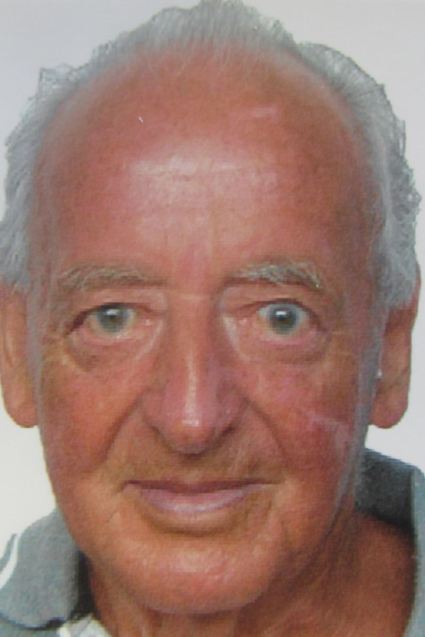
Indefatigable campaigner: Stan Williams,. deputy mayor Lyme Regis council
A quirky tale of campaigning pensioners exposing dodgy council dealings in a quaint old English seaside resort
This is a story of two extraordinary 85 year old campaigning pensioners. For 40 years have fought their local council over a dodgy land deal in a quaint Dorset seaside town and so far literally hit a brick wall.
It is happening in the unlikely place of Lyme Regis. The family holiday town, home to numerous bed and breakfasts, and with its iconic Cobb on the marina immortalised by the famous English novelist ,John Fowles in The French Lieutenants Woman ( later as a film with Meryl Streep) is not seen as a hotbed of intrigue.
But behind the public image of Olde English teashops lies a dark story that involves questionable dealings, dubious planning applications. illegal blocking of a public eight of way, secret deals over cream teas, fake entries put into Land Registry records, information hidden by local worthies, and threats to people who tried to find out what was going on.
The characters would not be out of place in a novel or could appear in a West Country version of Last of the Summer Wine. One, Stan Williams, is deputy mayor of Lyme Regis, now 85, and one of the longest serving councillors. The other, Nigel Marsh ,also 85, is probably regarded by officialdom as a local busy body questioning local decisions. Yet the two have combined to try and solve a land deal that has been festering for 40 years and still the town council won’t come clean.
The Cliff House mudslide that made 14 people homeless
The catalyst for the scandal took place almost 60 years ago. According toa paper by Richard Bull on the history of Lyme’s sea defences in the Lyme Regis museum the local council gave permission to property developer Edward Keen to build 20 bungalows and flats on unstable land prone to mudslides above Marine Parade. He excavated 50,000 tonnes of soil.
The book says: ” On..12th February 1962, only a few days after the excavation was completed, movement was noticed, with cracking and heaving in some nearby houses. Movements continued through the evening and by 9 pm the whole slope failed. Cliff House, which was standing empty, moved 3.2m nearer the sea and was back-tilted and ruined. Sunnydene Guest House caved in, and three other houses were left at crazy angles. Other houses were extensively damaged and 14 people made homeless. Above Cliff House a large back-scar appeared at the top of the slip plane or shear, cutting Stile Lane.”
Even after this the town clerk, Harry Williams was reported in the Daily Sketch as saying, … that the development project will eventually completely stabilise … the site…and, as far as the Borough Council knew, work could continue to excavate soil from the site.” This bloody mindedness was to be repeated by successor town clerks.
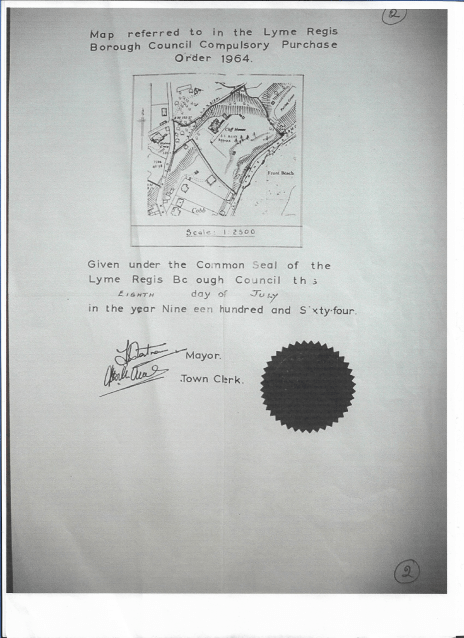
1964 compulsory purchase order
The developer aborted the plan and council put in a compulsory purchase order for the land in 1964 and have created a pleasant public gardens on the site of the now demolished Cliff House.
What was saved was the gardeners cottage called Cliff Cottage which was jacked up and restored. As the Lyme Regis book says: “Cliff Cottage, which still stands …was miraculously jacked up back to true from a drunken angle, leaning into the landslip scar, using dozens of hydraulic car jacks and quickly concreted in after use.”
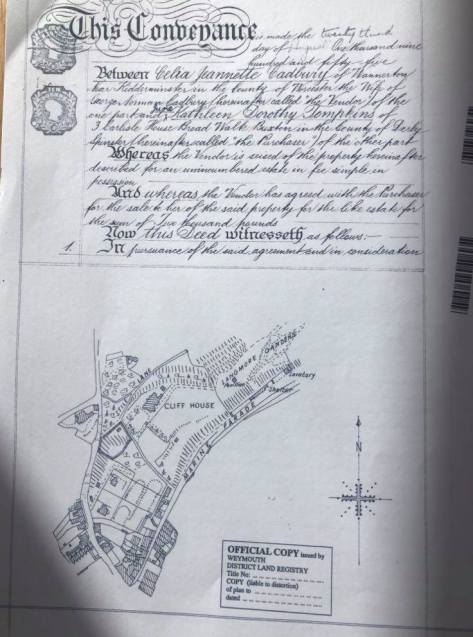
The Cadbury conveyance
The Cadbury chocolate dynasty connection
The property had been owned by Celia Jeannette Cadbury who married into the famous Cadbury chocolate dynasty. Her husband George ran an electrical engineering business in West Bromwich. She lived in Kidderminster which suggests the property was a holiday home.
She sold the property to Kathleen Dorothy Tompkins in 1955. A splendid deed of conveyence exists in Dorchester Archives with a map of the land.
In 1980 the rebuilt property changes ownership to Marilyn Bolton, then a formidable local councillor. There is no record of the price paid in the Land Registry entry and the property transaction appears to have taken place without a plan of the land. The solicitors were a respected local firm Kitson and Trotman who are also the council’s solicitors.
It is then that a series of events happened. First an old garage next to the cottage was replaced with a tearoom and then an extended high class restaurant was built with a terrace overlooking the new public gardens. The restaurant is now managed by celebrity chef, Mark Hix – see my previous blog here.
My own investigations of what happened next revealed that this new development was carried out illegally with the council’s connivance who then tried to cover it up what had happened until it couldn’t any more – including a false declaration to the Land Registry and the illegal removal of a right of way.
Merry Bolton, now an ex councillor in her 70s, told me of a meeting with a former town clerk, Mr Robin Munday.
cream tea deal
Over a cream tea with him in 1985 she said: ” We looked at the land next to the cottage and agreed that the boundary should be a line of trees. At the time the land was a mess after the upheaval so it wasn’t clear where it was.”
His successor Mike Lewis duly registered the boundary with the land registry allowing her to encroach on the council land covered by the compulsory purchase order. He was later challenged by both Nigel Marsh and councillor Stan Williams and promised to change it but never did.
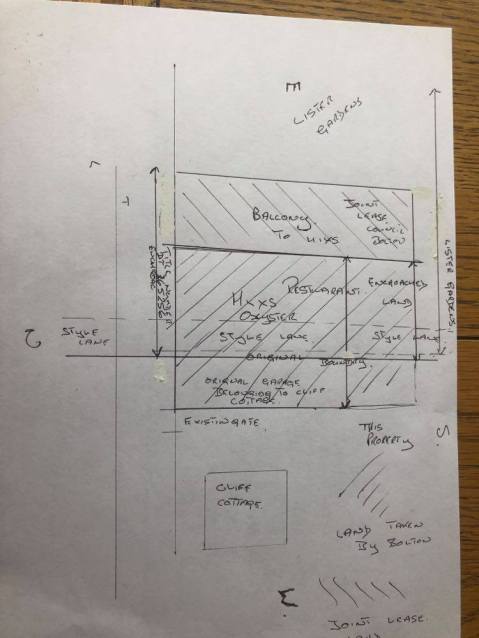
It was her two planning applications in 2006 to turn the tea room into an extended restaurant that caused the biggest stir. The tea room already obstructed a public footpath called Stiles Lane which is illegal but the new planning application encroached on to the council land. At the same time she never applied to either divert or extinguish the public right of way.
Plans for restuarant showing the encroachment on council land and the old right of way
Dorset council have confirmed to me that is the case. The told me:
“We can confirm that Footpath W2/12 from Pound Street to Marine Parade in Lyme Regis is obstructed by a number of buildings and landscaping works carried out over many years to re-profile the area following landslips and the creation of Langmoor Gardens.
“The Highway Authority has powers to enforce an obstruction of the public’s right of free passage over a public highway, but there is an alternative route, which is safer and more commodious for the public. Therefore, this is a considered to be a low priority for already stretched public funds.
“When planning permission was granted to extend the building that is currently obstructing the footpath, this did not give permission to obstruct the footpath. The applicant was advised to apply to divert the footpath by legal order and that this order must be confirmed before work commenced. We do not believe that West Dorset District Council received such an application.”
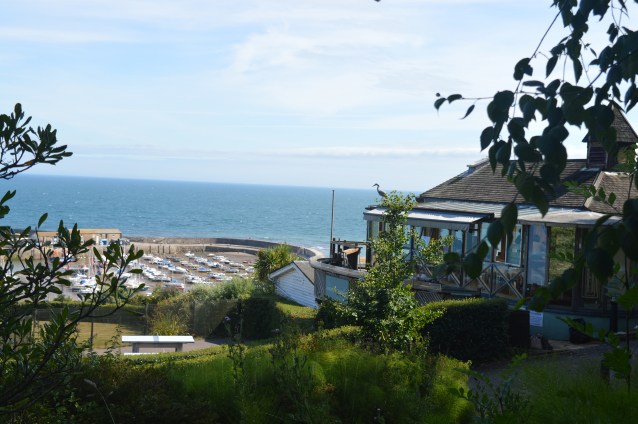
Gorgeous view of Lyme from restuarant
In 2009 after the restaurant had been extended the row led to the appointment by the council of a distinguished boundary demarcation expert David Powell. His report, which I have seen, came down firmly that the former councillor had encroached on council land. He suggested calling in the lawyers to sort it out.
But neither the council nor Ms Bolton agreed. She wrote to Mike Lewis on 2 November 2009 ” We are anxious as the Town Council to avoid expensive and pointless litigation, which will make both the experts and the lawyers rich, but leave the parties to the dispute the poorer”.
What followed was a rewriting of the council’s entry to the land registry to create a retrospective lease on the council land to the restaurant. But absolutely nothing was done to change the title deed of Cliff Cottage which included the council land.
John Wright town clerk
In 2017 the current town clerk John Wright put in an application to do this on Marilyn Bolton’s cottage but he never proceeded.
Instead he has followed his predecessors and tried to hush matters up. This included a letter to Nigel Marsh banning him from speaking to any Lyme Regis councillor or official. I am told this is not the first time he has done this which must be legally unenforceable.
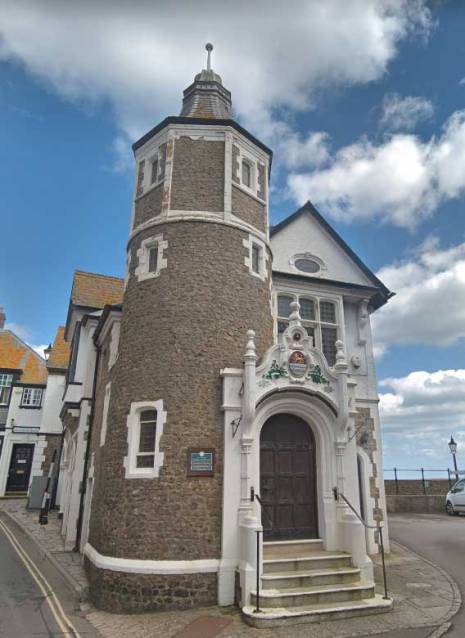
Lyme Regis’s quirky town hall
Since then he has declined to reply to my questions after telling me had no intention of doing anything about the footpath which he sees as a Dorset Council matter. The council’s lawyers have pleaded ” client confidentiality ” to any queries though they have refuted one allegation that they were working hand in hand with the ex-councillor and the council at the same time – which would lead to a complaint to the Solicitors Regulation Authority.
As for the two indefatigable pensioners. Stan Williams says: ” As a kid I used to walk up that footpath to go to school every day. I don’t wish to see the restaurant run by Mark Hix demolished as a result but I do think the council and Marilyn Bolton should come clean about what happened particularly as she has benefitted financially from the deal.”
Nigel Marsh also does not want the celebrity chef caught up in this shenanigans but is determined to get a solution and not be stopped by a brick wall.
Specimen £20 note – where have they all gone? Pic credit: James Oxley Bank of England
Bizarre story about the missing money
Today a report from MPs revealed the extraordinary fact that the Bank of England doesn’t know where £50 billion of its bank notes are.
It also revealed that since the Covid 19 lockdown the number of notes issued by the Bank of England is at an all time record. Yet this is at time when contactless payments by credit and debit cards are also at an all time high and many shops do not want to accept any cash at all.
Already a year before the Covid 19 led to lockdowns and smashed the economy some 7.4 million people – mainly in the 18-34 year age group were estimated to have virtually stopped using cash altogether.
So what is happening? We both can’t have a growing number of people no longer using cash yet record numbers of banks notes in circulation. There is something strange going on and the Bank of England seems remarkably complacent about it.
As Meg Hillier, Labour chair of the Commons Public Accounts Committee, which produced the report says:
” £50 billion of sterling notes – or about three quarters of this precious and dwindling supply – is stashed somewhere but the Bank of England doesn’t know where, who by or what for – and doesn’t seem very curious. It needs to be more concerned about where the missing £50 billion is. Depending where it is and what it’s being used for, that amount of money could have material implications for public policy and the public purse. The Bank needs to get a better handle on the national currency it controls.”
There is some curious speculation in the report. They wonder whether the people who traditionally like payments in cash – window cleaners, gardeners, the odd job man or woman are salting away the money. Or is it because – as I have reported before – that Rishi Sunak, the Chancellor, is offering such appalling interest rates for savers – that they are keeping the cash under the mattress?
Are criminals sorting away the cash?
Or is it something darker like criminals using the cash for nefarious purposes -or has the money been salted away in tax havens or are the Russians or Chinese siphoning off the cash hoping the British economy implodes?
The MPs are demanding the Bank of England investigates so we should have an answer early next year.
The same report also highlighted quite a different problem – that people in poor and rural areas have difficulty accessing this huge amount of cash in the system.
In September, the National Audit Office said that the Treasury, Bank of England, Royal Mint, the Financial Conduct Authority and Payments Systems Regulator need to coordinate more effectively so that people have access to cash.
But the number of cash machines are declining and the Post Office is not open all hours. so people can’t always access cash.
The Royal Mint is losing money striking coins as well.
The report said: “The Mint’s UK coin production has reduced by 65% over the last ten years, from about 1.1 billion coins made in 2010–11 to 383 million in 2019–20. This reflects the overall fall in production demand over the period, although production volumes increased in some years, for example between 2012 and 2016 with the issue of new 5p, 10p and £1 coins replacing stock already in circulation.”
Mass dumping of coins
It revealed that people have also been dumping coins in massive amounts. The report said:
“A Mint-run exercise to recall the old £1 coin, as an increasing counterfeit risk, led to an unexpectedly huge return of coins of all denominations as households and businesses emptied their stocks of coins. This led to a large increase in coin stocks and a consequent reduction in the number of coins that needed to be produced.”
But there still is some demand for coins.
The report said: “It now expects the Treasury to ask it to manufacture new 2p coins in the next 6 months and more £2 coins within the next 3 years. Nevertheless, the Mint expects the increase in demand to be temporary, and that the long-term impact of the pandemic will be to exacerbate the decline in coin use.”
Meanwhile it has lost millions of pounds for the last three years in minting new coins as it coins as it costs more than their face value to produce them.
Inside story of how the government can’t even organise a Covid- 19 survey let alone sort out the pandemic
Much has been said of the government’s expensive muddle and mishandling of the Covid -19 pandemic where millions if not billions of taxpayer’s cash has gone down the drain. Contracts have gone to the Vote Leave chumocracy, apps have failed, people have unnecessarily died in care homes and it has been bonanza time for private firms.
What has been missed is that while all this is happening the Department for Health through the Office for National Statistics and Oxford University have undertaken a randomised survey of 220,000 people to find out about the spread of Covid -19.
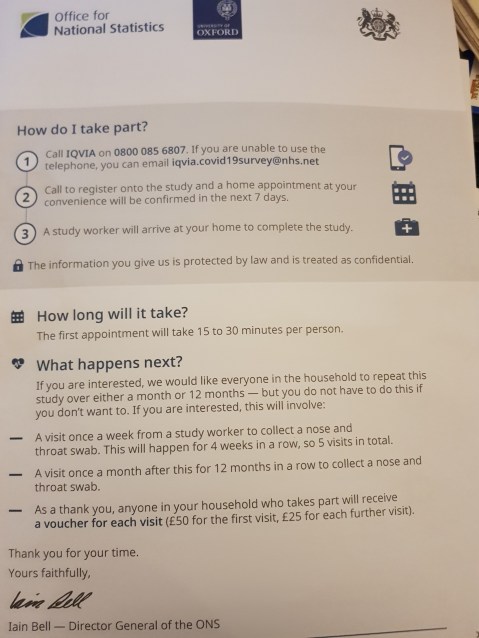
This is not just a once off questionnaire but those taking part in each household can opt to participate for a year. For the first month they are swabbed once a week and then monthly. The aim is to provide the government with a detailed picture of the pandemic’s progress and once approved the effectiveness of any new vaccines.
The scheme has been branded with trustworthy names – who would object to helping researchers at Oxford University or the Office for National Statistics.
Private company bonanza
But in fact the work is yet another bonanza for private companies and labs just like test and trace. What could possibly go wrong?
Well it did and this blog is my personal experience and my wife Margaret’s experience.
It started with a package being posted through our front door.
We were invited to ring a free number to sign up. Then within a week you would have an appointment. A pleasant socially distanced study worker would turn up, take your details, show you how to administer your own swab and send it off to a lab. You would get the result – if positive – within 24 to 72 hours from Public Health England. If it was negative you wouldn’t hear. You would also be eventually paid £50 in vouchers for the first visit and £25 for subsequent visits.
Sounds a doddle. It wasn’t.
First try and ring up and get an answer. I got through on the sixth attempt. And it is not to Oxford University but to IQVIA, an American multinational based in Durham, North Carolina, not Durham, England, with an income of $11.11 billion – effectively a health care data mining company. They have set up offices in the UK and guess what they are under staffed – hence the difficulty in getting through.
I was told to expect a call from NatCen, a private social research company, based in London that were in charge of appointments.
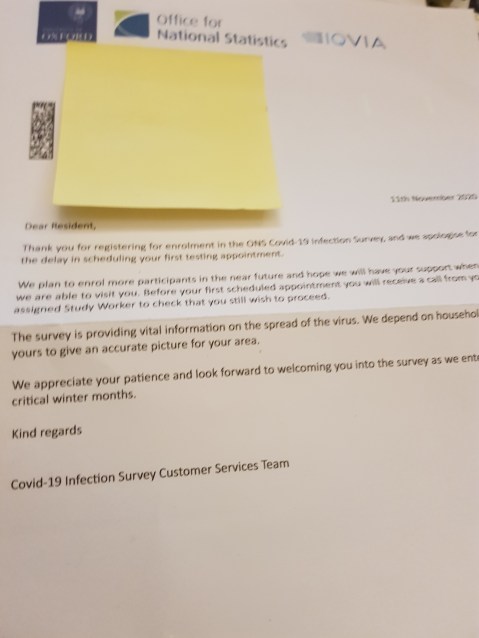
Rhe survey organisation must have been going wrong – they sent out this standardised apology to me and plenty of others.
A week went by, two, three, then a month and nothing. Finally there was a knock on the door and a genial man called Kirk asked me who I was.
” We have been trying to ring you for weeks and couldn’t get you. We got someone else who was already on the programme”, he told me
The reason was simple. The mobile number they had for me was not remotely like mine – they had put in someone else’s in their records
The came the swab – straightforward. We were told if we heard nothing after 48 hours we would be in the clear.
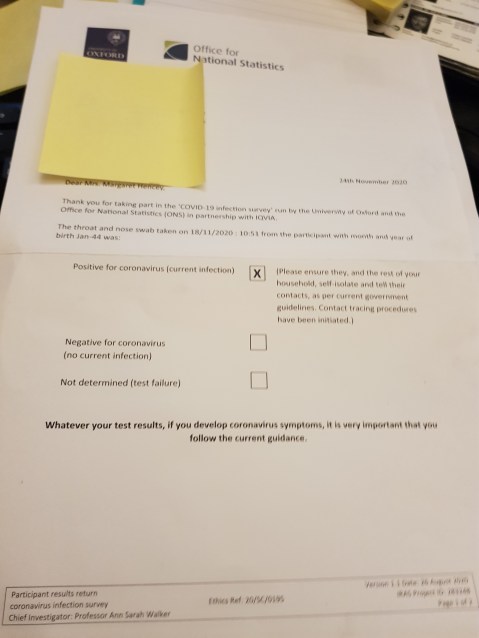
Then SIX days later we took a call from Hertfordshire County Council. It was for my wife – we are both in our 70s – she was Covid 19 positive . She had to self isolate for another four days. I was negative but had to self isolate for another seven.
The woman didn’t seem to know why we had been tested together, didn’t know about the national survey, and then told my wife not to have another swab in case it was a false positive.
This was scary because my wife did not have ONE SYMPTOM, no temperature, no cough, nothing. But we had to quickly cancel a hospital outpatient appointment for that day and cancel a visit due the next day from a physiotherapist.
The advice from Herts County Council was contradicted the next day by another study worker pointed out that the survey required people who were positive to take another test. He was puzzled that she – given we are part of the vulnerable group susceptible to Covid 19 – had no symptoms. He could not explain why we had been contacted by Herts County Council and not Public Health England.
Even after we got the invalidated result they still sent us the wrong result ( Note they spelt our surname wrong
After scary days of waiting to see if anything developed we had another call from IQVIA. It was to tell us that Lighthouse Laboratories – the privatised mega lab consortium – set up by Medicines Discovery Catapult Ltd and UK Biocentre Ltd- who tested the swab had got it wrong. She was not positive and the test had been invalidated because the lab had used the wrong compounds to test it.
Nor were we the only ones – an entire batch – was wrong. Imagine the distress this would cause.It wasn’t the first time either. The Independent reported in September that tens of thousands of people had been cleared of Covid- 19 by the same labs when they were positive.
We now await our promised vouchers. I see they are provided by Sodexo – a private company which I remember was responsible for the hopeless failed privatisation of the probation service. They also provide child care vouchers. I wonder what they can to do to muck things up. I can’t wait.
Amanda Speedie – one of the millions who would like to retire but now also hit by the job crisis caused by Covid 19.
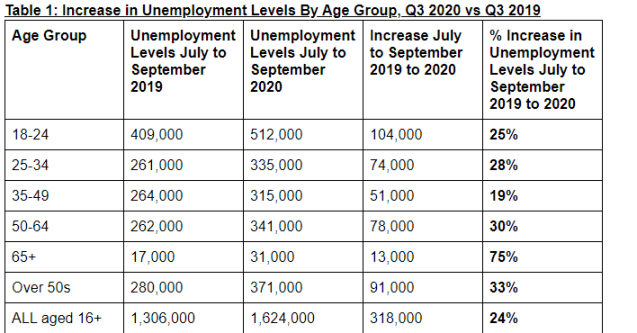
While the headlines concentrate on soaring youth unemployment the biggest rise in jobless totals are among the over 50s.
Figures from the Office for National Statistics analysed by the group, Rest Less, a jobs and community site for the over 50s. reveal unemployment has soared among this group by a staggering 33% year on year – the biggest percentage increase of all age groups and significantly more than the national average increase of 24%.The figures below tell the story.
Other figures shows that those furloughed over 50 who will later lose their jobs will be 80 per cent women. See this research here. And for the group I have championed through BackTo60 – the women born in the 1950s – who are now waiting up to six years to get their pension – the prospect of getting a job even if they wanted one will be worse.
But this is not just a tale about statistics. It is about human beings whose lives are being made more of a misery during this nasty Covid- 19 period.
One of those is Amanda Speedie, a resourceful and articulate 61 year old, who lives in Cornwall over the border from Plymouth. She was one of the women who did not find out until 2011 that she couldn’t retire at 60. She has since been dismayed by the failure of the judges decision on the BackTo60 court case. She had also tried using a local WASPI template to see if she could claim from the Ombudsman but that got nowhere.
She told me: ” When the decision was made it passed me by I was too busy bringing up a family, didn’t read newspapers ands rarely looked at TV news. If they had written to me I would at least have known”.
She is now divorced but well qualified-having worked in a variety of roles from estate agency to medical secretary to customer service and admin roles. She worked at one stage as a shift supervisor of the River Tamar toll plaza.
No full time job since 2012
She hasn’t had a full time job since 2012. She survives on two small private pensions – worth £40 a week – and by taking on some gardening work for which she earns £45 a week. She occasionally takes on sewing repair and alterations which might bring her in an extra £10 or £20 a week. She doesn’t qualify for any of the government payments.
Her real passion is to become a writer .Amanda studied for a BA in English with Media Studies and graduated with the MA in Professional Writing in 2007.
She has however some very strong views about what women in their 60s should do and that does not include work.
Rishi Sunak: didn’t even reply to letters about 1950s women poverty
” Many women are single, they can’t get jobs and even if they can haven’t the energy to do full time work ( I did a full time job for five weeks and came home exhausted every night and had to give it up) They suffer health issues and lose their energy after the menopause. Older people also face discrimination from employers who are not keen to employ them.”
She has written twice to Rushi Sunak, the Chancellor, suggesting that he introduced an allowance equal to the pension for women in their 60s. She has had no reply.
” Women could then do things they might want to do like volunteering or looking after their grandchildren or take a part time job if they wanted.”
lost generation
What is alarming is that generation born in 1960s are hitting the same problems. Rest Less had another case of a women in her 50s.
Claire Cassell is 54 from Willenhall near Birmingham. She lives with her husband. For nearly three years, Claire was working as a receptionist for a legal firm.
She was furloughed at the beginning of lockdown and didn’t hear anything from her employer until May when she was notified that they were hoping to get back to work soon.
By July she hadn’t heard anything more and texted her boss to find out if they were going back to work. He simply replied ‘No’.
At the end of August, she received an email telling her her role was at risk of redundancy. She was made redundant on 1 September. She is entitled to Job Seeker’s Allowance until March but as her husband works, she cannot claim Universal Credit. Since then, Claire has applied for 200 jobs and has had two disastrous Zoom interviews. She says she has a lot to give an employer and has 12 years of work still in front of her.
What this suggests is life is going to get much harder for the middle aged – who might have to face a decade or more of impoverished lives – before they get their pension. The government’s solution is to raise the age before you can get a state pension to 67 and then 68, and some pressure groups like Iain Duncan Smith’s Centre for Policy Studies would like it to be 75 asap – knowing he as an ex minister and his wife will retire on a huge state pension provided by Parliament and Whitehall.
Tax revenue down £70 billion while tens of billions spent saving jobs and the economy
Just before the first phase of Covid 19 peaked HM Revenue and Customs had a very good year. Tax revenues had peaked at £636.7 billion from more national insurance contributions, a record target of 95.3 per cent of tax due had been paid and £36.9 billion had been recovered from tax fraud and evasion. Then Covid hit.
Now as the Chancellor prepares his latest spending statement the latest annual report and accounts of HMRC and a National Audit Office report qualifying the accounts a very different picture is emerging. To give you an idea the Revenue lost £70 billion in tax revenue in five months.
The Covid-19 pandemic turned HMRC upside down and at least three planned targets will be missed this year. Just like the Department for Work and Pensions thousands of staff were moved to help handle the pandemic. But the pandemic also means a big loss of revenue , the cancellation of plans to combat firms who avoid tax by using the black market and an expected increase in money lost through fraud and error on working tax credit.|
On working tax credit it says: “As we no longer accept new claims to tax credits (with limited minor exceptions), our work to restrict error and fraud now focuses on existing awards.. ..The continuing need to divert compliance staff to support other departmental pressures means we expect not to meet the 5% maximum target for 2019 to 2020.”
On collecting tax it says:” Due to the impact of the COVID-19 outbreak, the end of year HMRC debt balance for March 2020 is £2.5 billion higher than forecast, coming in at £22.4 billion, significantly over the forecast of £19.9 billion… It is anticipated that the economic impact of COVID-19 will continue into financial year 2020 to 2021 as customers find it increasingly difficult to fulfil their tax obligations.”
black market tax avoidance
And on tackling black market tax avoidance – called conditionality in tax office jargon – it says:” Budget 2018 said that the government would consider legislating to introduce conditionality at Finance Bill 2019-20. However Budget 2020, which was delayed from autumn 2019, announced that the legislation would be included in Finance Bill 2020-21. Internal milestones were adjusted to work towards that revised timetable.”
You have to turn to the report by the NAO to find out the real impact of Covid-19 on the tax offices. For a start offices were deserted. 80 per cent of the 50,000 staff worked from home and as a result the public faced long delays in getting through to HMRC because only 7000 had secure phones to handle queries.
People kept waiting on the phone
From March 2020 there was an increase in the time HMRC took to answer telephone calls, peaking at 14:59 minutes in May and improving to 9:15 minutes in June 2020.
Like DWP large numbers were switched to working on Covid-19 work.
“At the peak, in May 2020, of 58,592 full-time equivalent staff, 9,097 (16%) were reallocated to COVID-19-related roles. Of the two largest groups of staff, 25.2% of staff in the customer services group were allocated to COVID-19-related work in April 2020 and 17.3% of staff from customer compliance group were allocated to COVID-19 in May 2020.”
Numbers have since fallen but will probably have gone up again with the second wave. The key schemes were the Coronavirus Job Retention Scheme, Self Employed scheme and “Eat to Help Out”. The Job Retention Scheme is thought to have been targeted by organised crime and billions of pounds may have been defrauded. See my article in Byline Times.
As a result “yield from its tax compliance activities is likely to reduce in 2020-21. For comparison purposes, HMRC achieved a compliance yield of some £7.5 billion in the period April to June 2020, 51% less than the yield of £15.4 billion achieved in the same period in 2019-20.”
tax losses
The detail over tax losses is daunting. Some £70 billion between April and August this year -£38 billion alone from VAT. Some £13.5 billion from tax and national insurance; Another £10 billion from Corporation tax and over £4 billion from fuel duties as people stopped travelling.
Receipts recovered at the end of the first lockdown in July and August, particularly VAT by £10 billion.
HMRC: Pic credit: David Palmer
However a tables in both report also reveal how much HMRC is paying out and how much they don’t how much it will cost. The furlough scheme was £39bn up to September; Eat Out to Help Out cost them £522m for August, Payments to the self employed cost £13bn but they don’t yet know the real cost of a host of projects. Some £1.5m was set aside for putting up basic working tax credit by £1045 for the tax year but figures for the claims are not available. Another £200m was put aside for repaying employers contributions to statutory sick pay but we don’t know how much was spent.
At least eight other measures spending figures are not available – these include the concessions on stamp duty for homer buyers, deferring tax payments for the self employed, VAT reductions on food and accommodation, exempting personal protective clothing from VAT, and cutting import duties on essential medical equipment.
We do know that as of June £28 billion of VAT was deferred.
Finally the Department’s bad record of recovering payments on working tax credits led its annual accounts to be qualified by the auditor general.
Some £1.11 billion was overpaid or almost 5 per cent of all payments and it will get worse this year. But because staff disruption over Covid 19 we won’t know this year’s figure until next June. Covid-19 could currently slow the transfer of people from working tax credit beyond the current delayed deadline of 2024.
Only 10 people switched to universal credit
Just TEN people instead of an expected 2000 transferred to Universal Credit last year under a new pilot project. The project has now been halted. Covid 19 did encourage a number of people to voluntarily transfer after the rates were temporarily raised.
Meanwhile the huge expense of preparing for Brexit – temporarily stalled by Covid 19 for part of the year – is now estimated to have cost £516m in the last tax year and there are now 6,100 staff working on it. Altogether since the referendum it has cost not far short of £800m because they have to prepare for so many scenarios.
Today the House of Lords expelled its first peer – after an excoriating report by the Lords conduct committee
Lord Nazir Ahmed, a life peer, who was ennobled by Tony Blair in 1998 and first Muslim peer in the UK, is being thrown out after the House of Lords Conduct Committee, headed by former Supreme Court judge, Lord Mance, upheld a serious complaint of sexual assault against a vunerable woman who sought his help.
The case is so bad that the report carries a health warning that it ” includes allegations of sexual misconduct and of racism which some readers may find upsetting or offensive.”
The decision to expel the peer followed a battle between him and the Lords Standards Commissioner, Lucy Scott-Moncrieff , after he appealed her findings against him and tried to discredit the woman who made the complaint. The appeal was heard by the conduct committee who have upheld her decision.
Labour Party suspension
The peer resigned once he knew the result and now says he is going to the European Court of Human Rights to clear his name. He had already resigned from the Labour Party in 2013 after the party suspended him when he said a ” Jewish conspiracy” was behind his conviction for a driving offence in Pakistan.
In 2017 he offered to help a woman who wanted to go to the Met Police to complain about a faith healer who she said was sexually and financially exploiting vulnerable people.
According to the report “Her complaint against Lord Ahmed was that when she asked him for help he initially made unwanted physical contact of a sexual nature with her and later held out the promise of using his influence to help her, when in fact his aim was to have sex with her.”
Instead of helping Tahura Zaman, the report says” “Lord Ahmed used the possibility of arranging a meeting with the Metropolitan Police to lure her to his house, where he had sex with her, possibly after drugging her. They then had a sexual relationship that lasted from September to November 2017, during which time he continued to say that he was going to arrange the meeting with the Metropolitan Police. “During their sexual relationship she said that Lord Ahmed tried to pass her to an associate, X, for X’s sexual gratification. She also told us that after Lord Ahmed ended their sexual relationship, this associate deleted or made her delete all messages and other data to and from Lord Ahmed from her phone, which she believed was at Lord Ahmed’s instigation.”
Lord Ahmed denied all this and said it was a social arrangement and claimed she had initiated the sexual relationship at his house which he claimed he had politely rebuffed and tried to end.
The Commissioner found for the woman and concluded that Lord Ahmed was being dishonest and in denial over the incident. The only point she did not uphold was that she was drugged while she was a his house.
He appealed to the conduct committee which has backed the commissioner’s findings and recommended he be expelled.
Today Lord Mance in moving the motion said:
“We noted that the commissioner had found Lord Ahmed unco-operative and dishonest in the key areas and that he had shown no regret, remorse or understanding of the inappropriateness of his conduct or its effect on a vulnerable victim. We said in paragraph 45 of our report:
“The abuse of the privileged position of membership for a member’s own gain or gratification, at the expense of the vulnerable or less privileged, involves a fundamental breach of trust and merits the gravest sanction. Even though it is possible to think of even more serious breaches, the case in all its circumstances which we have set out crosses the threshold calling for immediate and definitive expulsion.”
This finding comes when the House of Lords has strengthened its code of conduct and made all peers go on courses to improve their behaviour following two other cases involving former Labour peers.
Lord Ahmed will keep his title even though he is barred from sitting in the Lords as it would require legislation to remove an individual peer’s title.
But Lord Mance added:” Lord Ahmed will retain none of the privileges of a retired Member. If this Motion is agreed today, the House of Lords Commission has agreed that with immediate effect Lord Ahmed will not be entitled to a retired Member’s pass and will not be able to access any of the facilities of the House.”
The motion was agreed unanimously. I think the time has come in cases like this to change the law so he can lose his title – otherwise he could still pose as a peer to people who do not know his circumstances.












 Westminster Confidential