The Curate’s Egg: Child Sex Abuse inquiry reveals the Anglican Church has only half tackled the problem

Alexis Jay; Chair of the inquiry. Pic credit: iicsa

It is over six years ago that on Exaro News I worked with seven MPs from all parties to press Theresa May, then home secretary, to launch the Independent inquiry into Child Sexual Abuse. Now after two general elections only two – Caroline Lucas and Tim Loughton – remain as MPs.

Another Zac Goldsmith is now a government minister and peer. The remaining four Tom Watson, Simon Danczuk, Tessa Munt and John Hemming are Parliamentary history.

At the time with the help of Exaro colleague Mark Conrad, we drafted the letter that went to Theresa May – on behalf of the MPs- outlining the scale of abuse in the UK and citing specific cases and saying what needed to be tackled. She acted.

Tim Loughton MP

As Tim Loughton, a former children’s minister, put it at the time:

“Virtually every week, the public is bombarded with new stories about sexual abuse of children coming to light, yet they stretch as far back as the 1960’s.

“Few areas have been left untouched with increasingly alarming stories involving schools, churches, care homes, entertainment, sport and of course politicians and celebrities.

“Most alarming is a consistent theme of the reluctance or, more worryingly, the seeming complicity of police and other agencies to investigate the allegations seriously, and pursue the perpetrators rigorously.”

A lot has happened since – including the sentencing of Carl Beech, a paedophile , who made false allegations against prominent figures – as well as successful prosecutions in North Wales by the National Crime Agency – of paedophiles who got away with it for years.

Now the work of this inquiry has begun to bear fruit – and the publication this month of its over arching report into the Anglican Church and The Church of Wales is its most detailed investigation yet.

The report reveals both some progress and failure to tackle the problem. But I am pretty convinced without the catalyst of the national inquiry the Church would have continued to bury its head in the sand and still not taken half the measures it has.

The history of child sexual abuse in the church is damning. Since the 1940s as the report says 390 people have been convicted as sex offenders.

It goes on:” In 2018, 449 concerns were reported to the Church about recent child sexual abuse, of which more than half related to church officers. Latterly, a significant amount of offending involved the downloading or possession of indecent images of children. The Inquiry examined a number of cases relating to both convicted perpetrators and alleged perpetrators, many of which demonstrated the Church’s failure to take seriously disclosures by or about children or to refer allegations to the statutory authorities.”

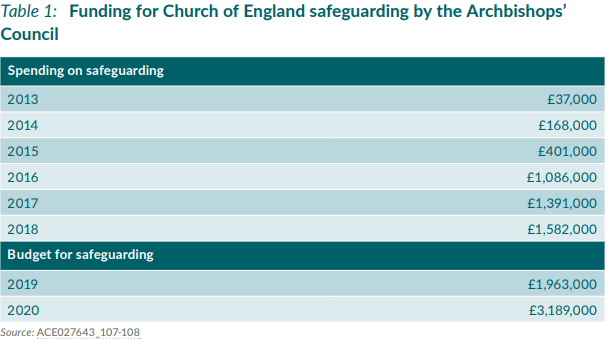
As extraordinary are the figures spent on safeguarding children – see below. A pathetic £37,000 was spent for whole Anglican church in 2013 a year before the call for the inquiry . The last year for 2020 is not fully approved.
The report shows failings in the culture of the church which allowed paedophiles to hide and a highly complex devolved hierarchy which meant there are many gaps for allegations of child sexual abuse not to be reported because of the autonomy of different sections of the church. For example cathedrals are not as you might expect run by bishops but the Dean and Chapter. Also although safeguarding has now been highlighted, the people in charge are designated as advisers rather than officers, allowing the clergy the last word on whether action should be taken.

On the plus side it looks as though the Church is taking safeguarding seriously and training its staff about the issue. Newly recruited ordained priests seem to have the most detailed training and the church is at last doing criminal checks before appointing anyone to an important position.

There have been a number of attempts to check back on historical sex abuse allegations. The numbers checked look impressive at 40,000 but only 13 cases were identified as it was mainly a book keeping exercise.

Salisbury cathedral – one of seven dioceses where past cases of child sex abuse are being re-examined because they may not have been competently checked. Pic credit: Flickr

When this was re-examined by Sir Roger Singleton, a safeguarding expert, he recommended: ” An “updated version” of the PCR[ Past Case review} should be conducted in the dioceses of Ely, Lichfield, Rochester, Salisbury, Sheffield, Winchester, and Sodor and Man given “the absence of evidence that the Past Cases Review had been carried out competently in these dioceses”.

This is now being done again and will report in 2022.

counselling cancelled

The report also includes some rather horrifying cases because the system did not work properly. In one case a person who was claiming compensation from the Church’s insurers for past sexual abuse had his counselling cancelled because a lawyer advised the Church he shouldn’t have it since he was claiming against the Church,

It is also clear that much abuse was not revealed at the time. When the inquiry looked into a past case of Bishop Victor Whitsey, who died in 1987, but was during his career Bishop of Chester, Suffragan Bishop of Hertford at St.Albans and a priest in Blackburn and Manchester, some 19 people came forward saying he abused them including a brother and sister.

The report also discloses that there is still much to do . The Church is divided about mandatory reporting of child sexual abuse, with even the Charity Commission thinking they could be flooded with too many cases; the position over insurance and compensation for victims is unresolved and the process of clergy discipline measures needs reform and artificial time limits covering complaints removed. The rules over disclosure of child sexual abuse during confessions needs to change – exempting it from the sacred duty of confidentiality. And record keeping in the Church of Wales needs a thorough overhaul as there is a serious problem there.

The inquiry plans to come back over these issues and rightly so.

But perhaps one of the most chilling and sad paragraph in the report is a description of the Church’s problems with sexuality.

fear and secrecy over sexuality

“There was a culture of fear and secrecy within the Church about
sexuality. Some members of the Church also wrongly conflated homosexuality with the sexual abuse of children and vulnerable adults. There was a lack of transparency, open dialogue and candour about sexual matters, together with an awkwardness about investigating such matters. This made it difficult to challenge sexual behaviour.
Mr Colin Perkins, diocesan safeguarding adviser (DSA) for the Diocese of Chichester, told us that homosexual clergy may have found themselves inadvertently “under the same cloak” as child sexual abusers, who sought to mask their behaviour “in the same cultural hiding place”.

For those who follow this blog this report signals that I am back keeping a regular eye on child sexual abuse issues. Those who follow me on the fight for 50swomen know I don’t give up easily.

Search for Justice: New Podcast on the 50s women struggle for their delayed pensions

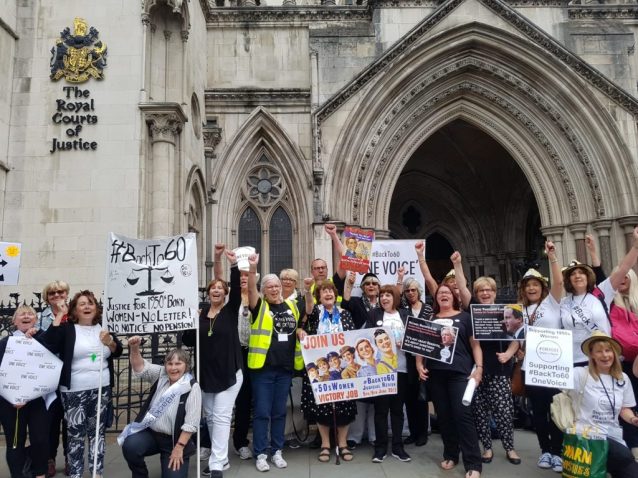
BackTo60 at the Royal Courts of Justice before the pandemic set in. They are now applying to appeal to the Supreme Court after losing their judicial review

I have given a long interview to Dave Niven, one of the country’s leading figures on the safeguarding of children, for socialworldpodcast on the issue of justice for the 50swomen. This podcast is aimed at the social work and caring professions and is watched by 2000 people in the field.

Dave contacted me after a gap of over 20 years because he had seen my writing on the plight of the 50s born women and wanted me to do an interview for his podcast. We last collaborated on a story in the 1990s when I was on The Guardian though both of us can’t remember what the story was exactly about.

He now runs his own consultancy, David Niven Associates (info@dnivenassociates.co.uk) which provides media training, and consultancy on child protection and safeguarding.

The podcast can be listened to here. That is the link to his site where you will also find other podcasts.

regular series of podcasts

It is part of a regular series of weekly podcasts on Thoughts on the Social World. Previous people who have been interviewed include Jim Gamble, a former national policing lead for child protection and the architect and CEO of the UK Child Exploitation and Online Protection (CEOP) Centre. He is now  CEO of the INEQE Safeguarding Group. http://www.ineqe.com

He also recently interviewed Christopher Lamb, a former Australian ambassador and chief diplomat with the International Federation of Red Cross and Red Crescent Societies (IFRC) in Geneva. He is now an adviser.to IFRC and the Australian Red Cross.

My own interview covers the case I have made on my blog for justice and proper equality for the 50swomen. I also talk about the exposures I did on The Guardian which led to the resignation of Tory ministers Neil Hamilton and Tim Smith over the “cash for questions” scandal in the 1990s and the first resignation of Peter Mandelson from the Labour government over his hidden ” home loan” to buy a posh pad in Notting Hill. And also my award winning story on how the former head of the Student Loans Company devised a scheme for legitimate tax avoidance which led to the government discovering that they had 2500 civil servants doing the same thing.

Amazing new digital exhibition celebrating how migrants around the world came to the aid of the NHS

Author and Poet Michael Rosen, recently recovered from Covid-19, narrates this short video on the exhibition

Migration Museum reveals the huge contribution of people overseas who came to the UK to work in the NHS

The NHS has been in people’s minds ever since the Covid-19 pandemic began and will continue to be so if there is a second wave of the virus.

During the worst part of the pandemic people came out in their thousands to clap and cheer the nurses, doctors, paramedics, care workers and ambulance drivers who work long hours in difficult circumstances to try and save people’s lives.

The Heart of the Nation exhibition puts a human face on the thousands of people who come to work and settle in the UK and take jobs in the National Health Service. People often say without them the NHS could not function and this exhibition rather proves the point.

It is not a sentimental account of the role of migrants helping the NHS to provide services for the last 72 years. It is a hard hitting. Some of it is “in your face”. It doesn’t pull punches about what it is like to be an immigrant in the UK.

A picture from the past: Nurses accommodation for new arrivals

It illustrates how migrants have over the years faced racial prejudice, hostility from landlords and even includes a racist cartoon in the national press. that would never be published now. It highlights migrants who found the traditional British diet tasteless and too heavy in carbohydrates which nowadays would be no problem with such a modern diverse range of cuisine in the UK. It includes some very tragic stories – including migrants who died in the Covid-19 outbreak while working in hospitals valiantly trying to save the lives of dying patients.

And it goes behind the scenes in the NHS to show the large number who work as porters and in the labs and stores.

But it is also a celebration – including a Spotify playlist of the music the migrants chose – and tales of young nurses dressed up to the hilt dancing all night to reggae and R & B only to shower and rush back to work at 7.0 am. And one of them was a founder member of a Notting Hill Carnival band designing the first colourful costumes that are a trade mark of that event.

As Allyson Williams said: “Carnival means so much to me. It has always been a celebration of our freedom and emancipation and acknowledgement of our ancestors. Here in London it’s all about family, community and inclusivity. “

“A story that needs to be told “

Aditi Anand, head of creative content at the Migration Museum and curator of the exhibition, said:

“Heart of the Nation highlights the vital role that migrants have always played in the NHS and the extent to which, just like the NHS, migration is central to the very fabric of who we are in Britain – as individuals, as communities and as a nation. Now more than ever, this is a story that needs to be told.”

You can download the digital exhibition here. As a Friend of the Migration Museum myself I am a supporter. But I think you will not be disappointed. It is an eye opener and reminder in times when populist nationalism is on the rise that Britain is also a very diverse and international country and all the better for it.

Covid-19: How the year of the bus became the year of bust

Pic Credit: Wes Hicks – Unsplash

2020 was supposed to be the Year of the Bus. A newly elected Tory government promised £220m to improve services which had been in decline since 2010 when another newly elected Tory led government created the cuts.

The initiative ticked every election promise box. It was going to reverse service cuts – mainly in the shires as part of levelling up. It was going to produce a brilliant new demonstration package of co-ordinated bus and train services in Cornwall – one of the poorest areas of England. It was going to be green -promising the first total electric powered bus service in an English city. It was going to be faster with more dedicated bus lanes and expressways and it was going to be easily accessible by introducing a national data system for services and fares available on the internet.

Then came Covid 19. And as a new National Audit Office report revealed on Friday the bus plan crashed off the road.

unglamourous buses

Buses have never been a glamourous subject. As the NAO report shows they are mainly used by the poor, over 70s, the 17-21 age group before they get their own wheels and single women seeking a safe way home.

It also suffered huge service cuts and big fare rises for many of its passengers outside London. A useful map in the NAO report shows how passenger traffic has declined by an average of 10 per cent between 2010 and 2019 – falling highest in places like Tyne and Wear, Lancashire, Teesside, East Sussex and Lincolnshire but rising in Bristol and Brighton and Hove.

Pic credit: Suzy Hazelwood Pexels

Some 3000 routes have disappeared with bus mileage down from 243 million to 112 million and the average local authority support for services dropping 38 per cent with 42 authorities slashing expenditure by over 50 per cent. Some of the worst examples are West Yorkshire, Surrey and Northamptonshire. Average fares went up 18 per cent between 2010 and 2019.

free bus pass

The biggest cost to local authorities has been the free bus pass – now estimated at £650m a year – a national service – but funded by the local authority where you live. Funding from central government to bus operators has dropped from 31 per cent to 24 per cent between 2010 and 2019.

One of the problems is that since the de-regulation of services the government has had little control – so it can make a lot of noise about improving services – but it can’t force private operators to do it. The plan for a national data system for bus timetables and fares – depends on whether individual operators want to spend the money.

When Covid 19 hit the government was faced with a dilemma – only key workers were encouraged to use public transport – slashing revenue. The government did provide extra cash in tranches to bus companies to keep them going. But it also raided its shiny new support budget to improve services.

The plan for a co-ordinated Cornwall transport service from Plymouth to Penzance was dumped.

So was the money put aside to restore cut services. And it looks like – despite interest from 50 different towns and cities – to be the first to run an all electric bus service – is being delayed by Whitehall inertia.

And other promises to improve express bus services = especially in the West Midlands – have been undermined by the operators themselves.

First Worcester cut service

One check I did on Google First Worcester company had created a furore by halving the number of express buses between Worcester and Birmingham north of Bromsgrove – forcing people to use more expensive services elsewhere. Yet this is an area given priority in the government’s new bus plan and it happened before the Covid 19 crisis hit.

There are some bright spots. Bristol has improved passenger use by 36 per cent. Nottingham has increased bus use and invested in clean bio gas buses and new trams by imposing a work car parking levy. And London, which was not examined in this report, has seen bus use up 89 per cent.

The lesson is clear to all. Grandiose plans to ” level up ” the poorest parts of the country are going to be very expensive if they are to work. And if they don’t deliver there will be a political price to pay for falsely raising people’s hopes. You have been warned.

A millionaire’s wife wins a 95 per cent divorce settlement against a ” lamentable” husband -Landmark Court of Appeal decision

Richard Rothschild and his new lover US model Sherra Pic credit: Instagram and Champion News

Decision to back ex wife by three male judges is greeted with surprise by The Sun and the Daily Mail who were sympathetic to a ” millionaire left penniless “.

This month the Court of Appeal took a rather extraordinary decision to award virtually all the money made by a business couple to his wife after being told a harrowing tale that she had been driven into huge debt caused by continual litigation from the husband and his mother.

Charmaine Le Souza was awarded £1.73m and a disputed £2.3 million condominium in Florida by the Court of Appeal. Her husband was left with £26,000.

Her husband who changed his name to Richard Rothschild in 2016 – he is not related to the Rothschild banking family- was said in the court to have spent nearly £1m in litigation to try to prevent his wife getting the whole business or the apartment forcing her into £900.000 debt – which are rising at £7000 a month with interest.

He was backed by his 76 year old mother, Wanda. who took an active role in pursuing his wife after her son moved in with a young former Playboy model, Sherra Michelle.

Mr Rothschild – original name Richard Pierzchalo-Piasecki – and Mrs de Souza got together at university in 1995 and had been married for 16 years. They have two children aged 9 and 13.

They married in 2005 and separated, in what the judge described as “highly acrimonious circumstances”, in 2016. The judge treated “the relationship as one of 21 years with the quality of the relationship premarriage being indistinguishable from that post-marriage”.

Their two children were said to have “suffered grievously as a result of the breakdown of the marriage”.

What followed was three years of ” destructive litigation ” against the wife including a claim dismissed by a judge that the mother owned the business and even proceedings under the 1980 Hague Child Abduction Convention after the husband abducted the children from Florida to England just after his wife had moved to America with her family.

Her lawyer told the court that the mother and husband lost successive cases but never paid any of the costs, never let the houses they owned in London, never took a job for three years, went on a spending spree to use up assets. Last December a family court judge ruled that the wife should get the business worth £1.85m and the properties in London and he should keep the £2.3 million apartment in Florida. But he laid down conditions that he should pay £225,000 to his ex wife in lieu of her getting her share, If he didn’t the property would be sold and the money given to his ex wife.

When both parties got to court on July it was discovered that he had transferred the flat to his mother without telling his or her lawyers in defiance of the court order.

The appeal was nearly cancelled as a result but went ahead and the three judges ruled that he should have less than he was awarded last December.

The judges argued that given she had a mountain of legal debt to pay off as a result of his actions and they didn’t believe he would contribute financially to the upbringing of his children when they were back in Florida – the award was not as generous as it looked. The business which was successful would provide her with a living.

Meanwhile he intends to marry the young model. She defended him after the case blaming unfair courts in the UK for his downfall.

She commented in the Daily Mail: “Rich and I are getting married no matter what. I stuck by him through all of these legal battles and I am here to stay. We have a real Soulmate connection that is pure and genuine. Rich is a born entrepreneur and he will always take care of his family and the ones he loves. I feel like the luckiest girl in the world to be with someone as kind, intelligent, handsome, loyal and good-hearted as Rich. Thank you to all of my friends and fans who see our true love for what it is and have supported us since day one. Charmaine we hope you find happiness soon too and stop punishing your children. Not letting Rich see his kids for 3 years is unacceptable.”

The ruling by the judges however will go into case law – and does suggest that in future women will get more than just a half share of the assets -if the man spends three years in vindictive litigation against the woman.

The chances of living longer are getting shorter – new Office of National Statistics figures show only small rise in longevity

Is the DWP not telling the truth over the rise in people living longer?

One of the biggest issues about funding future state pensions and the incessant demands for raising the pension age is the fact that we are all going to live longer. This ministers argue is going to be too expensive for new generations paying into the national insurance fund and therefore retirement should continue to rise, possibly eventually to 75.

This argument was used ruthlessly by the Department for Work and Pensions in the judicial review against the appellants supported by the BackTo60 campaign for not compensating any of the 3.8 million women who have seen their pension age rise from 60 to 66.

To justify this ministers always quote figures up to 2011. The reason why they use this year as a comparator is that it was last year of any big rise in longevity which had risen for decades.

Since then the rise has flattened – in one year it actually fell – and last year was the first in five years that showed a small rise. Next year the ONS is warning will be the first year they will have figures of the effects of Covid-19 – and the hint is that longevity will fall because of the disproportionate deaths among pensioners.

The figures released by the ONS in this report yesterday cover three years from 2017 to 2019 – which statisticians say is more reliable than taking one year in isolation.

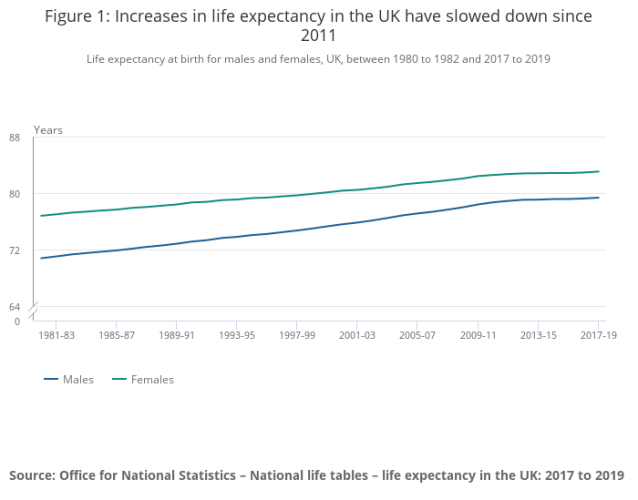
As you can see from this graph from the report illustrates longevity has largely flatlined. Women still live longer than men – but the greatest beneficiaries of rising longevity have been men. They are steadily catching up with women and the report wonders whether the huge drop in men smoking and moves from manual and agricultural work to less physical work in the office or behind a computer is the reason for this.

The report says: “Following decades of steady increases in life expectancy in the UK, a marked slowdown in the rate of improvements has been observed since 2011. Between 2002 to 2004 and 2009 to 2011, life expectancy at birth in the UK increased each year by an average of 16.7 weeks for males and 12.7 weeks for females. In contrast, between 2010 to 2012 and 2017 to 2019, these improvements slowed to an average of 6.3 weeks and 4.2 weeks per year for males and females respectively.”

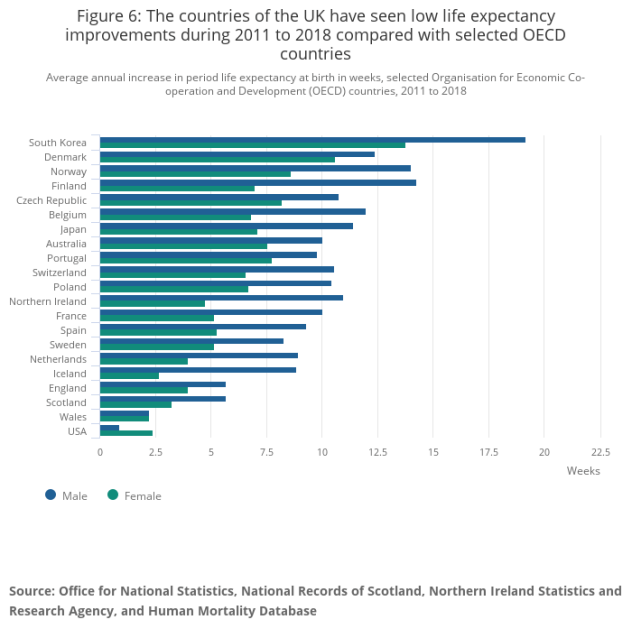
The report also reveals another startling fact. When you compare the UK to many other developed countries both men and women have lost out big time in the longevity stakes. The countries that make up the UK (with the exception of Northern Ireland) are all near the bottom of the table only beaten by the United States.

Near Bottom of the league UK

Top of the league is fast growing South Korea followed by Denmark, Norway and Finland. The figures are for the number of extra weeks people can expect to live – comparing 2018 with 2011. Note again with the exception of Wales and the USA men have been the biggest gainers not women.

So while we all are being expected to wait longer for our pension in the UK, our extra weeks of life expectancy fall well below many comparable developed countries. We are being cheated – or at least not given the full facts – by our political leaders. So don’t believe any facile claims we have a world beating system for pensioners. Far from it.

Now the figures for this small rise in longevity are not uniform throughout the UK.

Another report says:

  • The lowest regional life expectancy for both males and females in 2017 to 2019 was observed in the North East; the North East’s life expectancy at birth was also lower than in the countries of Wales and Northern Ireland but higher than in Scotland.
  • Males living in the four most southerly regions of England had life expectancies at birth exceeding 80 years, whereas regions of the midlands and the north fell short of 80 years; London exceeded the North East region by almost three years.

Women live longest in the Outer Hebrides

The largest local area increase in life expectancy between 2009 to 2011 and 2017 to 2019 for males at birth was in Westminster, while for females it was in Scotland’s council area of Na h-Eileanan Siar. ( better known as the Outer Hebrides).

Live longer in London, die sooner in Blackpool

The statisticians comment:

“The rate of growth in life expectancy in London continues to surpass that occurring in other regions and the constituent countries of the UK. This has resulted in London now having the highest life expectancy for both males and females among regions in England.

“Four of the top five local areas with the highest male life expectancy in 2017 to 2019 were London boroughs, while three were for females. Since 2001 to 2003 traditional deprived parts of London such as Tower Hamlets, Newham and Hackney have seen strong gains in life expectancy over the time series. In fact, 17 of the top 20 local areas with the strongest growth in male life expectancy since 2001 to 2003 were London boroughs. This contrasts with Ceredigion where male life expectancy has only grown by 0.8 years since 2001 to 2003. These patterns add to the growing inequality observed across different areas of the UK over the past decade.”

inequality

This is heightened by other observations :

“Overall, for the UK, the difference was 11.3 years between Westminster, with the highest life expectancy at birth, and Glasgow City, with the lowest.

” For females, the local area gap in life expectancy at birth in England was 7.7 years between Westminster (87.2 years) and Blackpool (79.5 years), meaning Blackpool was the lowest in England for males and females. In Scotland, the gap stood at 5.5 years between East Renfrewshire (84.0 years) and Glasgow City (78.5 years). “

These findings must call into question whether there should be such a rush to raise the pension age – since the UK is both lagging behind other countries in life expectancy, has a huge inequality between the prosperous South and London and the North East ( Red Wall MPs please note). Finally the DWP is misrepresenting what is happening – both in its evidence to the judicial review over the raising of the pension age for women and to the nation as a whole. Longer life expectancy is tailing off not growing anywhere near the rate it did when decisions were made to raise the pension age.

Assetco: The negligent privatisation audit that has cost Grant Thornton over £20m in damages

Top accountancy firm loses appeal over failing to spot forged documents in huge London fire brigade privatisation scandal

A London fire engine -once owned by Assetco

The big four accountancy firms make a fat living from auditing the large number of private companies taking over public services.

But a Court of Appeal ruling last month suggests that if they don’t do the job properly they could now face huge damages claims from directors of companies who were duped by their negligent auditing.

The Assetco saga has been extensively covered on this blog. It involved the sale and leasing of the entire fire engine fleet of London and Lincolnshire to a gang of spivs and fraudsters – who were last known to still be evading justice nearly a decade after swindling investors and conning the London Fire Brigade. The Fire Brigades Union also took up the issue on behalf of its members.

ban after causing fraud

A separate investigation by the Financial Reporting Council found Assetco’s chief executive John Shannon ” causing or facilitating fraud. He was banned as practising as a chartered accountant  for 16 years – a new British record – fined £250,000 and ordered to pay £300,000 in costs.

Raymond “Frank” Flynn (former Chief Financial Officer) for  banned from practising for 14 years and Matthew Boyle (former Financial Controller) for 12 years. Additionally, £150,000 and £100,000 respectively have been imposed and they share paying  part of the £400,000 costs bill.

Grant Thornton, and the accountant who audited the company Robert Napper,  has led to a £3.7m fine for  both of them for professional misconduct. ( Napper was fined £120,000) Neither Grant Thornton nor Mr Napper made any financial gain out of the scandal. The accountant took early retirement and now lives in a bucolic Oxfordshire village developing his hobby as a wine buff.. See here.

Now the Abu Dhabi directors of Assetco who took over in 2011- straight after the London and Lincoln operations collapsed have successfully sued Grant Thornton for £22m and their case has been upheld by the Court of Appeal.

The first trial lasted 20 days, involving extensive evidence from factual and expert witnesses and consideration of a large volume of documents and of 877 pages of written submissions as well as oral submissions.

Grant Thornton appealed but lost the case. The court was told that if Grant Thornton had audited the accounts properly they would have found evidence of forged documents which inflated the value of the firm.

Fraudster John Shannon when he was boss of Assetco

The court were told Mr Shannon and Mr Flynn told GT that the “unitary payments” due under the London Contract had increased by nearly £47,000 per month (£564,000pa) from April 2009 and produced documents to establish it. The statements were dishonestly made, and the documents were forged. It was only on the basis of these alleged payments that the London Contract appeared to be profitable.

Grant Thornton argued unsuccessfully that they couldn’t be responsible for all the losses. The judges found in the company’s favour.

The Financial Reporting Council did pass its findings to the Serious Fraud Office but so far it appears nothing further has happened. Mr Shannon has thought to have moved to Thailand while Mr Flynn remains in Northern Ireland.

The most important development is this judgement could form a major piece of caselaw if any other major accountancy firm does not do its auditing job properly. It is a big shot across the bows of the big four accountancy firms to be more diligent.

Revealed: Dramatic rise in benefit and disability claims from women born in the 1950s

Disclosure undermines ministry claim of no link between poverty and bad health and loss of state pension

DWP case undermined by new figures


Days after the Court of Appeal rejected the judicial review brought by the BackTo60 campaigners the House of Commons library produced a set of previously undisclosed figures showing huge leaps in the numbers of 50sborn women claiming universal credit[UC] or Jobseekers allowance[JSA] and employment and support allowance [ESA].

Claims for UC and JSA – which of course were non existent when the pension age was 60 – have gone up by an average of 382 per cent between 2013 and 2019. The figures are still relatively low (from 7582 to 36,531) but the trend is overwhelmingly upwards. It also excludes those who are battling on or using up savings rather than claim.

Claims for ESA – a difficult benefit to claim unless you are hospitalised and involving a 25 page questionnaire and work capacity assessment – have soared by 185 percent – to reach 205,385 -over the same six year period.

The figures are bound to be a huge underestimate as they take no account of the rule change that allowed people to claim the benefits if they had to stay at home because of Covid 19 this year. But they do allow a direct comparison during the period when the only big material change for this group of women was the loss of their state pension.

The disclosure of these figures -obviously not available at the time of the hearing – does undermine the forceful case made by Sir James Eadie, QC, who represented the Department of Work and Pensions, that any poverty or ill health suffered by these women could not be linked to the rise in the pension age to 66.

They also back up the argument made by Mr Mansfield who is quoted in the judgement:
” It is not uncommon for women born in the 1950s to have contracted various ailments and health problems by the time they reach their early 60s, because of the environment they lived in during their early years.  He said further that it is common for women in this age group to be living in straitened circumstances particularly if they are now single, with part time jobs at best and working for low pay. 

” It is also very common for them to be caring for elderly and infirm parents.  He argued that the lack of state pension means that they have to resort to makeshift measures to make ends meet, selling their houses, using up their savings and cutting back on any non-essential spending so that they are not in a position to enjoy their retirement years.”

But the judges concluded: ” there is no sufficient causal link here between the withdrawal of the state pension from women in the age group 60 to 65 and the disadvantage caused to that group. 

” The fact that poorer people are likely to experience a more serious adverse effect from the withdrawal of the pension and that groups who have historically been the victims of discrimination in the workplace are more likely to be poor does not make it indirectly discriminatory to apply the same criterion for eligibility to everyone, if that criterion is not more difficult for the group with the protected characteristic to satisfy.”

The figures also provide a useful constituency by constituency breakdown – showing an unequal distribution of the misery caused by ill health and failure to get as job depending on where you live. The guide would provide a very useful campaigning tool if people wish to lobby their MP over the bad treatment of 50s born women over their loss of pensions – as they can quote the figures back at their MP.

These are some of the top increases and the names of the MPs who were elected at the last election.

Unemployment biggest percentage constituency rises

Knowsley 1388 pc rise from 8 to 119 George Howarth ( Lab)

Newcastle North 1347 pc rise from 6 to 88 Catherine McKinnell (Lab)

Morecombe and Lunesdale 1300 pc rise from 6 to 84 David Morris (Con)

Birmingham Yardley 1270 pc rise from 10 to 137 Jess Phillips (Lab)

Wells 1220 per cent rise from 5 to 66 James Heappey (Con)

Disabled and ESA biggest constituency percentage rises

Glasgow North East 315 pc rise from 214 to 889 Anne McLaughlin (SNP)

NE Hampshire 300 pc rise from 32 to 128 Ranil Jayawardena (Con)

Linlithgow and East Falkirk 292pc rise 149 to 584 Martyn Day (SNP)

Brecon and Radnorshire 292 pc rise from 77 to 302 Fay Jones (Con)

Leeds NE 291pc rise from 89 to348 Fabian Hamilton (Lab)

Glasgow SW 287pc rise from 205 to 794 Chris Stephens (SNP)

Interestingly Martyn Day is the one MP who challenged Boris Johnson about the court judgement at Prime Minister’s Questions on Wednesday.

The full report is available here. You need to download the table on working age benefits 2020 to get all the info on the big increases in payments. There is also an up to date breakdown of the numbers of 50sborn women living in individual constituencies.

So again we yet have another disclosure backing up the case for the 50swomen to get their pensions.

50s Women to apply directly to Supreme Court to ask them to hear pensions case

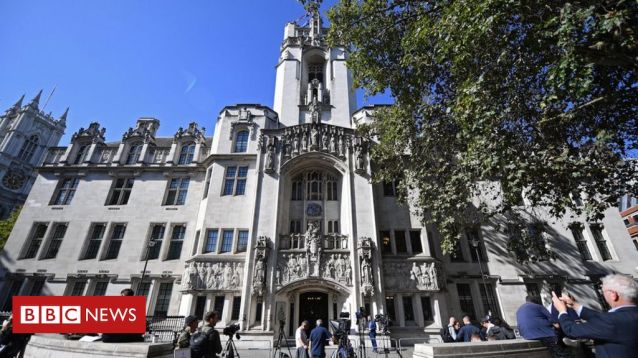
Supreme Court; Pic Credit:BBC News

Lawyers for Backto60 and the two complainants decided today to apply to the Supreme Court for permission to bring their case to the highest court in the UK.

The decision was taken after two of the Judges in the Court of Appeal, who heard their case,  Lord Justice Sir Nicholas Underhill and Lady Justice Dame Vivien Rose, refused permission for them to go to the Supreme Court.

Applicants are allowed to go to the Supreme Court directly to plead their case to be heard if they are turned down by the Court of Appeal.

The decision was announced by Joanne Welch, the founder of Back to 60, appropriately during an interview with the BBC radio programme Woman’s Hour.

The decision comes after the Court of Appeal comprehensively rejected their case in a judgement announced on Tuesday. The judges ruled that the first judge , Ms Justice Lang, should not have allowed the judicial review to go ahead because it was a long time after the 1995 Act raising the pension age for women was passed. They agreed with the arguments put forward by Sir James Eadie, the Treasury Counsel, on behalf of the Department for Work and Pensions that they had been adequately consulted about the rise in the pension age from 60 to 65 announced in 1995 and later extended to 66 under the Pensions Act in 2011.

Some 3.8 million women were affected by the change which Michael Mansfield, Henrietta Hill and Adam Straw, argued amounted to both direct and indirect age and sex discrimination and had led to women born in the 1950s being driven into poverty and ill health. This was rejected by the judge, chaired by Sir Terence Etherton, Master of the Rolls.

Joanne Welch told Woman’s Hour “I know that Julie Delve and Karen Glynn have been actively considering next steps. I believe that they are going to go ahead with an application for permission to have this heard in the Supreme Court”.

Plans to ask the Supreme Court to hear the case are now being drawn up by the legal team after Joanne Welch confirmed that the decision was taken at a meeting today.

50s women pension judgement: How the Court of Appeal rejected their case

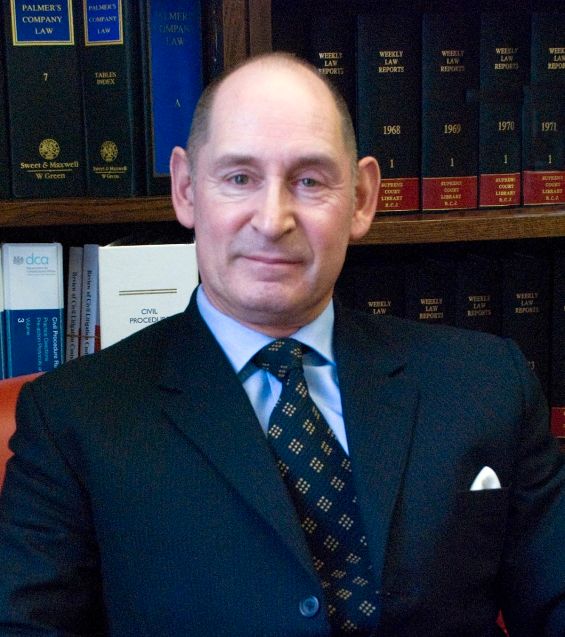
Sir Terence Etherton, Master of the Rolls

I have spent this morning reading the 21,000 word judgement of the Court of Appeal led by the Master of the Rolls, Sir Terence Etherton.

For the faint hearted I warn you this will make grim reading. But I think the women who have fought so hard to get their pensions back need to be properly informed about the logic used by the judges to come to their decision. It doesn’t mean I agree with it.

Their judgement will cause widespread misery and angst for the women themselves and total delight for the government, ministers, the Department for Work and Pensions and the small number of vocal detractors, mainly from the financial advice and private pensions industry, who didn’t want the women to get a penny.

Appeal on four grounds

The appeal was on four main grounds each of which were dismissed by the judges. Since it is a judicial review it depended a lot on case law which ranged from an immigration case, the bedroom tax, to a sex change case and to EU law and the Convention of Human Rights. It even included a novel way of approaching the law to consultation from Michael Mansfield QC.

To a lay person the case law might sound bizarre but the aim of the lawyers representing the women is to draw out rulings from these diverse set of cases to benefit the cause of the 50swomen to get their money back.

The four grounds for appeal were age discrimination according to an article from the European Convention of Human Rights; indirect sex discrimination or sex/age discrimination;notification and delay.

On the first case the judges rejected it. – citing they could not overrule an Act of Parliament.

“Despite that evidence and despite the sympathy that we, like the members of the Divisional Court, feel for the Appellants and other women in their position, we are satisfied that this is not a case where the court can interfere with the decisions taken through the Parliamentary process. “

They did concede that women got lower state pensions than men.

Women pensioners’ life expectancy – a strain on public fiances

“DWP figures in August 2018 for the mean weekly amount of state pension for men was £158.87 and for women £131.27.  Though they may have shorter life expectancy, men will still receive much more state pension than women even taking into account that women live for two years longer.  That does not, however, undermine the point that the SSWP [ Secretary of State for DWP] makes that longer life expectancy for women places a strain on public finances,(my emphasis) even if they would have received a lower pension over the years 60 – 65 than a man would receive.”

They rejected the indirect and age/ sex discrimination saying any EU directives allowing a differential age for men and women were a temporary measure.

women carry out 60 per cent more unpaid work than men

The judges note the argument that 50s women are hard done by. They quote facts” that women carry out an average of 60 per cent more unpaid work than men; 86 per cent of single parents are women and single parents have a higher risk of poverty than any other household type.  In the 50 – 64 year old age group, women are much more likely to give up work than men because of caring responsibilities.  The Appellants submit that it is therefore indirectly discriminatory, subject to the question of justification, for the state pension to be withdrawn from them because their gender adversely affected their ability to earn a living.”

But they recoil from accepting the arguments for fear that a victory would lead to a flood of new demands from other groups.

“it becomes clear what a significant expansion of the law would result from such a broad application … It is undoubtedly the case that many groups have traditionally suffered discrimination in the workplace because their protected characteristic meant that there were fewer opportunities open to them for advancement in stable, well-paid work.  That is the case not only for women but for disabled people, for lone parents, for some BME groups and for transgender people.”

They conclude that the state pension is a universal not a means tested benefit therefore it should not be used to right problems caused by discrimination – that should be left to other measures in the political field.

“In our judgement.. there is no sufficient causal link here between the withdrawal of the state pension from women in the age group 60 to 65 and the disadvantage caused to that group.  The fact that poorer people are likely to experience a more serious adverse effect from the withdrawal of the pension and that groups who have historically been the victims of discrimination in the workplace are more likely to be poor does not make it indirectly discriminatory to apply the same criterion for eligibility to everyone.”

DWP gave ” adequate and reasonable notification”

On consultation they buy the argument from the DWP that there was enough consultation going back to 1991 when the pension age change was first debated and they cast doubt on even sending a direct mail to everyone on the grounds that people might not read it anyway..

” We therefore dismiss Ground 3 of the appeal on the basis that there was no duty to notify those affected by the change in state pension age and that the Divisional Court were entitled to conclude as a fact that there has been adequate and reasonable notification given by the publicity campaigns implemented by the Department over a number of years.”

Criticism of Ms Justice Lang

Finally they condemn Ms Justice Lang for allowing the judicial review in the first place on the grounds that it was already out of time.

They castigate her for extending the time limit.

“Unlawful legislation is not a continuing unlawful act in the sense that the time limit for challenging it by way of judicial review rolls forward for as long as the legislation continues to apply.  If that were the test, there would effectively be no time limit for challenging primary or secondary legislation or for that matter administrative conduct which continues to affect a claimant unless or until the action is withdrawn or revised.”   

Lawyers for BackTo60 have asked the judges for permission to appeal their judgement.

Their judgement today shows what a big struggle it is to convince people of their case but it doesn’t meant it is wrong to fight this injustice for 3.8 million people.